
This Photo by Unknown Author is licensed under
This Photo by Unknown Author is licensed under CC BY-SA-NC
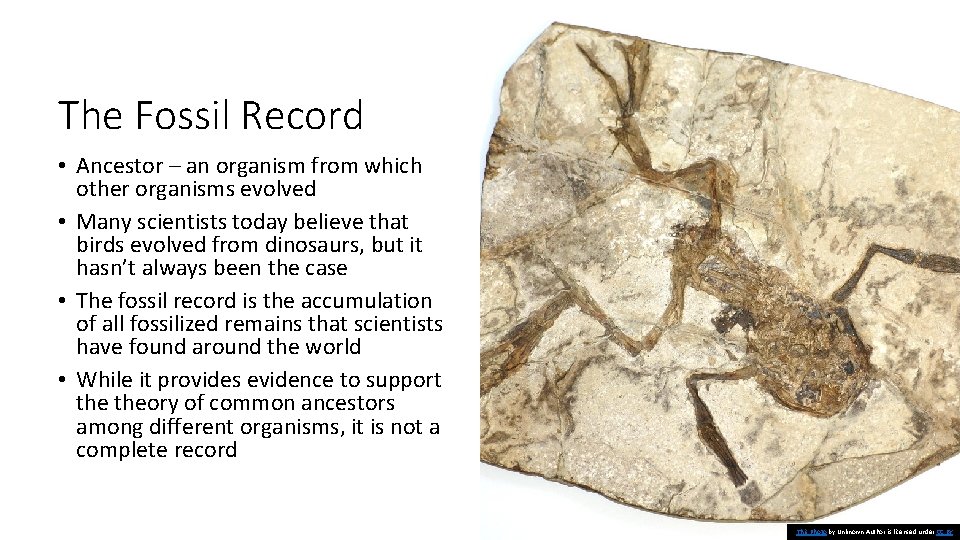
The Fossil Record • Ancestor – an organism from which other organisms evolved • Many scientists today believe that birds evolved from dinosaurs, but it hasn’t always been the case • The fossil record is the accumulation of all fossilized remains that scientists have found around the world • While it provides evidence to support theory of common ancestors among different organisms, it is not a complete record This Photo by Unknown Author is licensed under CC BY
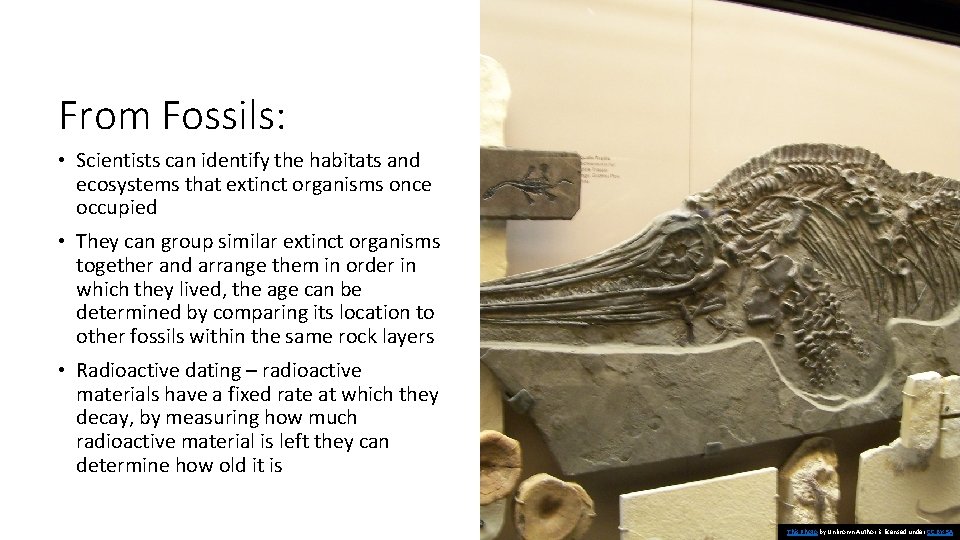
From Fossils: • Scientists can identify the habitats and ecosystems that extinct organisms once occupied • They can group similar extinct organisms together and arrange them in order in which they lived, the age can be determined by comparing its location to other fossils within the same rock layers • Radioactive dating – radioactive materials have a fixed rate at which they decay, by measuring how much radioactive material is left they can determine how old it is This Photo by Unknown Author is licensed under CC BY-SA
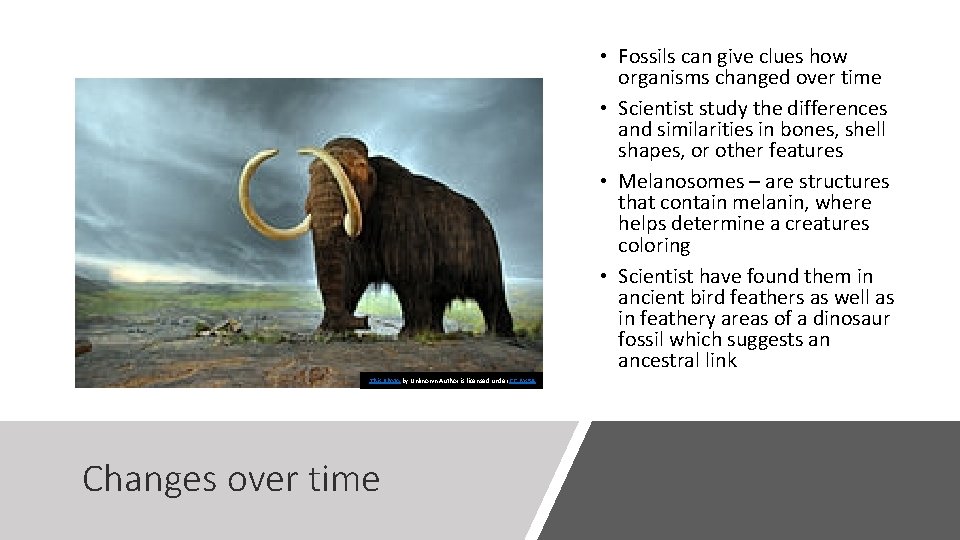
• Fossils can give clues how organisms changed over time • Scientist study the differences and similarities in bones, shell shapes, or other features • Melanosomes – are structures that contain melanin, where helps determine a creatures coloring • Scientist have found them in ancient bird feathers as well as in feathery areas of a dinosaur fossil which suggests an ancestral link This Photo by Unknown Author is licensed under CC BY-SA Changes over time
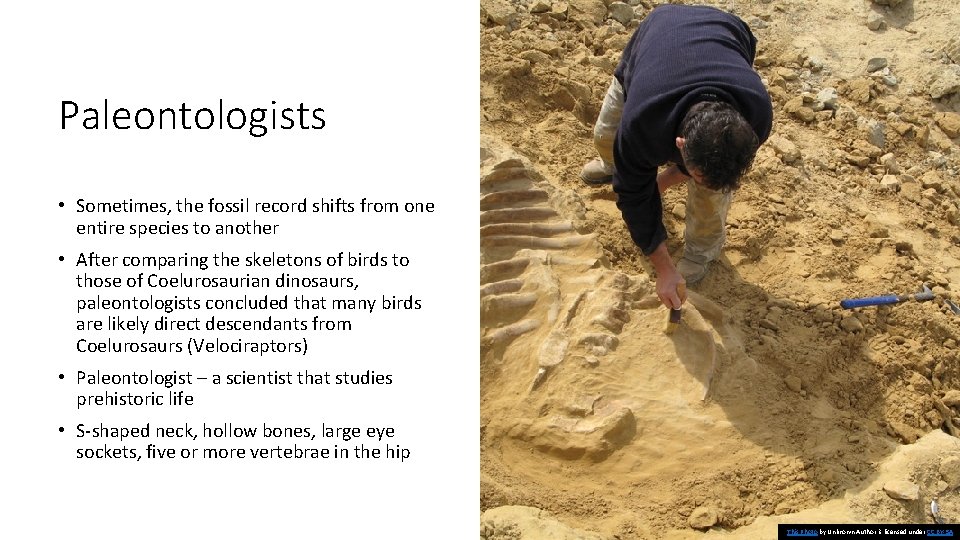
Paleontologists • Sometimes, the fossil record shifts from one entire species to another • After comparing the skeletons of birds to those of Coelurosaurian dinosaurs, paleontologists concluded that many birds are likely direct descendants from Coelurosaurs (Velociraptors) • Paleontologist – a scientist that studies prehistoric life • S-shaped neck, hollow bones, large eye sockets, five or more vertebrae in the hip This Photo by Unknown Author is licensed under CC BY-SA
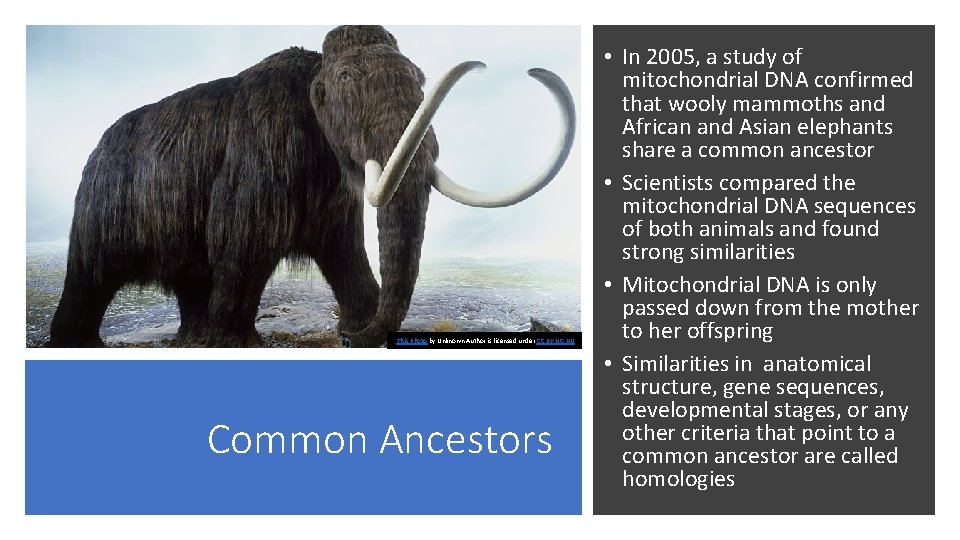
This Photo by Unknown Author is licensed under CC BY-NC-ND Common Ancestors • In 2005, a study of mitochondrial DNA confirmed that wooly mammoths and African and Asian elephants share a common ancestor • Scientists compared the mitochondrial DNA sequences of both animals and found strong similarities • Mitochondrial DNA is only passed down from the mother to her offspring • Similarities in anatomical structure, gene sequences, developmental stages, or any other criteria that point to a common ancestor are called homologies
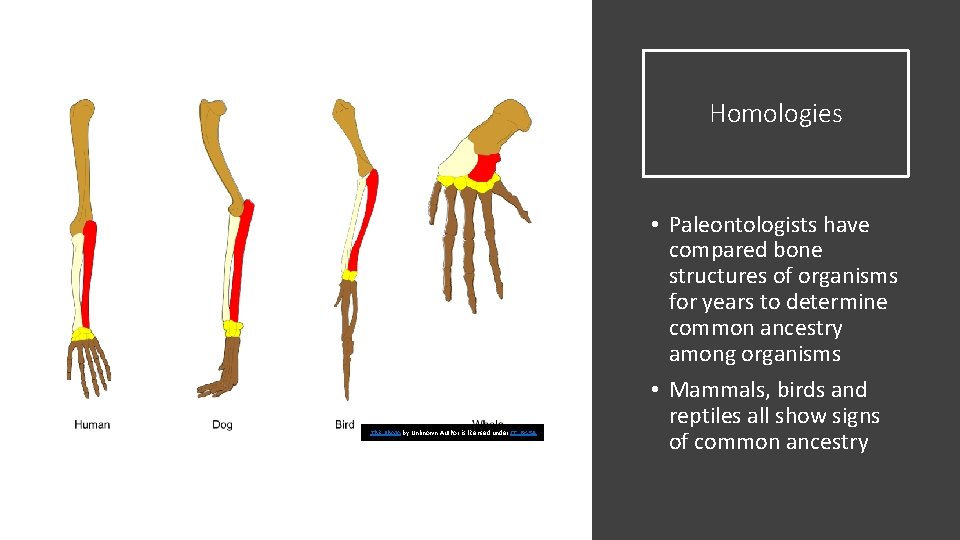
Homologies This Photo by Unknown Author is licensed under CC BY-SA • Paleontologists have compared bone structures of organisms for years to determine common ancestry among organisms • Mammals, birds and reptiles all show signs of common ancestry
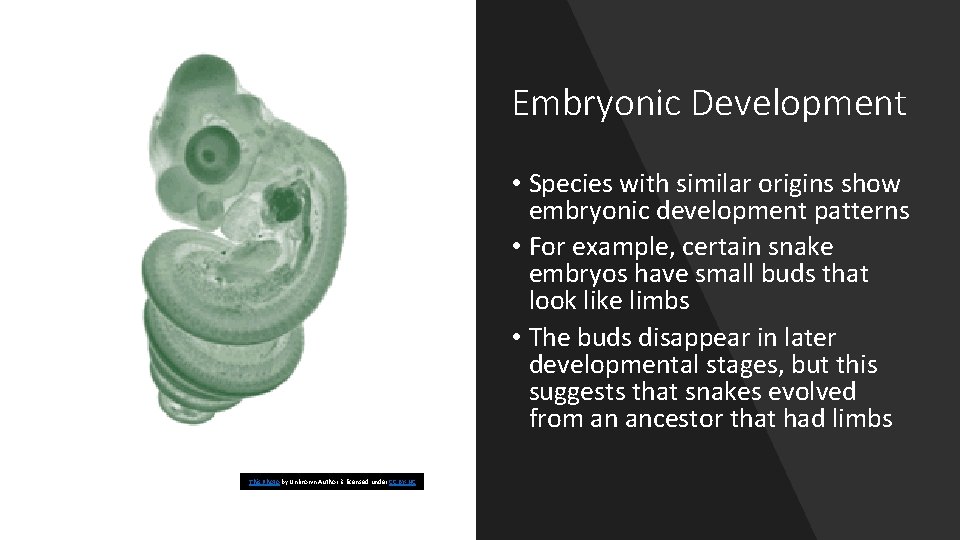
Embryonic Development • Species with similar origins show embryonic development patterns • For example, certain snake embryos have small buds that look like limbs • The buds disappear in later developmental stages, but this suggests that snakes evolved from an ancestor that had limbs This Photo by Unknown Author is licensed under CC BY-NC
Be Careful! • One hypothesis has received mixed reactions from the scientific community • Paleontologists found protein (collagen) in a 68 million year old T- rex bone, and in 2007 reported that 5 of the 7 collagen fragments matched that of chickens • No other scientists have found protein that has survived even one million years, let alone 68 million • Could the proteins have come from contamination? Could there have been different results if the instructions were written differently This Photo by Unknown Author is licensed under CC BY-NC-ND
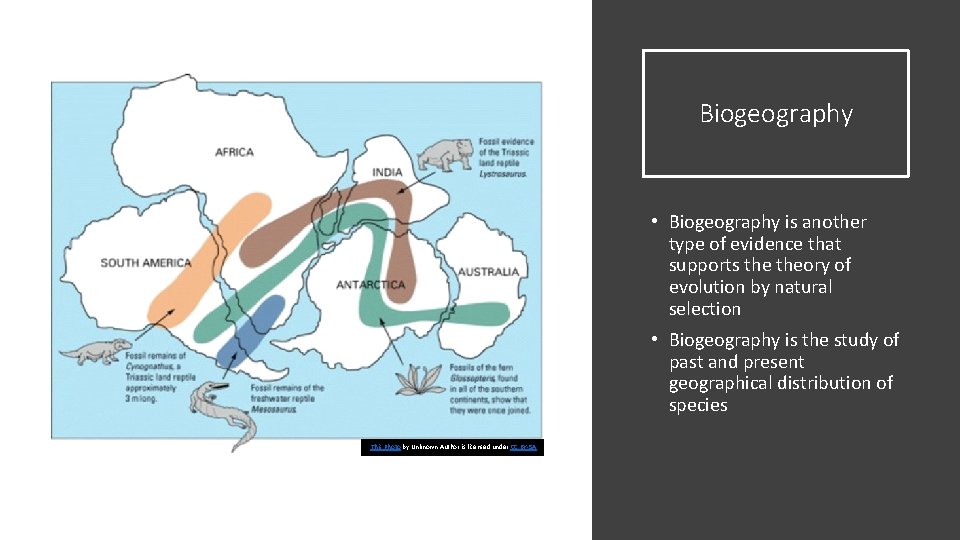
Biogeography • Biogeography is another type of evidence that supports theory of evolution by natural selection • Biogeography is the study of past and present geographical distribution of species This Photo by Unknown Author is licensed under CC BY-SA
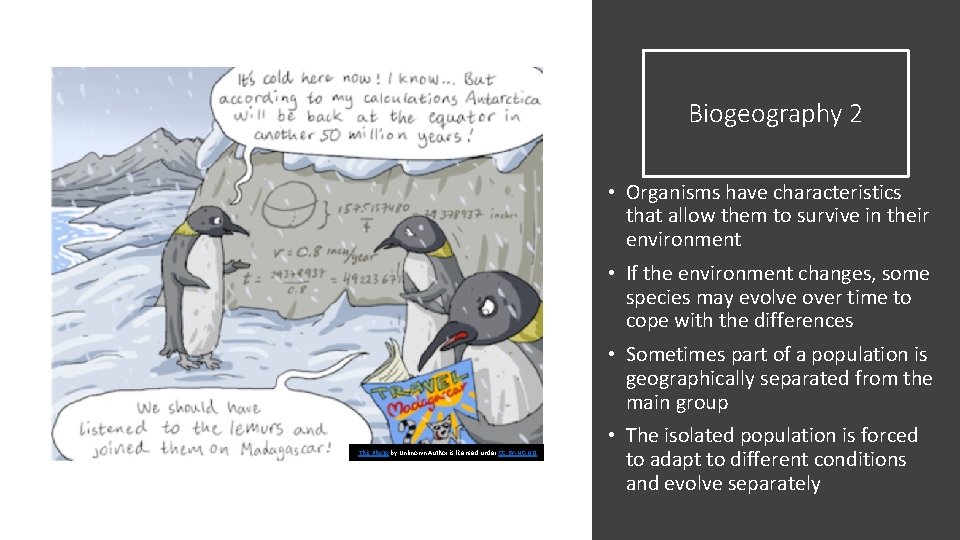
Biogeography 2 • Organisms have characteristics that allow them to survive in their environment • If the environment changes, some species may evolve over time to cope with the differences • Sometimes part of a population is geographically separated from the main group This Photo by Unknown Author is licensed under CC BY-NC-ND • The isolated population is forced to adapt to different conditions and evolve separately
This Photo by Unknown Author is licensed under CC BY-NC-ND Continental Drift • Continental Drift, the breaking apart and movement of continents from one massive landform called Pangaea, explains why many species evolved into knew species • As the land masses of Pangaea drifted apart, newly isolated species developed characteristics that set them apart from their common ancestor
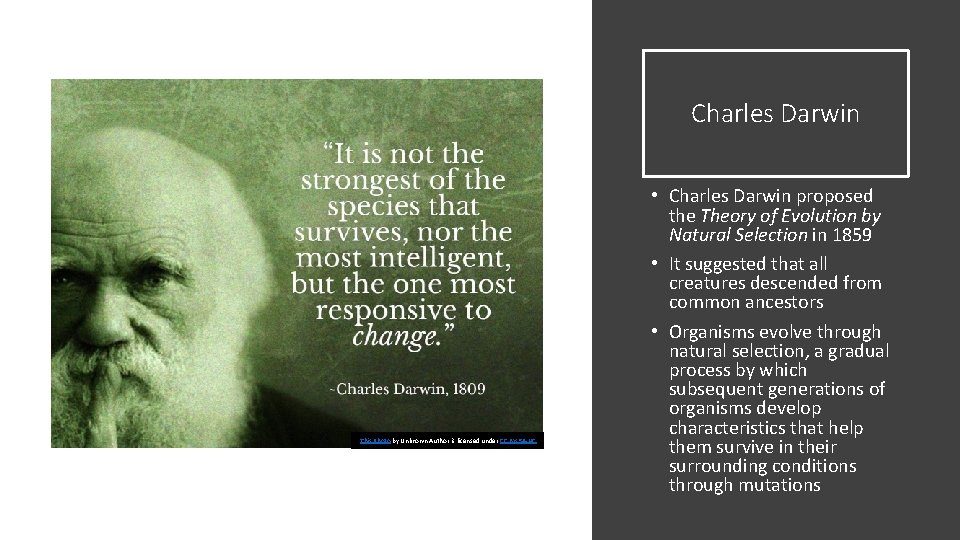
Charles Darwin This Photo by Unknown Author is licensed under CC BY-SA-NC • Charles Darwin proposed the Theory of Evolution by Natural Selection in 1859 • It suggested that all creatures descended from common ancestors • Organisms evolve through natural selection, a gradual process by which subsequent generations of organisms develop characteristics that help them survive in their surrounding conditions through mutations
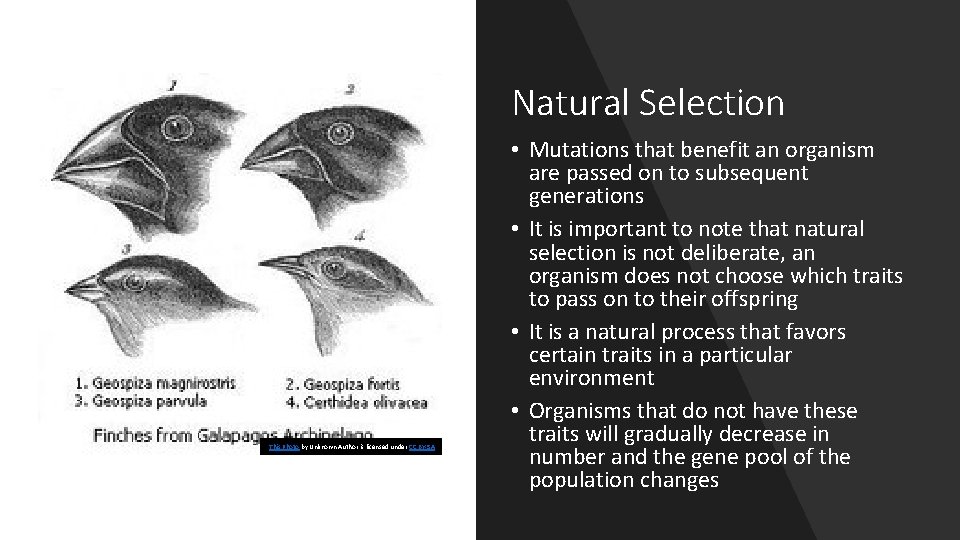
Natural Selection This Photo by Unknown Author is licensed under CC BY-SA • Mutations that benefit an organism are passed on to subsequent generations • It is important to note that natural selection is not deliberate, an organism does not choose which traits to pass on to their offspring • It is a natural process that favors certain traits in a particular environment • Organisms that do not have these traits will gradually decrease in number and the gene pool of the population changes
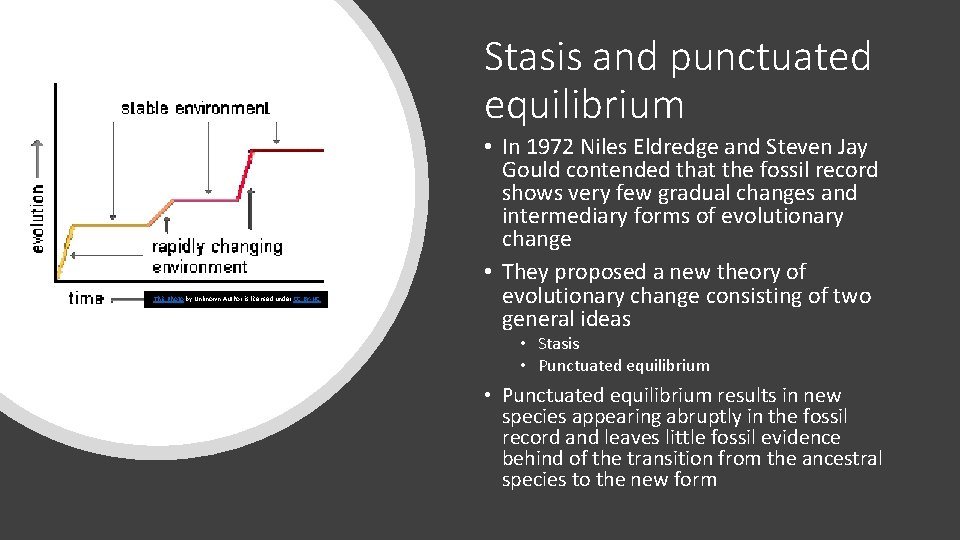
Stasis and punctuated equilibrium This Photo by Unknown Author is licensed under CC BY-NC • In 1972 Niles Eldredge and Steven Jay Gould contended that the fossil record shows very few gradual changes and intermediary forms of evolutionary change • They proposed a new theory of evolutionary change consisting of two general ideas • Stasis • Punctuated equilibrium results in new species appearing abruptly in the fossil record and leaves little fossil evidence behind of the transition from the ancestral species to the new form
- Slides: 15