
Introduction to Creative Commons Marieke Guy Interoperability Focus
Introduction to Creative Commons Marieke Guy Interoperability Focus UKOLN is supported by: www. ukoln. ac. uk A centre of expertise in digital information management www. bath. ac. uk
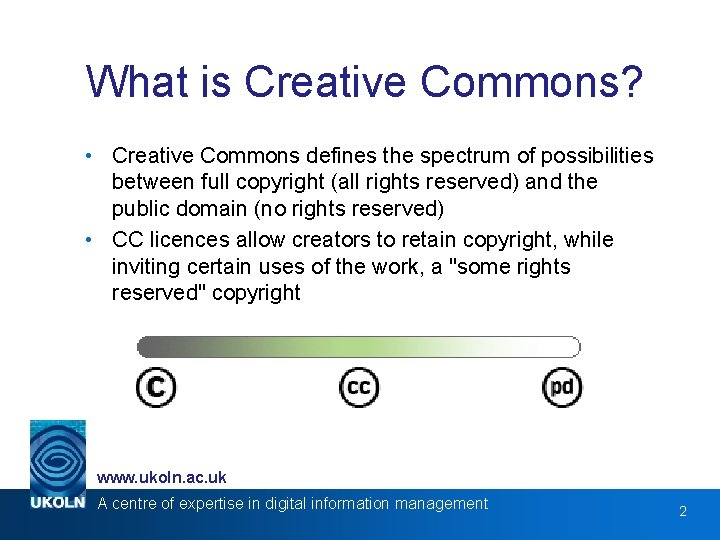
What is Creative Commons? • Creative Commons defines the spectrum of possibilities between full copyright (all rights reserved) and the public domain (no rights reserved) • CC licences allow creators to retain copyright, while inviting certain uses of the work, a "some rights reserved" copyright www. ukoln. ac. uk A centre of expertise in digital information management 2

Creative Commons Movement • As mentioned previously the CC movement evolved from open source software ideas and licences • US lawyer Lawrence Lessig established the public domain Web site after participating in an unsuccessful lawsuit • Lessig decided he wanted to “attempt to redesign copyright from within” • CC was officially founded in 2001 after Lessig received a grant from the Centre for Public Domain (CPD) • Lessig was assisted by IPR and IT experts (including James Boyle, Michael Carroll, Eric Saltzman, Hal Abelson and Eric Eldred) and fellows and students from Harvard Law School • Many respected experts now sit on the board of directors www. ukoln. ac. uk A centre of expertise in digital information management 3
CC Licences • The idea of the movement was to create licences that were: – easy-to-use – Used current copyright law to achieve their effect – Would allow creators to share their work with the public whilst maintaining certain control over it • There are now 16 million works using CC licences (wikipedia) www. ukoln. ac. uk A centre of expertise in digital information management 4

A few Definitions… • "Derivative Work" means any work created by the editing, modification, adaptation or translation of the Work in any media (however a work that constitutes a Collective Work will not be considered a Derivative Work for the purpose of this Licence) • "Non-Commercial" means not primarily intended for or directed towards commercial advantage or private monetary compensation www. ukoln. ac. uk A centre of expertise in digital information management 5
CC Baseline Rights #1 • Every licence will help you – retain your copyright – announce that other people's fair use, first sale, and free expression rights are not affected by the licence • Every licence requires licencees – to get your permission to do any of the things you choose to restrict e. g. , make a commercial use, create a derivative work – to keep any copyright notice intact on all copies – to link to your licence from copies of the work – not to alter the terms of the licence – not to use technology to restrict other licencees' lawful uses of the work (note this includes technical protection measures) www. ukoln. ac. uk A centre of expertise in digital information management 6
CC Baseline Rights #2 • Every licence allows licencees, provided they live up to your conditions – to copy the work – to distribute it – to display or perform it publicly – to make digital public performances of it (e. g. , webcasting) – to shift the work into another format as a verbatim copy • Every licence – applies worldwide – lasts for the duration of the work's copyright – is not revocable www. ukoln. ac. uk A centre of expertise in digital information management 7
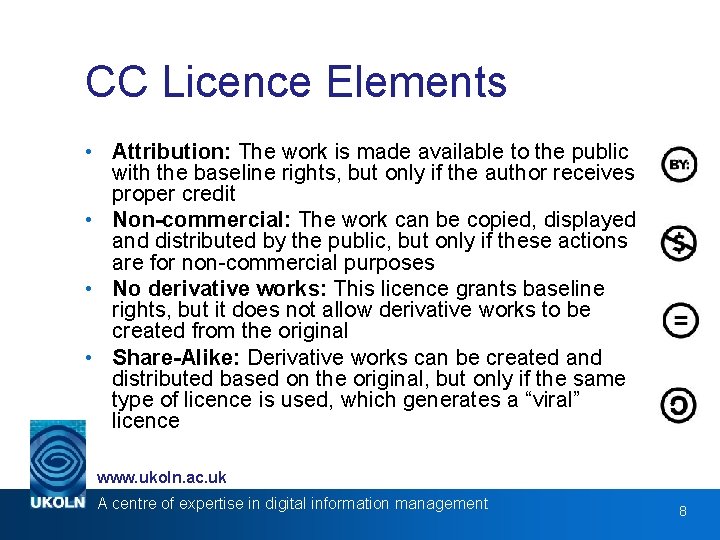
CC Licence Elements • Attribution: The work is made available to the public with the baseline rights, but only if the author receives proper credit • Non-commercial: The work can be copied, displayed and distributed by the public, but only if these actions are for non-commercial purposes • No derivative works: This licence grants baseline rights, but it does not allow derivative works to be created from the original • Share-Alike: Derivative works can be created and distributed based on the original, but only if the same type of licence is used, which generates a “viral” licence www. ukoln. ac. uk A centre of expertise in digital information management 8
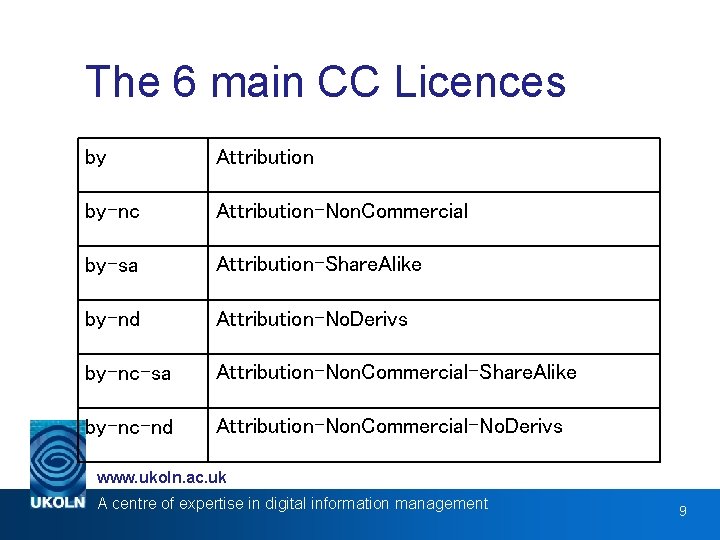
The 6 main CC Licences by Attribution by-nc Attribution-Non. Commercial by-sa Attribution-Share. Alike by-nd Attribution-No. Derivs by-nc-sa Attribution-Non. Commercial-Share. Alike by-nc-nd Attribution-Non. Commercial-No. Derivs www. ukoln. ac. uk A centre of expertise in digital information management 9
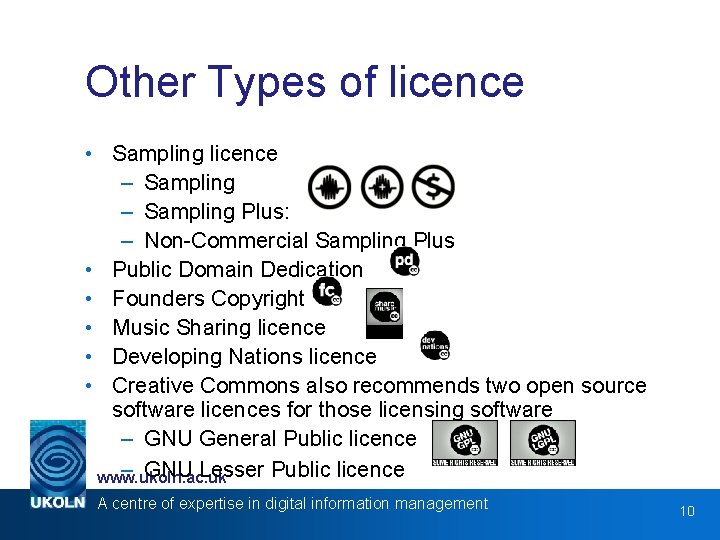
Other Types of licence • Sampling licence – Sampling Plus: – Non-Commercial Sampling Plus • Public Domain Dedication • Founders Copyright • Music Sharing licence • Developing Nations licence • Creative Commons also recommends two open source software licences for those licensing software – GNU General Public licence – GNU Lesser Public licence www. ukoln. ac. uk A centre of expertise in digital information management 10
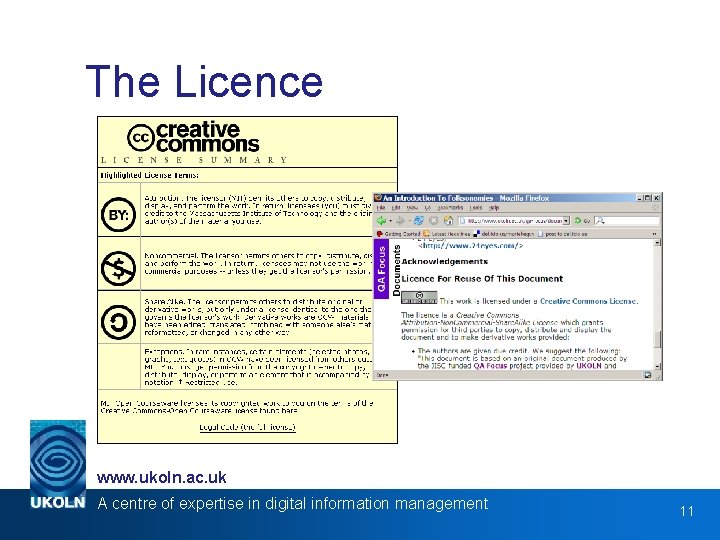
The Licence www. ukoln. ac. uk A centre of expertise in digital information management 11
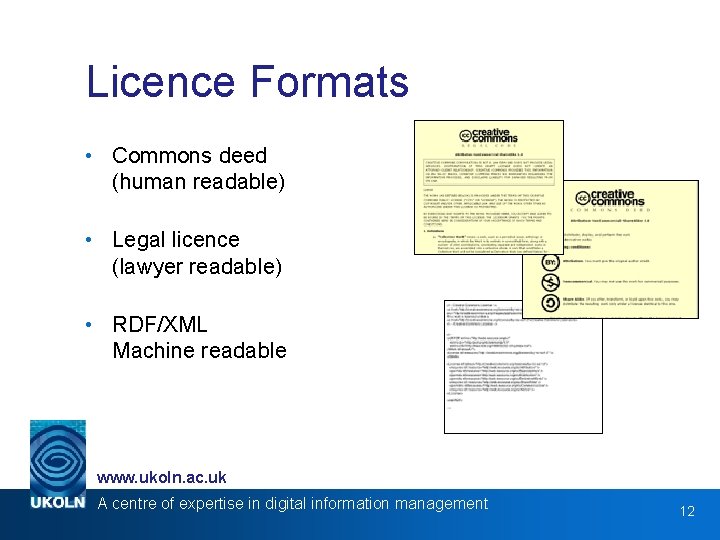
Licence Formats • Commons deed (human readable) • Legal licence (lawyer readable) • RDF/XML Machine readable www. ukoln. ac. uk A centre of expertise in digital information management 12
Licence Metadata • Resource Description Framework (RDF) metadata is used in the machine readable licence • Lines of code given to you with licence • You can also embed metadata in RSS, Audio (MP 3 and Ogg), XMP (PDF, image formats), SMIL • Working on other formats • For non-Web content it is suggested you embed a link to a licence information page • You can embed metadata using CC tools e. g. in MP 3 s using cc. Publisher www. ukoln. ac. uk A centre of expertise in digital information management 13
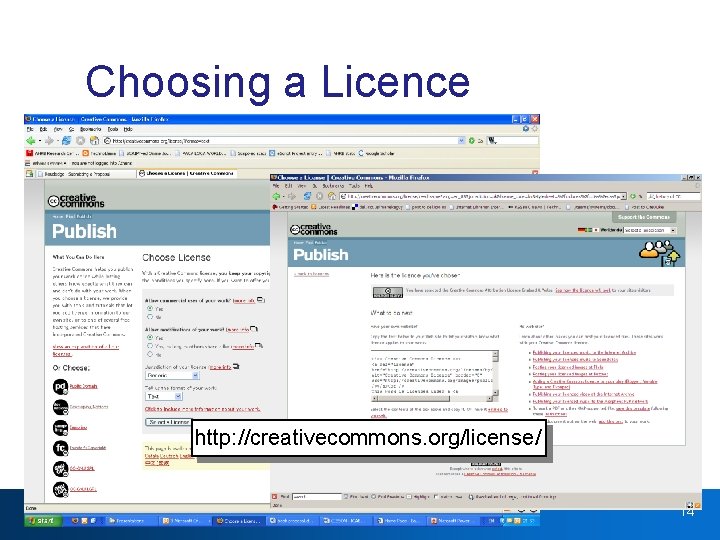
Choosing a Licence http: //creativecommons. org/license/ www. ukoln. ac. uk A centre of expertise in digital information management 14
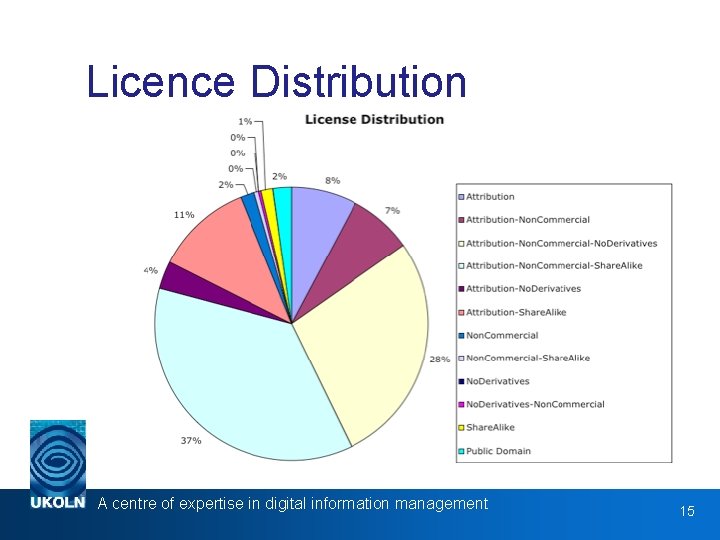
Licence Distribution www. ukoln. ac. uk A centre of expertise in digital information management 15
International CC • CC licences originally written using an American legal model • The licences were popular and adopted by users all around the world • However, there was a possibility that there might be validity problems in some jurisdictions • i. Commons - offshoot of the licensing project dedicated to the drafting and eventual adoption of jurisdictionspecific licences – 24 jurisdictions have completed licences (17/11/05) – 13 jurisdictions licences are being developed – at least 70 local jurisdiction licenses expected www. ukoln. ac. uk A centre of expertise in digital information management 16
CC United Kingdom • Complexities of UK law have meant the creation of two different set of licences • CC United Kingdom: England Wales – Completed April 2005 – Licence ported by Programme in Comparative Media Law and Policy at Oxford University • CC United Kingdom: Scotland – Still being developed – working draft – Licence being ported by the AHRB Centre for Studies in Intellectual Property and Technology Law at Edinburgh University • Also CC Ireland www. ukoln. ac. uk A centre of expertise in digital information management 17
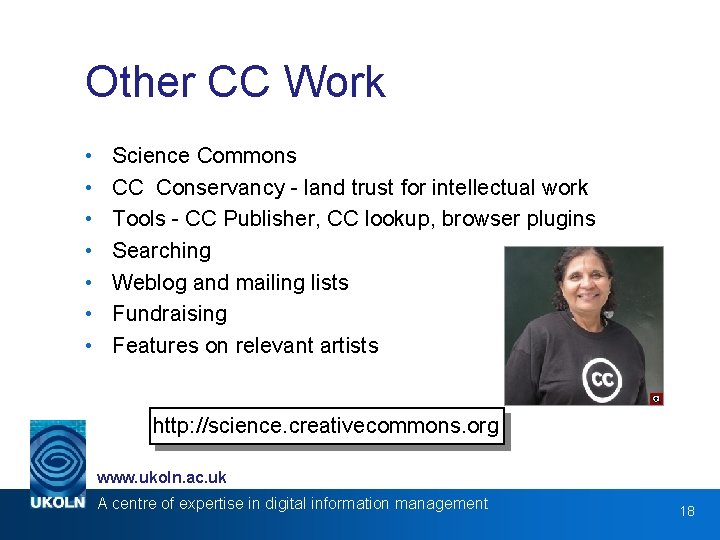
Other CC Work • • Science Commons CC Conservancy - land trust for intellectual work Tools - CC Publisher, CC lookup, browser plugins Searching Weblog and mailing lists Fundraising Features on relevant artists http: //science. creativecommons. org www. ukoln. ac. uk A centre of expertise in digital information management 18
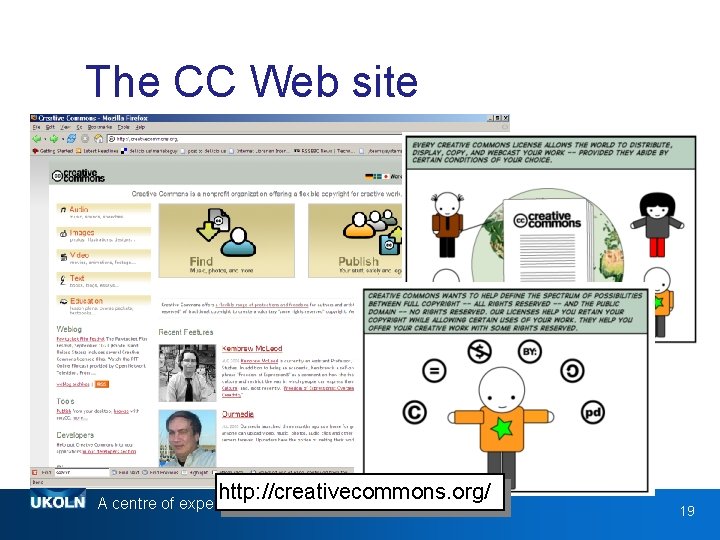
The CC Web site www. ukoln. ac. uk http: //creativecommons. org/ A centre of expertise in digital information management 19
CC Mailing Lists • Various discussion lists including: – Community – New licences – Developing nations – Education – Business ideas – Metadata – Software development • Accessible from CC Web site www. ukoln. ac. uk A centre of expertise in digital information management 20
Accrediting Use • The proper way to accredit use of CC-licensed work is to: – to keep intact any copyright notices for the Work – credit the author, licensor and/or other parties (such as a wiki or journal) in the manner they specify – the title of the Work – the Uniform Resource Identifier for the work if specified by the author and/or licensor • Also provide the Uniform Resource Locator for the Creative Commons licence that applies to the work www. ukoln. ac. uk A centre of expertise in digital information management 21
Acknowledgements • Some slides in this presentation are based on those used in a presentation entitled Creative Commons written by Andrés Guadamuz and Jordan Hatcher • This ppt is available at: http: //www. intrallect. com/ciestudy/index. htm • Note this is where you can find information on the CC study into Licensing Solutions for the Common Information Environment www. ukoln. ac. uk A centre of expertise in digital information management 22
Any Questions? www. ukoln. ac. uk A centre of expertise in digital information management 23
- Slides: 23