The University of Lahore Department of Civil Engineering

- Slides: 46
The University of Lahore Department of Civil Engineering GEOTECHNICAL & FOUNDATION ENGINEERING CE 4708 Instructors 1. Engr. Attique ur Rehman (Section C & D) 2. Engr. Farhan Ali (Section A & B) 3. Engr. Sadia Kalsoom (Lab Part of Section A, B & D) The University of Lahore 1
GEOTECHNICAL & FOUNDATION ENGINEERING Credit Hours: 2+1 = 3 Prerequisites: Soil Mechanics Specific Objectives of course: • To enhance the skills related to baring capacity and settlement evaluation of soils. • To apply principles of soil mechanics to engineering problems pertaining to retaining structures, foundations and embankments. The University of Lahore 2
GEOTECHNICAL & FOUNDATION ENGINEERING Course Outline: 1. Bearing Capacity of Soils: Definition of: gross, net, ultimate, safe and allowable bearing capacity. Methods of obtaining bearing capacity: Presumptive values from codes, from plate load test. Bearing capacity theories. Bearing capacity from SPT and CPT data. 2. Settlement Analysis: Definition, total settlement, differential settlement, angular distortion, immediate settlement. Primary and secondary consolidation settlements. Oedometer test: Determination of compression index and coefficient of consolidation, magnitude and time rate of consolidation settlement. Causes of settlement and methods of controlling settlement. Allowable total and differential settlement. 3
GEOTECHNICAL & FOUNDATION ENGINEERING • Course Outline: 3. Soil Improvement: Basic principles, objectives and methods. 4. Slope Stability: Types of slopes, Factors affecting stability and remedies. Types of failure. Methods of analysis: Ordinary methods of slices, Taylor's stability number method, Swedish circle method. Earth and Rock Fill Dams: Definition of an earth dam, types of earth and rock fill dams, Components of an earth dam and their functions. General design considerations and typical cross-sections. The University of Lahore 4
GEOTECHNICAL & FOUNDATION ENGINEERING • Course Outline: 6. Introduction to deep foundations: Types of piles, load carrying capacity of piles, group action, negative skin friction, pile load test. 7. Soil Dynamics: Sources of dynamic loading, spring-mass-dashpot system, application to machine foundations, liquefaction. 8. Introduction to Geotechnical Computer Software The University of Lahore 5
Chapter-1 Bearing Capacity of Soils: Definition of gross, net, ultimate, safe and allowable bearing capacity. Methods of obtaining bearing capacity: Presumptive values from codes, from plate load test. Bearing capacity theories. Bearing capacity from SPT and CPT data. The University of Lahore 6
Chapter-1 Bearing Capacity of Soils Foundation: • The lowest part of a structure is referred to as the foundation. • Its function is to transfer the load of structure to the soil on which it is resting. • A properly designed foundation transfers the load without overstressing the soil. § Overstressing the soil can result in either excessive settlement or shear failure of the soil, both of which cause damage to the structure. Foundations are generally grouped into two categories: A. Shallow Foundations B. Deep Foundations The University of Lahore 7
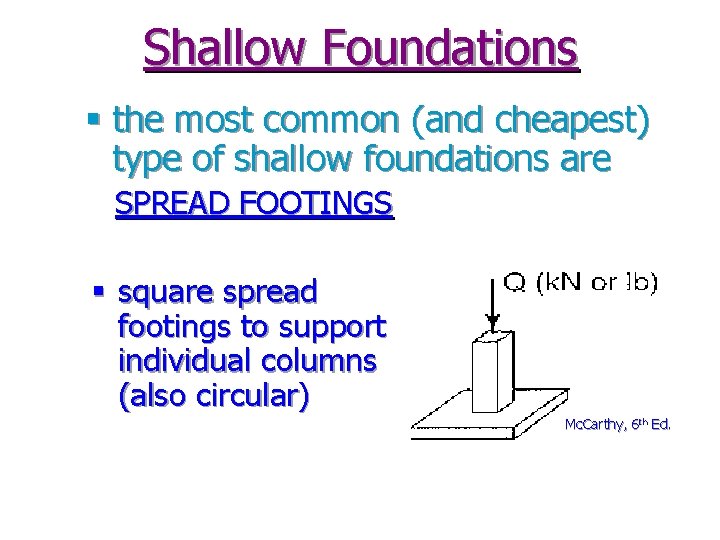
Shallow Foundations § the most common (and cheapest) type of shallow foundations are SPREAD FOOTINGS § square spread footings to support individual columns (also circular) Mc. Carthy, 6 th Ed.
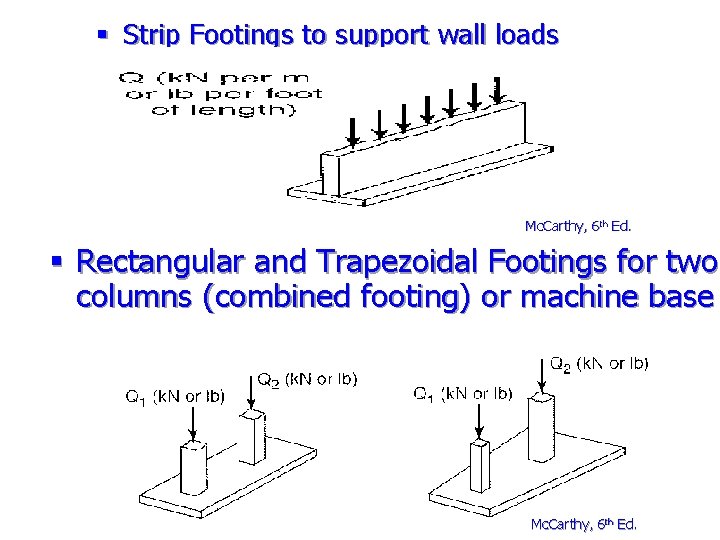
§ Strip Footings to support wall loads Mc. Carthy, 6 th Ed. § Rectangular and Trapezoidal Footings for two columns (combined footing) or machine base Mc. Carthy, 6 th Ed.
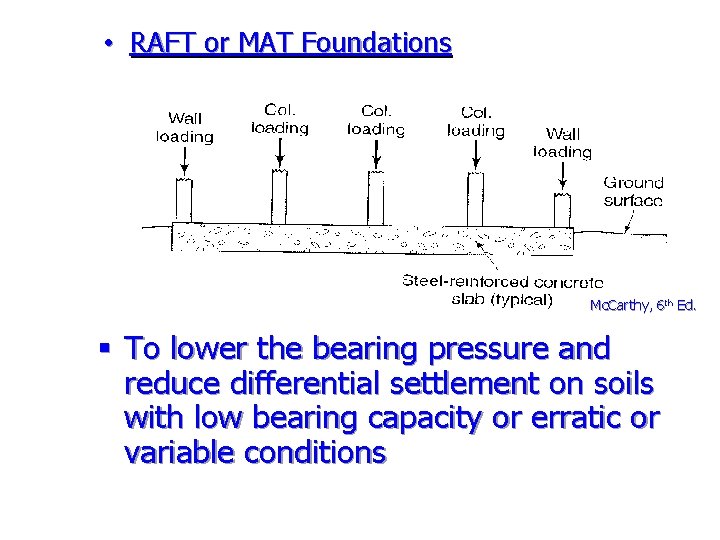
• RAFT or MAT Foundations Mc. Carthy, 6 th Ed. § To lower the bearing pressure and reduce differential settlement on soils with low bearing capacity or erratic or variable conditions
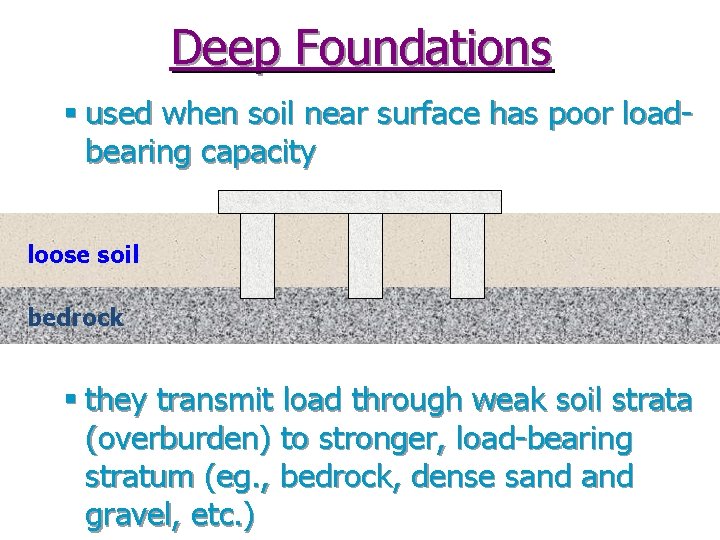
Deep Foundations § used when soil near surface has poor loadbearing capacity loose soil bedrock § they transmit load through weak soil strata (overburden) to stronger, load-bearing stratum (eg. , bedrock, dense sand gravel, etc. )
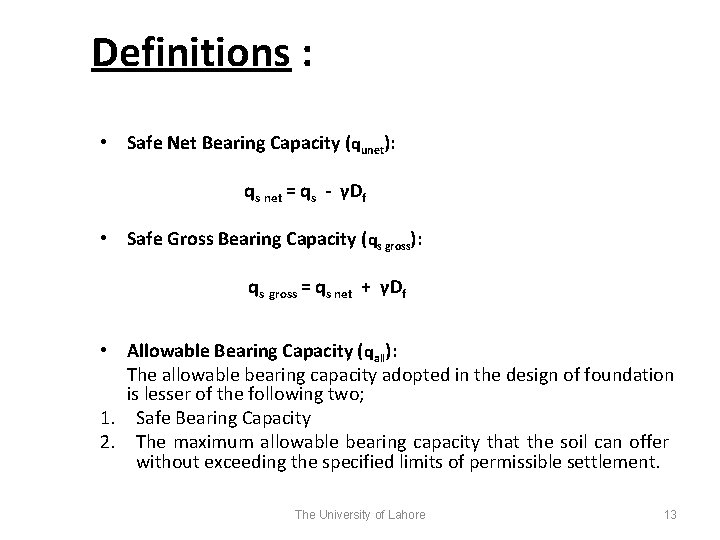
Definitions : • Ultimate Bearing Capacity (qu): The maximum pressure that can be supported by a soil mass without causing shear failure is termed as ultimate bearing capacity. • Safe Bearing Capacity (qs): Ultimate bearing capacity divided by FOS is termed as Safe bearing capacity. qs = qu/FOS • Ultimate Net Bearing Capacity (qu net): qu net = qu - γDf The University of Lahore 12
Definitions : • Safe Net Bearing Capacity (qunet): qs net = qs - γDf • Safe Gross Bearing Capacity (qs gross): qs gross = qs net + γDf • Allowable Bearing Capacity (qall): The allowable bearing capacity adopted in the design of foundation is lesser of the following two; 1. Safe Bearing Capacity 2. The maximum allowable bearing capacity that the soil can offer without exceeding the specified limits of permissible settlement. The University of Lahore 13
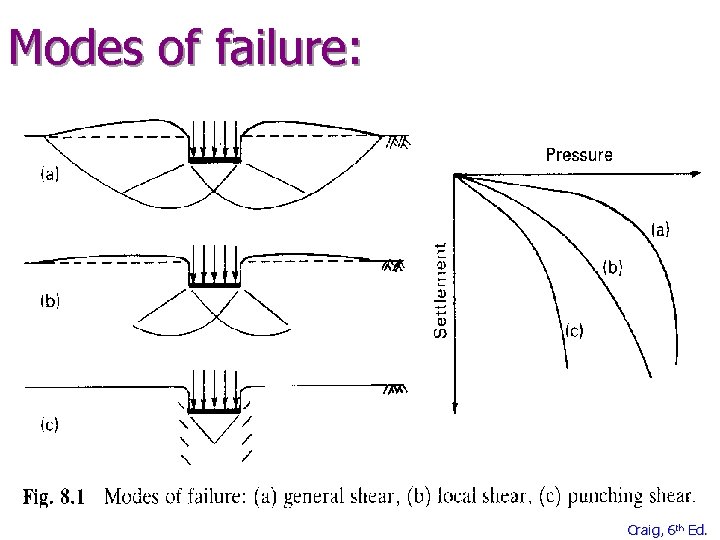
Modes of Shear failure: • When a uniformly distributed load of q per unit area is applied to the footing, it settles. • If the uniformly distributed load (q) is increased, the settlement of the footing gradually increases. • When the value of q = qu is reached, bearingcapacity failure occurs; the footing undergoes a very large settlement without any further increase of q. • The soil on one or both sides of the foundation bulges, and the slip surface extends to the ground surface. The University of Lahore 14
Modes of failure: Craig, 6 th Ed.
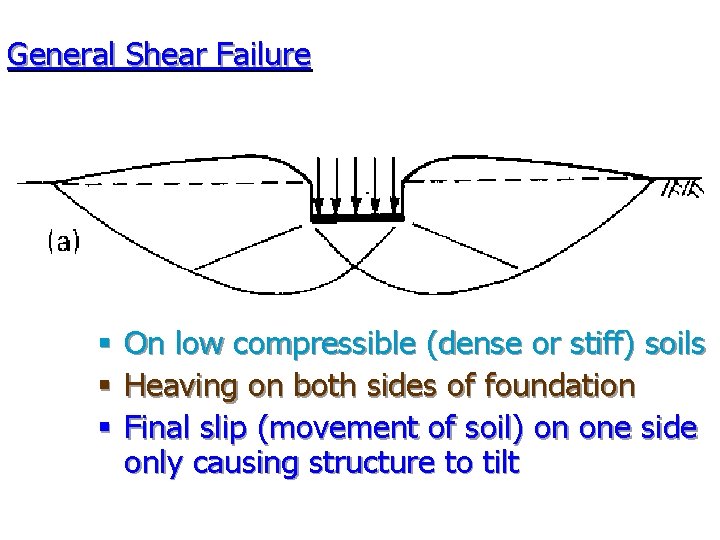
General Shear Failure § On low compressible (dense or stiff) soils § Heaving on both sides of foundation § Final slip (movement of soil) on one side only causing structure to tilt
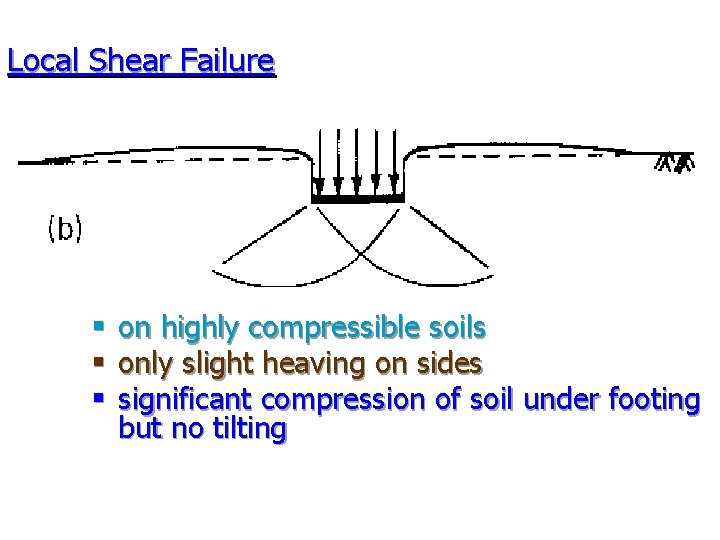
Local Shear Failure § on highly compressible soils § only slight heaving on sides § significant compression of soil under footing but no tilting
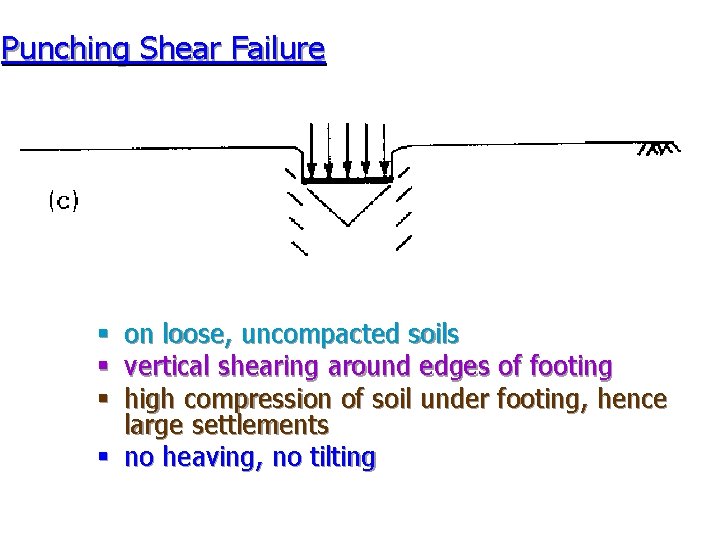
Punching Shear Failure on loose, uncompacted soils vertical shearing around edges of footing high compression of soil under footing, hence large settlements § no heaving, no tilting § § §
Methods of obtaining bearing capacity: 1. Presumptive values from codes 2. From plate load test 3. Bearing capacity theories 4. Bearing capacity from SPT and CPT data. The University of Lahore 19
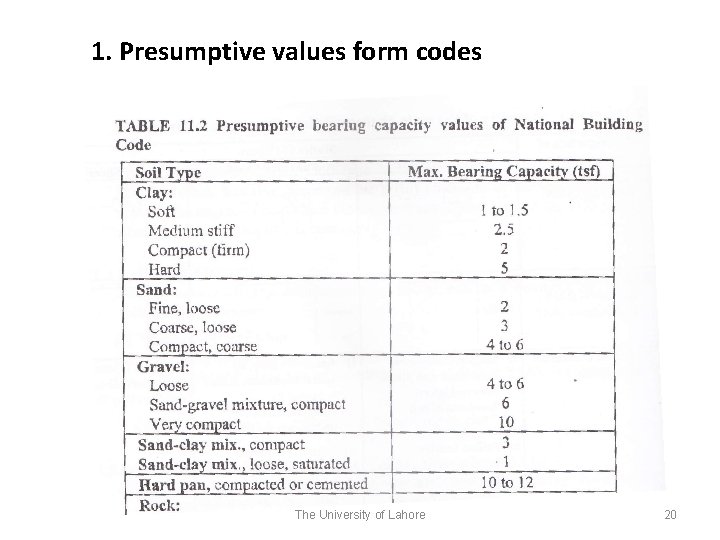
1. Presumptive values form codes The University of Lahore 20
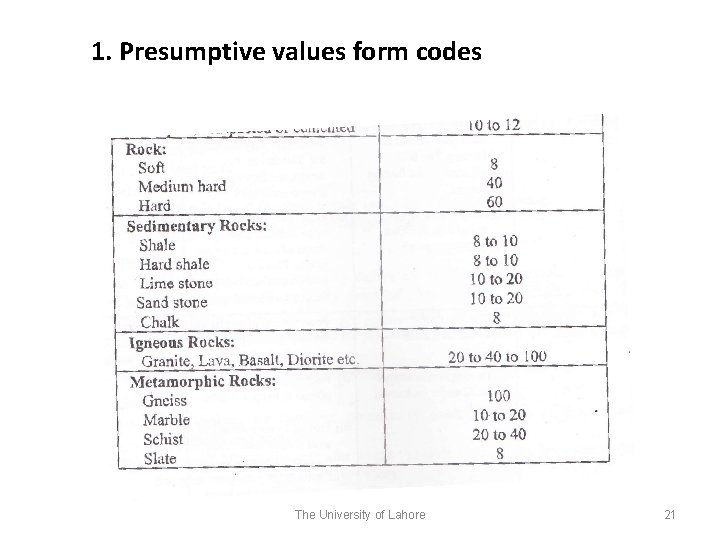
1. Presumptive values form codes The University of Lahore 21
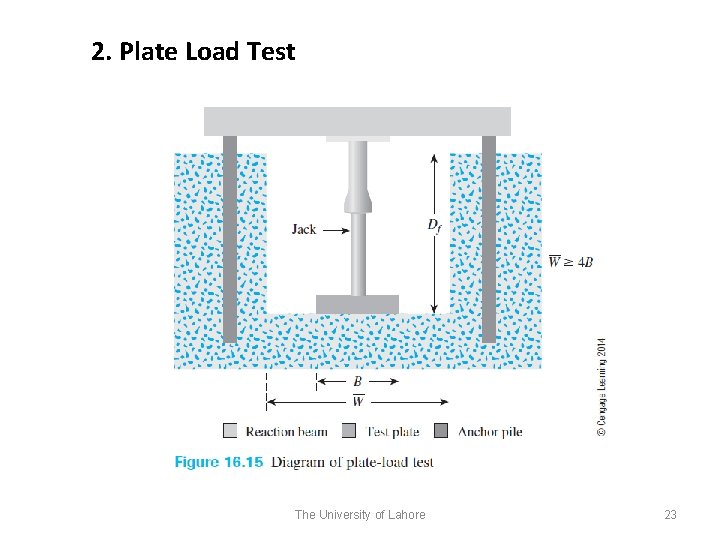
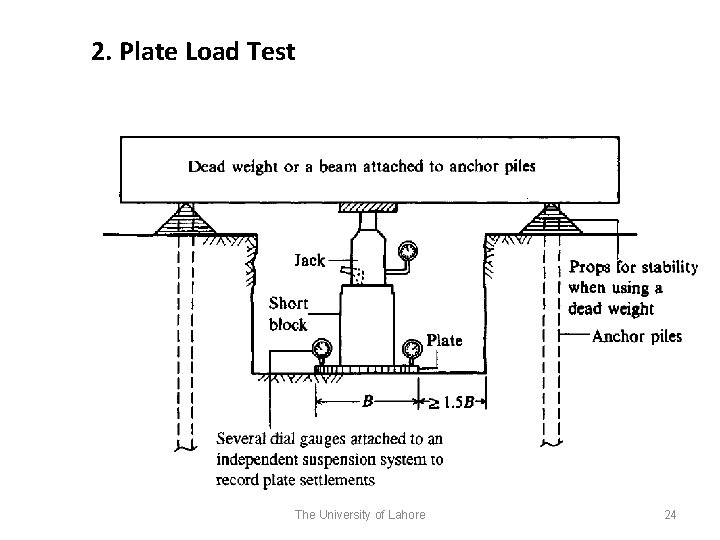
2. Plate Load Test • In some cases, conducting field-load tests to determine the soil-bearing capacity of foundations is desirable. • The standard method for a field-load test is given by the American Society for Testing and Materials (ASTM) under Designation D 1194 (ASTM, 1997). • Circular steel bearing plates 162 to 760 mm in diameter and 305 mm square plates are used for this type of test. • To conduct the test, one must have a pit of depth Df excavated. The University of Lahore 22
2. Plate Load Test The University of Lahore 23
2. Plate Load Test The University of Lahore 24
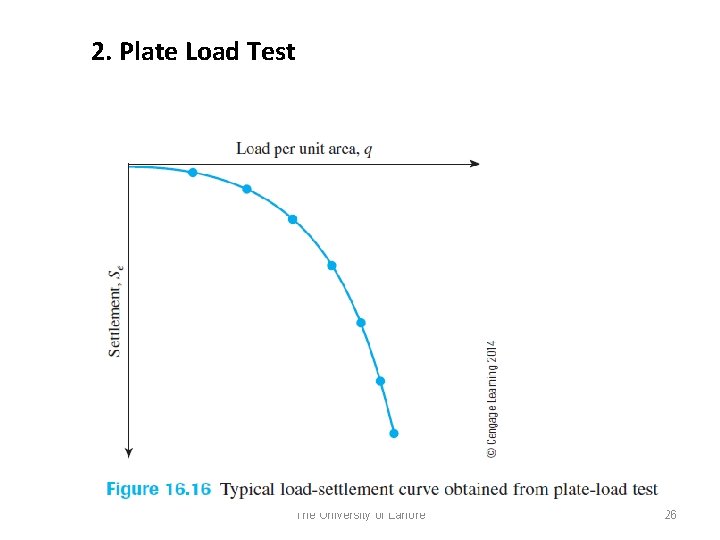
2. Plate Load Test • The width of the test pit should be at least four times the width of the bearing plate to be used for the test. • The bearing plate is placed on the soil at the bottom of the pit, and an incremental load on the bearing plate is applied. • After the application of an incremental load, enough time is allowed for settlement to occur. • When the settlement of the bearing plate becomes negligible, another incremental load is applied. • In this manner, a load-settlement plot can be obtained, as shown in Figure. The University of Lahore 25
2. Plate Load Test The University of Lahore 26
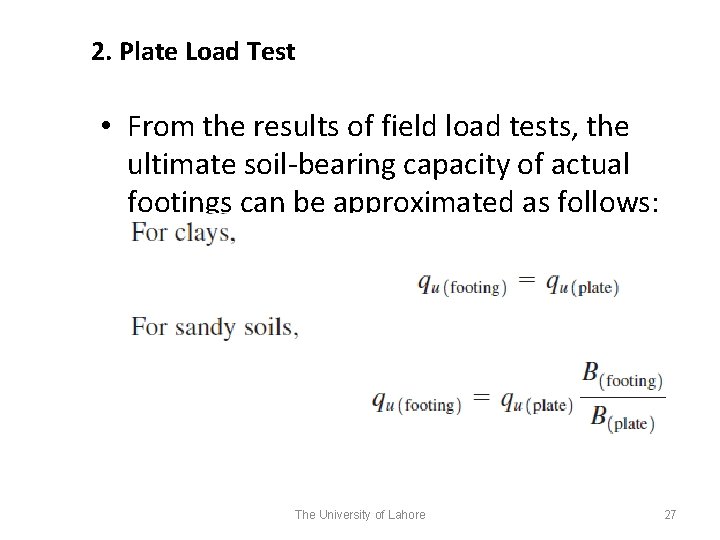
2. Plate Load Test • From the results of field load tests, the ultimate soil-bearing capacity of actual footings can be approximated as follows: The University of Lahore 27
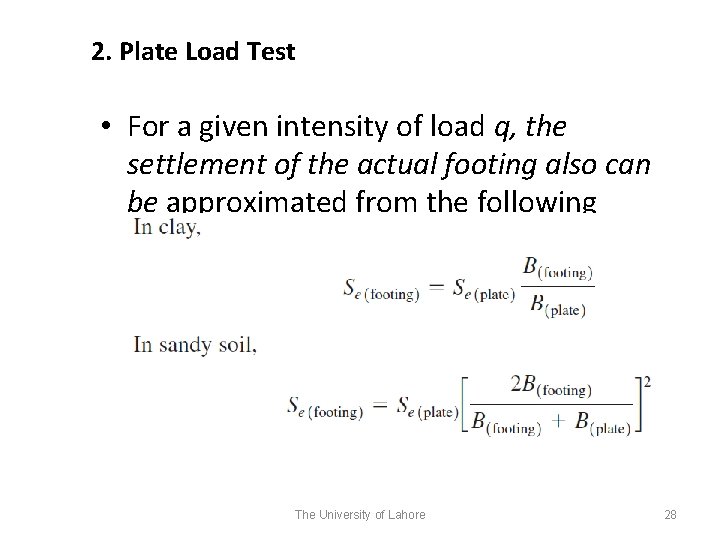
2. Plate Load Test • For a given intensity of load q, the settlement of the actual footing also can be approximated from the following equations: The University of Lahore 28
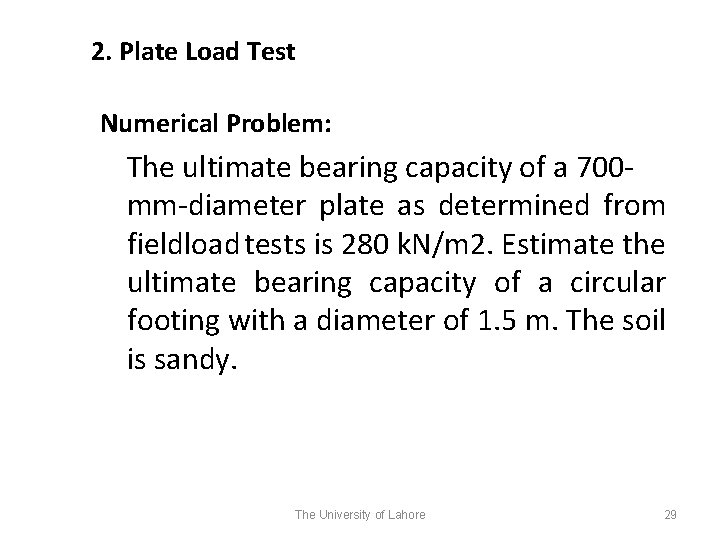
2. Plate Load Test Numerical Problem: The ultimate bearing capacity of a 700 mm-diameter plate as determined from fieldload tests is 280 k. N/m 2. Estimate the ultimate bearing capacity of a circular footing with a diameter of 1. 5 m. The soil is sandy. The University of Lahore 29
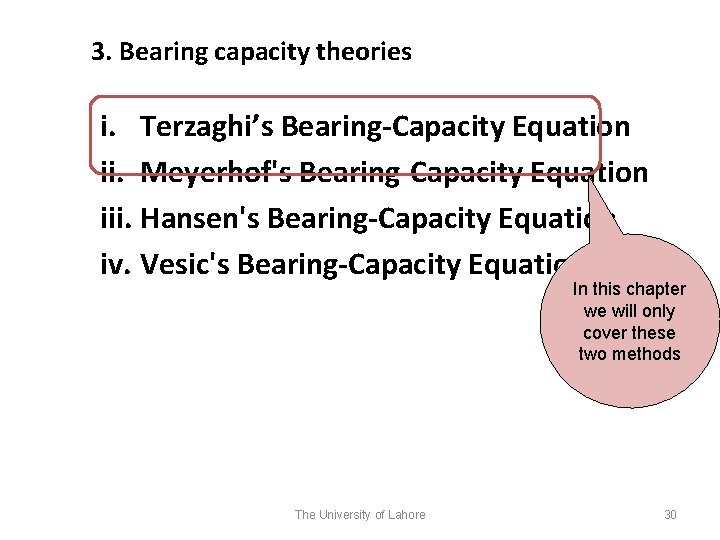
3. Bearing capacity theories i. Terzaghi’s Bearing-Capacity Equation ii. Meyerhof's Bearing-Capacity Equation iii. Hansen's Bearing-Capacity Equation iv. Vesic's Bearing-Capacity Equation In this chapter we will only cover these two methods The University of Lahore 30
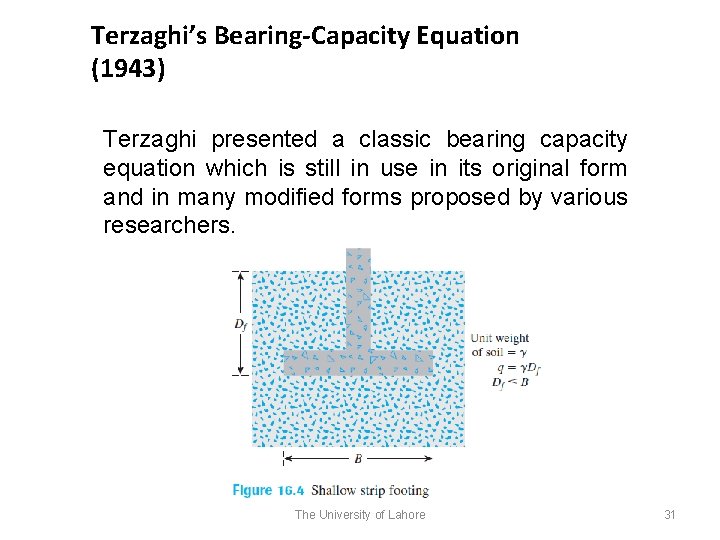
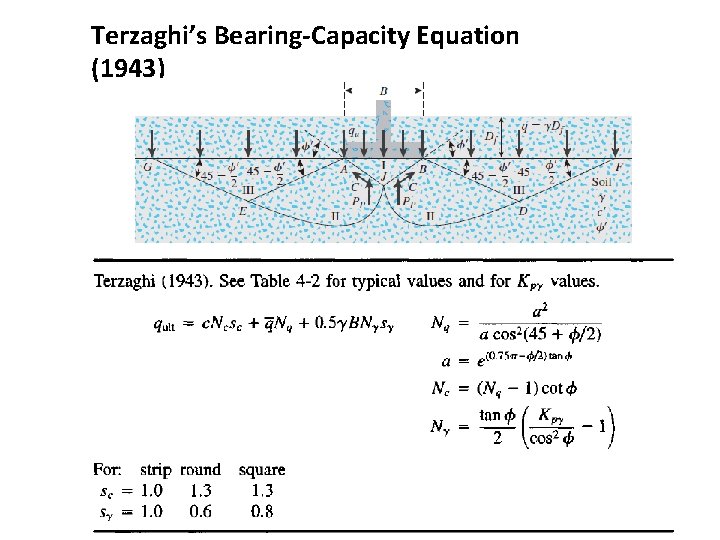
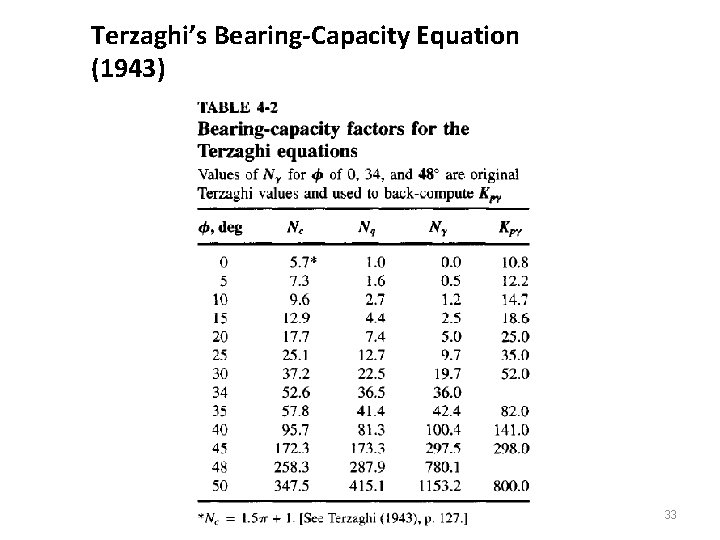
Terzaghi’s Bearing-Capacity Equation (1943) Terzaghi presented a classic bearing capacity equation which is still in use in its original form and in many modified forms proposed by various researchers. The University of Lahore 31
Terzaghi’s Bearing-Capacity Equation (1943) The University of Lahore 32
Terzaghi’s Bearing-Capacity Equation (1943) The University of Lahore 33
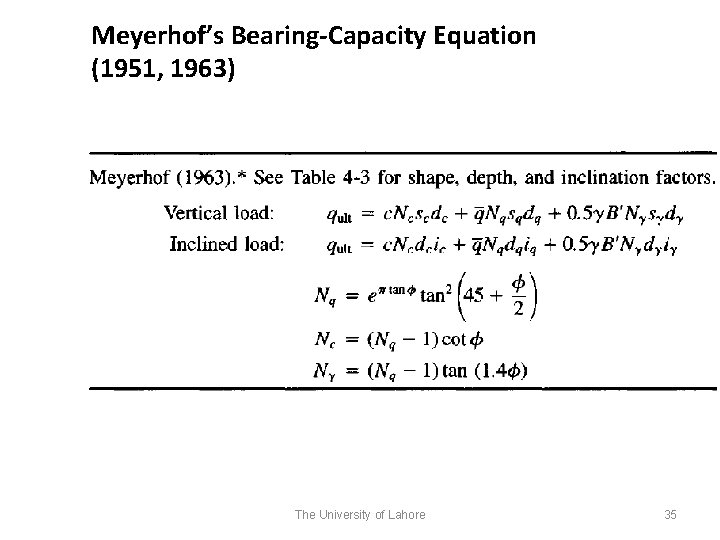
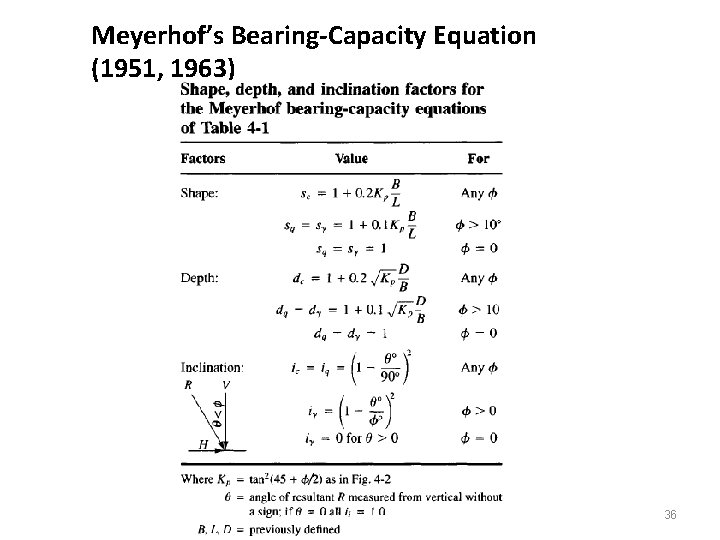
Meyerhof’s Bearing-Capacity Equation (1951, 1963) • Meyerhof (1951, 1963) proposed a bearingcapacity equation similar to that of Terzaghi but included a shape factor sq with the depth term N q. • He also included depth factors di and inclination factors ii for cases where the footing load is inclined from the vertical. The University of Lahore 34
Meyerhof’s Bearing-Capacity Equation (1951, 1963) The University of Lahore 35
Meyerhof’s Bearing-Capacity Equation (1951, 1963) The University of Lahore 36
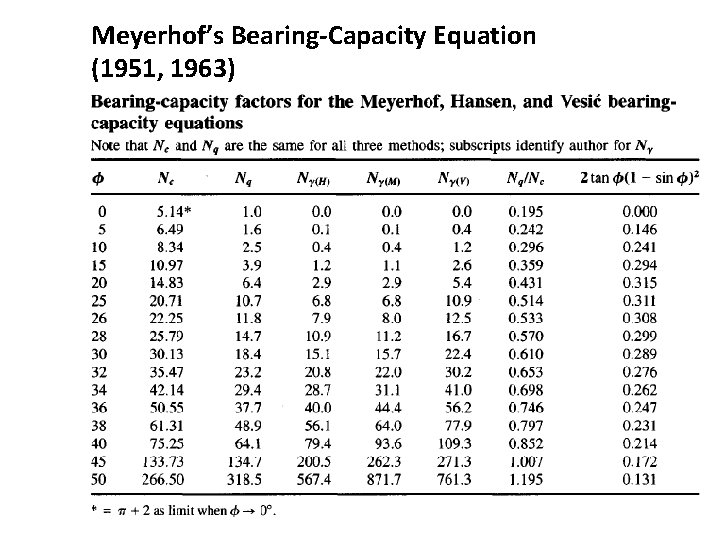
Meyerhof’s Bearing-Capacity Equation (1951, 1963) The University of Lahore 37
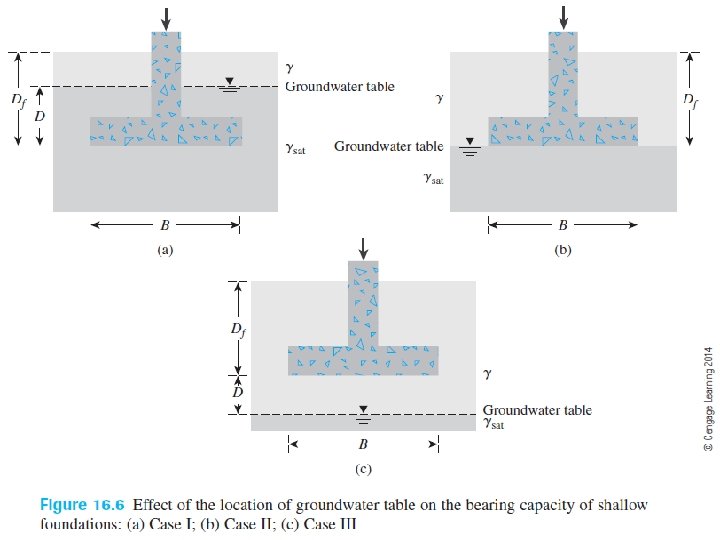
Effect of Groundwater Table • In developing the bearing-capacity equations given in the preceding section, we assumed that the groundwater table is located at a depth much greater than the width, B, of the footing. • However, if the groundwater table is close to the footing, some changes are required in the second and third terms of BC Eqs. • Three different conditions can arise regarding the location of the groundwater The University of Lahore 38
The University of Lahore 39
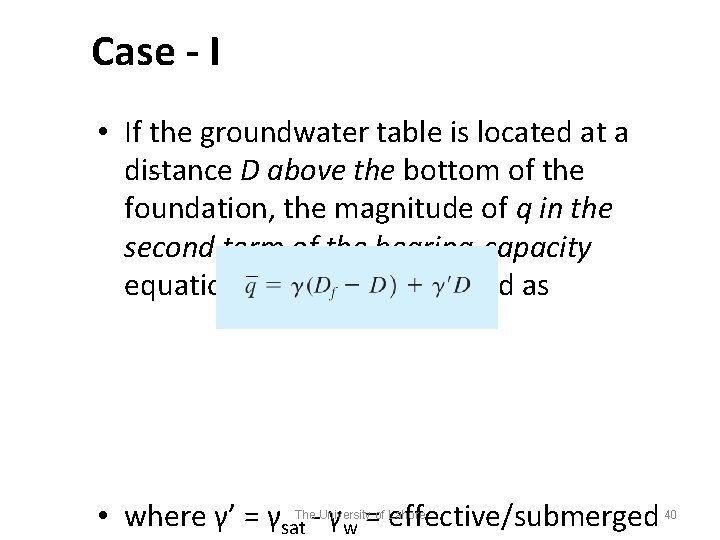
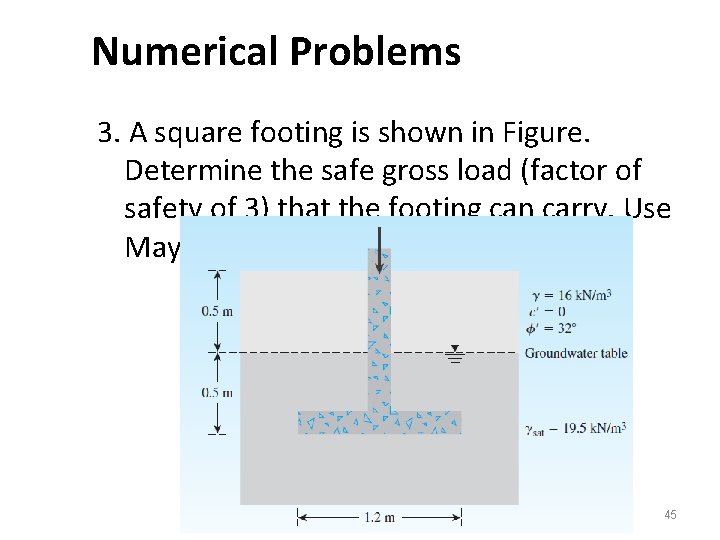
Case - I • If the groundwater table is located at a distance D above the bottom of the foundation, the magnitude of q in the second term of the bearing-capacity equation should be calculated as • where γ’ = γsat - γw = effective/submerged The University of Lahore 40
Case - II • If the groundwater table coincides with the bottom of the foundation, the magnitude of q is equal to γDf. However, the unit weight, , in the third term of the bearing-capacity equations should be replaced by γ’. The University of Lahore 41
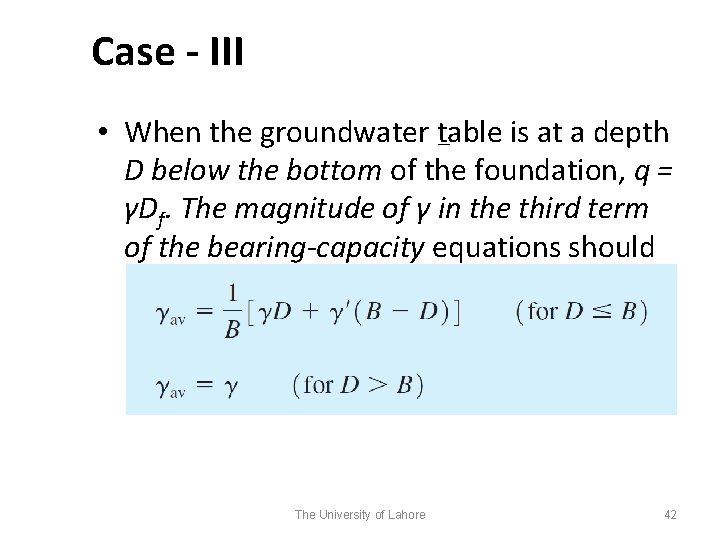
Case - III • When the groundwater table is at a depth D below the bottom of the foundation, q = γDf. The magnitude of γ in the third term of the bearing-capacity equations should be replaced by γav. The University of Lahore 42
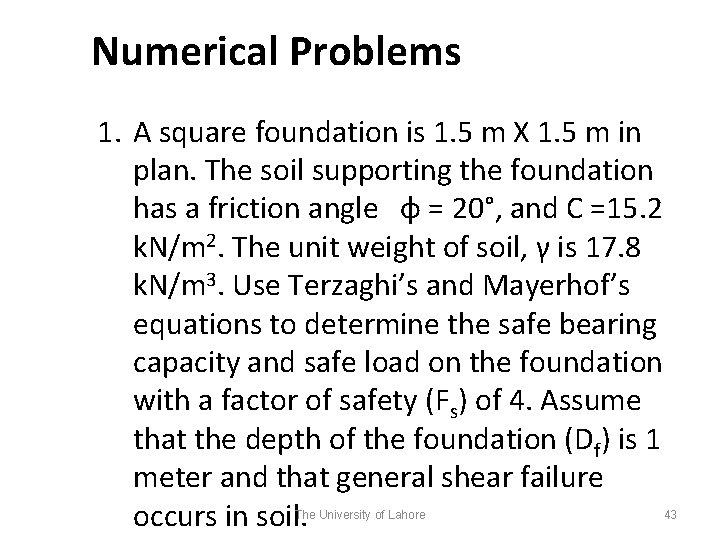
Numerical Problems 1. A square foundation is 1. 5 m X 1. 5 m in plan. The soil supporting the foundation has a friction angle φ = 20°, and C =15. 2 k. N/m 2. The unit weight of soil, γ is 17. 8 k. N/m 3. Use Terzaghi’s and Mayerhof’s equations to determine the safe bearing capacity and safe load on the foundation with a factor of safety (Fs) of 4. Assume that the depth of the foundation (Df) is 1 meter and that general shear failure occurs in soil. The University of Lahore 43
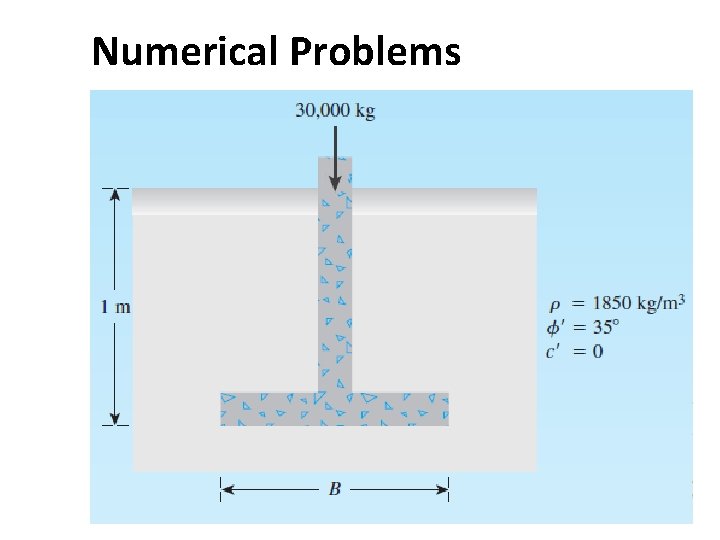
Numerical Problems The University of Lahore 44
Numerical Problems 3. A square footing is shown in Figure. Determine the safe gross load (factor of safety of 3) that the footing can carry. Use Mayerhof’s equation The University of Lahore 45
4. Bearing capacity from SPT and CPT data. To be continued in next lecture ………. The University of Lahore 46