
Industrial Instrumentation Dr Ing Naveed Ramzan 1 Level


- Slides: 37
Industrial Instrumentation Dr. –Ing. Naveed Ramzan 1
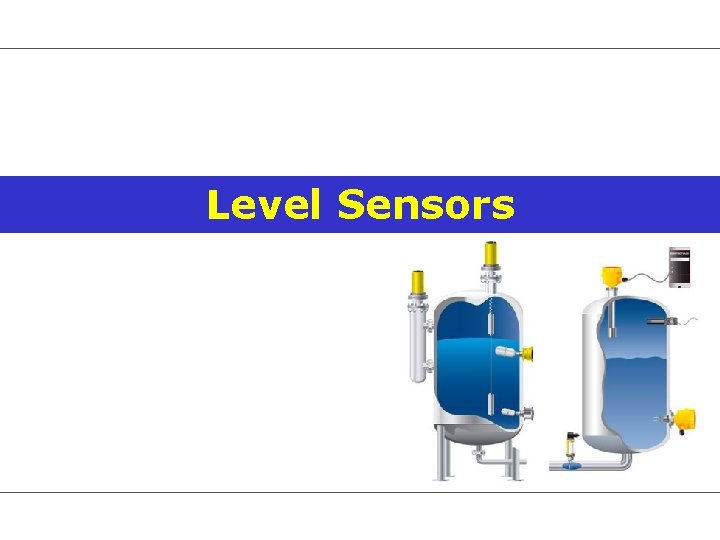
Level Sensors
Level Measurement Level is another common process variable that is measured in many industries. The method used will vary widely depending on the nature of the industry, the process, and the application. Inventory: -- a constant supply or storage of material Control: -- continuous, batch, blending, and mixing control -- stabilize flow to the next process Alarming: -- hi/lo limits, safety shut down Data Logging: -- material quantities for inventory and billing purposes and where regulatory requirements are necessary
What is measured? The measured medium can be liquid, gas or solid and stored in vessels (open/closed tanks), silos, bins and hoppers. Units of level can be expressed in: } feet (meters) } gallons (liters) } pounds (kilograms) } cubic volume (ft 3, m 3)
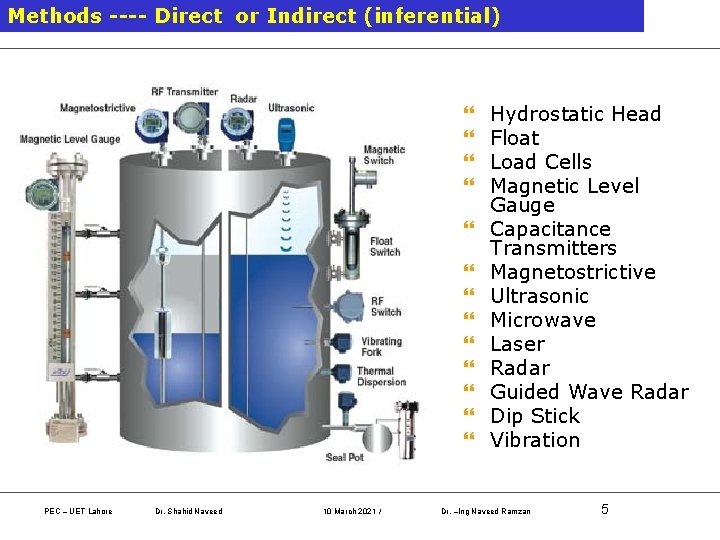
Methods ---- Direct or Indirect (inferential) } } } } PEC – UET Lahore Dr. Shahid Naveed 10 March 2021 / Hydrostatic Head Float Load Cells Magnetic Level Gauge Capacitance Transmitters Magnetostrictive Ultrasonic Microwave Laser Radar Guided Wave Radar Dip Stick Vibration Dr. –Ing Naveed Ramzan 5
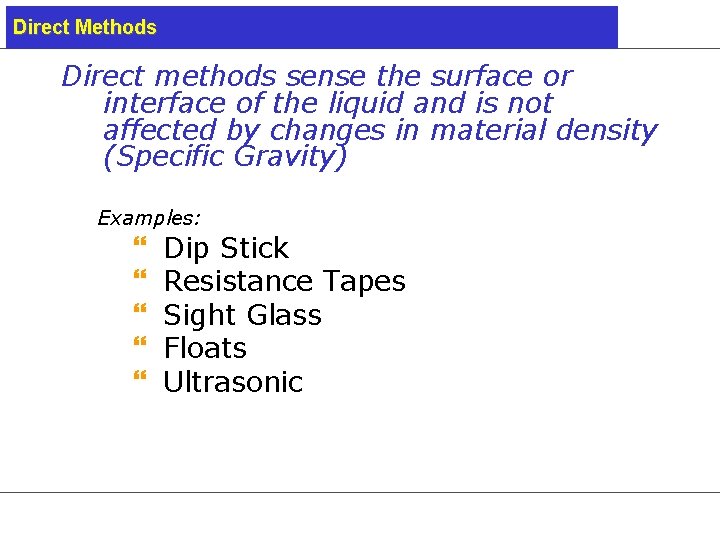
Direct Methods Direct methods sense the surface or interface of the liquid and is not affected by changes in material density (Specific Gravity) Examples: } } } Dip Stick Resistance Tapes Sight Glass Floats Ultrasonic
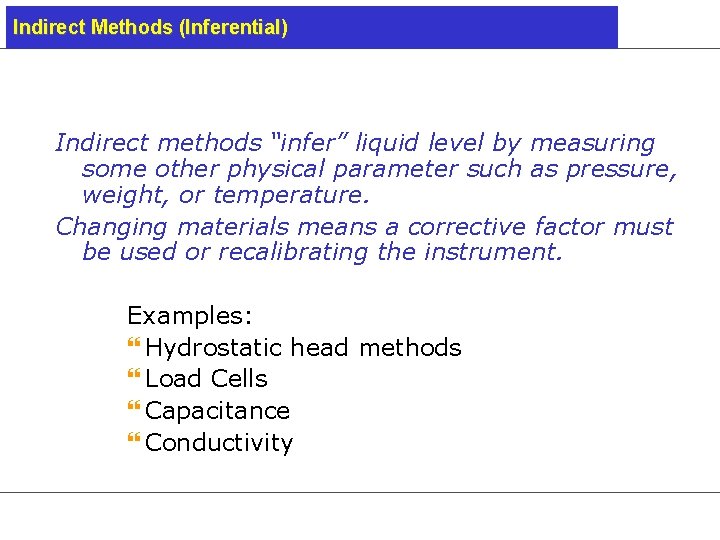
Indirect Methods (Inferential) Indirect methods “infer” liquid level by measuring some other physical parameter such as pressure, weight, or temperature. Changing materials means a corrective factor must be used or recalibrating the instrument. Examples: } Hydrostatic head methods } Load Cells } Capacitance } Conductivity
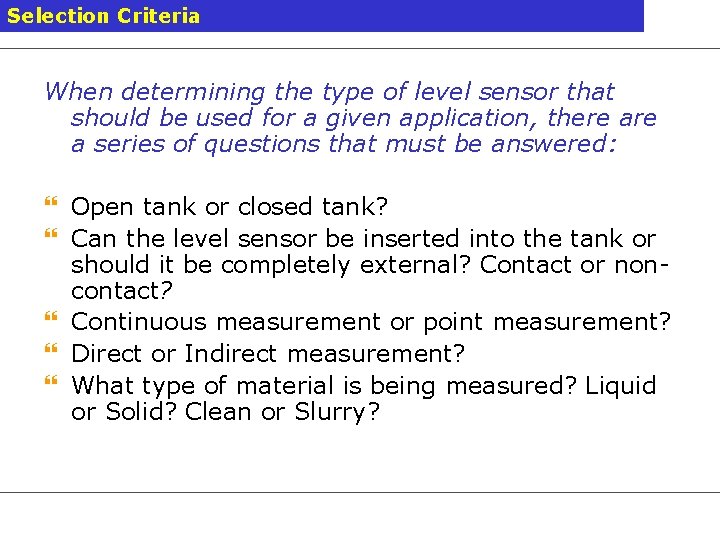
Selection Criteria When determining the type of level sensor that should be used for a given application, there a series of questions that must be answered: } Open tank or closed tank? } Can the level sensor be inserted into the tank or should it be completely external? Contact or noncontact? } Continuous measurement or point measurement? } Direct or Indirect measurement? } What type of material is being measured? Liquid or Solid? Clean or Slurry?
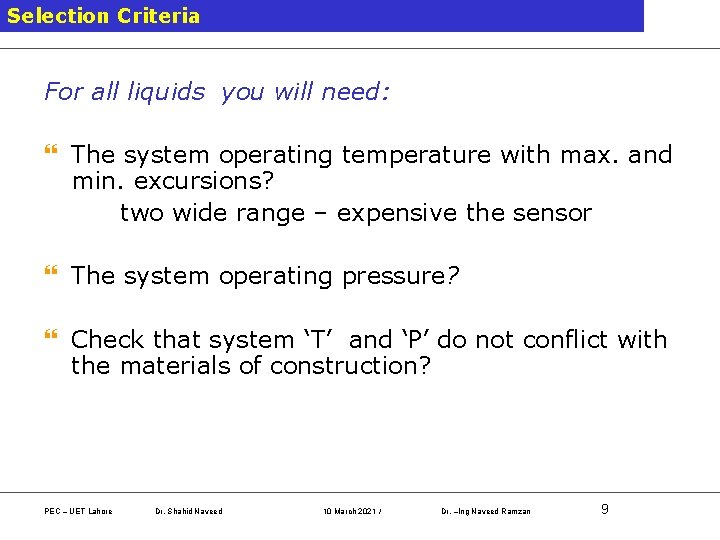
Selection Criteria For all liquids you will need: } The system operating temperature with max. and min. excursions? two wide range – expensive the sensor } The system operating pressure? } Check that system ‘T’ and ‘P’ do not conflict with the materials of construction? PEC – UET Lahore Dr. Shahid Naveed 10 March 2021 / Dr. –Ing Naveed Ramzan 9
Selection Criteria For Solids: } Bulk density Be careful with very large silos as compaction at the bottom can greatly change assume bulk densities } Flow characteristics? } Expected particle size distribution? } Is solid abrasive and/or corrosive and what is the moisture/solvent content? PEC – UET Lahore Dr. Shahid Naveed 10 March 2021 / Dr. –Ing Naveed Ramzan 10
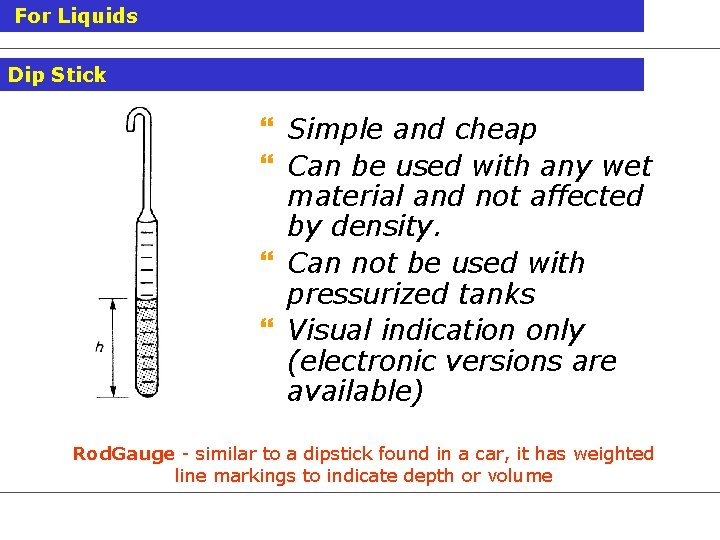
For Liquids Dip Stick } Simple and cheap } Can be used with any wet material and not affected by density. } Can not be used with pressurized tanks } Visual indication only (electronic versions are available) Rod. Gauge - similar to a dipstick found in a car, it has weighted line markings to indicate depth or volume
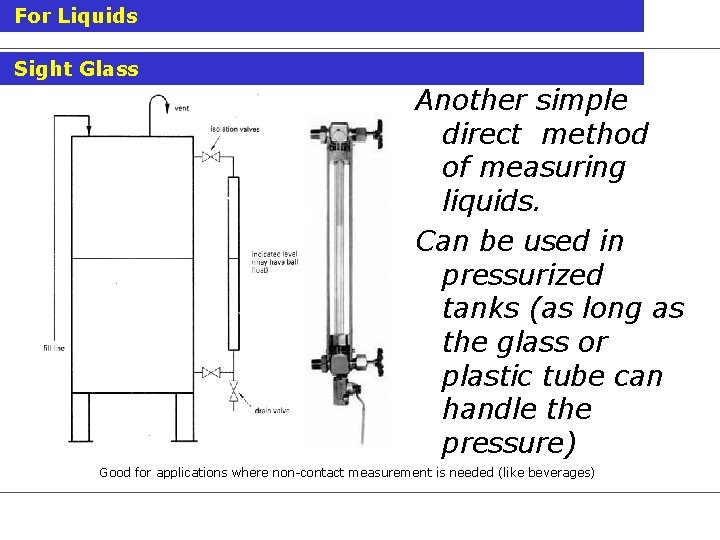
For Liquids Sight Glass Another simple direct method of measuring liquids. Can be used in pressurized tanks (as long as the glass or plastic tube can handle the pressure) Good for applications where non-contact measurement is needed (like beverages)
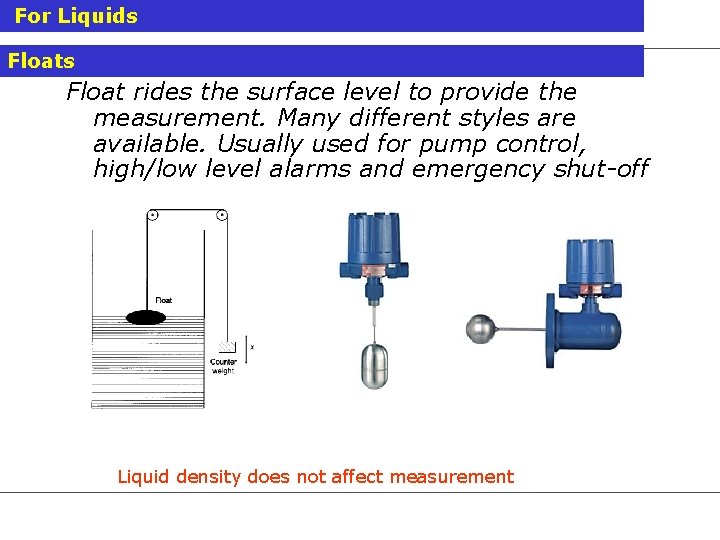
For Liquids Float rides the surface level to provide the measurement. Many different styles are available. Usually used for pump control, high/low level alarms and emergency shut-off Liquid density does not affect measurement
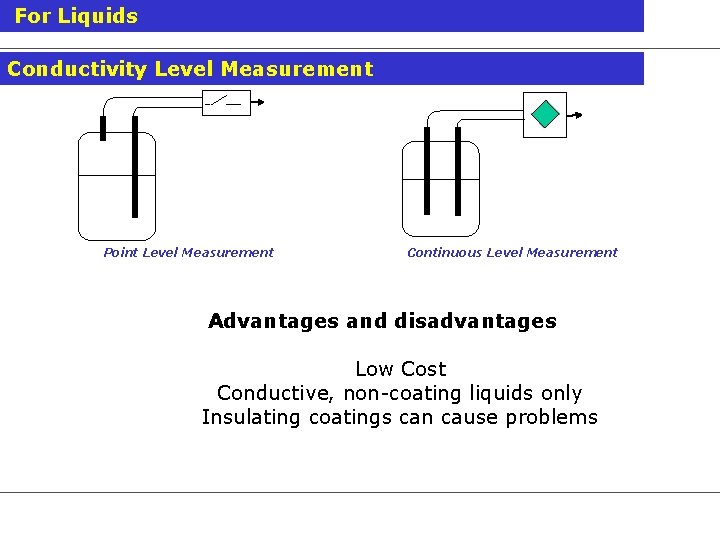
For Liquids Conductivity Level Measurement Point Level Measurement Continuous Level Measurement Advantages and disadvantages Low Cost Conductive, non-coating liquids only Insulating coatings can cause problems
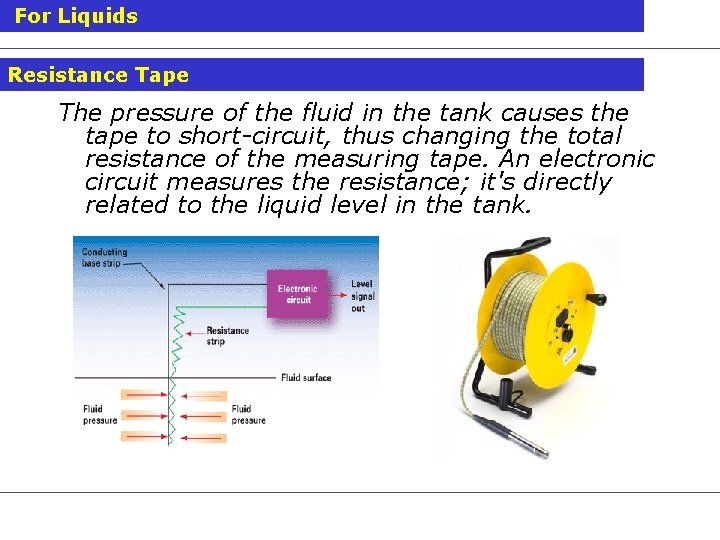
For Liquids Resistance Tape The pressure of the fluid in the tank causes the tape to short-circuit, thus changing the total resistance of the measuring tape. An electronic circuit measures the resistance; it's directly related to the liquid level in the tank.
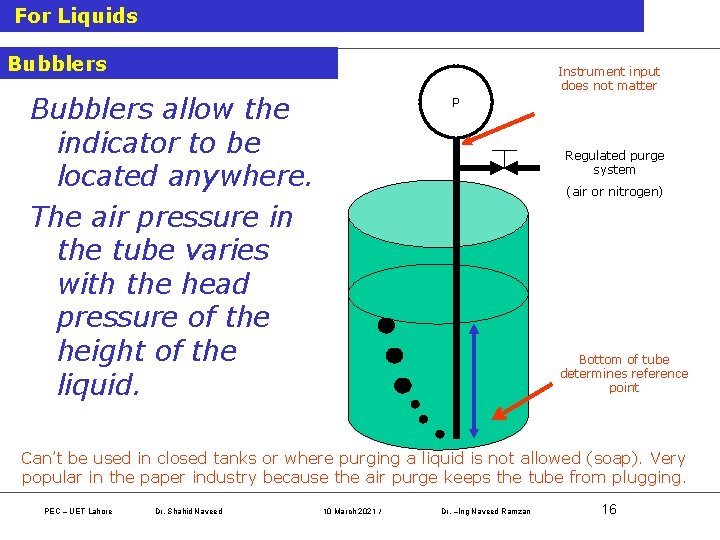
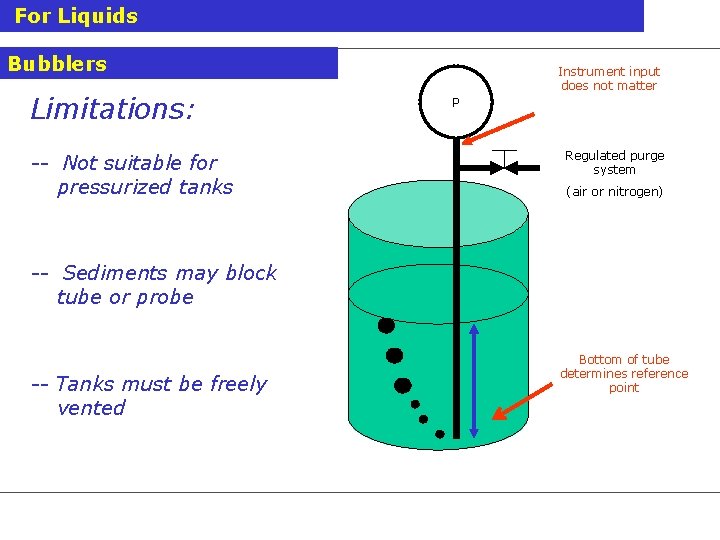
For Liquids Bubblers Instrument input does not matter Bubblers allow the indicator to be located anywhere. The air pressure in the tube varies with the head pressure of the height of the liquid. P Regulated purge system (air or nitrogen) Bottom of tube determines reference point Can’t be used in closed tanks or where purging a liquid is not allowed (soap). Very popular in the paper industry because the air purge keeps the tube from plugging. PEC – UET Lahore Dr. Shahid Naveed 10 March 2021 / Dr. –Ing Naveed Ramzan 16
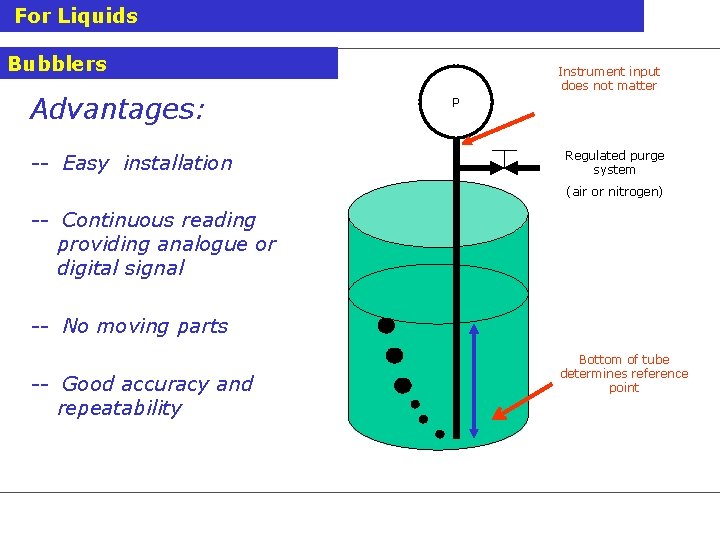
For Liquids Bubblers Advantages: -- Easy installation Instrument input does not matter P Regulated purge system (air or nitrogen) -- Continuous reading providing analogue or digital signal -- No moving parts -- Good accuracy and repeatability Bottom of tube determines reference point
For Liquids Bubblers Limitations: -- Not suitable for pressurized tanks Instrument input does not matter P Regulated purge system (air or nitrogen) -- Sediments may block tube or probe -- Tanks must be freely vented Bottom of tube determines reference point
Hydrostatic Head Level Sensors } These methods infer level by measuring the hydrostatic head produced by the liquid column. } A pressure sensing element is installed at the bottom of the tank and pressure is converted to level. } Different liquid densities or closed tank applications must be accounted for.
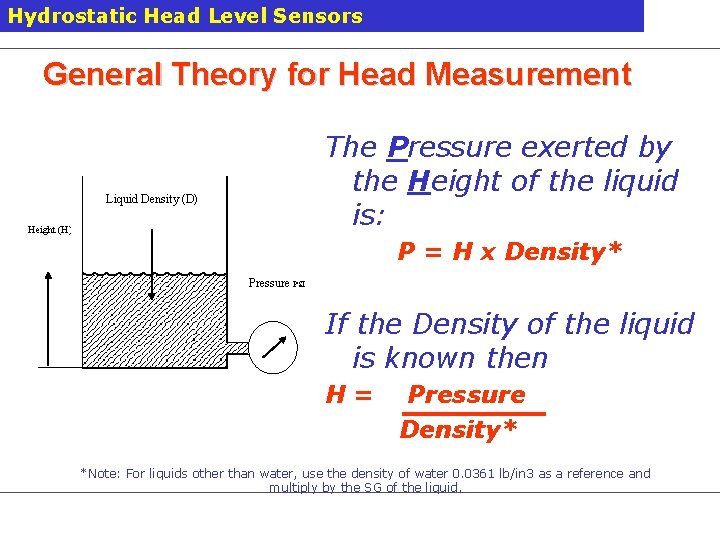
Hydrostatic Head Level Sensors General Theory for Head Measurement The Pressure exerted by the Height of the liquid is: Liquid Density (D) Height (H) P = H x Density* Pressure PSI If the Density of the liquid is known then H= Pressure Density* *Note: For liquids other than water, use the density of water 0. 0361 lb/in 3 as a reference and multiply by the SG of the liquid.
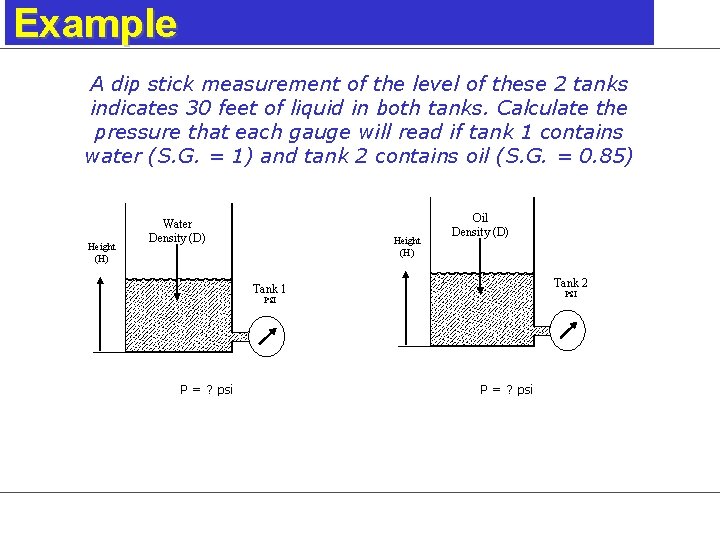
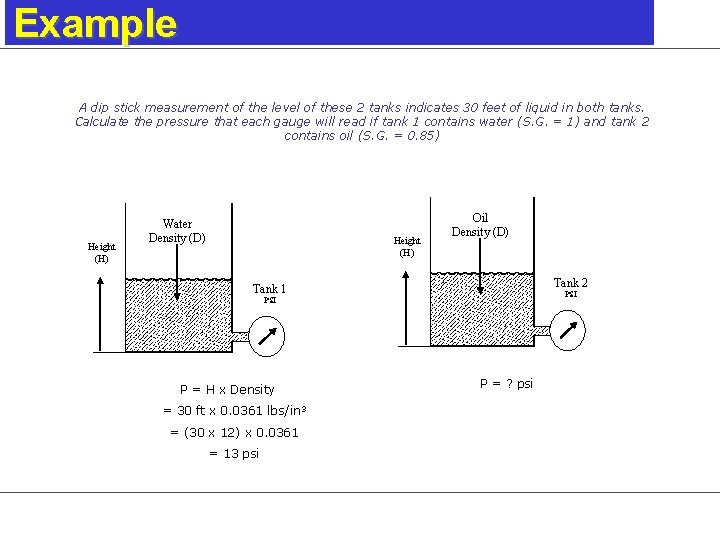
Example A dip stick measurement of the level of these 2 tanks indicates 30 feet of liquid in both tanks. Calculate the pressure that each gauge will read if tank 1 contains water (S. G. = 1) and tank 2 contains oil (S. G. = 0. 85) Height (H) Water Density (D) Height (H) Oil Density (D) Tank 2 Tank 1 PSI P = ? psi
Example A dip stick measurement of the level of these 2 tanks indicates 30 feet of liquid in both tanks. Calculate the pressure that each gauge will read if tank 1 contains water (S. G. = 1) and tank 2 contains oil (S. G. = 0. 85) Height (H) Water Density (D) Height (H) Oil Density (D) Tank 2 Tank 1 PSI P = H x Density = 30 ft x 0. 0361 lbs/in 3 = (30 x 12) x 0. 0361 = 13 psi P = ? psi
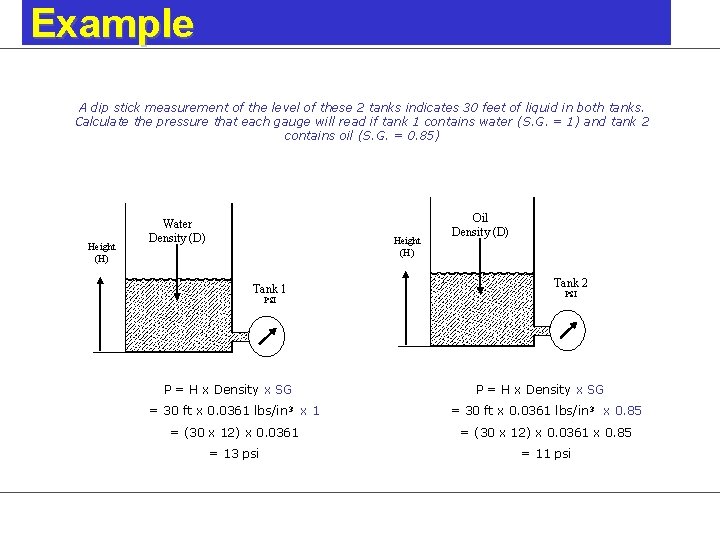
Example A dip stick measurement of the level of these 2 tanks indicates 30 feet of liquid in both tanks. Calculate the pressure that each gauge will read if tank 1 contains water (S. G. = 1) and tank 2 contains oil (S. G. = 0. 85) Height (H) Water Density (D) Height (H) Tank 1 PSI P = H x Density x SG Oil Density (D) Tank 2 PSI P = H x Density x SG = 30 ft x 0. 0361 lbs/in 3 x 1 = 30 ft x 0. 0361 lbs/in 3 x 0. 85 = (30 x 12) x 0. 0361 x 0. 85 = 13 psi = 11 psi
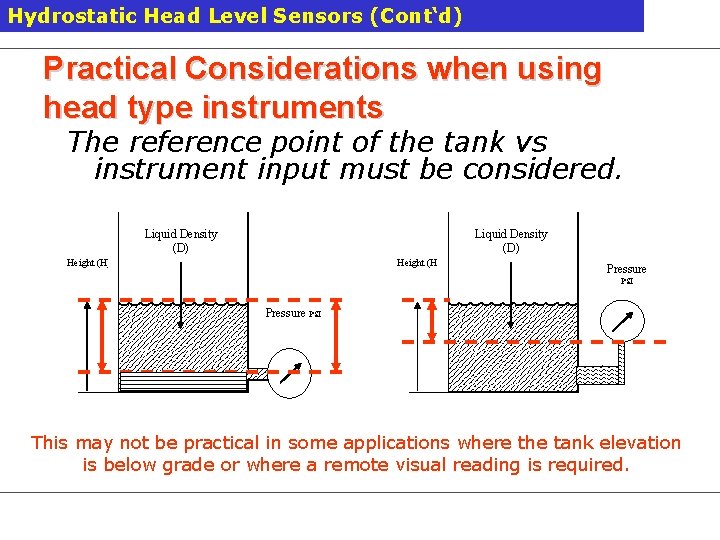
Hydrostatic Head Level Sensors (Cont‘d) Practical Considerations when using head type instruments The reference point of the tank vs instrument input must be considered. Liquid Density (D) Height (H) Pressure PSI This may not be practical in some applications where the tank elevation is below grade or where a remote visual reading is required.
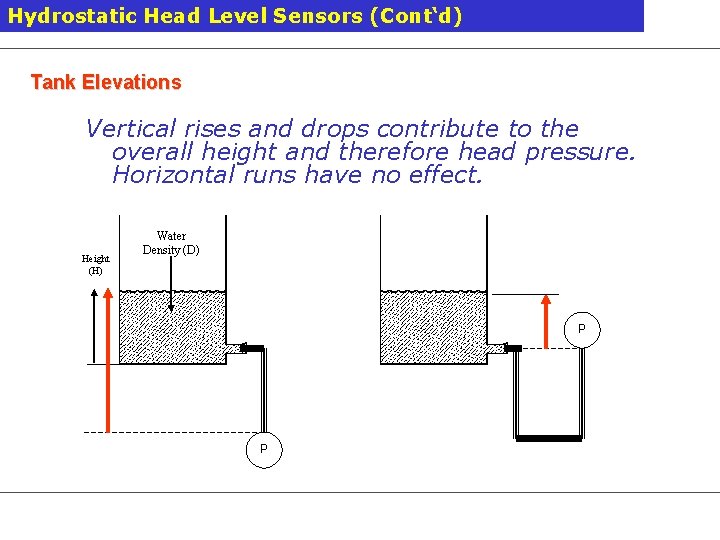
Hydrostatic Head Level Sensors (Cont‘d) Tank Elevations Vertical rises and drops contribute to the overall height and therefore head pressure. Horizontal runs have no effect. Height (H) Water Density (D) P P
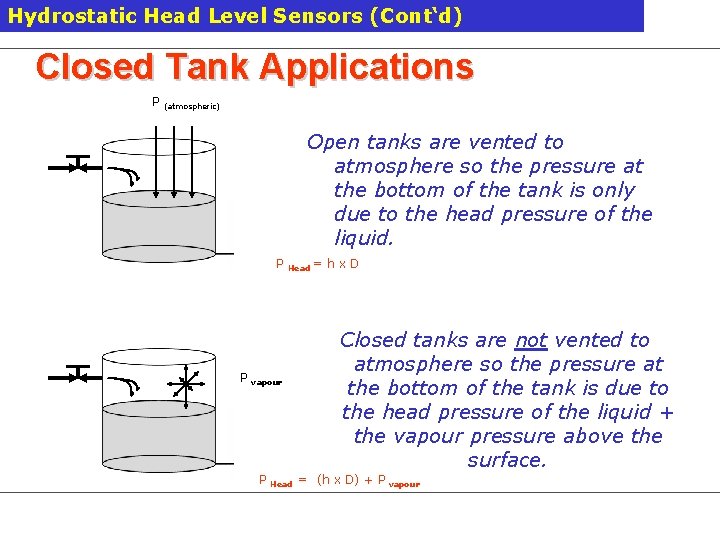
Hydrostatic Head Level Sensors (Cont‘d) Closed Tank Applications P (atmospheric) Open tanks are vented to atmosphere so the pressure at the bottom of the tank is only due to the head pressure of the liquid. P P Head vapour P Head =hx. D Closed tanks are not vented to atmosphere so the pressure at the bottom of the tank is due to the head pressure of the liquid + the vapour pressure above the surface. = (h x D) + P vapour
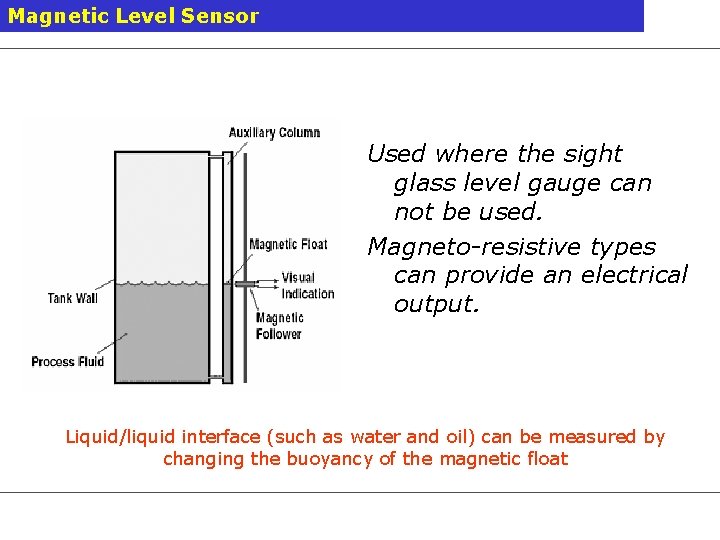
Magnetic Level Sensor Used where the sight glass level gauge can not be used. Magneto-resistive types can provide an electrical output. Liquid/liquid interface (such as water and oil) can be measured by changing the buoyancy of the magnetic float
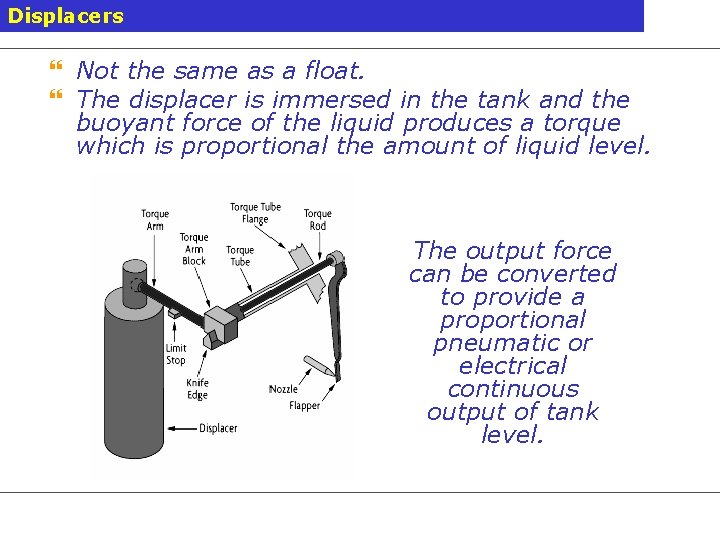
Displacers } Not the same as a float. } The displacer is immersed in the tank and the buoyant force of the liquid produces a torque which is proportional the amount of liquid level. The output force can be converted to provide a proportional pneumatic or electrical continuous output of tank level.
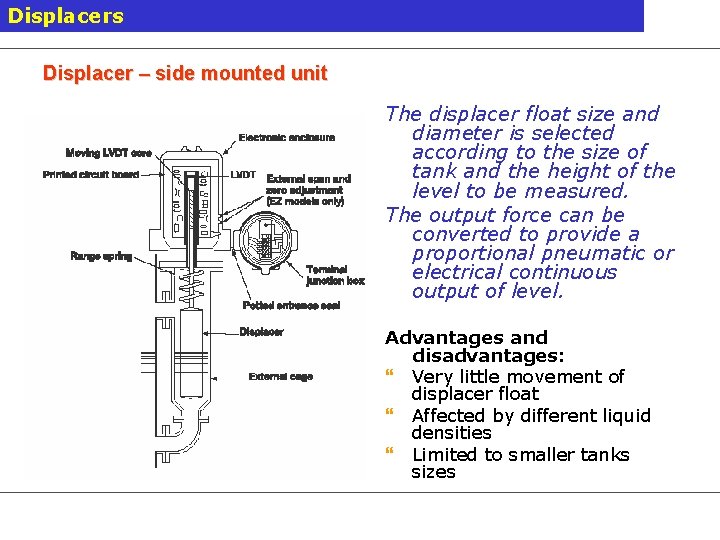
Displacers Displacer – side mounted unit The displacer float size and diameter is selected according to the size of tank and the height of the level to be measured. The output force can be converted to provide a proportional pneumatic or electrical continuous output of level. Advantages and disadvantages: } Very little movement of displacer float } Affected by different liquid densities } Limited to smaller tanks sizes
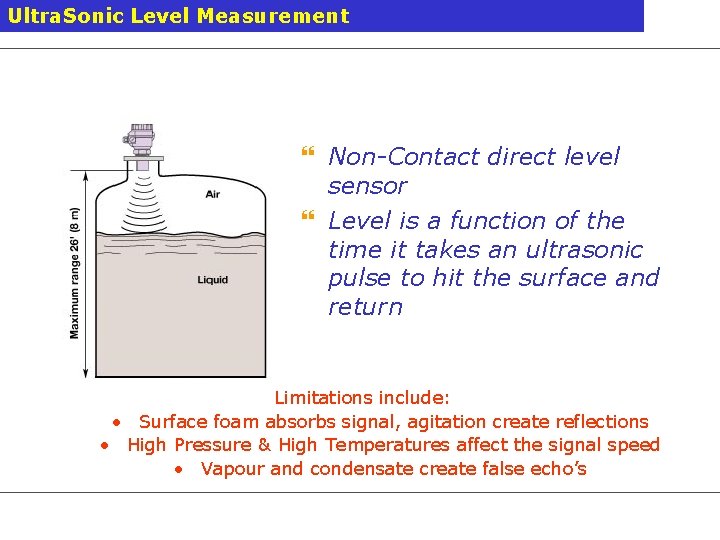
Ultra. Sonic Level Measurement } Non-Contact direct level sensor } Level is a function of the time it takes an ultrasonic pulse to hit the surface and return Limitations include: • Surface foam absorbs signal, agitation create reflections • High Pressure & High Temperatures affect the signal speed • Vapour and condensate create false echo’s
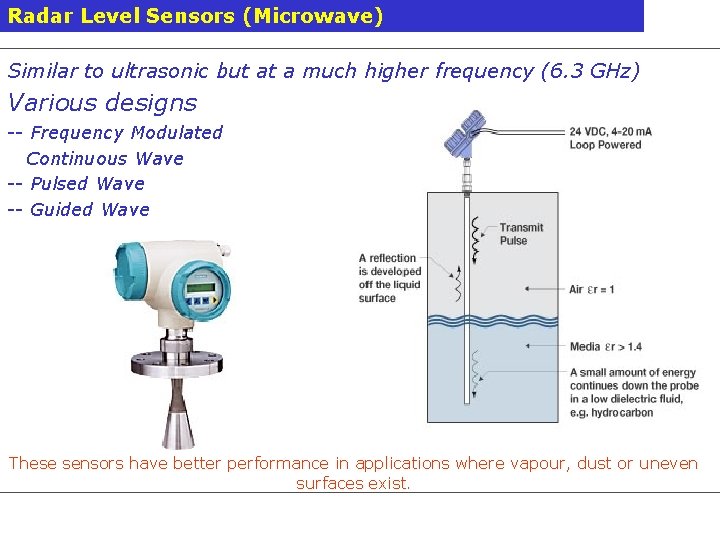
Radar Level Sensors (Microwave) Similar to ultrasonic but at a much higher frequency (6. 3 GHz) Various designs -- Frequency Modulated Continuous Wave -- Pulsed Wave -- Guided Wave These sensors have better performance in applications where vapour, dust or uneven surfaces exist.
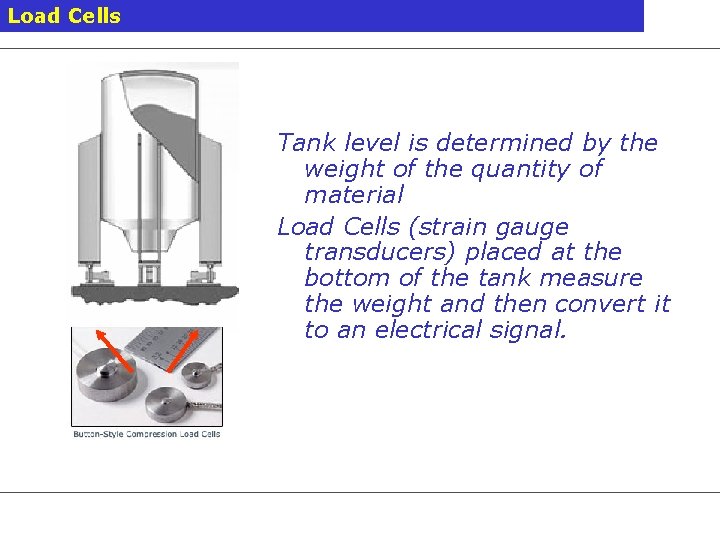
Load Cells Tank level is determined by the weight of the quantity of material Load Cells (strain gauge transducers) placed at the bottom of the tank measure the weight and then convert it to an electrical signal.
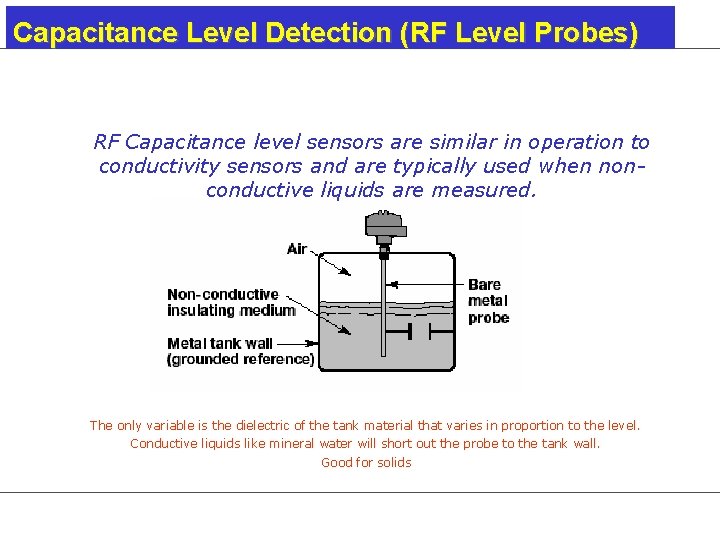
Capacitance Level Detection (RF Level Probes) RF Capacitance level sensors are similar in operation to conductivity sensors and are typically used when nonconductive liquids are measured. The only variable is the dielectric of the tank material that varies in proportion to the level. Conductive liquids like mineral water will short out the probe to the tank wall. Good for solids
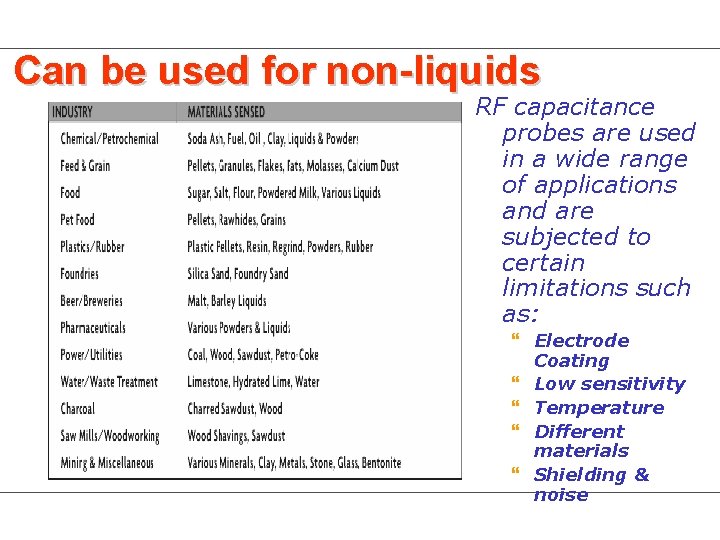
Can be used for non-liquids RF capacitance probes are used in a wide range of applications and are subjected to certain limitations such as: } Electrode Coating } Low sensitivity } Temperature } Different materials } Shielding & noise
Summary • Level is measured by locating the boundary between two media, called the interface • Level can be measured directly or indirectly • Noninvasive devices are preferred when the material is corrosive, hazardous, sterile, or at a high temperature or pressure
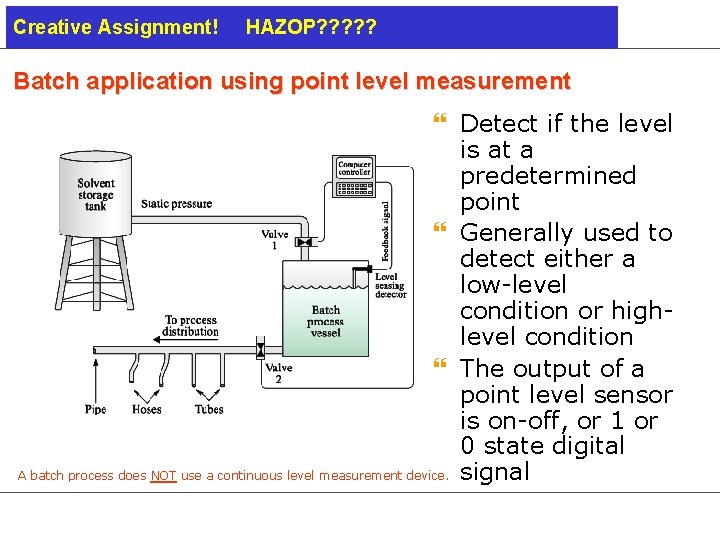
Creative Assignment! HAZOP? ? ? Batch application using point level measurement } Detect if the level is at a predetermined point } Generally used to detect either a low-level condition or highlevel condition } The output of a point level sensor is on-off, or 1 or 0 state digital A batch process does NOT use a continuous level measurement device. signal
Discussion & Questions?