
The Childrens Hospital Institute of Child Health Lahore

- Slides: 35
The Children’s Hospital & Institute of Child Health, Lahore CLINICAL PHARMACY SERVICES AT A PUBLIC SECTOR HOSPITAL Zaufishan Rahman
The Children Hospital & Institute of Child Health State of the art - Tertiary care hospital Centre of Excellence 45 different specialties in medicine, surgery and diagnostics 418 beds strength The hospital OPD operationalized in May 1995 and emergency in October 1996 In-patient services were first initiated in December 1998
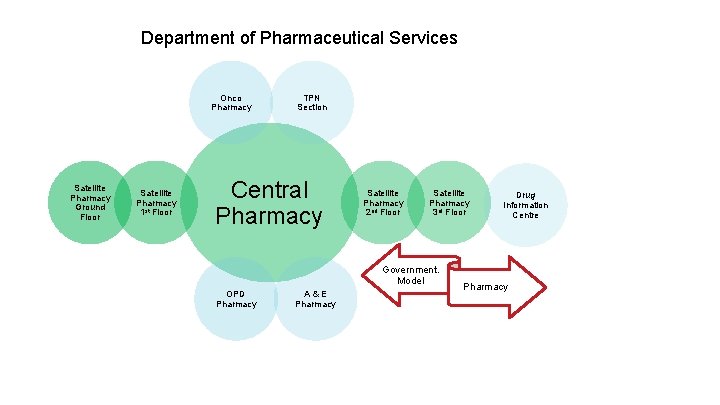
Department of Pharmaceutical Services Onco Pharmacy Satellite Pharmacy Ground Floor Satellite Pharmacy 1 st Floor TPN Section Central Pharmacy Satellite Pharmacy 2 nd Floor Satellite Pharmacy 3 rd Floor Government. Model OPD Pharmacy A&E Pharmacy Drug Information Centre Pharmacy
How the Pharmacy Services are different today? In changing times…. a need for pharmacists to shift their focus a need to target outcomes that matters a need to take responsibility for outcomes . . thereby, a need to provide patient centered care
Patient Centered Care Pharmaceutical care is: “The cooperative and responsible provision of drug therapy for the purpose of achieving definite outcomes that improve the patient’s quality of life”
PHARMACEUTICAL CARE PLANS
Key elements Drug Individualization � Monitoring of Drug Interactions � All pediatric patients need weight based dosing; hence at increased risk of adverse events Monitoring of In-Vitro and In-vivo drug interactions Monitoring and Reporting of potential ADRs
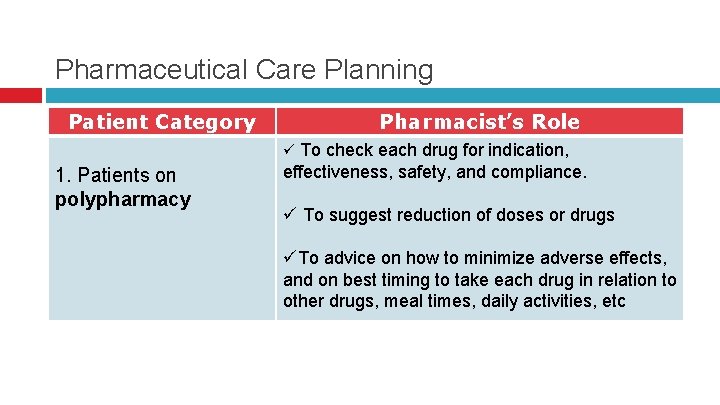
Pharmaceutical Care Planning Patient Category Pharmacist’s Role ü To check each drug for indication, 1. Patients on polypharmacy effectiveness, safety, and compliance. ü To suggest reduction of doses or drugs üTo advice on how to minimize adverse effects, and on best timing to take each drug in relation to other drugs, meal times, daily activities, etc
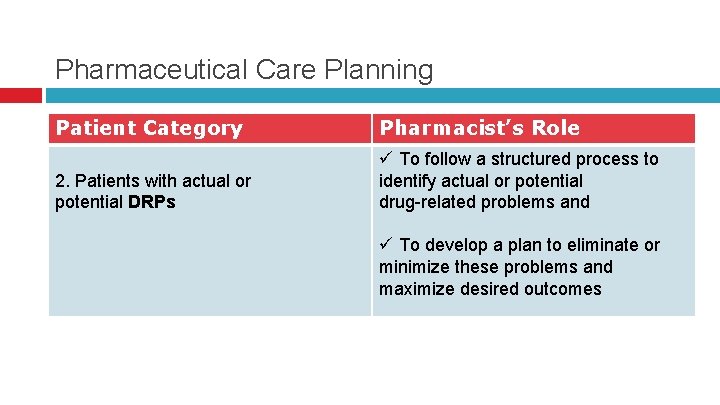
Pharmaceutical Care Planning Patient Category Pharmacist’s Role 2. Patients with actual or potential DRPs ü To follow a structured process to identify actual or potential drug-related problems and ü To develop a plan to eliminate or minimize these problems and maximize desired outcomes
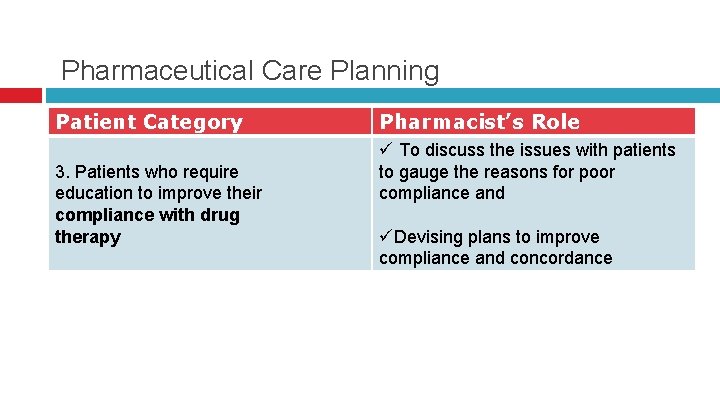
Pharmaceutical Care Planning Patient Category 3. Patients who require education to improve their compliance with drug therapy Pharmacist’s Role ü To discuss the issues with patients to gauge the reasons for poor compliance and üDevising plans to improve compliance and concordance
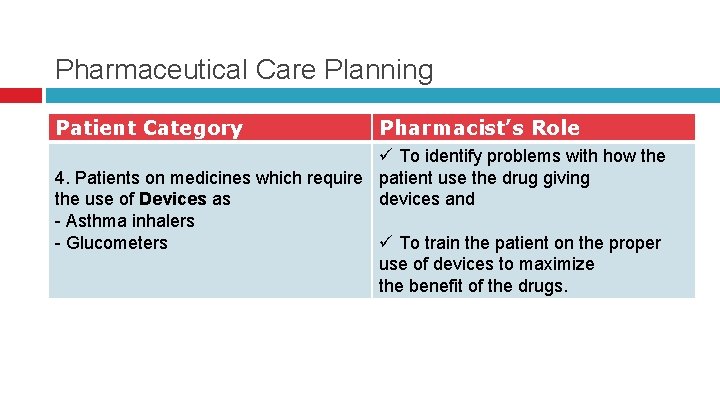
Pharmaceutical Care Planning Patient Category Pharmacist’s Role ü To identify problems with how the 4. Patients on medicines which require patient use the drug giving the use of Devices as devices and - Asthma inhalers ü To train the patient on the proper - Glucometers use of devices to maximize the benefit of the drugs.
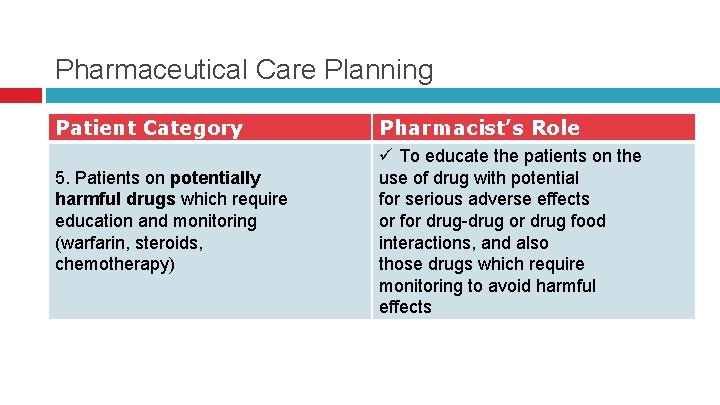
Pharmaceutical Care Planning Patient Category 5. Patients on potentially harmful drugs which require education and monitoring (warfarin, steroids, chemotherapy) Pharmacist’s Role ü To educate the patients on the use of drug with potential for serious adverse effects or for drug-drug or drug food interactions, and also those drugs which require monitoring to avoid harmful effects
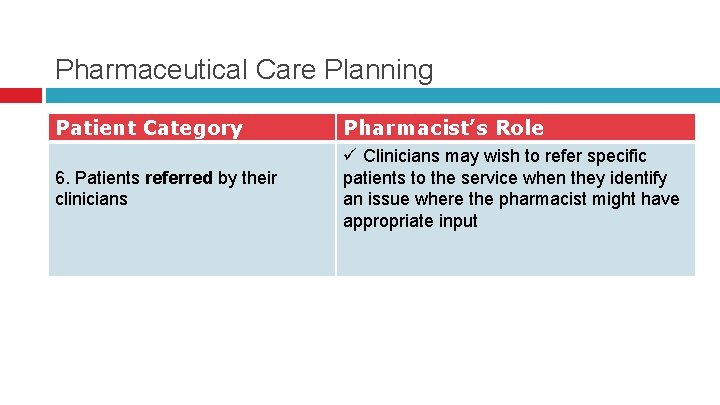
Pharmaceutical Care Planning Patient Category Pharmacist’s Role 6. Patients referred by their clinicians ü Clinicians may wish to refer specific patients to the service when they identify an issue where the pharmacist might have appropriate input
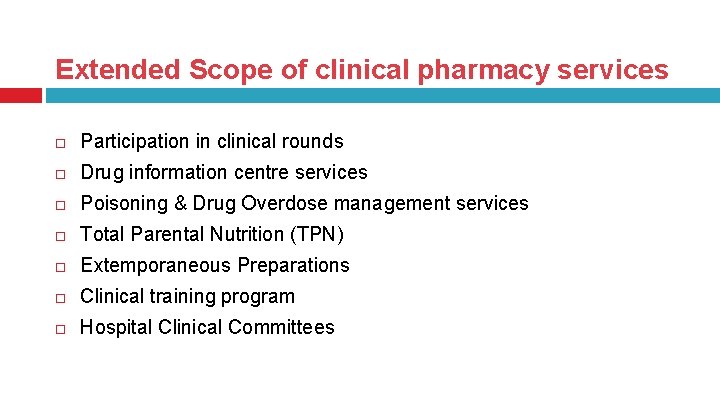
Extended Scope of clinical pharmacy services Participation in clinical rounds Drug information centre services Poisoning & Drug Overdose management services Total Parental Nutrition (TPN) Extemporaneous Preparations Clinical training program Hospital Clinical Committees
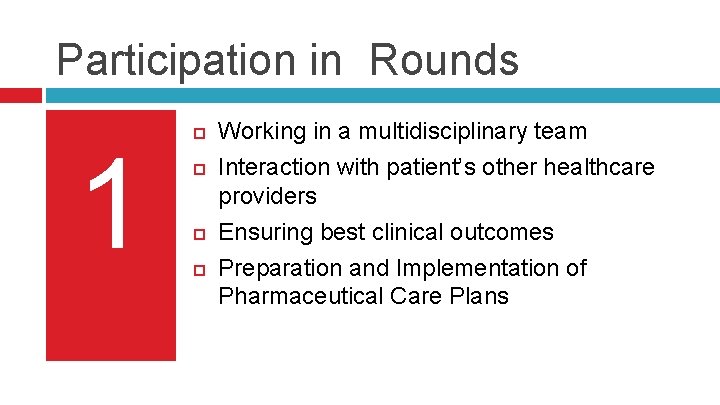
Participation in Rounds 1 Working in a multidisciplinary team Interaction with patient’s other healthcare providers Ensuring best clinical outcomes Preparation and Implementation of Pharmaceutical Care Plans
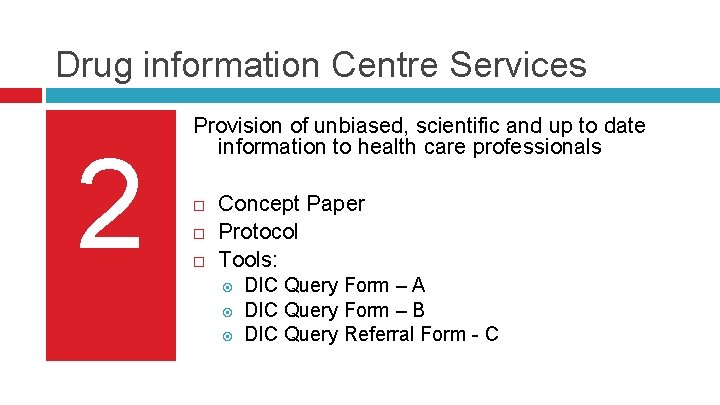
Drug information Centre Services 2 Provision of unbiased, scientific and up to date information to health care professionals Concept Paper Protocol Tools: DIC Query Form – A DIC Query Form – B DIC Query Referral Form - C
Clinical Pharmacist as Information Manger: …. …. Assessing the Evidence Where and When you need it! Developing Liaison with other Drug Information Centres and creating a network of knowledge banks, nationally & globally.
Poisoning & Drug Overdose Management 3 24/7 Presence of Pharmacist in Emergency Department Availability of antidotes Backup support from Drug Information Centre Examples: Management of Kerosine oil poisoning Management of patient who has ingested milk with a lizard
Total Parental Nutrition (TPN) 4 First of its kind in any public sector hospital in Punjab Caters individual needs of patients Plays a significant role in reducing the morbidity and improving the quality of life of patients Ensuring aseptic environment with use of Laminar Flow Hoods Provision of services to other hospitals
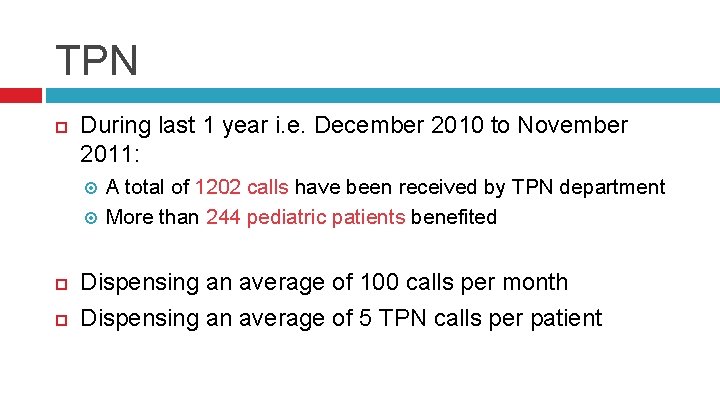
TPN During last 1 year i. e. December 2010 to November 2011: A total of 1202 calls have been received by TPN department More than 244 pediatric patients benefited Dispensing an average of 100 calls per month Dispensing an average of 5 TPN calls per patient
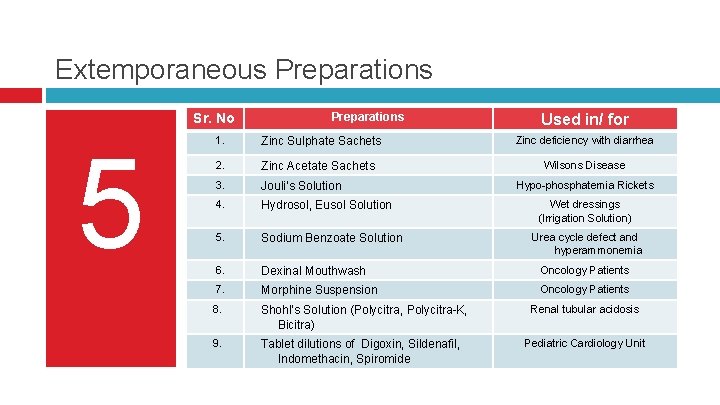
Extemporaneous Preparations Sr. No 5 Preparations Used in/ for 1. Zinc Sulphate Sachets Zinc deficiency with diarrhea 2. Zinc Acetate Sachets 3. Jouli’s Solution 4. Hydrosol, Eusol Solution 5. Sodium Benzoate Solution 6. Dexinal Mouthwash Oncology Patients 7. Morphine Suspension Oncology Patients 8. Shohl’s Solution (Polycitra, Polycitra-K, Bicitra) 9. Tablet dilutions of Digoxin, Sildenafil, Indomethacin, Spiromide Wilsons Disease Hypo-phosphatemia Rickets Wet dressings (Irrigation Solution) Urea cycle defect and hyperammonemia Renal tubular acidosis Pediatric Cardiology Unit
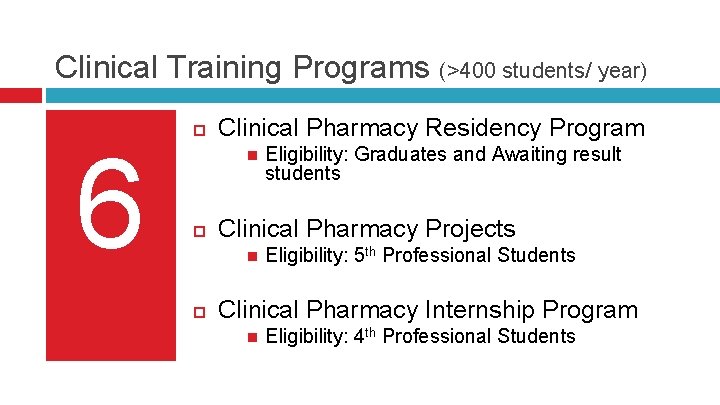
Clinical Training Programs (>400 students/ year) 6 Clinical Pharmacy Residency Program Clinical Pharmacy Projects Eligibility: Graduates and Awaiting result students Eligibility: 5 th Professional Students Clinical Pharmacy Internship Program Eligibility: 4 th Professional Students
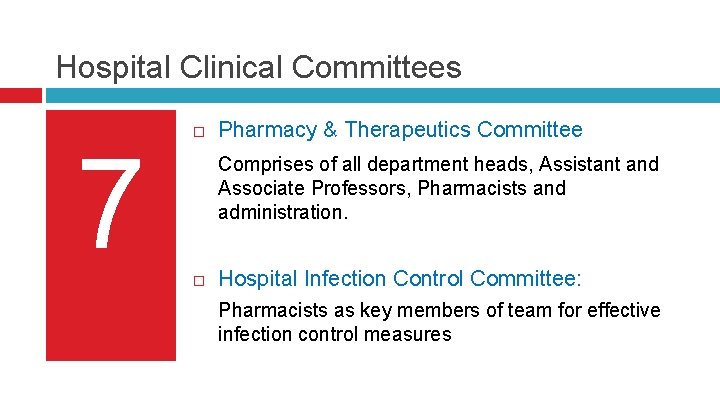
Hospital Clinical Committees 7 Pharmacy & Therapeutics Committee Comprises of all department heads, Assistant and Associate Professors, Pharmacists and administration. Hospital Infection Control Committee: Pharmacists as key members of team for effective infection control measures
“… and if anyone saved a life; it would be as if he saved the life of whole mankind” CASE SCENARIOS Clinical Pharmacy Services
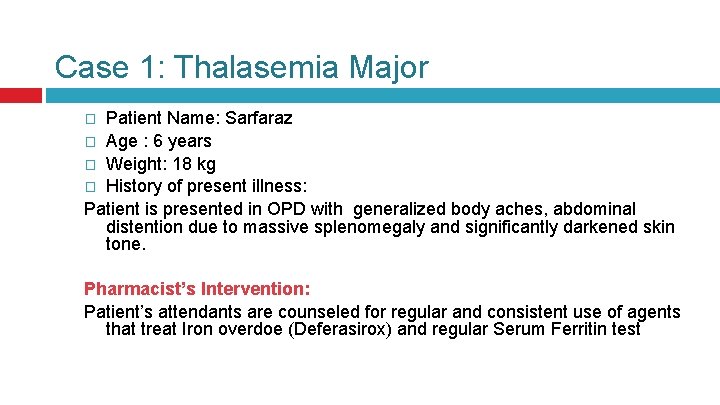
Case 1: Thalasemia Major Patient Name: Sarfaraz � Age : 6 years � Weight: 18 kg � History of present illness: Patient is presented in OPD with generalized body aches, abdominal distention due to massive splenomegaly and significantly darkened skin tone. � Pharmacist’s Intervention: Patient’s attendants are counseled for regular and consistent use of agents that treat Iron overdoe (Deferasirox) and regular Serum Ferritin test
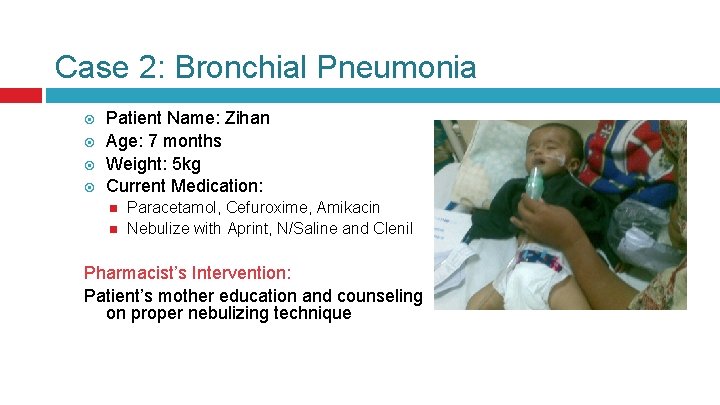
Case 2: Bronchial Pneumonia Patient Name: Zihan Age: 7 months Weight: 5 kg Current Medication: Paracetamol, Cefuroxime, Amikacin Nebulize with Aprint, N/Saline and Clenil Pharmacist’s Intervention: Patient’s mother education and counseling on proper nebulizing technique
Case 3: Pericardial Effusion Patient Name: Minahil � Age: 2 months � Weight: 3. 2 kg � Current Medication: � Inj. Ceftrioxone, Inj. Lasix, Inj. Vancomycin Pharmacist’s Intervention: Patient at increased risk of ototoxicity with combination of Ceftrioxone and Furosemide; Close monitoring is recommended after consultation with doctor
Case 4: Pneumonia and Sepsis � Patient Name: Iman Fatima � Age: 21 days � Weight: 2. 2 kg � Medication: Inj. Meropenam and Inj. Vancomycin are prescribed to patient after resistance to Ciprofloxacin, Ceftrioxone, Amikacin and Amoxicillin Pharmacist’s Intervention: � Pharmacist ensured that culture sensitivity test is done before prescribing the third line therapy. Culture was positive for Klebsella and Enterobacter � Separate administration of Ceftrioxone and Amikacin was recommended to nurse as these drugs can interact when administered together.
Case 5: Nephrotic Syndrome with Acute Renal Failure Suspected Meningococemia � � Patient Name: Abdul Malik Age: 16 months Weight: 10 kg Medication: Inj. Benzyl Penicillin, Inj. Solucortif, Inj. Ceftrioxone 500 mg IV 12 hourly, Syp Mucain 1 tsf 8 hourly, Inj Ranitidine 5 mg IV 6 hourly and others Pharmacist’s Intervention: - Dose of Ceftrioxone and Ranitidine is correct for normal patient but should be reduced to half for patient with severe renal impairment
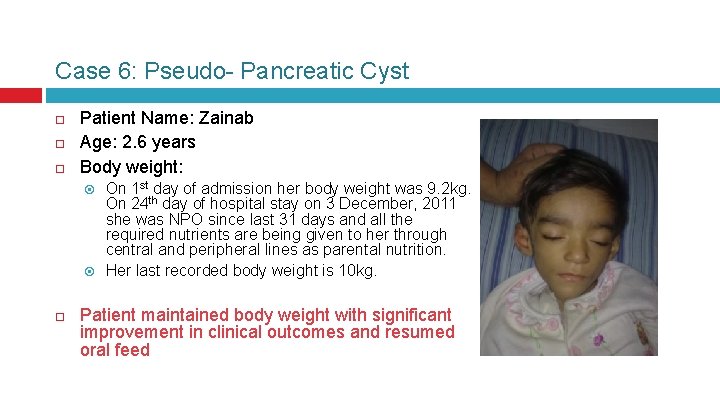
Case 6: Pseudo- Pancreatic Cyst Patient Name: Zainab Age: 2. 6 years Body weight: On 1 st day of admission her body weight was 9. 2 kg. On 24 th day of hospital stay on 3 December, 2011 she was NPO since last 31 days and all the required nutrients are being given to her through central and peripheral lines as parental nutrition. Her last recorded body weight is 10 kg. Patient maintained body weight with significant improvement in clinical outcomes and resumed oral feed
WHAT'S NEXT? Way Forward
Extension of Clinical Services Workshop on Identification of potential ADRs monitoring and reporting � Doctors, Pharmacists and Nurses Workshop on Poisoning and Drug Overdose Management Drug Utilization Reviews � � Utilization review of Meropenam – In Process Others - In design phase Impact Assessment Studies � Impact assessment study of TPN in improving quality of life of neonatal patients
Access to healthcare is a fundamental human right! “Of all forms of inequality, injustice in health care is the most shocking and inhumane” Martin Luther King, Jr
Every Single Life is Valuable…. ! UNICEF Missing Mothers a video message on maternal mortality. mp 4
THINK GLOBAL …. …. ACT LOCAL! Thankyou!