The University of Dodoma Department of Chemistry CH

- Slides: 28
The University of Dodoma Department of Chemistry CH 111: General Chemistry Lecture 12: Electrolysis Mtabazi Geofrey Sahini mtabazisahini@gmail. com, 0719116792, CNMS Office No. 225
An Overview of the Electrolytic Process • Elements which conduct electricity (e. g. metals) are not changed chemically by passage of the current. However, compounds which conduct electricity undergo chemical change during conduction. This chemical change is called electrolysis and the compounds are called electrolytes. When the current in the external circuit is switched on, 2 things occur in sequence: 1. Cathode becomes negatively charged with excess electrons from the circuit. Anode becomes positively charged because the circuit removes electrons from it. 2. CATIONS (positive ions) migrate towards the cathode while ANIONS (negative ions) migrate towards the anode.
Electrolysis • The splitting (lysing) of a substance or decomposing by forcing a current through a cell to produce a chemical change for which the cell potential is negative. • Electrolytic cell is an electrochemical cell which uses electrical energy to produce a chemical change. Electrolysis- forcing a current through a cell to bring a non spontaneous redox reaction to occur. Importance of electrolysis includes: • Extraction of metals • Refining of metals • Electroplating • Polymer synthesis and • Electro-analysis
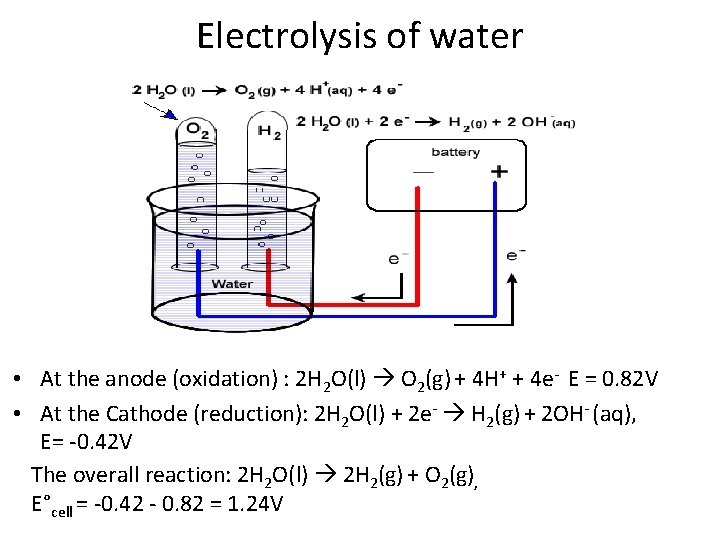
Electrolysis of water • At the anode (oxidation) : 2 H 2 O(l) O 2(g) + 4 H+ + 4 e- E = 0. 82 V • At the Cathode (reduction): 2 H 2 O(l) + 2 e- H 2(g) + 2 OH- (aq), E= -0. 42 V The overall reaction: 2 H 2 O(l) 2 H 2(g) + O 2(g), E°cell = -0. 42 - 0. 82 = 1. 24 V
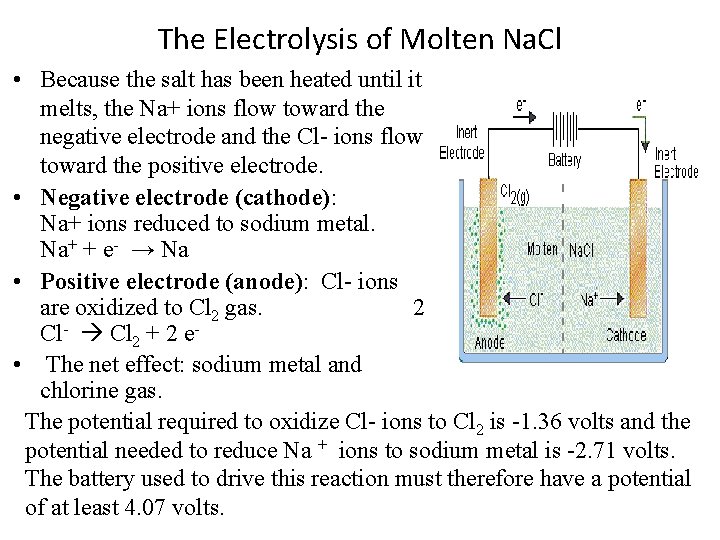
The Electrolysis of Molten Na. Cl • Because the salt has been heated until it melts, the Na+ ions flow toward the negative electrode and the Cl- ions flow toward the positive electrode. • Negative electrode (cathode): Na+ ions reduced to sodium metal. Na+ + e- → Na • Positive electrode (anode): Cl- ions are oxidized to Cl 2 gas. 2 Cl- Cl 2 + 2 e • The net effect: sodium metal and chlorine gas. The potential required to oxidize Cl- ions to Cl 2 is -1. 36 volts and the potential needed to reduce Na + ions to sodium metal is -2. 71 volts. The battery used to drive this reaction must therefore have a potential of at least 4. 07 volts.
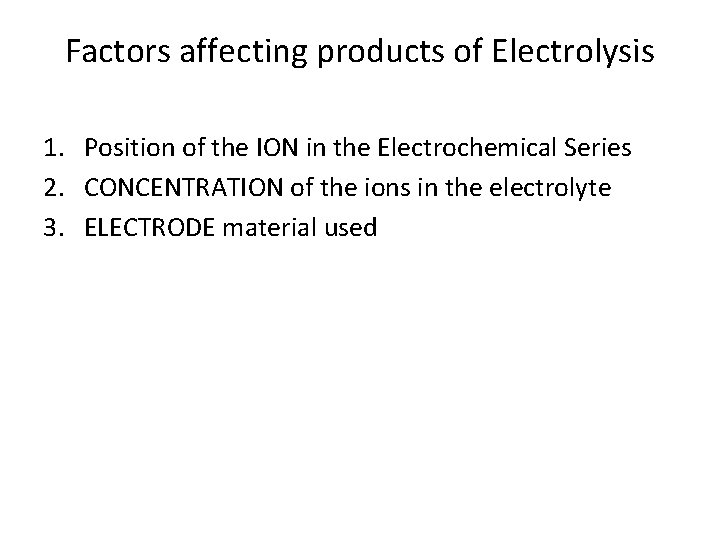
Factors affecting products of Electrolysis 1. Position of the ION in the Electrochemical Series 2. CONCENTRATION of the ions in the electrolyte 3. ELECTRODE material used
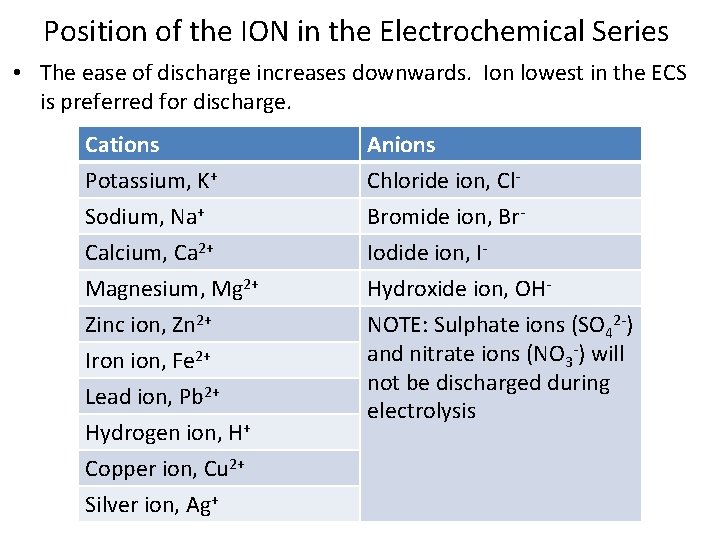
Position of the ION in the Electrochemical Series • The ease of discharge increases downwards. Ion lowest in the ECS is preferred for discharge. Cations Potassium, K+ Sodium, Na+ Calcium, Ca 2+ Anions Chloride ion, Cl. Bromide ion, Br. Iodide ion, I- Magnesium, Mg 2+ Zinc ion, Zn 2+ Iron ion, Fe 2+ Lead ion, Pb 2+ Hydrogen ion, H+ Copper ion, Cu 2+ Silver ion, Ag+ Hydroxide ion, OHNOTE: Sulphate ions (SO 42 -) and nitrate ions (NO 3 -) will not be discharged during electrolysis
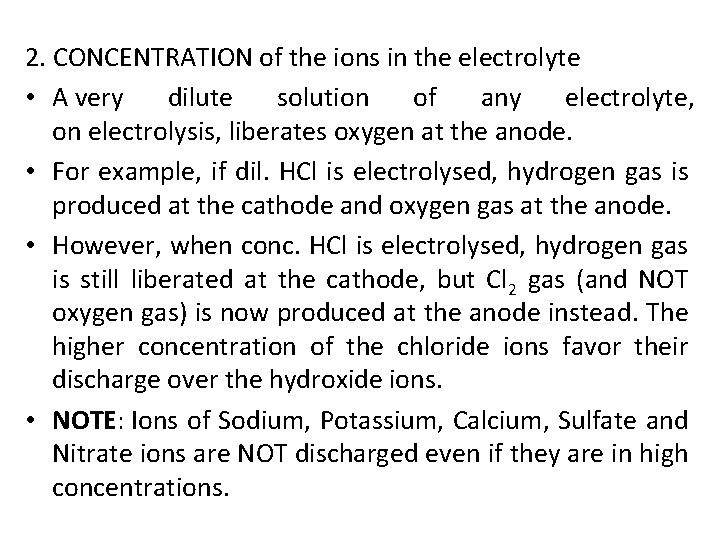
2. CONCENTRATION of the ions in the electrolyte • A very dilute solution of any electrolyte, on electrolysis, liberates oxygen at the anode. • For example, if dil. HCl is electrolysed, hydrogen gas is produced at the cathode and oxygen gas at the anode. • However, when conc. HCl is electrolysed, hydrogen gas is still liberated at the cathode, but Cl 2 gas (and NOT oxygen gas) is now produced at the anode instead. The higher concentration of the chloride ions favor their discharge over the hydroxide ions. • NOTE: Ions of Sodium, Potassium, Calcium, Sulfate and Nitrate ions are NOT discharged even if they are in high concentrations.
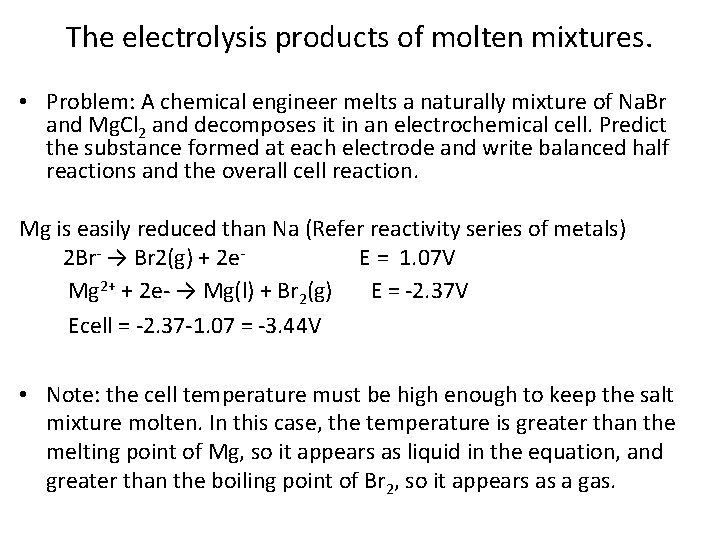
The electrolysis products of molten mixtures. • Problem: A chemical engineer melts a naturally mixture of Na. Br and Mg. Cl 2 and decomposes it in an electrochemical cell. Predict the substance formed at each electrode and write balanced half reactions and the overall cell reaction. Mg is easily reduced than Na (Refer reactivity series of metals) 2 Br- → Br 2(g) + 2 e- E = 1. 07 V Mg 2+ + 2 e- → Mg(l) + Br 2(g) E = -2. 37 V Ecell = -2. 37 -1. 07 = -3. 44 V • Note: the cell temperature must be high enough to keep the salt mixture molten. In this case, the temperature is greater than the melting point of Mg, so it appears as liquid in the equation, and greater than the boiling point of Br 2, so it appears as a gas.
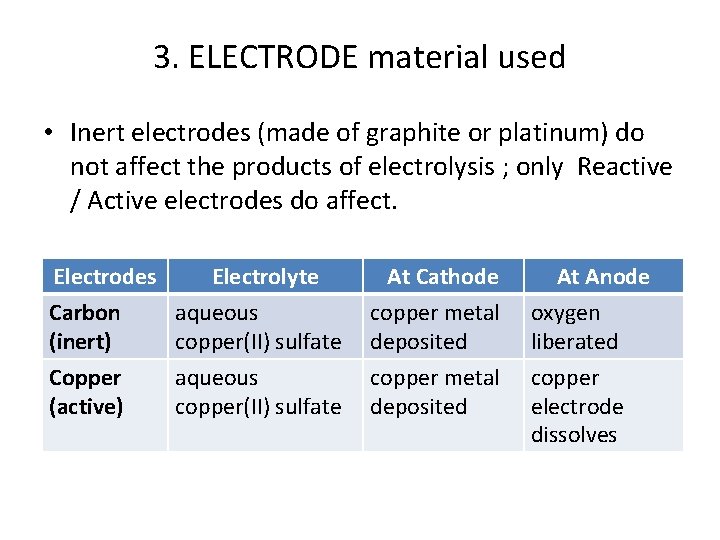
3. ELECTRODE material used • Inert electrodes (made of graphite or platinum) do not affect the products of electrolysis ; only Reactive / Active electrodes do affect. Electrodes Electrolyte Carbon aqueous (inert) copper(II) sulfate At Cathode copper metal deposited At Anode oxygen liberated Copper (active) copper metal deposited copper electrode dissolves aqueous copper(II) sulfate
Electrolysis of aqueous sodium chloride • Cathode (-): Na+ + e- → Na Eored = -2. 71 V 2 H 2 O + 2 e- → H 2 + 2 OH- Eored = -0. 83 V • Because it is much easier to reduce water than Na+ ions, the only product formed at the cathode is hydrogen gas. • 2 H 2 O(l) + 2 e- → H 2(g) + 2 OH-(aq)
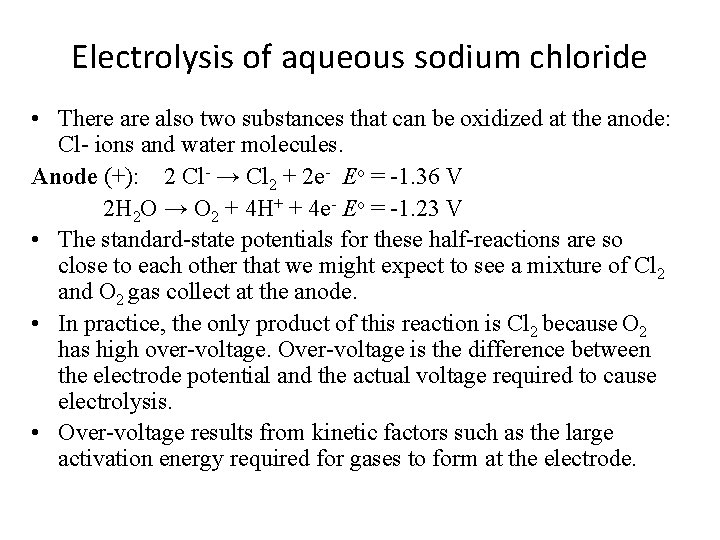
Electrolysis of aqueous sodium chloride • There also two substances that can be oxidized at the anode: Cl- ions and water molecules. Anode (+): 2 Cl- → Cl 2 + 2 e- Eo = -1. 36 V 2 H 2 O → O 2 + 4 H+ + 4 e- Eo = -1. 23 V • The standard-state potentials for these half-reactions are so close to each other that we might expect to see a mixture of Cl 2 and O 2 gas collect at the anode. • In practice, the only product of this reaction is Cl 2 because O 2 has high over-voltage. Over-voltage is the difference between the electrode potential and the actual voltage required to cause electrolysis. • Over-voltage results from kinetic factors such as the large activation energy required for gases to form at the electrode.
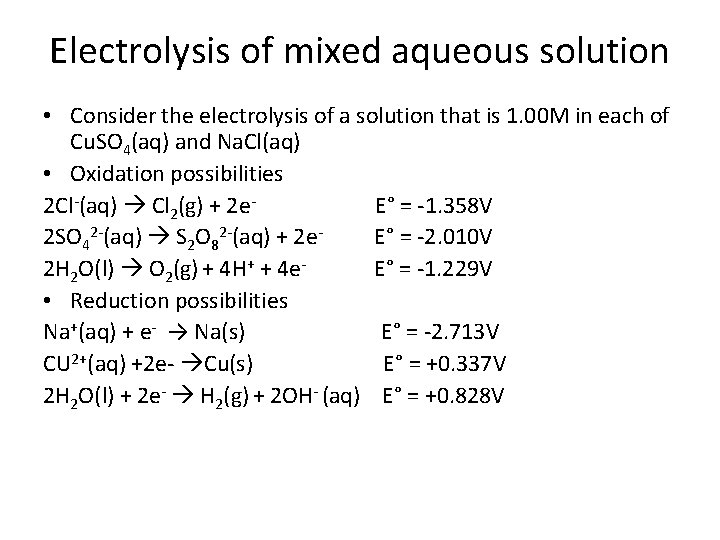
Electrolysis of mixed aqueous solution • Consider the electrolysis of a solution that is 1. 00 M in each of Cu. SO 4(aq) and Na. Cl(aq) • Oxidation possibilities 2 Cl-(aq) Cl 2(g) + 2 e- E° = -1. 358 V 2 SO 42 -(aq) S 2 O 82 -(aq) + 2 e- E° = -2. 010 V 2 H 2 O(l) O 2(g) + 4 H+ + 4 e- E° = -1. 229 V • Reduction possibilities Na+(aq) + e- → Na(s) E° = -2. 713 V CU 2+(aq) +2 e- Cu(s) E° = +0. 337 V 2 H 2 O(l) + 2 e- H 2(g) + 2 OH- (aq) E° = +0. 828 V
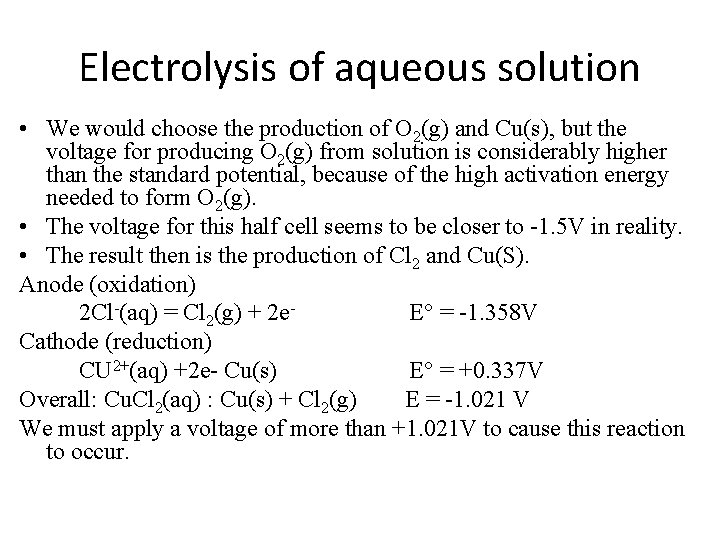
Electrolysis of aqueous solution • We would choose the production of O 2(g) and Cu(s), but the voltage for producing O 2(g) from solution is considerably higher than the standard potential, because of the high activation energy needed to form O 2(g). • The voltage for this half cell seems to be closer to -1. 5 V in reality. • The result then is the production of Cl 2 and Cu(S). Anode (oxidation) 2 Cl-(aq) = Cl 2(g) + 2 e- E° = -1. 358 V Cathode (reduction) CU 2+(aq) +2 e- Cu(s) E° = +0. 337 V Overall: Cu. Cl 2(aq) : Cu(s) + Cl 2(g) E = -1. 021 V We must apply a voltage of more than +1. 021 V to cause this reaction to occur.
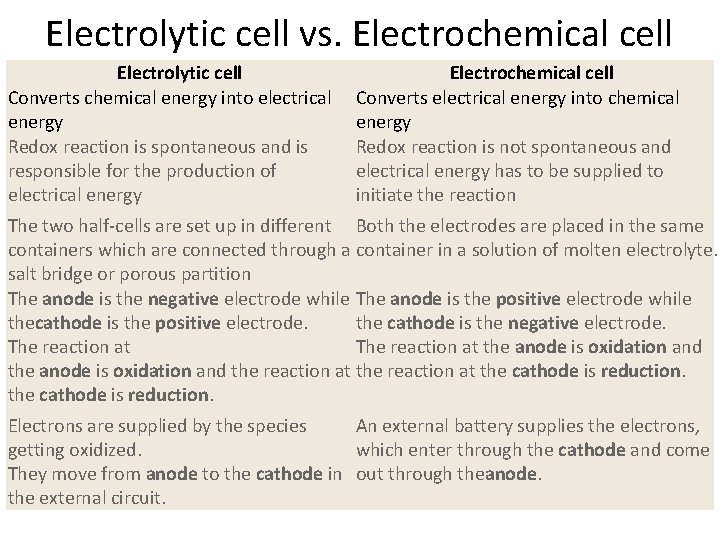
Electrolytic cell vs. Electrochemical cell Electrolytic cell Converts chemical energy into electrical energy Redox reaction is spontaneous and is responsible for the production of electrical energy Electrochemical cell Converts electrical energy into chemical energy Redox reaction is not spontaneous and electrical energy has to be supplied to initiate the reaction The two half-cells are set up in different Both the electrodes are placed in the same containers which are connected through a container in a solution of molten electrolyte. salt bridge or porous partition The anode is the negative electrode while The anode is the positive electrode while thecathode is the positive electrode. the cathode is the negative electrode. The reaction at the anode is oxidation and the reaction at the cathode is reduction. Electrons are supplied by the species An external battery supplies the electrons, getting oxidized. which enter through the cathode and come They move from anode to the cathode in out through theanode. the external circuit.
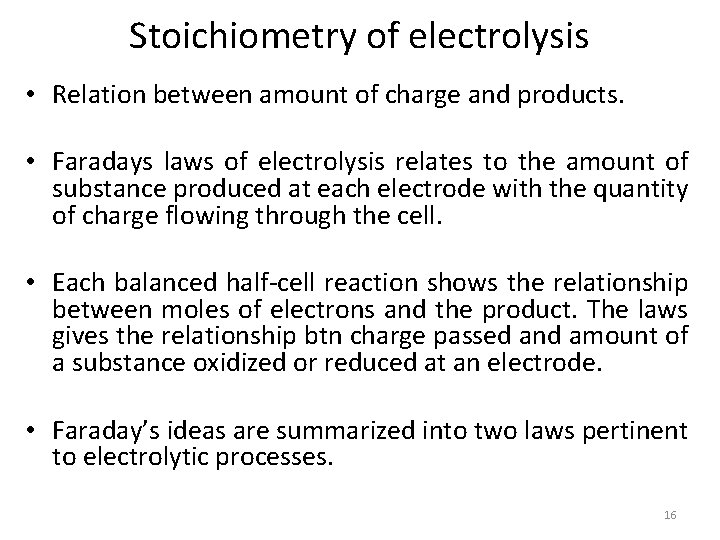
Stoichiometry of electrolysis • Relation between amount of charge and products. • Faradays laws of electrolysis relates to the amount of substance produced at each electrode with the quantity of charge flowing through the cell. • Each balanced half-cell reaction shows the relationship between moles of electrons and the product. The laws gives the relationship btn charge passed and amount of a substance oxidized or reduced at an electrode. • Faraday’s ideas are summarized into two laws pertinent to electrolytic processes. 16
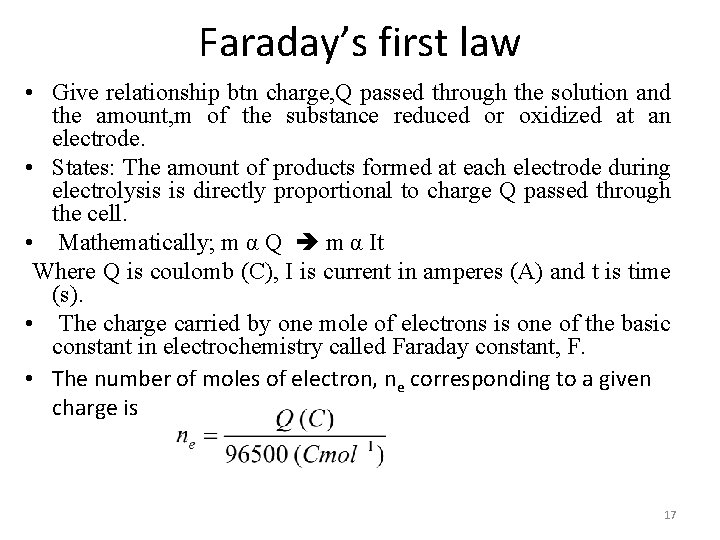
Faraday’s first law • Give relationship btn charge, Q passed through the solution and the amount, m of the substance reduced or oxidized at an electrode. • States: The amount of products formed at each electrode during electrolysis is directly proportional to charge Q passed through the cell. • Mathematically; m α Q m α It Where Q is coulomb (C), I is current in amperes (A) and t is time (s). • The charge carried by one mole of electrons is one of the basic constant in electrochemistry called Faraday constant, F. • The number of moles of electron, ne corresponding to a given charge is 17
Faraday’s second law • If the same quantity of electricity (electric charge) is passed through different electrolytes, the mass of an substance liberated or deposited at an electrode is directly proportional to their chemical equivalents. • m α E m 1 / m 2 = E 1 / E 2 Here m 1 and m 2 are the masses of the substances liberated or deposited and E 1 and E 2 are their respective chemical equivalents. • Chemical equivalent = atomic mass / valence Example of electrode reactions; Ag+ + e- → Ag(s) 1 mol of electrons is required to deposit 1 mol of silver metal from solution. Zn+ + 2 e- → Zn(s) 2 mols of electrons are required to deposit 1 mol of Zn metal from solution. 18
Faraday’s second law. Consider the following half reactions; 2 H 2 O(l) = O 2(g) + 4 H+(aq) + 4 e CU 2+(aq) +2 e- → Cu(s) What will be the mol of substances produced after passage of one mol of electrons? The two laws can be concisely stated in one equation m = s. MIt where m is the amount produced (g) n. F M is a molar mass (g/mol) n is the number of electrons, F is the Faradays constant = 96500 C/mol I is a current in ampere (A) and t is time in seconds (s). s is the stoichiometry coefficient of the species. 19
The Faraday constant, F, is the quantity of electricity carried by one mole of electrons. F = Avogadro's Number x charge on electron in coulombs F = 6. 022 x 1023 mol-1 x 1. 602192 x 10 -19 C, = 96, 484 C mol-1 This is usually rounded off to 96, 500 C mol-1 for calculations in chemistry. In solving problems involving Faraday’s laws • First balance the half reactions to find number of moles of electron needed per mole of product. • Use Faraday constant (F = 96500 C/mol e-) to find corresponding charge. • Use the molar mass of substance to find the charge needed for a given mass of product. 1 ampere = 1 coulomb/second or 1 A = 1 C/s 20
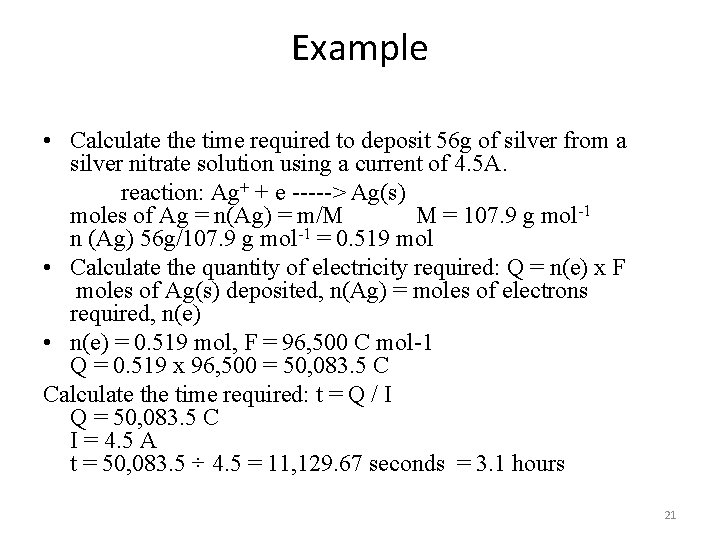
Example • Calculate the time required to deposit 56 g of silver from a silver nitrate solution using a current of 4. 5 A. reaction: Ag+ + e -----> Ag(s) moles of Ag = n(Ag) = m/M M = 107. 9 g mol-1 n (Ag) 56 g/107. 9 g mol-1 = 0. 519 mol • Calculate the quantity of electricity required: Q = n(e) x F moles of Ag(s) deposited, n(Ag) = moles of electrons required, n(e) • n(e) = 0. 519 mol, F = 96, 500 C mol-1 Q = 0. 519 x 96, 500 = 50, 083. 5 C Calculate the time required: t = Q / I Q = 50, 083. 5 C I = 4. 5 A t = 50, 083. 5 ÷ 4. 5 = 11, 129. 67 seconds = 3. 1 hours 21
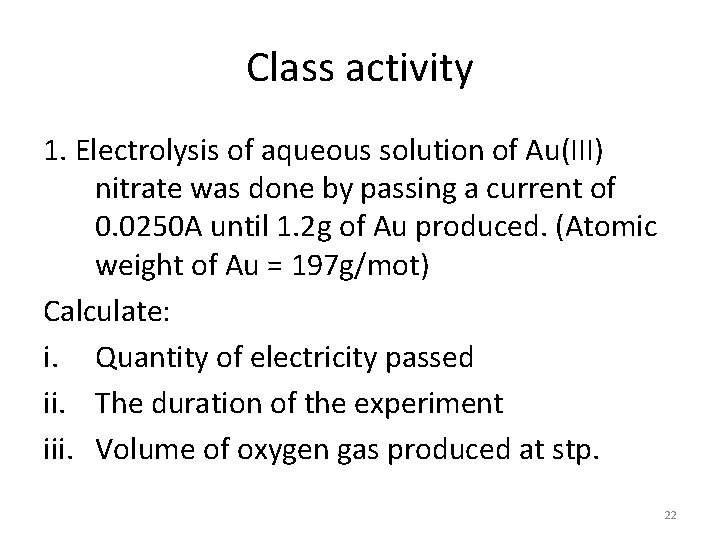
Class activity 1. Electrolysis of aqueous solution of Au(III) nitrate was done by passing a current of 0. 0250 A until 1. 2 g of Au produced. (Atomic weight of Au = 197 g/mot) Calculate: i. Quantity of electricity passed ii. The duration of the experiment iii. Volume of oxygen gas produced at stp. 22
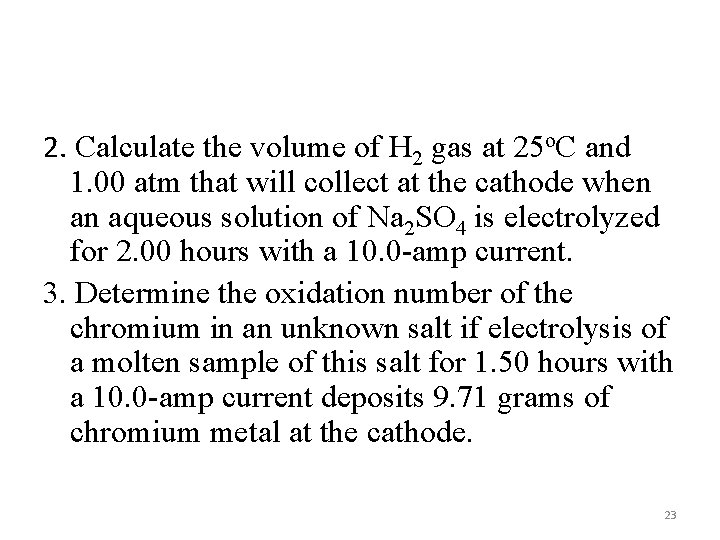
2. Calculate the volume of H 2 gas at 25 o. C and 1. 00 atm that will collect at the cathode when an aqueous solution of Na 2 SO 4 is electrolyzed for 2. 00 hours with a 10. 0 -amp current. 3. Determine the oxidation number of the chromium in an unknown salt if electrolysis of a molten sample of this salt for 1. 50 hours with a 10. 0 -amp current deposits 9. 71 grams of chromium metal at the cathode. 23
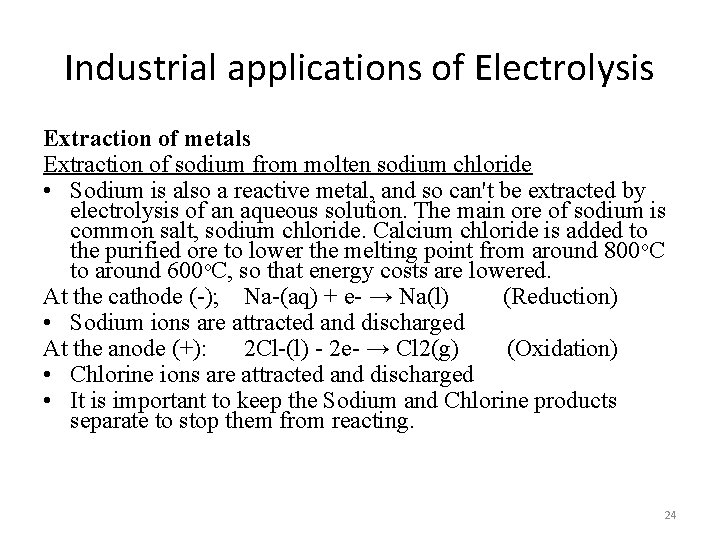
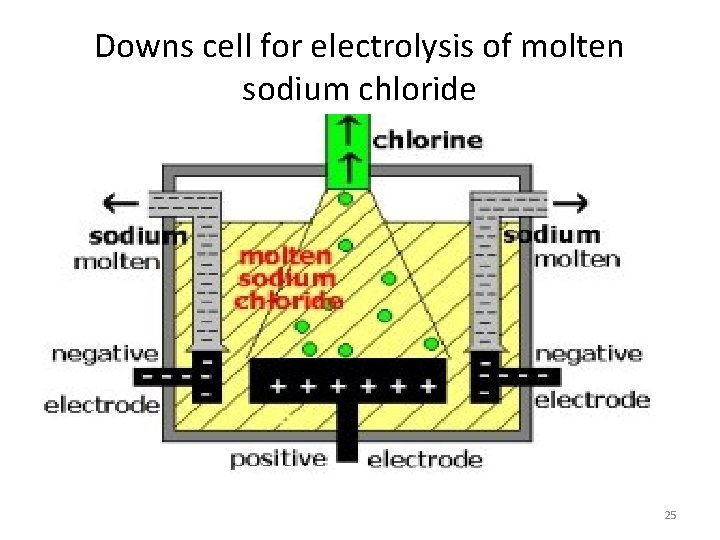
Industrial applications of Electrolysis Extraction of metals Extraction of sodium from molten sodium chloride • Sodium is also a reactive metal, and so can't be extracted by electrolysis of an aqueous solution. The main ore of sodium is common salt, sodium chloride. Calcium chloride is added to the purified ore to lower the melting point from around 800 o. C to around 600 o. C, so that energy costs are lowered. At the cathode (-); Na-(aq) + e- → Na(l) (Reduction) • Sodium ions are attracted and discharged At the anode (+): 2 Cl-(l) - 2 e- → Cl 2(g) (Oxidation) • Chlorine ions are attracted and discharged • It is important to keep the Sodium and Chlorine products separate to stop them from reacting. 24
Downs cell for electrolysis of molten sodium chloride 25
Electro-refining • Electro-refining is a method for purifying a metal using electrolysis. An electric current is passed between a sample of the impure metal and a cathode when both are immersed in a solution that contains cations of the metal. Metal is stripped off the impure sample and deposited in pure form on the cathode. • Electro-refining is used separate dangerous heavy metals such as plutonium, cesium, and strontium from the less-toxic bulk of the nuclear waste, not only leaving less to dispose of, but removing many materials that could harm the environment or potentially be made into weapons. 26
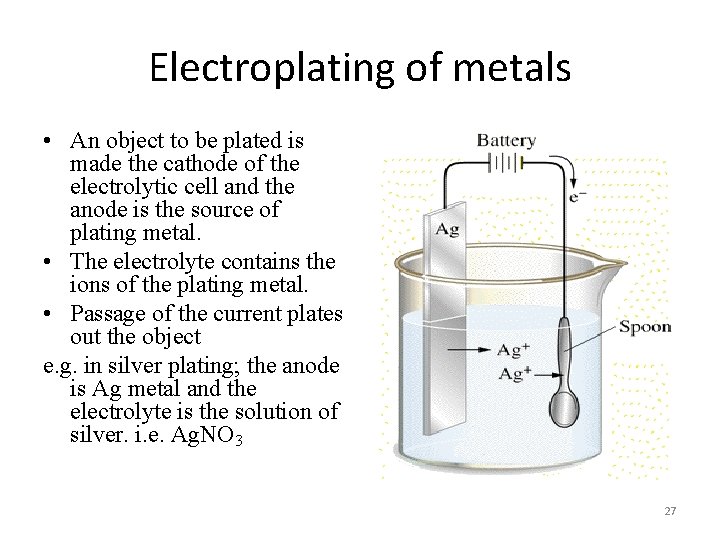
Electroplating of metals • An object to be plated is made the cathode of the electrolytic cell and the anode is the source of plating metal. • The electrolyte contains the ions of the plating metal. • Passage of the current plates out the object e. g. in silver plating; the anode is Ag metal and the electrolyte is the solution of silver. i. e. Ag. NO 3 27
Electro-analysis • Electro-analysis is a chemical analysis of an electrolyte by means of electrolysis. • Electro-analytical methods are a class of techniques in analytical chemistry which study an analyte by measuring the potential (Volts) and/or current (Amps) in an electrochemical cell containing the analyte. The three main categories are; i. Potentiometry (the difference in electrode potentials is measured), ii. Coulometry (the cell's current is measured over time), and iii. Voltammetry (the cell's current is measured while actively altering the cell's potential). 28