The Rotational Spectrum of Tryptophan Maria Eugenia Sanz
- Slides: 16
The Rotational Spectrum of Tryptophan Maria Eugenia Sanz, Carlos Cabezas, Santiago Mata, José L. Alonso
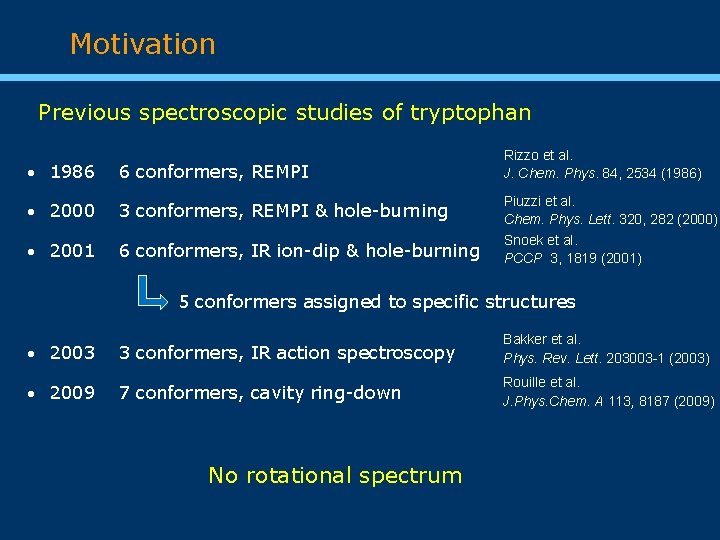
Motivation Previous spectroscopic studies of tryptophan 1986 6 conformers, REMPI 2000 3 conformers, REMPI & hole-burning 2001 6 conformers, IR ion-dip & hole-burning Rizzo et al. J. Chem. Phys. 84, 2534 (1986) Piuzzi et al. Chem. Phys. Lett. 320, 282 (2000) Snoek et al. PCCP 3, 1819 (2001) 5 conformers assigned to specific structures 2003 3 conformers, IR action spectroscopy Bakker et al. Phys. Rev. Lett. 203003 -1 (2003) 2009 7 conformers, cavity ring-down Rouille et al. J. Phys. Chem. A 113, 8187 (2009) No rotational spectrum
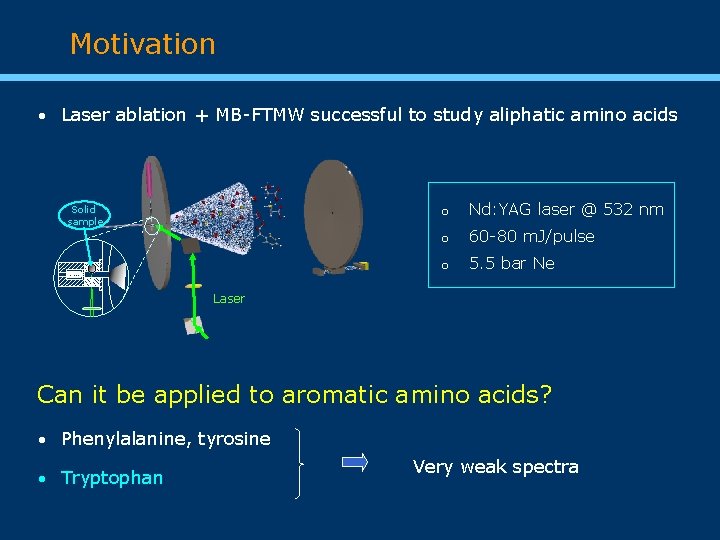
Motivation Laser ablation + MB-FTMW successful to study aliphatic amino acids Solid sample o Nd: YAG laser @ 532 nm o 60 -80 m. J/pulse o 5. 5 bar Ne Laser Can it be applied to aromatic amino acids? Phenylalanine, tyrosine Tryptophan Very weak spectra
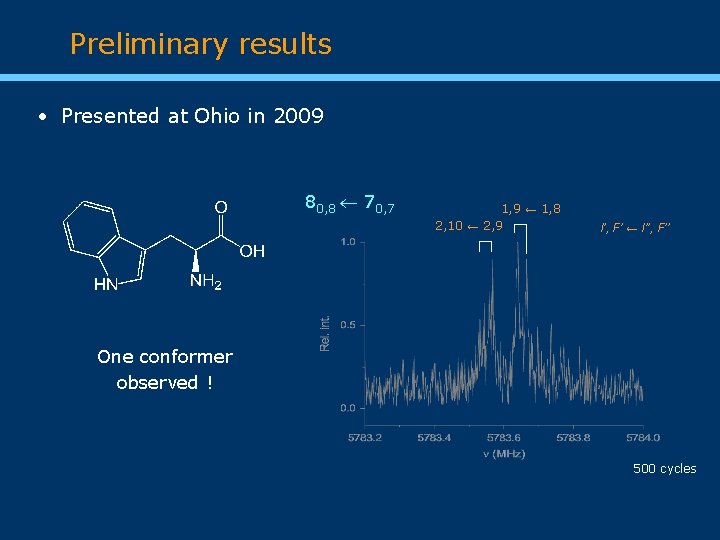
Preliminary results Presented at Ohio in 2009 80, 8 70, 7 1, 9 ← 1, 8 2, 10 ← 2, 9 I’, F’ ← I’’, F’’ One conformer observed ! 500 cycles
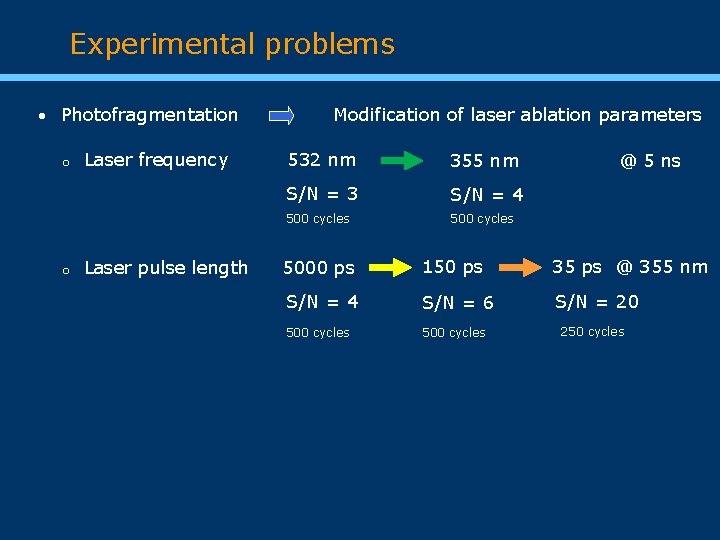
Experimental problems Photofragmentation o o Laser frequency Laser pulse length Modification of laser ablation parameters 532 nm 355 nm S/N = 3 S/N = 4 500 cycles @ 5 ns 5000 ps 150 ps 35 ps @ 355 nm S/N = 4 S/N = 6 S/N = 20 500 cycles 250 cycles
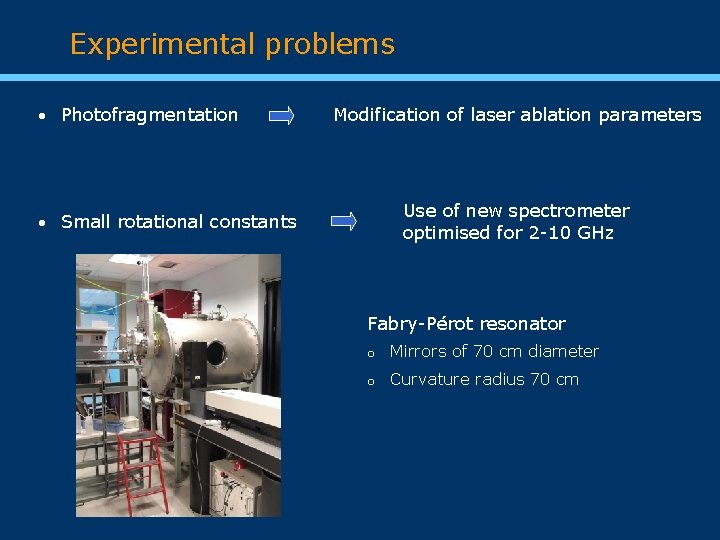
Experimental problems Photofragmentation Modification of laser ablation parameters Use of new spectrometer optimised for 2 -10 GHz Small rotational constants Fabry-Pérot resonator o Mirrors of 70 cm diameter o Curvature radius 70 cm
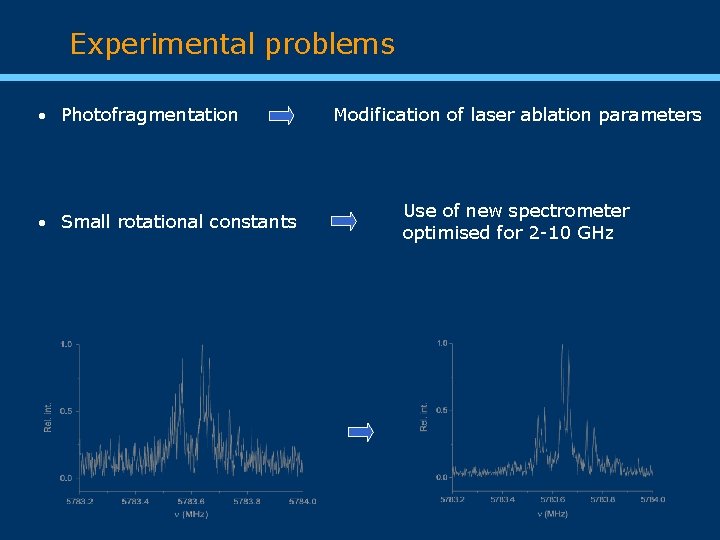
Experimental problems Photofragmentation Small rotational constants Modification of laser ablation parameters Use of new spectrometer optimised for 2 -10 GHz
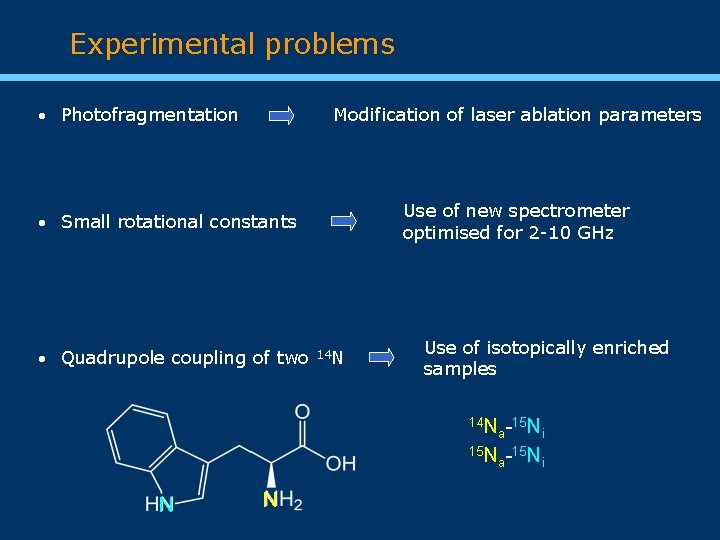
Experimental problems Photofragmentation Modification of laser ablation parameters Use of new spectrometer optimised for 2 -10 GHz Small rotational constants Quadrupole coupling of two N N 14 N Use of isotopically enriched samples 14 N a- 15 N i 15 N a- 15 N i
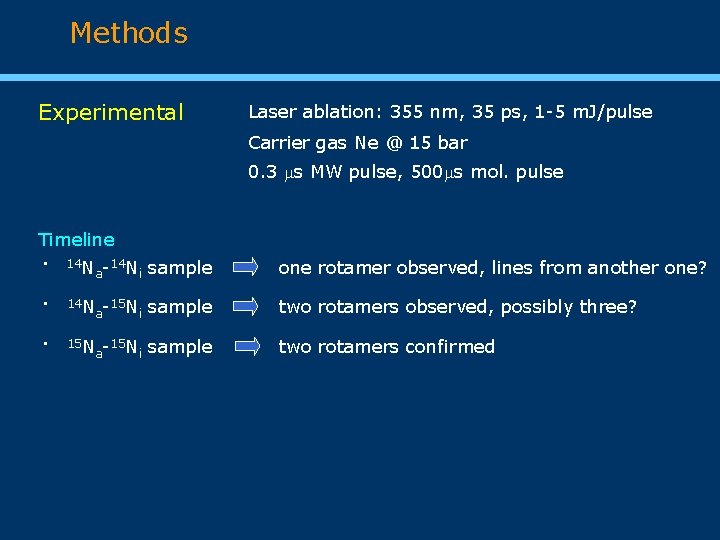
Methods Experimental Laser ablation: 355 nm, 35 ps, 1 -5 m. J/pulse Carrier gas Ne @ 15 bar 0. 3 ms MW pulse, 500 ms mol. pulse Timeline • 14 N a- • 14 N • 15 N 14 N i sample one rotamer observed, lines from another one? a- 15 N i sample two rotamers observed, possibly three? a- 15 N i sample two rotamers confirmed
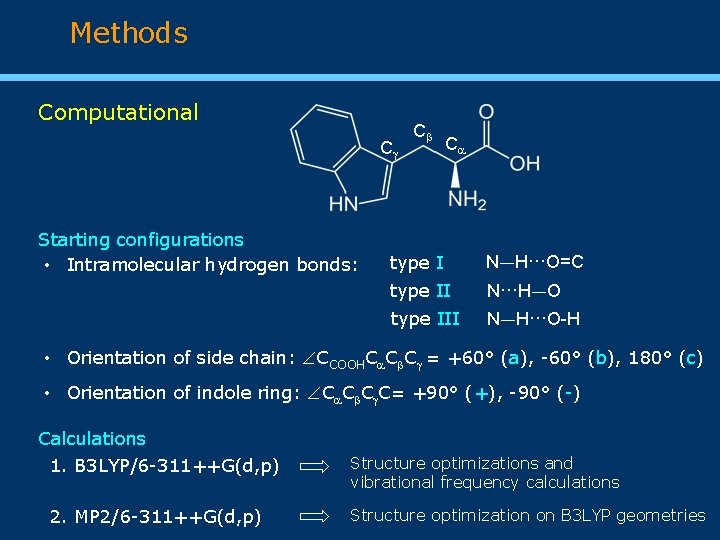
Methods Computational Cg Starting configurations • Intramolecular hydrogen bonds: Cb Ca type I N―H···O=C type II N···H―O type III N―H···O-H • Orientation of side chain: CCOOHCa. Cb. Cg = +60° (a), -60° (b), 180° (c) • Orientation of indole ring: Ca. Cb. Cg. C= +90° (+), -90° (-) Calculations 1. B 3 LYP/6 -311++G(d, p) Structure optimizations and vibrational frequency calculations 2. MP 2/6 -311++G(d, p) Structure optimization on B 3 LYP geometries
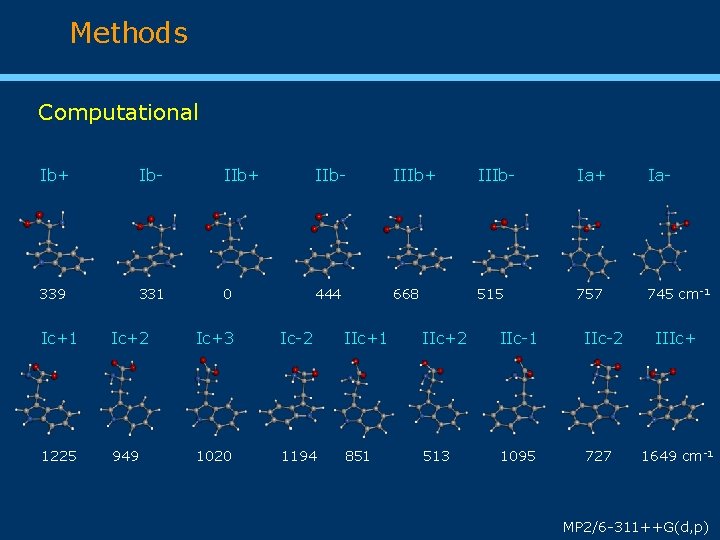
Methods Computational Ib+ Ib- IIb+ IIb- IIIb+ IIIb- Ia+ Ia- 339 331 0 444 668 515 757 745 cm-1 Ic+2 Ic+3 Ic-2 IIc+1 IIc+2 IIc-1 IIc-2 1225 949 1020 1194 851 513 1095 727 IIIc+ 1649 cm-1 MP 2/6 -311++G(d, p)
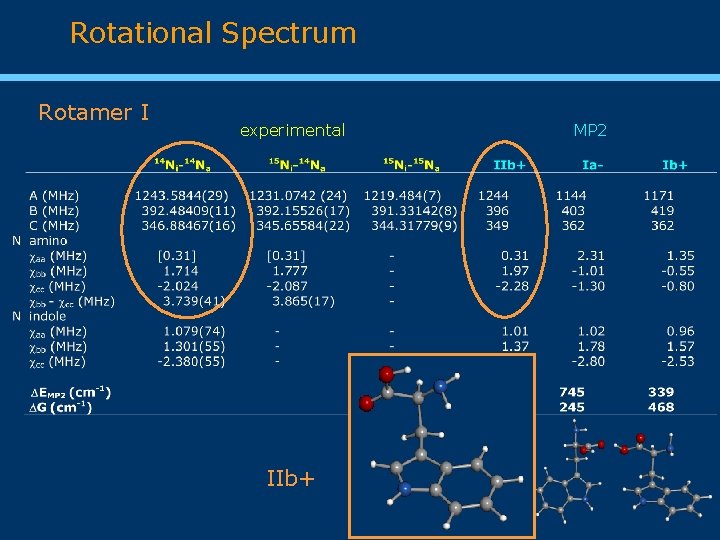
Rotational Spectrum Rotamer I experimental IIb+ MP 2
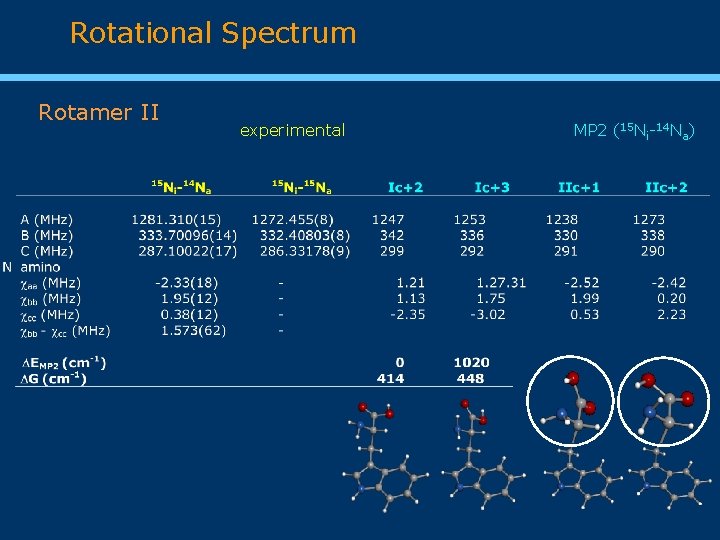
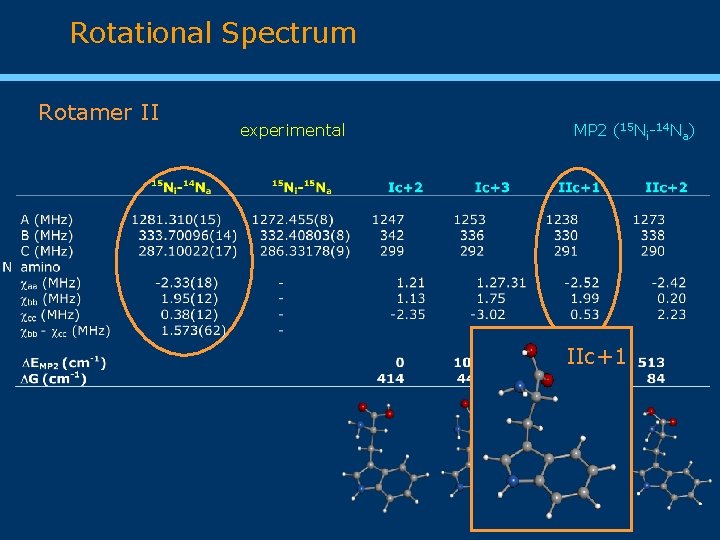
Rotational Spectrum Rotamer II experimental MP 2 (15 Ni-14 Na)
Rotational Spectrum Rotamer II experimental MP 2 (15 Ni-14 Na) IIc+1
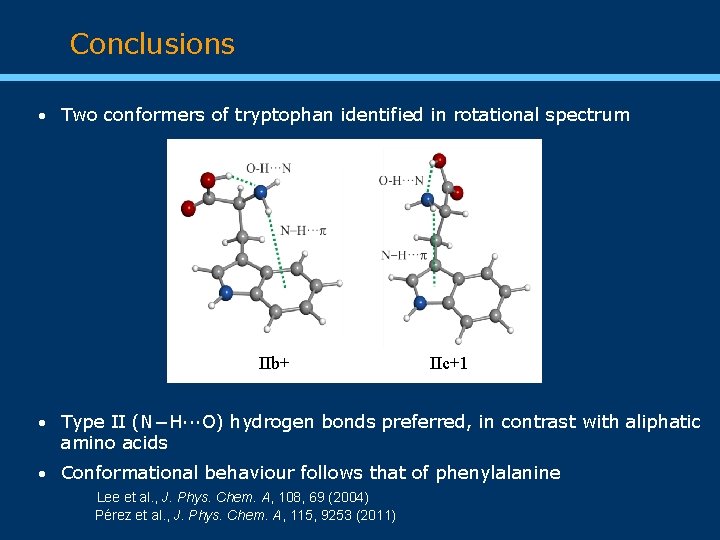
Conclusions Two conformers of tryptophan identified in rotational spectrum IIb+ IIc+1 Type II (N−H···O) hydrogen bonds preferred, in contrast with aliphatic amino acids Conformational behaviour follows that of phenylalanine Lee et al. , J. Phys. Chem. A, 108, 69 (2004) Pérez et al. , J. Phys. Chem. A, 115, 9253 (2011)
Acknowledgements • Grupo de Espectroscopia Molecular Isabel Peña Susana Blanco Lucie Kolesnicová Juan Carlos López Celina Bermúdez Agustín Martín Vanesa Vaquero Cristóbal Pérez • Prof. Dr. Jens-Uwe Grabow, Hannover University MB-FTMW control software Funding Thank you for your attention