The Renaissance and Reformation 1300 1650 Chapter 13

- Slides: 48
The Renaissance and Reformation 1300 -1650 Chapter 13 Focus: How did the Renaissance shape European art, thought, and religion?
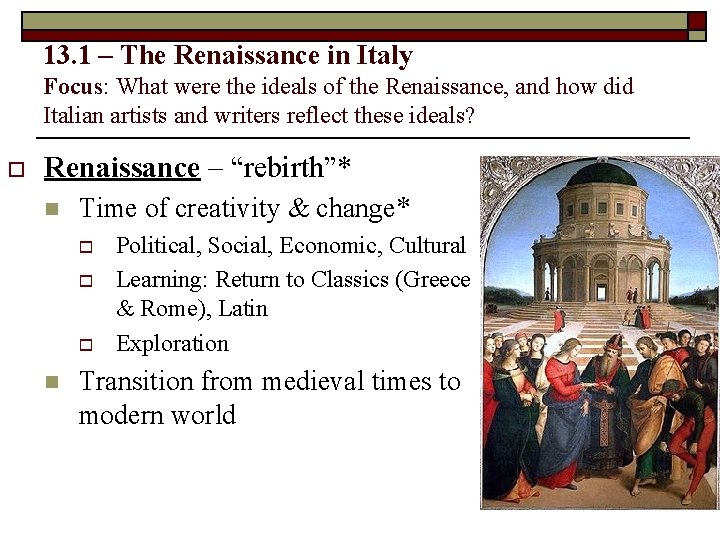
13. 1 – The Renaissance in Italy Focus: What were the ideals of the Renaissance, and how did Italian artists and writers reflect these ideals? o Renaissance – “rebirth”* n Time of creativity & change* o o o n Political, Social, Economic, Cultural Learning: Return to Classics (Greece & Rome), Latin Exploration Transition from medieval times to modern world
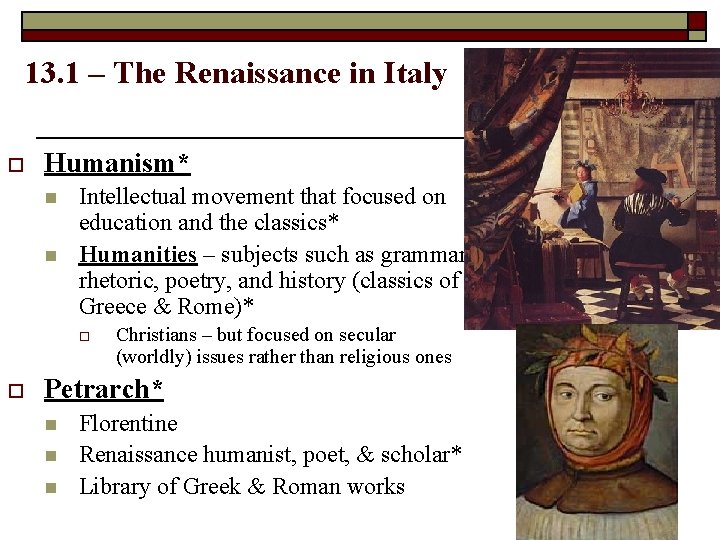
13. 1 – The Renaissance in Italy o Humanism* n n Intellectual movement that focused on education and the classics* Humanities – subjects such as grammar, rhetoric, poetry, and history (classics of Greece & Rome)* o o Christians – but focused on secular (worldly) issues rather than religious ones Petrarch* n n n Florentine Renaissance humanist, poet, & scholar* Library of Greek & Roman works
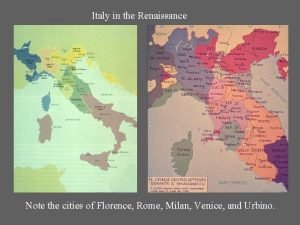
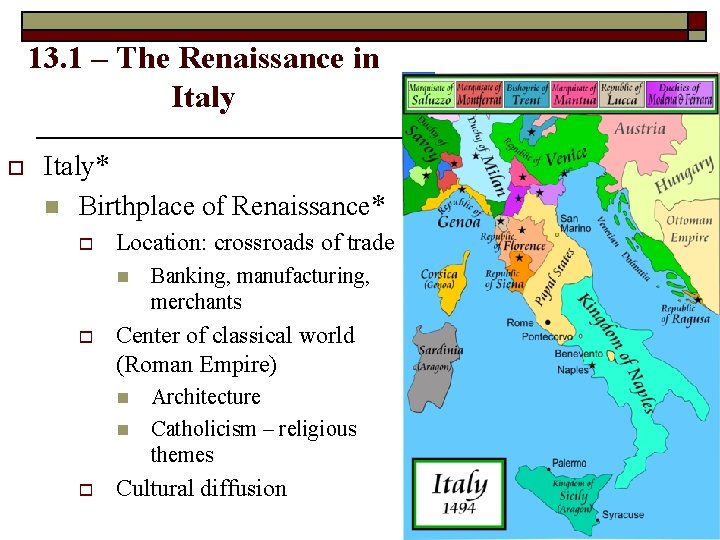
13. 1 – The Renaissance in Italy o Italy* n Birthplace of Renaissance* o Location: crossroads of trade n o Center of classical world (Roman Empire) n n o Banking, manufacturing, merchants Architecture Catholicism – religious themes Cultural diffusion
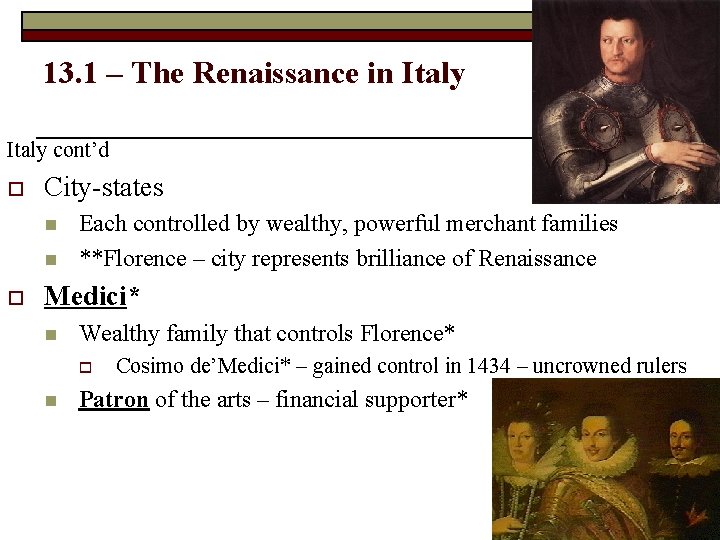
13. 1 – The Renaissance in Italy cont’d o City-states n n o Each controlled by wealthy, powerful merchant families **Florence – city represents brilliance of Renaissance Medici* n Wealthy family that controls Florence* o n Cosimo de’Medici* – gained control in 1434 – uncrowned rulers Patron of the arts – financial supporter*
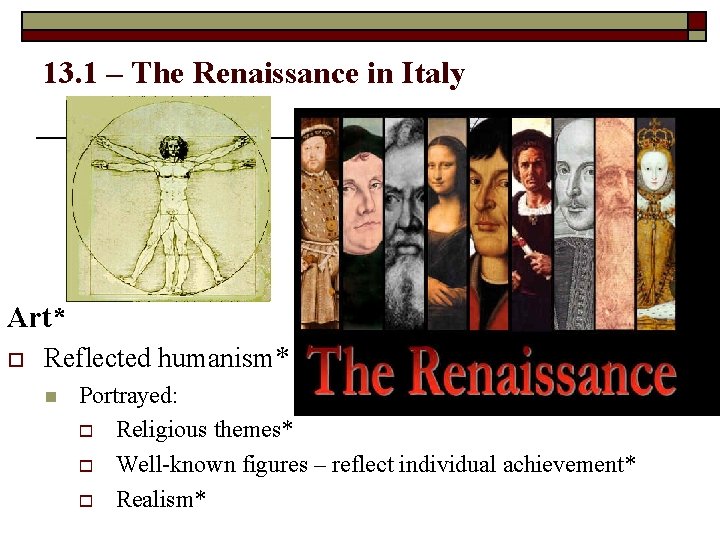
13. 1 – The Renaissance in Italy Art* o Reflected humanism* n Portrayed: o Religious themes* o Well-known figures – reflect individual achievement* o Realism*
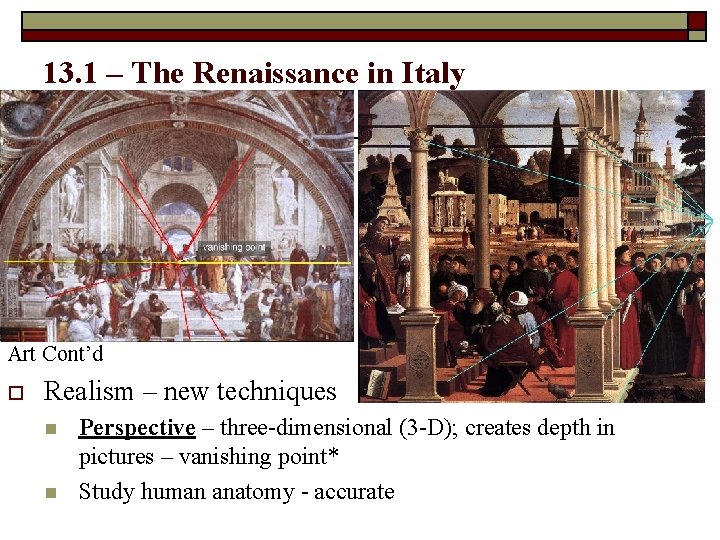
13. 1 – The Renaissance in Italy Art Cont’d o Realism – new techniques n n Perspective – three-dimensional (3 -D); creates depth in pictures – vanishing point* Study human anatomy - accurate
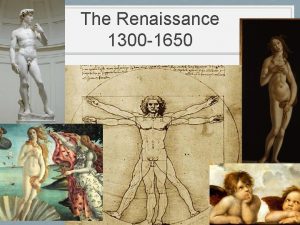
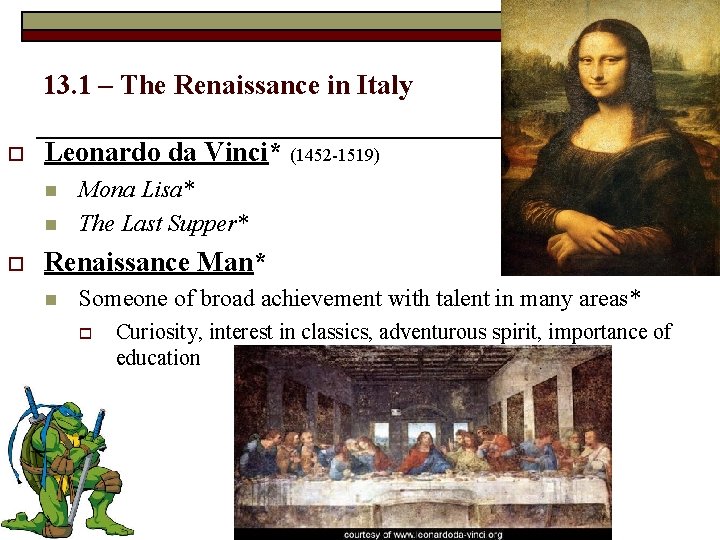
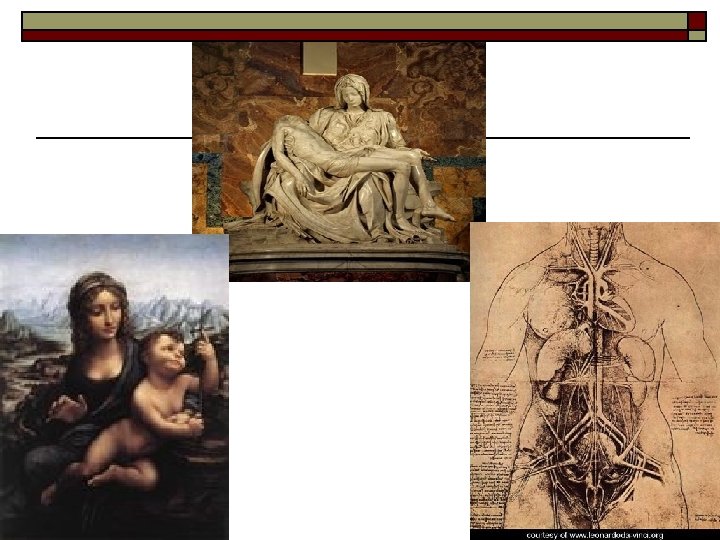
13. 1 – The Renaissance in Italy o Leonardo da Vinci* (1452 -1519) n n o Mona Lisa* The Last Supper* Renaissance Man* n Someone of broad achievement with talent in many areas* o Curiosity, interest in classics, adventurous spirit, importance of education
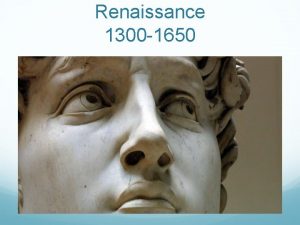
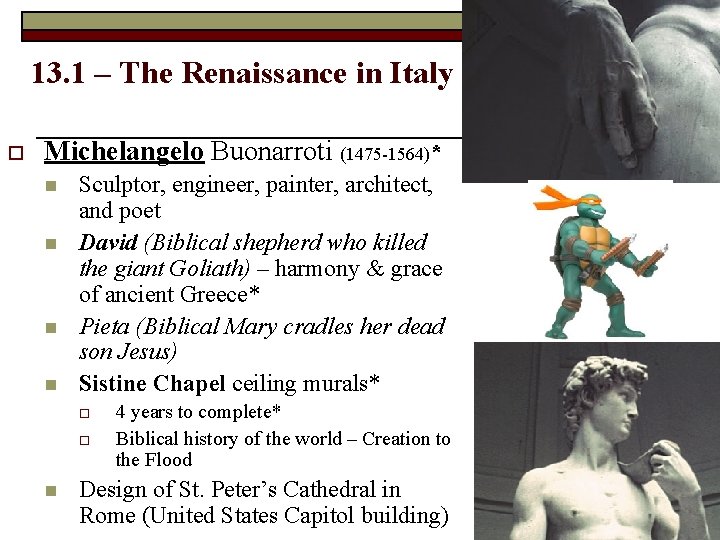
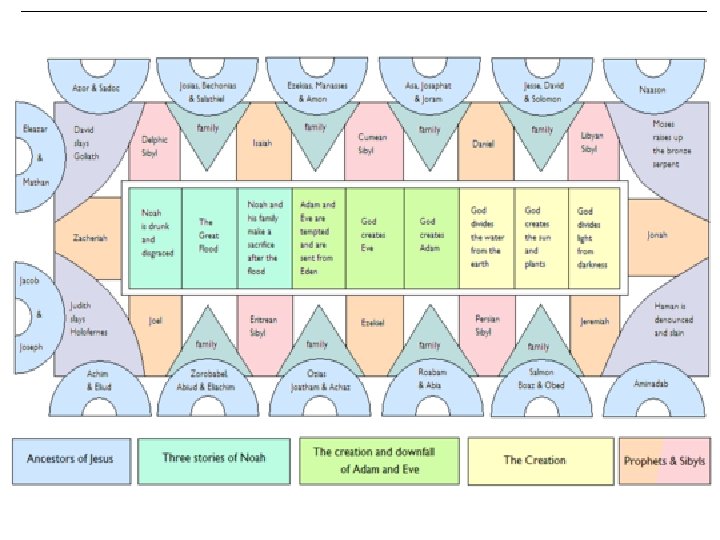
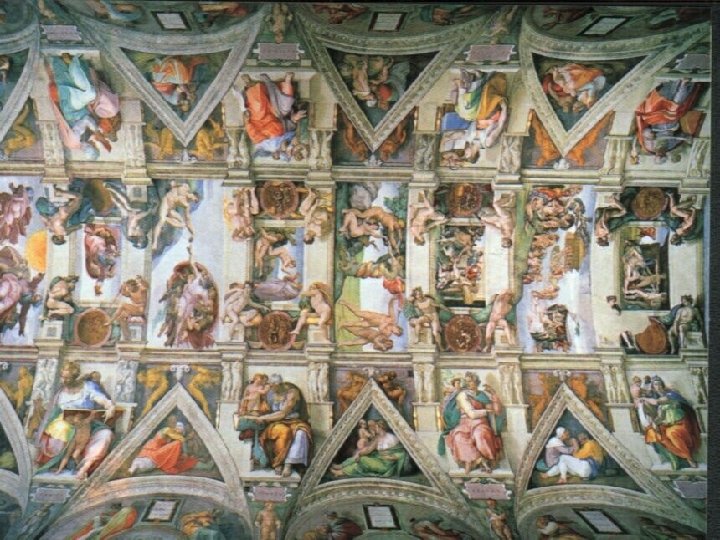
13. 1 – The Renaissance in Italy o Michelangelo Buonarroti (1475 -1564)* n n Sculptor, engineer, painter, architect, and poet David (Biblical shepherd who killed the giant Goliath) – harmony & grace of ancient Greece* Pieta (Biblical Mary cradles her dead son Jesus) Sistine Chapel ceiling murals* o o n 4 years to complete* Biblical history of the world – Creation to the Flood Design of St. Peter’s Cathedral in Rome (United States Capitol building)
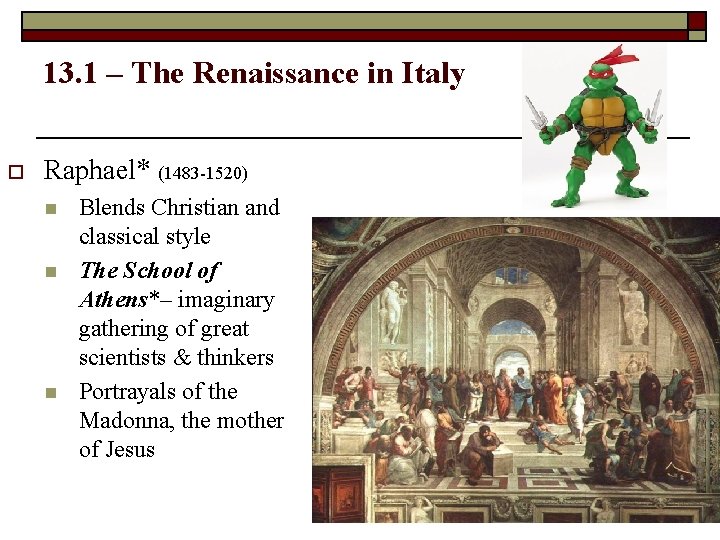
13. 1 – The Renaissance in Italy o Raphael* (1483 -1520) n n n Blends Christian and classical style The School of Athens*– imaginary gathering of great scientists & thinkers Portrayals of the Madonna, the mother of Jesus
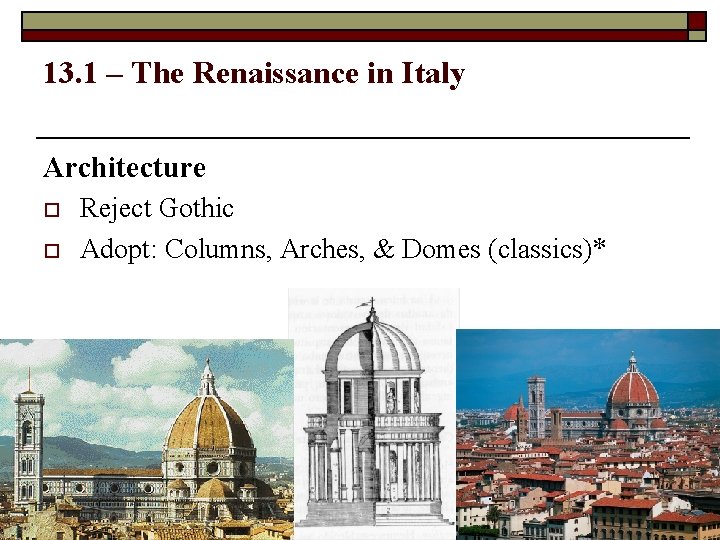
13. 1 – The Renaissance in Italy Architecture o o Reject Gothic Adopt: Columns, Arches, & Domes (classics)*
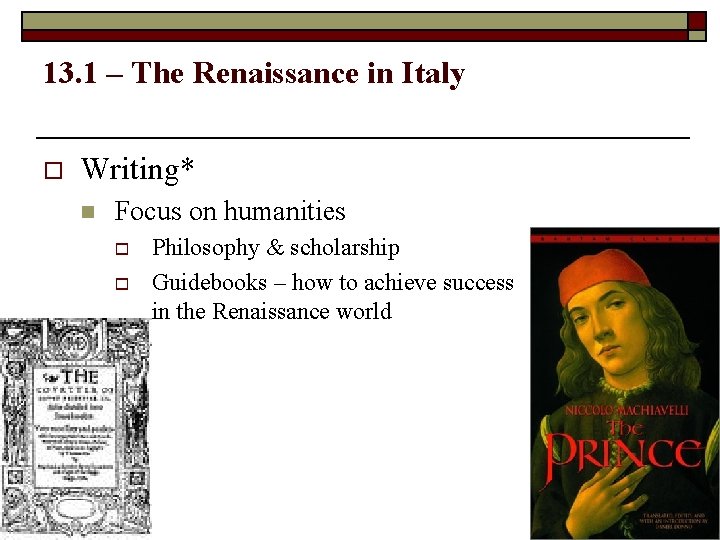
13. 1 – The Renaissance in Italy o Writing* n Focus on humanities o o Philosophy & scholarship Guidebooks – how to achieve success in the Renaissance world
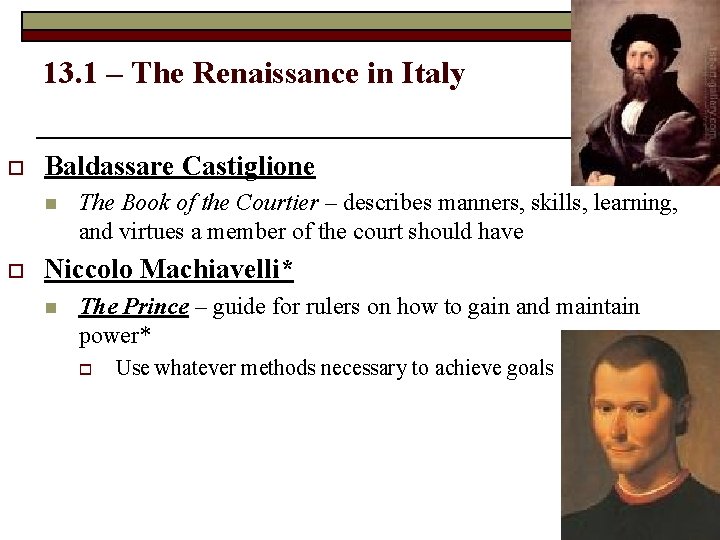
13. 1 – The Renaissance in Italy o Baldassare Castiglione n o The Book of the Courtier – describes manners, skills, learning, and virtues a member of the court should have Niccolo Machiavelli* n The Prince – guide for rulers on how to gain and maintain power* o Use whatever methods necessary to achieve goals
13. 1 – The Renaissance in Italy
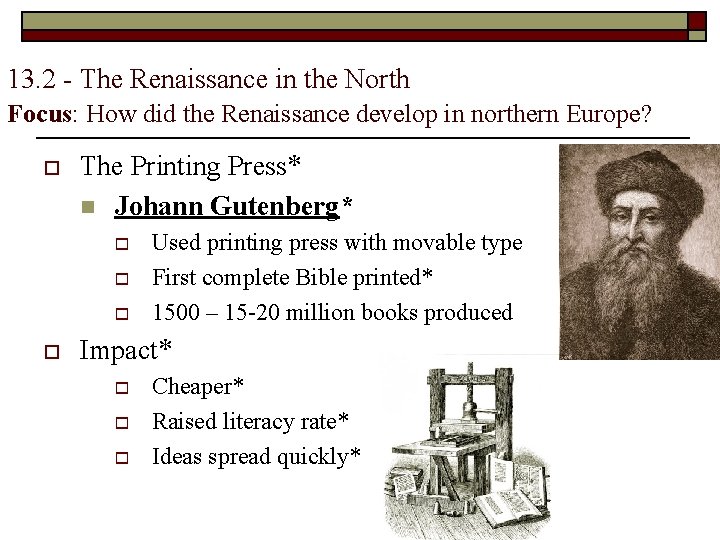
13. 2 - The Renaissance in the North Focus: How did the Renaissance develop in northern Europe? o The Printing Press* n Johann Gutenberg* o o Used printing press with movable type First complete Bible printed* 1500 – 15 -20 million books produced Impact* o o o Cheaper* Raised literacy rate* Ideas spread quickly*
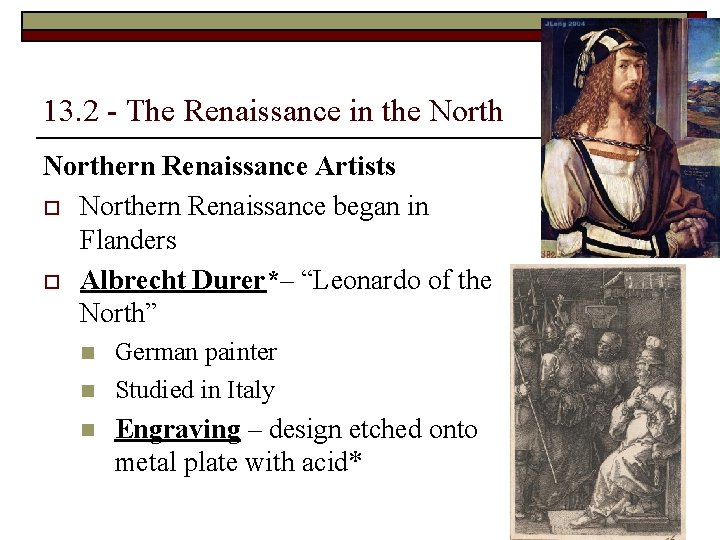
13. 2 - The Renaissance in the Northern Renaissance Artists o Northern Renaissance began in Flanders o Albrecht Durer*– “Leonardo of the North” n n n German painter Studied in Italy Engraving – design etched onto metal plate with acid*
13. 2 - The Renaissance in the North o Northern Humanists and Writers o Humanists – stress education and classical learning* Vernacular – everyday language of ordinary people* o
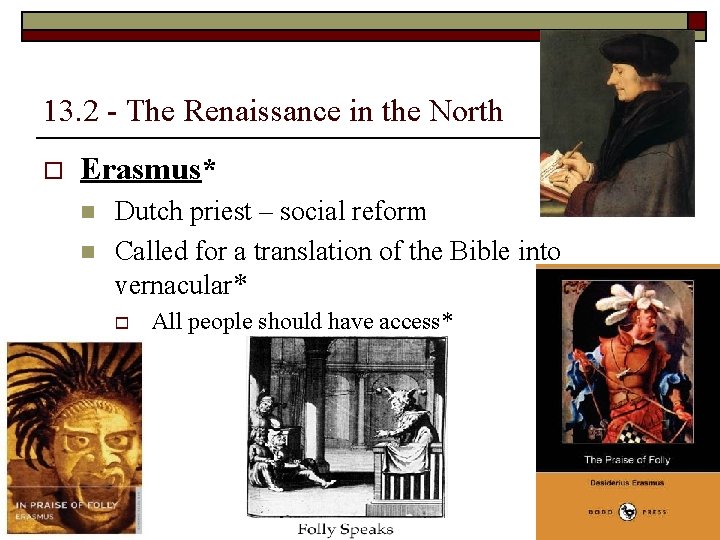
13. 2 - The Renaissance in the North o Erasmus* n n Dutch priest – social reform Called for a translation of the Bible into vernacular* o All people should have access*
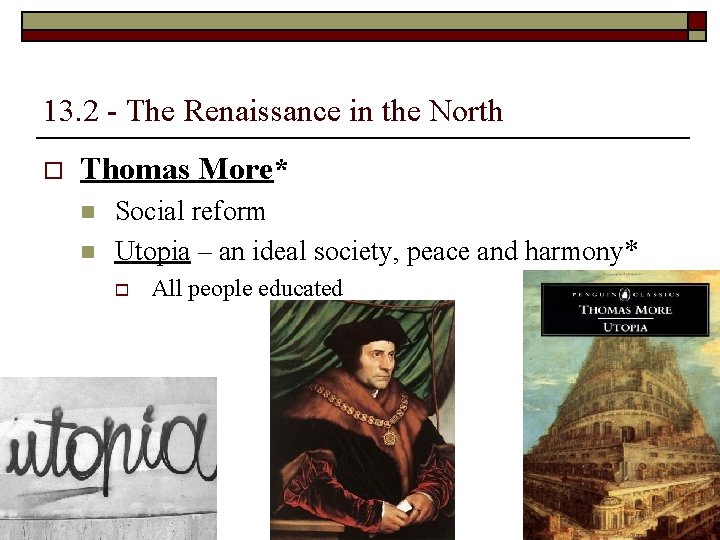
13. 2 - The Renaissance in the North o Thomas More* n n Social reform Utopia – an ideal society, peace and harmony* o All people educated
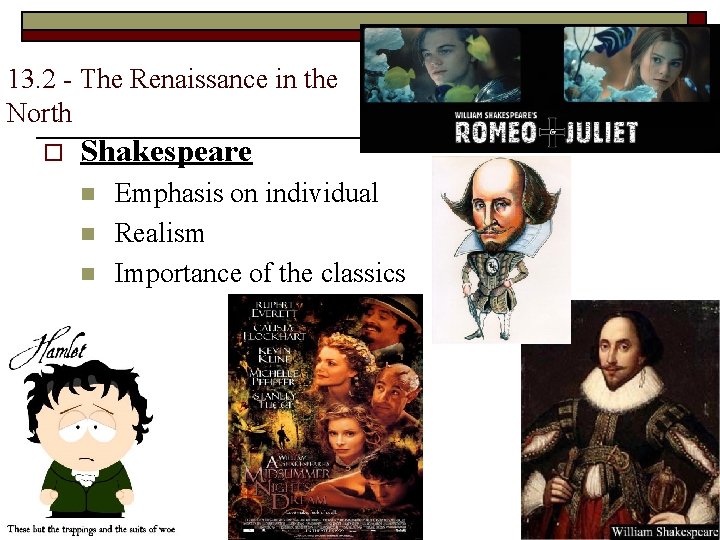
13. 2 - The Renaissance in the North o Shakespeare n n n Emphasis on individual Realism Importance of the classics
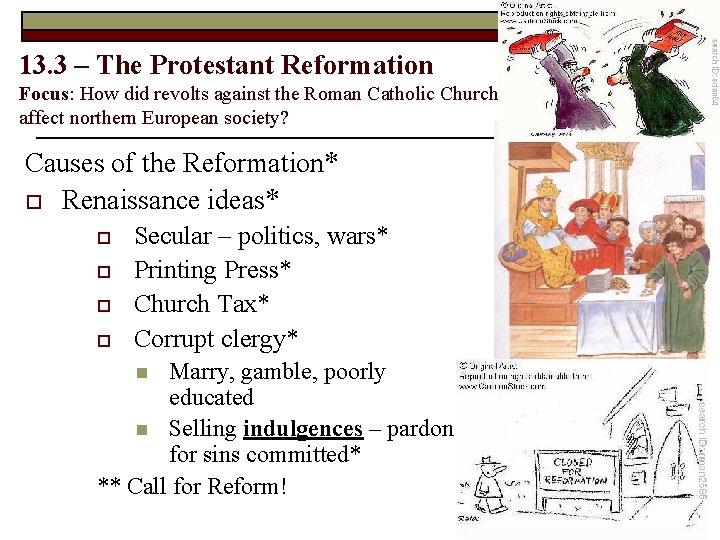
13. 3 – The Protestant Reformation Focus: How did revolts against the Roman Catholic Church affect northern European society? Causes of the Reformation* o Renaissance ideas* o o Secular – politics, wars* Printing Press* Church Tax* Corrupt clergy* Marry, gamble, poorly educated n Selling indulgences – pardon for sins committed* ** Call for Reform! n
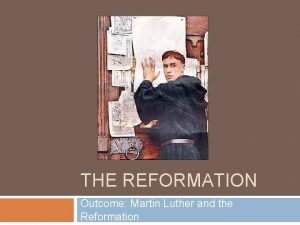
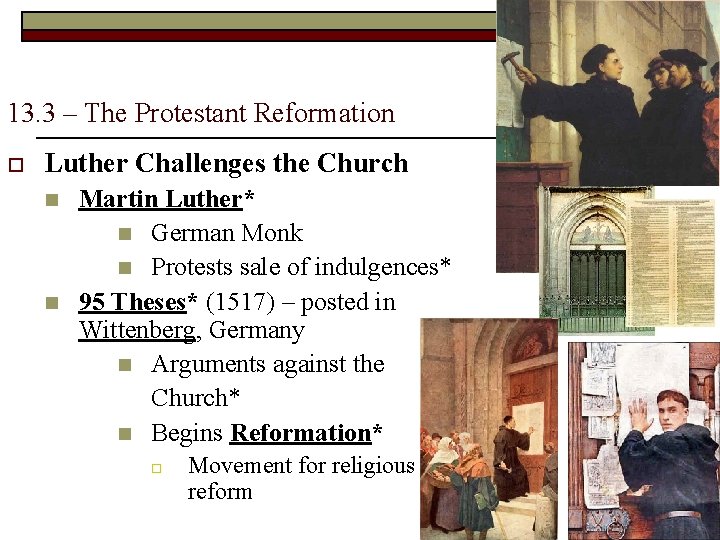
13. 3 – The Protestant Reformation o Luther Challenges the Church n n Martin Luther* n German Monk n Protests sale of indulgences* 95 Theses* (1517) – posted in Wittenberg, Germany n Arguments against the Church* n Begins Reformation* o Movement for religious reform
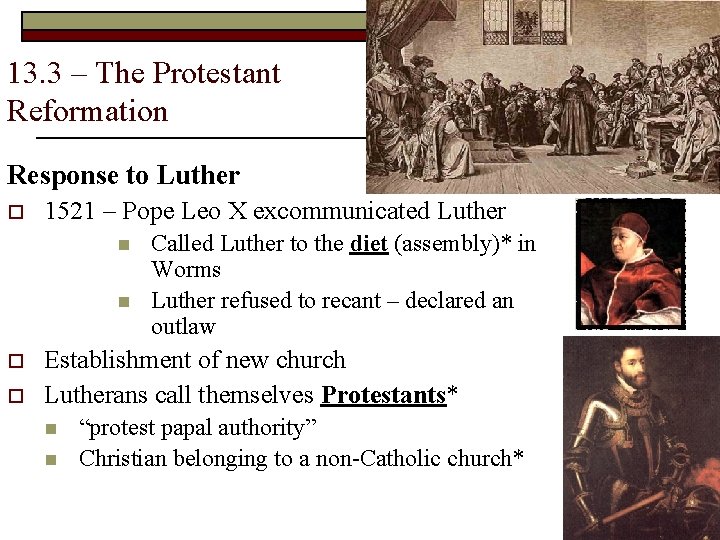
13. 3 – The Protestant Reformation Response to Luther o 1521 – Pope Leo X excommunicated Luther n n o o Called Luther to the diet (assembly)* in Worms Luther refused to recant – declared an outlaw Establishment of new church Lutherans call themselves Protestants* n n “protest papal authority” Christian belonging to a non-Catholic church*
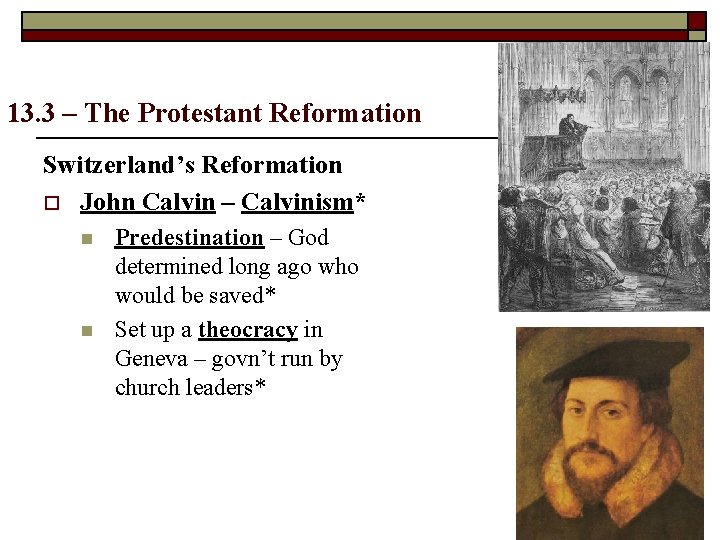
13. 3 – The Protestant Reformation Switzerland’s Reformation o John Calvin – Calvinism* n n Predestination – God determined long ago who would be saved* Set up a theocracy in Geneva – govn’t run by church leaders*
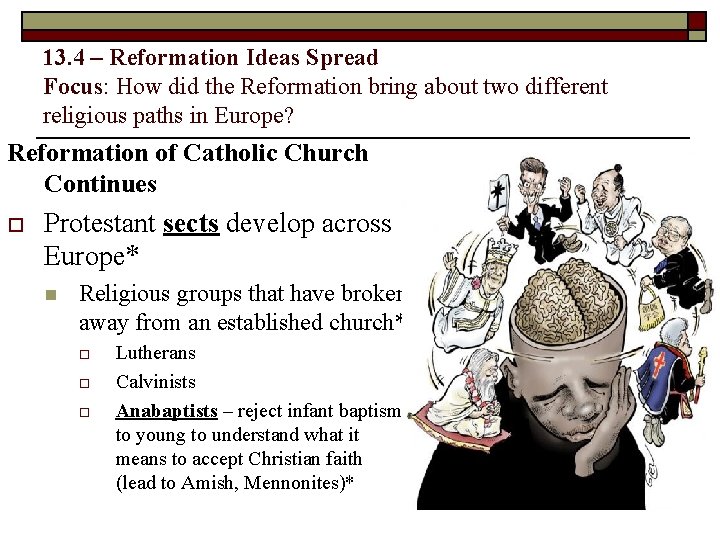
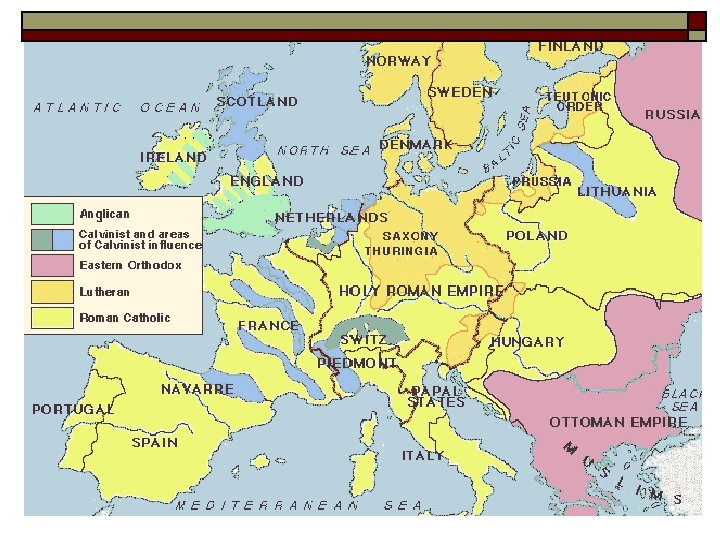
13. 4 – Reformation Ideas Spread Focus: How did the Reformation bring about two different religious paths in Europe? Reformation of Catholic Church Continues o Protestant sects develop across Europe* n Religious groups that have broken away from an established church* o o o Lutherans Calvinists Anabaptists – reject infant baptism; to young to understand what it means to accept Christian faith (lead to Amish, Mennonites)*
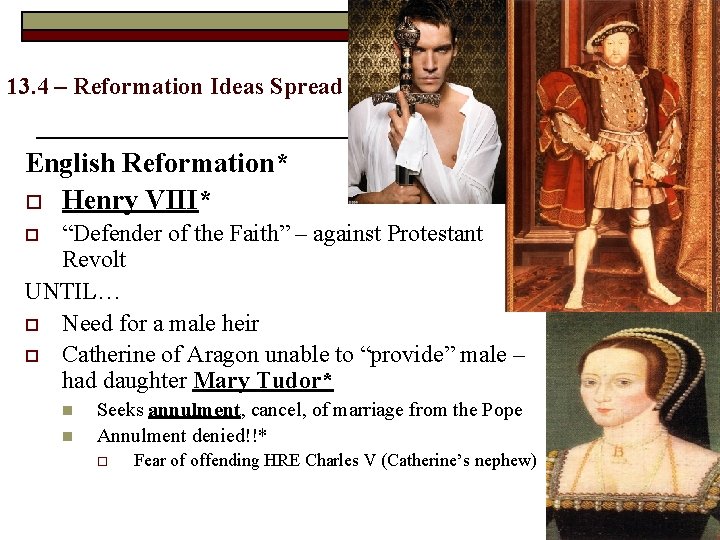
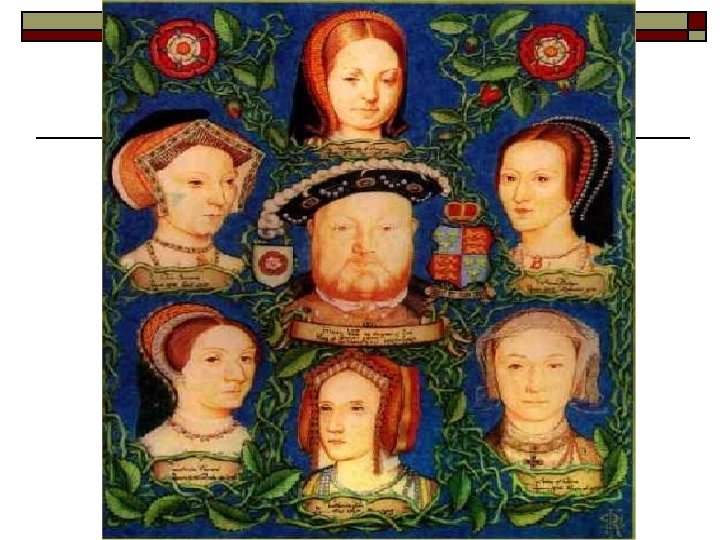
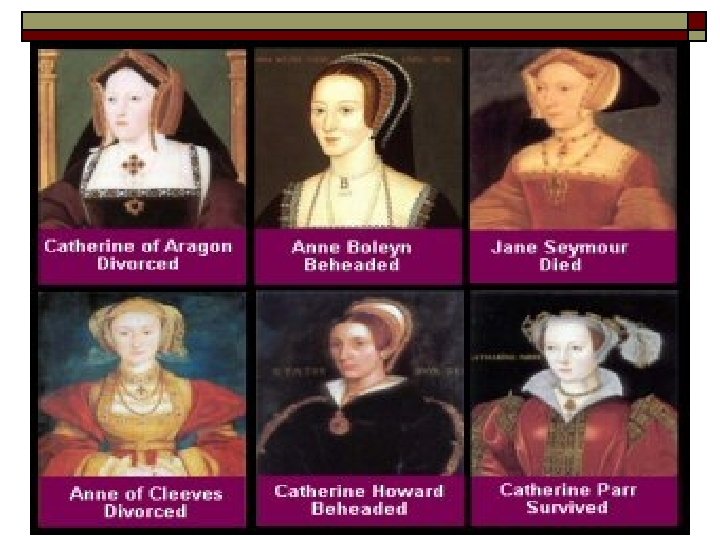
13. 4 – Reformation Ideas Spread English Reformation* o Henry VIII* “Defender of the Faith” – against Protestant Revolt UNTIL… o Need for a male heir o Catherine of Aragon unable to “provide” male – had daughter Mary Tudor* o n n Seeks annulment, cancel, of marriage from the Pope Annulment denied!!* o Fear of offending HRE Charles V (Catherine’s nephew)
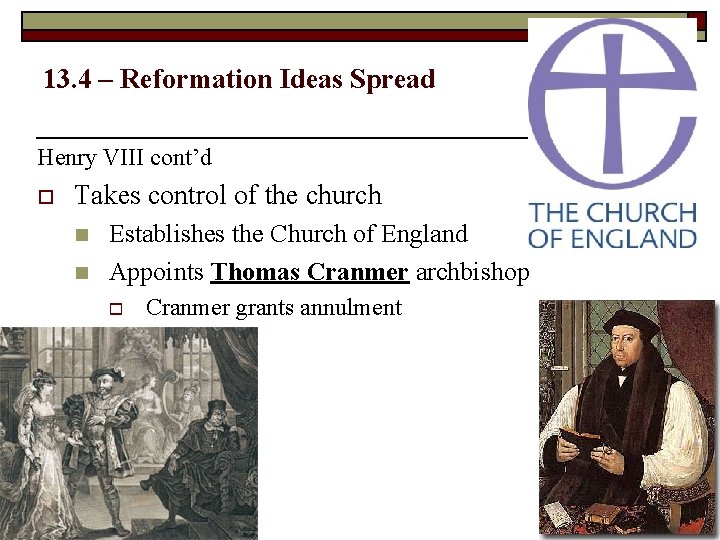
13. 4 – Reformation Ideas Spread Henry VIII cont’d o Takes control of the church n n Establishes the Church of England Appoints Thomas Cranmer archbishop o Cranmer grants annulment
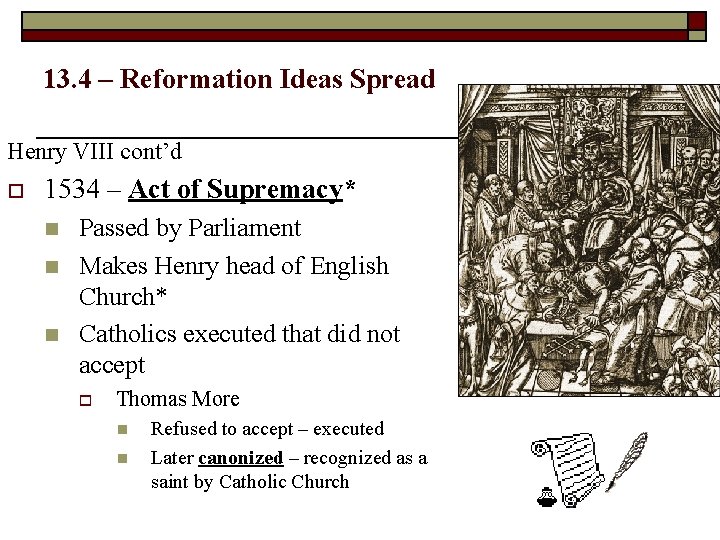
13. 4 – Reformation Ideas Spread Henry VIII cont’d o 1534 – Act of Supremacy* n n n Passed by Parliament Makes Henry head of English Church* Catholics executed that did not accept o Thomas More n n Refused to accept – executed Later canonized – recognized as a saint by Catholic Church
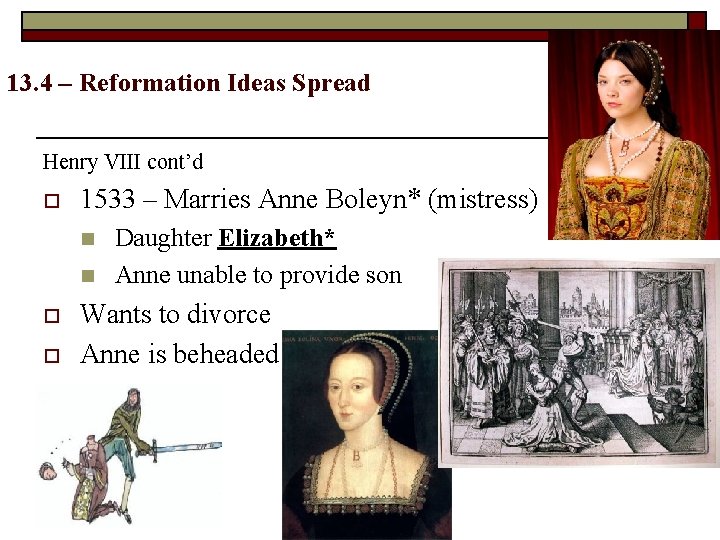
13. 4 – Reformation Ideas Spread Henry VIII cont’d o 1533 – Marries Anne Boleyn* (mistress) n n o o Daughter Elizabeth* Anne unable to provide son Wants to divorce Anne is beheaded
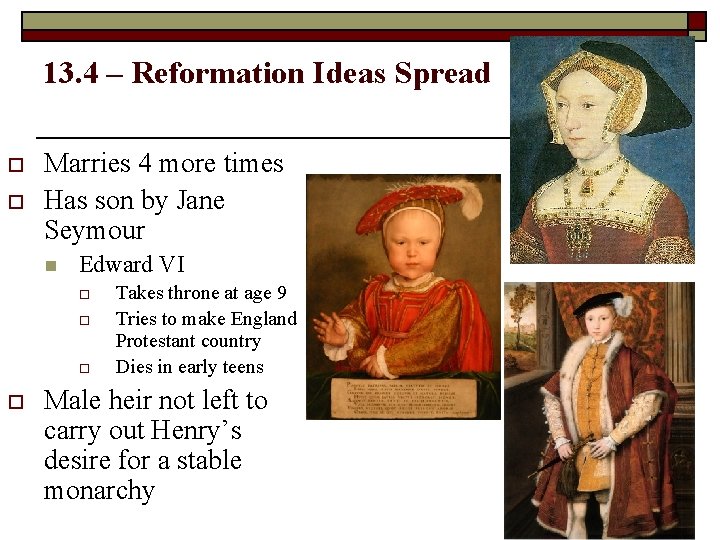
13. 4 – Reformation Ideas Spread o o Marries 4 more times Has son by Jane Seymour n Edward VI o o Takes throne at age 9 Tries to make England Protestant country Dies in early teens Male heir not left to carry out Henry’s desire for a stable monarchy
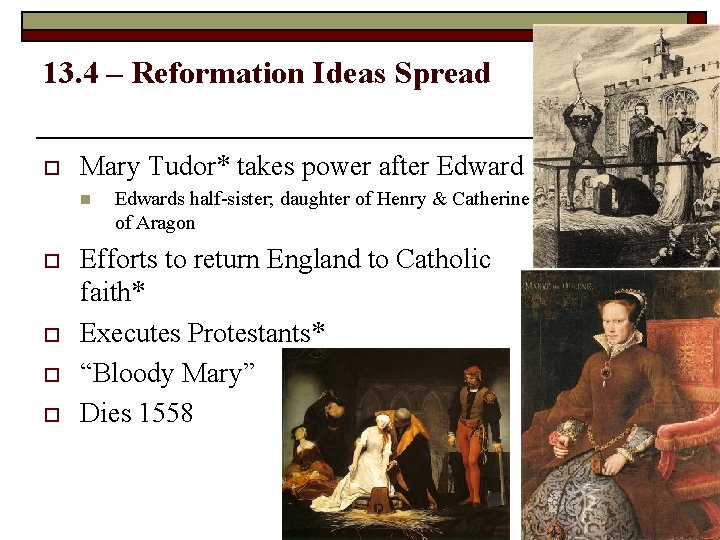
13. 4 – Reformation Ideas Spread o Mary Tudor* takes power after Edward n o o Edwards half-sister; daughter of Henry & Catherine of Aragon Efforts to return England to Catholic faith* Executes Protestants* “Bloody Mary” Dies 1558
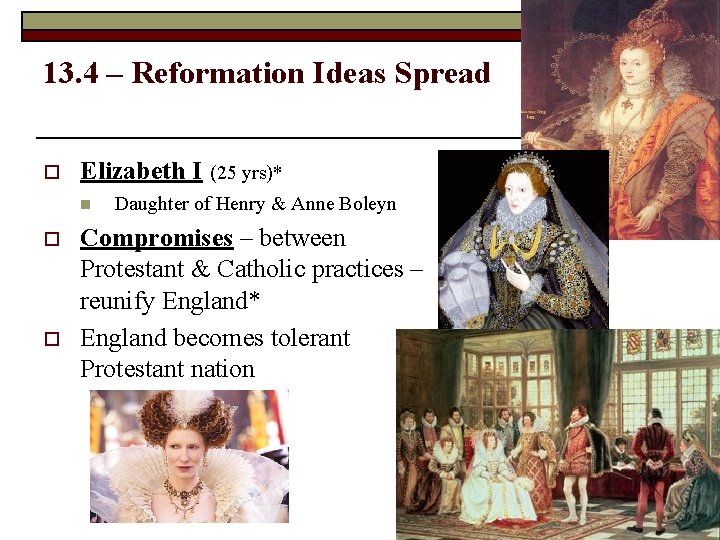
13. 4 – Reformation Ideas Spread o Elizabeth I n o o (25 yrs)* Daughter of Henry & Anne Boleyn Compromises – between Protestant & Catholic practices – reunify England* England becomes tolerant Protestant nation
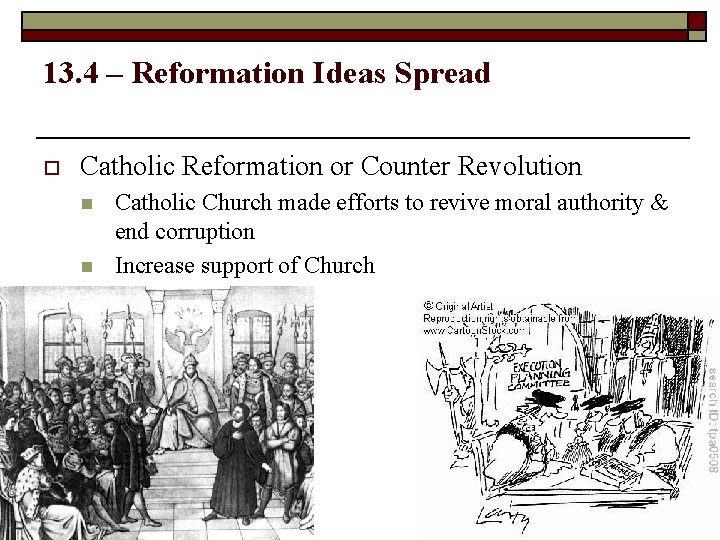
13. 4 – Reformation Ideas Spread o Catholic Reformation or Counter Revolution n n Catholic Church made efforts to revive moral authority & end corruption Increase support of Church
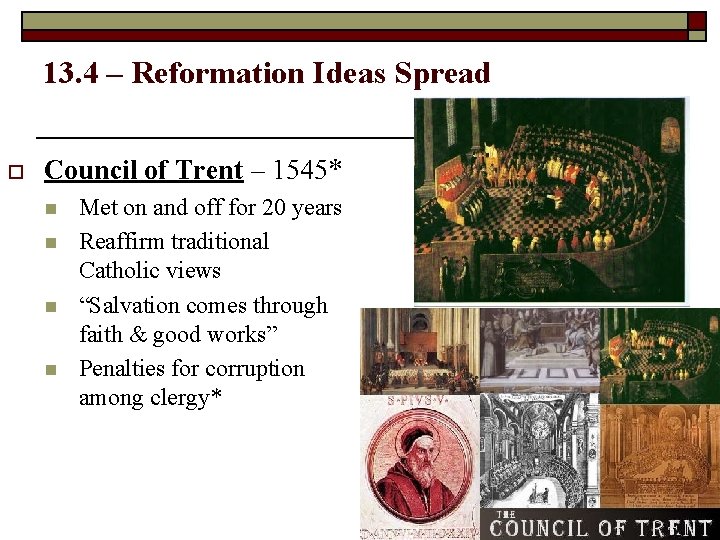
13. 4 – Reformation Ideas Spread o Council of Trent – 1545* n n Met on and off for 20 years Reaffirm traditional Catholic views “Salvation comes through faith & good works” Penalties for corruption among clergy*
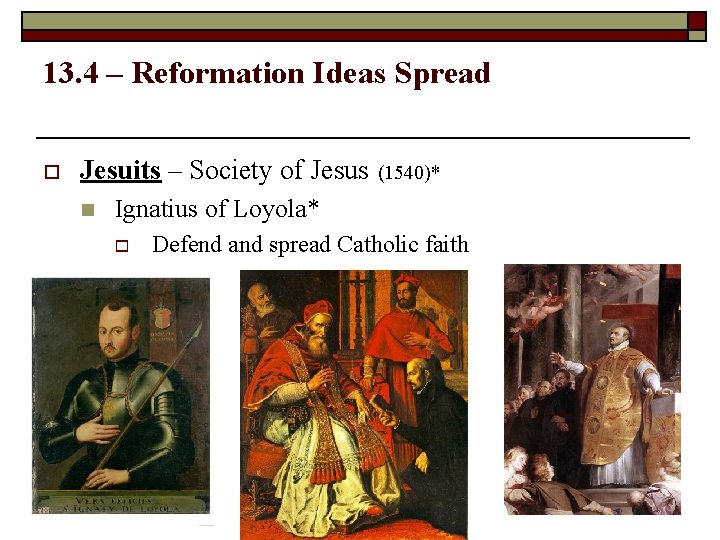
13. 4 – Reformation Ideas Spread o Jesuits – Society of Jesus (1540)* n Ignatius of Loyola* o Defend and spread Catholic faith
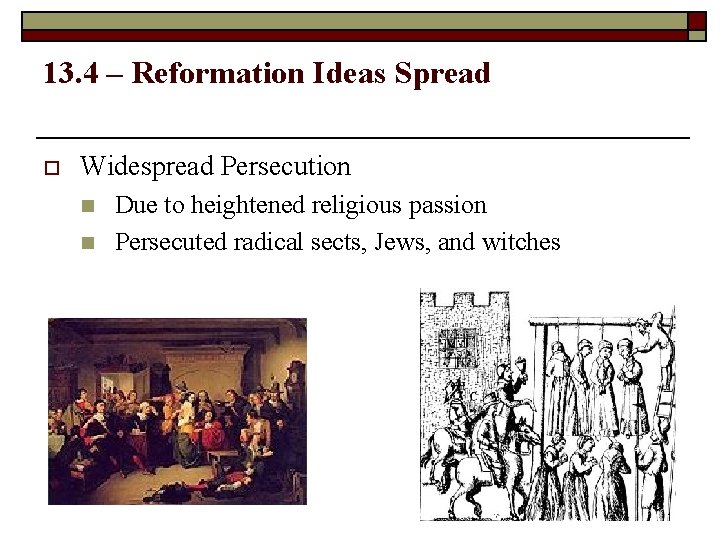
13. 4 – Reformation Ideas Spread o Widespread Persecution n n Due to heightened religious passion Persecuted radical sects, Jews, and witches
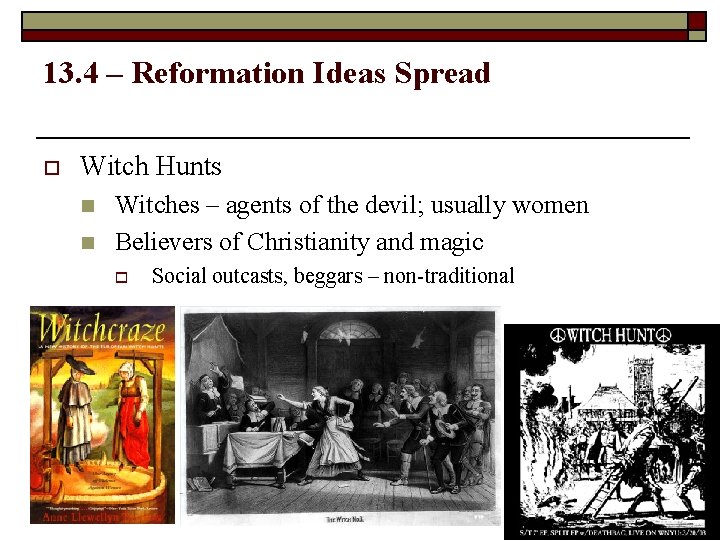
13. 4 – Reformation Ideas Spread o Witch Hunts n n Witches – agents of the devil; usually women Believers of Christianity and magic o Social outcasts, beggars – non-traditional
13. 4 – Reformation Ideas Spread o Jewish Persecution n Those who did not convert forced to live in o Ghettos –separate quarters of the city*
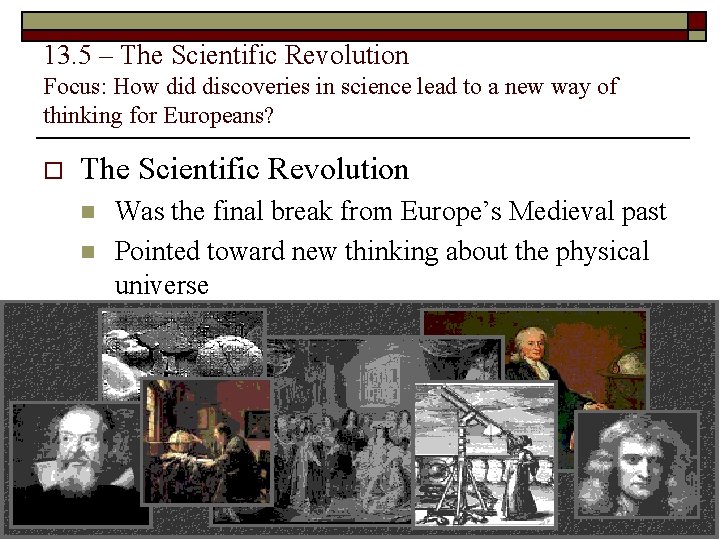
13. 5 – The Scientific Revolution Focus: How did discoveries in science lead to a new way of thinking for Europeans? o The Scientific Revolution n n Was the final break from Europe’s Medieval past Pointed toward new thinking about the physical universe
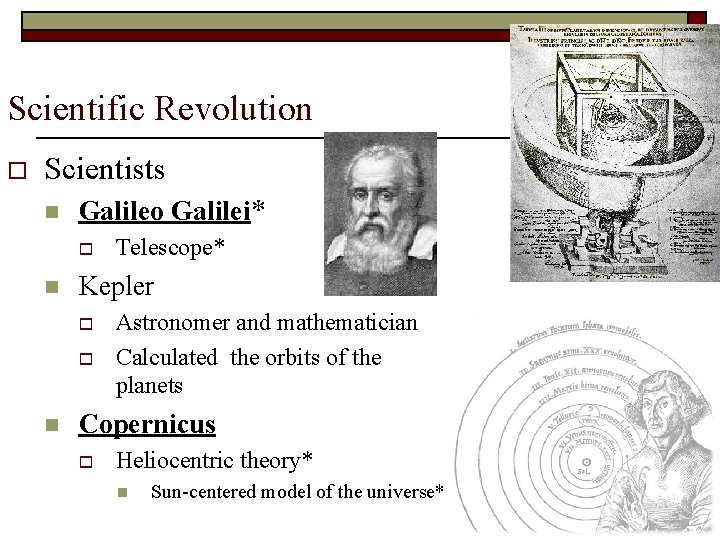
Scientific Revolution o Scientists n Galileo Galilei* o n Kepler o o n Telescope* Astronomer and mathematician Calculated the orbits of the planets Copernicus o Heliocentric theory* n Sun-centered model of the universe*
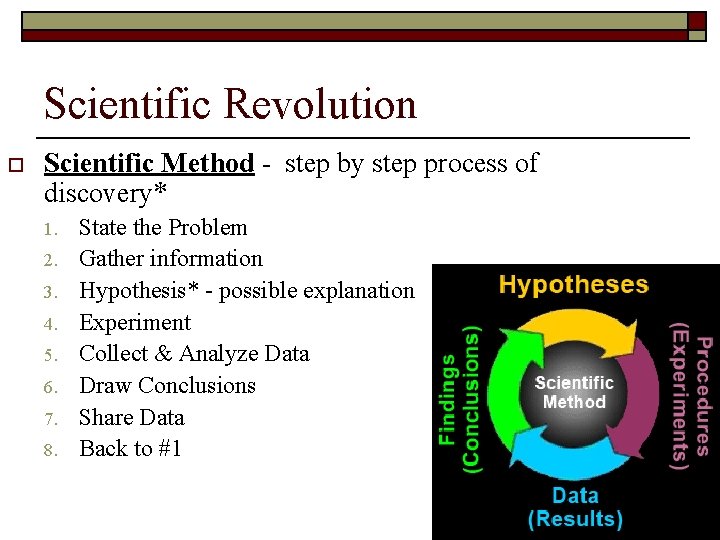
Scientific Revolution o Scientific Method - step by step process of discovery* 1. 2. 3. 4. 5. 6. 7. 8. State the Problem Gather information Hypothesis* - possible explanation Experiment Collect & Analyze Data Draw Conclusions Share Data Back to #1
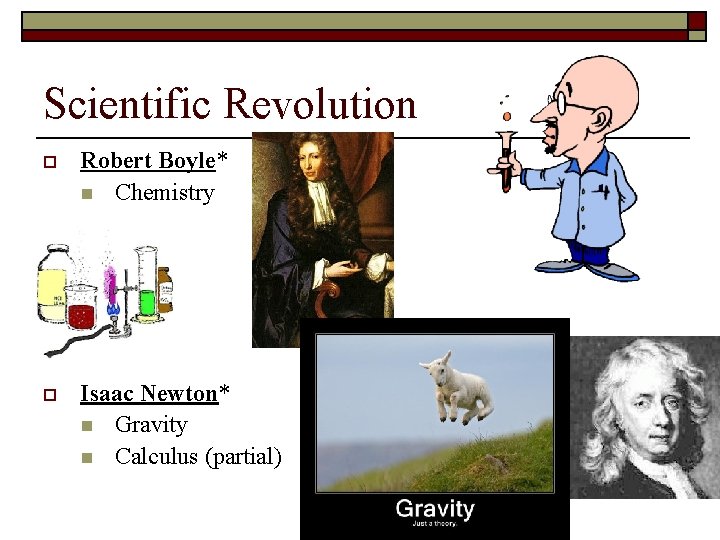
Scientific Revolution o Robert Boyle* n Chemistry o Isaac Newton* n Gravity n Calculus (partial)