The Postanesthesia Care Unit Dr Rafiei PACU n
- Slides: 19
The Postanesthesia Care Unit Dr Rafiei
PACU n n n Recovery from anesthesia can range from completely uncomplicated to life-threatening. Must be managed by skilled medical and nursing personnel. Anesthesiologist plays a key role in optimizing safe recovery from anesthesia.
History of the PACU n n n Methods of anesthesia have been available for more than 160 years, the PACU has only been common for the past 50 years. 1920’s and 30’s: several PACU’s opened in the US and abroad. It was not until after WW II that the number of PACU’s increased significantly. This was do to the shortage of nurses in the US. In 1947 a study was released which showed that over an 11 year period, nearly half of the deaths that occurred during the first 24 hours after surgery were preventable. 1949: having a PACU was considered a standard of care.
PACU Staffing n n n One nurse to one patient for the first 15 minutes of recovery. Then one nurse for every two patients. The anesthesiologist responsible for the surgical anesthetic remains responsible for managing the patient in the PACU.
PACU Location n n n Should be located close to the operating suite. Immediate access to x-ray, blood bank, blood gas and clinical labs. Should have 1. 5 PACU beds per operating room used. An open ward is optimal for patient observation, with at least one isolation room. Central nursing station. Piped in oxygen, air, and vacuum for suction. Requires good ventilation, because the exposure to waste anesthetic gases may be hazardous. National Institute of Occupational Safety (NIOSH) has established recommended exposure limits of 25 ppm for nitrous and 2 ppm for volatile anesthetics.
PACU Equipment n n Automated BP, pulse ox, EKG, and intravenous supports should be located at each bed. Area for charting, bed-side supply storage, suction, and oxygen flow meter at each bedside. Capability for arterial and CVP monitoring. Supply of immediately available emergency equipment. Crash cart. Defibrillator.
Admission Report § § Preoperative history Intra-operative factors: § § § Procedure Type of anesthesia EBL UO Assessment and report of current status Post-operative instructions
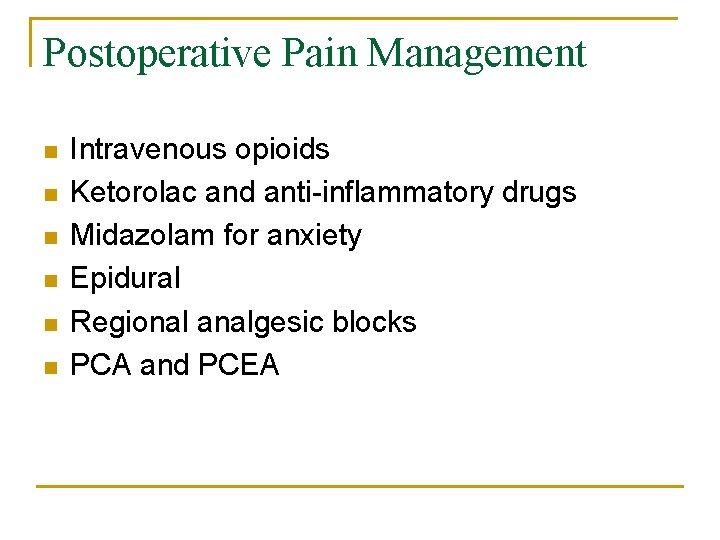
Postoperative Pain Management n n n Intravenous opioids Ketorolac and anti-inflammatory drugs Midazolam for anxiety Epidural Regional analgesic blocks PCA and PCEA
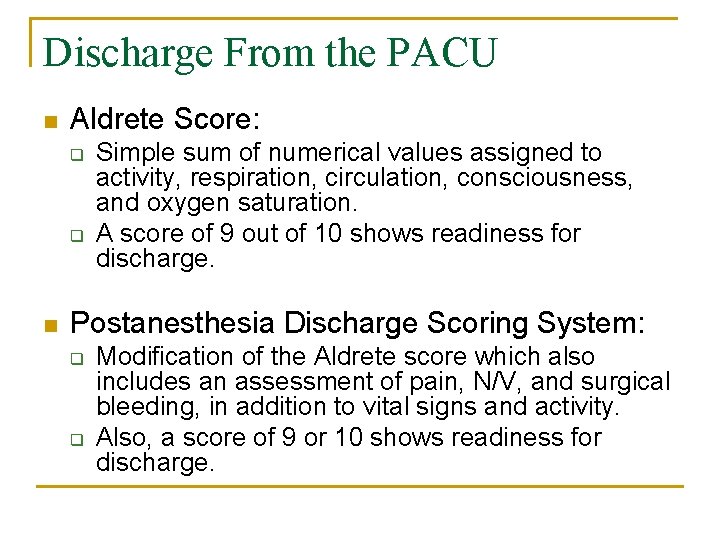
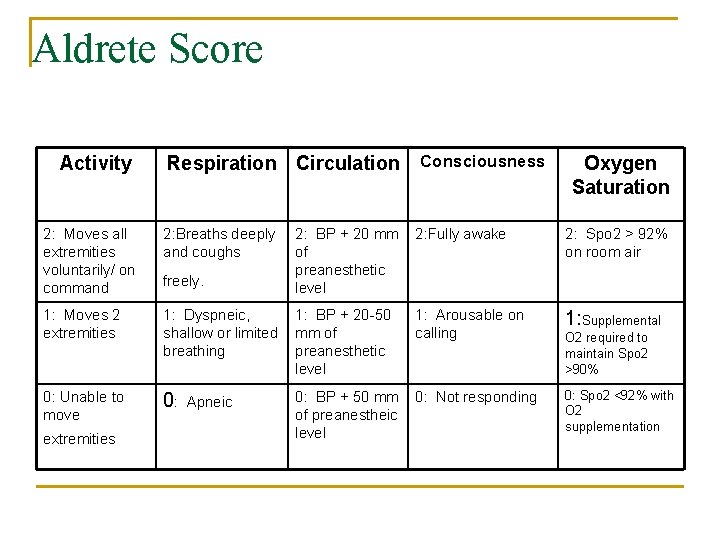
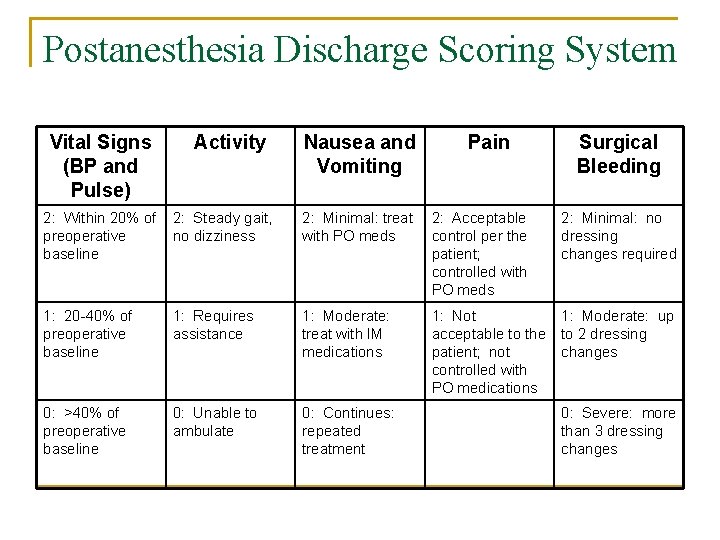
Discharge From the PACU n Aldrete Score: q q n Simple sum of numerical values assigned to activity, respiration, circulation, consciousness, and oxygen saturation. A score of 9 out of 10 shows readiness for discharge. Postanesthesia Discharge Scoring System: q q Modification of the Aldrete score which also includes an assessment of pain, N/V, and surgical bleeding, in addition to vital signs and activity. Also, a score of 9 or 10 shows readiness for discharge.
Aldrete Score Activity Respiration Circulation 2: Moves all extremities voluntarily/ on command 2: Breaths deeply and coughs 1: Moves 2 extremities 0: Unable to move extremities Consciousness Oxygen Saturation 2: BP + 20 mm of preanesthetic level 2: Fully awake 2: Spo 2 > 92% on room air 1: Dyspneic, shallow or limited breathing 1: BP + 20 -50 mm of preanesthetic level 1: Arousable on calling 1: Supplemental 0: BP + 50 mm of preanestheic level 0: Not responding 0: Spo 2 <92% with O 2 supplementation freely. Apneic O 2 required to maintain Spo 2 >90%
Postanesthesia Discharge Scoring System Vital Signs (BP and Pulse) Activity Nausea and Vomiting Pain Surgical Bleeding 2: Within 20% of preoperative baseline 2: Steady gait, no dizziness 2: Minimal: treat with PO meds 2: Acceptable control per the patient; controlled with PO meds 2: Minimal: no dressing changes required 1: 20 -40% of preoperative baseline 1: Requires assistance 1: Moderate: treat with IM medications 1: Not acceptable to the patient; not controlled with PO medications 1: Moderate: up to 2 dressing changes 0: >40% of preoperative baseline 0: Unable to ambulate 0: Continues: repeated treatment 0: Severe: more than 3 dressing changes
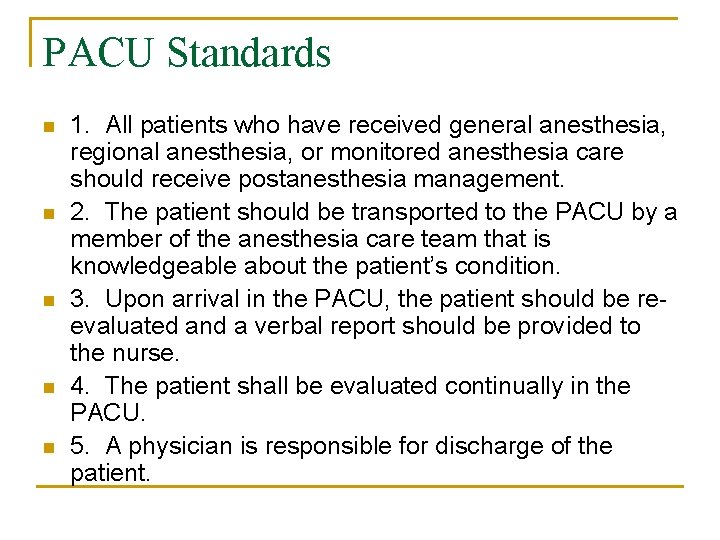
PACU Standards n n n 1. All patients who have received general anesthesia, regional anesthesia, or monitored anesthesia care should receive postanesthesia management. 2. The patient should be transported to the PACU by a member of the anesthesia care team that is knowledgeable about the patient’s condition. 3. Upon arrival in the PACU, the patient should be reevaluated and a verbal report should be provided to the nurse. 4. The patient shall be evaluated continually in the PACU. 5. A physician is responsible for discharge of the patient.
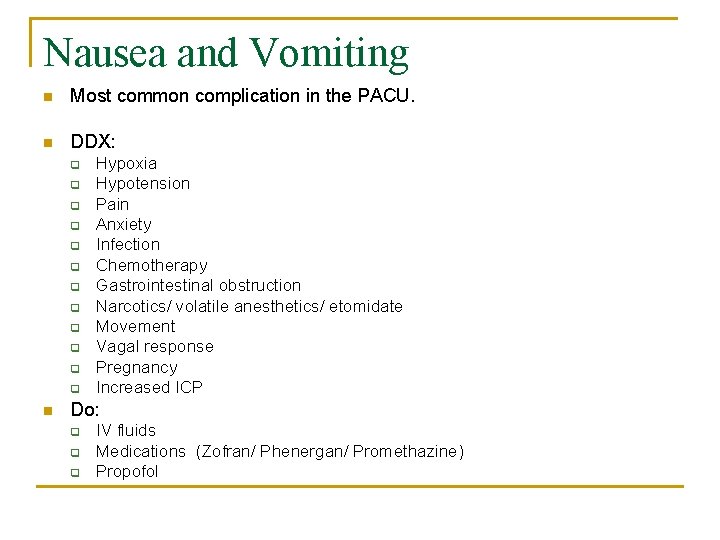
Nausea and Vomiting n Most common complication in the PACU. n DDX: q q q n Hypoxia Hypotension Pain Anxiety Infection Chemotherapy Gastrointestinal obstruction Narcotics/ volatile anesthetics/ etomidate Movement Vagal response Pregnancy Increased ICP Do: q q q IV fluids Medications (Zofran/ Phenergan/ Promethazine) Propofol
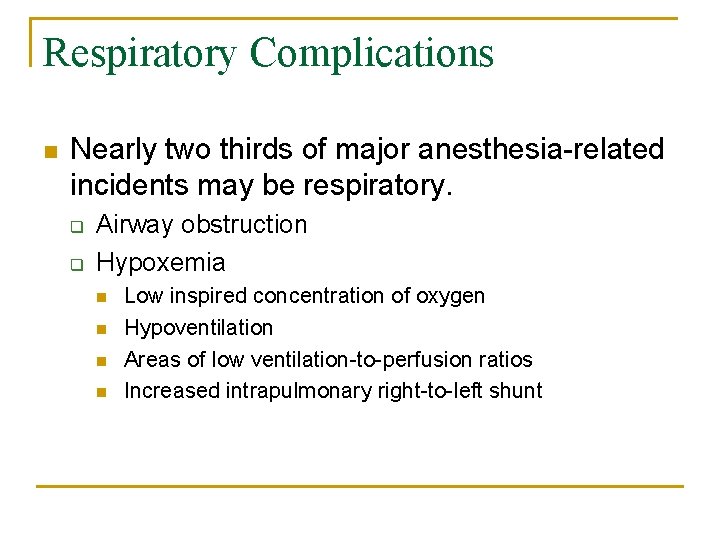
Respiratory Complications n Nearly two thirds of major anesthesia-related incidents may be respiratory. q q Airway obstruction Hypoxemia n n Low inspired concentration of oxygen Hypoventilation Areas of low ventilation-to-perfusion ratios Increased intrapulmonary right-to-left shunt
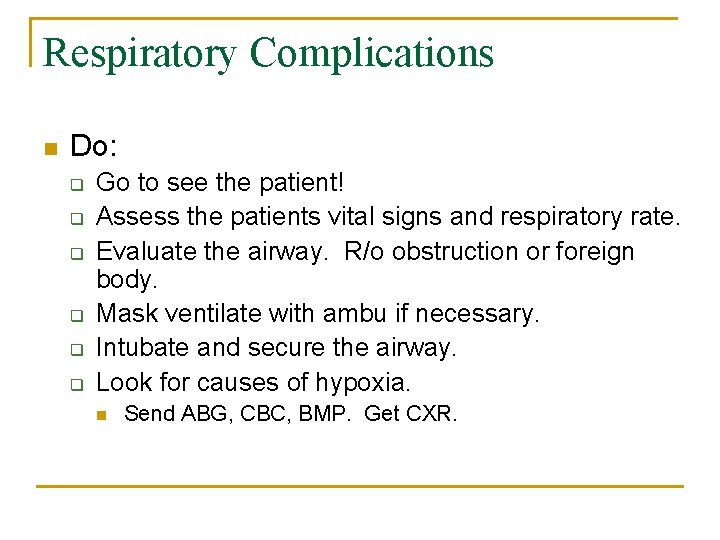
Respiratory Complications n Do: q q q Go to see the patient! Assess the patients vital signs and respiratory rate. Evaluate the airway. R/o obstruction or foreign body. Mask ventilate with ambu if necessary. Intubate and secure the airway. Look for causes of hypoxia. n Send ABG, CBC, BMP. Get CXR.
Failure to Regain Consciousness n n n n Preoperative intoxication Residual anesthetics: IV or inhaled Profound neuromuscular block Profound hypothermia Electrolyte abnormalities Thromboembolic cerebrovascular accident Seizure
Myocardial Ischemia n n n Increased risk: q History of CAD q CHF q Smoker q HTN q Tachycardia q Severe hypoxemia q Anemia Same risk if the patient has GA or regional anesthesia. Treatment q Oxygen, ASA, NTG, and morphine if needed q 12 lead EKG q History q Consult cardiology
Fever n Causes: q q q Infections Drug / blood reactions Tissue damage Neoplastic disorders Metabolic disorders n n n Thyroid storm Adrenal crisis Pheochromocytoma MH Neuroleptic malignant syndrome Acute porphyria
Bibliography n n n Miller: Miller’s Anesthesia, 6 th ed. (2005) Baresh: Clinical Anesthesia, 4 th ed. (2001) Morgan: Clinical Anesthesiology, 3 rd ed. (2002)