
Chapter 17 Preoperative Nursing Management Copyright 2014 Wolters

- Slides: 74
Chapter 17 Preoperative Nursing Management Copyright © 2014 Wolters Kluwer Health | Lippincott Williams & Wilkins
Perioperative Nursing • Preoperative phase: period of time from decision for surgery until patient is transferred into operating room • Intraoperative phase: period of time from when patient is transferred into operating room to admission to postanesthesia care unit (PACU) • Postoperative phase: period of time from when patient is admitted to PACU to follow-up evaluation in clinical setting or at home Copyright © 2014 Wolters Kluwer Health | Lippincott Williams & Wilkins
Surgical Classifications • Seriousness – Major – Minor • Urgency – Elective – Urgent – Emergency • Purpose Copyright © 2014 Wolters Kluwer Health | Lippincott Williams & Wilkins
Surgical Classifications • Purpose – Diagnostic – Ablative – Palliative – Reconstructive/Restorative – Procurement – Constructive – Cosmetic Copyright © 2014 Wolters Kluwer Health | Lippincott Williams & Wilkins
Preadmission Testing • Initiates initial preoperative assessment • Initiates teaching appropriate to patient’s needs • Involves family in interview • Verifies completion of preoperative diagnostic testing • Verifies understanding of surgeon-specific preoperative orders • Discusses, reviews advanced-directive document • Begins discharge planning by assessing patient’s need for postoperative transportation, care Copyright © 2014 Wolters Kluwer Health | Lippincott Williams & Wilkins
Gerontological Considerations • Cardiac and circulatory compromise • Respiratory compromise • Renal function • Confusion • Fluid and electrolyte imbalances • Skin • Comorbidities • Altered sensory • Mobility restrictions Copyright © 2014 Wolters Kluwer Health | Lippincott Williams & Wilkins
Special Considerations During Preoperative Period • Bariatric patients or persons who are obese • Patients with disabilities • Patients undergoing ambulatory surgery • Patients undergoing emergency surgery Copyright © 2014 Wolters Kluwer Health | Lippincott Williams & Wilkins
Informed Consent • Client’s decision • Responsibility of surgeon • Nurse witness the signature • Must be signed prior to premed Copyright © 2014 Wolters Kluwer Health | Lippincott Williams & Wilkins
Preoperative Assessment • Nutritional, fluid status • Dentition • Drug or alcohol use • Respiratory status • Cardiovascular status • Hepatic, renal function Copyright © 2014 Wolters Kluwer Health | Lippincott Williams & Wilkins
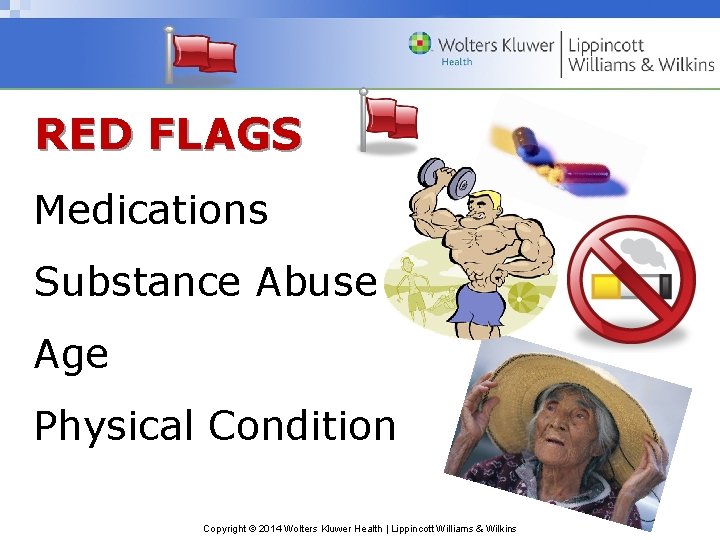
RED FLAGS Medications Substance Abuse Age Physical Condition Copyright © 2014 Wolters Kluwer Health | Lippincott Williams & Wilkins
Preoperative Assessment (cont’d) • Endocrine function • Immune function • Previous medication use • Psychosocial factors • Spiritual, cultural beliefs Copyright © 2014 Wolters Kluwer Health | Lippincott Williams & Wilkins
Medications that Potentially Affect on Surgical Experience • Corticosteroids • Anticoagulants • Diuretics • Antiseizure medications • Phenothiazines • Thyroid hormone • Tranquilizers • Opioids • Insulin • OTC and herbals • Antibiotics Copyright © 2014 Wolters Kluwer Health | Lippincott Williams & Wilkins
How Medications Potentially Affect on Surgical Experience Diuretics during anesthesia may cause excessive respiratory depression resulting from an associated electrolyte imbalance. Corticosteroids can cause cardiovascular collapse if discontinued suddenly. Phenothiazines may increase the hypotensive action of anesthetics. Interaction between anesthetics and insulin must be considered when a patient with diabetes mellitus undergoes surgery. Copyright © 2014 Wolters Kluwer Health | Lippincott Williams & Wilkins
Informed Consent • Client’s agreement to allow something to happen such as a surgery, treatment or procedure. • Should be in writing • Should contain the following: – Explanation of procedure, risks – Description of benefits, alternatives – Offer to answer questions about procedure – Instructions that patient may withdraw consent – Statement informing patient if protocol differs from customary procedure Copyright © 2014 Wolters Kluwer Health | Lippincott Williams & Wilkins
Voluntary Consent • Valid consent must be freely given, without coercion • Patient must be at least 18 years of age (unless emancipated minor) • Consent must be obtained by physician • Patient’s signature must be witnessed by professional staff member Copyright © 2014 Wolters Kluwer Health | Lippincott Williams & Wilkins
Incompetent Patient • Individual who is not autonomous • Cannot give or withhold consent – Cognitively impaired – Mentally ill – Neurologically incapacitated Copyright © 2014 Wolters Kluwer Health | Lippincott Williams & Wilkins
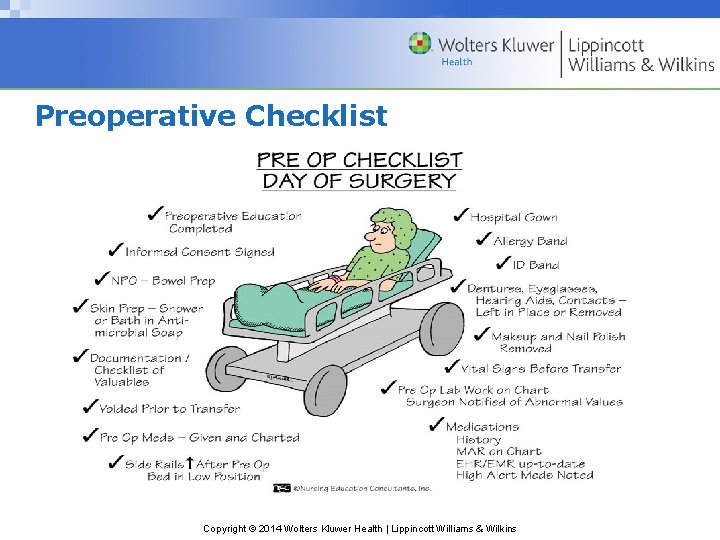
Preoperative Checklist • Must be completed prior to client going to surgery • Responsibility of nurse sending client to surgery to ensure checklist is complete – • Contains critical elements that MUST be checked and verified before client is sent to surgery Copyright © 2014 Wolters Kluwer Health | Lippincott Williams & Wilkins
Preoperative Checklist Copyright © 2014 Wolters Kluwer Health | Lippincott Williams & Wilkins
Preoperative • Check chart for orders for preoperative preps, medications, labs, diagnostic test • Ensure client is NPO for at least 6 -8 hours prior to surgery – check orders for specific times • Ensure all dentures, jewelry, makeup, hair clips, nail polish, glasses etc… removed and placed in a secure place • Assess for any changes in client assessment Copyright © 2014 Wolters Kluwer Health | Lippincott Williams & Wilkins
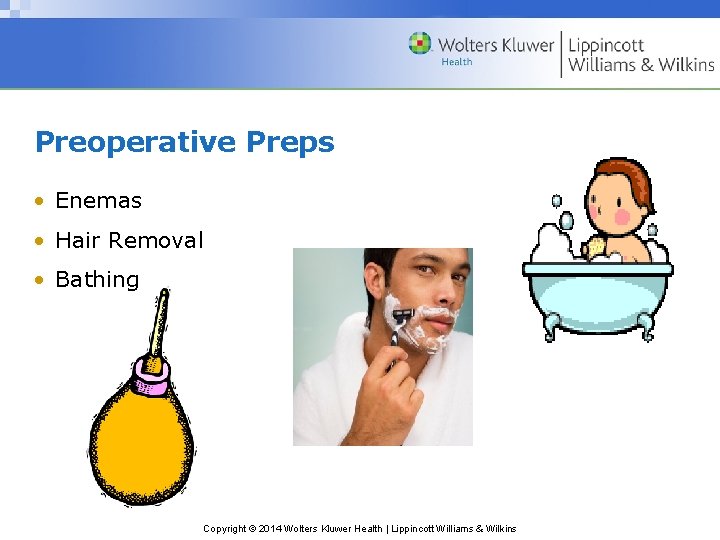
Preoperative Preps • Enemas • Hair Removal • Bathing Copyright © 2014 Wolters Kluwer Health | Lippincott Williams & Wilkins
Patient Education • Deep breathing, coughing, incentive spirometry • Mobility, active body movement • Pain management • Cognitive coping strategies • Instruction for patients undergoing ambulatory surgery Copyright © 2014 Wolters Kluwer Health | Lippincott Williams & Wilkins
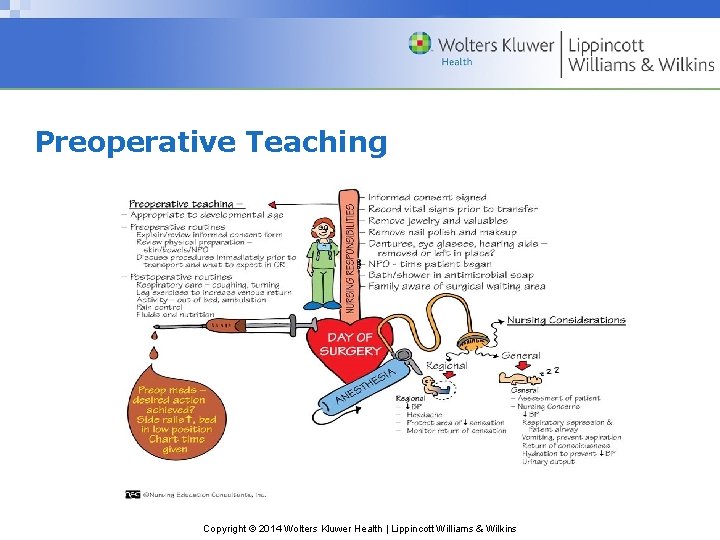
Preoperative Teaching Copyright © 2014 Wolters Kluwer Health | Lippincott Williams & Wilkins
General Preoperative Nursing Interventions • Providing psychosocial interventions – Reducing anxiety, decreasing fear – Respecting cultural, spiritual, religious beliefs • Maintaining patient safety • Managing nutrition, fluids • Preparing bowel • Preparing skin Copyright © 2014 Wolters Kluwer Health | Lippincott Williams & Wilkins
Immediate Preoperative Nursing Interventions • Administering preanesthetic medication • Maintaining preoperative record • Transporting patient to presurgical area • Attending to family needs Copyright © 2014 Wolters Kluwer Health | Lippincott Williams & Wilkins
Preoperative Instructions to Prevent Postoperative Complications • Diaphragmatic breathing • Coughing • Leg exercises • Turning to side • Getting out of bed Copyright © 2014 Wolters Kluwer Health | Lippincott Williams & Wilkins
Preoperative Summary • Nursing process – Preoperative assessment – Formulate nurse diagnosis – Expected outcomes – Nursing interventions Copyright © 2014 Wolters Kluwer Health | Lippincott Williams & Wilkins
Chapter 18 Intraoperative Nursing Management Copyright © 2014 Wolters Kluwer Health | Lippincott Williams & Wilkins
Members of the Surgical Team • Patient • Circulating nurse • Scrub role • Surgeon • Registered nurse first assistant • Anesthesiologist, anesthetist Copyright © 2014 Wolters Kluwer Health | Lippincott Williams & Wilkins
Gerontologic Considerations • Older adult patients are at increased risk for complications of surgery, anesthesia due to – Increased likelihood of coexisting conditions – Aging heart, pulmonary systems – Decreased homeostatic mechanisms – Changes in responses to drugs, anesthetic agents due to aging changes (decreased renal function), changes in body composition of fat, water Copyright © 2014 Wolters Kluwer Health | Lippincott Williams & Wilkins
Prevention of Infection • Surgical environment, refer to Figure 18 -1 – Unrestricted zone – Semirestricted zone – Restricted zone • Surgical asepsis • Environmental controls • Refer to Figure 18 -2 Copyright © 2014 Wolters Kluwer Health | Lippincott Williams & Wilkins
Basic Guidelines for Surgical Asepsis • All material within sterile field must be sterile • Gowns sterile in front from chest to level of sterile field, sleeves from 2 inches above elbow to cuff • Only top of draped tables considered sterile • Items dispensed by methods to preserve sterility • Movements of surgical team are from sterile to sterile, from unsterile to unsterile only Copyright © 2014 Wolters Kluwer Health | Lippincott Williams & Wilkins
Guidelines for Surgical Asepsis (cont’d) • Movement at least 1 -foot distance from sterile field must be maintained • When sterile barrier is breached, area is considered contaminated • Every sterile field is constantly maintained, monitored – Items of doubtful sterility considered unsterile • Sterile fields prepared as close to time of use Copyright © 2014 Wolters Kluwer Health | Lippincott Williams & Wilkins
Surgical Team Roles • Circulating nurse • Scrub role • Surgeon • Registered nurse first assistant • Anesthesiologist, anesthetist • Note: Role of nurse as patient advocate • Refer to Chart 18 -1 Copyright © 2014 Wolters Kluwer Health | Lippincott Williams & Wilkins
Intraoperative Complications • Anesthesia awareness • Hypothermia • Nausea, vomiting • Malignant hyperthermia • Anaphylaxis • Disseminated intravascular coagulation (DIC) • Hypoxia, respiratory complications • Infection Copyright © 2014 Wolters Kluwer Health | Lippincott Williams & Wilkins
Adverse Effects of Surgery and Anesthesia • Allergic reactions, drug toxicity or reactions • Cardiac dysrhythmias • CNS changes, oversedation, undersedation • Trauma: laryngeal, oral, nerve, skin, including burns • Hypotension • Thrombosis • Refer to Chart 18 -2 Copyright © 2014 Wolters Kluwer Health | Lippincott Williams & Wilkins
Question Through which route are general anesthetics primarily eliminated? A. Kidneys B. Liver C. Lungs D. Skin Copyright © 2014 Wolters Kluwer Health | Lippincott Williams & Wilkins
Answer C. Lungs Rationale: The lungs are the primary route from which general anesthetics are eliminated from the body. Copyright © 2014 Wolters Kluwer Health | Lippincott Williams & Wilkins
Comparison of Anesthetic Agents and Delivery Systems • General • Inhalation: Refer to Table 18– 1; Figure 18 -3 (A, B, C) • Intravenous: Refer to Table 18 -2 • Regional: Refer to Table 18 -3 • Epidural: Refer to Figure 18 -4 • Spinal: Refer to Figure 18 -4 Copyright © 2014 Wolters Kluwer Health | Lippincott Williams & Wilkins
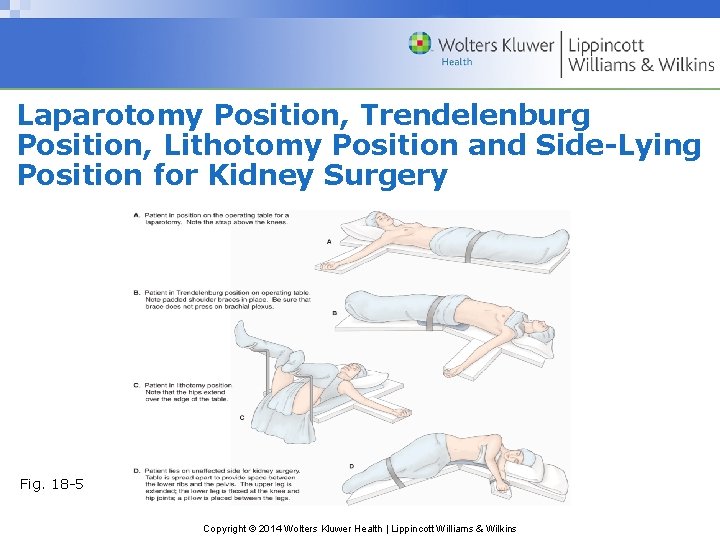
Nursing Process: Interventions • Reducing anxiety • Reducing latex exposure • Preventing positioning injuries, refer to Figure 18 -5 • Protecting patient from injury • Serving as patient advocate • Monitoring, managing potential complications Copyright © 2014 Wolters Kluwer Health | Lippincott Williams & Wilkins
Laparotomy Position, Trendelenburg Position, Lithotomy Position and Side-Lying Position for Kidney Surgery Fig. 18 -5 Copyright © 2014 Wolters Kluwer Health | Lippincott Williams & Wilkins
Positioning Factors to Consider • Patient should be as comfortable as possible • Operative field must be adequately exposed • Position must not obstruct/compress respirations, vascular supply, or nerves • Extra safety precautions for older adults, patients who are thin or obese, and anyone with a physical deformity • Light restraint before induction in case of excitement Copyright © 2014 Wolters Kluwer Health | Lippincott Williams & Wilkins
Protecting the Patient From Injury • Patient identification • Correct informed consent • Verification of records of health history, exam • Results of diagnostic tests • Allergies (include latex allergy) • Monitoring, modifying physical environment • Safety measures (grounding of equipment, restraints, not leaving a sedated patient) • Verification, accessibility of blood Copyright © 2014 Wolters Kluwer Health | Lippincott Williams & Wilkins
Chapter 19 Postoperative Nursing Management Copyright © 2014 Wolters Kluwer Health | Lippincott Williams & Wilkins
Nursing Management in the PACU • Provide care for patient until patient has recovered from effects of anesthesia • Patient has resumption of motor and sensory function, is oriented, has stable VS, shows no evidence of hemorrhage or other complications of surgery • Vital to perform frequent skilled assessment of patient Copyright © 2014 Wolters Kluwer Health | Lippincott Williams & Wilkins
Postanesthesia Care Unit (Recovery) • Refer to Figure 19 -3 • PACU environment • Beds, other equipment • Three phases – Phase I- immediate recovery – Phase II-client prepare for self care in hospital – Phase III-client prepare for discharge Copyright © 2014 Wolters Kluwer Health | Lippincott Williams & Wilkins
Responsibilities of the PACU Nurse • Review pertinent information, baseline assessment upon admission to unit • Assess airway, respirations, cardiovascular function, surgical site, function of CNS, IVs, all tubes and equipment • Reassess VS, patient status every 15 minutes or more frequently as needed • Transfer report, to another unit or discharge patient to home, refer to Charts 19 -1 and 19 -3 Copyright © 2014 Wolters Kluwer Health | Lippincott Williams & Wilkins
Postoperative The primary nursing goal in the immediate postoperative period is maintenance of pulmonary function and prevention of hypoxemia and hypercapnia. Copyright © 2014 Wolters Kluwer Health | Lippincott Williams & Wilkins
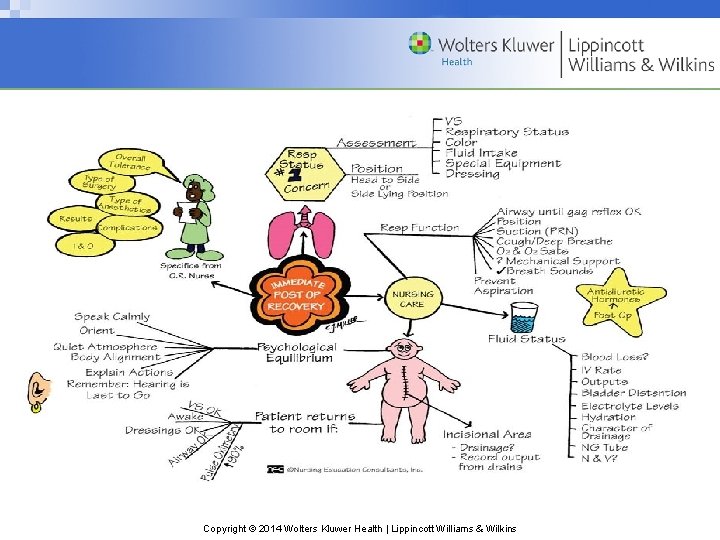
Copyright © 2014 Wolters Kluwer Health | Lippincott Williams & Wilkins
Outpatient Surgery/Direct Discharge • Discharge planning, discharge assessment • Refer to Charts 19 -2 and 19 -5 • Provide written, verbal instructions regarding follow-up care, complications, wound care, activity, medications, diet • Give prescriptions, phone numbers – Discuss actions to take if complications occur Copyright © 2014 Wolters Kluwer Health | Lippincott Williams & Wilkins
Outpatient Surgery/Direct Discharge (cont’d) • Give instructions to patient, responsible adult who will accompany patient • Patients are not to drive home or be discharge to home alone – Sedation, anesthesia may cloud memory, judgment, effect ability Copyright © 2014 Wolters Kluwer Health | Lippincott Williams & Wilkins
Maintaining a Patent Airway • Primary consideration: necessary to maintain ventilation, oxygenation • Provide supplemental oxygen as indicated • Assess breathing by placing hand near face to feel movement of air • Keep head of bed elevated 15 to 30 degrees unless contraindicated • May require suctioning • If vomiting occurs, turn patient to side Copyright © 2014 Wolters Kluwer Health | Lippincott Williams & Wilkins
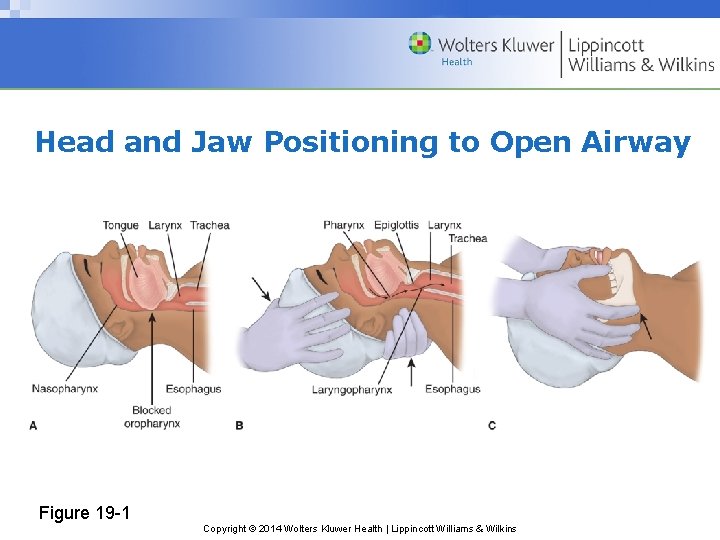
Head and Jaw Positioning to Open Airway Figure 19 -1 Copyright © 2014 Wolters Kluwer Health | Lippincott Williams & Wilkins
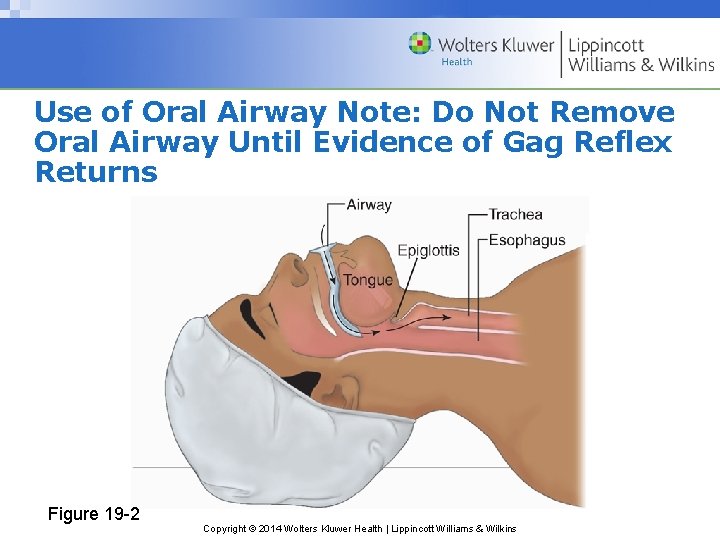
Use of Oral Airway Note: Do Not Remove Oral Airway Until Evidence of Gag Reflex Returns Figure 19 -2 Copyright © 2014 Wolters Kluwer Health | Lippincott Williams & Wilkins
Maintaining Cardiovascular Stability • Monitor all indicators of cardiovascular status • Assess all IV lines • Potential for hypotension, shock • Potential for hemorrhage • Potential for hypertension, dysrhythmias • Refer to Table 19 -1 Copyright © 2014 Wolters Kluwer Health | Lippincott Williams & Wilkins
Indicators of Hypovolemic Shock • Pallor • Cool, moist skin • Rapid respirations • Cyanosis • Rapid, weak, thready pulse • Decreasing pulse pressure • Low blood pressure • Concentrated urine Copyright © 2014 Wolters Kluwer Health | Lippincott Williams & Wilkins
Relieving Pain and Anxiety • Assess patient comfort • Control of environment: quiet, low lights, noise level • Administer analgesics as indicated; usually short-acting opioids IV • Family visit, dealing with family anxiety • Refer to Chart 19 -6 Copyright © 2014 Wolters Kluwer Health | Lippincott Williams & Wilkins
Controlling Nausea and Vomiting • Intervene at first indication of nausea • Medications • Assessment of postoperative nausea, vomiting risk, prophylactic treatment • Refer to Table 19 -2 Copyright © 2014 Wolters Kluwer Health | Lippincott Williams & Wilkins
Postoperative The most important nursing intervention when vomiting occurs postoperatively is to turn the patient’s head to prevent aspiration of vomitus into the lungs. Copyright © 2014 Wolters Kluwer Health | Lippincott Williams & Wilkins
Gerontologic Considerations • Decreased physiologic reserve • Monitor carefully, frequently • Increased confusion • Dosage • Increased likelihood of postoperative confusion, delirium • Hypoxia, hypotension, hypoglycemia • Reorient as needed • Pain • Hydration • Refer to Chart 19 -7 Copyright © 2014 Wolters Kluwer Health | Lippincott Williams & Wilkins
Wound Healing • First-intention wound healing • Second-intention wound healing • Third-intention wound healing • Factors that affect wound healing • Refer to Chart 19 -4 and Table 19 -3 Copyright © 2014 Wolters Kluwer Health | Lippincott Williams & Wilkins
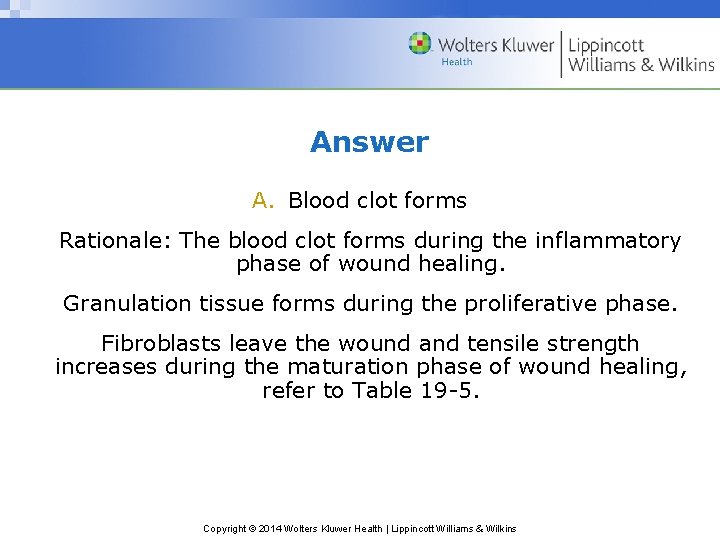
Question Which of the following occurs during the inflammatory stage of wound healing? A. Blood clot forms B. Granulation tissue forms C. Fibroblasts leave wound D. Tensile strength increases Copyright © 2014 Wolters Kluwer Health | Lippincott Williams & Wilkins
Answer A. Blood clot forms Rationale: The blood clot forms during the inflammatory phase of wound healing. Granulation tissue forms during the proliferative phase. Fibroblasts leave the wound and tensile strength increases during the maturation phase of wound healing, refer to Table 19 -5. Copyright © 2014 Wolters Kluwer Health | Lippincott Williams & Wilkins
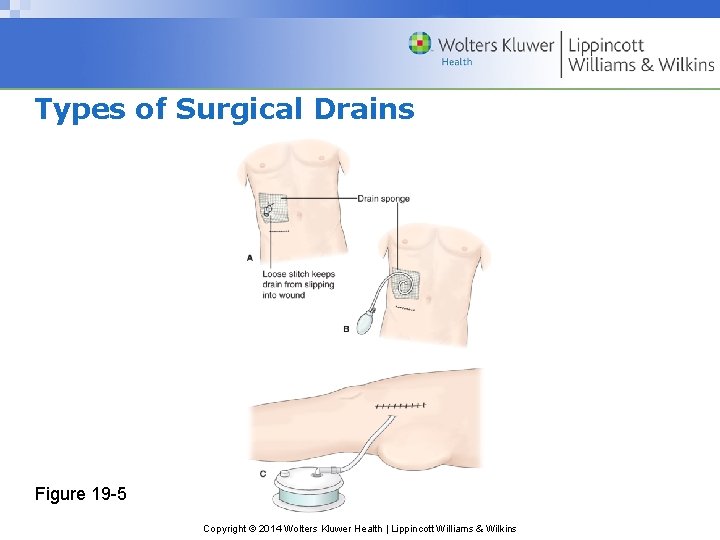
Types of Surgical Drains Figure 19 -5 Copyright © 2014 Wolters Kluwer Health | Lippincott Williams & Wilkins
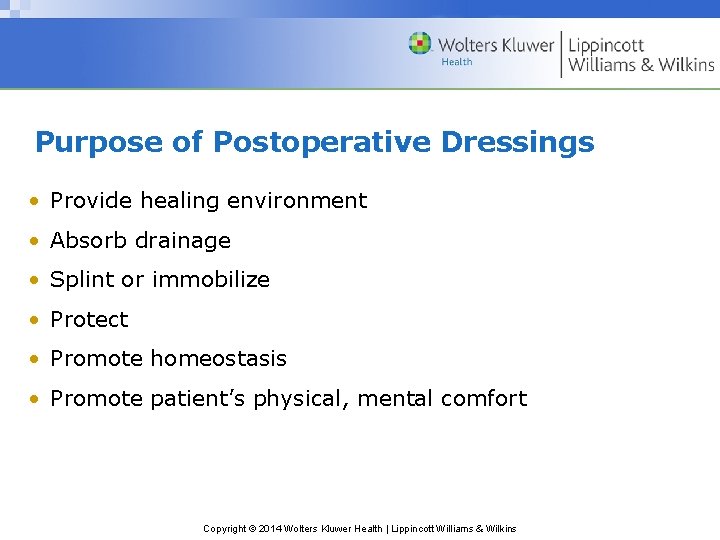
Purpose of Postoperative Dressings • Provide healing environment • Absorb drainage • Splint or immobilize • Protect • Promote homeostasis • Promote patient’s physical, mental comfort Copyright © 2014 Wolters Kluwer Health | Lippincott Williams & Wilkins
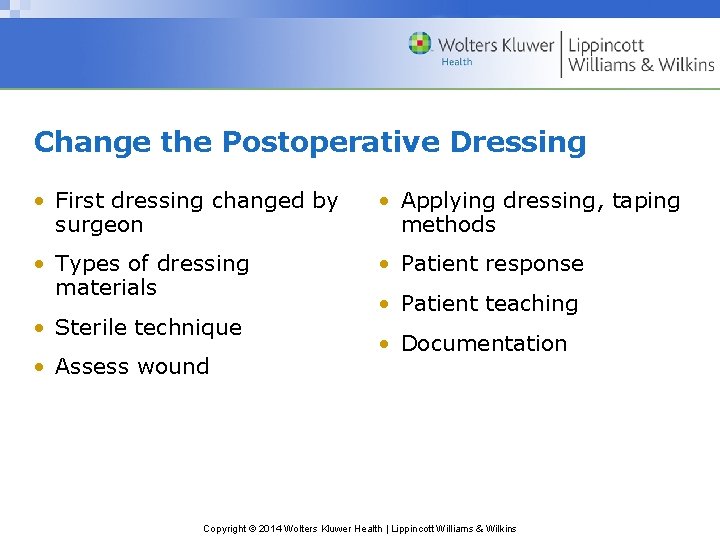
Change the Postoperative Dressing • First dressing changed by surgeon • Applying dressing, taping methods • Types of dressing materials • Patient response • Sterile technique • Assess wound • Patient teaching • Documentation Copyright © 2014 Wolters Kluwer Health | Lippincott Williams & Wilkins
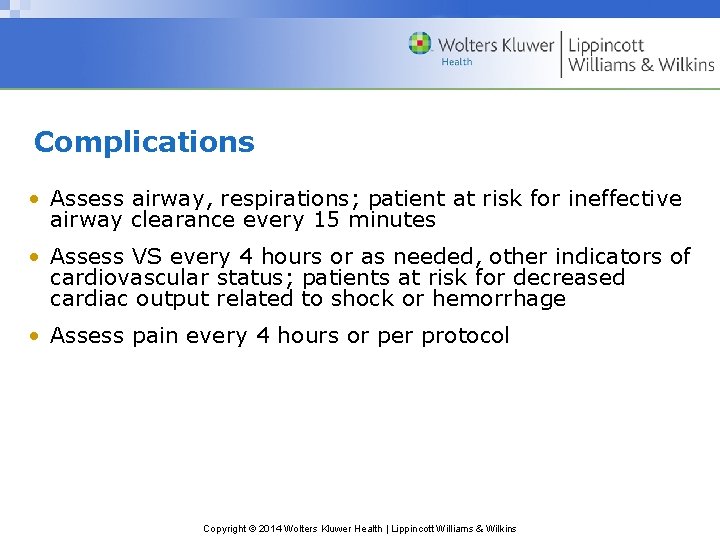
Complications • Assess airway, respirations; patient at risk for ineffective airway clearance every 15 minutes • Assess VS every 4 hours or as needed, other indicators of cardiovascular status; patients at risk for decreased cardiac output related to shock or hemorrhage • Assess pain every 4 hours or per protocol Copyright © 2014 Wolters Kluwer Health | Lippincott Williams & Wilkins
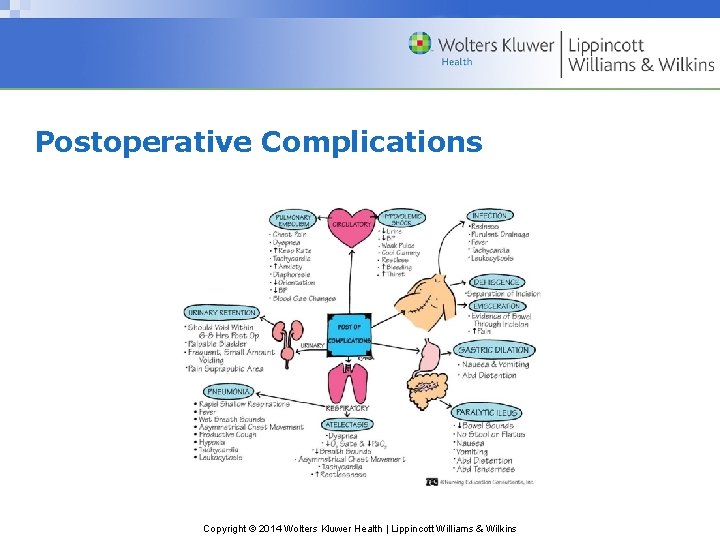
Postoperative Complications Copyright © 2014 Wolters Kluwer Health | Lippincott Williams & Wilkins
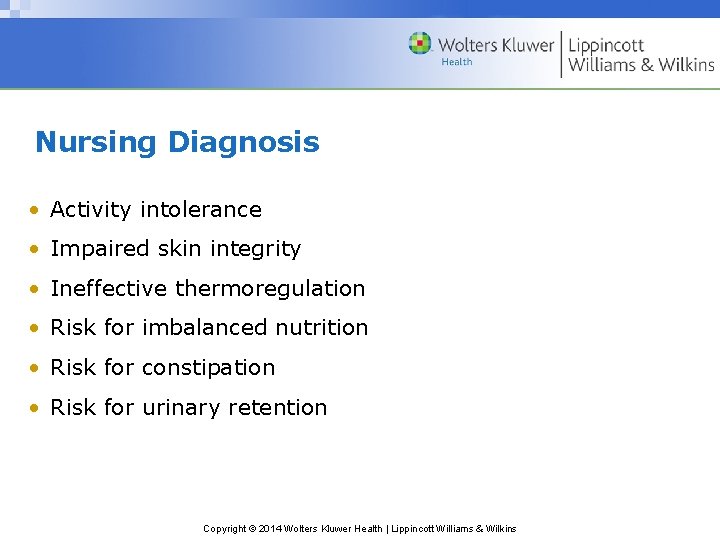
Nursing Diagnosis • Activity intolerance • Impaired skin integrity • Ineffective thermoregulation • Risk for imbalanced nutrition • Risk for constipation • Risk for urinary retention Copyright © 2014 Wolters Kluwer Health | Lippincott Williams & Wilkins
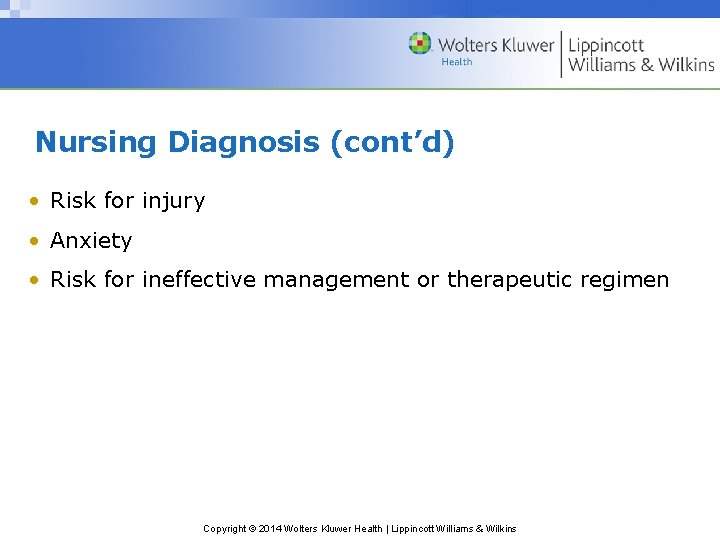
Nursing Diagnosis (cont’d) • Risk for injury • Anxiety • Risk for ineffective management or therapeutic regimen Copyright © 2014 Wolters Kluwer Health | Lippincott Williams & Wilkins
Collaborative Problems • Pulmonary infection/hypoxia • Deep vein thrombosis • Hematoma/hemorrhage • Pulmonary embolism • Wound dehiscence or evisceration • Refer to Table 19 -4 Copyright © 2014 Wolters Kluwer Health | Lippincott Williams & Wilkins
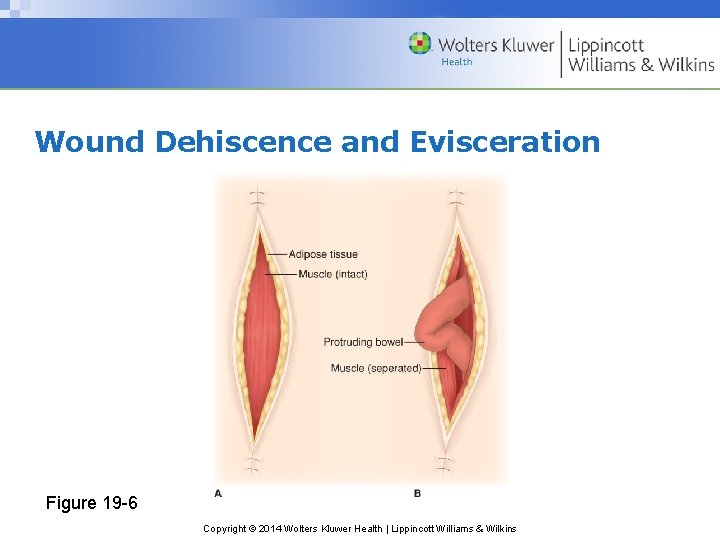
Wound Dehiscence and Evisceration Figure 19 -6 Copyright © 2014 Wolters Kluwer Health | Lippincott Williams & Wilkins
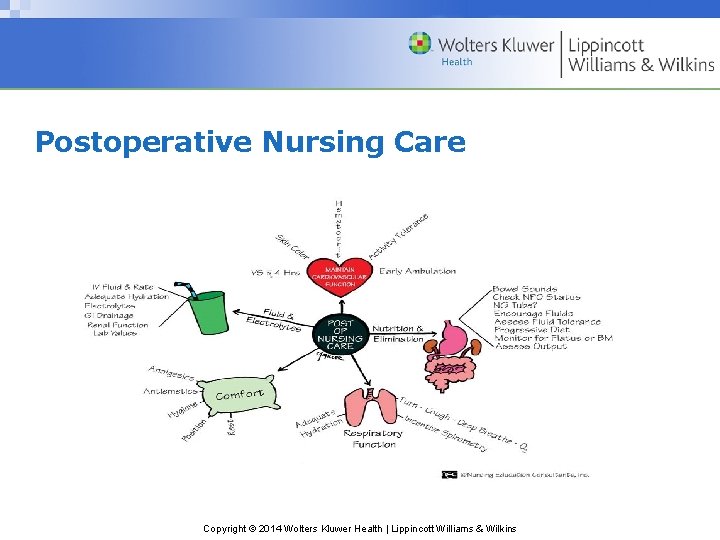
Postoperative Nursing Care Copyright © 2014 Wolters Kluwer Health | Lippincott Williams & Wilkins
Safety Guidelines for Nursing Skills • Coughing and deep breathing may be contraindicated after brain, spinal, head, neck, or eye surgery. • Bariatric patients may have more improved lung function and vital capacity in the reverse Trendelenburg or sidelying position. • Report any signs of venous thromboembolism such as pain, tenderness, redness, warmth, or swelling in the upper or lower extremities to the medical team immediately. Copyright © 2017, Elsevier Inc. All Rights Reserved. Copyright © 2014 Wolters Kluwer Health | Lippincott Williams & Wilkins 73
Summary • Nurse plays an important role for the client having surgery • The nurse serves an advocate for client • The ultimate goal for the client is maintain safety y prevent harm/injury to client • Preop • Intraop • Postop Copyright © 2014 Wolters Kluwer Health | Lippincott Williams & Wilkins