The Organizational Reward System Chapter 12 Mc GrawHillIrwin

- Slides: 29
The Organizational Reward System Chapter 12 Mc. Graw-Hill/Irwin Copyright © 2008 by The Mc. Graw-Hill Companies, Inc. All Rights Reserved.
Chapter Overview • Defining the System • Selection of Rewards • Relating Rewards to Performance • Job Satisfaction and Rewards • Employee Compensation • The Role of the Human Resource Manager in the Reward System • Summary of Learning Objectives 12 -3
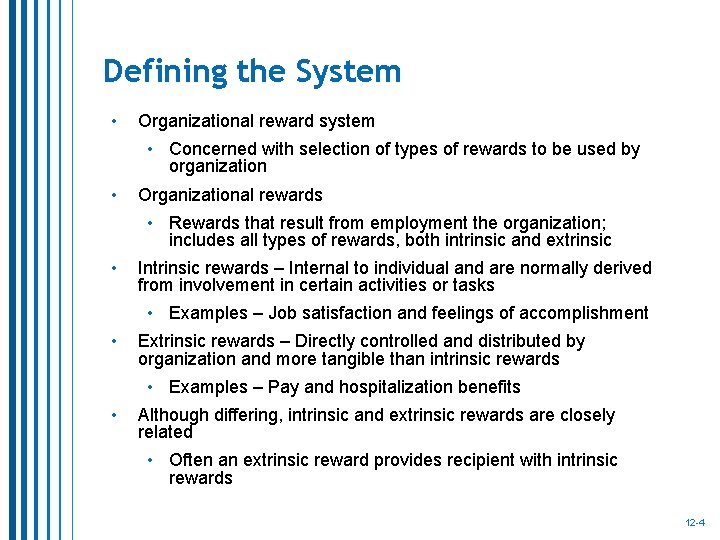
Defining the System • Organizational reward system • Concerned with selection of types of rewards to be used by organization • Organizational rewards • Rewards that result from employment the organization; includes all types of rewards, both intrinsic and extrinsic • Intrinsic rewards – Internal to individual and are normally derived from involvement in certain activities or tasks • Examples – Job satisfaction and feelings of accomplishment • Extrinsic rewards – Directly controlled and distributed by organization and more tangible than intrinsic rewards • Examples – Pay and hospitalization benefits • Although differing, intrinsic and extrinsic rewards are closely related • Often an extrinsic reward provides recipient with intrinsic rewards 12 -4
Intrinsic versus Extrinsic Rewards 12 -5
Selection of Rewards • Management must recognize what employees perceive as meaningful rewards • Pay is usually the first, and sometimes the only, reward most people think about • However, rewards should be viewed in the larger perspective as anything employees value • May include things such as • Office location • Allocation of certain pieces of equipment • Assignment of preferred work tasks • Informal recognition 12 -6
Selection of Rewards • Another false assumption is exemplified by fact that most organizations offer same mix of rewards to all employees • Studies show that many variables can influence employee preferences for certain rewards. They include • Age • Sex • Marital status • Number of dependents • Years of service • For example, older employees are usually much more concerned with pension and retirement benefits than are younger employees 12 -7
Selection of Rewards • When selecting types of rewards to offer, intrinsic benefits that might accrue as a result of the rewards need to be considered • Managers and employees alike consider only tangible benefits associated with a reward • External factors that place limitations on an organization’s reward system also exist • These factors (usually beyond the control of the organization) include such things as • Organization’s size • Environmental conditions • Stage in product life cycle • Labor market 12 -8
Relating Rewards to Performance • Free enterprise system is based on the premise that rewards should depend on performance • Performance–reward relationship is desirable at • Organizational or corporate level • Individual level • Employees will be motivated when they believe such motivation will lead to desired rewards • Many formal rewards provided by organizations are not related to performance • These rewards are almost always determined by organizational membership and seniority; they include • Paid vacations • Insurance plans • Paid holidays 12 -9
Preconditions for Implementing pay-for -Performance Program • Trust in management • If employees are skeptical of management, it is difficult to make a pay-for-performance program work • Absence of performance constraints • Jobs must be structured so that an employee’s performance is not hampered by factors beyond his or her control • Trained supervisors and managers • Supervisors and managers must be trained in setting and measuring performance standards • Good measurement systems • Performance should be based on criteria that are job specific and focus on results achieved 12 -10
Preconditions for Implementing Pay-for -Performance Program • Ability to pay • Merit portion of the salary increase budget must be large enough to get the attention of employees • Clear distinction among cost of living, seniority, and merit • In absence of strong evidence to the contrary, employees will naturally assume a pay increase is a cost-of- living or seniority increase • Well-communicated total pay policy • Employees must have a clear understanding of how merit pay fits into the total pay picture • Flexible reward schedule • It is easier to establish a credible pay-for-performance plan if all employees do not receive pay adjustments on the same date 12 -11
Job Satisfaction and Rewards • • • An employee’s general attitude toward the job • Organizational reward system often has a significant impact on level of employee job satisfaction • Manner in which extrinsic rewards are dispersed can affect intrinsic rewards (and satisfaction) of recipients There are five major components of job satisfaction: • Attitude toward the work group • General working conditions • Attitude toward the company • Monetary benefits • Attitude toward management Other components include • Employee’s state of mind about the work itself • Life in general • Health, age • Level of aspiration, social status, and political and social activities 12 -12
The Satisfaction–Performance Controversy • “The path of least resistance” – Attempts to explain belief that a satisfied employee is necessarily a good employee • If a performance problem exists, increasing an employee’s happiness is far more pleasant than discussing with the employee his or her failure to meet standards • Although happiness eventually results from satisfaction, the latter goes much deeper and is far less tenuous than happiness • Two propositions concerning the satisfaction-performance theory exist • Traditional view is that satisfaction causes performance • Satisfaction is the effect rather than the cause of performance 12 -13
The Satisfaction–Performance Controversy • Performance leads to rewards that result in a certain level of satisfaction • Rewards constitute a necessary intervening variable in the relationship • Another position considers both satisfaction and performance to be functions of rewards • Satisfaction results from rewards, but current performance also affects subsequent performance if rewards are based on current performance • Research evidence generally rejects the more popular view that satisfaction leads to performance • It does provide moderate support for the view that performance leads to satisfaction 12 -14
The Satisfaction–Performance Controversy • It has been clearly established that job satisfaction does have a positive impact on • Turnover • Absenteeism • Tardiness • Accidents • Grievances • Strikes • Experience, gender, and performance can have a moderating effect on these relationships • Organizations prefer satisfied employees simply because they make the work environment more pleasant • Although a satisfied employee is not necessarily a high performer, there are numerous reasons for cultivating employee satisfaction 12 -15
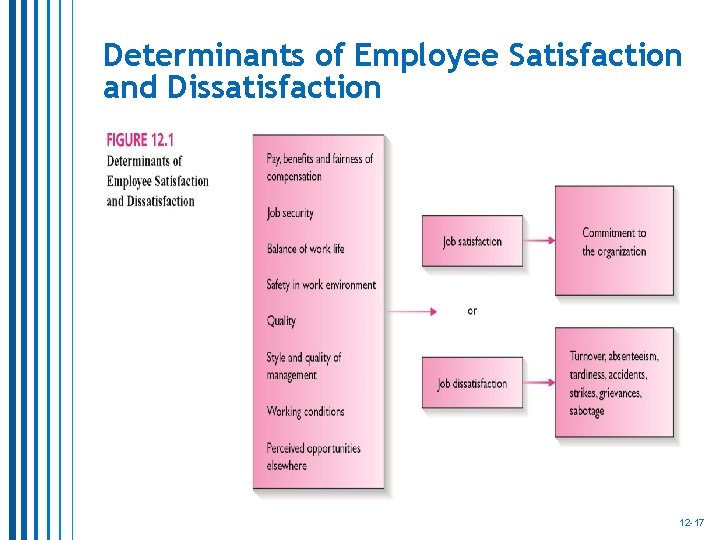
Other Factors Affecting Job Satisfaction • Wide range of both internal and external factors affect an employee’s level of satisfaction • Surveys have found that the top drivers of employee job satisfaction were • Pay, and benefits • Job security, and feeling safe in the work environment • Flexibility to balance work and life • Job satisfaction and motivation are not synonymous • Motivation is a drive to perform • Organizational reward systems can influence both job satisfaction and employee motivation • It affects job satisfaction by making the employee more or less comfortable as a result of the rewards received • It influences motivation primarily through the perceived value of the rewards and their contingency on performance 12 -16
Determinants of Employee Satisfaction and Dissatisfaction 12 -17
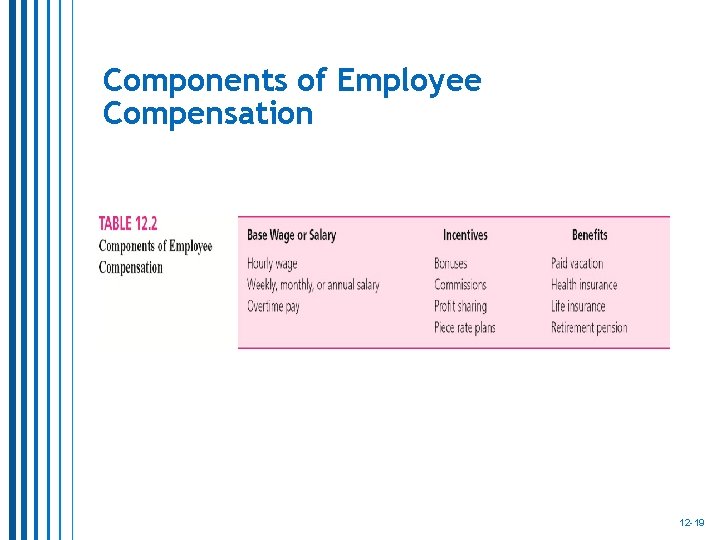
Employee Compensation • All extrinsic rewards that employees receive in exchange for their work • Composed of base wage or salary, any incentives or bonuses, and any benefits • Base wage or salary – Hourly, weekly, or monthly pay employees receive for their work • Incentives – Rewards offered in addition to the base wage or salary and are usually directly related to performance • Benefits – Rewards employees receive as a result of their employment and position with the organization (Examples: Paid vacations, health insurance, and retirement plans) • Pay • Refers only to actual dollars employees receive in exchange for work 12 -18
Components of Employee Compensation 12 -19
Compensation Policies • Policies must deal with following issues: • Minimum and maximum levels of pay – Taking into consideration • Worth of job to organization • Organization’s ability to pay • Government regulations • Union influences • Market pressures • General relationships among levels of pay (e. g. , between senior management and operating management, operative employees, and supervisors) • Division of total compensation dollar (i. e. , what portion goes into base pay, incentive programs, and benefits) 12 -20
Compensation Policies • Organizations must also make decisions concerning • How much money will go into pay increases for the next year • Who will recommend them • How raises will generally be determined • Another important decision concerns whether pay information will be kept secret or made public 12 -21
Pay Secrecy • Many organizations have a policy of not disclosing pay-related information • Information about pay system as well as individual pay received • Justification for pay secrecy • To avoid any discontent that might result from employees’ knowing what everybody else is being paid • Many employees, especially high achievers, feel very strongly that their pay is nobody else’s business • Drawbacks of pay secrecy • Difficult for employees to determine whether pay is related to performance and does not eliminate pay comparisons • May cause employees to overestimate pay of their peers and underestimate pay of their supervisors • Can create feelings of dissatisfaction • Employees may become suspicious 12 -22
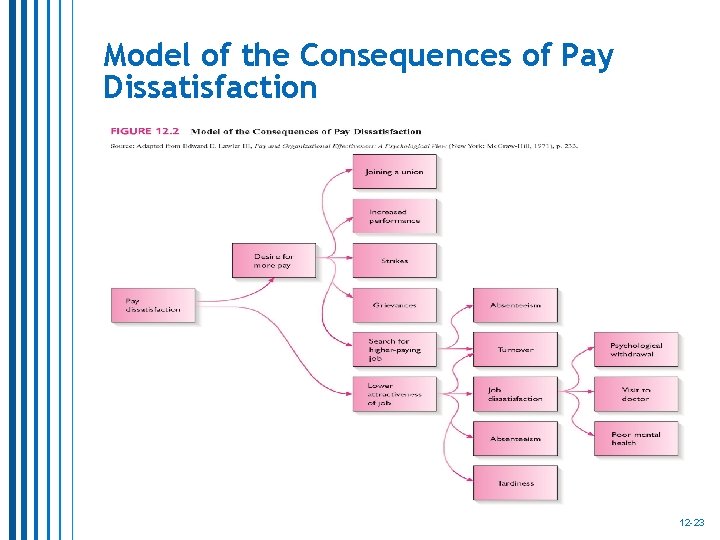
Model of the Consequences of Pay Dissatisfaction 12 -23
Pay Equity • Equity theory of motivation holds that • Employees have a strong need to maintain a balance between what they perceive as their inputs to their jobs and what they receive from their jobs in the form of rewards • Employees who perceive inequities will take action to eliminate or reduce them • Pay equity concerns whether employees believe they are being fairly paid • For example, if an employee believes he or she is underpaid, that employee will likely reduce expended effort by working more slowly, taking off early, or being absent • Similarly, if an employee believes she or he is being overpaid, that employee is likely to work harder or for longer hours 12 -24
Pay Equity • Several dimensions of equity to be considered when looking at pay equity • Internal equity – Addresses what an employee is being paid for doing a job compared to what other employees in the same organization are being paid to do their jobs • External equity – Addresses what employees in other organizations are being paid for performing similar jobs • Individual equity – Addresses issue of rewarding individual contributions; is very closely related to the pay-for-performance question • Organizational equity – Addresses how profits are divided up within the organizations 12 -25
Pay Equity • Employee interpretations of pay equity are based on their perceptions • Organizations should make these perceptions as accurate as possible • An employee can also feel good about one or more equity dimensions and feel bad about others • For example, an employee may feel good about his or her pay in comparison to what friends working in other organizations are making • She or he may also believe the company profits are fairly distributed within the company • However, this same person may be very unhappy about his or her pay relative to several other people in the same organization 12 -26
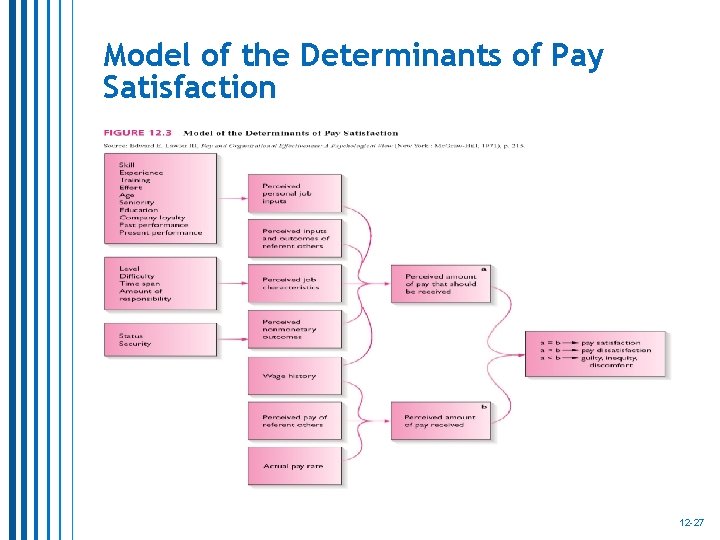
Model of the Determinants of Pay Satisfaction 12 -27
The Role of the Human Resource Manager in the Reward System • Role of human resource manager in overall organizational reward system is to assist in its design and to administer the system • Administering the system – Carries responsibility of ensuring that system is fair to all employees and that it is clearly communicated to all employees • Ensuring that the system is fair places burden of minimizing reward inequities and employee’s perceptions of reward inequities squarely on the human resources manager • Little doubt exists that organizations need to do a better job of explaining and communicating their compensation system to employees • Many tools and techniques are available to assist human resource managers in designing and administering compensation systems 12 -28
Summary of Learning Objectives • Define organizational rewards • Distinguish between intrinsic and extrinsic rewards • List several desirable preconditions for implementing a pay -for-performance program • Define job satisfaction and list its five major components • Summarize the satisfaction–performance relationship • Define compensation, pay, incentives, and benefits • List several pieces of government legislation that have had a significant impact on organizational compensation • Explain the equity theory of motivation • Discuss internal, external, individual, and organizational equity 12 -29