
Summary of the presentation by Jane Clelland MD
Summary of the presentation by Jane Clelland MD, deacon postulant, to St. Mark’s Men’s Group, Nov 14, 2019 Why should we at St Mark’s, as 21 st century Christians, become knowledgeable and involved in the response to the BC Opioid Crisis?
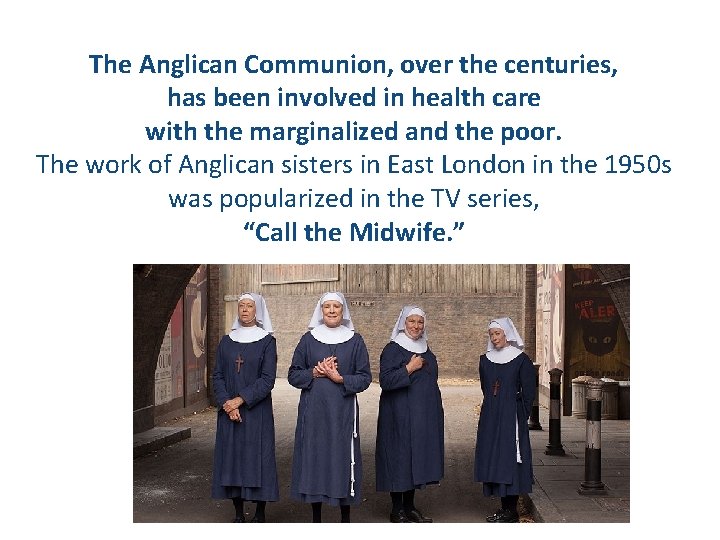
The Anglican Communion, over the centuries, has been involved in health care with the marginalized and the poor. The work of Anglican sisters in East London in the 1950 s was popularized in the TV series, “Call the Midwife. ”
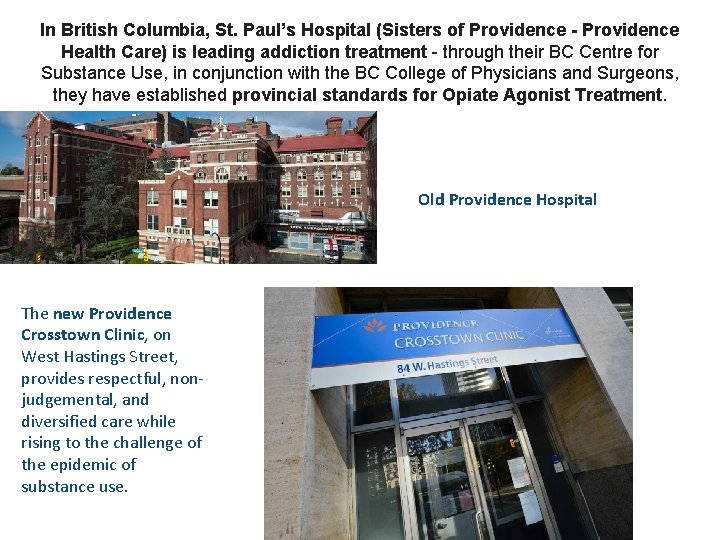
P r o v i d The new Providence e Crosstown Clinic, on West Hastings Street, n provides respectful, nonjudgemental, and c diversified care while rising to the challenge of e the epidemic of In British Columbia, St. Paul’s Hospital (Sisters of Providence - Providence Health Care) is leading addiction treatment - through their BC Centre for Substance Use, in conjunction with the BC College of Physicians and Surgeons, they have established provincial standards for Opiate Agonist Treatment. substance use. Old Providence Hospital
Definition of Addiction is a health problem, a treatable, chronic medical disease with a psychosocial spiritual component. Addiction involves complex interactions among brain circuits, genetics, the environment, and an individual’s life experiences. People with addiction use substances or engage in behaviors that become compulsive and often continue despite harmful consequences. Prevention efforts and treatment approaches for addiction are generally as successful as those for other chronic diseases.
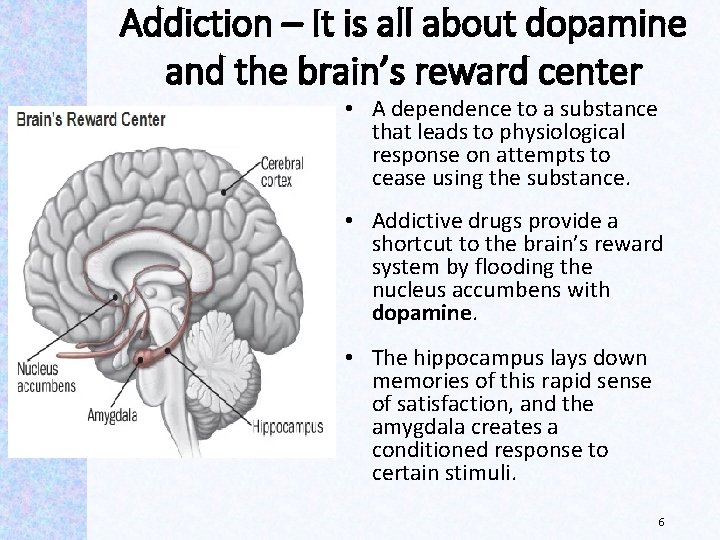
Addiction – It is all about dopamine and the brain’s reward center • A dependence to a substance that leads to physiological response on attempts to cease using the substance. • Addictive drugs provide a shortcut to the brain’s reward system by flooding the nucleus accumbens with dopamine. • The hippocampus lays down memories of this rapid sense of satisfaction, and the amygdala creates a conditioned response to certain stimuli. 6
The pathways to substance use Many persons with substance use disorder have significant histories of adverse childhood experiences (ACE), Trauma Abuse: emotional, physical, sexual Neglect: emotional, physical Household experience: domestic abuse, mental illness, marriage breakdown, criminal behaviour, household substance use. Many also do not have any Adverse Childhood Experiences, having 3 or more ACEs is: 4 -5 times more likely in substance users 7 -10 times more likely in injection users Genetic factors show a higher predisposition with certain genetics. However, there is no one “addiction gene” Pain and prescription opioids can be a pathway to dependence – this is a subset of people with substance abuse. “Gateway drugs” – seem not to be a major pathway. Also not strong evidence on the role of cannabis in protection. 7
World Health Organization Opiate Treatment standards In 2005, methadone and buprenorphine (Suboxone) were added to the World Health Organization’s list of essential medicines intended to be available in all health systems at a fair price. Guidelines for the Psychosocially Assisted Pharmacological Treatment of Opioid Dependence

Opiate Agonist Treatment (OAT), such as treatment with medications such as Methadone and Suboxone (buprenorphine), is the international standard of care in heroin/fentanyl addiction With opiate agonist treatment, there is: a decreased risk of crime and incarceration, a decreased risk of contracting viral hepatitis, HIV, infection of the heart valves, or other serious illnesses. Whether short term or life long, OAT is a valuable tool in recovery, Each patient is an individual and each individual has a separate treatment plan. 9
Stigma kills “Stigma around addiction is killing people. Addiction is often a response to deep pain or trauma, and stigma drives our loved ones to act and live in dark silence. We need to knock down the walls of silence and encourageous conversations …" Judy Darcy, Minister of Mental Health and Addictions 10
Community Action Team (CAT) Oceanside Over 40 members from the community and VIHA are working together to bring positive change – with a public launch event coming soon r
What could the members of St. Mark’s do to help? Today (Nov 14 th), the St. Mark’s Men’s Group learned about the extent of the local opioid problem and about treatment options. We also discussed what each community member could do to help, including the following: You could talk with others to help them understand the problem, thus reducing stigma and encouraging compassion What can You could encourage family members or friends who have problems to seek help as early as possible, before problems escalate The Oceanside Community Action Team is planning a launch event in the next few weeks. You could watch for announcements and consider attending to learn more about this issue. You could volunteer with a community agency or donate You could pray for and support those with family problems You could talk to and welcome newcomers to the church, even if their backgrounds and appearance are different.
- Slides: 11