
Managing Employee Performance and Reward Concepts Practices Strategies


- Slides: 17
Managing Employee Performance and Reward Concepts, Practices, Strategies 2 nd edition
Performance feedback and development 1. 2. 3. 4. 5. 6. 7. The performance management cycle Analysing individual performance deficiencies Providing feedback: three approaches Counselling underperformers Action planning Providing negative feedback High performance coaching
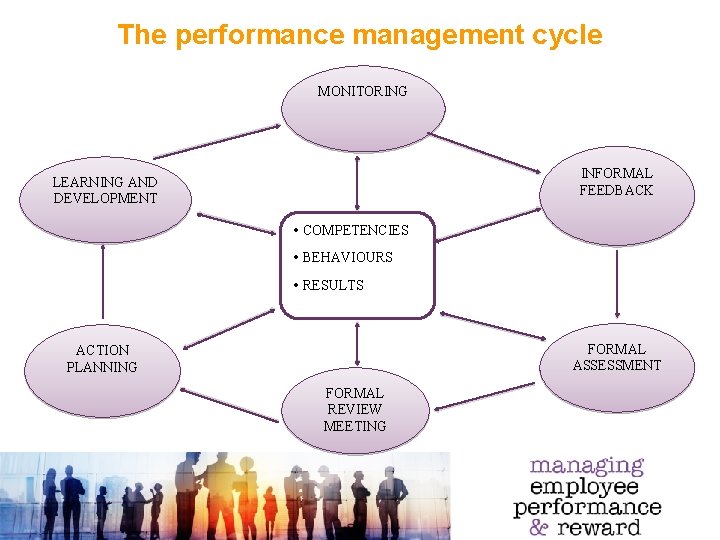
The performance management cycle MONITORING INFORMAL FEEDBACK LEARNING AND DEVELOPMENT COMPETENCIES BEHAVIOURS RESULTS FORMAL ASSESSMENT ACTION PLANNING FORMAL REVIEW MEETING
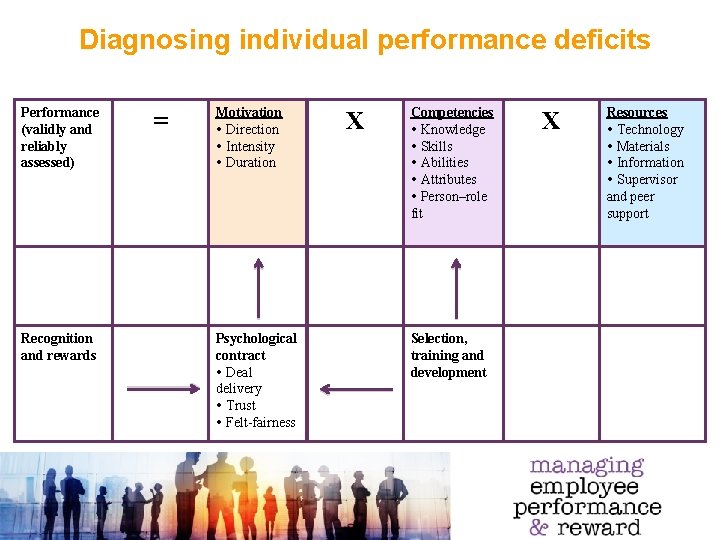
Diagnosing individual performance deficits Performance (validly and reliably assessed) Recognition and rewards = Motivation Direction Intensity Duration Psychological contract Deal delivery Trust Felt-fairness X Competencies Knowledge Skills Abilities Attributes Person–role fit Selection, training and development X Resources Technology Materials Information Supervisor and peer support
Performance review meetings (or formal feedback sessions) A formal dialogue/exchange between employee and supervisor about the employee’s performance over the review period for the purpose of reaching agreement about what has been achieved, what can be improved and how such improvements can be achieved.
Performance review meetings Key steps: 1. 2. 3. 4. Evaluate performance (competencies, behaviours, results) Summative and detailed feedback on performance Provide positive reinforcement Exchange of views about what has been achieved and what needs to be done 5. Agreement about what needs to be done next (action planning)
Providing feedback: three approaches ‘Tell and sell’ Aims 1. 2. 3. Role of supervisor Sentencing judge Supervisor’s attitude That employees appreciate advice and constructive criticism Tell employee of performance Obtain employee acceptance of evaluation Persuade employee to agree to supervisor’s plan for improvement
Providing feedback: three approaches ‘Tell and listen’ Aims 1. 2. 3. Role of supervisor Attentive judge Supervisor’s attitude Feelings of the employee should be understood and respected Tell employee of performance Allow employee to respond to appraisal Consider both views together, reach conclusion and plan for improvement
Providing feedback: three approaches ‘Problem-solving’ Aims 1. 2. 3. Role of supervisor Helper/counsellor/coach Supervisor’s attitude Mutual and constructive approach is best for identifying and correcting problems Discuss appraisal jointly Work together to identify solutions to performance problems Encourage employee development and improvement
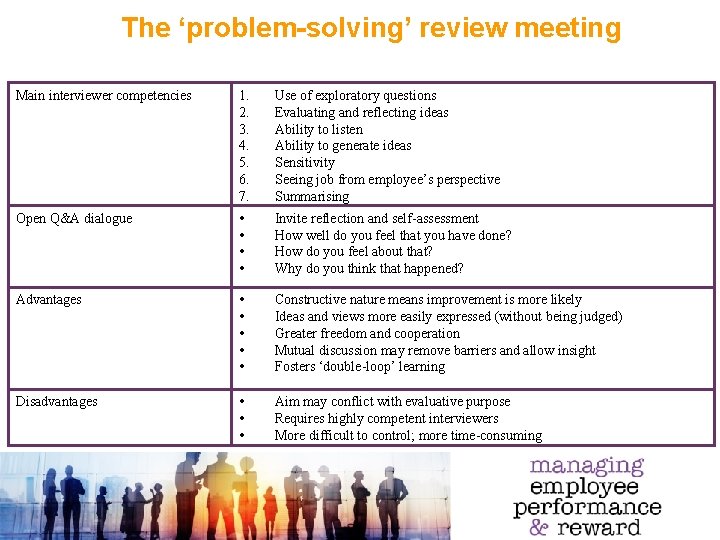
The ‘problem-solving’ review meeting Main interviewer competencies 1. 2. 3. 4. 5. 6. 7. Use of exploratory questions Evaluating and reflecting ideas Ability to listen Ability to generate ideas Sensitivity Seeing job from employee’s perspective Summarising Open Q&A dialogue Invite reflection and self-assessment How well do you feel that you have done? How do you feel about that? Why do you think that happened? Advantages Constructive nature means improvement is more likely Ideas and views more easily expressed (without being judged) Greater freedom and cooperation Mutual discussion may remove barriers and allow insight Fosters ‘double-loop’ learning Disadvantages Aim may conflict with evaluative purpose Requires highly competent interviewers More difficult to control; more time-consuming
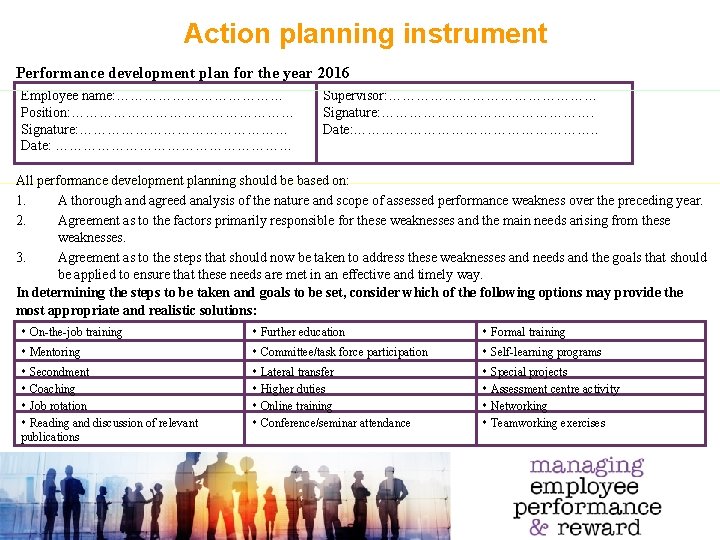
Action planning instrument Performance development plan for the year 2016 Employee name: ……………… Position: …………………… Signature: …………………… Date: ……………………… Supervisor: …………………… Signature: ……………………. Date: ………………………. . All performance development planning should be based on: 1. A thorough and agreed analysis of the nature and scope of assessed performance weakness over the preceding year. 2. Agreement as to the factors primarily responsible for these weaknesses and the main needs arising from these weaknesses. 3. Agreement as to the steps that should now be taken to address these weaknesses and needs and the goals that should be applied to ensure that these needs are met in an effective and timely way. In determining the steps to be taken and goals to be set, consider which of the following options may provide the most appropriate and realistic solutions: On-the-job training Further education Formal training Mentoring Committee/task force participation Self-learning programs Secondment Coaching Job rotation Reading and discussion of relevant publications Lateral transfer Higher duties Online training Conference/seminar attendance Special projects Assessment centre activity Networking Teamworking exercises
Action planning instrument Performance development goals 3– 5 high priority development needs for 2016: 1. 2. 3. 4. 5. 1– 3 longer-term career development needs/aspirations: 1. 2. 3. Specific goal and measure to address each need: Goal and measure for addressing each nominated longterm need/aspiration:
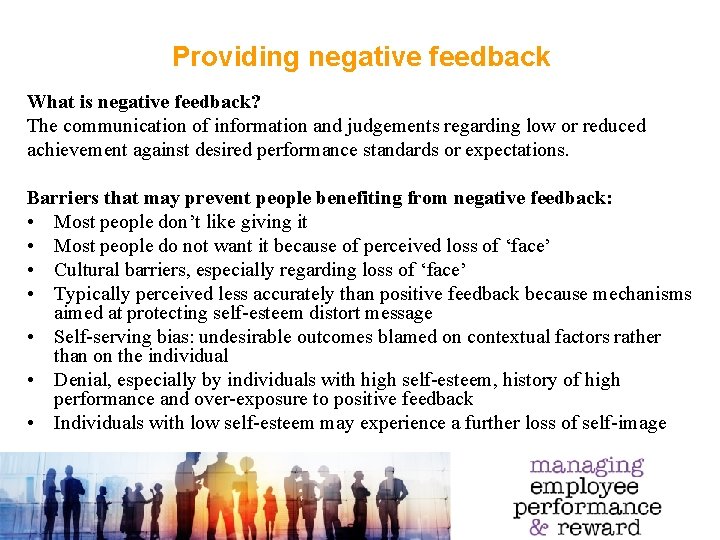
Providing negative feedback What is negative feedback? The communication of information and judgements regarding low or reduced achievement against desired performance standards or expectations. Barriers that may prevent people benefiting from negative feedback: • Most people don’t like giving it • Most people do not want it because of perceived loss of ‘face’ • Cultural barriers, especially regarding loss of ‘face’ • Typically perceived less accurately than positive feedback because mechanisms aimed at protecting self-esteem distort message • Self-serving bias: undesirable outcomes blamed on contextual factors rather than on the individual • Denial, especially by individuals with high self-esteem, history of high performance and over-exposure to positive feedback • Individuals with low self-esteem may experience a further loss of self-image
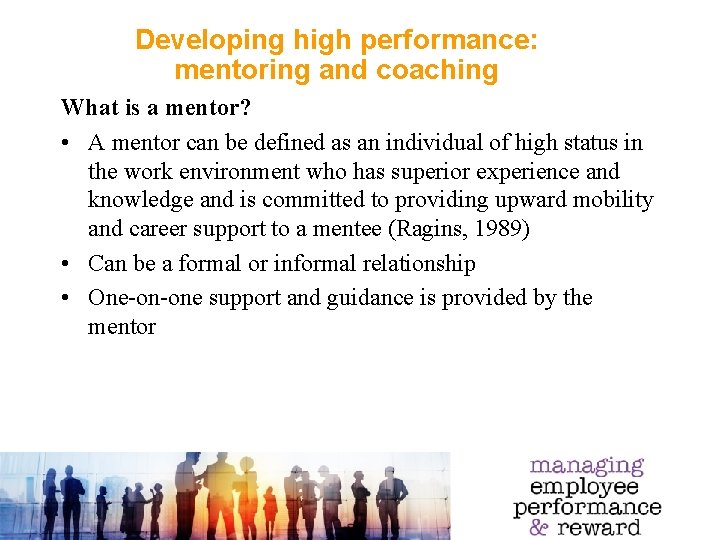
Developing high performance: mentoring and coaching What is a mentor? • A mentor can be defined as an individual of high status in the work environment who has superior experience and knowledge and is committed to providing upward mobility and career support to a mentee (Ragins, 1989) • Can be a formal or informal relationship • One-on-one support and guidance is provided by the mentor
Performance coaching What is performance coaching? • A learning process to help high-performing employees to further enhance their performance • The purpose is to examine areas for development and to assist the ‘coachee’ in thinking through work-related problems and identifying and evaluating possible responses • The coach helps establish development plans and, if the relationship continues, can track accomplishments in carrying out the plan
Performance coaching • Historically, focused on remediation for derailing executives • Today, is focused on preparing high-potential employees for career advancement such as: - accelerating high-potential development - developing special populations (e. g. minority executives) - special needs (e. g. on boarding or managing remote teams, or managing a specific project) (Bono et al. , 2009) • Emphasis is on drawing a strong link with learning and development and assisting individuals or teams to reach their full potential.
Forms of coaching • • Leadership Executive (custom-tailored) Results Group Organisational Business Behavioural Life