
Mining Pool Reward Methods Bitcoin 2013 San Jose
Mining Pool Reward Methods Bitcoin 2013, San Jose Meni Rosenfeld Bitcoil 5/19/2013 Written by Meni Rosenfeld 1
Outline �Mining primer �Simple reward methods �PPS �Proportional �Advanced methods �DGM �Reward method triangle �Shift-PPLNS �The future �Questions 5/19/2013 Written by Meni Rosenfeld 2
Mining primer �Bitcoin mining exists to: �Determine initial distribution of coins �Synchronize transactions �Miners calculate hashes in an attempt to find blocks and be rewarded with bitcoins 5/19/2013 Written by Meni Rosenfeld 3

Mining rewards �One in 232 hashes will be a share �A share has probability p = 1 / D to be a block � Currently D ≈ 10 M �A block is rewarded with B bitcoins � Currently B = 25 (+ tx fees) �Expected reward per share: p. B �Example: a 10 GH/s miner finds: � 8 K shares per hour (73 M per year) � Per year, on average, ~7 blocks (180 BTC) 5/19/2013 Written by Meni Rosenfeld 4
Variance �Actual number of blocks found is random �Follows Poisson distribution �Variance is equal to mean �Relative variance: D / #shares �Example: 10 GH/s miner, one year, B = 25, D = 10 M �Average reward: 180 BTC �Standard deviation: 68 BTC �Reward range: 25 – 350 BTC 5/19/2013 Written by Meni Rosenfeld 5
Mining pools �Group of people mining together sharing rewards �Relative variance based on combined hashrate �Allows continuous rewards similar to expectation �Contribution is measured by number of shares �Actual calculation of rewards is not trivial! �Hence the need for (and variety of) “reward methods” 5/19/2013 Written by Meni Rosenfeld 6
PPS (Pay per share) �Pool operator takes an active role �Pays miners a fixed amount p. B per share (minus fees) �Operator keeps all block rewards �Advantages: �Simple �Miners completely shielded from randomness and variance �Payment sent instantly 5/19/2013 Written by Meni Rosenfeld 7
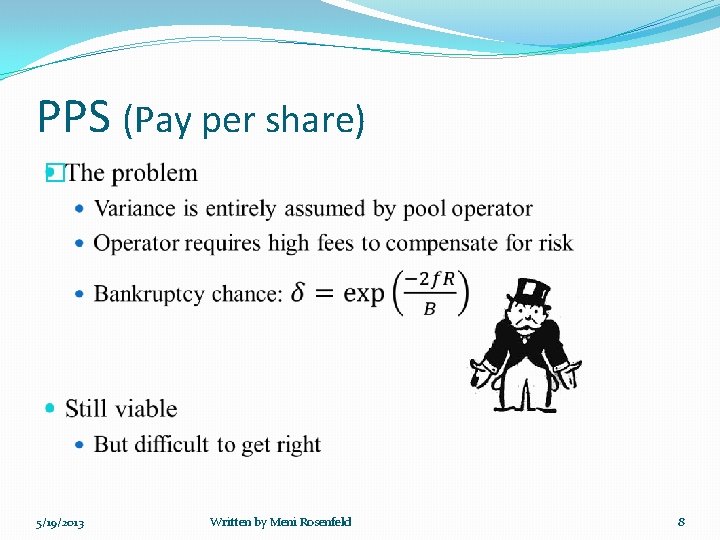
PPS (Pay per share) � 5/19/2013 Written by Meni Rosenfeld 8
Proportional �Mining is organized into rounds �Finding a block ends previous round and starts new one �Block reward distributed among miners in latest round in proportion to shares they submitted this round �Operator has no risk; miners do have variance �Problem: Method is completely broken! 5/19/2013 Written by Meni Rosenfeld 9

Pool hopping In good times… 5/19/2013 Written by Meni Rosenfeld and in bad? 10
Pool hopping �Proportional method based on wrong intuition �Suitable for deterministic tasks �Not for random, memoryless tasks �Reward per share = B / (#shares in round) �#shares in round = #past shares + #future shares �#future shares unknown but always look the same �#past shares is known and variable! �Mining most lucrative when #past shares is low 5/19/2013 Written by Meni Rosenfeld 11
DGM (Double geometric method) �When miner submits a share, his score increases �Score decreases geometrically when: 1. A share is found 2. A block is found �Miners are rewarded for blocks according to current score �Independent of everyone else’s scores! 5/19/2013 Written by Meni Rosenfeld 12
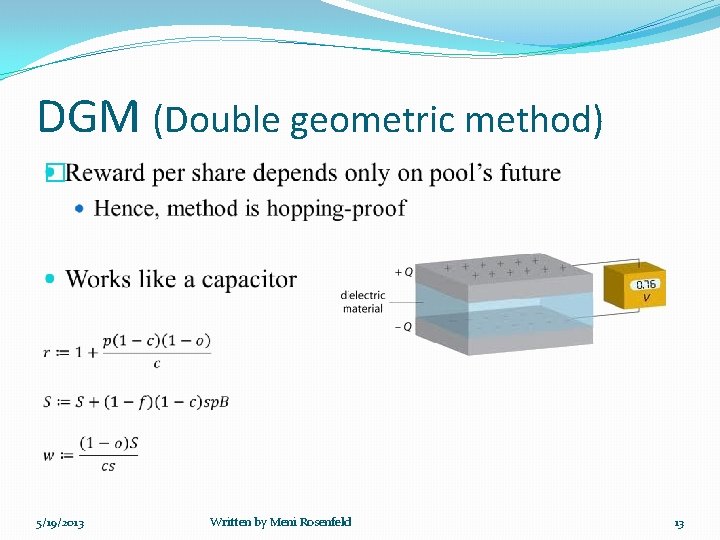
DGM (Double geometric method) � 5/19/2013 Written by Meni Rosenfeld 13
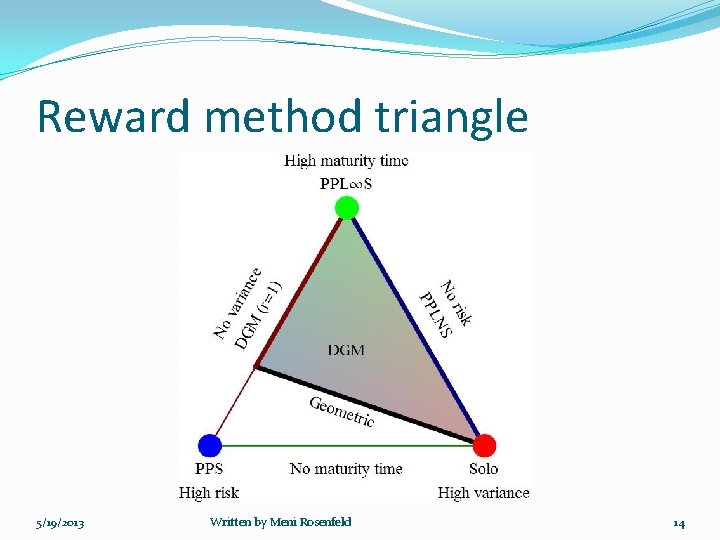
Reward method triangle 5/19/2013 Written by Meni Rosenfeld 14
Shift-PPLNS �Work is divided into “shifts” �Ending a shift is arbitrary �But not based on finding blocks! �Miners are paid for shares submitted in last N shifts �Method can work asynchronously �Suitable for scalable, parallel implementations 5/19/2013 Written by Meni Rosenfeld 15

Pool landscape 5/19/2013 Pool Method BTCGuild Shift-PPLNS / PPS 50 BTC PPS Slush Bitminter Shift-PPLNS Bitparking DGM Eclipse DGM / PPS Deepbit Proportional / PPS Ozcoin DGM / PPS Itzod RSMPPS Eligius CPPSRB P 2 pool (decentralized) PPLNS Written by Meni Rosenfeld 16
The future �Currently: “Standard” pools �Pool assigns work to miners �Miners submit proof of completed work �Pool pays miners �Problem: �Pool performance improves with pool size �Mining tends to concentrate at biggest pools �Control of mining is centralized 5/19/2013 Written by Meni Rosenfeld 17

The future �Some combination of: � Multi-pool mining � p 2 p pools � Variable-difficulty shares � Smart miners � Distributed insurance agents � Proxy pools �Will allow: �PPS payments (simple, no variance) �Low fees �Decentralization of power 5/19/2013 Written by Meni Rosenfeld 18

Questions? 5/19/2013 Written by Meni Rosenfeld 19
Thank you �Meni Rosenfeld �meni@bitcoil. co. il �https: //bitcoil. co. il � 1 Ddrvajp. K 221 W 9 d. Tzo 5 c. Lox. Mnaxu 859 QN 6 �“Analysis of Bitcoin Pooled Mining Reward Systems” �https: //bitcoil. co. il/pool_analysis. pdf 5/19/2013 Written by Meni Rosenfeld 20
- Slides: 20