The Impact of Healthcare Law and Ethics on
- Slides: 44
“The Impact of Healthcare Law and Ethics on the Incarcerated Individual. ” Presented by: Gregory Dober
Objectives. Understand the legal and ethical history that mandates healthcare rights to incarcerated and detained individuals in the United States. Understanding the legal and ethical healthcare responsibilities to incarcerated and detained individuals. Understand the ethical challenges for healthcare providers when delivering healthcare services to incarcerated and detained individuals. Understand that ethical healthcare decisions are not waived by an individual because they are in the custody of the penal system.
Tribune Excerpts on Ford Shooting Friends and family of a man a Pittsburgh police officer shot during a traffic stop said Wednesday that UPMC Presbyterian staff and police won't let them see him in the hospital. “We just want some answers, ” Mondale Ford, 26, of East Liberty, the brother of the suspect, said during a news conference in Garfield surrounded by about 40 friends, relatives and members of community groups. “As of right now, there's no reason we shouldn't be allowed to be there by his side. ” (Note: The detainee is also shackled despite being paralyzed from the waist down) Police said Leon Ford, 19, of East Liberty is in critical but stable condition. “For people that are in custody in a hospital setting, our policy is they're not allowed visitors, ” police Lt. Kevin Kraus said. “Based on the circumstances of everything that happened, we have not permitted anyone to see him. ” Read more: http: //triblive. com/home/2956608 -74/police-ford-leon-pittsburgh-derbish-members-family-reached-shoteast#ixzz 3 BPH 3 ef. RY
Contents 1) Terms. 2) Who, What and Where. 3) Health Care Law and the Incarcerated. 4) Healthcare Ethics and the Incarcerated.
Terms Jail – usually pre-trail detainees or those sentenced to less than 2 years including “time served. ” Usually a local jurisdiction. Prison – usually those sentenced to 2+ years in a state or federal jurisdiction. Pretrial detainee – Not convicted, protected under 14 th amendment. No bail set or can’t post bail. Prisoner – prison, usually convicted and protected under 8 th amendment. Inmate – jail or prison, pretrial detainee or convicted.
Who, What and Where.
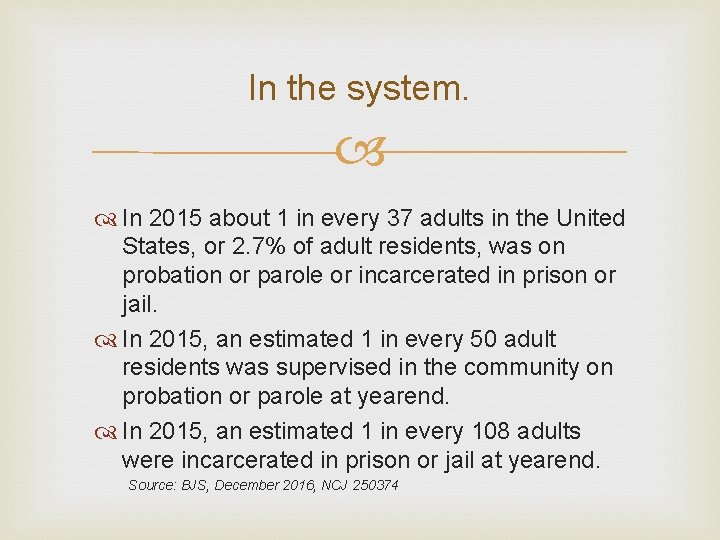
In the system. In 2015 about 1 in every 37 adults in the United States, or 2. 7% of adult residents, was on probation or parole or incarcerated in prison or jail. In 2015, an estimated 1 in every 50 adult residents was supervised in the community on probation or parole at yearend. In 2015, an estimated 1 in every 108 adults were incarcerated in prison or jail at yearend. Source: BJS, December 2016, NCJ 250374
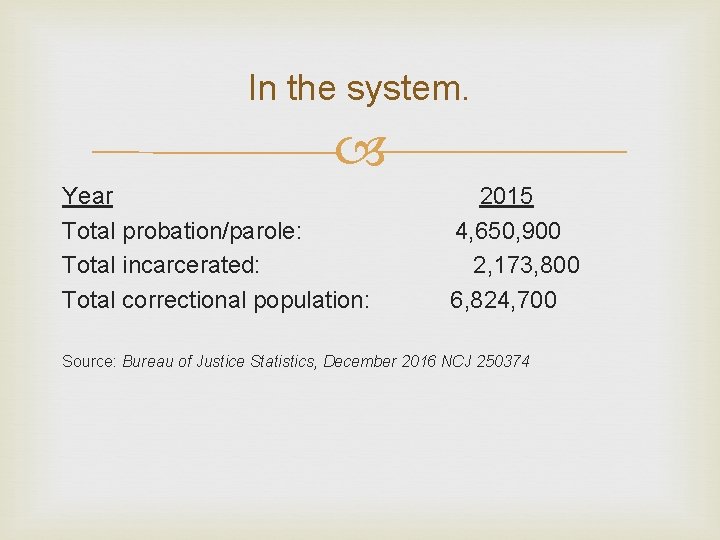
In the system. Year Total probation/parole: Total incarcerated: Total correctional population: 2015 4, 650, 900 2, 173, 800 6, 824, 700 Source: Bureau of Justice Statistics, December 2016 NCJ 250374
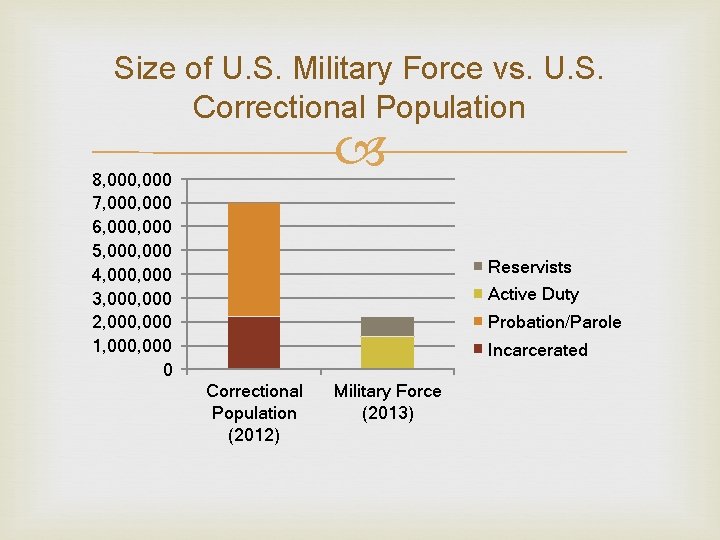
Size of U. S. Military Force vs. U. S. Correctional Population 8, 000 7, 000 6, 000 5, 000 4, 000 3, 000 2, 000 1, 000 0 Reservists Active Duty Probation/Parole Incarcerated Correctional Population (2012) Military Force (2013)
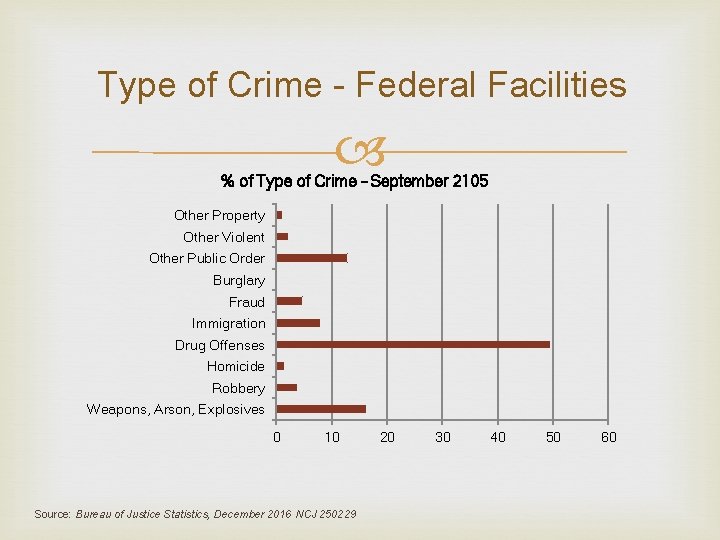
Type of Crime - Federal Facilities % of Type of Crime – September 2105 Other Property Other Violent Other Public Order Burglary Fraud Immigration Drug Offenses Homicide Robbery Weapons, Arson, Explosives 0 10 Source: Bureau of Justice Statistics, December 2016 NCJ 250229 20 30 40 50 60
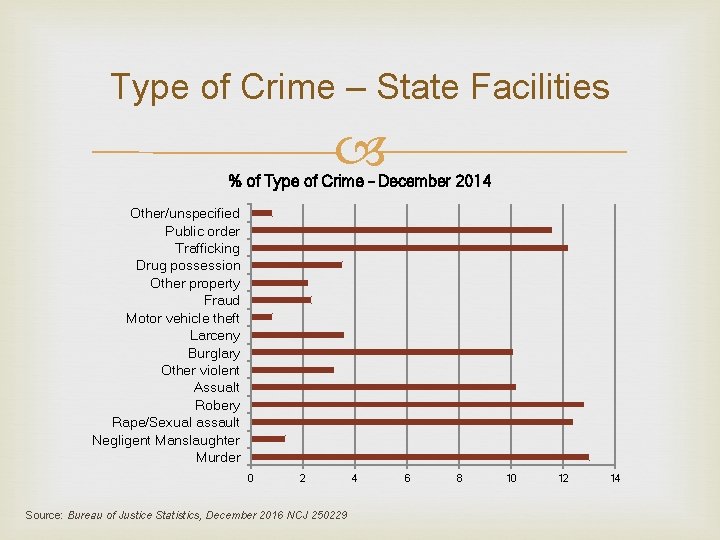
Type of Crime – State Facilities % of Type of Crime – December 2014 Other/unspecified Public order Trafficking Drug possession Other property Fraud Motor vehicle theft Larceny Burglary Other violent Assualt Robery Rape/Sexual assault Negligent Manslaughter Murder 0 2 Source: Bureau of Justice Statistics, December 2016 NCJ 250229 4 6 8 10 12 14
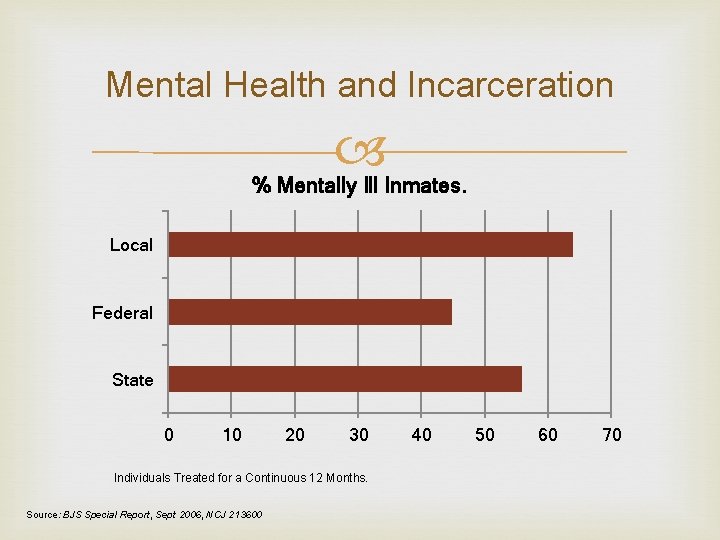
Mental Health and Incarceration % Mentally Ill Inmates. Local Federal State 0 10 20 30 Individuals Treated for a Continuous 12 Months. Source: BJS Special Report, Sept 2006, NCJ 213600 40 50 60 70
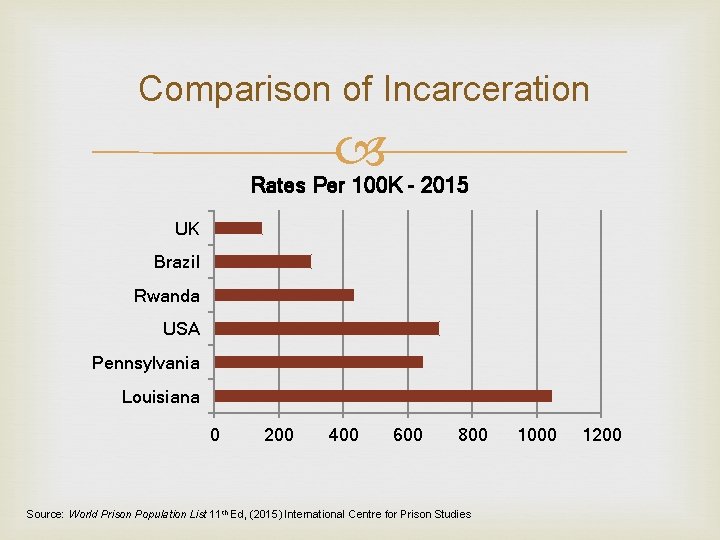
Comparison of Incarceration Rates Per 100 K - 2015 UK Brazil Rwanda USA Pennsylvania Louisiana 0 200 400 600 800 Source: World Prison Population List 11 th Ed, (2015) International Centre for Prison Studies 1000 1200
Healthcare Law and the Incarcerated.
Spicer v. Williamson, 132 E. E. 291, 293 (N. C. 1926). “It is but just that the public be required to care for the prisoner, who cannot, by reason of the deprivation of his liberty, care for himself. ”
NEWMAN v. STATE OF ALABAMA 349 F. Supp. 278 (1972) It is the holding of this Court that failure of the Board of Corrections to provide sufficient medical facilities and staff to afford inmates basic elements of adequate medical care constitutes a willful and intentional violation of the rights of prisoners guaranteed under the Eighth and Fourteenth Amendments. Further, the intentional refusal by correctional officers to allow inmates access to medical personnel and to provide prescribed medicines and other treatment is cruel and unusual punishment in violation of the Constitution.
Estelle v. Gamble 429 U. S. 97 (1976) Justice Marshall writing for the majority: “ … deliberate indifference to serious medical needs of prisoners” constitutes the “unnecessary and wanton infliction of pain. ” The court reasoned since prisoners cannot care for themselves, the government has responsibility, under the Eight Amendment to provide medical care. *
Eighth Amendment to the U. S. Constitution: “Excessive bail shall not be required nor excessive fines imposed nor cruel and unusual punishments inflicted. ”
Deliberate Indifference Deliberate indifference is a state of mind more blame worthy than mere negligence* but less culpable than purposeful misconduct. (Farmer) A prison official will be held liable under the Eight Amendment “only if he knows that inmates face a substantial serious risk of serious harm and disregard that risk by failing to take reasonable measures to abate it. ” (Farmer) Note: Malpractice type care may not be deliberate indifference.
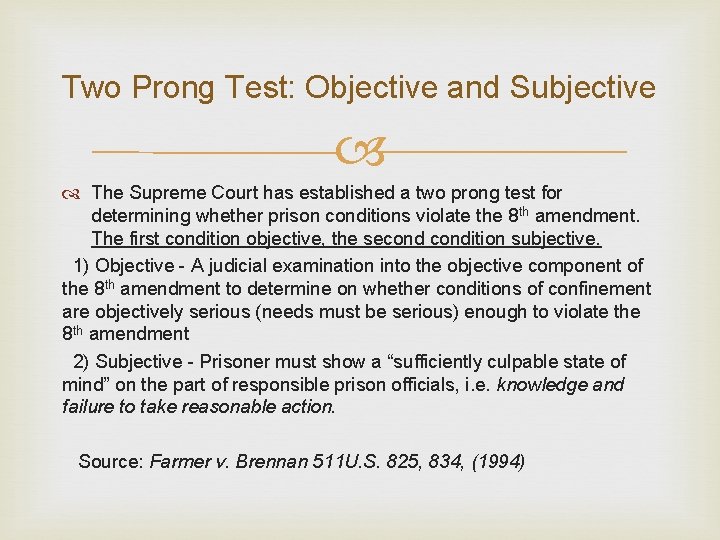
Two Prong Test: Objective and Subjective The Supreme Court has established a two prong test for determining whether prison conditions violate the 8 th amendment. The first condition objective, the secondition subjective. 1) Objective - A judicial examination into the objective component of the 8 th amendment to determine on whether conditions of confinement are objectively serious (needs must be serious) enough to violate the 8 th amendment 2) Subjective - Prisoner must show a “sufficiently culpable state of mind” on the part of responsible prison officials, i. e. knowledge and failure to take reasonable action. Source: Farmer v. Brennan 511 U. S. 825, 834, (1994)
Failure to take Reasonable Action “. . . prison officials who act reasonably cannot be found liable under the cruel and unusual punishments clause. ” (Farmer) Officials act reasonably when they provide whatever treatment decides is appropriate. (Estelle) Officials act with deliberate indifference if they deny, delay, obstruct or interfere with needed or prescribed medical treatment. (Estelle) Lack of funds will not excuse the failure of a system to provide adequate care. Harris v. Thigpen 941 F. 2 d 1495 (1991)
Deliberate Indifference - Medical Staff Numerous cases have affirmed that medical staff is not liable under the Eight Amendment if the diagnosis and treatment ultimately prove incorrect and result in further pain. Estelle opinion noted that the prisoner may have a course of civil action for malpractice even though no deliberate indifference occurred. [This would pass the objective “serious needs” test but not the subjective “deliberate indifference” test. ]
Serious Needs Generally, a serious need is determined on a case-by case basis. Estelle’s “serious medical needs” test does not address ailments lying between the two extremes. (eg tooth decay – infection, minor cut – MRSA, fever to TB) A serious medical need is defined as one that has been diagnosed by a physician as requiring treatment or one that is so obvious that a lay person would recognize the necessity for a doctors attention. Monmouth County Inmates v. Lanzaro 834 F 2 d 326, 347 (3 rd Cir 1987)
Examples of Serious Needs Life threatening emergencies and injuries or illness (Estelle) MRSA (Stewart v Kelchner 3 rd Circuit 2009) Hepatitis C (Merritt v. Fogel 3 rd Circuit 2009) Heatstroke (Kost v. Kazakiewicz (3 rd Circuit 1993) Insulin dependent diabetes (Rouse v. Plantier 3 rd Circuit 1999)
Detainees Eight Amendment “two-prong” test of treatment applicable but detainee’s are protected under the Fourteenth Amendment Due Process Clause. Fourteenth Amendment, Section 1: Section. 1. “All persons born or naturalized in the United States and subject to the jurisdiction thereof, are citizens of the United States and of the State wherein they reside. * No State shall make or enforce any law which shall abridge the privileges or immunities of citizens of the United States; nor shall any State deprive any person of life, liberty, or property, without due process of law; nor deny to any person within its jurisdiction the equal protection of the laws. ” * Note: Problematic with immigration detainee’s.
Mental Health Mental health needs are assessed using the same two prong test of seriousness and deliberate indifference. A mental health need is serious if it has “caused significant disruption in an inmates everyday life … prevents his functioning in the general population without disturbing or endangering others or himself. ” (Tillery v. Owens 719 F. Supp. 1256 (1989)[SCIPittsburgh case]
Healthcare Ethics and the Incarcerated.
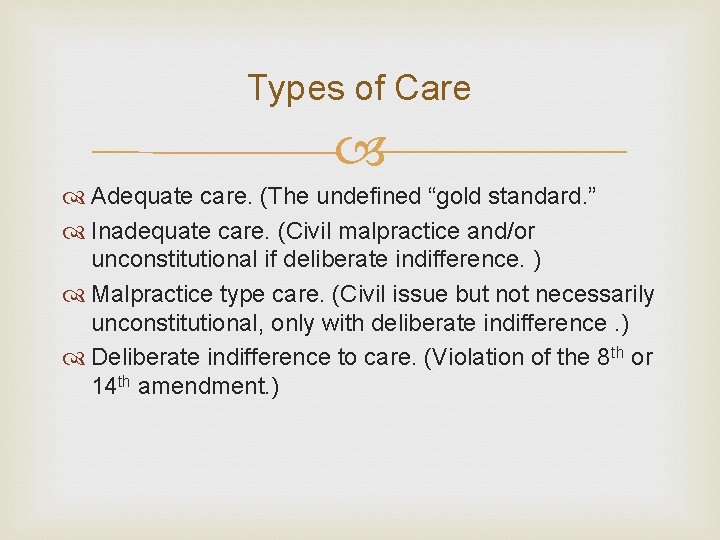
Types of Care Adequate care. (The undefined “gold standard. ” Inadequate care. (Civil malpractice and/or unconstitutional if deliberate indifference. ) Malpractice type care. (Civil issue but not necessarily unconstitutional, only with deliberate indifference. ) Deliberate indifference to care. (Violation of the 8 th or 14 th amendment. )
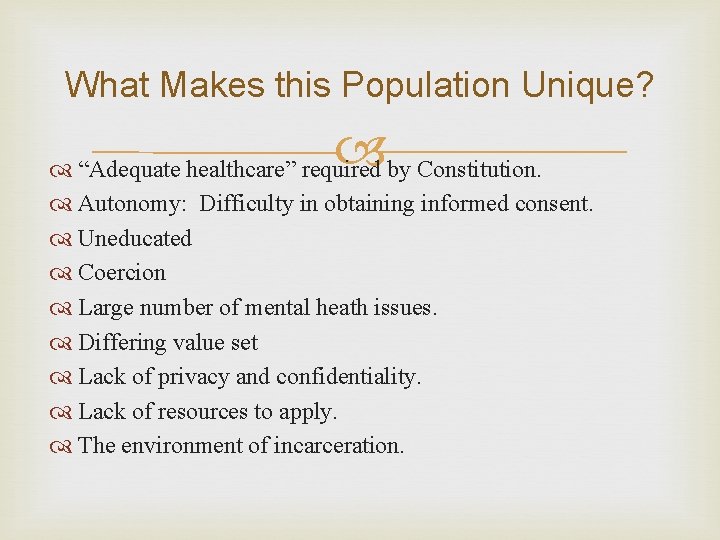
What Makes this Population Unique? “Adequate healthcare” required by Constitution. Autonomy: Difficulty in obtaining informed consent. Uneducated Coercion Large number of mental heath issues. Differing value set Lack of privacy and confidentiality. Lack of resources to apply. The environment of incarceration.
The Principles Still Apply… Autonomy Beneficence Nonmaleficience Justice … with some difficulties
… With Some Difficulties Cost containment Best interest standard…inmates or states? Adequate care versus medical standard of care.
Decision making and informed consent Advance Directives, including DNR’s, are requested in most incarceration facilities at pre-entry medical physical. Medical decision making should follow the same protocol for prisoners as non-prisoners. (AD, surrogate, ACT 169, court appointed guardian, best interest. ) Prison guards and officials are not medical decision makers for an inmate. The prisoner has a right to refuse unwanted care. The prison medical officer must use the “best interest” model. Decision making and informed consent for an inmate follows the same legal and ethical requirements as a non -inmate.
Right to Refuse Care Schloendorff v. Society of New York Hospital, 211 N. Y. 125, 105 N. E. 92 (1914) “Every human being of adult years and sound mind has a right to determine what shall be done with his own body. . . ” Cruzan v. Director, Missouri Department of Health, 497 U. S. 261 (1990) “Reasoning that the right of self-determination should not be lost merely because an individual is unable to sense a violation of it, the court held that incompetent individuals retain a right to refuse treatment. ” White v. Napoleon (897 F. 2 d 103 (1990)) “We hold that convicted prisoners, like involuntarily committed mental patients, retain a limited right to refuse treatment and a related right to be informed of the proposed treatment and viable alternatives. ”
Right to Refuse Care; Not Absolute. The right to refuse care. * Refusal to vaccinate and public health interest. Jacobson v. Massachusetts 197 U. S. 11 (1905) Refusal to take dialysis constituted a form of protest. Commissioner of Corrections v. Myers 399 N. E. 2 d 452 (1979) Refusal of antipsychotic medication. Washington v. Harper 494 U. S. 210 (1990) *Note: Refusal can lead to punishment.
Solitary Confinement Often times, inmates are put in administrative custody (solitary) because the administration is mad at the inmate rather than them being violent. A clinicians “report card” on behavior, attitude or cooperation can lead to a “ticket” for administrative custody.
Allegheny County Jail “ Information regarding the inmates emergency contact information or next of kin shall be obtained from the inmate during their admission into the facility. ” [Reminder; This may be the individuals surrogate decision maker too. ] The inmate may fill out an AD or medical POA at medical intake at the jail. [Reminder; If not, decision making should follow proper legal and ethical means. ] “In the event of suicide, serious suicide attempt, death or where the inmate is unconscinsious and unresponsive is being sent out by ambulance to the hospital, the County Homicide detectives are to be called into the jail to investigate. ” Source: ACBOC Policy # 32, Date March 11, 2014.
State SCI’s Prior decision making and informed consent guidelines are relevant to state SCI’s.
Detainee’s; Decision Making and Informed Consent Advance Directives, including DNR’s, are requested in most incarceration facilities at pre-entry medical physical. Medical decision making should follow the same protocol for police detainees as any other patient. (AD, surrogate, ACT 169, court appointed guardian, best interest. ) Police officers and officials are not medical decision makers for a detainee. The detainee has a right to refuse unwanted care. Decision making and informed consent for a detainee follows the same legal and ethical requirements as any other patient.
Visitors and Detainee’s “No one shall be permitted to visit a prisoner in custody in a hospital setting w/out permission from the zone commander…” Source: PBOP Order # 50 -03 , June 1 , 2000. Ethical and legal landmines! How are decisions properly made for the incapacitated patient? Police INTERNAL policy does not override state law (PA Act 169)
Guarded Detainee’s “Common sense shall be a necessary guideline whether or not a twenty-four hour guard is needed. ” “When transporting disabled and injured prisoners, the degree of physical restraints will be applied within reason, . . . ” “The officer will remove the restraints only when it is deemed necessary and he/she is requested by medical staff. ” Pregnant women should not be in restraining devices! Source: PBOP Order # 50 -03 , June 1 , 2000.
HIPPA A hospital providing prison health care may disclose PHI to a “correctional institution” or a law enforcement official having lawful custody of an inmate if the correctional institution or law enforcement official represents that such protected health information is necessary for: A) the provision of health care to such individuals; B) the health and safety of such individual or other inmates; C) the health and safety of officers or employees or others at the correctional institution; D) the health and safety of such individuals and officers or other persons responsible for the transport of inmates or their transfer from one institution, facility or setting to another; E) Law enforcement on the premises of the correctional institution; F) The administration and maintenance of the safety, security, and good order of the correctional institute.
Public Health Problems Mental health. (Staffing*, screening and follow-up) Addictions (Staffing*, screening and follow-up) HCV (Exclusion policies, cost of drugs and follow-up) HIV, AIDS, STD’s (Staffing*, follow-up, better testing/treatment policies. ) TB (Staffing*, follow-up, better testing/treatment policies. )** *Staffing includes medical, educational and follow-up clinicians. ** In PA, refusal to get TB test results in solitary confinement.
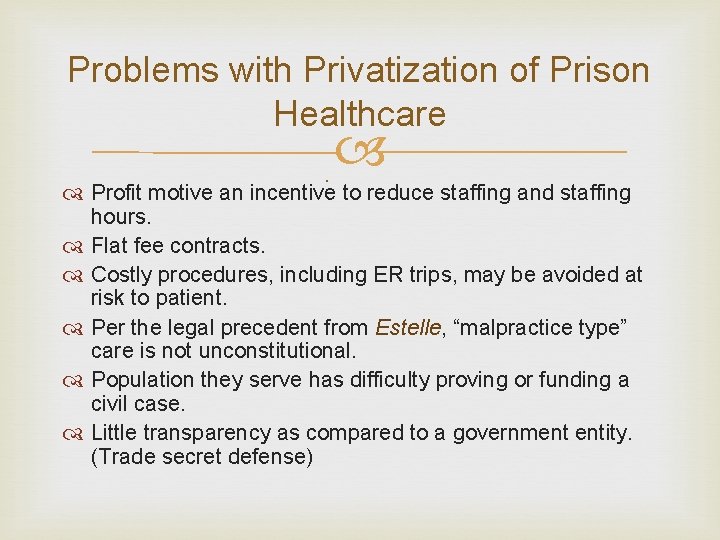
Problems with Privatization of Prison Healthcare . Profit motive an incentive to reduce staffing and staffing hours. Flat fee contracts. Costly procedures, including ER trips, may be avoided at risk to patient. Per the legal precedent from Estelle, “malpractice type” care is not unconstitutional. Population they serve has difficulty proving or funding a civil case. Little transparency as compared to a government entity. (Trade secret defense)
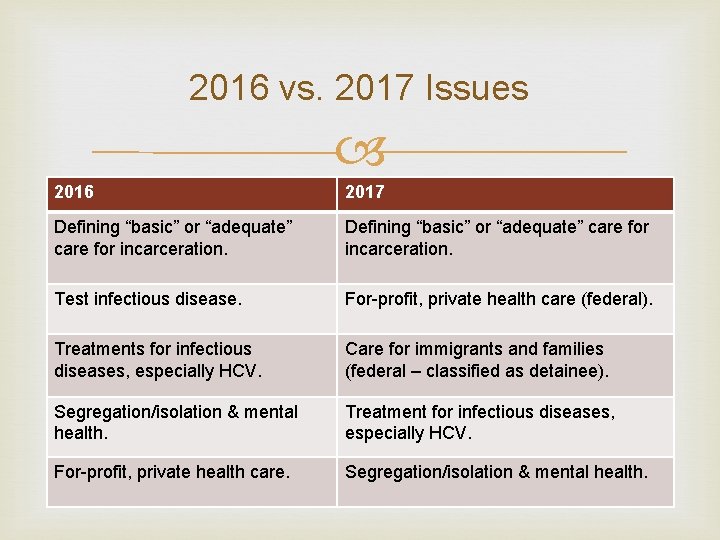
2016 vs. 2017 Issues 2016 Defining 2017 “basic” or “adequate” care for incarceration. Defining “basic”for or “adequate” Defining “basic” or “adequate” care for Testing infectious diseases. care for incarceration. Treatments for infectious diseases, especially HCV. Test infectious disease. For-profit, private health care (federal). Segregation/isolation and mental health. For-profit, private health care. Treatments for infectious diseases, especially HCV. Care for immigrants and families (federal – classified as detainee). Segregation/isolation & mental health. Treatment for infectious diseases, especially HCV. For-profit, private health care. Segregation/isolation & mental health.