
Ethics and the law from an integrated healthcare




- Slides: 51
Ethics and the law from an integrated healthcare perspective Deb Lessard, JD, MA, BSN, CPHRM, FASHRM
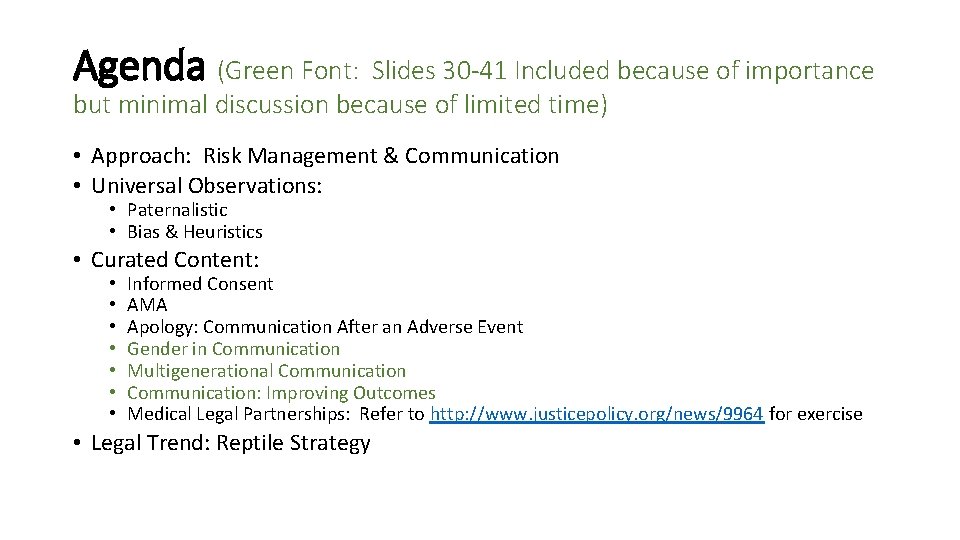
Agenda (Green Font: Slides 30 -41 Included because of importance but minimal discussion because of limited time) • Approach: Risk Management & Communication • Universal Observations: • Paternalistic • Bias & Heuristics • Curated Content: • • Informed Consent AMA Apology: Communication After an Adverse Event Gender in Communication Multigenerational Communication: Improving Outcomes Medical Legal Partnerships: Refer to http: //www. justicepolicy. org/news/9964 for exercise • Legal Trend: Reptile Strategy
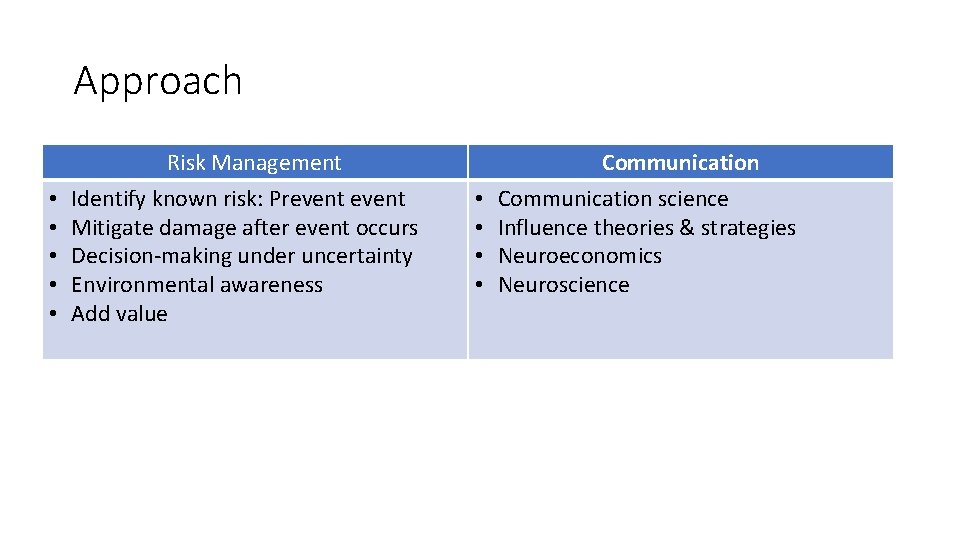
Approach • • • Risk Management Identify known risk: Prevent Mitigate damage after event occurs Decision-making under uncertainty Environmental awareness Add value • • Communication science Influence theories & strategies Neuroeconomics Neuroscience
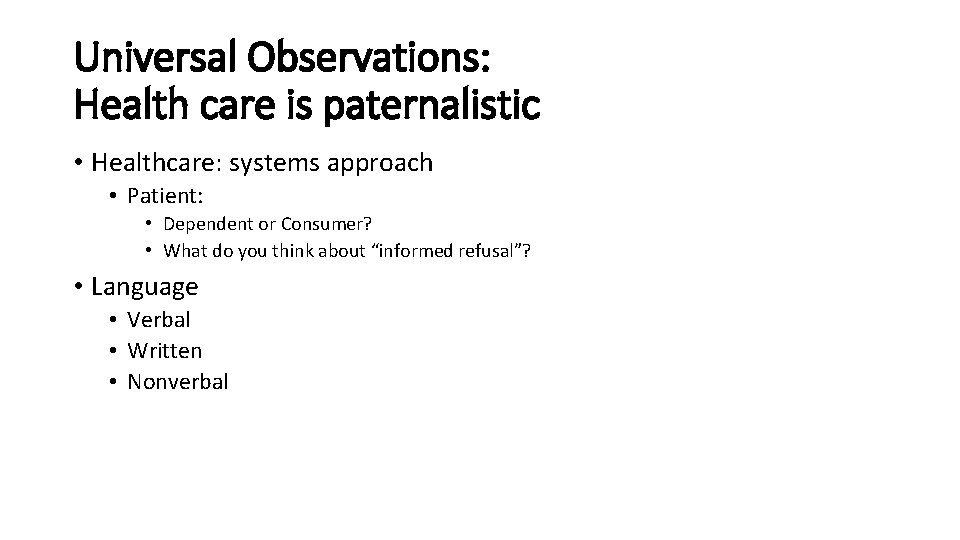
Universal Observations: Health care is paternalistic • Healthcare: systems approach • Patient: • Dependent or Consumer? • What do you think about “informed refusal”? • Language • Verbal • Written • Nonverbal
Universal Observations: Health care is paternalistic The provider traditionally operates from a disease framework and focuses on the patient history, treatment plan and care management. The patient is likely operating from an illness framework which includes expectations, fears, anxieties, and perceptions about the healthcare system, health insurance and their illness.
Universal Observations: Health care is paternalistic What is patient-centered healthcare? • Handout
Universal Observations: Health care is paternalistic What is patient-centered healthcare? • Consulting example
But what was their “Core Product”? Leadership / Language Exercise Mission is to improve the health of communities, one person at a time. • This implies a continuation of a relationship with the patient after discharge “The authentic personalized relationship” provides for “patients to receive personalized care during and beyond their encounters” Core product is partnership Partnership vs patient
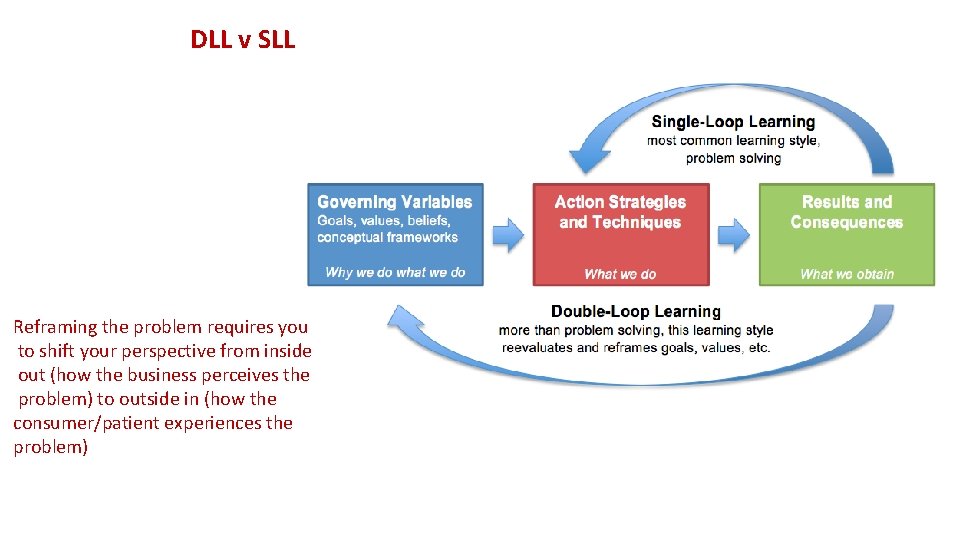
Staff with LSW & NP DLL v SLL:
DLL v SLL Reframing the problem requires you to shift your perspective from inside out (how the business perceives the problem) to outside in (how the consumer/patient experiences the problem)
Universal Observations: Bias & Heuristics • The feeling of knowing is separate from the knowledge • We judge on a relative basis and find safety with the “herd” (group think) • Bias is classified differently by different experts. Some common categories are comfort zone bias, cognitive bias, motivational bias, fallacies in reasoning and group think. It is human nature to prefer doing what we already know how to do, whether or not it leads to a good decision.
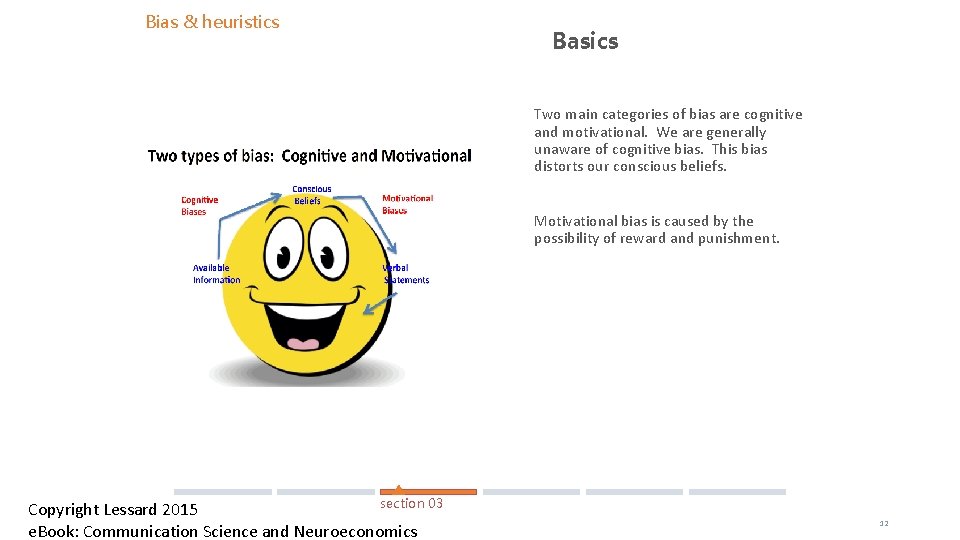
Bias & heuristics Basics Two main categories of bias are cognitive and motivational. We are generally unaware of cognitive bias. This bias distorts our conscious beliefs. Motivational bias is caused by the possibility of reward and punishment. section 03 Copyright Lessard 2015 e. Book: Communication Science and Neuroeconomics 12
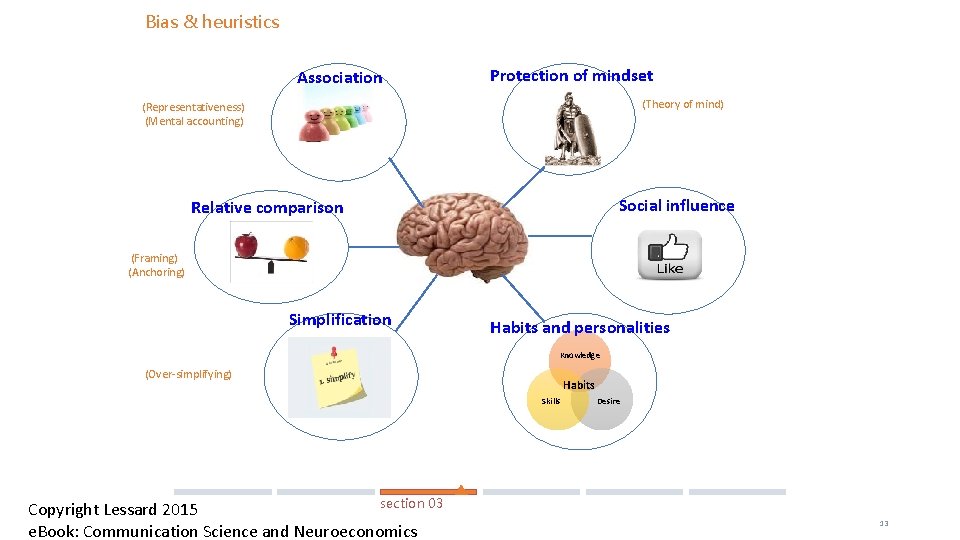
Bias & heuristics Association Protection of mindset (Theory of mind) (Representativeness) (Mental accounting) Social influence Relative comparison (Framing) (Anchoring) Simplification Habits and personalities Knowledge (Over-simplifying) Habits Skills section 03 Copyright Lessard 2015 e. Book: Communication Science and Neuroeconomics Desire 13
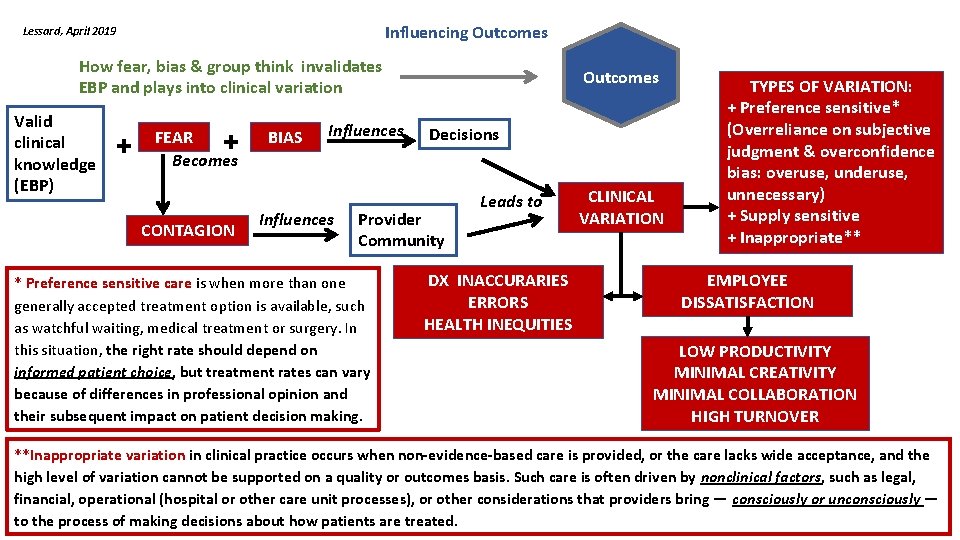
Influencing Outcomes Lessard, April 2019 How fear, bias & group think invalidates EBP and plays into clinical variation Valid clinical knowledge (EBP) + + FEAR Becomes CONTAGION BIAS Influences Outcomes Decisions Provider Community * Preference sensitive care is when more than one generally accepted treatment option is available, such as watchful waiting, medical treatment or surgery. In this situation, the right rate should depend on informed patient choice, but treatment rates can vary because of differences in professional opinion and their subsequent impact on patient decision making. Leads to DX INACCURARIES ERRORS HEALTH INEQUITIES CLINICAL VARIATION TYPES OF VARIATION: + Preference sensitive* (Overreliance on subjective judgment & overconfidence bias: overuse, underuse, unnecessary) + Supply sensitive + Inappropriate** EMPLOYEE DISSATISFACTION LOW PRODUCTIVITY MINIMAL CREATIVITY MINIMAL COLLABORATION HIGH TURNOVER **Inappropriate variation in clinical practice occurs when non-evidence-based care is provided, or the care lacks wide acceptance, and the high level of variation cannot be supported on a quality or outcomes basis. Such care is often driven by nonclinical factors, such as legal, financial, operational (hospital or other care unit processes), or other considerations that providers bring — consciously or unconsciously — to the process of making decisions about how patients are treated.
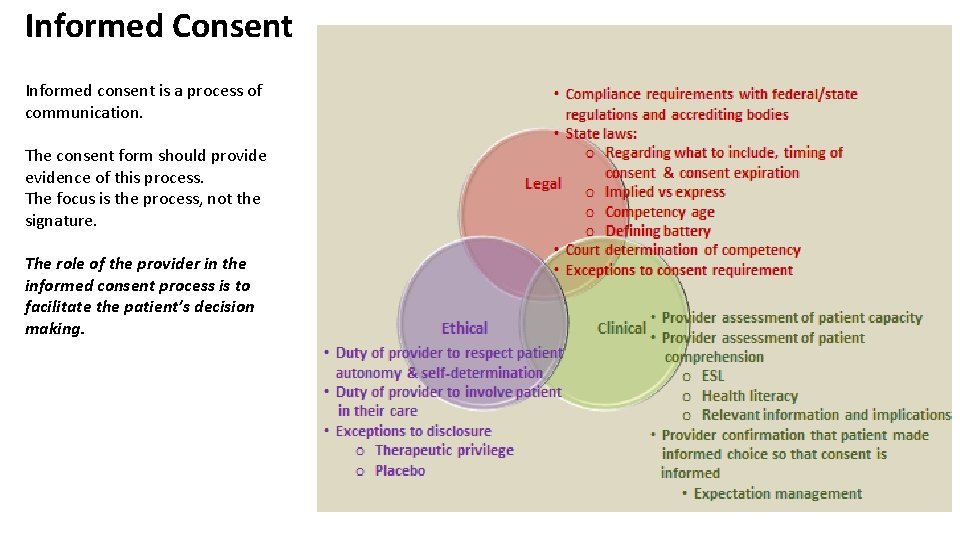
Informed Consent Informed consent is a process of communication. The consent form should provide evidence of this process. The focus is the process, not the signature. The role of the provider in the informed consent process is to facilitate the patient’s decision making.
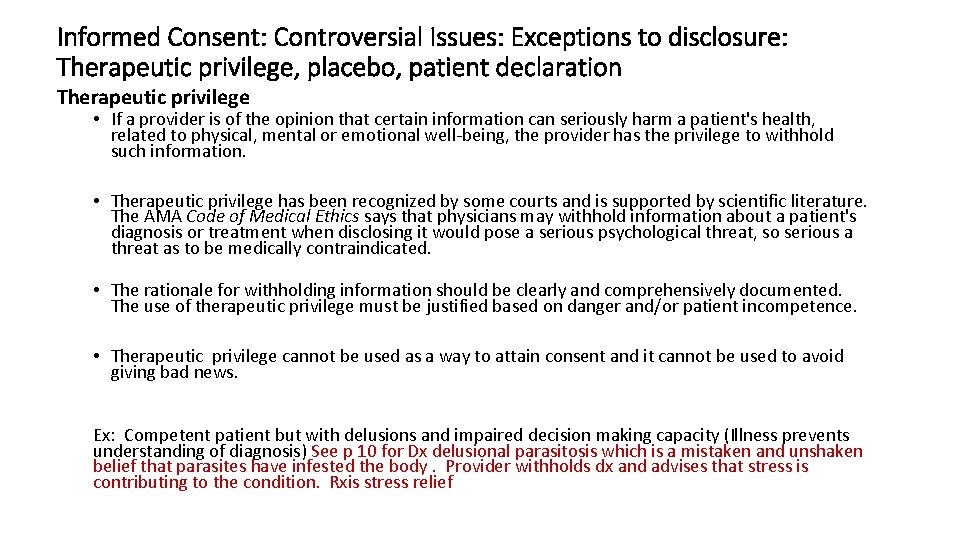
Informed Consent: Controversial Issues: Exceptions to disclosure: Therapeutic privilege, placebo, patient declaration Therapeutic privilege • If a provider is of the opinion that certain information can seriously harm a patient's health, related to physical, mental or emotional well-being, the provider has the privilege to withhold such information. • Therapeutic privilege has been recognized by some courts and is supported by scientific literature. The AMA Code of Medical Ethics says that physicians may withhold information about a patient's diagnosis or treatment when disclosing it would pose a serious psychological threat, so serious a threat as to be medically contraindicated. • The rationale for withholding information should be clearly and comprehensively documented. The use of therapeutic privilege must be justified based on danger and/or patient incompetence. • Therapeutic privilege cannot be used as a way to attain consent and it cannot be used to avoid giving bad news. Ex: Competent patient but with delusions and impaired decision making capacity (Illness prevents understanding of diagnosis) See p 10 for Dx delusional parasitosis which is a mistaken and unshaken belief that parasites have infested the body. Provider withholds dx and advises that stress is contributing to the condition. Rxis stress relief
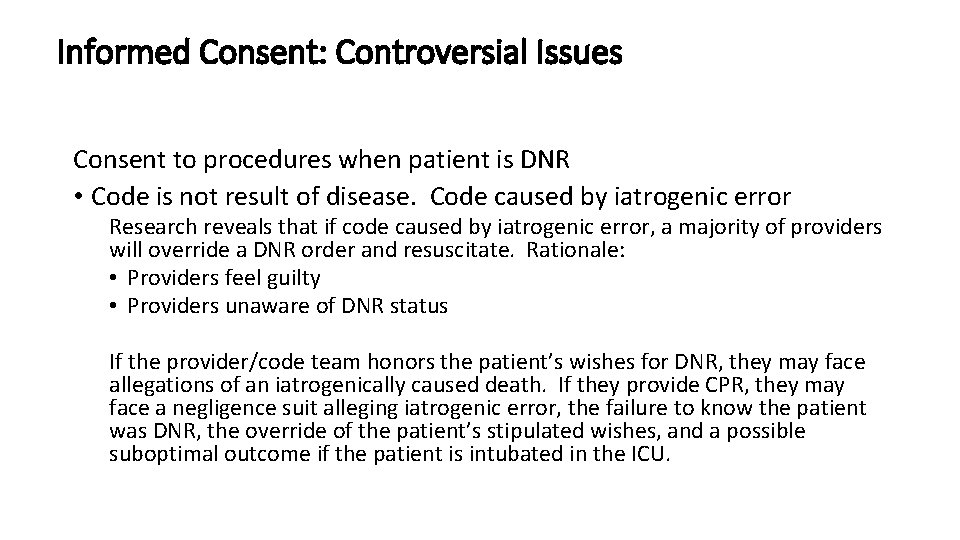
Informed Consent: Controversial Issues Consent to procedures when patient is DNR • Code is not result of disease. Code caused by iatrogenic error Research reveals that if code caused by iatrogenic error, a majority of providers will override a DNR order and resuscitate. Rationale: • Providers feel guilty • Providers unaware of DNR status If the provider/code team honors the patient’s wishes for DNR, they may face allegations of an iatrogenically caused death. If they provide CPR, they may face a negligence suit alleging iatrogenic error, the failure to know the patient was DNR, the override of the patient’s stipulated wishes, and a possible suboptimal outcome if the patient is intubated in the ICU.
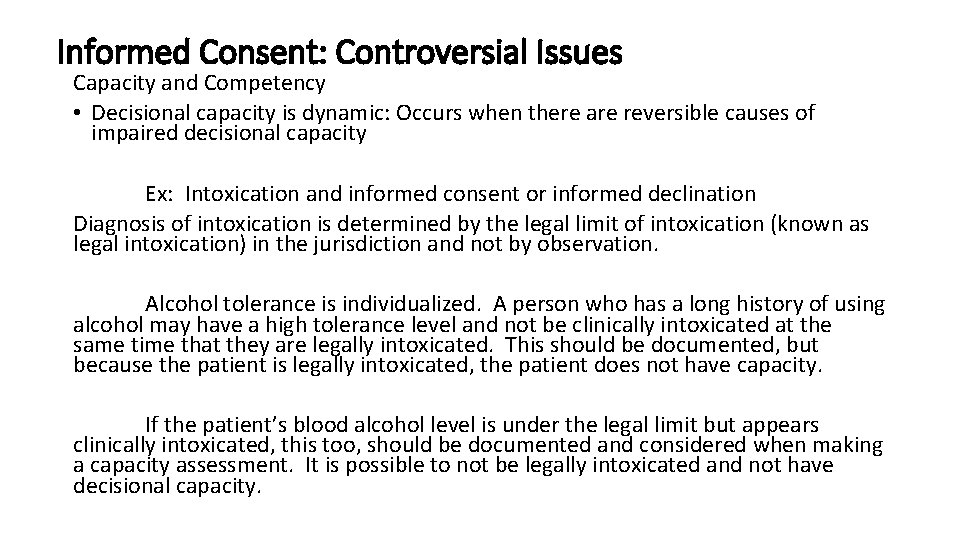
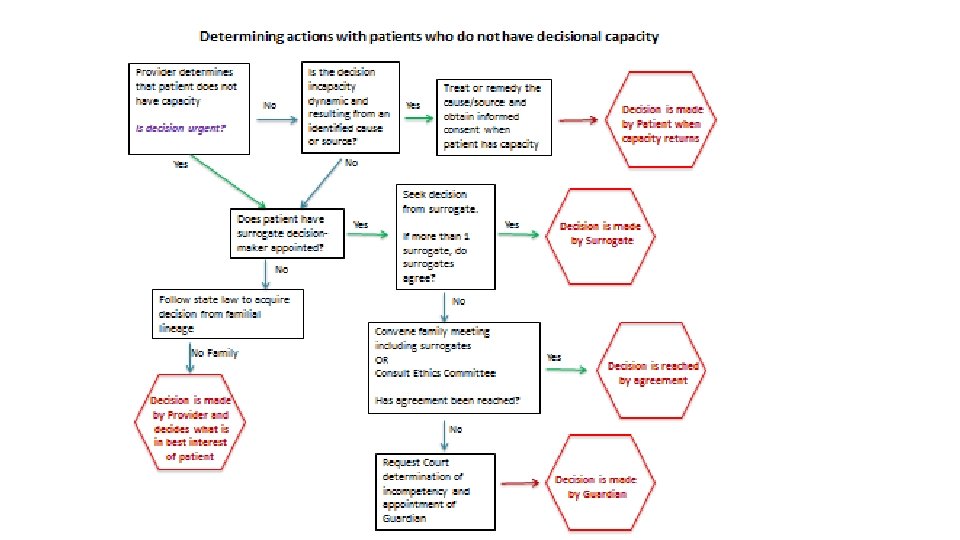
Informed Consent: Controversial Issues Capacity and Competency • Decisional capacity is dynamic: Occurs when there are reversible causes of impaired decisional capacity Ex: Intoxication and informed consent or informed declination Diagnosis of intoxication is determined by the legal limit of intoxication (known as legal intoxication) in the jurisdiction and not by observation. Alcohol tolerance is individualized. A person who has a long history of using alcohol may have a high tolerance level and not be clinically intoxicated at the same time that they are legally intoxicated. This should be documented, but because the patient is legally intoxicated, the patient does not have capacity. If the patient’s blood alcohol level is under the legal limit but appears clinically intoxicated, this too, should be documented and considered when making a capacity assessment. It is possible to not be legally intoxicated and not have decisional capacity.
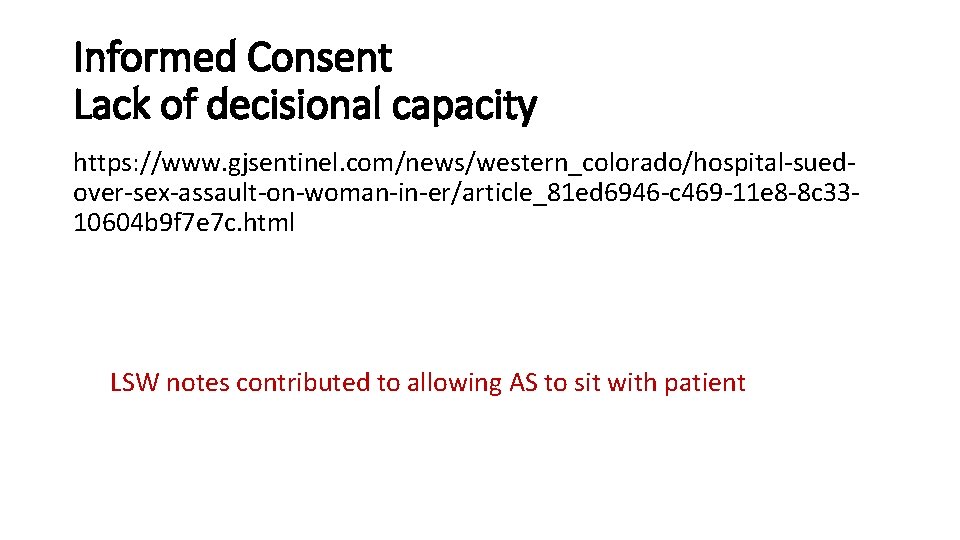
Informed Consent Lack of decisional capacity https: //www. gjsentinel. com/news/western_colorado/hospital-suedover-sex-assault-on-woman-in-er/article_81 ed 6946 -c 469 -11 e 8 -8 c 3310604 b 9 f 7 e 7 c. html LSW notes contributed to allowing AS to sit with patient
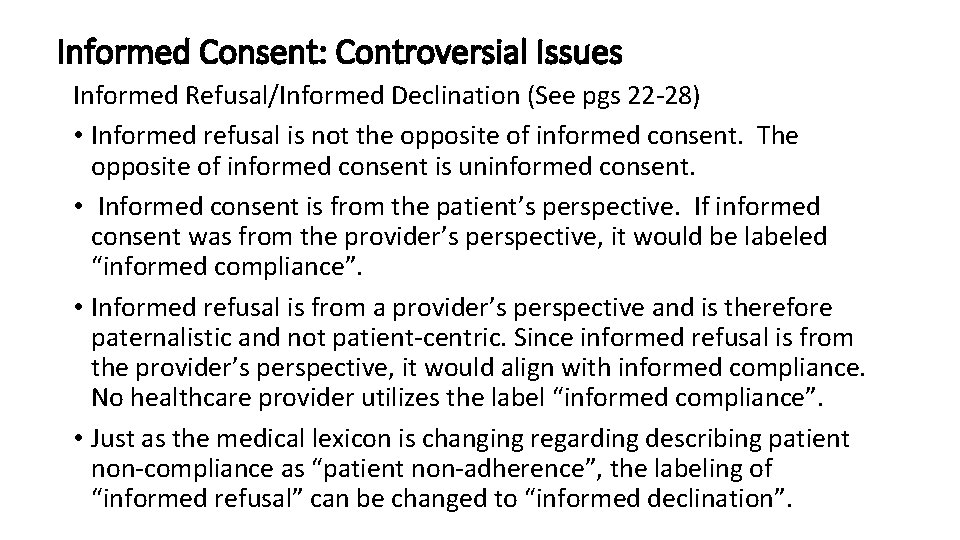
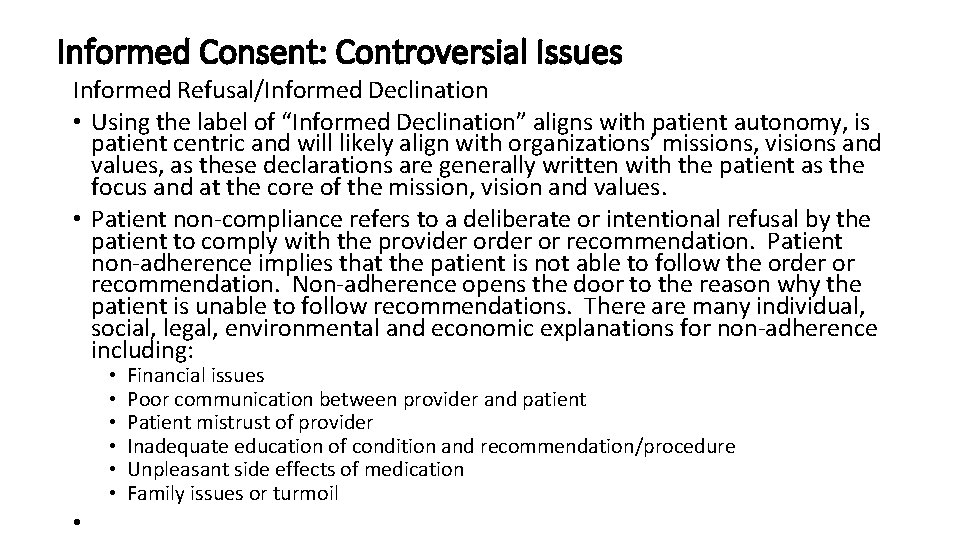
Informed Consent: Controversial Issues Informed Refusal/Informed Declination (See pgs 22 -28) • Informed refusal is not the opposite of informed consent. The opposite of informed consent is uninformed consent. • Informed consent is from the patient’s perspective. If informed consent was from the provider’s perspective, it would be labeled “informed compliance”. • Informed refusal is from a provider’s perspective and is therefore paternalistic and not patient-centric. Since informed refusal is from the provider’s perspective, it would align with informed compliance. No healthcare provider utilizes the label “informed compliance”. • Just as the medical lexicon is changing regarding describing patient non-compliance as “patient non-adherence”, the labeling of “informed refusal” can be changed to “informed declination”.
Informed Consent: Controversial Issues Informed Refusal/Informed Declination • Using the label of “Informed Declination” aligns with patient autonomy, is patient centric and will likely align with organizations’ missions, visions and values, as these declarations are generally written with the patient as the focus and at the core of the mission, vision and values. • Patient non-compliance refers to a deliberate or intentional refusal by the patient to comply with the provider or recommendation. Patient non-adherence implies that the patient is not able to follow the order or recommendation. Non-adherence opens the door to the reason why the patient is unable to follow recommendations. There are many individual, social, legal, environmental and economic explanations for non-adherence including: • • Financial issues Poor communication between provider and patient Patient mistrust of provider Inadequate education of condition and recommendation/procedure Unpleasant side effects of medication Family issues or turmoil
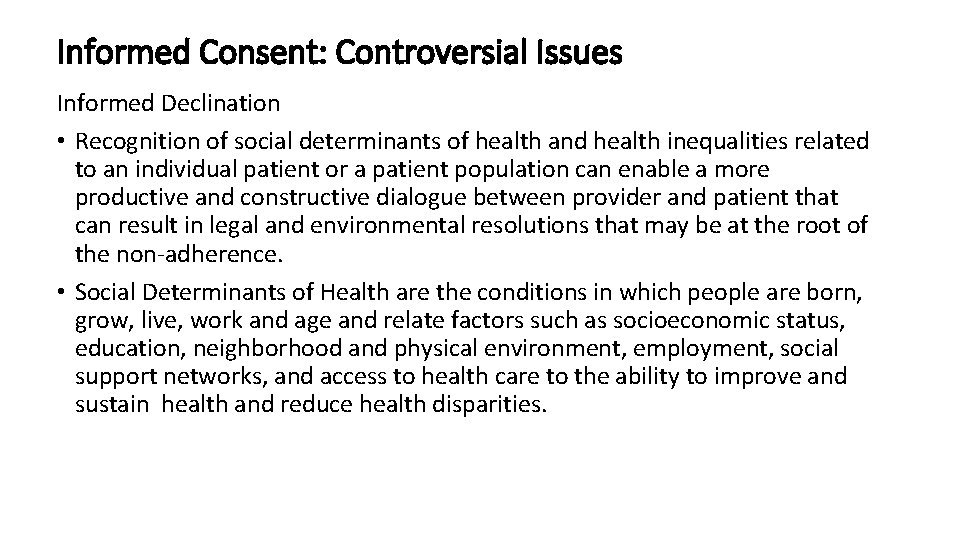
Informed Consent: Controversial Issues Informed Declination • Recognition of social determinants of health and health inequalities related to an individual patient or a patient population can enable a more productive and constructive dialogue between provider and patient that can result in legal and environmental resolutions that may be at the root of the non-adherence. • Social Determinants of Health are the conditions in which people are born, grow, live, work and age and relate factors such as socioeconomic status, education, neighborhood and physical environment, employment, social support networks, and access to health care to the ability to improve and sustain health and reduce health disparities.
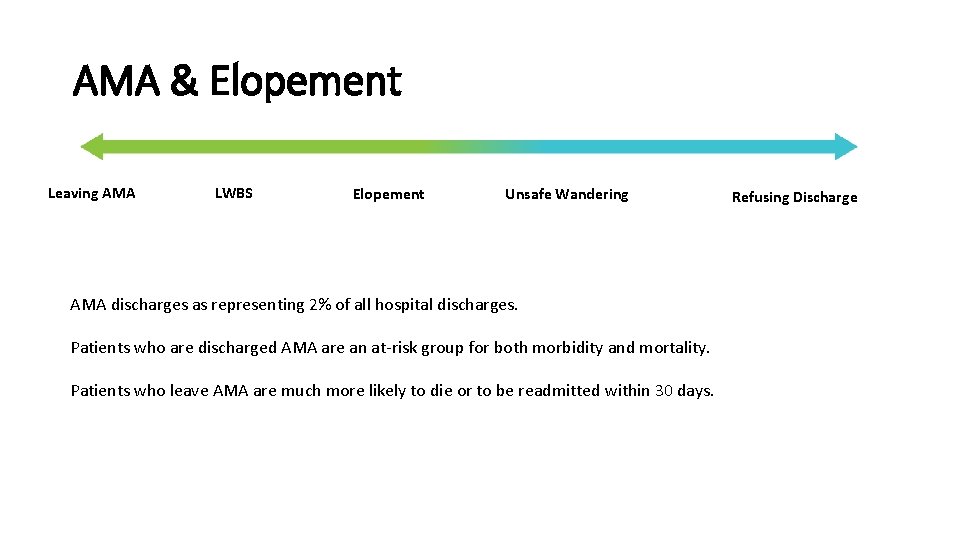
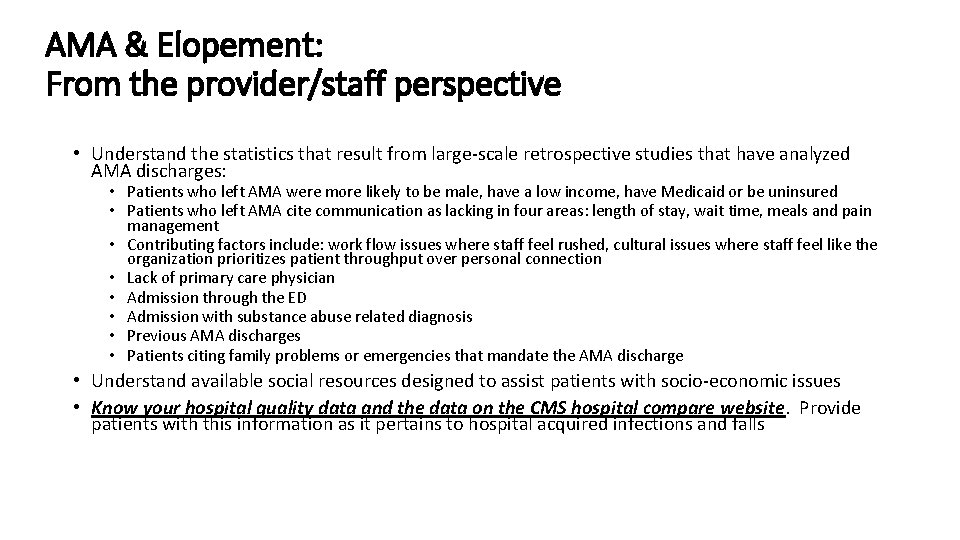
AMA & Elopement Leaving AMA LWBS Elopement Unsafe Wandering AMA discharges as representing 2% of all hospital discharges. Patients who are discharged AMA are an at-risk group for both morbidity and mortality. Patients who leave AMA are much more likely to die or to be readmitted within 30 days. Refusing Discharge
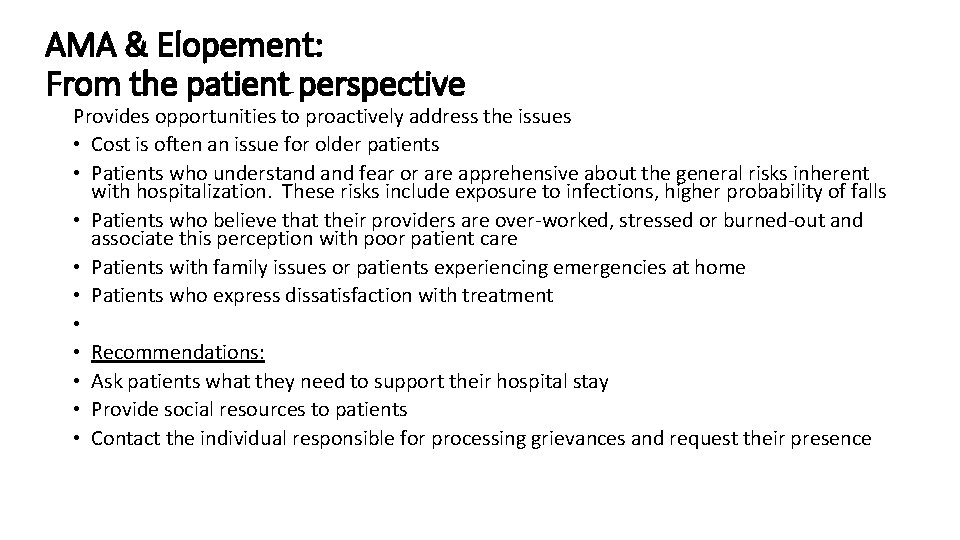
AMA & Elopement: From the patient perspective Provides opportunities to proactively address the issues • Cost is often an issue for older patients • Patients who understand fear or are apprehensive about the general risks inherent with hospitalization. These risks include exposure to infections, higher probability of falls • Patients who believe that their providers are over-worked, stressed or burned-out and associate this perception with poor patient care • Patients with family issues or patients experiencing emergencies at home • Patients who express dissatisfaction with treatment • • Recommendations: • Ask patients what they need to support their hospital stay • Provide social resources to patients • Contact the individual responsible for processing grievances and request their presence
AMA & Elopement: From the provider/staff perspective • Understand the statistics that result from large-scale retrospective studies that have analyzed AMA discharges: • Patients who left AMA were more likely to be male, have a low income, have Medicaid or be uninsured • Patients who left AMA cite communication as lacking in four areas: length of stay, wait time, meals and pain management • Contributing factors include: work flow issues where staff feel rushed, cultural issues where staff feel like the organization prioritizes patient throughput over personal connection • Lack of primary care physician • Admission through the ED • Admission with substance abuse related diagnosis • Previous AMA discharges • Patients citing family problems or emergencies that mandate the AMA discharge • Understand available social resources designed to assist patients with socio-economic issues • Know your hospital quality data and the data on the CMS hospital compare website. Provide patients with this information as it pertains to hospital acquired infections and falls
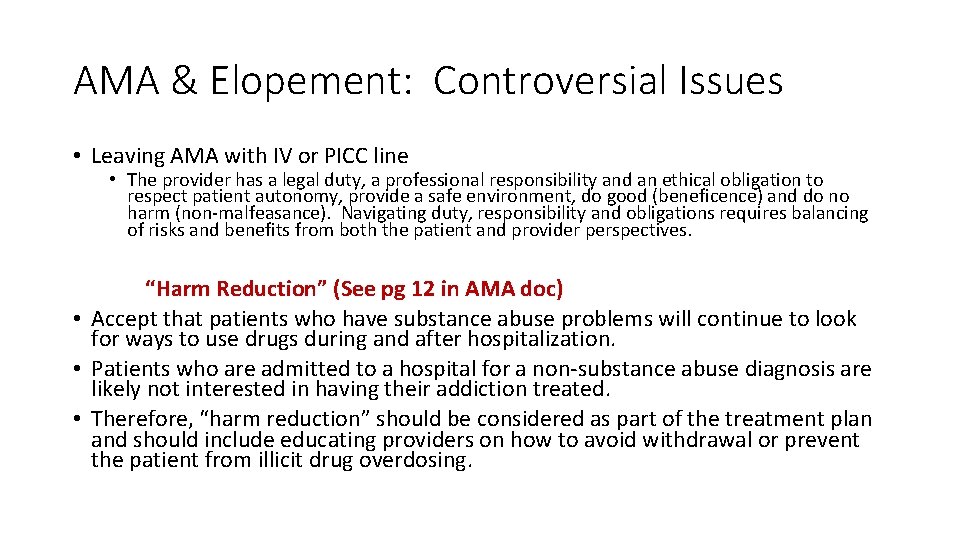
AMA & Elopement: Controversial Issues • Leaving AMA with IV or PICC line • The provider has a legal duty, a professional responsibility and an ethical obligation to respect patient autonomy, provide a safe environment, do good (beneficence) and do no harm (non-malfeasance). Navigating duty, responsibility and obligations requires balancing of risks and benefits from both the patient and provider perspectives. “Harm Reduction” (See pg 12 in AMA doc) • Accept that patients who have substance abuse problems will continue to look for ways to use drugs during and after hospitalization. • Patients who are admitted to a hospital for a non-substance abuse diagnosis are likely not interested in having their addiction treated. • Therefore, “harm reduction” should be considered as part of the treatment plan and should include educating providers on how to avoid withdrawal or prevent the patient from illicit drug overdosing.
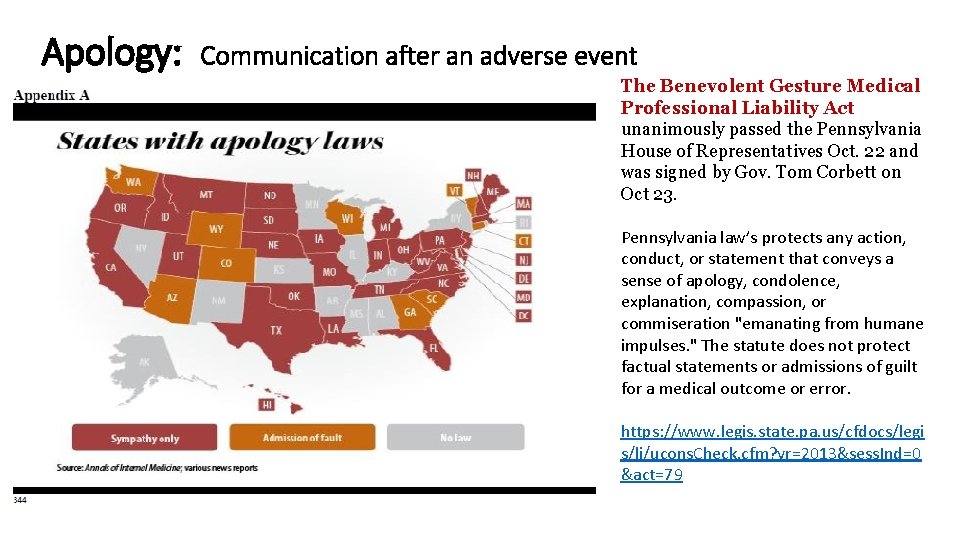
Apology: Communication after an adverse event The Benevolent Gesture Medical Professional Liability Act unanimously passed the Pennsylvania House of Representatives Oct. 22 and was signed by Gov. Tom Corbett on Oct 23. Pennsylvania law’s protects any action, conduct, or statement that conveys a sense of apology, condolence, explanation, compassion, or commiseration "emanating from humane impulses. " The statute does not protect factual statements or admissions of guilt for a medical outcome or error. https: //www. legis. state. pa. us/cfdocs/legi s/li/ucons. Check. cfm? yr=2013&sess. Ind=0 &act=79
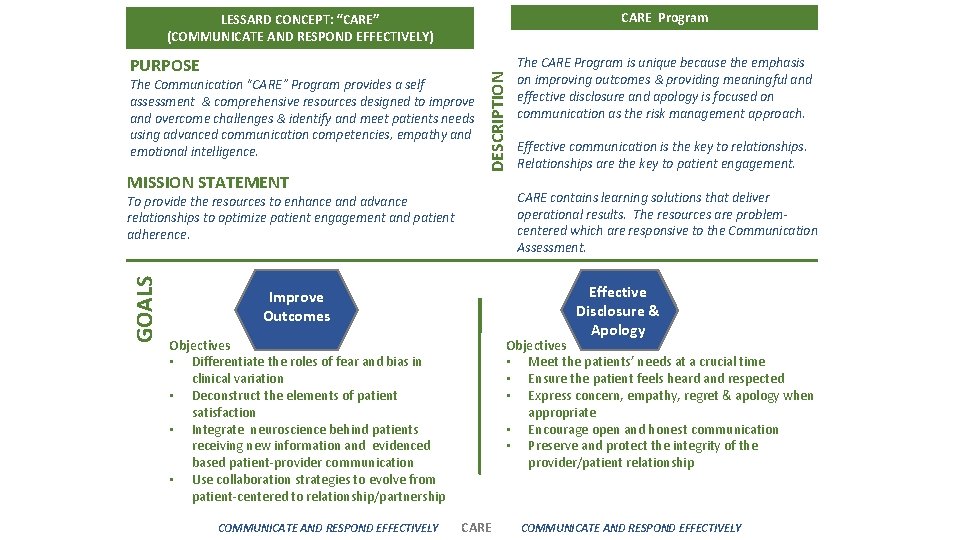
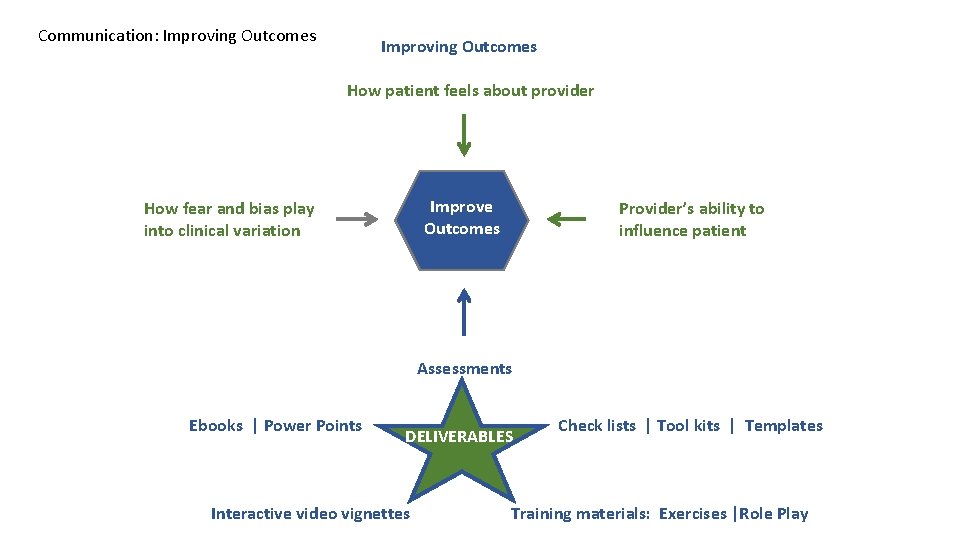
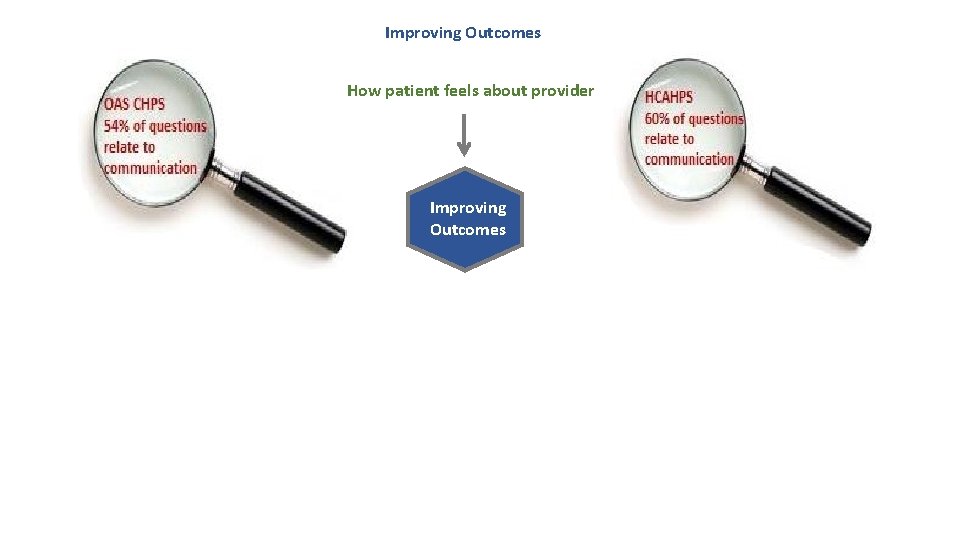
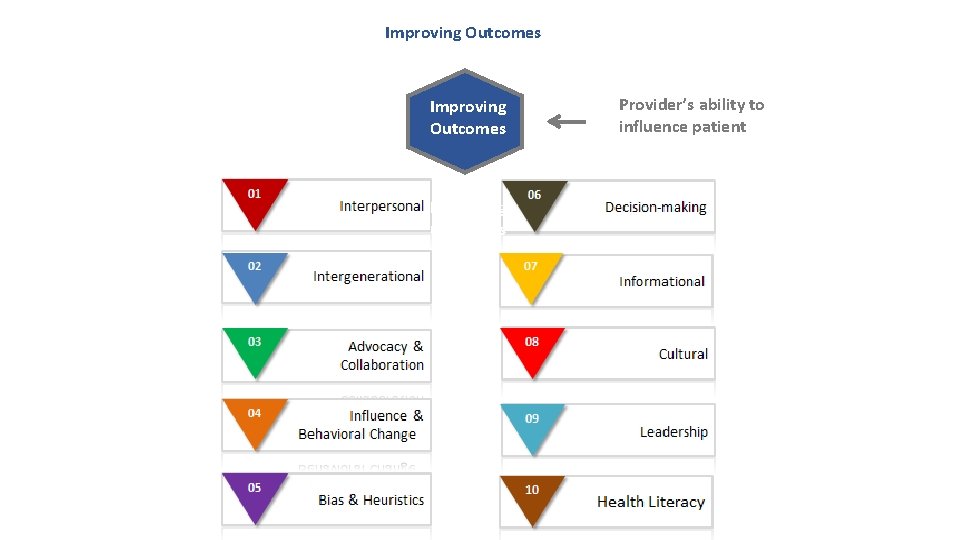
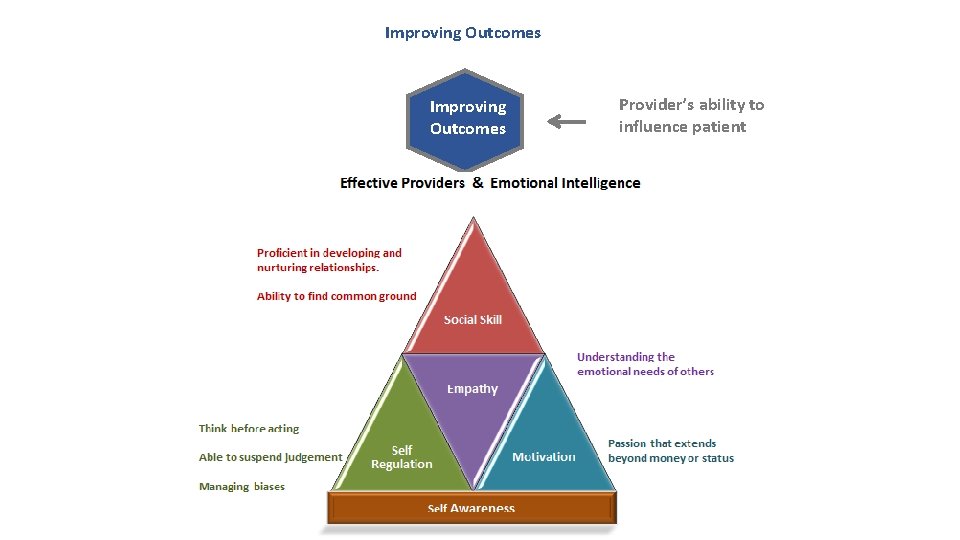
CARE Program PURPOSE The Communication “CARE” Program provides a self assessment & comprehensive resources designed to improve and overcome challenges & identify and meet patients needs using advanced communication competencies, empathy and emotional intelligence. MISSION STATEMENT DESCRIPTION LESSARD CONCEPT: “CARE” (COMMUNICATE AND RESPOND EFFECTIVELY) GOALS Effective communication is the key to relationships. Relationships are the key to patient engagement. CARE contains learning solutions that deliver operational results. The resources are problemcentered which are responsive to the Communication Assessment. To provide the resources to enhance and advance relationships to optimize patient engagement and patient adherence. Effective Disclosure & Apology Improve Outcomes Objectives • Differentiate the roles of fear and bias in clinical variation • Deconstruct the elements of patient satisfaction • Integrate neuroscience behind patients receiving new information and evidenced based patient-provider communication • Use collaboration strategies to evolve from patient-centered to relationship/partnership COMMUNICATE AND RESPOND EFFECTIVELY The CARE Program is unique because the emphasis on improving outcomes & providing meaningful and effective disclosure and apology is focused on communication as the risk management approach. Objectives • Meet the patients’ needs at a crucial time • Ensure the patient feels heard and respected • Express concern, empathy, regret & apology when appropriate • Encourage open and honest communication • Preserve and protect the integrity of the provider/patient relationship CARE COMMUNICATE AND RESPOND EFFECTIVELY
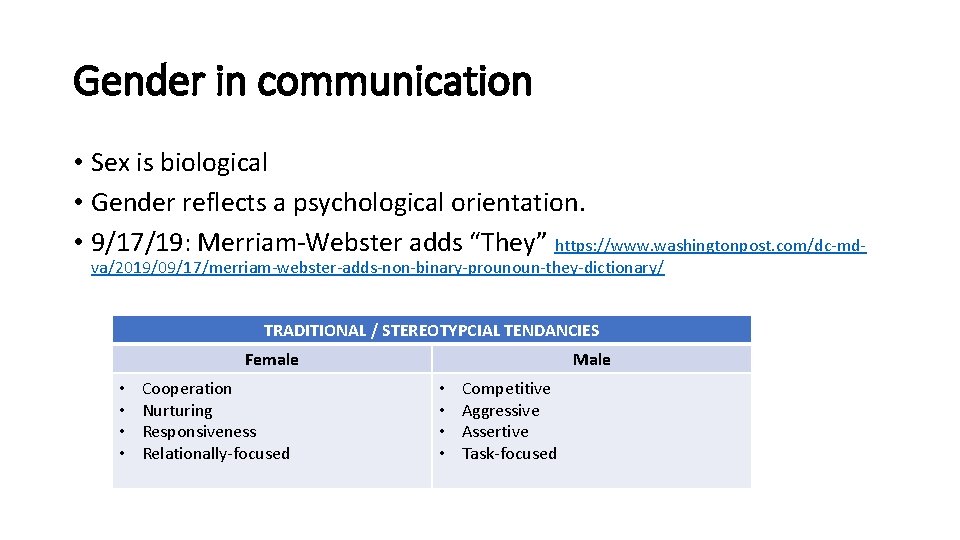
Gender in communication • Sex is biological • Gender reflects a psychological orientation. • 9/17/19: Merriam-Webster adds “They” https: //www. washingtonpost. com/dc-mdva/2019/09/17/merriam-webster-adds-non-binary-prounoun-they-dictionary/ TRADITIONAL / STEREOTYPCIAL TENDANCIES Female • • Cooperation Nurturing Responsiveness Relationally-focused Male • • Competitive Aggressive Assertive Task-focused
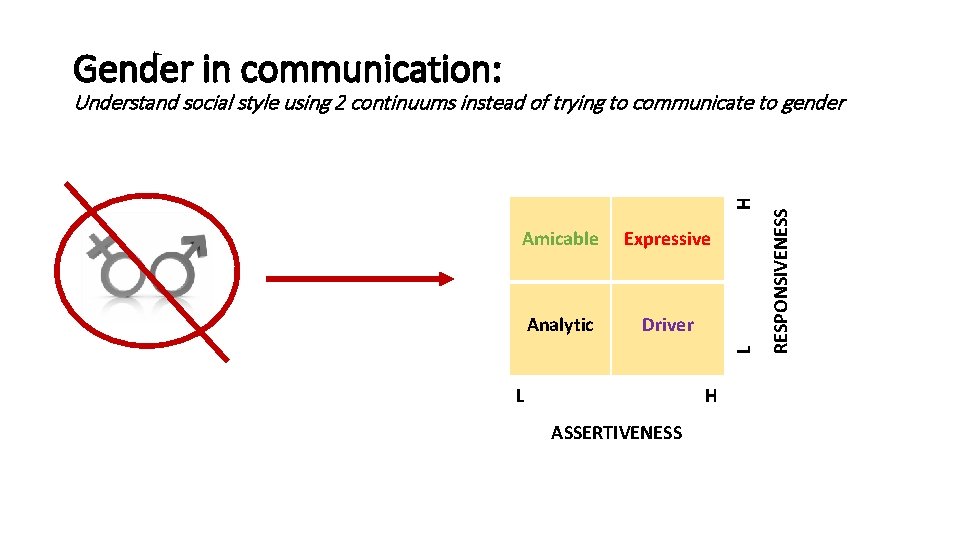
Gender in communication: Amicable Expressive Analytic Driver L H ASSERTIVENESS RESPONSIVENESS L H Understand social style using 2 continuums instead of trying to communicate to gender
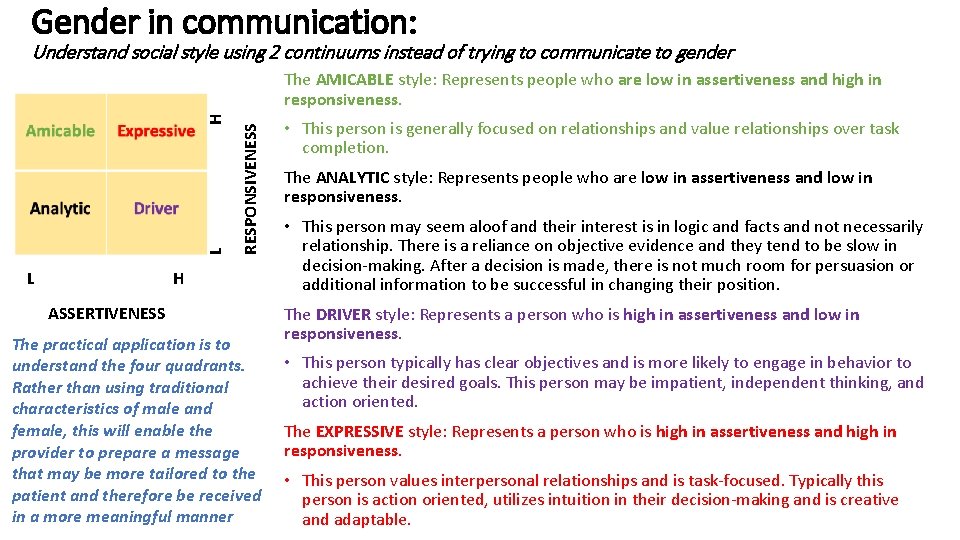
Gender in communication: Understand social style using 2 continuums instead of trying to communicate to gender RESPONSIVENESS L H The AMICABLE style: Represents people who are low in assertiveness and high in responsiveness. L H ASSERTIVENESS The practical application is to understand the four quadrants. Rather than using traditional characteristics of male and female, this will enable the provider to prepare a message that may be more tailored to the patient and therefore be received in a more meaningful manner • This person is generally focused on relationships and value relationships over task completion. The ANALYTIC style: Represents people who are low in assertiveness and low in responsiveness. • This person may seem aloof and their interest is in logic and facts and not necessarily relationship. There is a reliance on objective evidence and they tend to be slow in decision-making. After a decision is made, there is not much room for persuasion or additional information to be successful in changing their position. The DRIVER style: Represents a person who is high in assertiveness and low in responsiveness. • This person typically has clear objectives and is more likely to engage in behavior to achieve their desired goals. This person may be impatient, independent thinking, and action oriented. The EXPRESSIVE style: Represents a person who is high in assertiveness and high in responsiveness. • This person values interpersonal relationships and is task-focused. Typically this person is action oriented, utilizes intuition in their decision-making and is creative and adaptable.
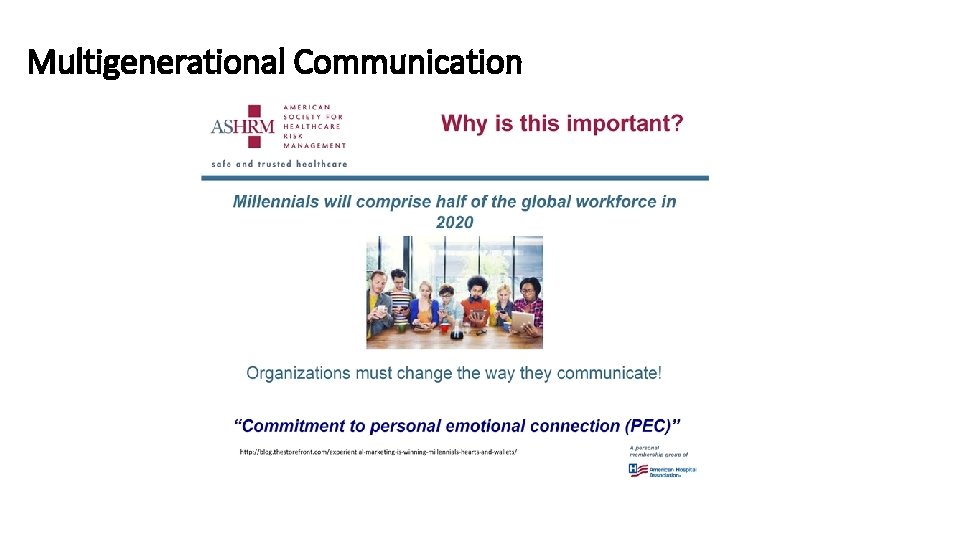
Multigenerational Communication
Communication: Improving Outcomes How patient feels about provider Improve Outcomes How fear and bias play into clinical variation Provider’s ability to influence patient Assessments Ebooks | Power Points DELIVERABLES Interactive video vignettes Check lists | Tool kits | Templates Training materials: Exercises |Role Play
Improving Outcomes How patient feels about provider Improving Outcomes
Improving Outcomes Provider’s ability to influence patient
Improving Outcomes Provider’s ability to influence patient
Medical Legal Partnerships: Next 6 slides copied with permission from
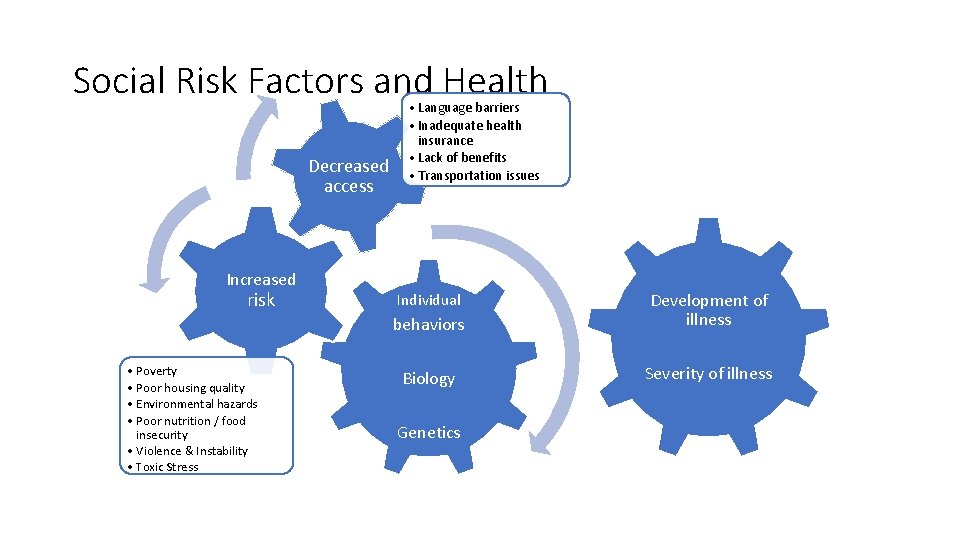
Social Risk Factors and Health Decreased access Increased risk • Poverty • Poor housing quality • Environmental hazards • Poor nutrition / food insecurity • Violence & Instability • Toxic Stress • Language barriers • Inadequate health insurance • Lack of benefits • Transportation issues behaviors Development of illness Biology Severity of illness Individual Genetics
Health-Harming Legal Needs Question: What types of legal issues can affect the health and wellbeing of low-income patients? Refer to “Why you should know what happened in Freddie Gray’s life – long before his death” (Washington Post) http: //www. justicepolicy. org/news/9964
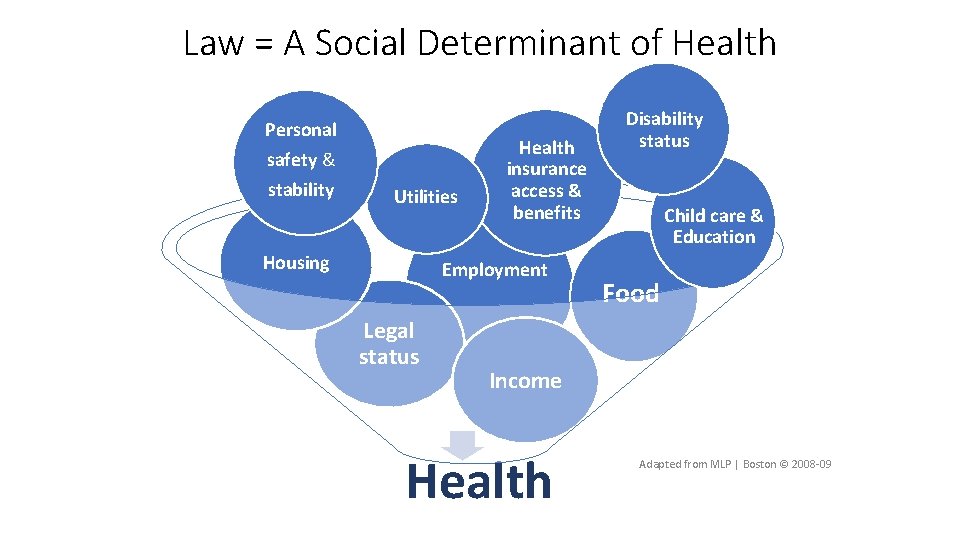
Law = A Social Determinant of Health Personal Health insurance access & benefits safety & stability Utilities Housing Employment Legal status Disability status Child care & Education Food Income Health Adapted from MLP | Boston © 2008 -09
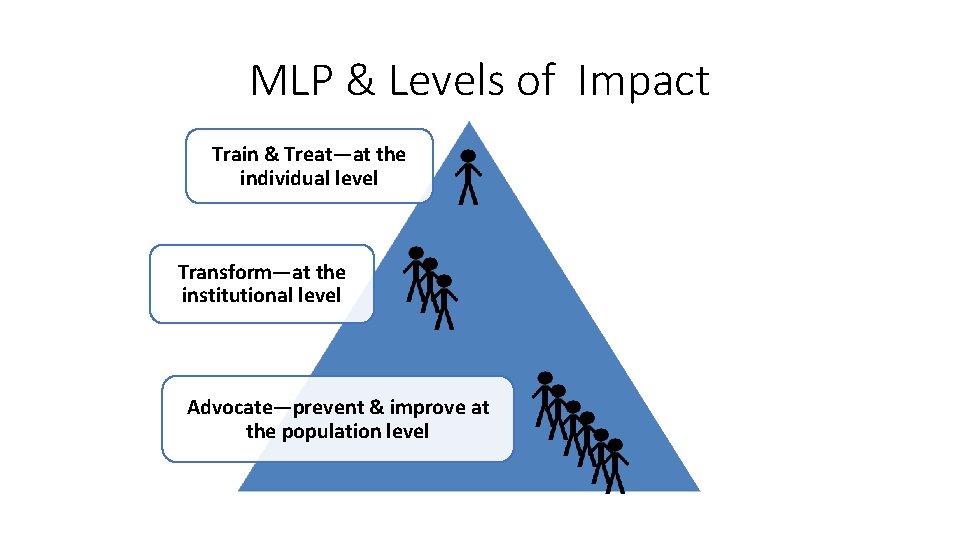
MLP & Levels of Impact Train & Treat—at the individual level Transform—at the institutional level Advocate—prevent & improve at the population level
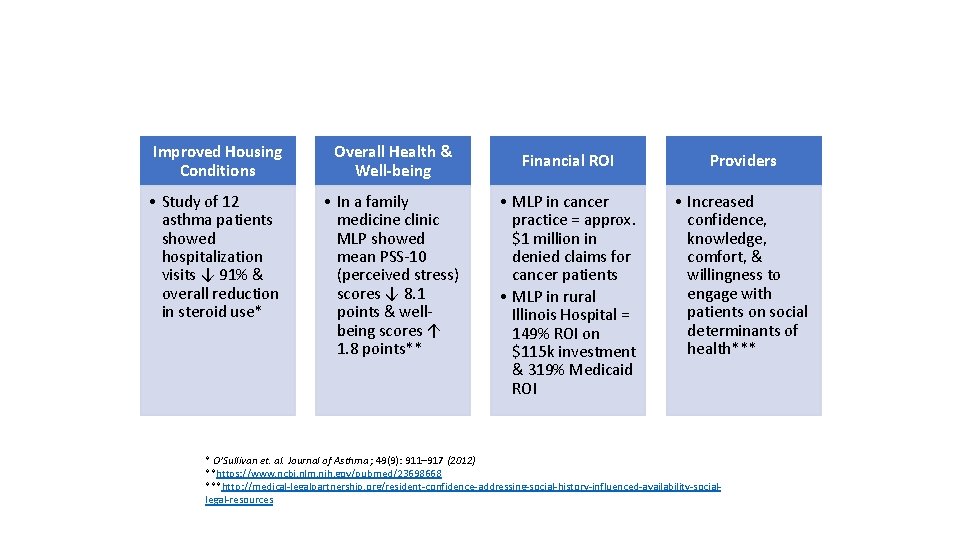
MLP Impact & Examples Improved Housing Conditions Overall Health & Well-being • Study of 12 asthma patients showed hospitalization visits ↓ 91% & overall reduction in steroid use* • In a family medicine clinic MLP showed mean PSS-10 (perceived stress) scores ↓ 8. 1 points & wellbeing scores ↑ 1. 8 points** Financial ROI Providers • MLP in cancer practice = approx. $1 million in denied claims for cancer patients • MLP in rural Illinois Hospital = 149% ROI on $115 k investment & 319% Medicaid ROI • Increased confidence, knowledge, comfort, & willingness to engage with patients on social determinants of health*** * O’Sullivan et. al. Journal of Asthma ; 49(9): 911– 917 (2012) **https: //www. ncbi. nlm. nih. gov/pubmed/23698668 ***http: //medical-legalpartnership. org/resident-confidence-addressing-social-history-influenced-availability-sociallegal-resources
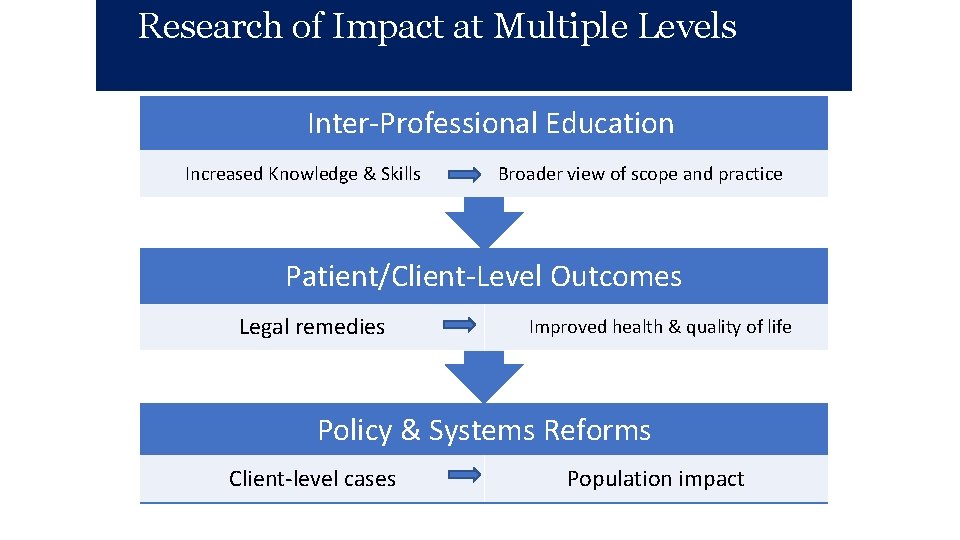
Research of Impact at Multiple Levels Inter-Professional Education Increased Knowledge & Skills Broader view of scope and practice Patient/Client-Level Outcomes Legal remedies Improved health & quality of life Policy & Systems Reforms Client-level cases Population impact
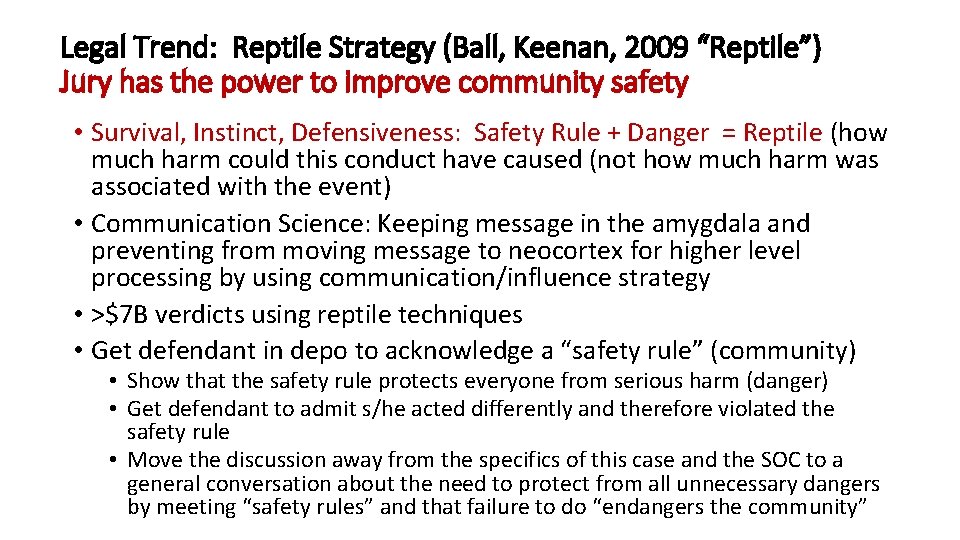
Legal Trend: Reptile Strategy (Ball, Keenan, 2009 “Reptile”) Jury has the power to improve community safety • Survival, Instinct, Defensiveness: Safety Rule + Danger = Reptile (how much harm could this conduct have caused (not how much harm was associated with the event) • Communication Science: Keeping message in the amygdala and preventing from moving message to neocortex for higher level processing by using communication/influence strategy • >$7 B verdicts using reptile techniques • Get defendant in depo to acknowledge a “safety rule” (community) • Show that the safety rule protects everyone from serious harm (danger) • Get defendant to admit s/he acted differently and therefore violated the safety rule • Move the discussion away from the specifics of this case and the SOC to a general conversation about the need to protect from all unnecessary dangers by meeting “safety rules” and that failure to do “endangers the community”
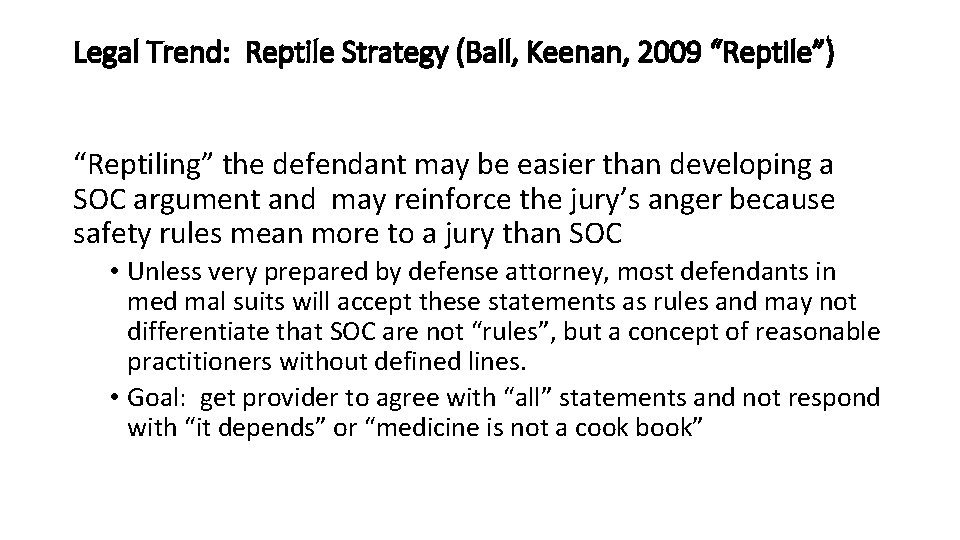
Legal Trend: Reptile Strategy (Ball, Keenan, 2009 “Reptile”) “Reptiling” the defendant may be easier than developing a SOC argument and may reinforce the jury’s anger because safety rules mean more to a jury than SOC • Unless very prepared by defense attorney, most defendants in med mal suits will accept these statements as rules and may not differentiate that SOC are not “rules”, but a concept of reasonable practitioners without defined lines. • Goal: get provider to agree with “all” statements and not respond with “it depends” or “medicine is not a cook book”
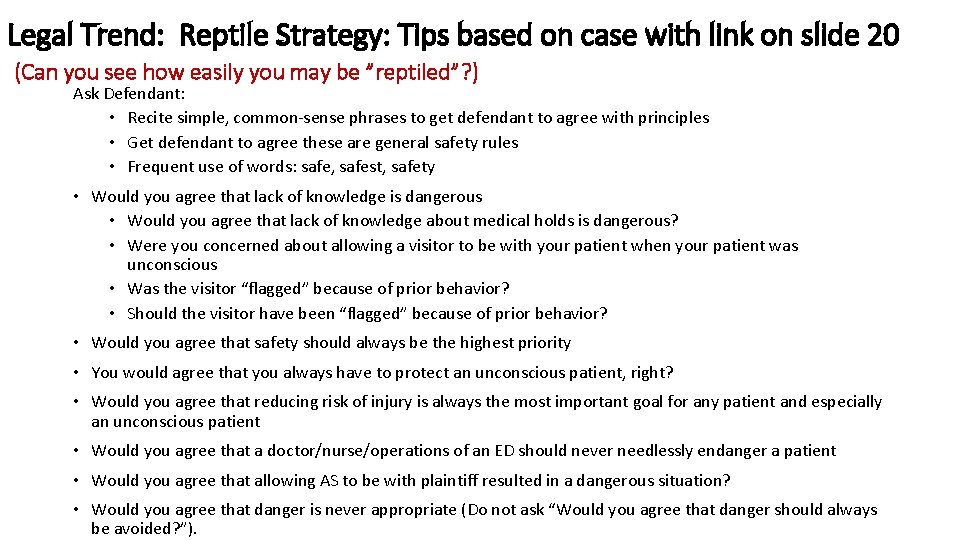
Legal Trend: Reptile Strategy: Tips based on case with link on slide 20 (Can you see how easily you may be ”reptiled”? ) Ask Defendant: • Recite simple, common-sense phrases to get defendant to agree with principles • Get defendant to agree these are general safety rules • Frequent use of words: safe, safest, safety • Would you agree that lack of knowledge is dangerous • Would you agree that lack of knowledge about medical holds is dangerous? • Were you concerned about allowing a visitor to be with your patient when your patient was unconscious • Was the visitor “flagged” because of prior behavior? • Should the visitor have been “flagged” because of prior behavior? • Would you agree that safety should always be the highest priority • You would agree that you always have to protect an unconscious patient, right? • Would you agree that reducing risk of injury is always the most important goal for any patient and especially an unconscious patient • Would you agree that a doctor/nurse/operations of an ED should never needlessly endanger a patient • Would you agree that allowing AS to be with plaintiff resulted in a dangerous situation? • Would you agree that danger is never appropriate (Do not ask “Would you agree that danger should always be avoided? ”).
Deb Lessard, JD, MA, BSN, CPHRM, FASHRM dl 975@Georgetown. edu 717|856 -4266