
Ethical Theories Learning objectives To explain meaning and
Ethical Theories
Learning objectives • To explain meaning and significance of ethical theories • To differentiate major ethical theories • To analyze ethical behaviors based on ethical theories
Differences Between Law vs. Ethics • Law is a systems of principles and rules of human conduct prescribed or organized by society and enforced by public authority • Ethics is study of standards of conduct and moral judgment. When referring to a profession, it is a system, principles, or code of that group
Ethical Theories • Utilitarianism • Deontology • Utiritarianism • Jeremy Bentham, John Stuart Mill • Greatest good for the greatest number • The end justifies the means
Utilitarianism • placing the locus of right and wrong solely on the outcomes (consequences) of choosing one action/policy over other actions/policies. • Moves beyond the scope of one's own interests • Takes into account the interests of others
Basic beliefs of Utilitarianism • What is moral right is whatever produces the greatest overall amount of pleasure or happiness • Producing good consequences, not having good intentions • Do whatever will bring the most benefit (i. e. , intrinsic value) to all of humanity
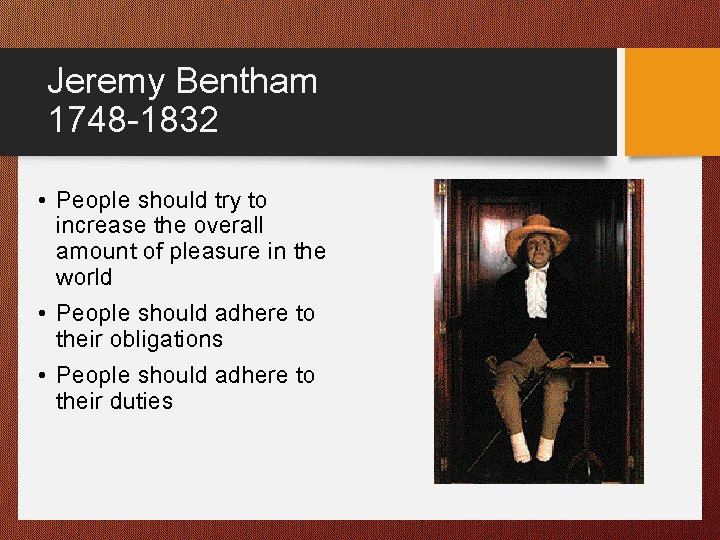
Jeremy Bentham 1748 -1832 • People should try to increase the overall amount of pleasure in the world • People should adhere to their obligations • People should adhere to their duties
Jeremy Bentham • Recognizes the fundamental role of pain and pleasure in human life • Approves or disapproves of an action on the basis of the amount of pain or pleasure brought about i. e, consequences • Equates good with pleasure and evil with pain, and asserts that pleasure and pain are capable of quantification
John Stuart Mill • It is not the quantity of pleasure, but the quality of happiness that is central to utilitarianism • The calculus is unreasonable, that is, qualities cannot be quantified • Utilitarianism refers to the Greatest Happiness Principle to promote the capability of achieving happiness (higher pleasures) for the most amount of people
Deontology • Immanuel Kant • Considering one's duties and the rights of others • The means justifies the end
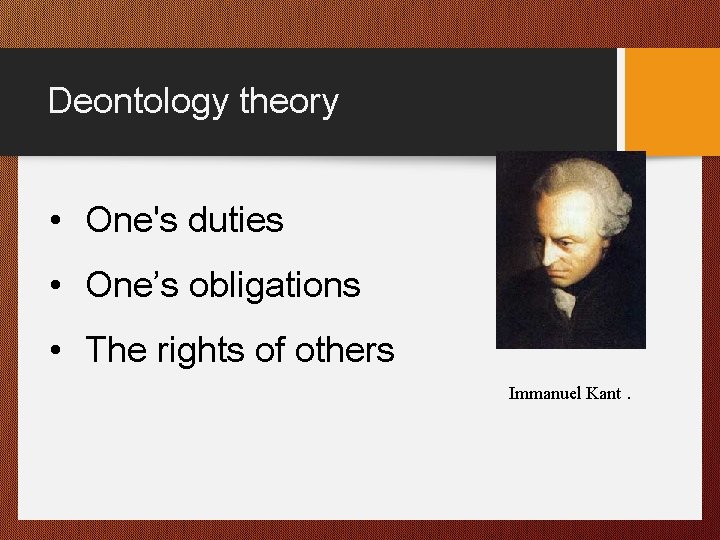
Deontology theory • One's duties • One’s obligations • The rights of others Immanuel Kant.
Basic beliefs of Deontology • Adhere to their obligations and duties because upholding one's duty is what is considered ethically correct • Keeping promises to a friend • Following the law • A person who follows this theory will produce very consistent decisions since they will be based on the individual's set duties
Difference between Utiritarianism and Deontology • The Utiritarianism believes that only the consequences of an act are important. • The Deontology is concerned with whether an act is intrinsically right or wrong • Deontology deals with intentions and motives
Virtue Ethics: Definition • Virtue Ethics is a classification within Normative Ethics • It attempts to discover and classify what might be deemed of moral character • Applying the moral character as a base for one's choices and actions
Key Concepts • focusing on what the individual should choose for his/her own personal inward behavior (character( • Rather than the individual relying solely on the external laws and customs of the person's culture • If a person's character is good then so ought the person's choices and actions be good.
Key Concepts • Aristotle believed that a virtue lay in the middle of two contrary vices and described it as “the mean by reference to two vices: the one of excess and the other of deficiency” • Examples • Courage lies between foolhardiness and cowardice • Compassion lies between callousness and indulgence
Case Study • Friends or Lovers? ? • Tony, Claire, and Beth were the best of friends through high school. • After graduation they announced their engagement and Beth asked Claire to be her maid of honor. About six months before the wedding, Beth's mother became ill. • Two months passed and Beth's mother's condition worsened. Given the circumstance, Claire offered to help Beth to call off the wedding.
Case Analysis • One evening Claire met Tony for dinner, and noticed while dining that he was very quiet. She asked him if there was something bothering him • Tony paused for a moment and asked Claire if she could keep a secret. • He proceeded to confess that he had a brief affair shortly after Beth's mother became ill.
Case Analysis (Cont. ) • Tony told Claire how grateful he was to have gotten all of that off his chest and thanked Claire for being such a good friend. Still, Claire was speechless. • Question • If you were Claire, what you gonna do?
Conclusion • Ethical theory serves as the foundation for ethical solutions • Philosophers have come up with theoretical ways of telling right from wrong • giving guidelines about how to live and act ethically

Questions!!!
- Slides: 21