THE 7 TH EAHSC Site personnel survey on
- Slides: 15
THE 7 TH EAHSC Site personnel survey on practical and training aspect related to the implementation of Point of Care test for HIV Early Infant Diagnosis Hellen Mahiga, Study Clinician
Outline �Introduction �Objective �Method �Results �Conclusion
Introduction � Point-of-Care (Po. C) HIV testing for early infant diagnosis (EID) enables nurse-based, decentralized testing with the potential to replace centralized laboratory EID. � Xpert HIV-1 (Cepheid) is one of the recommended tests for EID in the latest 2016 WHO guidelines. � Xpert® HIV-1 Qual assays is simple to use test suitable for operators with limited experience and training. � Self-contained tests � RT-PCR and PCR reagents and processes are hosted in single use, self-contained Gene. Xpert cartridges. � Operator intervention is not required during analysis steps. � Specialized training is not required for troubleshooting or error code interpretation and results are easy to interpret. � The BABY Study was a prospective diagnostic cohort study in infants born from HIV infected mothers evaluating the accuracy and operational feasibility of the Xpert® HIV-1 Qual Po. C test at different timepoints performed by nurses or midwives at five primary obstetric heath facilities in Mbeya. � Recruitment period: June 2015 to Sep 2016. � We observed a 100% sensitivity and specificity of Xpert HIV-1 Qual Po. C from whole blood for the detection of neonatal HIV from birth until week 6.
Objective � To undertake a field based performance study to demonstrate that the results obtained by the intended user, nurses and lab technicians, are comparable with results obtained by a professional user (laboratory technologist) in a central testing facility and that % error/invalid results remains below 5%. � To assess training requirements to ensure competency at different end users skill levels in Mbeya, Tanzania
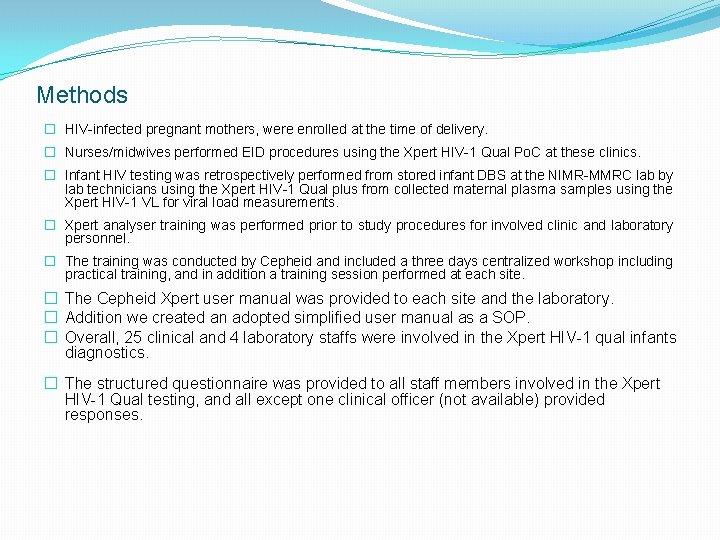
Methods � HIV-infected pregnant mothers, were enrolled at the time of delivery. � Nurses/midwives performed EID procedures using the Xpert HIV-1 Qual Po. C at these clinics. � Infant HIV testing was retrospectively performed from stored infant DBS at the NIMR-MMRC lab by lab technicians using the Xpert HIV-1 Qual plus from collected maternal plasma samples using the Xpert HIV-1 VL for viral load measurements. � Xpert analyser training was performed prior to study procedures for involved clinic and laboratory personnel. � The training was conducted by Cepheid and included a three days centralized workshop including practical training, and in addition a training session performed at each site. � The Cepheid Xpert user manual was provided to each site and the laboratory. � Addition we created an adopted simplified user manual as a SOP. � Overall, 25 clinical and 4 laboratory staffs were involved in the Xpert HIV-1 qual infants diagnostics. � The structured questionnaire was provided to all staff members involved in the Xpert HIV-1 Qual testing, and all except one clinical officer (not available) provided responses.
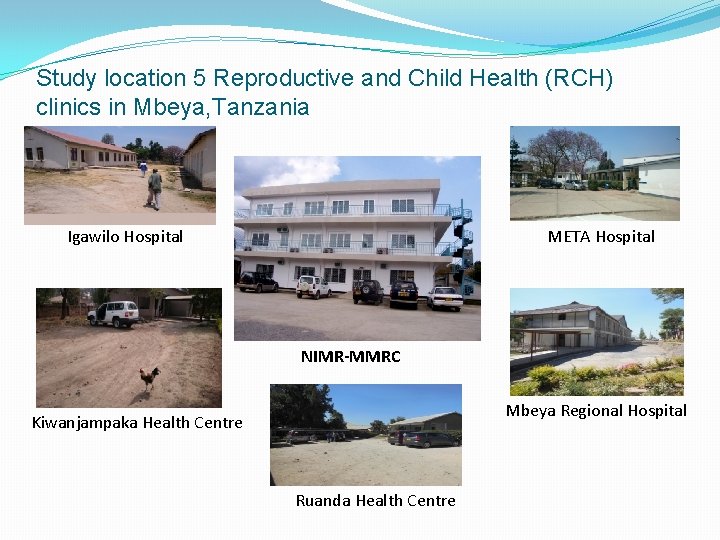
Study location 5 Reproductive and Child Health (RCH) clinics in Mbeya, Tanzania Igawilo Hospital META Hospital NIMR-MMRC Mbeya Regional Hospital Kiwanjampaka Health Centre Ruanda Health Centre
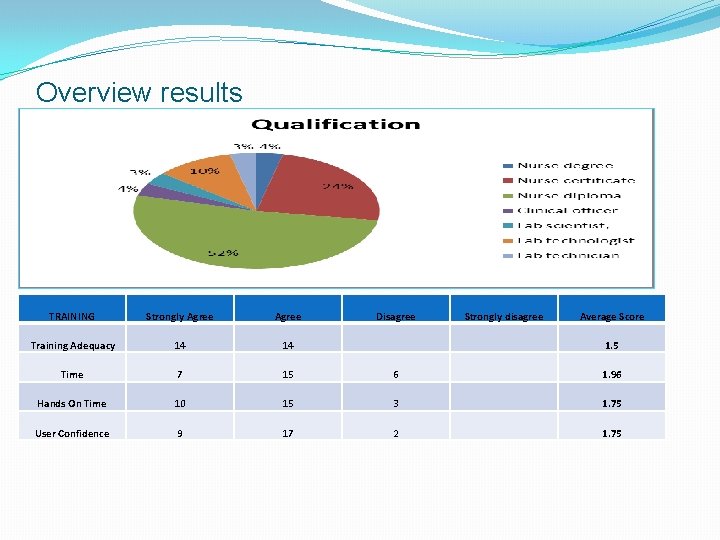
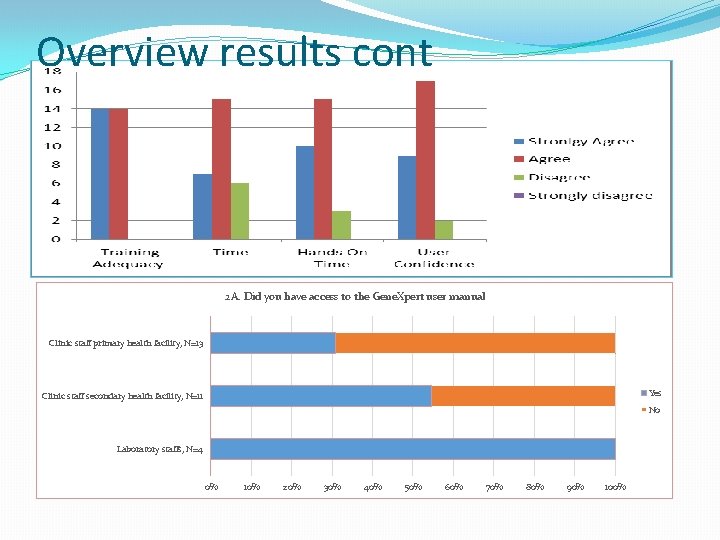
Overview results TRAINING Strongly Agree Disagree Strongly disagree Average Score Training Adequacy 14 14 Time 7 15 6 1. 96 Hands On Time 10 15 3 1. 75 User Confidence 9 17 2 1. 75 1. 5
Overview results cont 2 A. Did you have access to the Gene. Xpert user manual Clinic staff primary health facility, N=13 Yes Clinic staff secondary health facility, N=11 No Laboratory staffs, N=4 0% 10% 20% 30% 40% 50% 60% 70% 80% 90% 100%
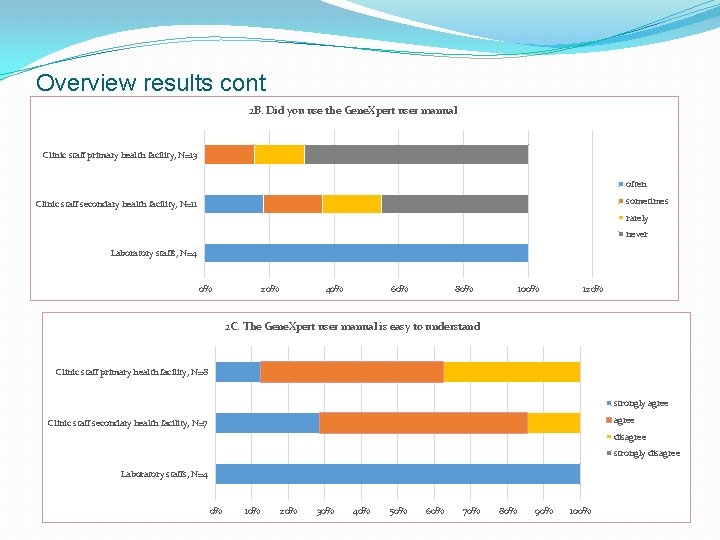
Overview results cont 2 B. Did you use the Gene. Xpert user manual Clinic staff primary health facility, N=13 often sometimes Clinic staff secondary health facility, N=11 rarely never Laboratory staffs, N=4 0% 20% 40% 60% 80% 100% 120% 2 C. The Gene. Xpert user manual is easy to understand Clinic staff primary health facility, N=8 strongly agree Clinic staff secondary health facility, N=7 disagree strongly disagree Laboratory staffs, N=4 0% 10% 20% 30% 40% 50% 60% 70% 80% 90% 100%
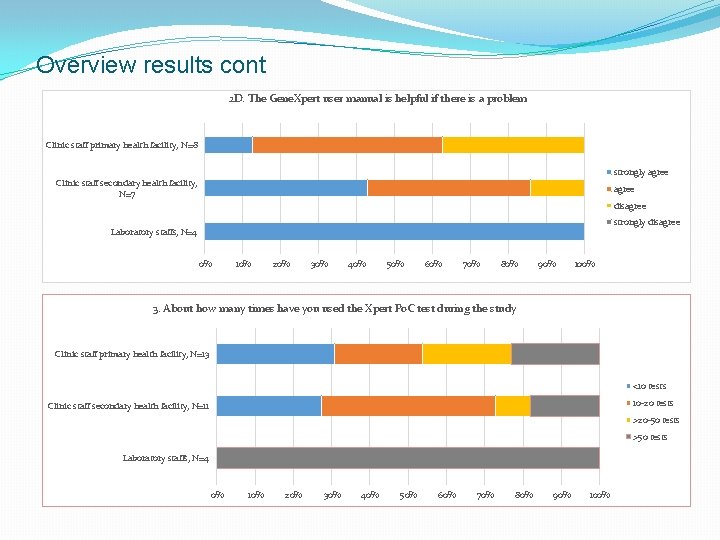
Overview results cont 2 D. The Gene. Xpert user manual is helpful if there is a problem Clinic staff primary health facility, N=8 strongly agree Clinic staff secondary health facility, N=7 agree disagree strongly disagree Laboratory staffs, N=4 0% 10% 20% 30% 40% 50% 60% 70% 80% 90% 100% 3. About how many times have you used the Xpert Po. C test during the study Clinic staff primary health facility, N=13 <10 tests 10 -20 tests Clinic staff secondary health facility, N=11 >20 -50 tests >50 tests Laboratory staffs, N=4 0% 10% 20% 30% 40% 50% 60% 70% 80% 90% 100%
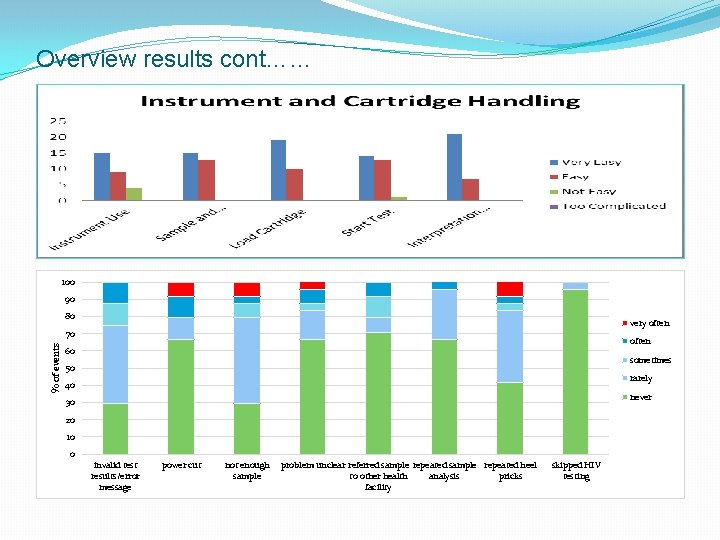
Overview results cont…… 100 90 80 very often % of events 70 often 60 sometimes 50 rarely 40 never 30 20 10 0 invalid test results/error message power cut not enough sample problem unclear referred sample repeated heel to other health analysis pricks facility skipped HIV testing
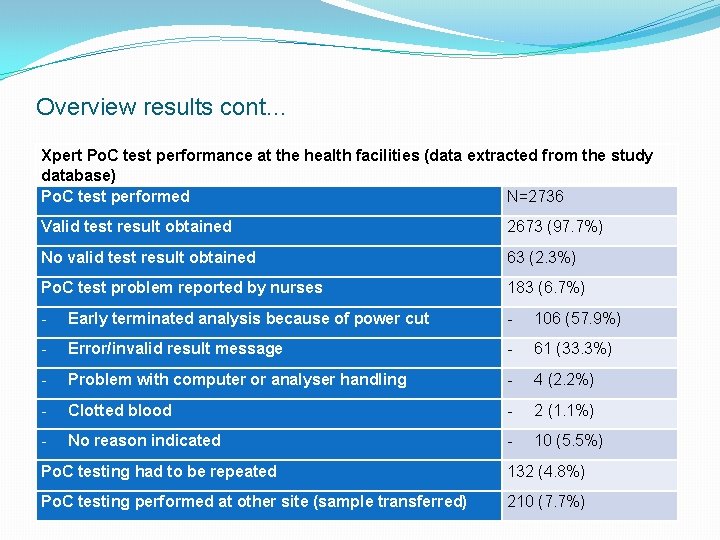
Overview results cont… Xpert Po. C test performance at the health facilities (data extracted from the study database) Po. C test performed N=2736 Valid test result obtained 2673 (97. 7%) No valid test result obtained 63 (2. 3%) Po. C test problem reported by nurses 183 (6. 7%) - Early terminated analysis because of power cut - 106 (57. 9%) - Error/invalid result message - 61 (33. 3%) - Problem with computer or analyser handling - 4 (2. 2%) - Clotted blood - 2 (1. 1%) - No reason indicated - 10 (5. 5%) Po. C testing had to be repeated 132 (4. 8%) Po. C testing performed at other site (sample transferred) 210 (7. 7%)
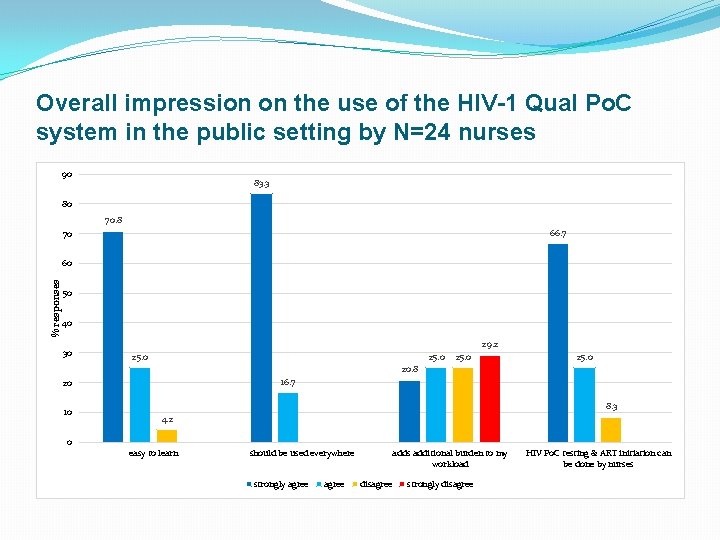
Overall impression on the use of the HIV-1 Qual Po. C system in the public setting by N=24 nurses 90 83. 3 80 70. 8 66. 7 70 % responses 60 50 40 30 29. 2 25. 0 20. 8 16. 7 20 10 0 8. 3 4. 2 easy to learn should be used everywhere strongly agree adds additional burden to my workload disagree strongly disagree HIV Po. C testing & ART initiation can be done by nurses
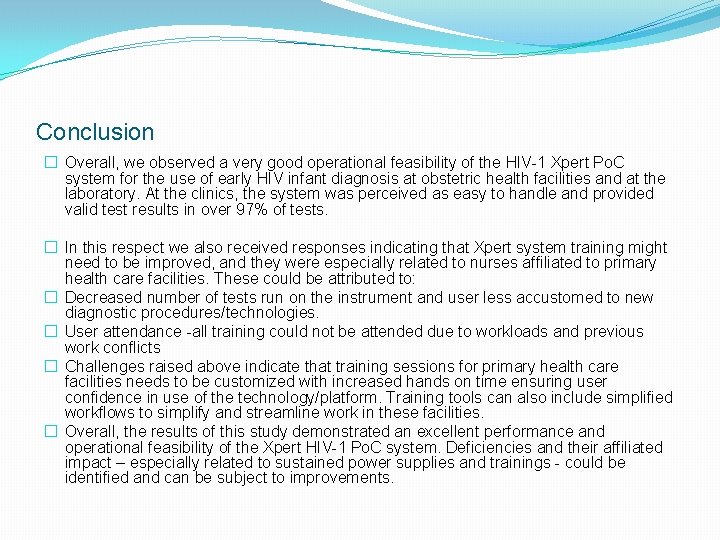
Conclusion � Overall, we observed a very good operational feasibility of the HIV-1 Xpert Po. C system for the use of early HIV infant diagnosis at obstetric health facilities and at the laboratory. At the clinics, the system was perceived as easy to handle and provided valid test results in over 97% of tests. � In this respect we also received responses indicating that Xpert system training might need to be improved, and they were especially related to nurses affiliated to primary health care facilities. These could be attributed to: � Decreased number of tests run on the instrument and user less accustomed to new diagnostic procedures/technologies. � User attendance -all training could not be attended due to workloads and previous work conflicts � Challenges raised above indicate that training sessions for primary health care facilities needs to be customized with increased hands on time ensuring user confidence in use of the technology/platform. Training tools can also include simplified workflows to simplify and streamline work in these facilities. � Overall, the results of this study demonstrated an excellent performance and operational feasibility of the Xpert HIV-1 Po. C system. Deficiencies and their affiliated impact – especially related to sustained power supplies and trainings - could be identified and can be subject to improvements.
Acknowledgment Mbeya Medical Research Center & Mbeya Zonal Referral Hospital Clinic Issa Sabi (PI) Hellen Mahiga (cordinator) Debora Kikaro (nurse) Sarah Mlelwa (nurse) John France (Ho. D Obs & Gyn MZRH) Data Management Peter Agrea Willyhelmina Olomi Lab Lilian Njovu Last Mwaipopo Lucy Mesayi Epifania Ndunguru All nurses and midwives at the Mbeya study sites ! LMU Munich Arne Kroidl Otto Geisenberger (monitoring) Sabine Kastner (monitoring) Fidelina Zekoll (data managment) Conny Luer (local lab management) Michael Hoelscher Cepheid South Africa Dipti Lallubhai Gwynn Stevens Supported by: