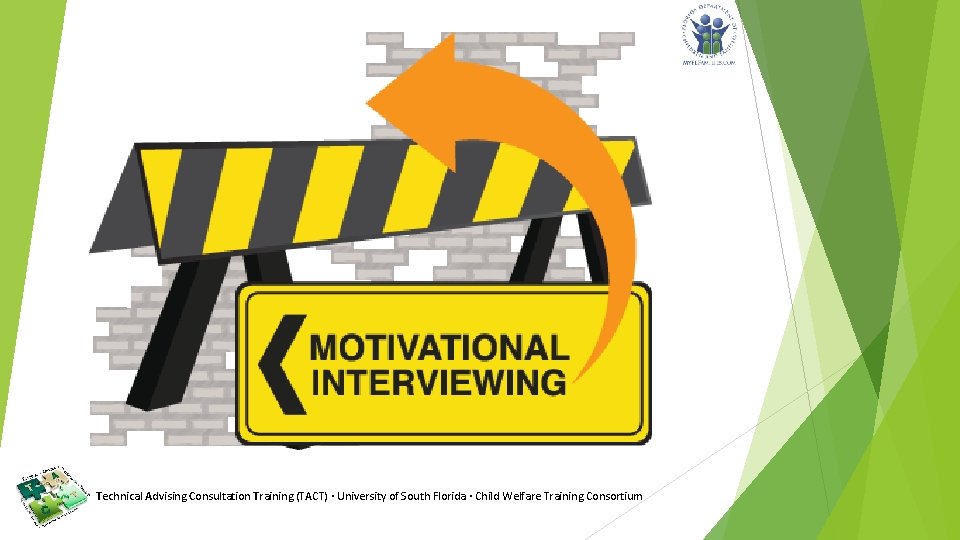
Technical Advising Consultation Training TACT University of South



- Slides: 37
Technical Advising Consultation Training (TACT) · University of South Florida · Child Welfare Training Consortium
Developed by TACT: Pamela E. Aeppel, M. A. Shawna L. Thomas, B. A. Chief Visual Designer: Kayvrie Vega Child Welfare Training Consortium University of South Florida Technical Advising Consultation Training (TACT) · University of South Florida · Child Welfare Training Consortium
Introductions Name / Role How long have you been interviewing families and collaterals to gather information for the six (6) domains? Technical Advising Consultation Training (TACT) · University of South Florida · Child Welfare Training Consortium
Pre-Test Technical Advising Consultation Training (TACT) · University of South Florida · Child Welfare Training Consortium
What Can Be Expected? Technical Advising Consultation Training (TACT) · University of South Florida · Child Welfare Training Consortium
A Little Test… True or False? In Motivational Interviewing (MI) how you say something is just as important as what you say? Ambivalence is a sign of denial? Resistance is an interpersonal process? Directiveness is a key concept in MI? Autonomy means that we don’t have goals for our families behaviors? Technical Advising Consultation Training (TACT) · University of South Florida · Child Welfare Training Consortium
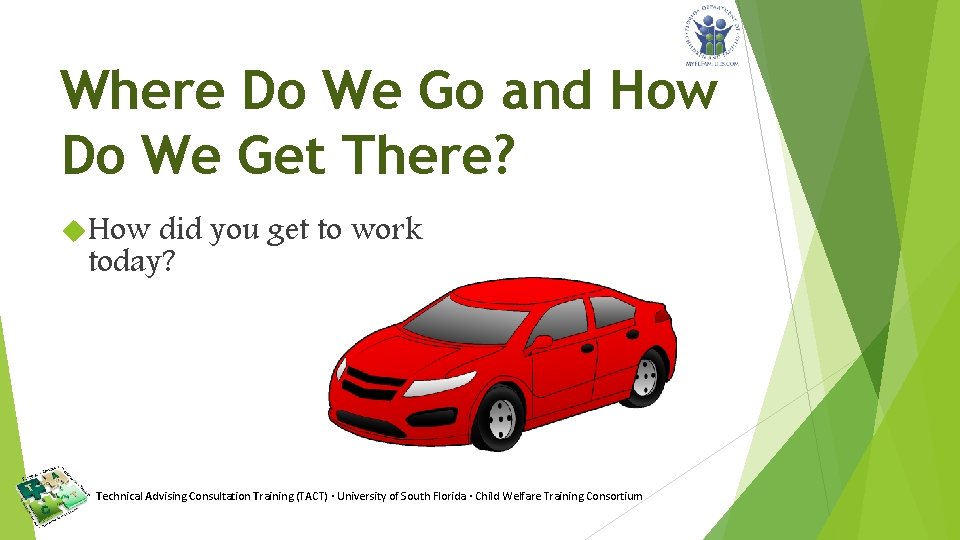
Where Do We Go and How Do We Get There? How did you get to work today? Technical Advising Consultation Training (TACT) · University of South Florida · Child Welfare Training Consortium
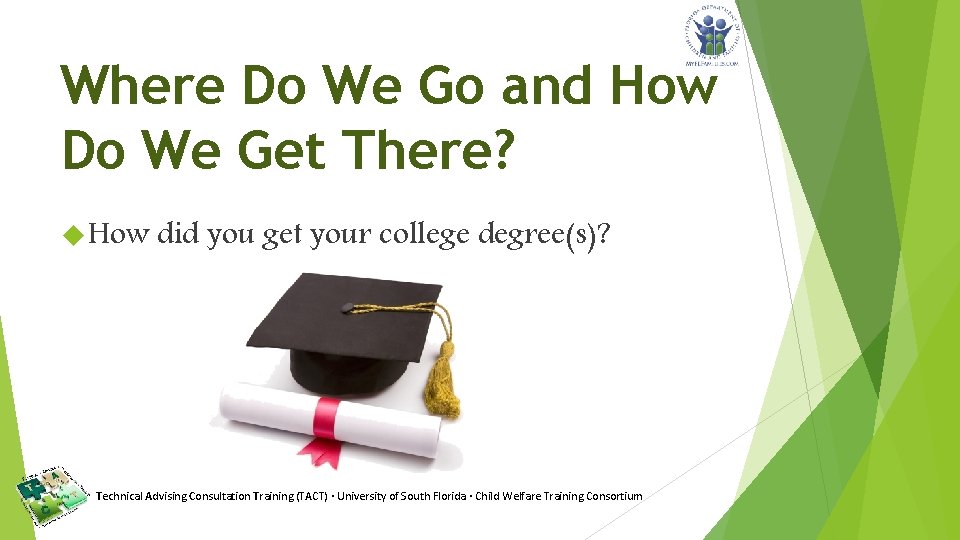
Where Do We Go and How Do We Get There? How did you get your college degree(s)? Technical Advising Consultation Training (TACT) · University of South Florida · Child Welfare Training Consortium
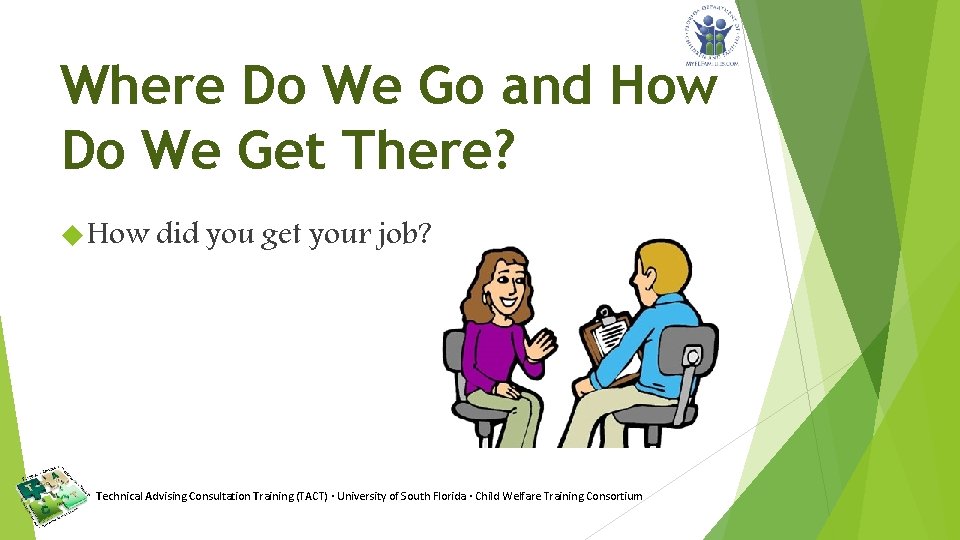
Where Do We Go and How Do We Get There? How did you get your job? Technical Advising Consultation Training (TACT) · University of South Florida · Child Welfare Training Consortium
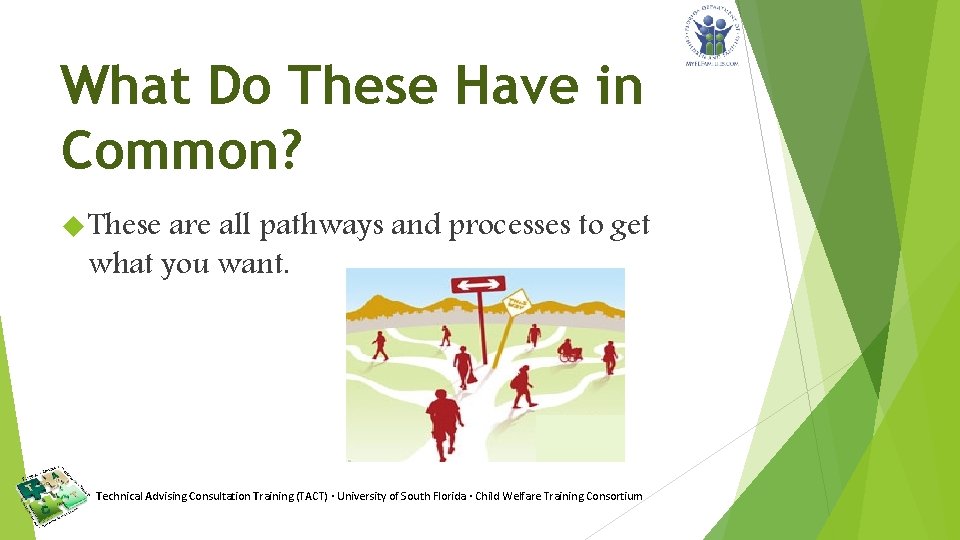
What Do These Have in Common? These are all pathways and processes to get what you want. Technical Advising Consultation Training (TACT) · University of South Florida · Child Welfare Training Consortium
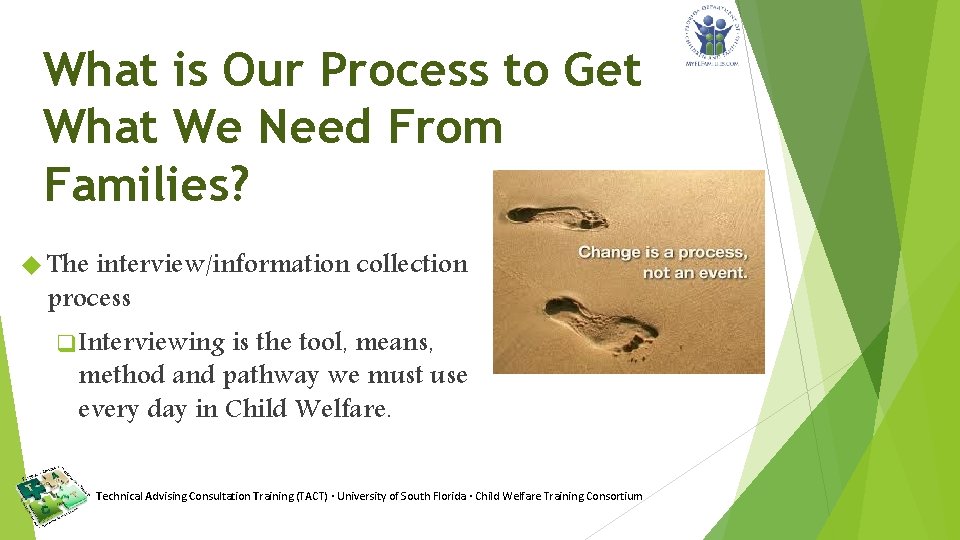
What is Our Process to Get What We Need From Families? The interview/information collection process q Interviewing is the tool, means, method and pathway we must use every day in Child Welfare. Technical Advising Consultation Training (TACT) · University of South Florida · Child Welfare Training Consortium
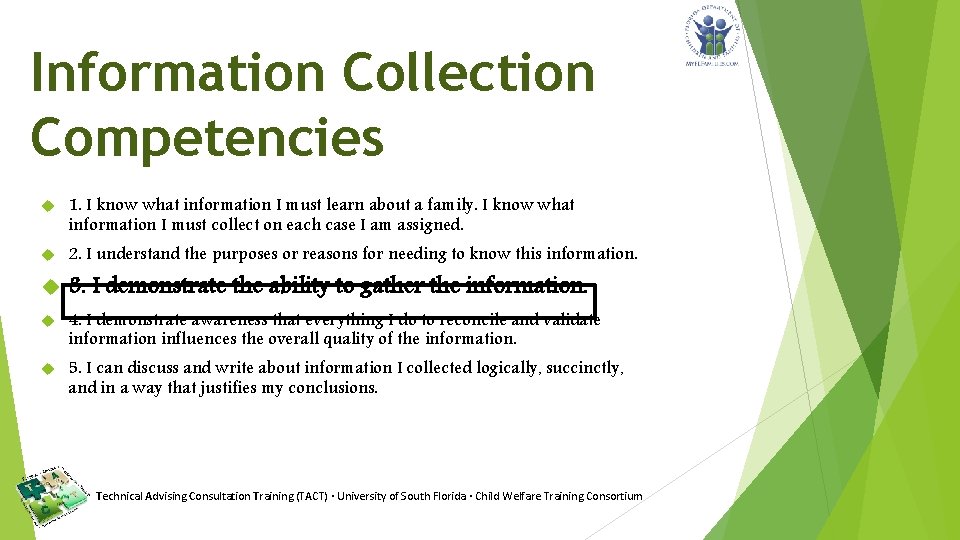
Information Collection Competencies 1. I know what information I must learn about a family. I know what information I must collect on each case I am assigned. 2. I understand the purposes or reasons for needing to know this information. 3. I demonstrate the ability to gather the information. 4. I demonstrate awareness that everything I do to reconcile and validate information influences the overall quality of the information. 5. I can discuss and write about information I collected logically, succinctly, and in a way that justifies my conclusions. Technical Advising Consultation Training (TACT) · University of South Florida · Child Welfare Training Consortium
Learning Objectives Identify and differentiate interviewing techniques of Motivational Interviewing (MI) and demonstrate how the correlated skills are successful when engaging with families. Demonstrate techniques and develop skills from MI, specific to Child Welfare, which can evoke “Change Talk” with families. Technical Advising Consultation Training (TACT) · University of South Florida · Child Welfare Training Consortium
Learning Objectives Identify and differentiate interviewing techniques of Motivational Interviewing (MI) and demonstrate how the correlated skills are successful when engaging with families. Demonstrate techniques and develop skills from MI, specific to Child Welfare, which can evoke “Change Talk” with families. Technical Advising Consultation Training (TACT) · University of South Florida · Child Welfare Training Consortium
“If you treat an individual as he is, he will stay as he is, but if you treat him as if he were what he ought to be and could be, he will become what he ought to be and could be. ” -Johann Wolfgang von Goethe (German writer and statesman) Technical Advising Consultation Training (TACT) · University of South Florida · Child Welfare Training Consortium
What is Motivational Interviewing? A style of communication that enhances motivation for change by helping the individual clarify and resolve ambivalence about the need for behavioral change. Technical Advising Consultation Training (TACT) · University of South Florida · Child Welfare Training Consortium
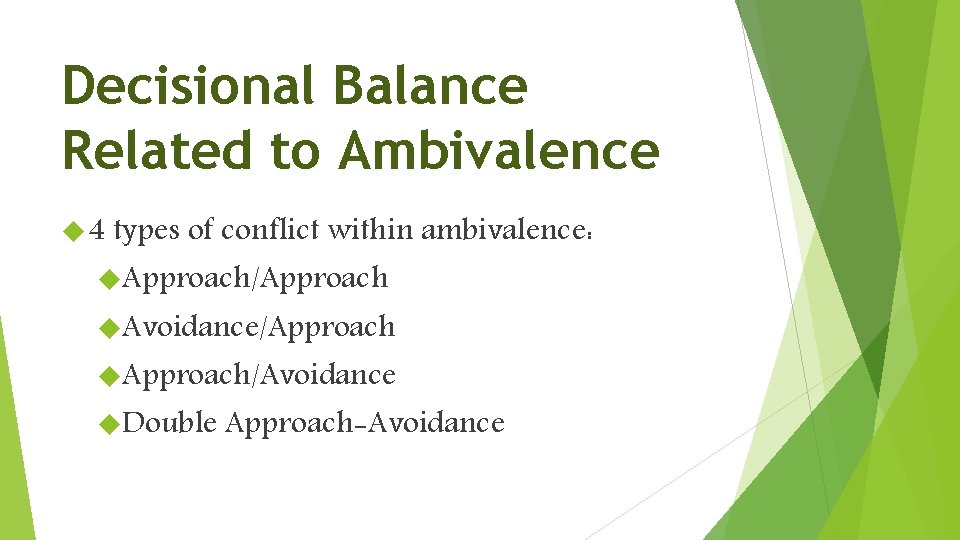
Decisional Balance Related to Ambivalence 4 types of conflict within ambivalence: Approach/Approach Avoidance/Approach/Avoidance Double Approach-Avoidance
Important Principles of MI Express empathy, support self-efficacy (effectiveness), developing discrepancy, and rolling with resistance. RULE: Resist the righting reflex. Understand your client’s motivation. Listen to your client. Empower your client.
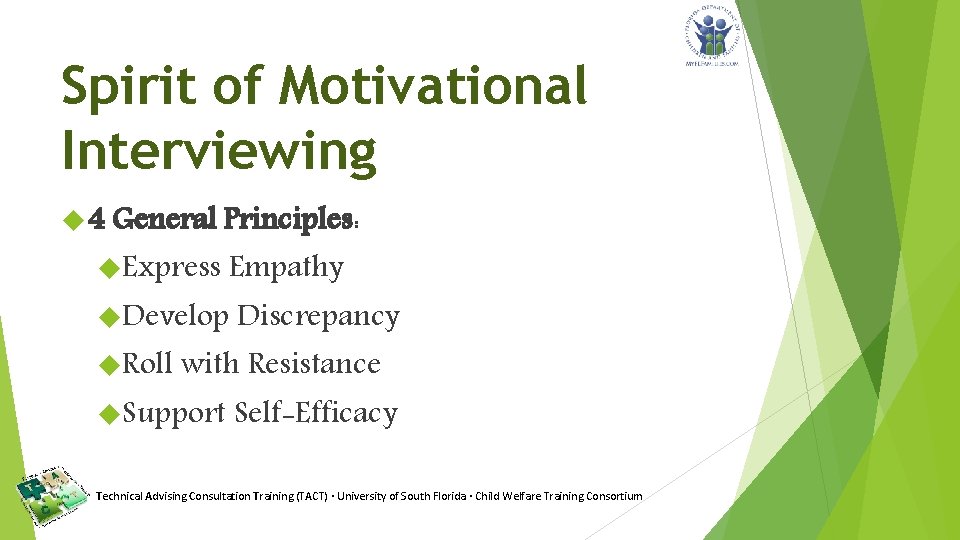
Spirit of Motivational Interviewing 4 General Principles: Express Empathy Develop Discrepancy Roll with Resistance Support Self-Efficacy Technical Advising Consultation Training (TACT) · University of South Florida · Child Welfare Training Consortium
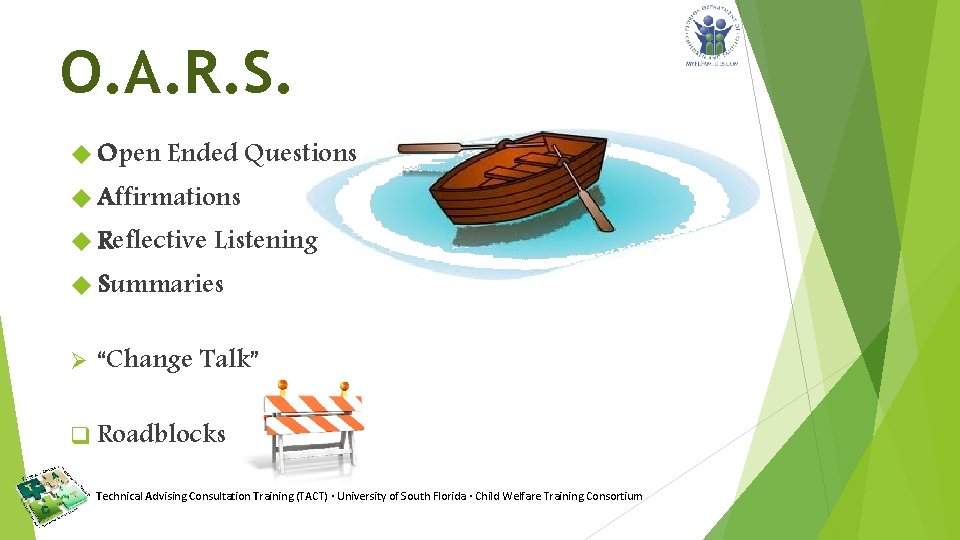
O. A. R. S. Open Ended Questions Affirmations Reflective Listening Summaries Ø “Change Talk” q Roadblocks Technical Advising Consultation Training (TACT) · University of South Florida · Child Welfare Training Consortium
Activity #1 Are you “Open” to this Technique? In your groups, look at your assigned domain. Look at the way questions are asked in your domain that are closed. Develop an open ended question that seeks to obtain the same information as the closed question. This will be “practiced” in your group until all questions are utilized and “transformed” into open ended interview questions. Technical Advising Consultation Training (TACT) · University of South Florida · Child Welfare Training Consortium
Activity Debrief Technical Advising Consultation Training (TACT) · University of South Florida · Child Welfare Training Consortium
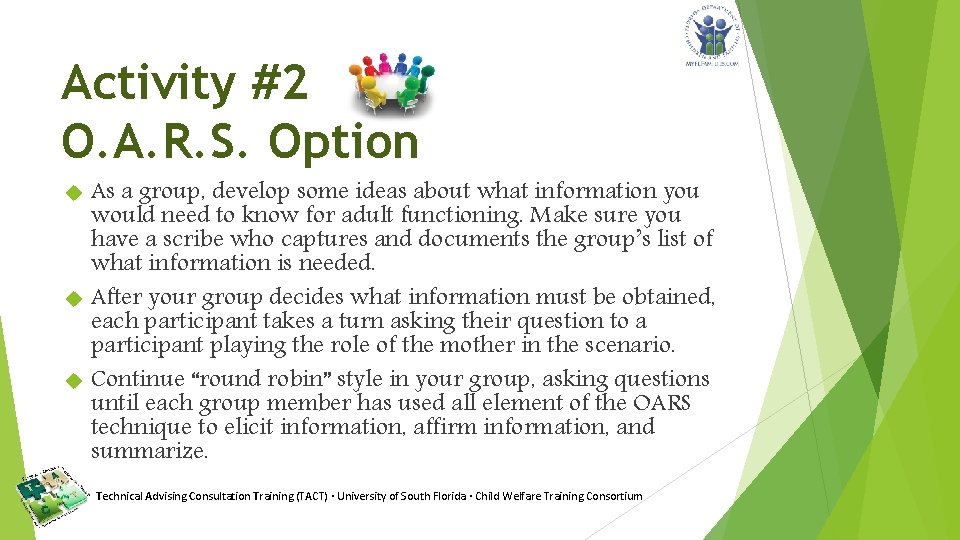
Activity #2 O. A. R. S. Option As a group, develop some ideas about what information you would need to know for adult functioning. Make sure you have a scribe who captures and documents the group’s list of what information is needed. After your group decides what information must be obtained, each participant takes a turn asking their question to a participant playing the role of the mother in the scenario. Continue “round robin” style in your group, asking questions until each group member has used all element of the OARS technique to elicit information, affirm information, and summarize. Technical Advising Consultation Training (TACT) · University of South Florida · Child Welfare Training Consortium
Activity Debrief Technical Advising Consultation Training (TACT) · University of South Florida · Child Welfare Training Consortium
Learning Objectives Identify and differentiate interviewing techniques of Motivational Interviewing (MI) and demonstrate how the correlated skills are successful when engaging with families. Demonstrate techniques and develop skills from MI, specific to Child Welfare, which can evoke “Change Talk” with families. Technical Advising Consultation Training (TACT) · University of South Florida · Child Welfare Training Consortium
“Change Talk” What is Change Talk? 7 Strategies known as the “Change Talk Strategies” Technical Advising Consultation Training (TACT) · University of South Florida · Child Welfare Training Consortium
Asking Evocative Questions Open ended questions Examples? Technical Advising Consultation Training (TACT) · University of South Florida · Child Welfare Training Consortium
Use the Importance Ruler On a scale from 1 to 10… Examples? Technical Advising Consultation Training (TACT) · University of South Florida · Child Welfare Training Consortium
Elaborating Asking for clarification Asking for specific examples Examples? Technical Advising Consultation Training (TACT) · University of South Florida · Child Welfare Training Consortium
Querying Extremes Ask people to describe extremes of their concerns Examples? Technical Advising Consultation Training (TACT) · University of South Florida · Child Welfare Training Consortium
Looking Back Recalls a time before problems emerged. Highlight both the discrepancy with how things are now and possibility of life getting better. Examples? Technical Advising Consultation Training (TACT) · University of South Florida · Child Welfare Training Consortium
Looking Forward Asking for realistic appraisal of a future unchanged or realistic hopes for a future change. Examples? Technical Advising Consultation Training (TACT) · University of South Florida · Child Welfare Training Consortium
Exploring Goals & Values Discover ways in which current behavior is inconsistent with important values and goals for the person. Examples? Technical Advising Consultation Training (TACT) · University of South Florida · Child Welfare Training Consortium
Activity #3 Thinking On Your Feet Partner up with your assigned interview partner. One partner reads one of the provided statements from a family member. The other partner looks at the “Change Talk Strategies” handout in your Participant Guide (pg 31). A change talk strategy method is selected to develop a question that would elicit more information about the statement just made by your partner. Switch partners and select another statement so your partner has a turn asking their question using a different strategy. Repeat activity until all statements and strategies are used or Trainer calls time. Technical Advising Consultation Training (TACT) · University of South Florida · Child Welfare Training Consortium
Activity Debrief Technical Advising Consultation Training (TACT) · University of South Florida · Child Welfare Training Consortium
Questions Technical Advising Consultation Training (TACT) · University of South Florida · Child Welfare Training Consortium
What Stuck? Ah Ha! Technical Advising Consultation Training (TACT) · University of South Florida · Child Welfare Training Consortium