Tampere CityRegion Towards a Knowledge Economy Mika Kautonen

- Slides: 17
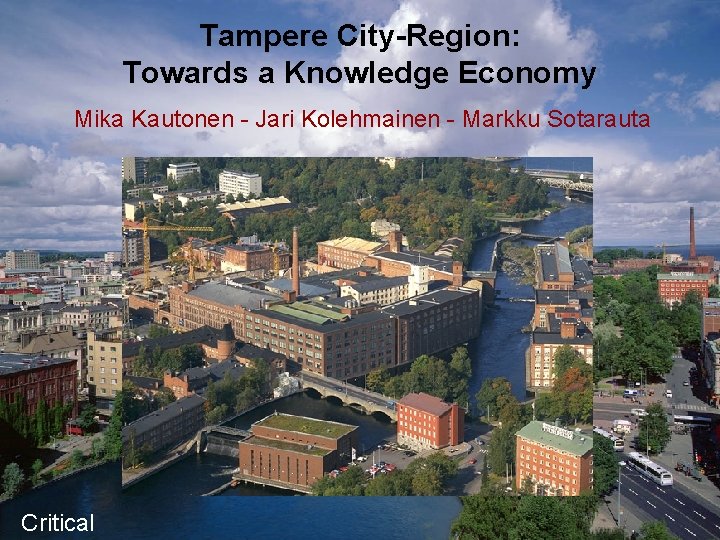
Tampere City-Region: Towards a Knowledge Economy Mika Kautonen - Jari Kolehmainen - Markku Sotarauta Critical
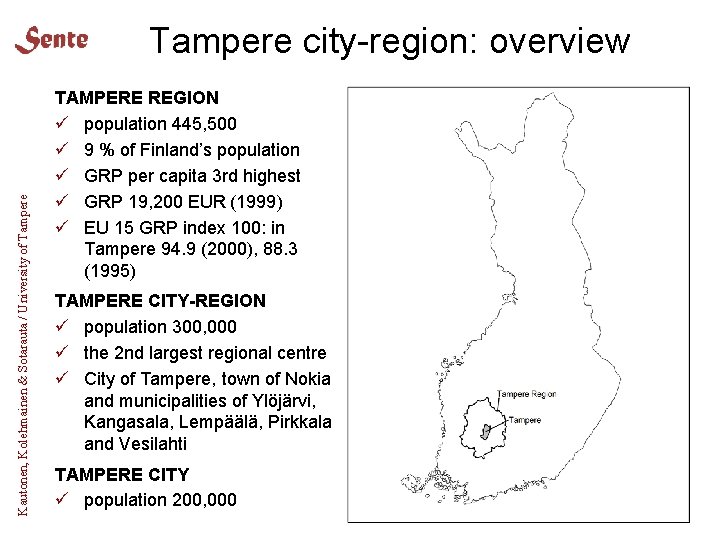
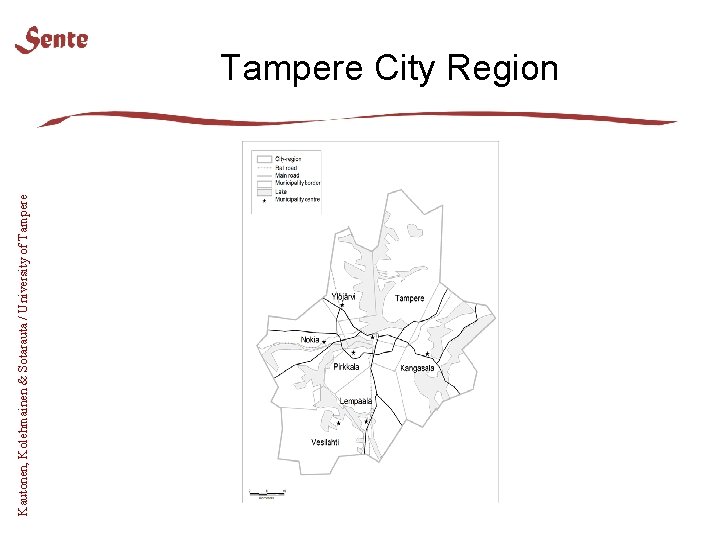
Kautonen, Kolehmainen & Sotarauta / University of Tampere city-region: overview TAMPERE REGION ü population 445, 500 ü 9 % of Finland’s population ü GRP per capita 3 rd highest ü GRP 19, 200 EUR (1999) ü EU 15 GRP index 100: in Tampere 94. 9 (2000), 88. 3 (1995) TAMPERE CITY-REGION ü population 300, 000 ü the 2 nd largest regional centre ü City of Tampere, town of Nokia and municipalities of Ylöjärvi, Kangasala, Lempäälä, Pirkkala and Vesilahti TAMPERE CITY ü population 200, 000
Kautonen, Kolehmainen & Sotarauta / University of Tampere City Region
Tampere city-region: from manufacturing to services Kautonen, Kolehmainen & Sotarauta / University of Tampere ü ü ü Industry to develop in the 19 th century: manufacturing of textile and clothing At the end of the century, 69% of industrial employees in textile industry, 13% in pulp and paper industry and 8% in metal industry Reparations after World War II contributed to the growth of metal industry In the 1960 s, textile, clothing, leather and shoe industries employed 38%, metal industry 31% and pulp and paper industry 14% In the early 1980 s reorganizations, spin-offs and specialization Collapse of the Soviet trade affected traditional industries
Kautonen, Kolehmainen & Sotarauta / University of Tampere city-region: from manufacturing to services ü ü recession from the early 1990 s growth of information and telecommunication technology and KIBS sectors (Nokia Group alone 3. 600 in R&D) in 2000, textile, clothing, leather and shoe industries employed 4%, metal products and machine building together 26% (9. 800 employees), pulp and paper industry 11%, and electronics 9% of industrial employees (total manufacturing employment 32. 000) in comparison, so-called KIBS sector alone 19. 000 employees (software and computer services, technical services, consultancy, R&D services, private training etc. )
Kautonen, Kolehmainen & Sotarauta / University of Tampere Roots of local competitiveness Educated population in Tampere city-region ü of total adult population (>15 years), 64. 5% at least secondary level degree, and 26. 5% HEI degree (nat. average of 59. 4 and 23. 3 %) ü number of university students about 25. 000 R&D intensity ü R&D investments 14 per cent of national spending ü 25% real annual change 1995 -1999 (nat. average 14%) ü growth particularly in the business sector ü share of R&D personnel of the workforce high, 4. 6% (nat. average 3. 1) ü Nevertheless, Helsinki Region dominates R&D expenditures with a share of 45% strongly.
Kautonen, Kolehmainen & Sotarauta / University of Tampere Knowledge Centres” in Tampere
Kautonen, Kolehmainen & Sotarauta / University of Tampere The basics of digital media agglomeration in Tampere ü roots quite far in history, but the real emergence and rapid growth in the 1990 s (5. 000 employees in 1996 -> 10. 000 in 2000) ü the business structure very diverse, but dominated by the business units of large, internationalised ICT companies (especially Nokia Group) ü major strengths: strong large companies, educational institutions and science and technology base ü major weakness: weak entrepreneurial atmosphere, the paucity of (new) companies aiming at fast growth and internationalisation ü digital media has been one of the most important focus areas of local business development and innovation policy -> large e. Tampere Programme (appr. EUR 130 million) for five years.
Kautonen, Kolehmainen & Sotarauta / University of Tampere
Kautonen, Kolehmainen & Sotarauta / University of Tampere Cosmopolitanism and image ü traditionally, Finland has been a closed society with a very homogenous population ü access to the EU -> increased in- and outmigration, immigrants ü yet, “images of Finland especially its urban regions outside of the Capital region were not particularly prominent in the foreign experts’ field of choices” (Raunio 2002) ü several nation-wide polls consistently shown that as a city to live in, Tampere rated highest of all cities in Finland ü based on e. g. increase of jobs, central location and good connections, and the cultural amenities of the city (e. g. theatres, festivals, congresses).
Kautonen, Kolehmainen & Sotarauta / University of Tampere Social polarisation ü economic crisis of the early 1990 s had serious social consequences for Tampere city-region as the unemployment rate skyrocketed to over 20 per cent ü despite economic growth unemployment rate is still over 10% (12, 9% in 2001, whole country 12, 0) ü about 25% of the unemployed long-term unemployed and among them every second unemployed for more than two years ü ‘skills mismatches’ of the transformation period -> permanent problem? ü 60 per cent of the long-term unemployed 50 years old or older, risk especially high in manufacturing sectors.
Sustainability Kautonen, Kolehmainen & Sotarauta / University of Tampere ü ü during the 1990 s, rise of the environmentalism, “environmental awakening” local environmental movements key actors in process of change by challenging the local political traditions/culture and especially the tradition of local governance, called “brothers-in-arms axis” City of Tampere with a holistic environmental management system based on ISO 14001 Tampere Forum to stimulate local democracy and to activate citizen participation in sustainable development (est. 1996), a bottom-up approach.
Kautonen, Kolehmainen & Sotarauta / University of Tampere Governance ü in Finland, trend of the 90’s the increasing sub-regional cooperation between municipalities ü reasons, e. g. : new Regional Development Act (1994), small size of municipalities ü local government gained more importance in regional policy. The new Act splits the responsibility for institutional regional development efforts between state and municipalities ü sub-regions form the smallest regional policy unit ü sub-regional co-operation significant part of local activities, yet experiences and success vary greatly.
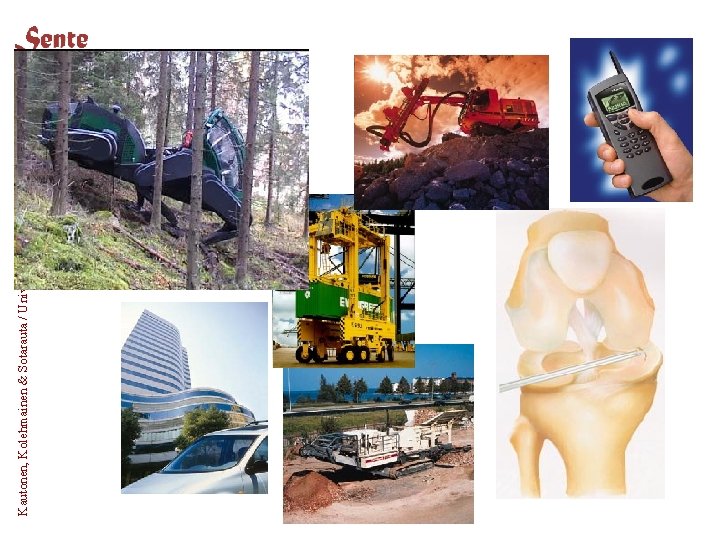
Kautonen, Kolehmainen & Sotarauta / University of Tampere Strategies focus on… ü ü ü ü Health care technology (Finn-Medi ltd) ICT (Tampere Technology Centre ltd) Automation and mechanical engineering (Tampere Technology Centre ltd) Media communication (Media. Tampere ltd) KIBS (Professia ltd) Tourism City of Tampere is building institutions, infrastructure, and is co-ordinating the development network etc.
Kautonen, Kolehmainen & Sotarauta / University of Tampere
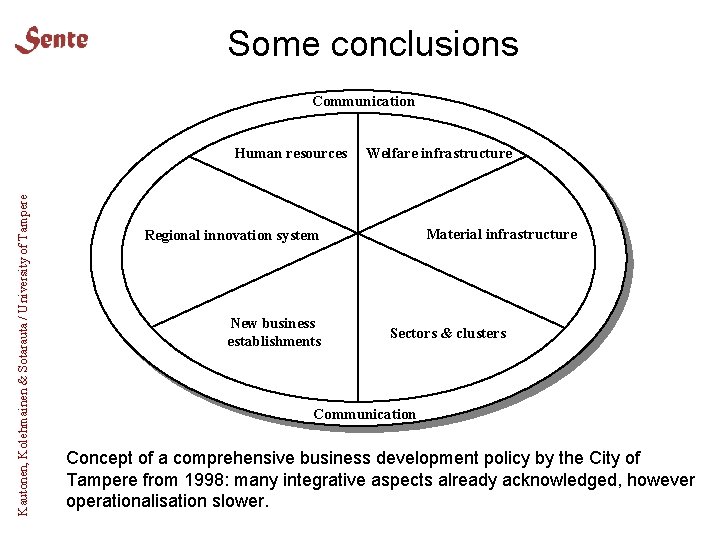
Some conclusions Communication Kautonen, Kolehmainen & Sotarauta / University of Tampere Human resources Welfare infrastructure Material infrastructure Regional innovation system New business establishments Sectors & clusters Communication Concept of a comprehensive business development policy by the City of Tampere from 1998: many integrative aspects already acknowledged, however operationalisation slower.
Kautonen, Kolehmainen & Sotarauta / University of Tampere Some conclusions ü several of the proposed challenges are well acknowledged in Tampere city-region, including learning- and innovation-based competitiveness, image of the region, and social inclusion ü cultural aspects increasingly seen important also for the local economic development ü cosmopolitanism considered very important, yet maybe most challenging among the policy-makers ü sustainability-related matters usually conceived as a part of separate policy domain.