
TAMPERE UNIVERSITY OF TECHNOLOGY Ragnar Granit Institute Bioelectromagnetism
TAMPERE UNIVERSITY OF TECHNOLOGY Ragnar Granit Institute Bioelectromagnetism Exercise #2 – Answers
Q 1: Characteristic Length and Time Constant n The intracellular resistance of a nerve cell is 8. 2*106 Ω/cm (ri). Resistance of the cell membrane is 1. 5*104 Ωcm and capacitance 12 n. F/cm (cm). Calculate the characteristic length and time constant of the axon. (start from the general cable equation to see how the time constant is derived) Bioelectromagnetism Exercise 2 TAMPERE UNIVERSITY OF TECHNOLOGY Ragnar Granit Institute
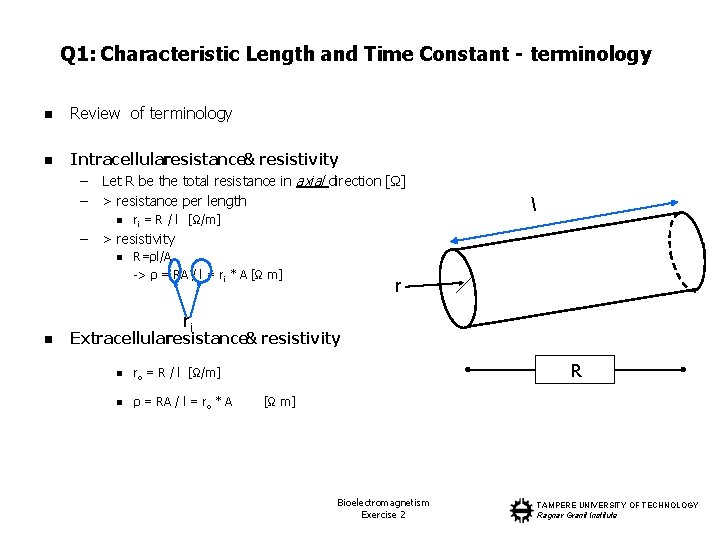
Q 1: Characteristic Length and Time Constant - terminology n Review of terminology n Intracellularresistance& resistivity – – Let R be the total resistance in axial direction [Ω] > resistance per length n – l > resistivity n n ri = R / l [Ω/m] R=ρl/A -> ρ = RA / l = ri * A [Ω m] r ri Extracellularresistance& resistivity n ro = R / l [Ω/m] n ρ = RA / l = ro * A R [Ω m] Bioelectromagnetism Exercise 2 TAMPERE UNIVERSITY OF TECHNOLOGY Ragnar Granit Institute
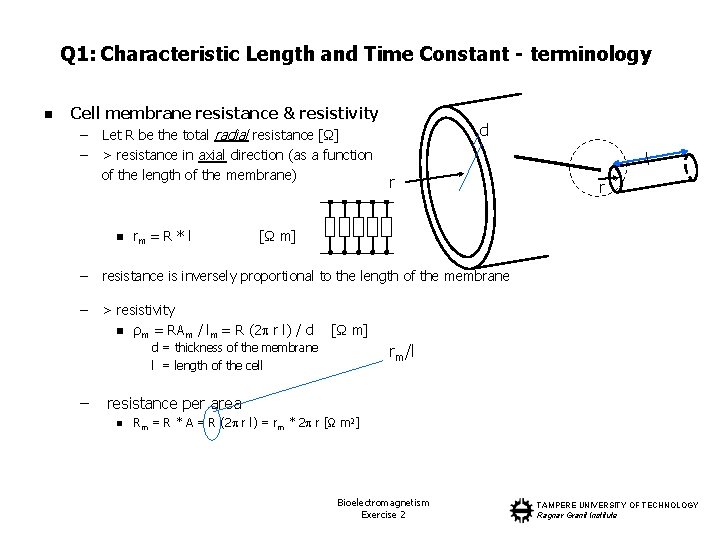
Q 1: Characteristic Length and Time Constant - terminology n Cell membrane resistance & resistivity – – Let R be the total radial resistance [Ω] > resistance in axial direction (as a function of the length of the membrane) n rm = R * l d l r [Ω m] – resistance is inversely proportional to the length of the membrane – > resistivity n ρm = RAm / lm = R (2 r l) / d [Ω m] d = thickness of the membrane l = length of the cell – r rm/l resistance per area n Rm = R * A = R (2 r l) = rm * 2 r [Ω m 2] Bioelectromagnetism Exercise 2 TAMPERE UNIVERSITY OF TECHNOLOGY Ragnar Granit Institute
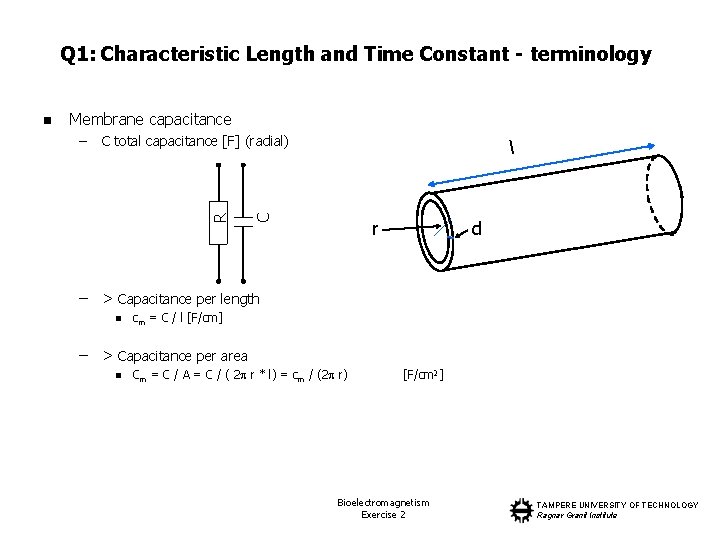
Q 1: Characteristic Length and Time Constant - terminology Membrane capacitance C total capacitance [F] (radial) l C – R n d r – > Capacitance per length n cm = C / l [F/cm] – > Capacitance per area n Cm = C / A = C / ( 2 r * l) = cm / (2 r) [F/cm 2] Bioelectromagnetism Exercise 2 TAMPERE UNIVERSITY OF TECHNOLOGY Ragnar Granit Institute
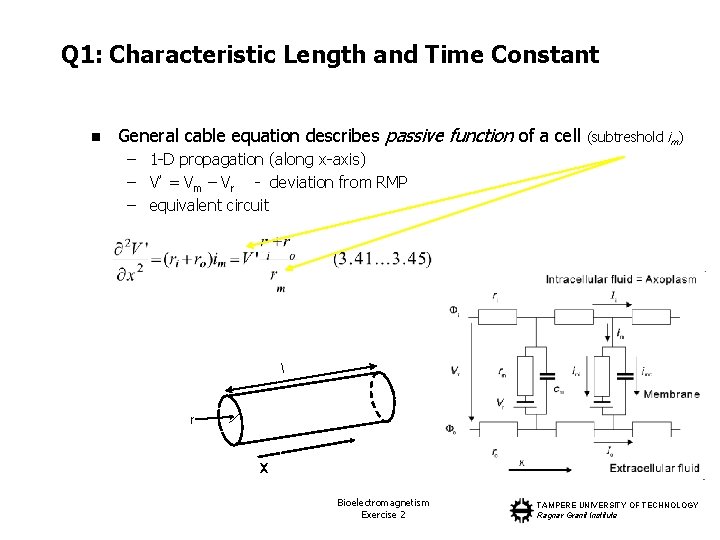
Q 1: Characteristic Length and Time Constant n General cable equation describes passive function of a cell (subtreshold im) – 1 -D propagation (along x-axis) – V’ = Vm – Vr - deviation from RMP – equivalent circuit l r x Bioelectromagnetism Exercise 2 TAMPERE UNIVERSITY OF TECHNOLOGY Ragnar Granit Institute
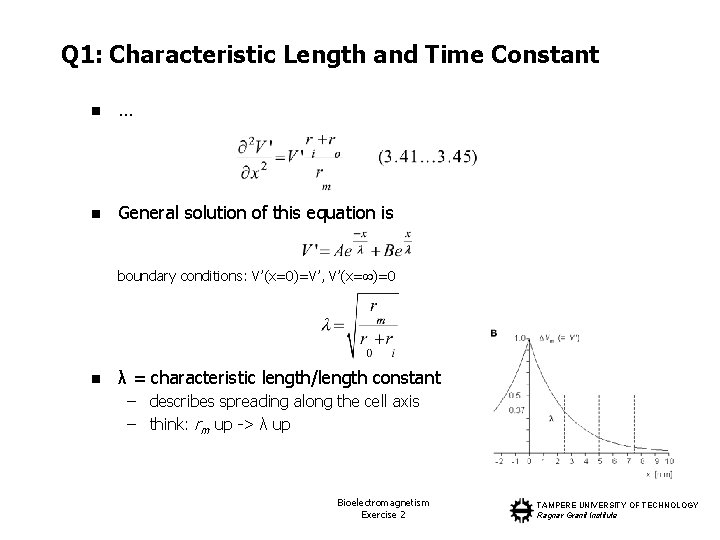
Q 1: Characteristic Length and Time Constant n … n General solution of this equation is boundary conditions: V’(x=0)=V’, V’(x= )=0 n λ = characteristic length/length constant – describes spreading along the cell axis – think: rm up -> λ up Bioelectromagnetism Exercise 2 TAMPERE UNIVERSITY OF TECHNOLOGY Ragnar Granit Institute
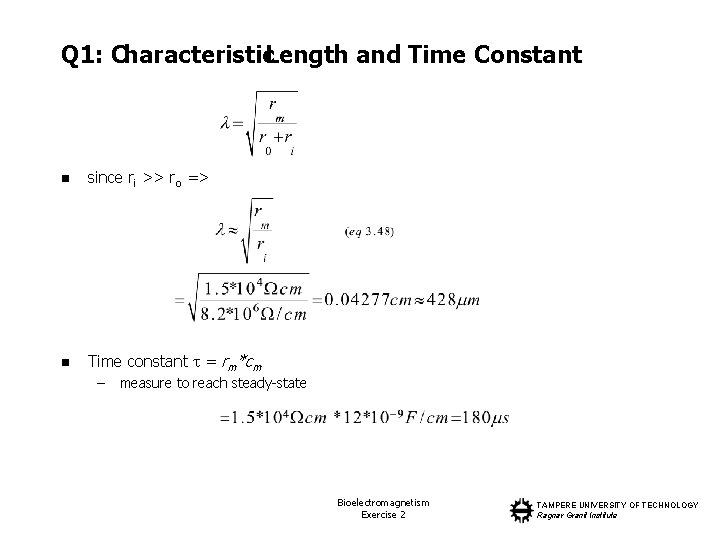
Q 1: Characteristic. Length and Time Constant n since ri >> ro => n Time constant = rm*cm – measure to reach steady-state Bioelectromagnetism Exercise 2 TAMPERE UNIVERSITY OF TECHNOLOGY Ragnar Granit Institute
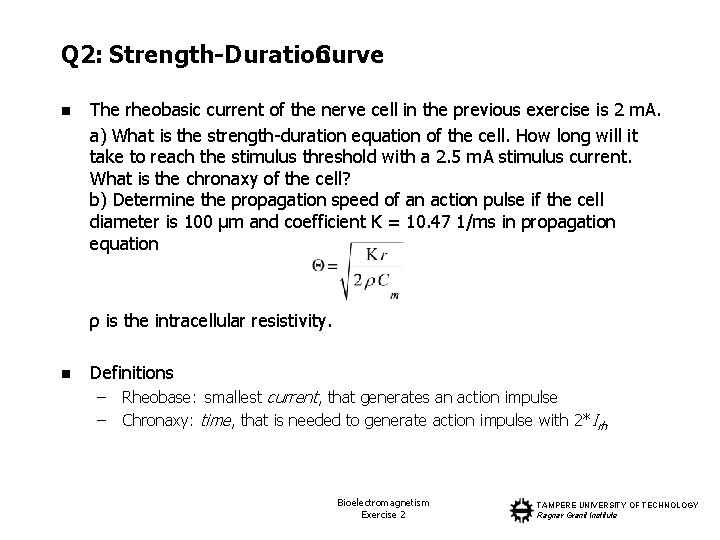
Q 2: Strength-Duration Curve n The rheobasic current of the nerve cell in the previous exercise is 2 m. A. a) What is the strength-duration equation of the cell. How long will it take to reach the stimulus threshold with a 2. 5 m. A stimulus current. What is the chronaxy of the cell? b) Determine the propagation speed of an action pulse if the cell diameter is 100 µm and coefficient K = 10. 47 1/ms in propagation equation ρ is the intracellular resistivity. n Definitions – – Rheobase: smallest current, that generates an action impulse Chronaxy: time, that is needed to generate action impulse with 2*Irh Bioelectromagnetism Exercise 2 TAMPERE UNIVERSITY OF TECHNOLOGY Ragnar Granit Institute

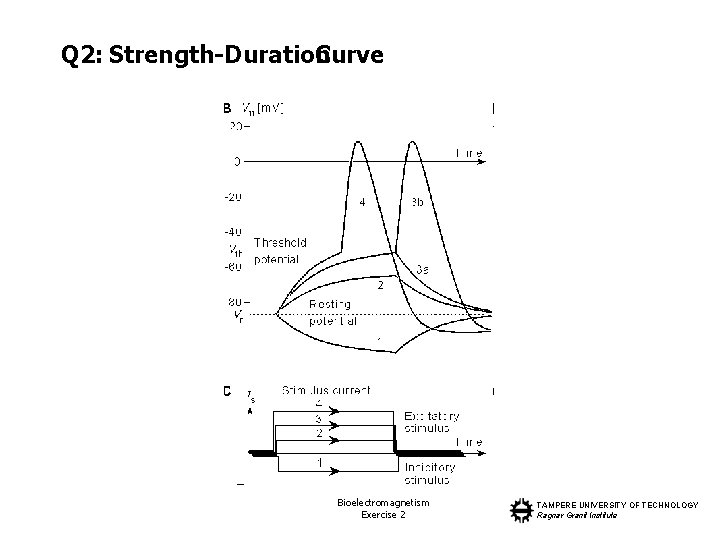
Q 2: Strength-Duration Curve n Definitions – impulse response of the membrane (radial direction only) Is Vm Time Bioelectromagnetism Exercise 2 TAMPERE UNIVERSITY OF TECHNOLOGY Ragnar Granit Institute
Q 2: Strength-Duration Curve Bioelectromagnetism Exercise 2 TAMPERE UNIVERSITY OF TECHNOLOGY Ragnar Granit Institute
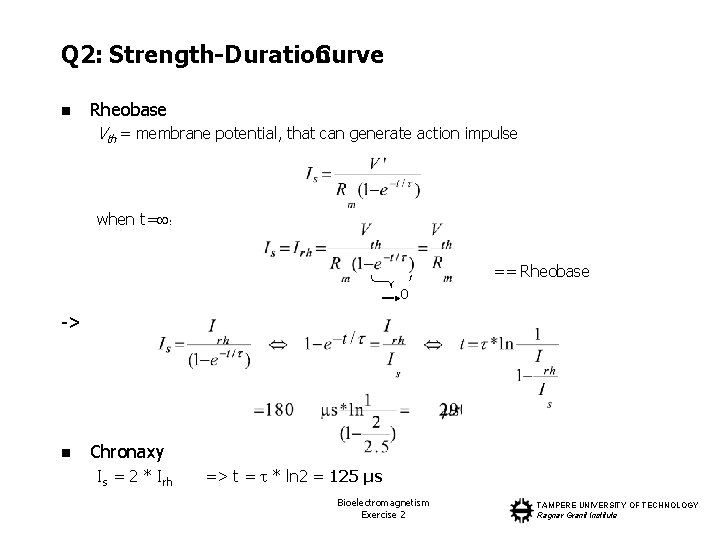
Q 2: Strength-Duration Curve n Rheobase Vth = membrane potential, that can generate action impulse when t= : == Rheobase 0 -> n Chronaxy Is = 2 * Irh => t = * ln 2 = 125 µs Bioelectromagnetism Exercise 2 TAMPERE UNIVERSITY OF TECHNOLOGY Ragnar Granit Institute
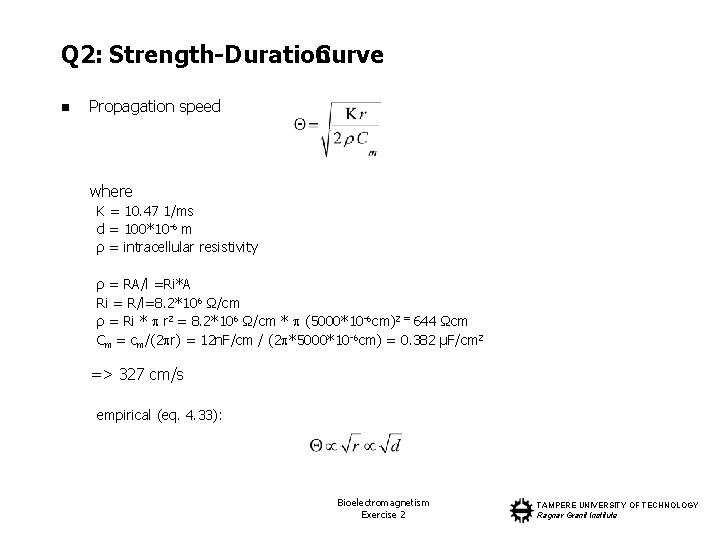
Q 2: Strength-Duration Curve n Propagation speed where K = 10. 47 1/ms d = 100*10 -6 m ρ = intracellular resistivity ρ = RA/l =Ri*A Ri = R/l=8. 2*106 Ω/cm ρ = Ri * r 2 = 8. 2*106 Ω/cm * (5000*10 -6 cm)2 = 644 Ωcm Cm = cm/(2 r) = 12 n. F/cm / (2 *5000*10 -6 cm) = 0. 382 µF/cm 2 => 327 cm/s empirical (eq. 4. 33): Bioelectromagnetism Exercise 2 TAMPERE UNIVERSITY OF TECHNOLOGY Ragnar Granit Institute
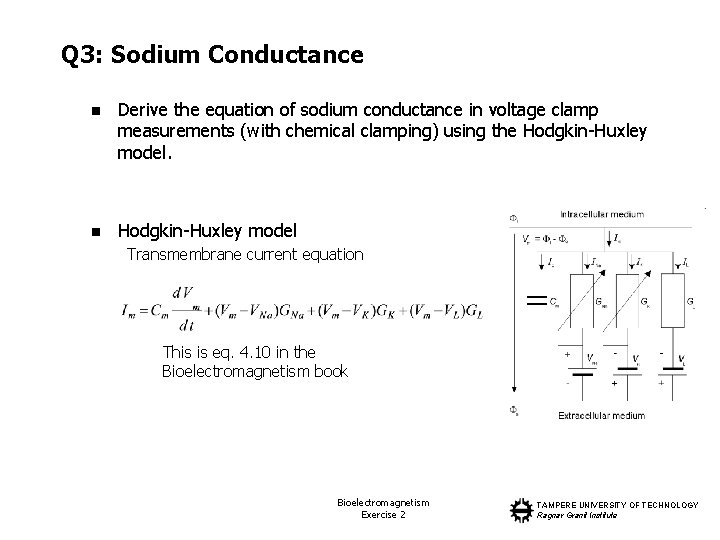
Q 3: Sodium Conductance n Derive the equation of sodium conductance in voltage clamp measurements (with chemical clamping) using the Hodgkin-Huxley model. n Hodgkin-Huxley model Transmembrane current equation This is eq. 4. 10 in the Bioelectromagnetism book Bioelectromagnetism Exercise 2 TAMPERE UNIVERSITY OF TECHNOLOGY Ragnar Granit Institute
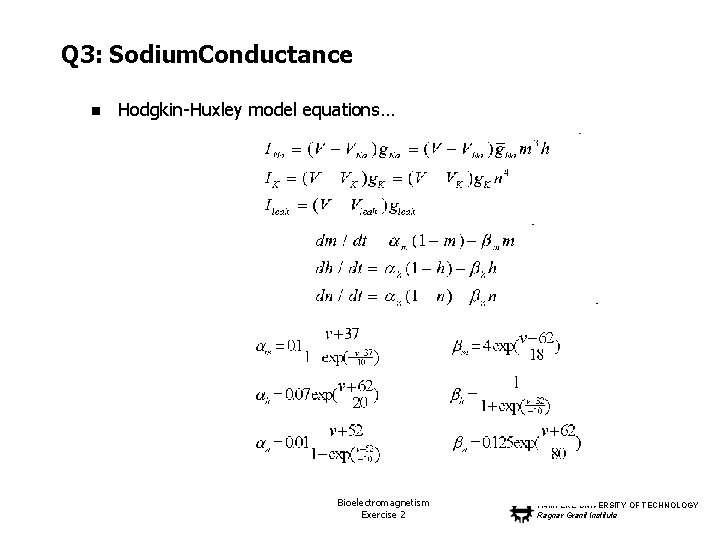
Q 3: Sodium. Conductance n Hodgkin-Huxley model equations… Bioelectromagnetism Exercise 2 TAMPERE UNIVERSITY OF TECHNOLOGY Ragnar Granit Institute
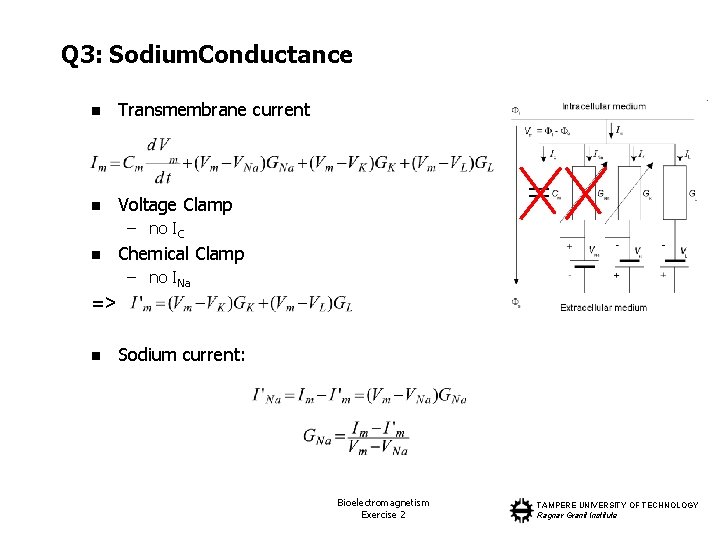
Q 3: Sodium. Conductance n Transmembrane current n Voltage Clamp – no IC n Chemical Clamp – no INa => n Sodium current: Bioelectromagnetism Exercise 2 TAMPERE UNIVERSITY OF TECHNOLOGY Ragnar Granit Institute
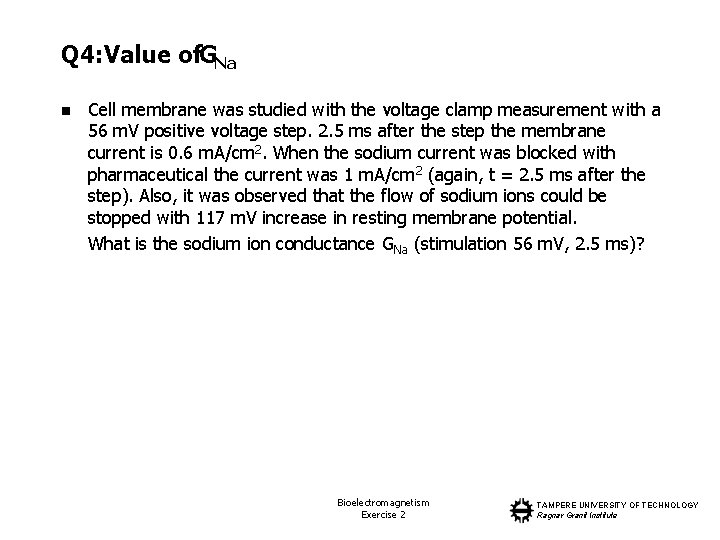
Q 4: Value of. GNa n Cell membrane was studied with the voltage clamp measurement with a 56 m. V positive voltage step. 2. 5 ms after the step the membrane current is 0. 6 m. A/cm 2. When the sodium current was blocked with pharmaceutical the current was 1 m. A/cm 2 (again, t = 2. 5 ms after the step). Also, it was observed that the flow of sodium ions could be stopped with 117 m. V increase in resting membrane potential. What is the sodium ion conductance GNa (stimulation 56 m. V, 2. 5 ms)? Bioelectromagnetism Exercise 2 TAMPERE UNIVERSITY OF TECHNOLOGY Ragnar Granit Institute
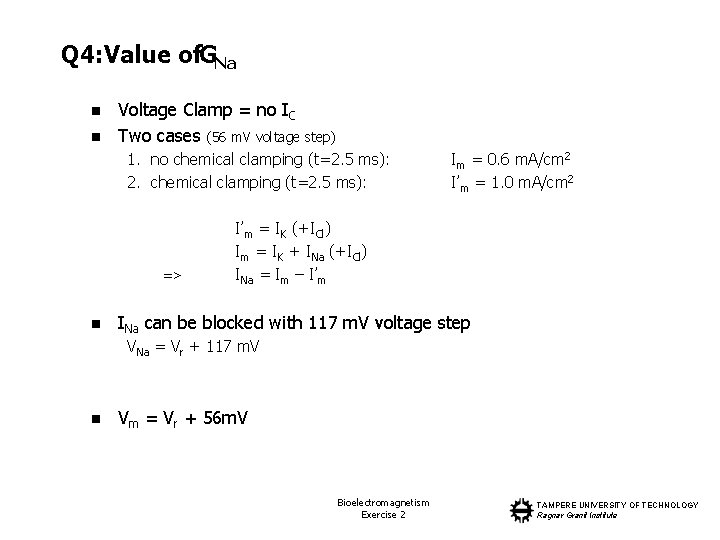
Q 4: Value of. GNa n n Voltage Clamp = no IC Two cases (56 m. V voltage step) 1. no chemical clamping (t=2. 5 ms): 2. chemical clamping (t=2. 5 ms): => n Im = 0. 6 m. A/cm 2 I’m = 1. 0 m. A/cm 2 I’m = IK (+ICl) Im = IK + INa (+ICl) INa = Im – I’m INa can be blocked with 117 m. V voltage step VNa = Vr + 117 m. V n Vm = Vr + 56 m. V Bioelectromagnetism Exercise 2 TAMPERE UNIVERSITY OF TECHNOLOGY Ragnar Granit Institute
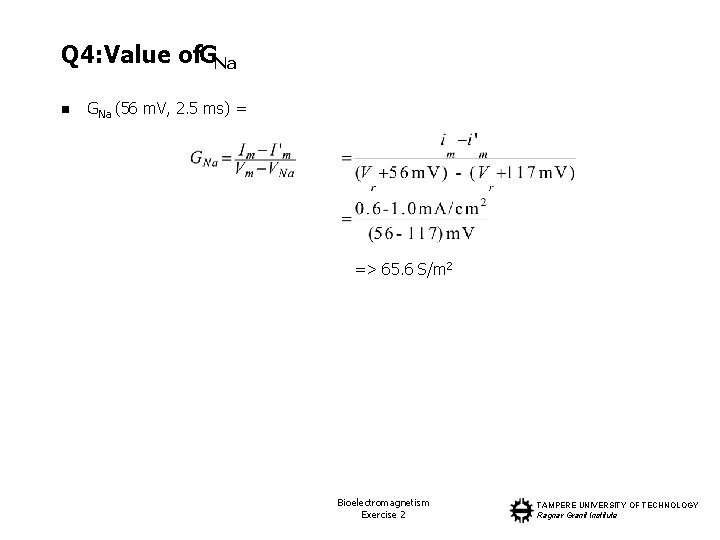
Q 4: Value of. GNa n GNa (56 m. V, 2. 5 ms) = => 65. 6 S/m 2 Bioelectromagnetism Exercise 2 TAMPERE UNIVERSITY OF TECHNOLOGY Ragnar Granit Institute
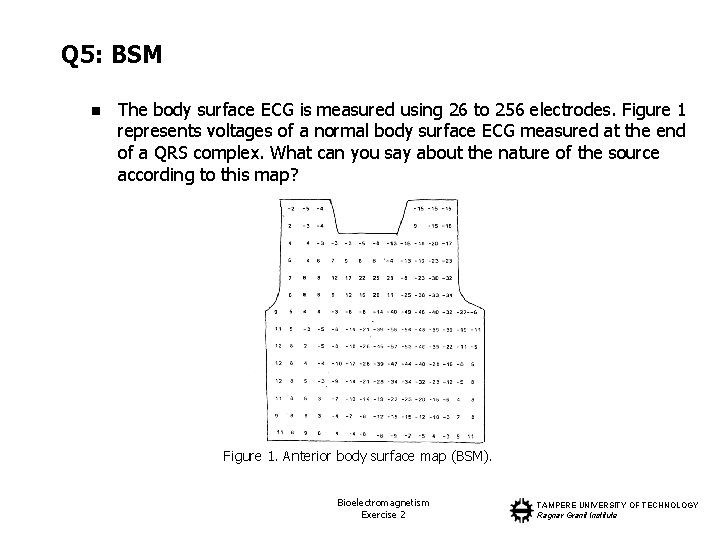
Q 5: BSM n The body surface ECG is measured using 26 to 256 electrodes. Figure 1 represents voltages of a normal body surface ECG measured at the end of a QRS complex. What can you say about the nature of the source according to this map? Figure 1. Anterior body surface map (BSM). Bioelectromagnetism Exercise 2 TAMPERE UNIVERSITY OF TECHNOLOGY Ragnar Granit Institute
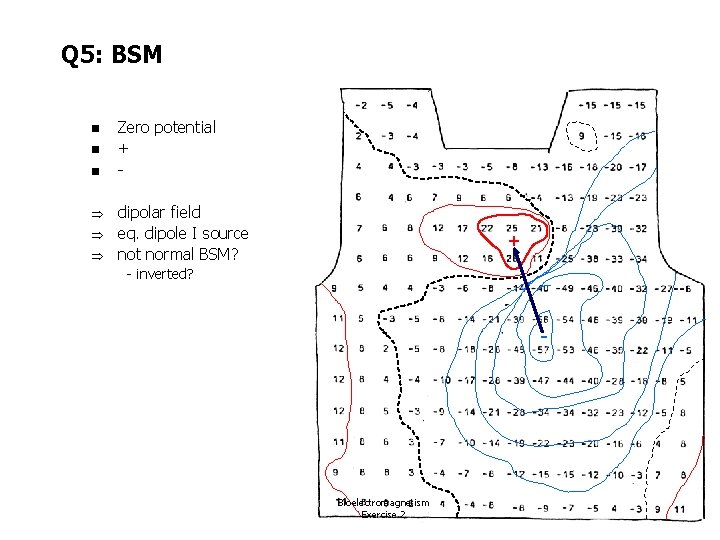
Q 5: BSM n n n Þ Þ Þ Zero potential + dipolar field eq. dipole I source not normal BSM? + - inverted? - Bioelectromagnetism Exercise 2 TAMPERE UNIVERSITY OF TECHNOLOGY Ragnar Granit Institute
- Slides: 21