
TAMPERE UNIVERSITY OF TECHNOLOGY Ragnar Granit Institute Bioelectromagnetism
TAMPERE UNIVERSITY OF TECHNOLOGY Ragnar Granit Institute Bioelectromagnetism Exercise #1 – Answers
Q 1: Equilibrium. Voltages n In nerve and muscle cells the concentration ratios of the chloride and potassium ions between intracellular and extracellular fluids are approximately 1: 30 (that is, for example 4 x 10 -6 : 120 x 10 -6 mol/cm 3) and 38. 8: 1. What are the corresponding equilibrium voltages for chloride and potassium ions? (The value of the potential difference across the cell membrane that clamps the specific ionic flow) Bioelectromagnetism Exercise 1 TAMPERE UNIVERSITY OF TECHNOLOGY Ragnar Granit Institute
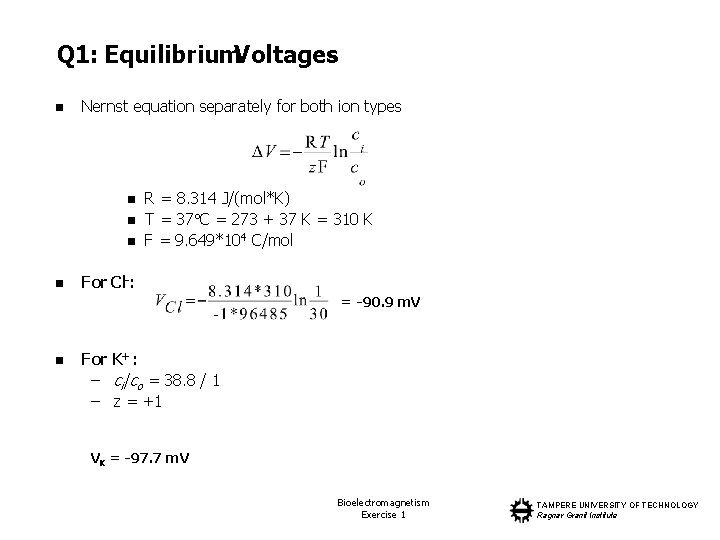
Q 1: Equilibrium. Voltages n Nernst equation separately for both ion types n n R = 8. 314 J/(mol*K) T = 37 C = 273 + 37 K = 310 K F = 9. 649*104 C/mol For Cl-: = -90. 9 m. V n For K+ : – ci/co = 38. 8 / 1 – z = +1 VK = -97. 7 m. V Bioelectromagnetism Exercise 1 TAMPERE UNIVERSITY OF TECHNOLOGY Ragnar Granit Institute
Q 2: Resting. Membrane. Potential n The permeabilities of potassium, sodium and chloride ions in the giant axon of a squid at 36 °C are PK: PNa: PCl = 1: 0. 04: 0. 45. The concentrations of the ions in intracellular and extracellular fluids are [10 -3 mol/cm 3]: [K+]i = 3. 45 [Na+]i = 0. 72 [Cl-]i = 0. 61 [K+]o = 0. 10 [Na+]o = 4. 55 [Cl-]o = 5. 40 Determine the resting membrane potential. Bioelectromagnetism Exercise 1 TAMPERE UNIVERSITY OF TECHNOLOGY Ragnar Granit Institute
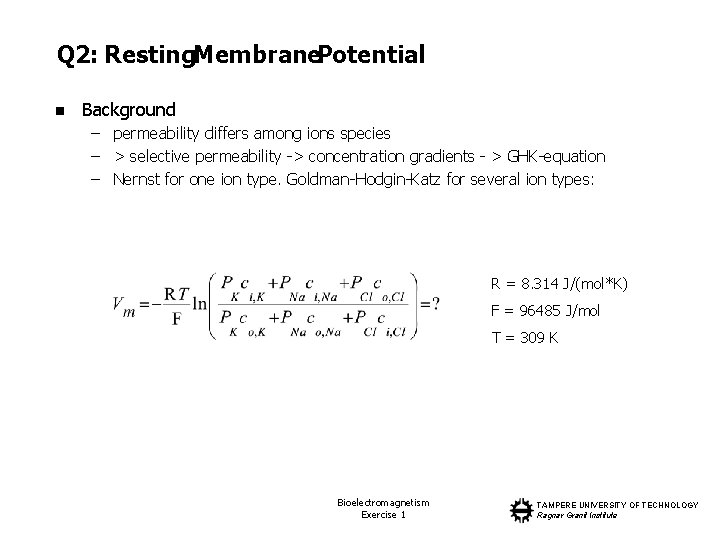
Q 2: Resting. Membrane. Potential n Background – permeability differs among ions species – > selective permeability -> concentration gradients - > GHK-equation – Nernst for one ion type. Goldman-Hodgin-Katz for several ion types: R = 8. 314 J/(mol*K) F = 96485 J/mol T = 309 K Bioelectromagnetism Exercise 1 TAMPERE UNIVERSITY OF TECHNOLOGY Ragnar Granit Institute
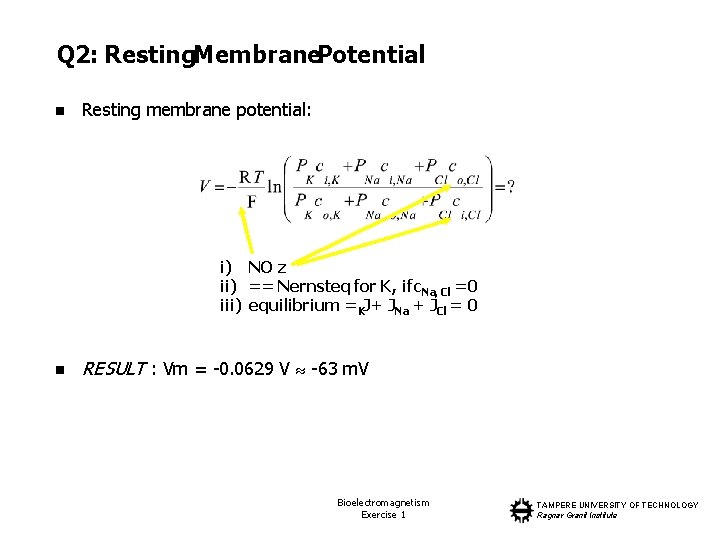
Q 2: Resting. Membrane. Potential n Resting membrane potential: i) NO z ii) == Nernsteq for K, if c. Na, Cl =0 iii) equilibrium = KJ+ JNa + JCl = 0 n RESULT : Vm = -0. 0629 V -63 m. V Bioelectromagnetism Exercise 1 TAMPERE UNIVERSITY OF TECHNOLOGY Ragnar Granit Institute
Q 3: Chloride Pump n A special single cell organism that lives in a natural mineral water spring has permeabilities of 0. 09, 1. 00 and 0. 04 for the Cl-, K+ and Na+, respectively, and the following concentrations [Cl-]i = 178 [K+]i = 135 [Na+]i = 0. 05 [Cl-]o = 0. 47 [K+]o = 83 [Na+]o = 118 To maintain the chloride gradient, this cell has a special chloride pump. Which direction does the pump have to move chloride in order to maintain the status? n Solution: pump will have to counteract the net force (C+E) – GHK = resting potential – Nernst for Cl- Bioelectromagnetism Exercise 1 TAMPERE UNIVERSITY OF TECHNOLOGY Ragnar Granit Institute
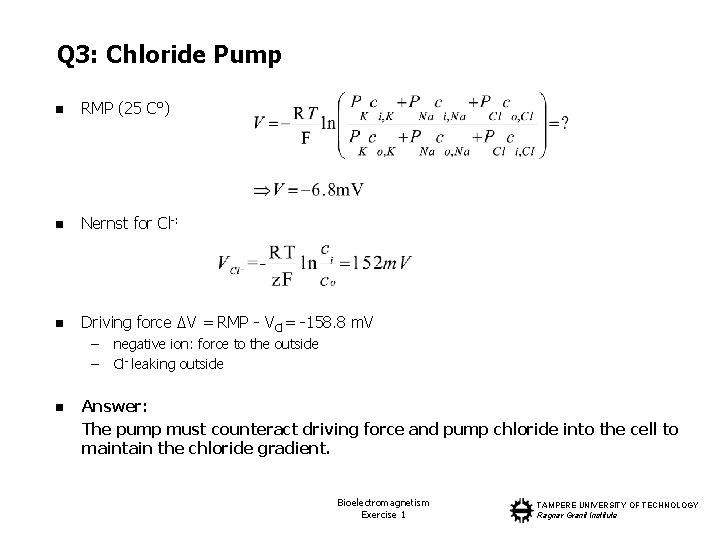
Q 3: Chloride Pump n RMP (25 C°) n Nernst for Cl-: n Driving force ∆V = RMP - VCl= -158. 8 m. V – – n negative ion: force to the outside Cl- leaking outside Answer: The pump must counteract driving force and pump chloride into the cell to maintain the chloride gradient. Bioelectromagnetism Exercise 1 TAMPERE UNIVERSITY OF TECHNOLOGY Ragnar Granit Institute
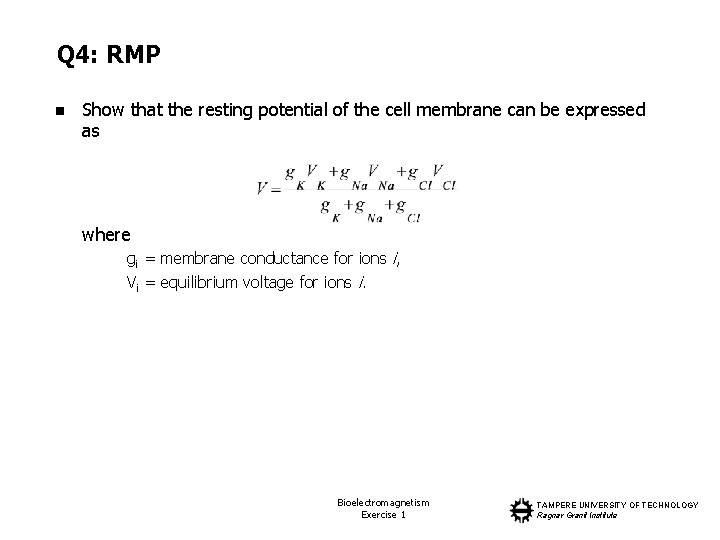
Q 4: RMP n Show that the resting potential of the cell membrane can be expressed as where gi = membrane conductance for ions i, Vi = equilibrium voltage for ions i. Bioelectromagnetism Exercise 1 TAMPERE UNIVERSITY OF TECHNOLOGY Ragnar Granit Institute
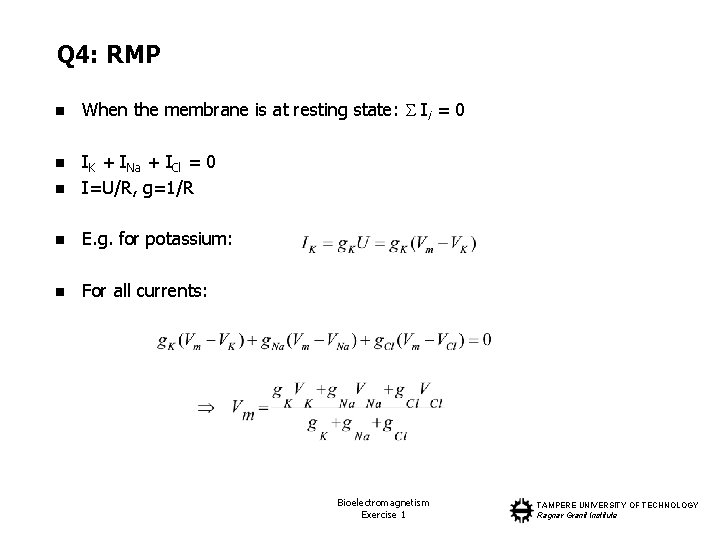
Q 4: RMP n When the membrane is at resting state: Ii = 0 n n IK + INa + ICl = 0 I=U/R, g=1/R n E. g. for potassium: n For all currents: Bioelectromagnetism Exercise 1 TAMPERE UNIVERSITY OF TECHNOLOGY Ragnar Granit Institute
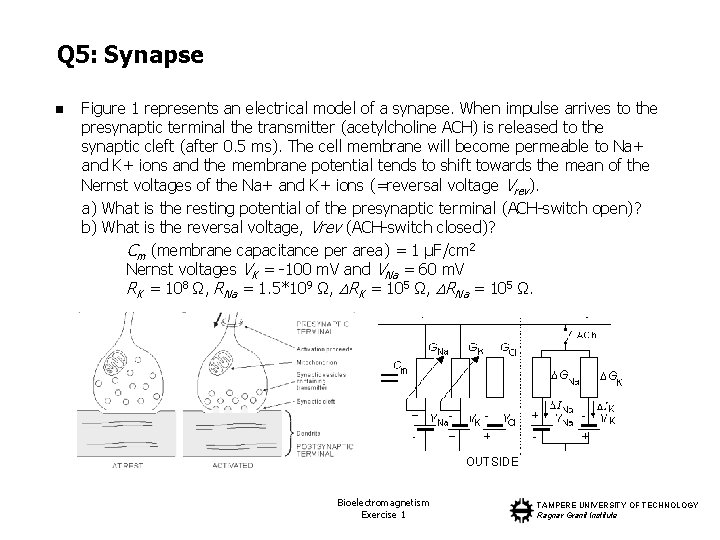
Q 5: Synapse n Figure 1 represents an electrical model of a synapse. When impulse arrives to the presynaptic terminal the transmitter (acetylcholine ACH) is released to the synaptic cleft (after 0. 5 ms). The cell membrane will become permeable to Na+ and K+ ions and the membrane potential tends to shift towards the mean of the Nernst voltages of the Na+ and K+ ions (=reversal voltage Vrev). a) What is the resting potential of the presynaptic terminal (ACH-switch open)? b) What is the reversal voltage, Vrev (ACH-switch closed)? Cm (membrane capacitance per area) = 1 µF/cm 2 Nernst voltages VK = -100 m. V and VNa = 60 m. V RK = 108 Ω, RNa = 1. 5*109 Ω, RK = 105 Ω, RNa = 105 Ω. Bioelectromagnetism Exercise 1 TAMPERE UNIVERSITY OF TECHNOLOGY Ragnar Granit Institute
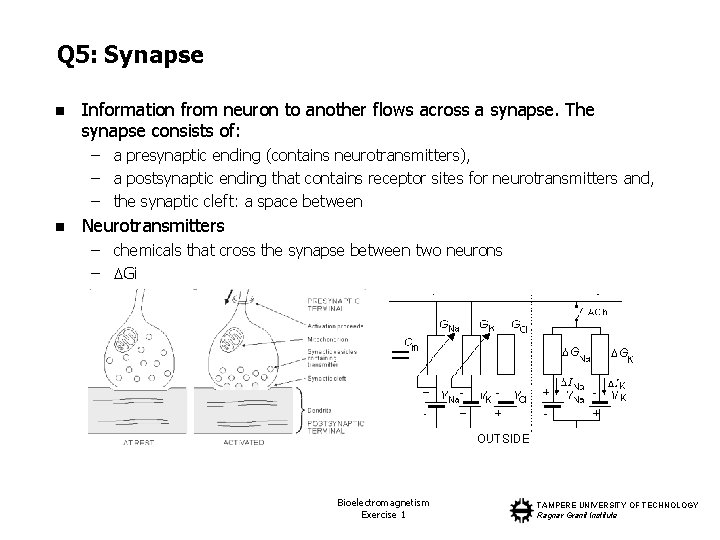
Q 5: Synapse n Information from neuron to another flows across a synapse. The synapse consists of: – a presynaptic ending (contains neurotransmitters), – a postsynaptic ending that contains receptor sites for neurotransmitters and, – the synaptic cleft: a space between n Neurotransmitters – chemicals that cross the synapse between two neurons – Gi Bioelectromagnetism Exercise 1 TAMPERE UNIVERSITY OF TECHNOLOGY Ragnar Granit Institute
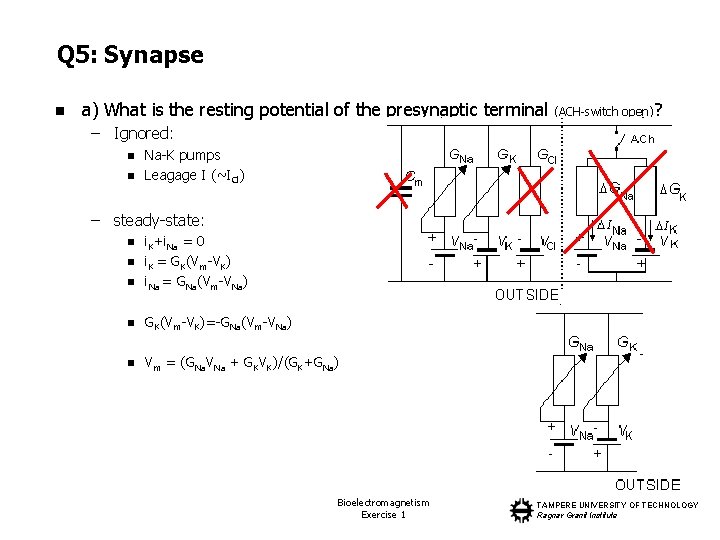
Q 5: Synapse n a) What is the resting potential of the presynaptic terminal (ACH-switch open) ? – Ignored: n n Na-K pumps Leagage I (~ICl) – steady-state: n i. K+i. Na = 0 i. K = GK(Vm-VK) i. Na = GNa(Vm-VNa) n GK(Vm-VK)=-GNa(Vm-VNa) n Vm = (GNa. VNa + GKVK)/(GK+GNa) n n Bioelectromagnetism Exercise 1 TAMPERE UNIVERSITY OF TECHNOLOGY Ragnar Granit Institute
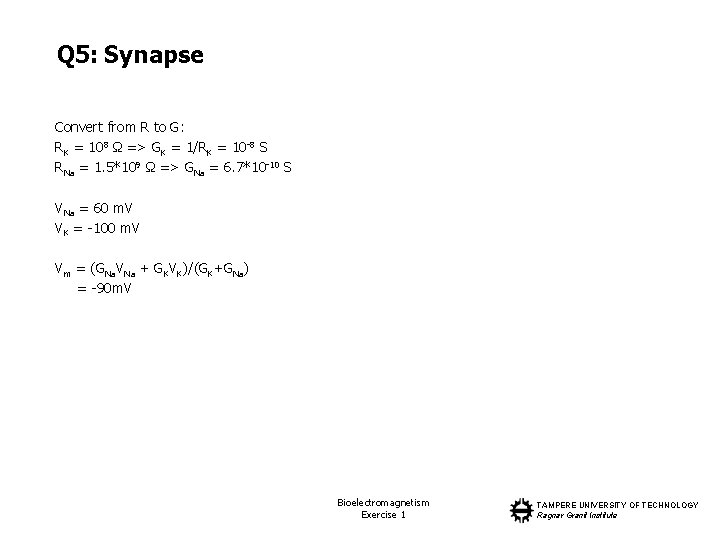
Q 5: Synapse Convert from R to G: RK = 108 Ω => GK = 1/RK = 10 -8 S RNa = 1. 5*109 Ω => GNa = 6. 7*10 -10 S VNa = 60 m. V VK = -100 m. V Vm = (GNa. VNa + GKVK)/(GK+GNa) = -90 m. V Bioelectromagnetism Exercise 1 TAMPERE UNIVERSITY OF TECHNOLOGY Ragnar Granit Institute

Q 5: Synapse n b) What is the reversal voltage, Vrev (ACH-switch closed)? n I=0 after the release of ACH n i. K+i. Na = 0 n n i. K = (GK + GK)*(Vr-VK)= G’K *(Vr-VK) i. Na = (GNa + GNa) *(Vr-VNa)= G’Na *(Vr-VNa) n G’K*(Vr-VK)=- G’Na*(Vr-VNa) n Vr = (G’Na. VNa + G’KVK)/(G’K+ G’Na) Bioelectromagnetism Exercise 1 TAMPERE UNIVERSITY OF TECHNOLOGY Ragnar Granit Institute
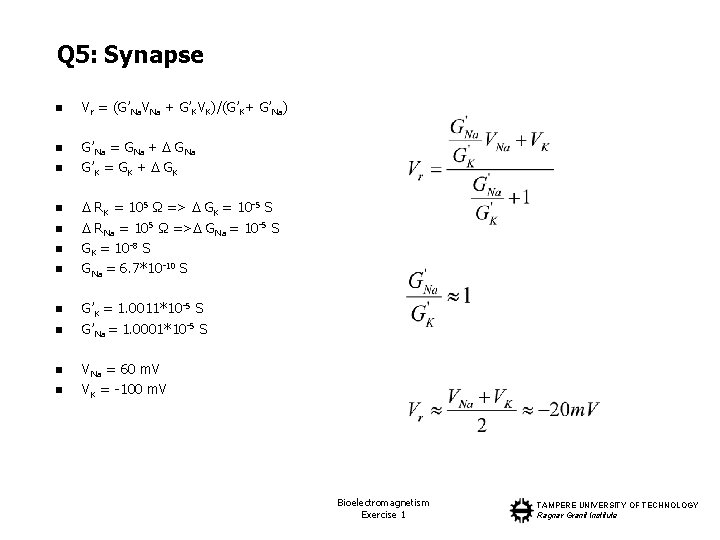
Q 5: Synapse n Vr = (G’Na. VNa + G’KVK)/(G’K+ G’Na) n G’Na = GNa + GNa G’K = GK + GK n n n n n RK = 105 Ω => GK = 10 -5 S RNa = 105 Ω => GNa = 10 -5 S GK = 10 -8 S GNa = 6. 7*10 -10 S G’K = 1. 0011*10 -5 S G’Na = 1. 0001*10 -5 S VNa = 60 m. V VK = -100 m. V Bioelectromagnetism Exercise 1 TAMPERE UNIVERSITY OF TECHNOLOGY Ragnar Granit Institute
- Slides: 16