SYDE 575 Digital Image Processing Image Compression JPEG
- Slides: 18
SYDE 575: Digital Image Processing Image Compression: JPEG Example (Variable Rate Compression)
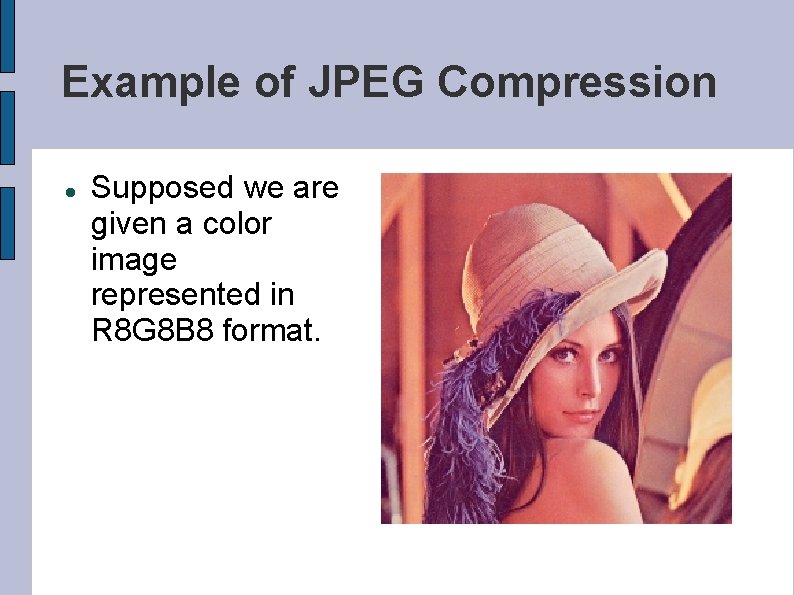
Example of JPEG Compression Supposed we are given a color image represented in R 8 G 8 B 8 format.
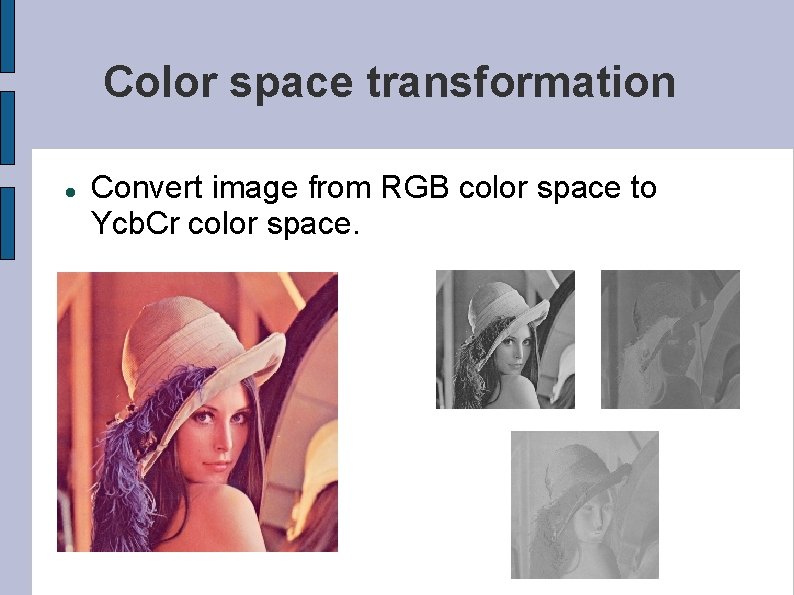
Color space transformation Convert image from RGB color space to Ycb. Cr color space.
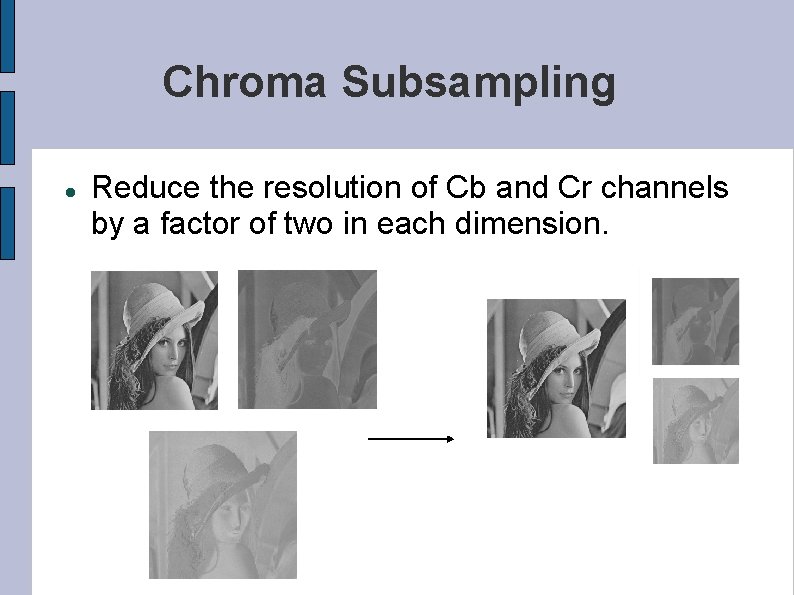
Chroma Subsampling Reduce the resolution of Cb and Cr channels by a factor of two in each dimension.
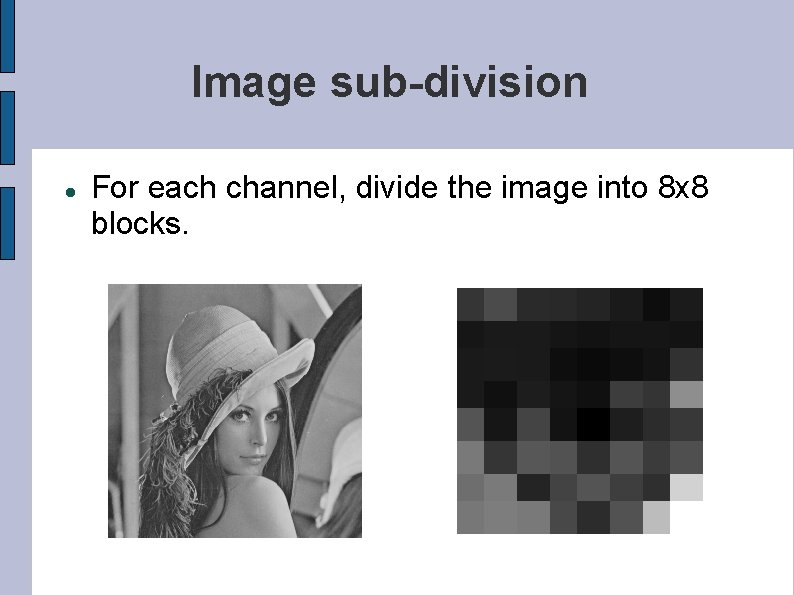
Image sub-division For each channel, divide the image into 8 x 8 blocks.
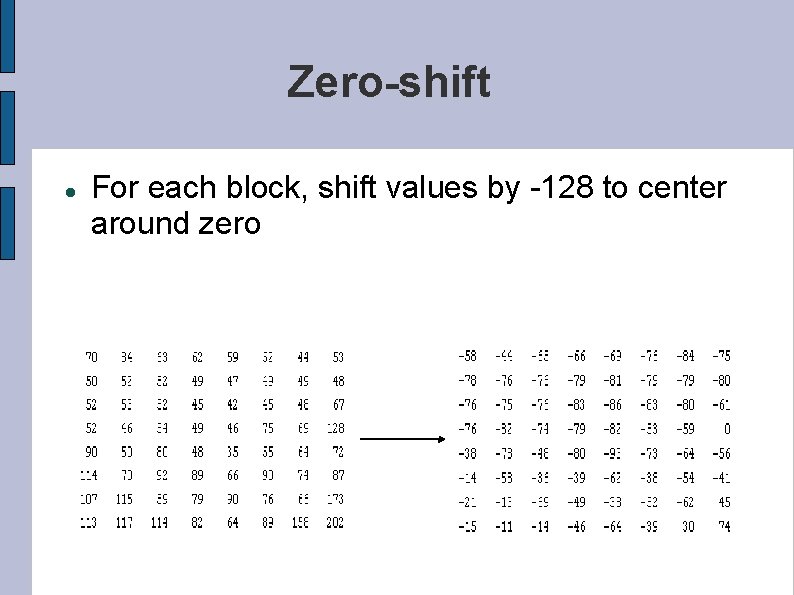
Zero-shift For each block, shift values by -128 to center around zero
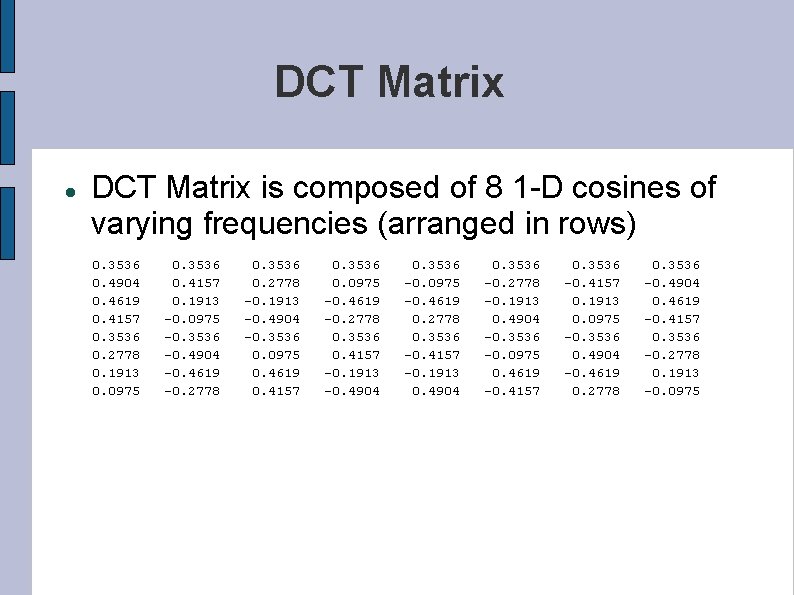
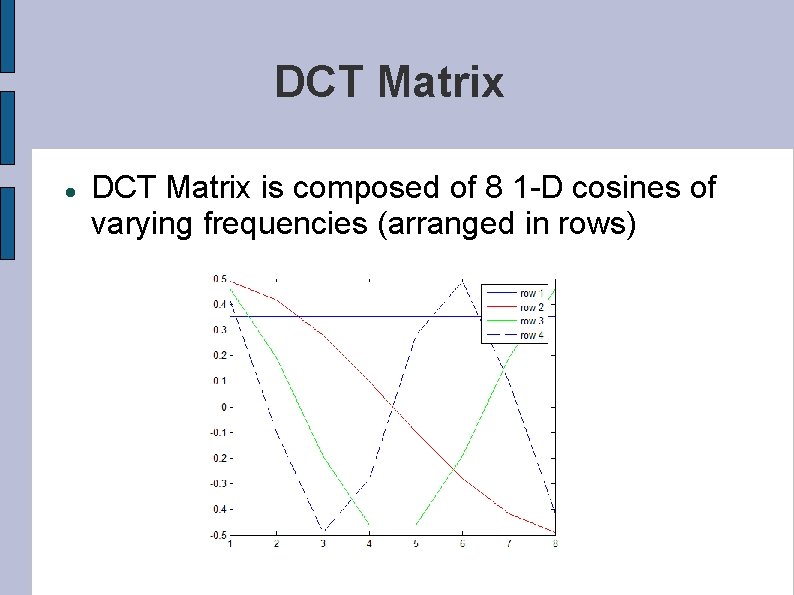
DCT Matrix is composed of 8 1 -D cosines of varying frequencies (arranged in rows)
DCT Matrix is composed of 8 1 -D cosines of varying frequencies (arranged in rows)
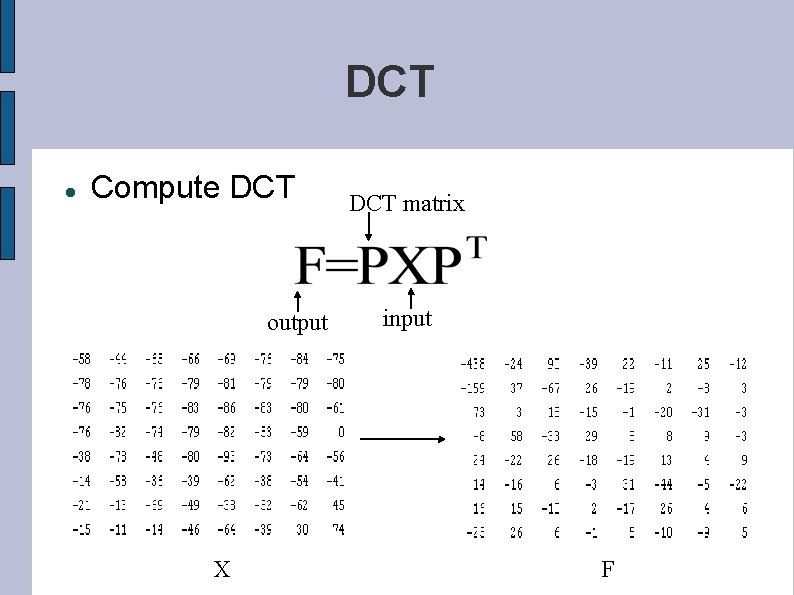
DCT Compute DCT output X DCT matrix input F
DCT Memory Requirements Notice that the DC coefficient (i. e. , F(0, 0)) requires more than 8 bits to represent Since much of the energy is stored in the DC coefficient Therefore, internally, more bits are required for storage during DCT computation This does not increase memory requirements that much as we are only operating on small 8 x 8 blocks at a time.
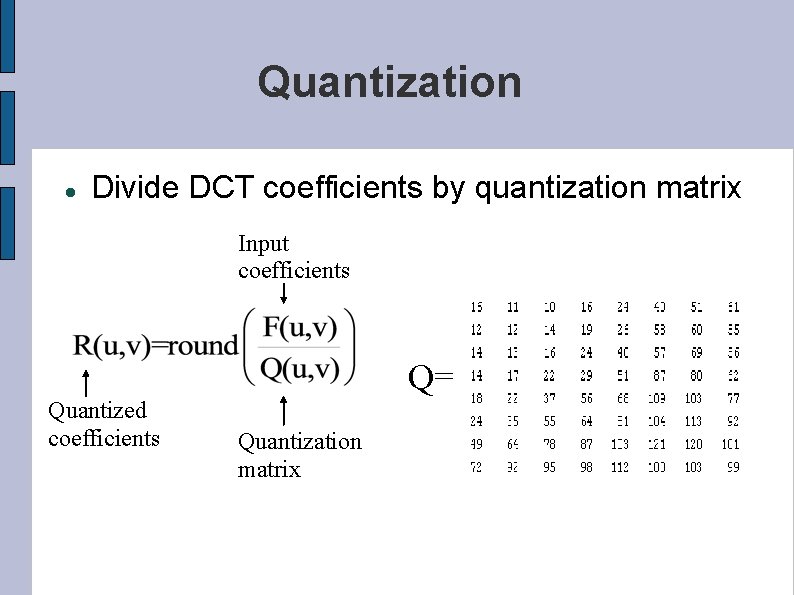
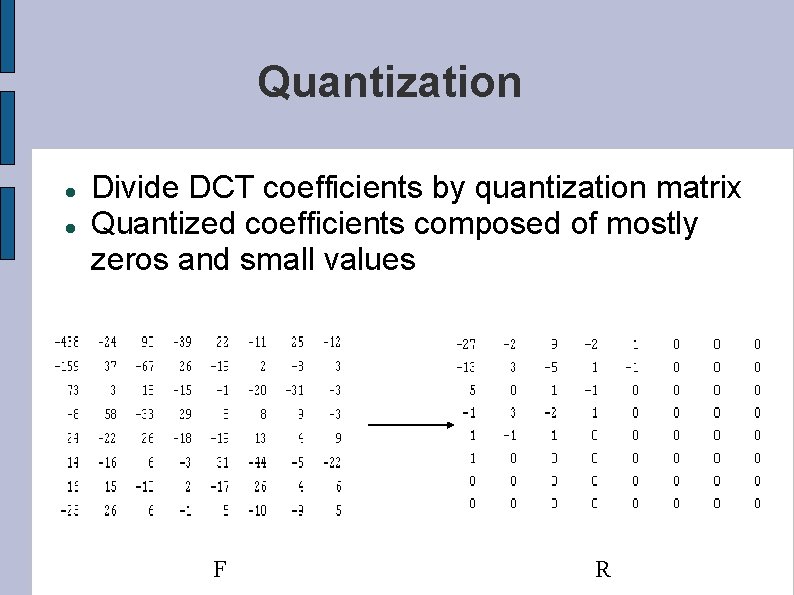
Quantization Divide DCT coefficients by quantization matrix Input coefficients Q= Quantized coefficients Quantization matrix
Quantization Divide DCT coefficients by quantization matrix Quantized coefficients composed of mostly zeros and small values F R
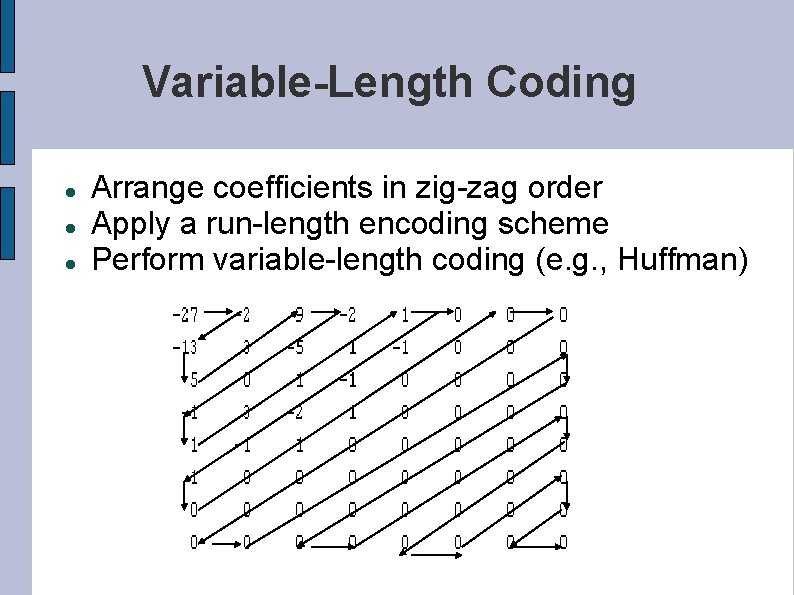
Variable-Length Coding Arrange coefficients in zig-zag order Apply a run-length encoding scheme Perform variable-length coding (e. g. , Huffman)
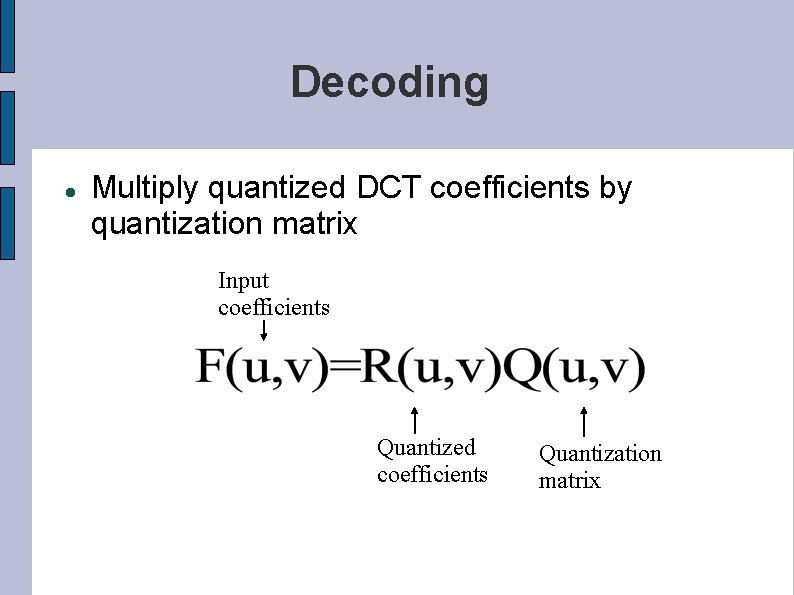
Decoding Multiply quantized DCT coefficients by quantization matrix Input coefficients Quantized coefficients Quantization matrix
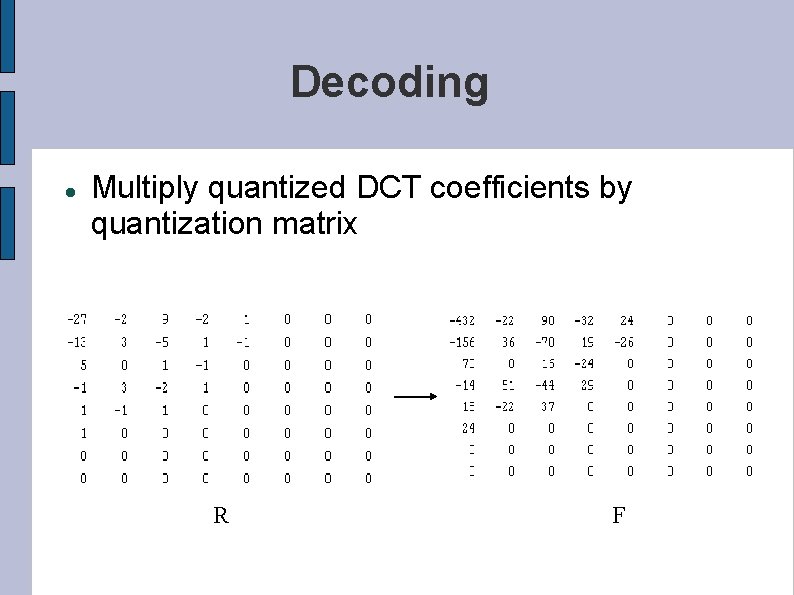
Decoding Multiply quantized DCT coefficients by quantization matrix R F
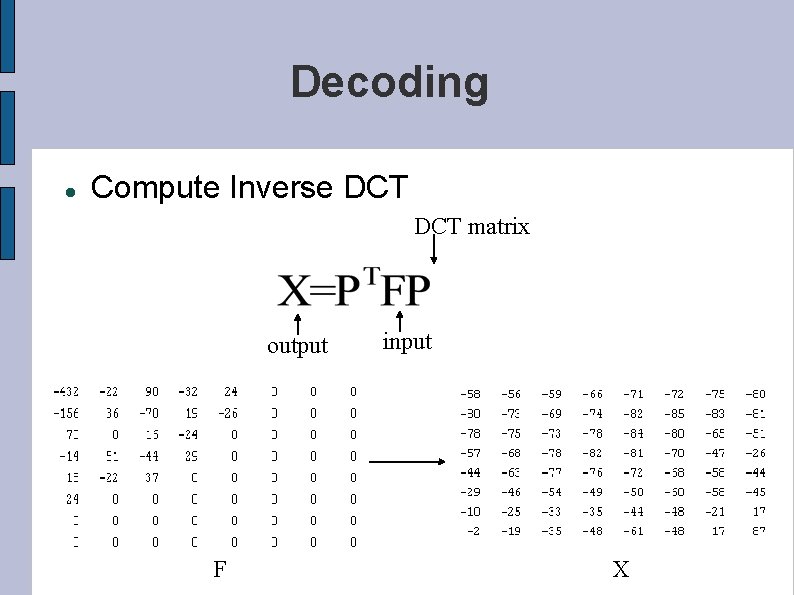
Decoding Compute Inverse DCT matrix output F input X
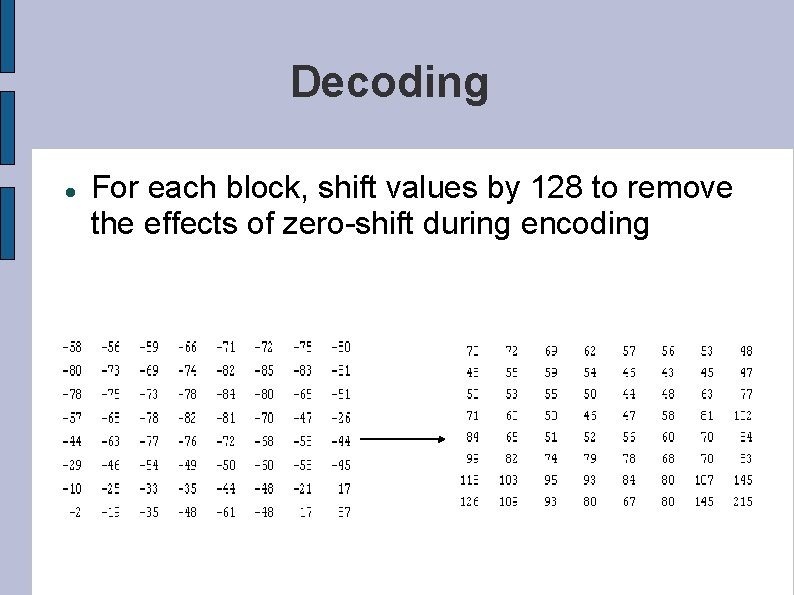
Decoding For each block, shift values by 128 to remove the effects of zero-shift during encoding
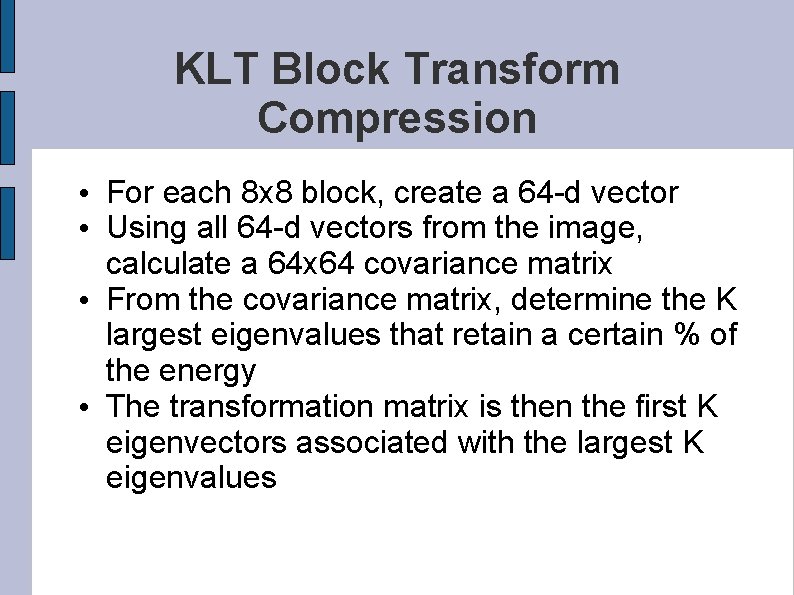
KLT Block Transform Compression • For each 8 x 8 block, create a 64 -d vector • Using all 64 -d vectors from the image, calculate a 64 x 64 covariance matrix • From the covariance matrix, determine the K largest eigenvalues that retain a certain % of the energy • The transformation matrix is then the first K eigenvectors associated with the largest K eigenvalues