SYDE 575 Digital Image Processing Lecture 2 1
- Slides: 11
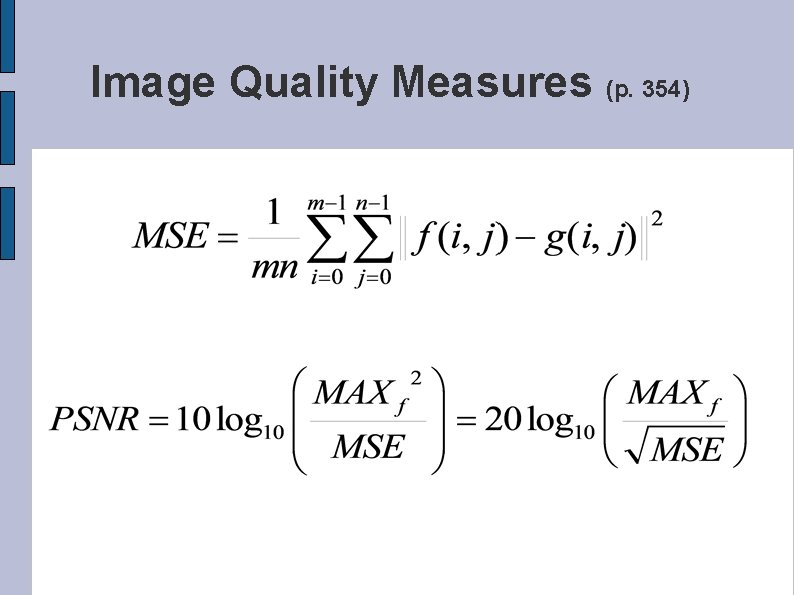
SYDE 575: Digital Image Processing Lecture 2. 1 Point Operations • • Resampling/Zooming (Text 2. 4. 4) Image Quality Metrics (Text p. 354) Point Noise Models (Text 5. 2) Blackboard Notes
Labs • Labs #1 -#5 are each two week labs • Due the Friday after the second lab session • Sometimes, need both lab sessions based on lecture – Try to keep lectures close to lab sessions so labs reinforce lectures • If you can’t make a due date for a lab, please contact the TAs – Keep in mind that TAs are also students and they have their own deadlines to take care of
Image Zooming/Resampling • Resampling is used when resizing an image • Resizing involves changing the number of pixels by increasing/decreasing the number of rows/columns, usually by the same % • See blackboard
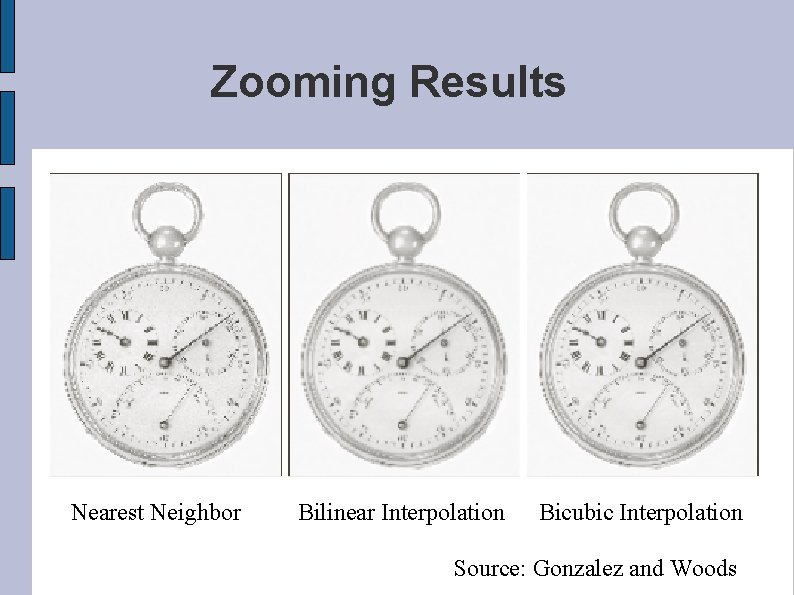
Digital Zooming Nearest neighbor interpolation Look for closest pixel in original image Fast but causes undesirable checkerboard effect Bilinear interpolation Determines pixel value based on four nearest neighbors Perform linear interpolation in x direction Perform linear interpolation in y direction based on results of interpolation from x direction Does not suffer from checkerboard effect but can result in a blurred appearance
Digital Zooming (cont. ) Bicubic Interpolation Determines pixel value based on sixteen nearest neighbors (4 x 4) Perform cubic spline interpolation in x direction Perform cubic spline interpolation in y direction based on results of interpolation from x direction Does not suffer from checkerboard effect like nearest neighbor interpolation and preserves fine details better than bilinear interpolation
Zooming Results Nearest Neighbor Bilinear Interpolation Bicubic Interpolation Source: Gonzalez and Woods
Image Quality Measures (p. 354)
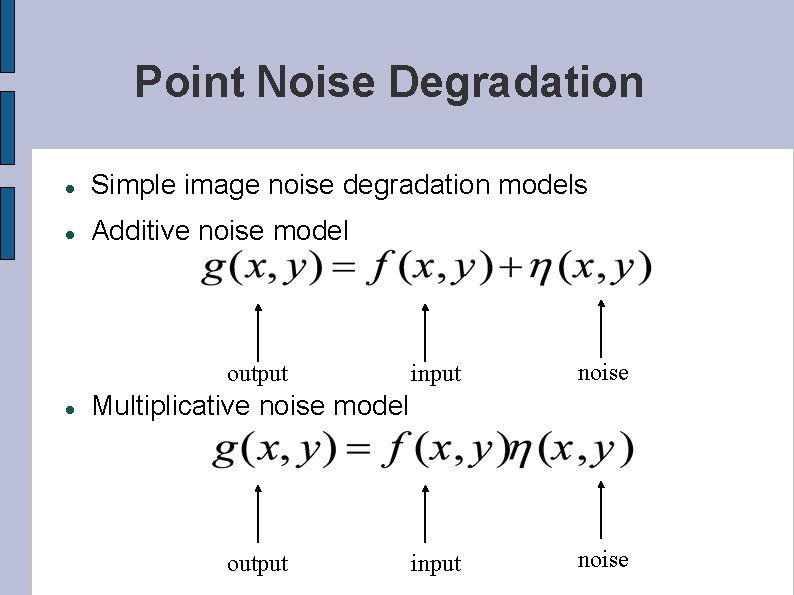
Point Noise Degradation Simple image noise degradation models Additive noise model output input noise Multiplicative noise model output
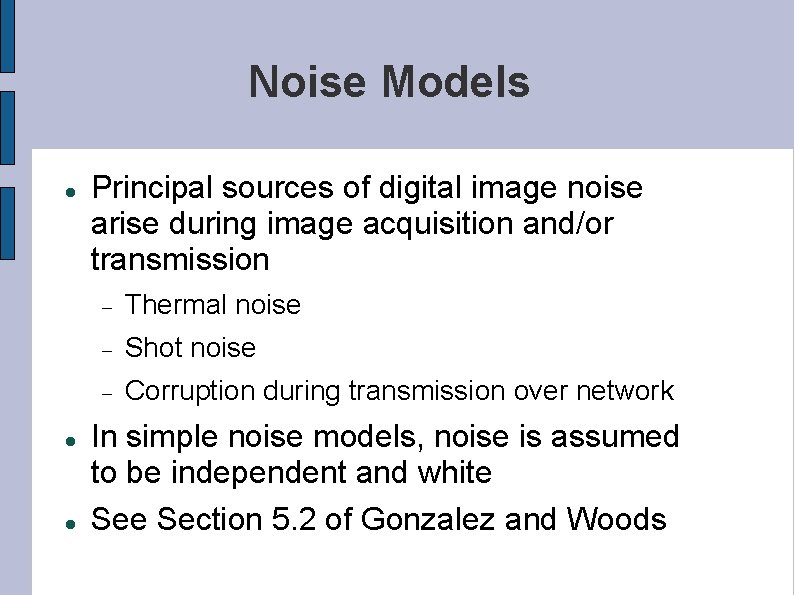
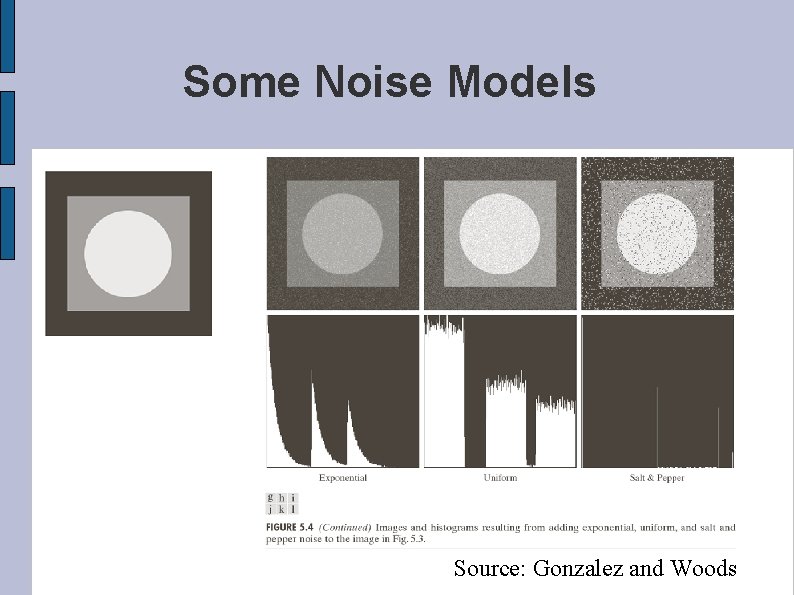
Noise Models Principal sources of digital image noise arise during image acquisition and/or transmission Thermal noise Shot noise Corruption during transmission over network In simple noise models, noise is assumed to be independent and white Section 5. 2 of Gonzalez and Woods
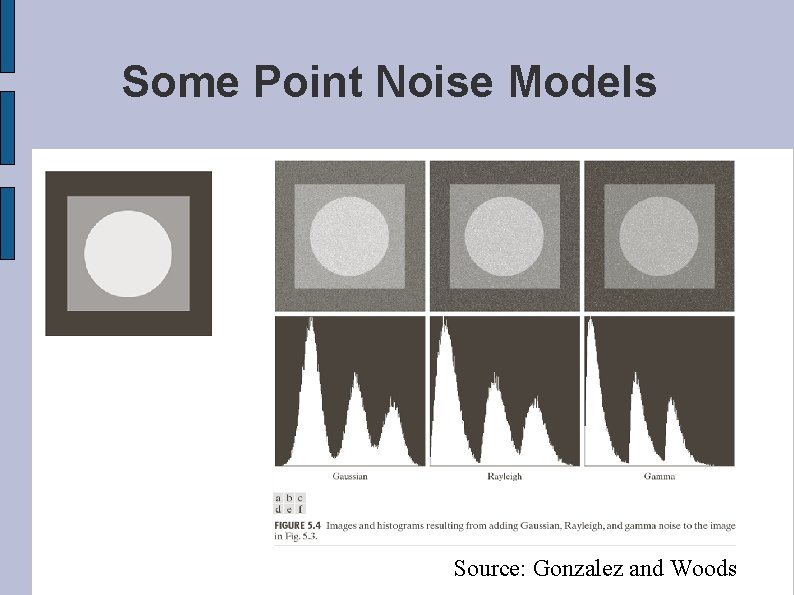
Some Point Noise Models Source: Gonzalez and Woods
Some Noise Models Source: Gonzalez and Woods