Swarm Intelligence Corey Fehr Merle Good Shawn Keown




- Slides: 51
Swarm Intelligence Corey Fehr Merle Good Shawn Keown Gordon Fedoriw
Ants in the Pants! An Overview • Real world insect examples • Theory of Swarm Intelligence • From Insects to Realistic A. I. Algorithms • Examples of AI applications
Real World Insect Examples
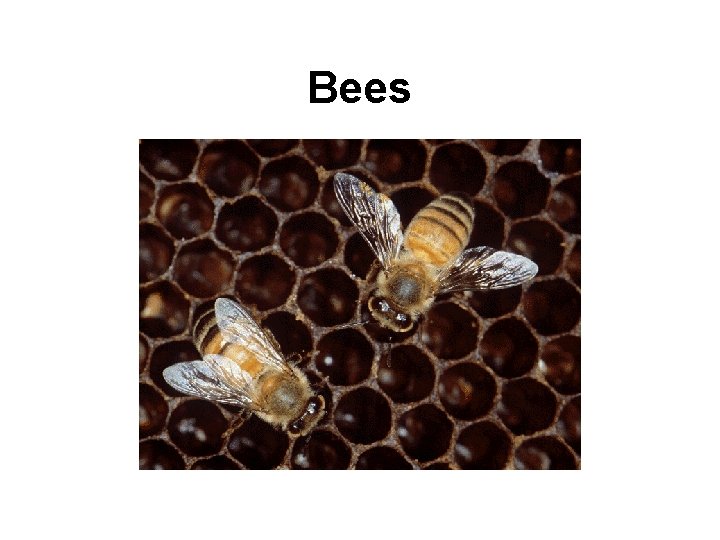
Bees
Bees • Colony cooperation • Regulate hive temperature • Efficiency via Specialization: division of labour in the colony • Communication : Food sources are exploited according to quality and distance from the hive
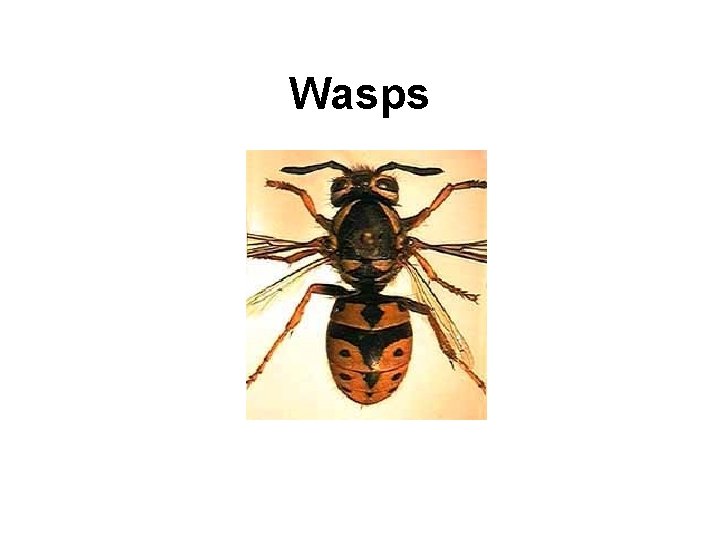
Wasps
Wasps • Pulp foragers, water foragers & builders • Complex nests – Horizontal columns – Protective covering – Central entrance hole
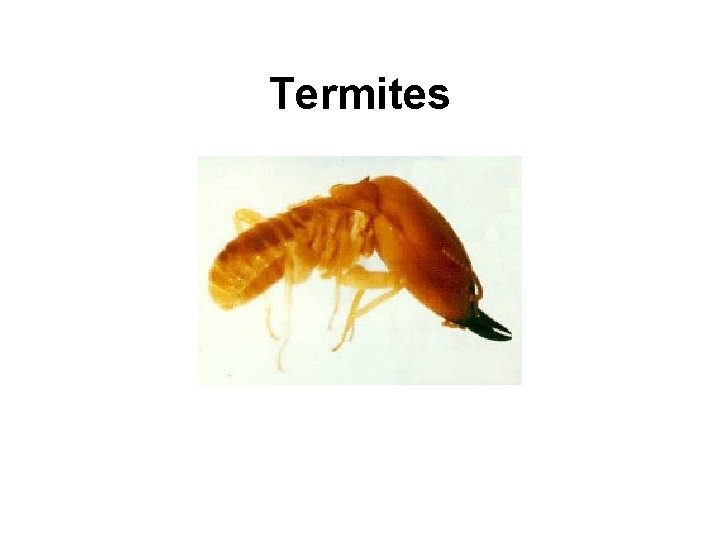
Termites
Termites • Cone-shaped outer walls and ventilation ducts • Brood chambers in central hive • Spiral cooling vents • Support pillars
Ants
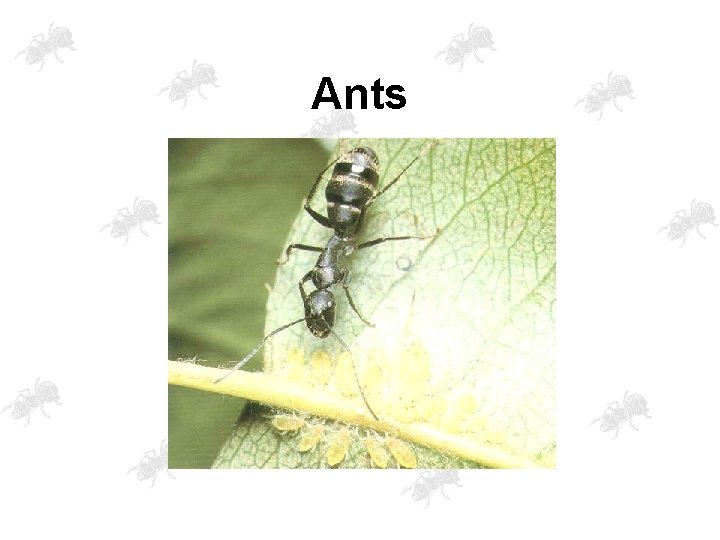
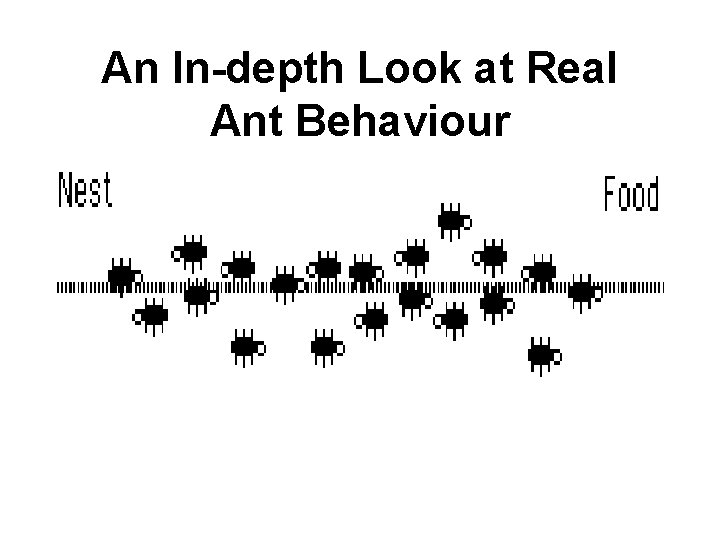
Ants • Organizing highways to and from their foraging sites by leaving pheromone trails • Form chains from their own bodies to create a bridge to pull and hold leafs together with silk • Division of labour between major and minor ants
Social Insects • Problem solving benefits include: – Flexible – Robust – Decentralized – Self-Organized
Summary of Insects • The complexity and sophistication of Self-Organization is carried out with no clear leader • What we learn about social insects can be applied to the field of Intelligent System Design • The modeling of social insects by means of Self-Organization can help design artificial distributed problem solving devices. This is also known as Swarm Intelligent Systems.
Swarm Intelligence in Theory
An In-depth Look at Real Ant Behaviour
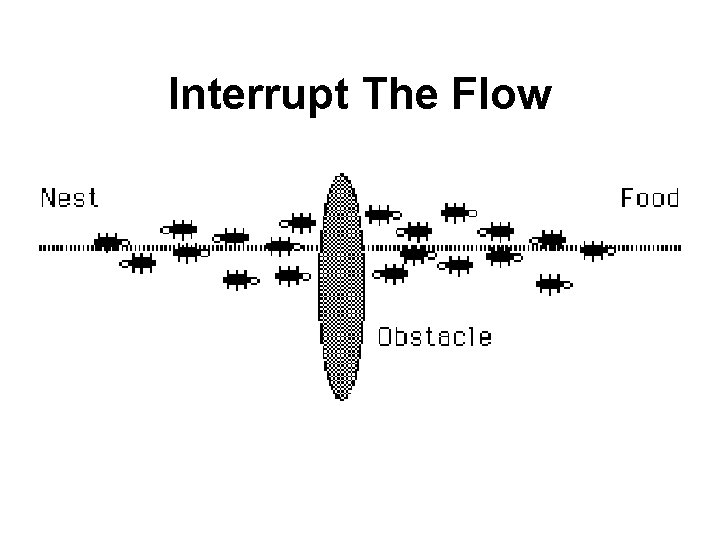
Interrupt The Flow
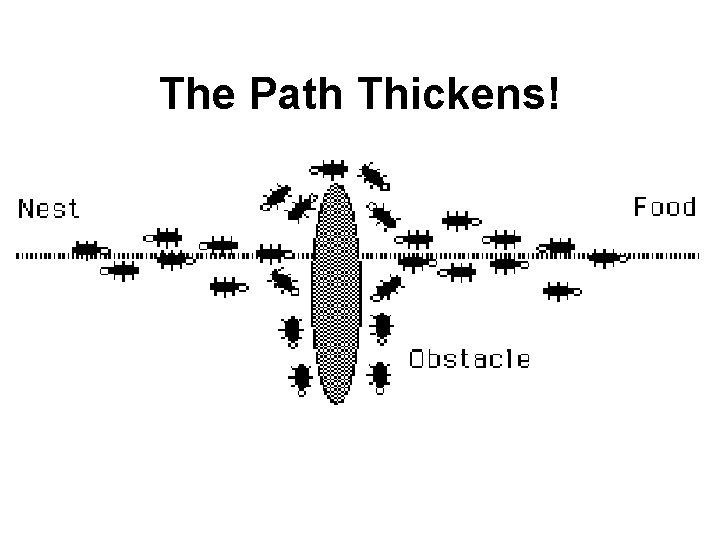
The Path Thickens!
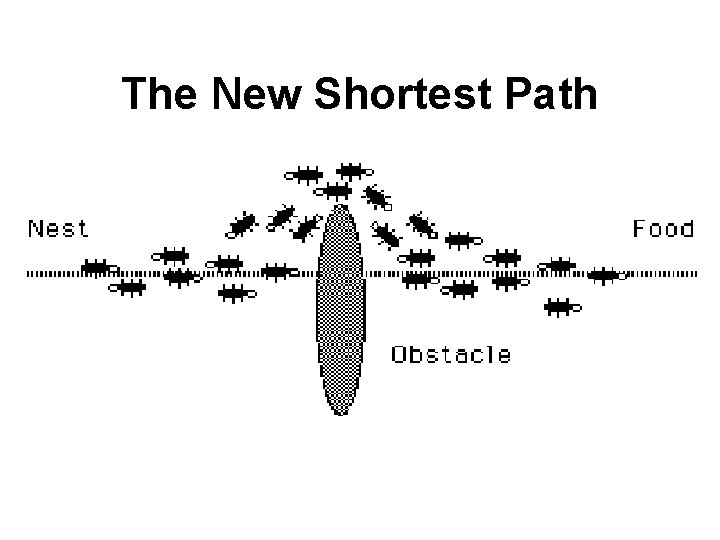
The New Shortest Path
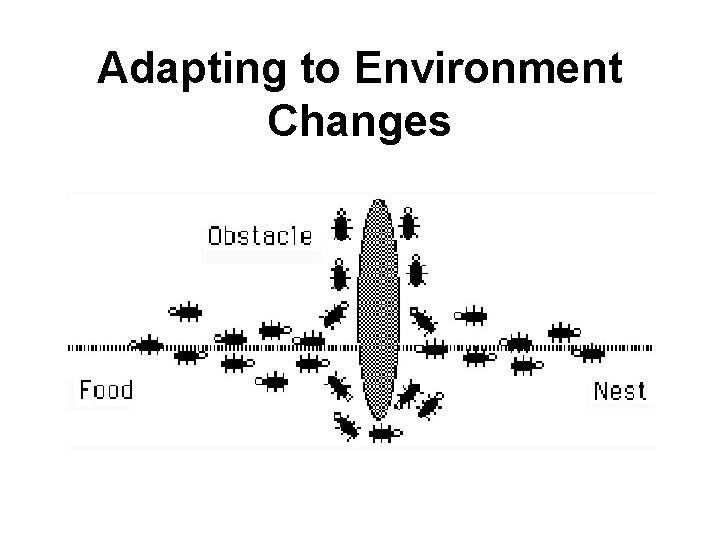
Adapting to Environment Changes
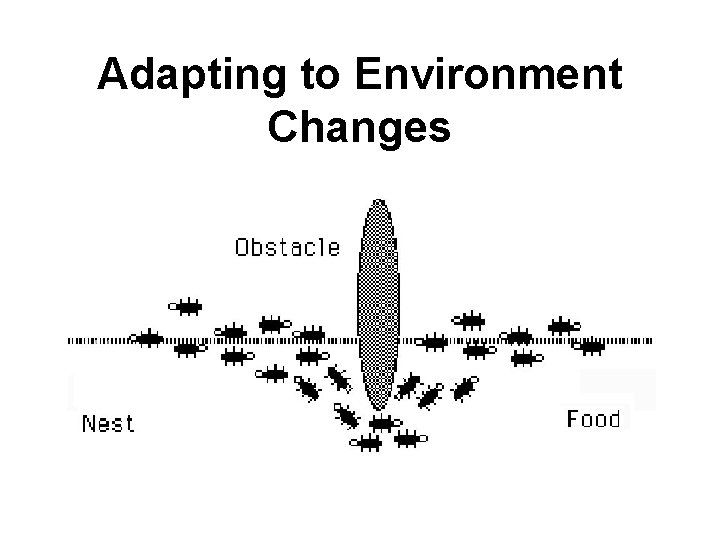
Adapting to Environment Changes
Ant Pheromone and Food Foraging Demo
Problems Regarding Swarm Intelligent Systems • Swarm Intelligent Systems are hard to ‘program’ since the problems are usually difficult to define – Solutions are emergent in the systems – Solutions result from behaviors and interactions among and between individual agents
Possible Solutions to Create Swarm Intelligence Systems • Create a catalog of the collective behaviours (Yawn!) • Model how social insects collectively perform tasks – Use this model as a basis upon which artificial variations can be developed – Model parameters can be tuned within a biologically relevant range or by adding nonbiological factors to the model
Four Ingredients of Self Organization • Positive Feedback • Negative Feedback • Amplification of Fluctuations randomness • Reliance on multiple interactions
Recap: Four Ingredients of Self Organization • Positive Feedback • Negative Feedback • Amplification of Fluctuations randomness • Reliance on multiple interactions
Properties of Self-Organization • Creation of structures – Nest, foraging trails, or social organization • Changes resulting from the existence of multiple paths of development – Non-coordinated & coordinated phases • Possible coexistence of multiple stable states – Two equal food sources
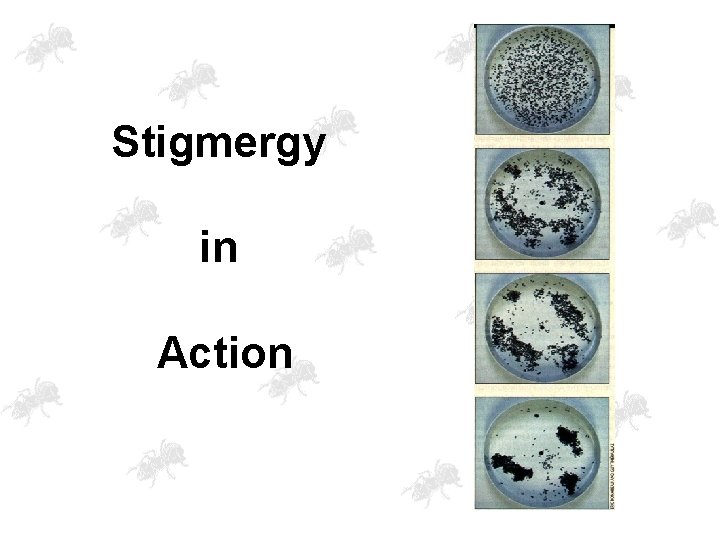
Types of Interactions For Social Insects • Direct Interactions – Food/liquid exchange, visual contact, chemical contact (pheromones) • Indirect Interactions (Stigmergy) – Individual behavior modifies the environment, which in turn modifies the behavior of other individuals
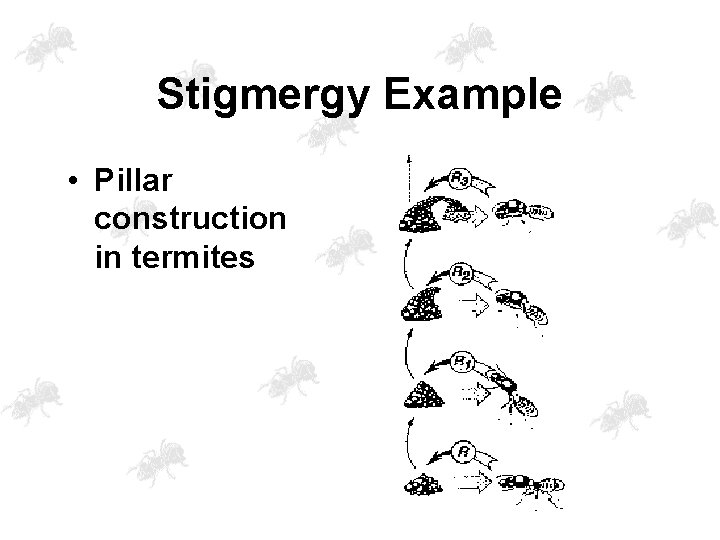
Stigmergy Example • Pillar construction in termites
Stigmergy in Action
Ants Agents • Stigmergy can be operational – Coordination by indirect interaction is more appealing than direct communication – Stigmergy reduces (or eliminates) communications between agents
From Insects to Realistic A. I. Algorithms
From Ants to Algorithms • Swarm intelligence information allows us to address modeling via: – Problem solving – Algorithms – Real world applications
Modeling • Observe Phenomenon • Create a biologically motivated model • Explore model without constraints
Modeling. . . • Creates a simplified picture of reality • Observable relevant quantities become variables of the model • Other (hidden) variables build connections
A Good Model has. . . • Parsimony (simplicity) • Coherence • Refutability • Parameter values correspond to values of their natural counterparts
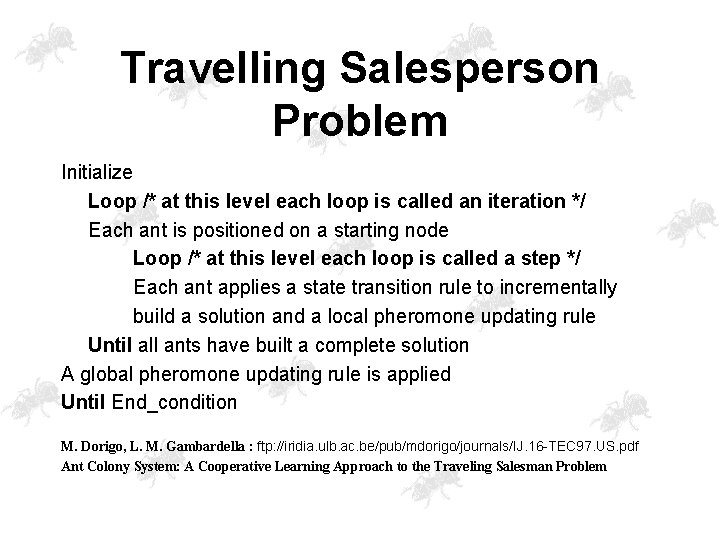
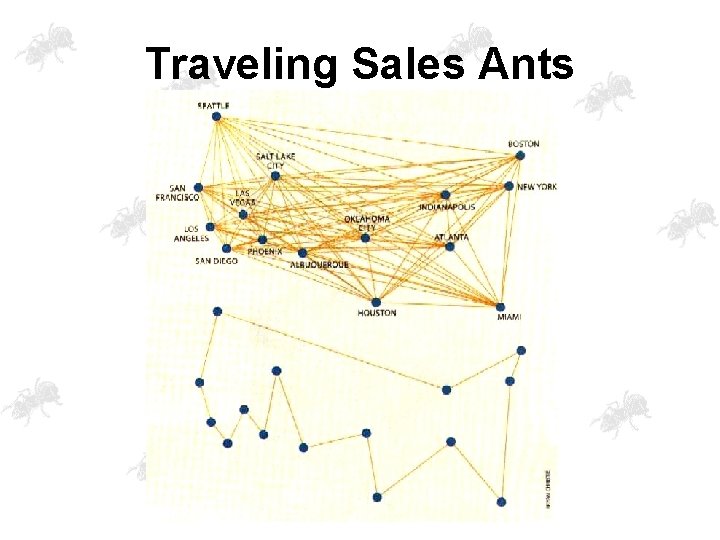
Travelling Salesperson Problem Initialize Loop /* at this level each loop is called an iteration */ Each ant is positioned on a starting node Loop /* at this level each loop is called a step */ Each ant applies a state transition rule to incrementally build a solution and a local pheromone updating rule Until all ants have built a complete solution A global pheromone updating rule is applied Until End_condition M. Dorigo, L. M. Gambardella : ftp: //iridia. ulb. ac. be/pub/mdorigo/journals/IJ. 16 -TEC 97. US. pdf Ant Colony System: A Cooperative Learning Approach to the Traveling Salesman Problem
Traveling Sales Ants
Welcome to the Real World
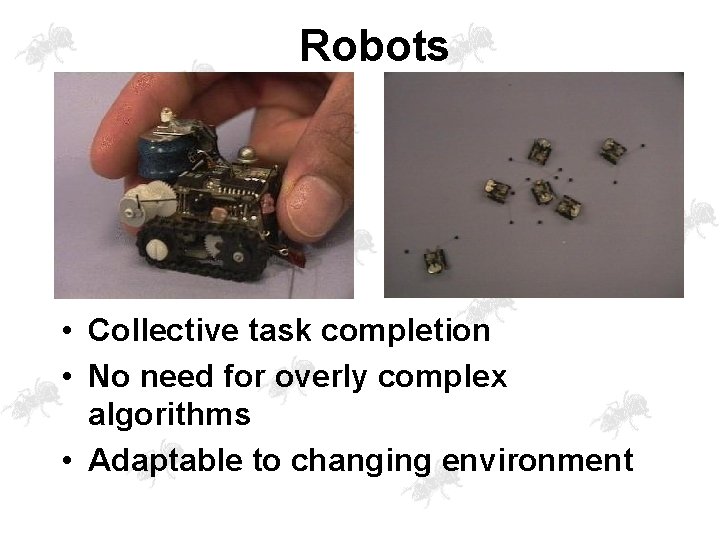
Robots • Collective task completion • No need for overly complex algorithms • Adaptable to changing environment
Robot Feeding Demo
Communication Networks • Routing packets to destination in shortest time • Similar to Shortest Route • Statistics kept from prior routing (learning from experience)
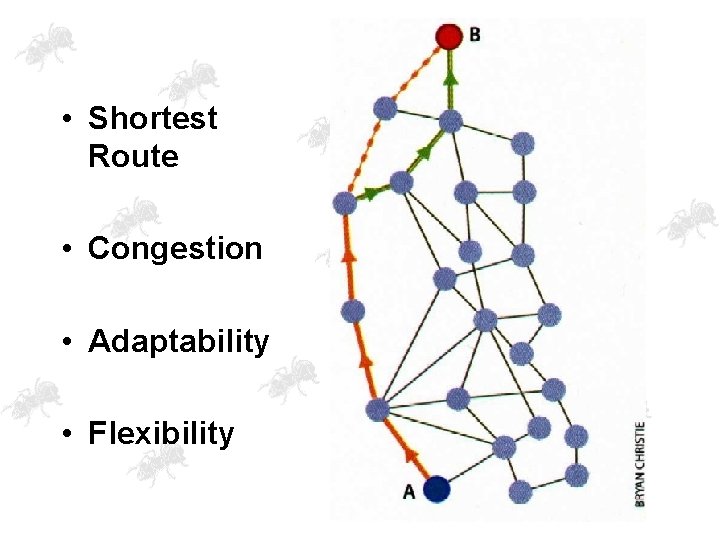
• Shortest Route • Congestion • Adaptability • Flexibility
Antifying Website Searching • Digital-Information Pheromones (DIPs) • Ant World Server • Transform the web into a gig. ANTic neural net
Closing Arguments • Still very theoretical • No clear boundaries • Details about inner workings of insect swarms • The future…? ? ?
Dumb parts, properly connected into a swarm, yield smart results. Kevin Kelly
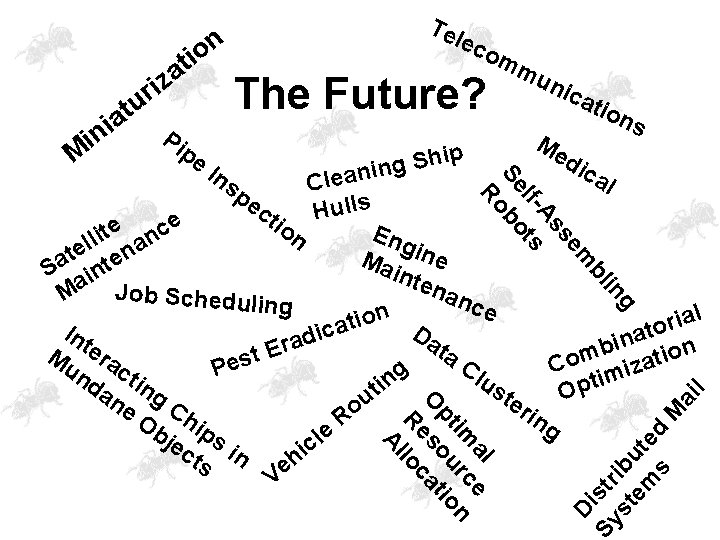
n o ti a z i ur in t a i Pi Te lec om The Future? mu nic ati on s Me p i h dic S g n In i al sp Clean ec ls l u H tio e e c t Eng n i an l l ine te ten M a ain S in ten a Job Schedul anc M ing e n al o i i t r a o In Da t ic a d n a t i b ta n Er o Mu era m t i t s o a Cl C z i Pe g nd ctin m u i in pt s t an g O t u er e O Ch o in R i g bj ps e l ec ic ts in h Ve pe ai l g in bl m se As lf- ts Se bo Ro al e im rc n pt u io O eso at R lloc A Di Sy str st ibu em te s d. M M
References Ant Algorithms for Discrete Optimization Artificial Life M. Dorigo, G. Di Caro & L. M. Gambardella (1999). addr: http: //iridia. ulb. ac. be/~mdorigo/ Swarm Intelligence, From Natural to Artificial Systems M. Dorigo, E. Bonabeau, G. Theraulaz The Yellowjackets of the Northwestern United States, Matthew Kweskin addr: http: //www. evergreen. edu/user/serv_res/research/arthropod/TESCBiota/Vespidae/Kwe skin 97/main. htm Entomology & Plant Pathology, Dr. Michael R. Williams addr: http: //www. msstate. edu/Entomology/GLOWORM/GLOW 1 PAGE. html Urban Entomology Program, Dr. Timothy G. Myles addr: http: //www. utoronto. ca/forest/termite. htm
References Page 2 Gakken’s Photo Encyclopedia: Ants, Gakushu Kenkyusha addr: http: //ant. edb. miyakyo-u. ac. jp/INTRODUCTION/Gakken 79 E/Intro. html The Ants: A Community of Microrobots at the MIT Artificial Intelligence Lab addr: http: //www. ai. mit. edu/projects/ants/ Scientific American March 2000 - Swarm Smarts Pages: 73 -79 Pink Panther Image Archive addr: http: //www. high-tech. com/panther/source/graphics. html C. Ronald Kube, Ph. D Collective Robotic Intelligence Project (CRIP). addr: www. cs. ualberta. ca/~kube