
Fusion Friction RF Welding Shawn Andres James Szymanowski


- Slides: 36
Fusion, Friction, & RF Welding Shawn Andres, James Szymanowski, & Dario Kis PLET 370
Purpose l To familiarize the class on the joining of composite plastic parts l Specifically fusion, friction, and RF welding
Presentation Outline l l Plastics Welding Generalities RF Welding l l Introduction Theory and Background l l Basic Operation l l l l ADV/DISADV Procedure Equipment Used Design Requirements Examples Conclusion Fusion Welding (same) Friction Welding (same) Extra Info
Plastics Welding Generalities l Definition: l l Welding terminology l l l Uniting parts by joining their heated surfaces and allowing them to flow together Thermowelding Heat sealing Dielectric heating Cannot be used on thermosets Best for semicrystalline materials with good heat stability Different than adhesion bonding
Welding Generalities Cont. l Importance when combining plastic components over l l l Molded in components Simple assembly Material Compatibility Issues l l Melt Temperature/Degradation Mechanical Properties Melt Strength Others
Generalities - Influence of Additives/Fillers l Can add or detract w/ respect to weldability l Glass fillers Colorants/Lubricants Talc filled l l
Generalities - Methods of Heat Application l l l Gas Electric Gun Heated Tool Induction Heating Friction (spinning)
RF Welding (sealing) Introduction l Also known as l l l Dielectric welding High Frequency Welding Definition l Process of fusing materials together by applying radio frequency energy
RF Welding Theory & Background l History l l l WWI and WWII detecting underwater subs with radio waves 1963 First application to rigid thermoplastics First application l l Joining film in the 1950’s 1963 Applied to rigid thermoplastics
RF Welding Advantages/Disadvantages l Advantages l l l Only heated during RF generation RF tooling is usually run “cold” Clean, fast welds Economical Resultant joint strength = parent material(s) Disadvantages l l l Joint design Application contingencies Material-to-material differences
RF Welding Basic Operation & Process l l l l High frequency emission Alternating current switches polarity Causes back and forth molecular movement In turn causes localized heating/bonding
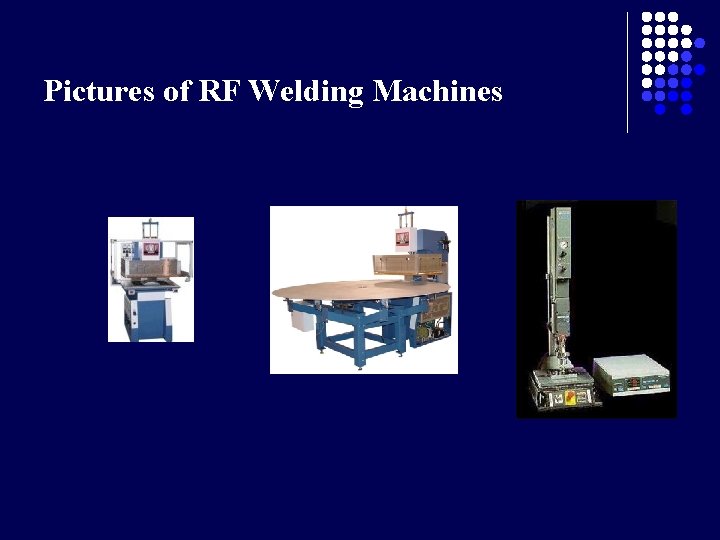
RF Welding Equipment l l Machined brass die RF machine (Platen) l l Mech NRG to vibration NRG converter Horn Stand Programmer
Pictures of RF Welding Machines
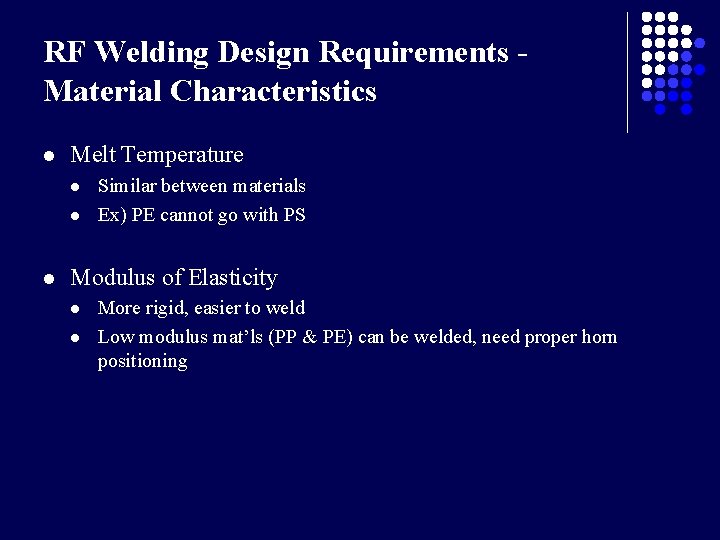
RF Welding Design Requirements Material Characteristics l Melt Temperature l l l Similar between materials Ex) PE cannot go with PS Modulus of Elasticity l l More rigid, easier to weld Low modulus mat’ls (PP & PE) can be welded, need proper horn positioning
RF Welding Design Requirements Material Characteristics Cont. l Impact resistance of composite part l l Coefficient of friction l l Strong weld necessary Similar and higher is better Thermal conductivity l Similar and high or low depending on wall thickness
Example Materials Used in RF Welding l l l PVC PU PE Acrylic Polychlorotriflouroethylene Others
RF Welding Examples of Common Applications l Where fluid-proof seal is necessary l Medical industry Health care industry Industrial applications Consumer products l l l
RF Welding Conclusion l Polar and non-polar plastics can be joined w/ special equipment l Materials as thin as. 00025 in w/ special equipment l Economical l Fast
Fusion Welding Introduction l Definition l l Portions of the parts to be joined are heated to softening and pressed together Types l l l Plate Bonding Butt Welding (Uniform bead) Electrofusion (Coupler)
Fusion Welding Advantages & Disadvantages l Advantages l l l Welds stronger than parent components Simple joints Disadvantages l l Butt joints Only used for pipes
Fusion Welding Basic Operation l Procedure l l l Initial heating Pressing Video l http: //www. mcelroymfg. com/fusion/flash/fusion 101. html
Fusion Welding Equipment Used l Equipment l l l Welder Warming Collar Clamping/Holding Equipment
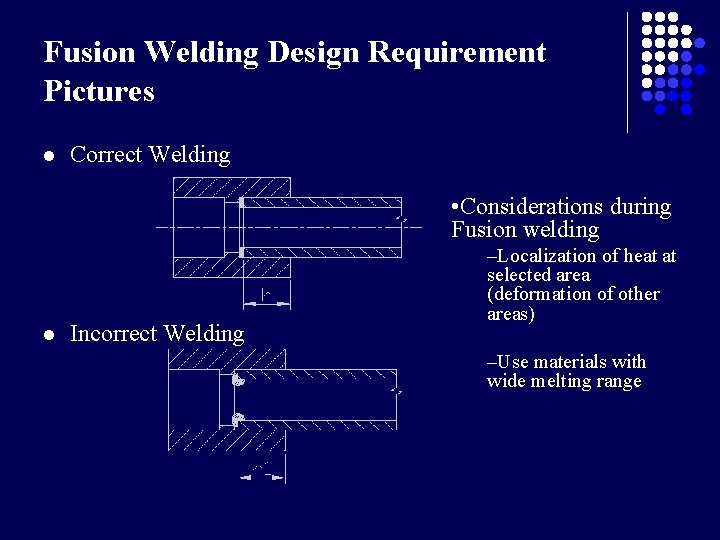
Fusion Welding Design Requirement Pictures l Correct Welding • Considerations during Fusion welding l Incorrect Welding –Localization of heat at selected area (deformation of other areas) –Use materials with wide melting range
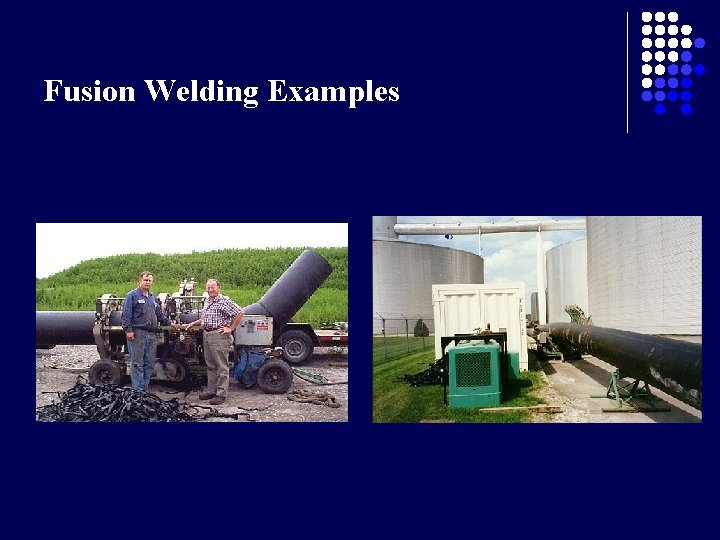
Fusion Welding Examples
Fusion Welding Conclusion l Used for joining pipe l Clear weld areas l Warming time l Warming surface depth l Joining time (pressure application)
Friction (Spin) Welding Introduction/ Theory and Background l Definition l l Component-to-component similarities l l Heat required to soften and fuse two materials achieved by friction generated from two materials moving while in contact Mechanical properties Physical properties Geometry First application – sealing water filled compasses
Friction Welding Advantages & Disadvatages l Advantages l l Oxygen is excluded from the joint (direct contact) Weld strength=parent material Good appearance Disadvatages l l Configuration limited to circular parts Flashing
Friction Welding Basic Operation l Procedure l l Component rotation Pressure Contact Heat Production Concluded by Forge Force
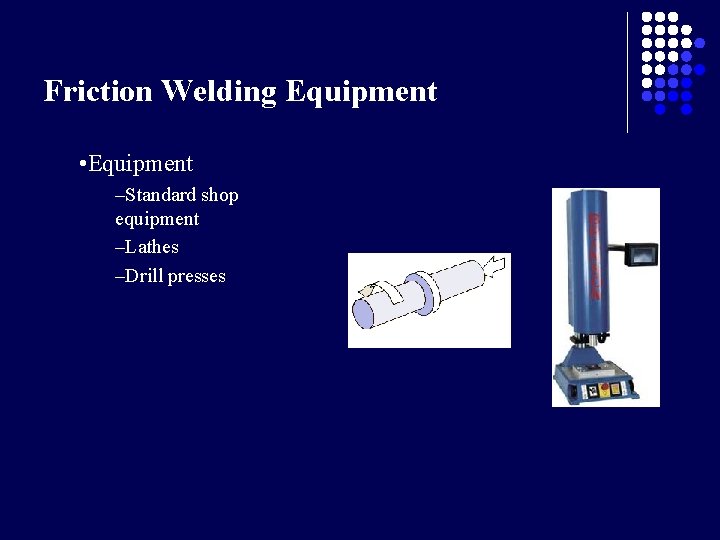
Friction Welding Equipment • Equipment –Standard shop equipment –Lathes –Drill presses
Friction Welding Design Requirements/Considerations l Smooth surfaces l Low melting temps. l Surfaces are free of contamination l Large surfaces are difficult to weld l Circular areas can be molded in
Friction Welding Considerations Cont. – Weld Quality Factors l Joint geometry most important l Surface velocity l Contact Pressure l Coefficient of Friction l Heat transfer capacity of material(s)
Friction Welding Examples l l l Floats Aerosol bottles Joining studs to plastic parts l l l Automotive Electronics Furniture Toy Appliance Industries
Friction Welding Conclusion l Flashing may occur l Must be circular weld joints l Good weld strength l No air entrance l Inexpensive tooling
Extra Info - Other Methods of Welding Plastics l l l l Sheet Hot air/gas Track Speed Tractor/Machine Linear Vibration Induction/Electromagnetic
Extra Info - Weld Testing l Importance of joint strength l Factors that affect joint strength l Test Methods/Tools/Ops
Questions? ? ?