Supporting Primary Education Katharine Passmore and Lizzie Kirk

- Slides: 47
Supporting Primary Education Katharine Passmore and Lizzie Kirk
• Have you got any specific questions about Primary Education? • Which year group is the child/children in?
Aims By the end of the workshop delegates will have an improved understanding of: • The Primary National Curriculum for English and Mathematics • The creative curriculum- making learning fun! • How to support your young person effectively at home • Useful websites to support learning for primary school children • How phonics is taught in school • Why children may fall behind with phonics • How you can support children when reading
Overview v. Introduction to the Primary Curriculum v. English and maths v. Break v. Phonics and reading
Introduction to the Primary curriculum v New National Curriculum implemented in September 2014 v Children from Year 1 onwards v Raised expectations v Assessment for primary aged children
Early Years v Children from 0 -5 years old follow the Early Years Foundation Stage Curriculum (EYFS) v Assessment at the end of the Reception Year to see if the children have achieved a Good Level of Development (GLD)
The Maths Curriculum v By the end of Year 1 children are expected to count to 100 (previously 20) v By the end of Year 4 all time tables must be learnt fluently (previously Year 6) v Fluency is about the recall and application of maths learning v Greater emphasis on reasoning where children have to explain their calculations
Maths in everyday life FOUNDATION STAGE q. Counting objects around the home q. Songs and rhymes q. Practical materials – sand, play dough q. Ordering objects q. Charts – weather / date / day
Maths in everyday life Key Stage 1 and Key Stage 2 v Money v Cooking v Time (days, week, months and years) v Estimating v Measuring v Shapes
Number Bonds Number bonds in Reception Children start to learn about number bonds in the Foundation stage, when they might be given a number, such as 5, and then asked to select two groups of objects that will add up to that number. Number bonds in Year 1 Children are expected to know number bonds to 10 and number bonds to 20. Number bonds in Year 2 Children by now need to be very confident with their number bonds to 20. They need to be able to work out number bonds to 100. They also need to be confident with the corresponding subtraction facts (for example: 20 - 13 = 7). Number bonds in Key Stage 2 In Key Stage 2, children move onto being able to work out number bonds to 1000 (e. g. 450 and 550) and number bonds to 1 (e. g. 0. 8 and 0. 2).
Multiplication tables check v Taking place in the summer term 2020 for all year 4 pupils v Times tables up to 12 x 12 https: //www. youtube. com/watch? v=Gh. AJMJU s. Aac
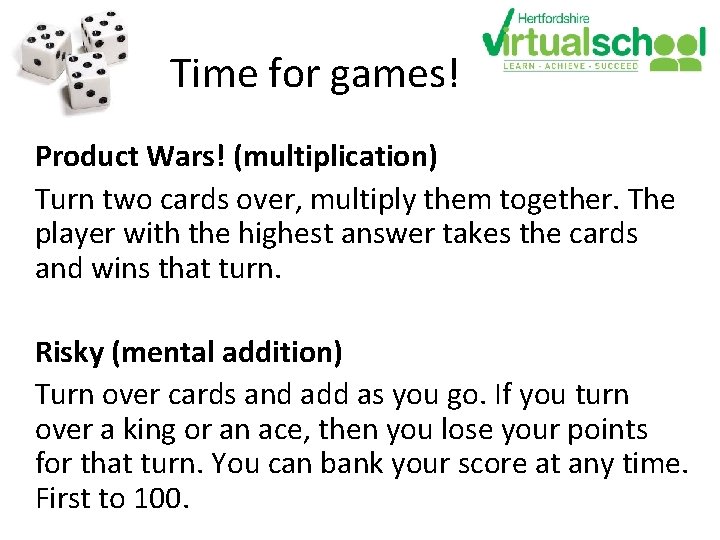
Time for games! Product Wars! (multiplication) Turn two cards over, multiply them together. The player with the highest answer takes the cards and wins that turn. Risky (mental addition) Turn over cards and add as you go. If you turn over a king or an ace, then you lose your points for that turn. You can bank your score at any time. First to 100.
Vocabulary v Vocabulary is a vitally important part of maths v Vocabulary poster in your pack v https: //webarchive. nationalarchives. gov. uk/20 110203115237/https: //nationalstrategies. stan dards. dcsf. gov. uk/node/84996
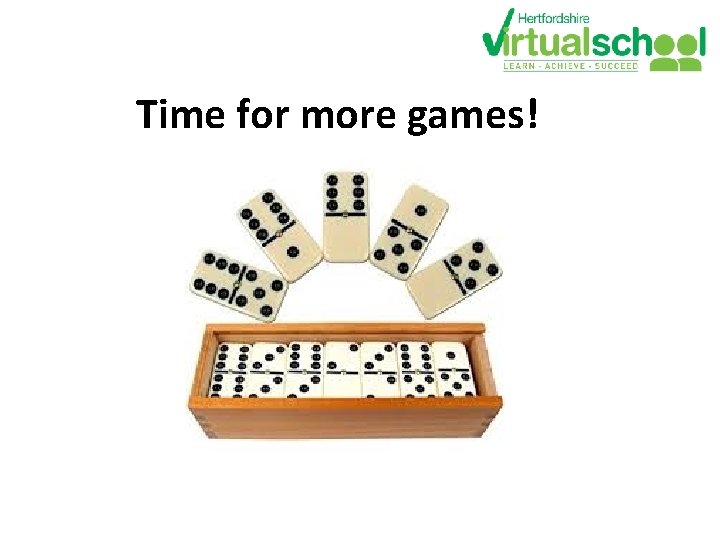
Time for more games!
Online games! http: //www. learnyourtables. co. uk/en/index 2. htm https: //www. topmarks. co. uk/maths-games/5 -7 -years/counting https: //www. mathplayground. com/ http: //fluencychallenge. com/play-claw. html
The English Curriculum v Phonics and reading for pleasure is a priority v Less focus on genre and more on quality writing v Greater emphasis on spoken English including debating, reciting poetry and presenting skills v Handwriting must be fluent, legible and speedy v Greater emphasis on spelling and grammar
Unlocking Talent, Fulfilling Potential (Dec 2017) • Development gap – On average, 40% of the overall gap between disadvantaged 16 -year-olds and their peers have already emerged by the age of five. There is significant variation across the country: while 71% of disadvantaged five-year-olds in Lewisham achieve a good level of development, in York it is only 46%. • ‘Word gap’ – These gaps are particularly pronounced in early language and literacy. By the age of three, more disadvantaged children are on average already almost a full year and a half behind their more affluent peers in their early language development. Around two fifths of disadvantaged five-year-olds are not meeting the expected literacy standard for their age.
The evidence is clear that the teaching of systematic synthetic phonics is the most effective way of teaching young children to read, particularly for those at risk of having problems with reading. Unless children have learned to read, the rest of the curriculum is a secret garden to which they will never enjoy access. Taken from “The Importance of Teaching”, Government White Paper, 2010.
Phonics is all about using … skills for reading and spelling + knowledge of the alphabet Learning phonics will help a child to become a good reader and writer.
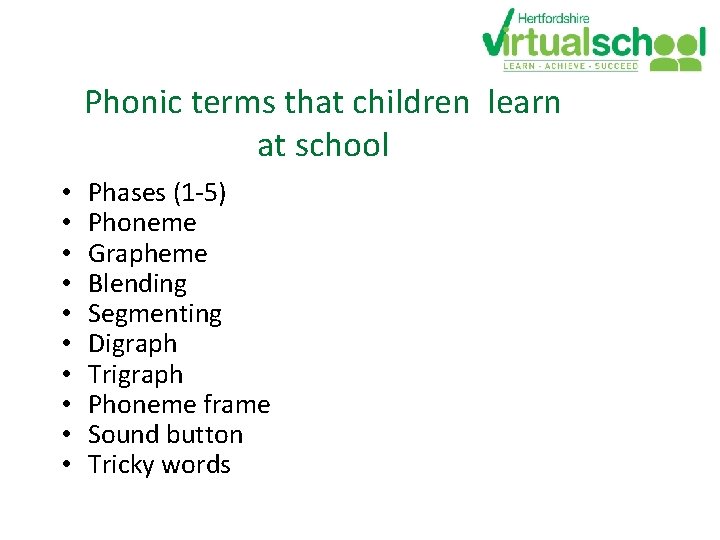
Phonic terms that children learn at school • • • Phases (1 -5) Phoneme Grapheme Blending Segmenting Digraph Trigraph Phoneme frame Sound button Tricky words
Saying the sounds • Sounds should be articulated clearly and precisely. https: //www. youtube. com/user/breakthruchris? app=desktop www. phonicsplay. co. uk https: //www. youtube. com/watch? v=Bqh. XUW_v-1 s http: //www. bbc. co. uk/bitesize/ks 1/literacy/
Phonics Words Your children will learn to use the term: Blending • Children need to be able to hear the separate sounds in a word and then blend them together to say the whole word.
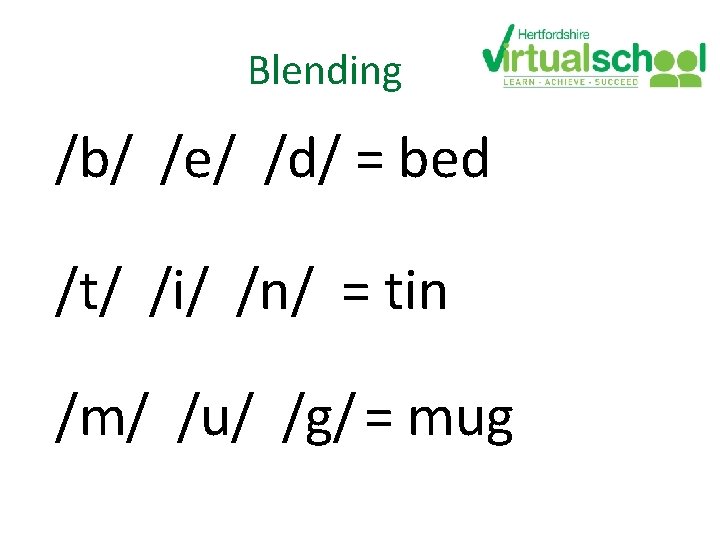
Blending /b/ /e/ /d/ = bed /t/ /i/ /n/ = tin /m/ /u/ /g/ = mug
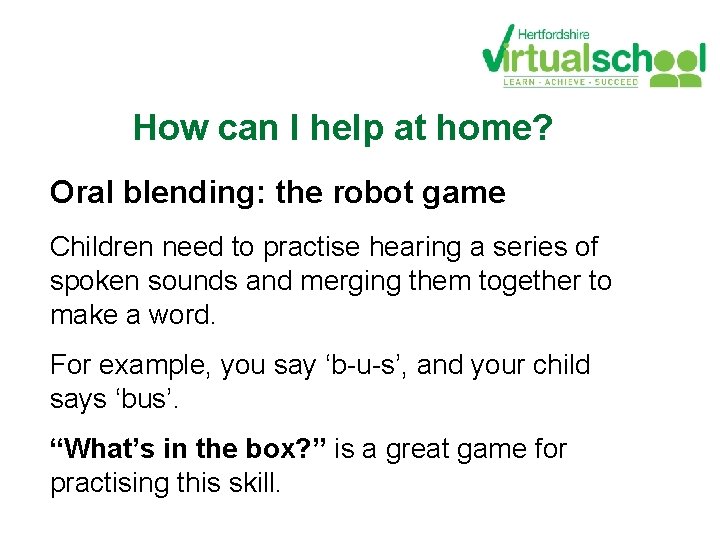
How can I help at home? Oral blending: the robot game Children need to practise hearing a series of spoken sounds and merging them together to make a word. For example, you say ‘b-u-s’, and your child says ‘bus’. “What’s in the box? ” is a great game for practising this skill.
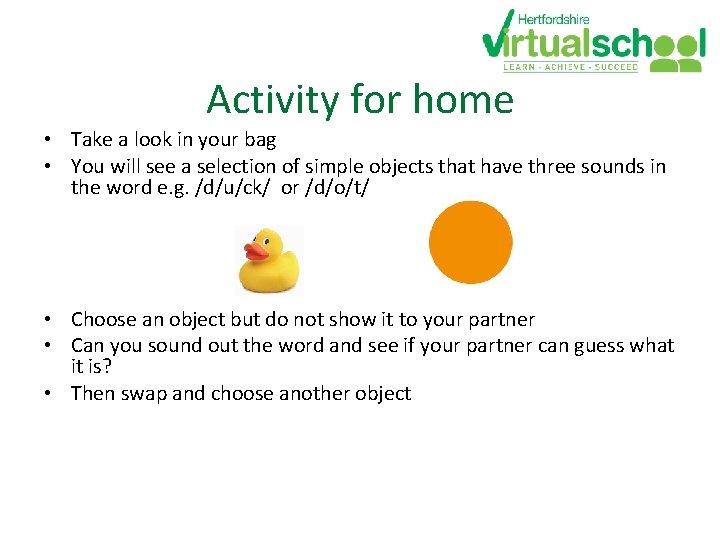
Activity for home • Take a look in your bag • You will see a selection of simple objects that have three sounds in the word e. g. /d/u/ck/ or /d/o/t/ • Choose an object but do not show it to your partner • Can you sound out the word and see if your partner can guess what it is? • Then swap and choose another object
Phonics Words Your children will learn to use the term: Segmenting • Children need to be able to hear a whole word and say every sound that they hear
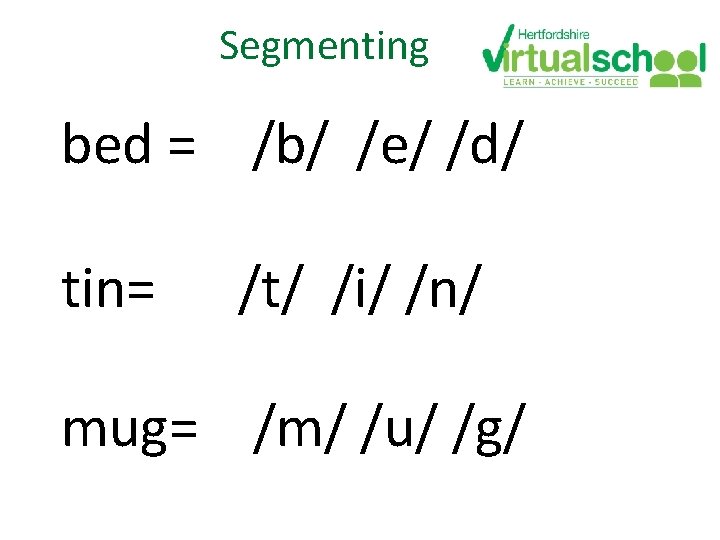
Segmenting bed = /b/ /e/ /d/ tin= /t/ /i/ /n/ mug= /m/ /u/ /g/
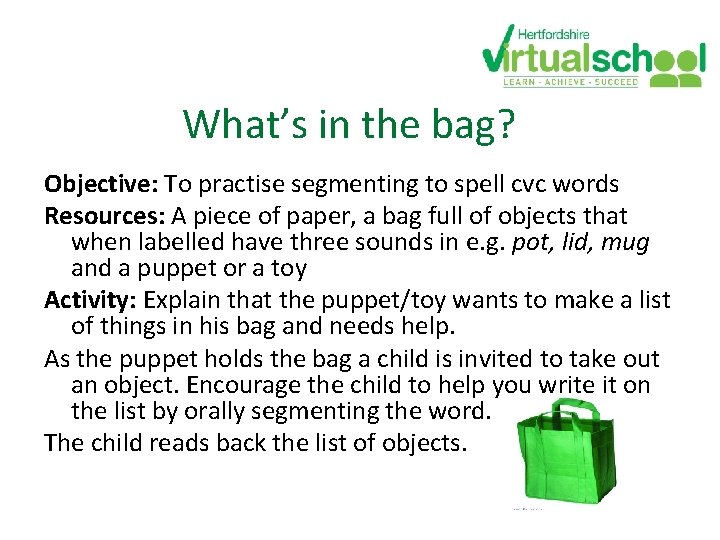
What’s in the bag? Objective: To practise segmenting to spell cvc words Resources: A piece of paper, a bag full of objects that when labelled have three sounds in e. g. pot, lid, mug and a puppet or a toy Activity: Explain that the puppet/toy wants to make a list of things in his bag and needs help. As the puppet holds the bag a child is invited to take out an object. Encourage the child to help you write it on the list by orally segmenting the word. The child reads back the list of objects.
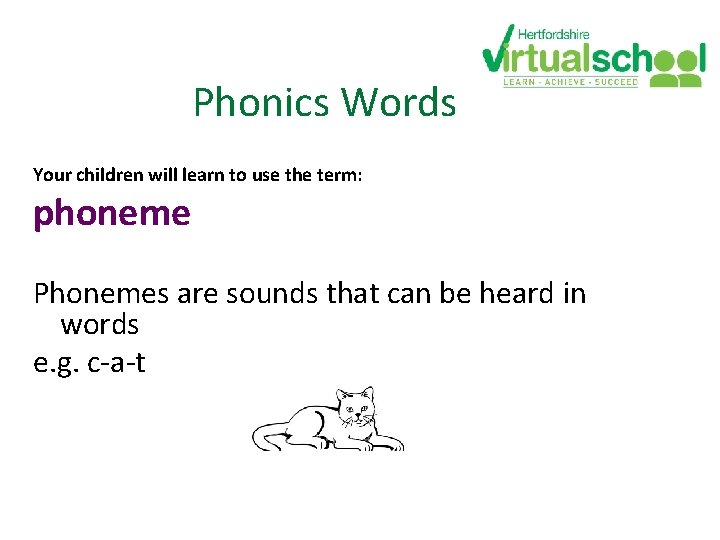
Phonics Words Your children will learn to use the term: phoneme Phonemes are sounds that can be heard in words e. g. c-a-t
Phonics Words Your children will learn to use the term: grapheme This is how a phoneme is written down
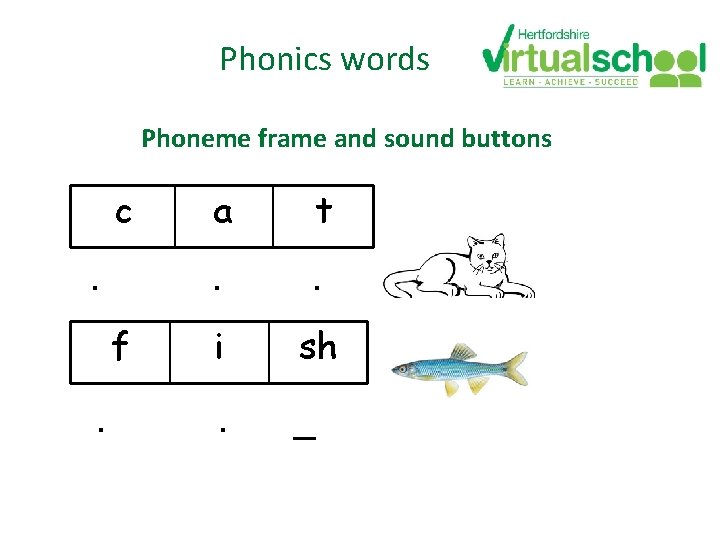
Phonics words Phoneme frame and sound buttons c . f . a t . . i sh . _
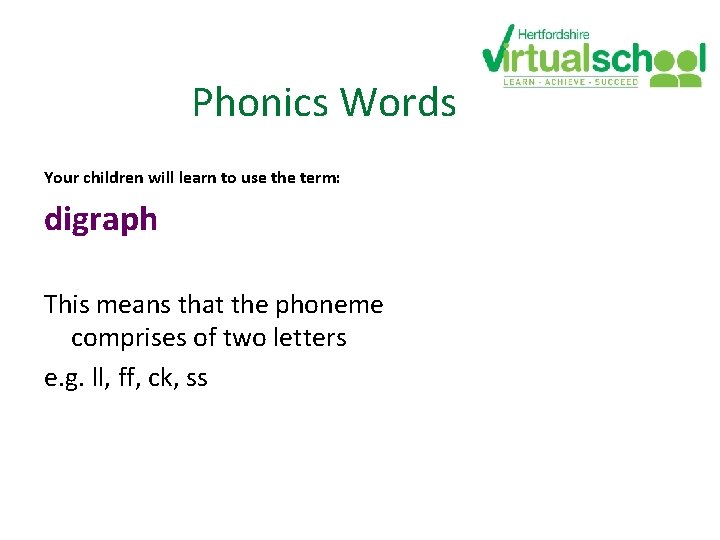
Phonics Words Your children will learn to use the term: digraph This means that the phoneme comprises of two letters e. g. ll, ff, ck, ss
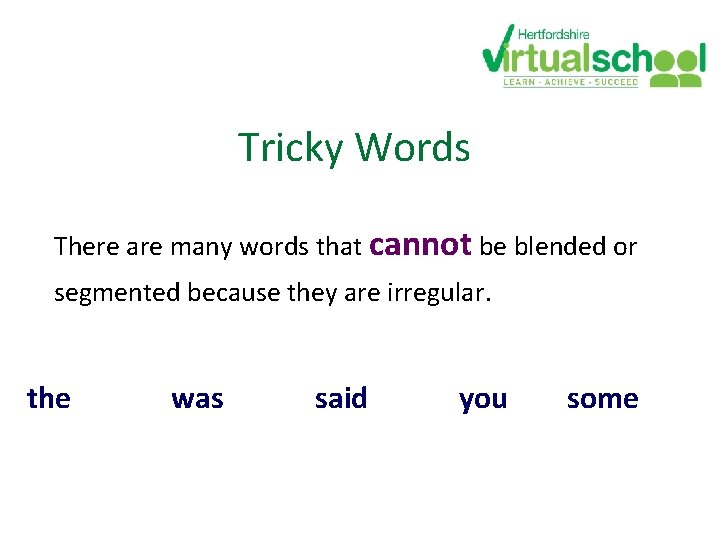
Tricky Words There are many words that cannot be blended or segmented because they are irregular. the was said you some
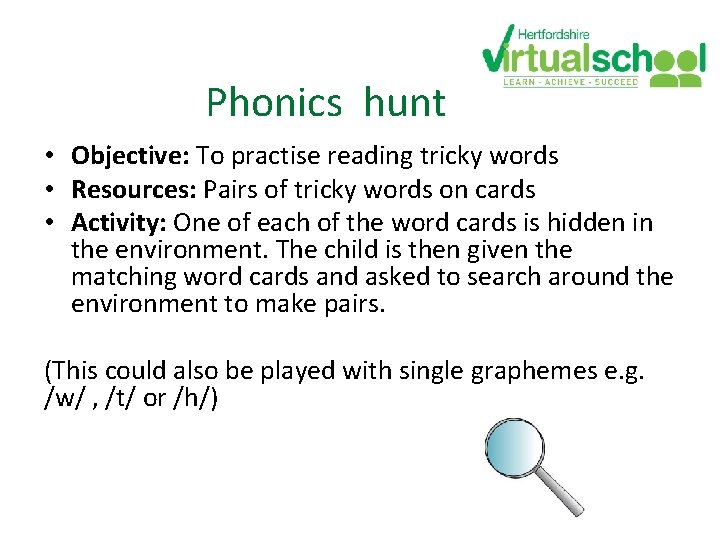
Phonics hunt • Objective: To practise reading tricky words • Resources: Pairs of tricky words on cards • Activity: One of each of the word cards is hidden in the environment. The child is then given the matching word cards and asked to search around the environment to make pairs. (This could also be played with single graphemes e. g. /w/ , /t/ or /h/)
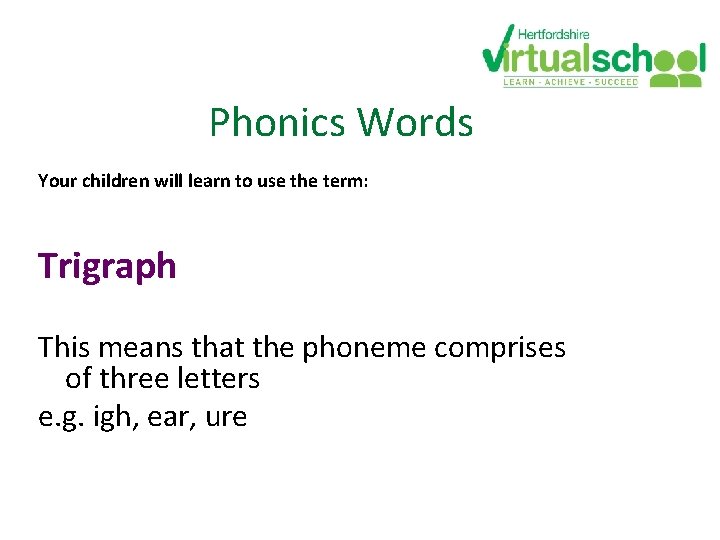
Phonics Words Your children will learn to use the term: Trigraph This means that the phoneme comprises of three letters e. g. igh, ear, ure
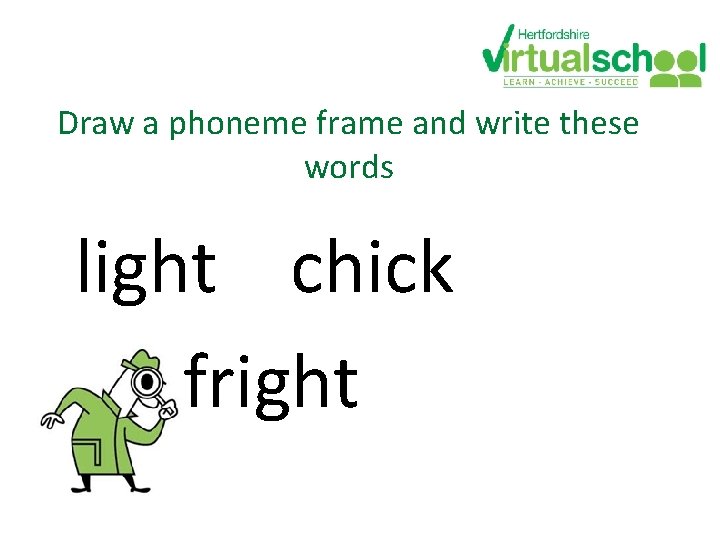
Draw a phoneme frame and write these words light chick fright
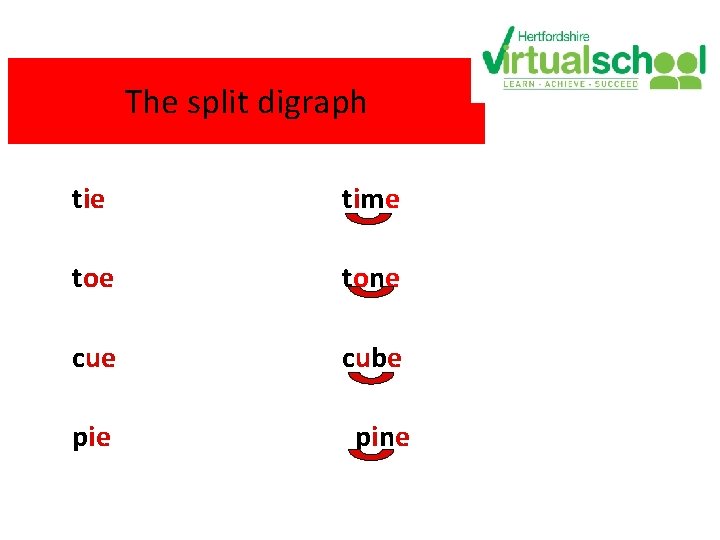
The split digraph tie time tone cube pine
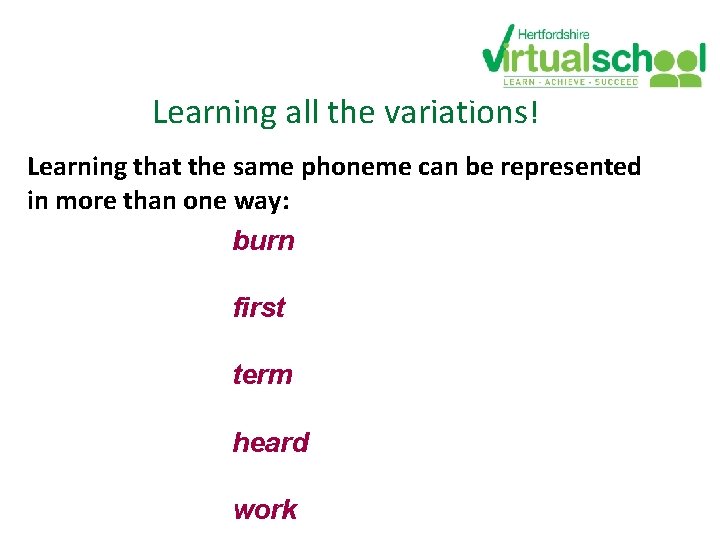
Learning all the variations! Learning that the same phoneme can be represented in more than one way: burn first term heard work
Y 1 Phonics Screening Check • The reading check will be taken by children in Y 1 in the second half of the summer term to establish whether they can read a variety of words using the phonemes from Phases 2 – 5 • Y 2 children who did not attain the threshold in Y 1 will retake in Y 2 • The words will be both real and pseudo (alien) • It will be delivered in mid June 2019
Learning words/spellings at home • • Your child may bring words/spellings home to learn Look, Say, Cover, Write and Check Discuss each word for meaning Put them into sentences Blend them to read Write them in a phoneme frame (if possible) Identify the trick in a word if it is a tricky word Phoneme flash cards
Research has found that early readers need to read about 600 to 1000 words a week to become competent readers. This is crucial, so that lots of reading at home will contribute to the child’s reading mileage; it can be familiar books as well as new ones, comics, magazine, newspapers, recipes…the list is endless!
Top reading tips 1) Spend ten minutes a day reading together. Make it fun – choose books that you both enjoy. Talk about the pictures and characters. You can also make up your own stories 2) Build reading time into your daily routine 3) Join a local library (Summer Reading Challenge) 4) Let the child see you reading and discuss your likes and dislikes 5) It is also important for children to be read to everyday as well as them reading to you 6) Confidence is key for reading. Encourage a child that is struggling and remind them of times where they had to practise things that they are now successful at e. g. cycling. https: //www. youtube. com/watch? v=Idbc 6 f. SBUhw
What should I do when a child gets stuck on a word? Keep out of the reading and try to say as little as possible as they might be able to read it themselves eventually. 1) Give them a choice of two options, one of which is correct. 2) Just tell them so that they can move on quickly and therefore not disturbing the flow.
Checking for understanding v Comprehension is a key barrier for CLA, especially inference, unknown vocabulary and lack of life experience v Decoding and comprehending are two different things v Both of these skills are required to reach age related expectations v Talk about books with children at any given opportunity
Useful resources • • Audiobooks White board, pen and rubber Phoneme frames Magnetic letters on the fridge Foam letters in the bath Word cards Dictionary Are there any questions?
Website https: //www. hertfordshire. gov. uk/microsites/virtual-school