
NURSING THEORY IN PRACTICE COMFORT VERSUS SELF CARE


- Slides: 18
NURSING THEORY IN PRACTICE: COMFORT VERSUS SELF CARE PERSPECTIVES Trudi Mc. Isaac, 3399005 Athabasca University
OBJECTIVES • Describe Kolcaba’s Comfort Theory. • Describe Orem’s Theory of Self Care. • Discuss comparisons between Kolcaba and Orem in regards to a patient scenario. • Contrast Kolcaba and Orem’s theories in reference to a patient scenario. • Discuss the implications these theories have on nursing practice.
KOLCABA’S COMFORT THEORY • Katherine Kolcaba (2003) first developed her Comfort Care Theory in the 1990’s. • It was based as a middle range theory meant to help guide health practice, education and research (Kolcaba, 2011). • Her goal was to place comfort as the forefront of health care and focus on comfort to help patient’s meet their health needs while improving patient outcomes (Bergstrom, Hakansson, Stromberg & Bjersa, 2018; HARVEY & Kovalesky 2018; Kolcaba, 2011; Krinsky, Murillo & Johnson 2014; Samonte & Vallente, 2018). • Comfort theory was to be used to prioritize patient comfort based on the assessment of nurses (Samonte & Vallente, 2018; Karabulut, Aktas, Gurcayir, Yilmaz & Gokmen, 2015). • It is based on three stages of comfort described as relief, ease and transcendence (Kolcaba, 2011). These stages of comfort are achieved through the use of four contexts, and main concepts of Kolcaba’s theory.
KOLCABA STAGES OF COMFORT • Relief addresses patient comfort (e. g. . Pain alleviated through the use of analgesia) and is achieved through alleviation of symptoms (Kolcaba, 2011; Samonte & Vallente, 2018). • Ease is achieved through contentment felt by the patient (e. g. . The alleviation of anxiety caused by uncertainty and illness) and is addressed by the nurses as they discuss issues being experienced by the patient (Kolcaba, 2011; Samonte & Vallente, 2018). • Transcendence is achieved by the patient being able to rise above the challenges they face and defined by how they cope with their illness (Bergstrom et al. 2018; Kolcaba, 2011; Samonte & Vallente, 2018).
KOLCABA CONTINUED… These stages of comfort are achieved through the use of four contexts, and main concepts of Kolcaba’s (2003) theory. These contexts are physical, psychospiritual, environmental and sociocultural (Bergstrom et al. 2018; Kolcaba, 2011; Samonte & Vallente, 2018). These concepts help achieve comfort as a holistic approach, in regard to patient’s recovery and nurses’ clinical decision making to increase positive outcomes (e. g. Wellness, selfconfidence, and patient satisfaction). (Kolcaba, 2011; Samonte & Vallente, 2018).
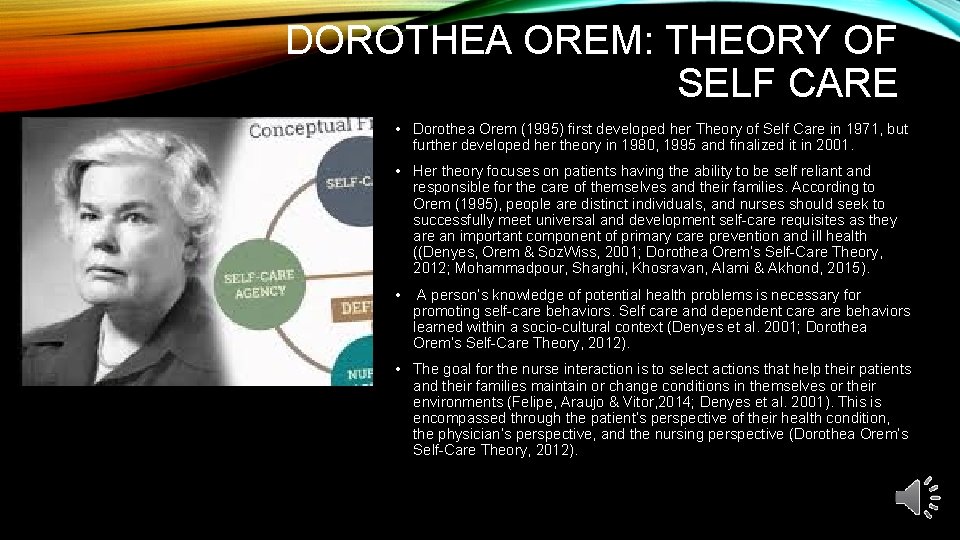
DOROTHEA OREM: THEORY OF SELF CARE • Dorothea Orem (1995) first developed her Theory of Self Care in 1971, but further developed her theory in 1980, 1995 and finalized it in 2001. • Her theory focuses on patients having the ability to be self reliant and responsible for the care of themselves and their families. According to Orem (1995), people are distinct individuals, and nurses should seek to successfully meet universal and development self-care requisites as they are an important component of primary care prevention and ill health ((Denyes, Orem & Soz. Wiss, 2001; Dorothea Orem’s Self-Care Theory, 2012; Mohammadpour, Sharghi, Khosravan, Alami & Akhond, 2015). • A person’s knowledge of potential health problems is necessary for promoting self-care behaviors. Self care and dependent care behaviors learned within a socio-cultural context (Denyes et al. 2001; Dorothea Orem’s Self-Care Theory, 2012). • The goal for the nurse interaction is to select actions that help their patients and their families maintain or change conditions in themselves or their environments (Felipe, Araujo & Vitor, 2014; Denyes et al. 2001). This is encompassed through the patient’s perspective of their health condition, the physician’s perspective, and the nursing perspective (Dorothea Orem’s Self-Care Theory, 2012).
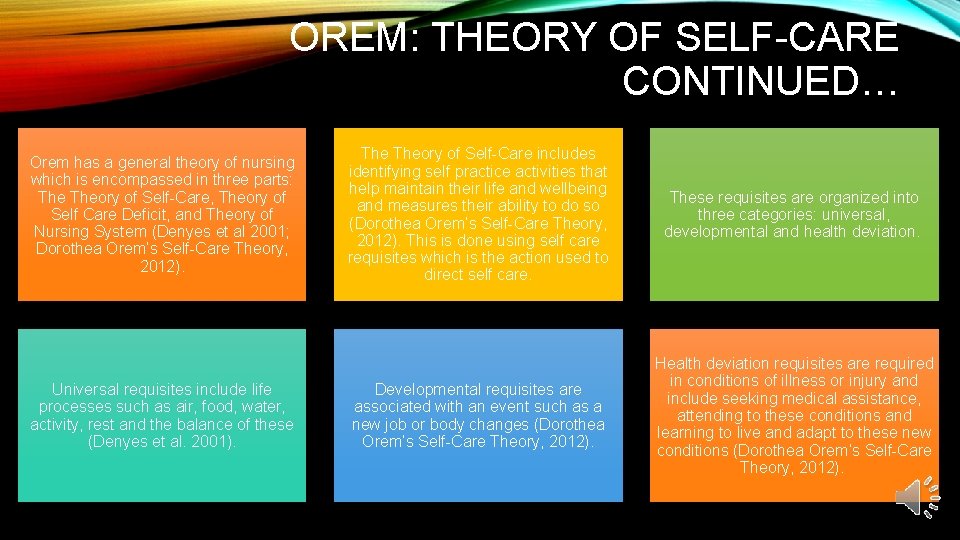
OREM: THEORY OF SELF-CARE CONTINUED… Orem has a general theory of nursing which is encompassed in three parts: Theory of Self-Care, Theory of Self Care Deficit, and Theory of Nursing System (Denyes et al 2001; Dorothea Orem’s Self-Care Theory, 2012). Universal requisites include life processes such as air, food, water, activity, rest and the balance of these (Denyes et al. 2001). Theory of Self-Care includes identifying self practice activities that help maintain their life and wellbeing and measures their ability to do so (Dorothea Orem’s Self-Care Theory, 2012). This is done using self care requisites which is the action used to direct self care. These requisites are organized into three categories: universal, developmental and health deviation. Developmental requisites are associated with an event such as a new job or body changes (Dorothea Orem’s Self-Care Theory, 2012). Health deviation requisites are required in conditions of illness or injury and include seeking medical assistance, attending to these conditions and learning to live and adapt to these new conditions (Dorothea Orem’s Self-Care Theory, 2012).
OREM: THEORY OF SELF-CARE – DEFICIT AND PROCESS Theory of Self-Care Deficit gives nurses the specific circumstances or situations in which nursing assessment is needed. These situations are instances where the nurse is needed to care for a patient who has become dependent, or incapable/limited in completing activities (Denyes et al. 2001; Dorothea Orem’s Self-Care Theory, 2012). Orem (1995) describes the nursing process as a method to determine the self-care deficits and then to define the roles of person or nurse to meet the self-care demands. The steps within the approach are considered to be the technical component of the nursing process. Orem (1995) emphasizes that the technological component "must be coordinated with interpersonal and social processes within nursing situations” (Denyes et al. 2001; Dorothea Orem’s Self-Care Theory, 2012)
SCENARIO S. M is a 67 year old female newly diagnosed with a non ST segment elevated myocardial infarction or NSTEMI. She had a 2 day history of intermittent central chest pain radiating to her right shoulder and lower back with intermittent nausea associated with the pain on arrival to the emergency department. She has a history of Type 2 Diabetes, is non insulin dependent, and has a further past medical history of hypertension, gastrointestinalesophageal reflux disease (GERD) and is an occasional smoker. She has a familial history of ischemic heart disease and NSTEMI on her paternal grandfather’s side. After being admitted to hospital S. M has developed a hospital acquired infection (HAI), and has been diagnosed with pneumonia. She has not been out of bed since being admitted to hospital 5 days ago. She has stated “I’m afraid to get out of bed. What if I have pain again? ”. She is noted to be is closed off, withdrawn and fearful.
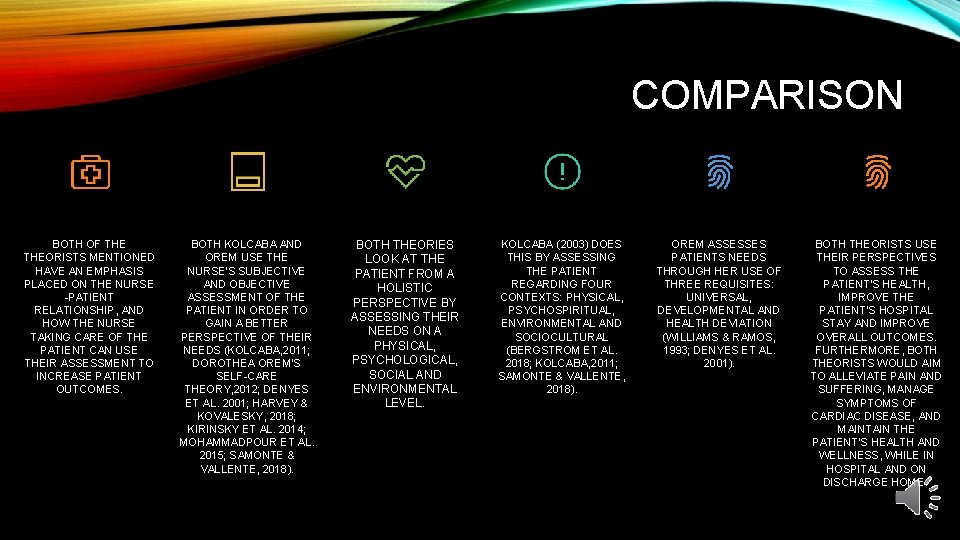
COMPARISON BOTH OF THEORISTS MENTIONED HAVE AN EMPHASIS PLACED ON THE NURSE -PATIENT RELATIONSHIP, AND HOW THE NURSE TAKING CARE OF THE PATIENT CAN USE THEIR ASSESSMENT TO INCREASE PATIENT OUTCOMES. BOTH KOLCABA AND OREM USE THE NURSE’S SUBJECTIVE AND OBJECTIVE ASSESSMENT OF THE PATIENT IN ORDER TO GAIN A BETTER PERSPECTIVE OF THEIR NEEDS (KOLCABA, 2011; DOROTHEA OREM’S SELF-CARE THEORY, 2012; DENYES ET AL. 2001; HARVEY & KOVALESKY, 2018; KIRINSKY ET AL. 2014; MOHAMMADPOUR ET AL. 2015; SAMONTE & VALLENTE, 2018). BOTH THEORIES LOOK AT THE PATIENT FROM A HOLISTIC PERSPECTIVE BY ASSESSING THEIR NEEDS ON A PHYSICAL, PSYCHOLOGICAL, SOCIAL AND ENVIRONMENTAL LEVEL. KOLCABA (2003) DOES THIS BY ASSESSING THE PATIENT REGARDING FOUR CONTEXTS: PHYSICAL, PSYCHOSPIRITUAL, ENVIRONMENTAL AND SOCIOCULTURAL (BERGSTROM ET AL. 2018; KOLCABA, 2011; SAMONTE & VALLENTE, 2018). OREM ASSESSES PATIENTS NEEDS THROUGH HER USE OF THREE REQUISITES: UNIVERSAL, DEVELOPMENTAL AND HEALTH DEVIATION (WILLIAMS & RAMOS, 1993; DENYES ET AL. 2001). BOTH THEORISTS USE THEIR PERSPECTIVES TO ASSESS THE PATIENT’S HEALTH, IMPROVE THE PATIENT’S HOSPITAL STAY AND IMPROVE OVERALL OUTCOMES. FURTHERMORE, BOTH THEORISTS WOULD AIM TO ALLEVIATE PAIN AND SUFFERING, MANAGE SYMPTOMS OF CARDIAC DISEASE, AND MAINTAIN THE PATIENT’S HEALTH AND WELLNESS, WHILE IN HOSPITAL AND ON DISCHARGE HOME.
CONTRAST Kolcaba’s (2003) Comfort Theory places emphasis on comforting the patient. The goal of care is to meet her three stages of comfort: relief, ease and transcendence (Bergstrom et al. 2018; Harvey & Kovalesky, 2018; Karabulut et al. 2015; Kolcaba, 2011, KRINSKY et al. 2014). This would encompass things that provide comfort for patient through the nurse’s assessment. Orem’s (1995) Self Care Theory places emphasis on what the nurse can learn from their assessment that would promote self efficacy in their patient (Delatorra & Chaves, 2013; Dorothea Orem’s Self-Care Theory; 2012; Felipe et al. 2014; Mohammadpour et al. 2015; Noguchi-Watanabe, Yamamoto-Mitani, Arimoto, Murashima, 2017).
CONTRAST CONTINUED While Kolcaba’s (2003) theory focuses on the nurse-patient relationship and what the nurse can do to provide comfort to the patient, Orem (1995) suggests education and interventions that help promote independence for the patient and their families. This could include interventions such as increasing ambulation in small increments and teaching the patient about the benefits of early ambulation (Dorothea Orem’s Self-Care Theory, 2012; Delatorra & Chaves, 2013; Felipe et al. 2014; Mohammadpour et al. 2015; Noguchi-Watanabe et al. 2017). Studies have shown that providing patients with this education not only helps them better understand their illness and improves the efficacy of their hospital stay. Also, education improves their outcomes on discharge; while decreasing their risk of recurring cardiac events, exacerbation of cardiac syndromes, and readmission (Dorothea Orem’s Self. Care Theory, 2012; Delatorra & Chaves, 2013; Felipe et al. 2014; Mohammadpour et al. 2015; Noguchi-Watanabe et al. 2017).
SUMMARY • Both of these theories focus on the nurse-patient relationship and how they can improve this relationship in order to improve patient outcomes. • Both theorists use their perspectives to provide a better overall picture of the patient’s health and how the nurse can use this in practice to improve their patient’s hospital stays and overall outcomes. Both theorists would look to alleviate pain and suffering of cardiac patients, such as the patient in the scenario. • By using their theories in order to reduce pain, manage symptoms of their disease, and maintain their feelings of health and wellness both in hospital and at home.
IMPLICATIONS FOR NURSING PRACTICE • Proficient nursing assessment should be used to gain a better perspective regarding patient’s needs. • By using Kolcaba’s (2003) theory, nurses will be better able to recognize patient’s pain and discomfort and the actions they can take to alleviate it. This also teaches patient’s signs and symptoms to look for in order to have a better experience while in hospital. These interventions also are able to transcribe well after discharge. • Orem’s (1995) theory allows nurses to empower their patients by giving them better access to information and resources while enabling them to become more independent. This improves patient’s outcomes by giving them autonomy and the skills to manage their health conditions at home.
• Both of these theorists focus on the nurse-patient relationship and how they can improve this relationship in order to improve patient outcomes. • Kolcaba (2003) and Orem’s (1995) theories work to improve patient’s wellbeing on a long term scale, and for the focus of cardiac patient’s, this would lead to better quality of life, and improved hospital experiences and reduced readmissions.
QUESTIONS? • If you have any questions or any information you would like to add to this presentation please feel free to contact me at: • tmcisaac 1@athabasca. edu
REFERENCES • Bergstrom, A. , Hakansson, A. , Stromberg, M. W. , Bjersa, K. (2018). Comfort theory in practice – Nurse anesthetists’ comfort measures and interventions in a preoperative context. Journal of Peri. Anesthesia Nurses, 33, 162 -171. doi: 10. 1016/j. jopan. 2016. 07. 004 • Delatorra, P. G. & Chaves, S. P. (2013). Educational technology for the hospital discharge of the elderly subjects undergoing percutaneous transluminal coronary angioplasty. Journal of Nursing UFPE, 7, 5040 -5043. doi: 10. 5205/reuol. 4700 -39563 -1 -ED. 0707 esp 201330 • Denyes, M. J. , Orem, D. E. & Soz. Wiss, G. B. (2001). Self-care: A foundational science. Nursing Science Quarterly, 14, 48 -54. Retrieved from: https: //journals. sagepub. com/home/nsq • Dorothea Orem’s Self-Care Theory. (2012). In Nursing theories: A companion to nursing theories and models. Retrieved from: http: //currentnursing. com/nursing_theory/self_care _deficit _theory. html • Felipe, L. C. , Araujo, A. R. A. & Vitor, A. F. (2014). Nursing process according the model of self-care in a cardiac bedridden patient. Journal of Research Fundamental Care Online, 6, 897 -908. doi: 10. 9789/2175 -5361. 2014 v 6 n 3 p 897 • Harvey, K. A. & Kovalesky, A. (2018). Post-operative pain and comfort in children after heart surgery: A comparison of nurses and families pre-operative expectations. Journal of Pediatric Nursing, 43, 9 -15. doi: 10. 1016/j. pedn. 2018. 07. 014 • Karabulut, N. , Aktas, Y. Y. , Gurcayir, D. , Yilmaz, D. & Gokmen, V. (2015). Patient satisfaction with their pain management and comfort level after open heart surgery. Australian Journal of Advanced Nursing, 23, 16 -24. Retrieved from: http: //www. ajan. com. a
REFERENCES • Krinsky, R. , Murillo, I. & Johnson, J. (2014). A practical application of Katharine Kolcaba’s comfort theory to cardiac patients. Applied Nursing Research, 27, 147 -159. doi: 10. 1016/j. apnr. 2014. 02. 004 • Kolcaba, K. (2003). Comfort theory and practice: a vision for holistic health care and research. Springer Publishing Company, New York • Kolcaba, K. (2011). Comfort theory. Nursing theories: A companion to nursing theories and models. Retrieved from: http: //currentnursing. com/nursing_theory/comfort_theory_ Kathy_Kolcaba. html • Noguchi-Watanabe, M. , Yamamoto-Mitani, N. , Arimoto, A. & Murashima, S. (2017). Relationship between patient group participation and self-care agency among patients with a history of cardiac surgery: A cross-sectional study. Heart & Lung, 46, 280 -286. doi: 10. 1016/j. hrtlng. 2017. 04. 006 • Mohammadpour, A. , Sharghi, N. R. , Khosravan, S. , Alami, A. & Akhond, M. (2015). The effect of a supportive educational intervention developed based on the Orem’s self-care theory on the selfcare ability of patients with myocardial infarction: A randomised controlled trial. Journal of Clinical Nursing, 24, 1686 -1692. doi: 10. 1111/jocn. 12775 • Orem, D. E. (1995). Nursing: Concepts of practice (5 th ed. ). St. Louis, MO: C. V. Mosby. • Samonte, P. R. V. & Vallente, R. U. (2018). Comfort theory (nursing). Salem Press Encyclopedia of Health. Retrieved from: https: //www. salempress. com • Williams, S. & Ramos, M. C. (1993). Mitral valve prolapse and its effects: A programme of inquiry within Orem’s self-care deficit theory of nursing. Journal of Advance Nursing, 18, 742 -751. Retrieved from: https: //www. wiley. com/enus/Journal+of+Advanced +Nursing- p- 9780 JRNL 61470