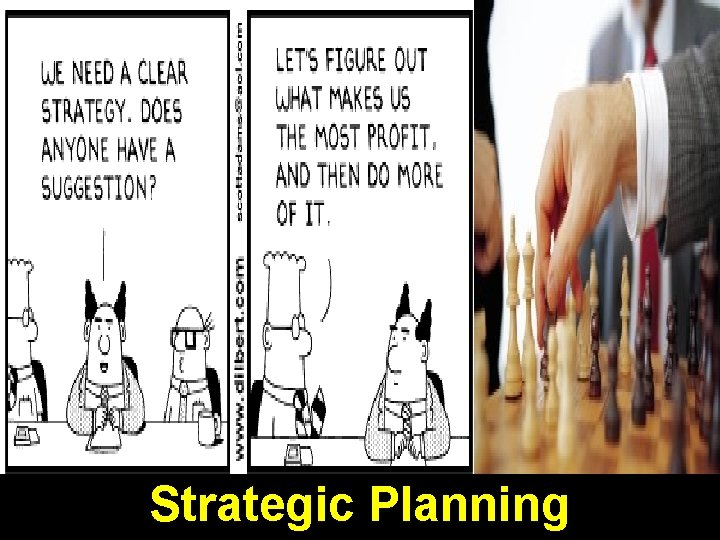
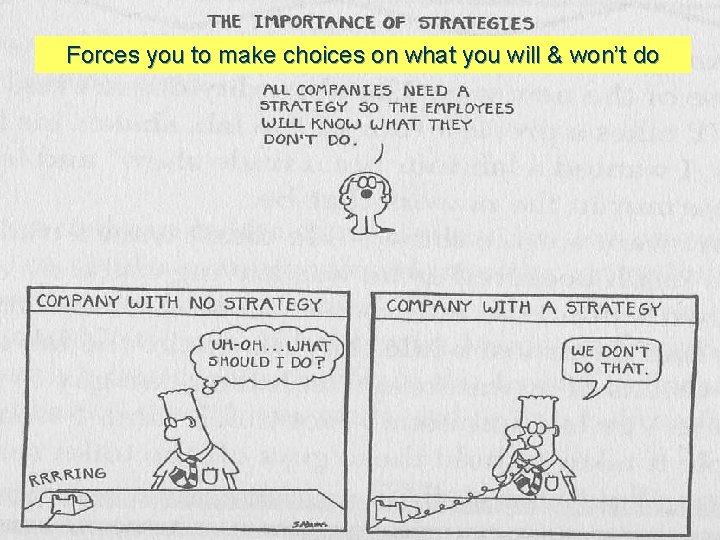
Strategic Planning Forces you to make choices on


- Slides: 41
Strategic Planning
Forces you to make choices on what you will & won’t do
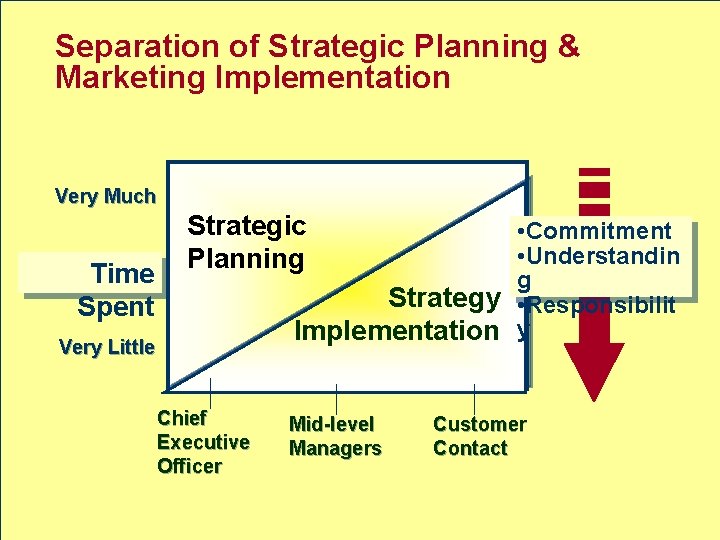
Separation of Strategic Planning & Marketing Implementation Very Much Time Spent Strategic Planning • Commitment • Understandin g Strategy • Responsibilit Implementation y Very Little Chief Executive Officer Mid-level Managers Customer Contact
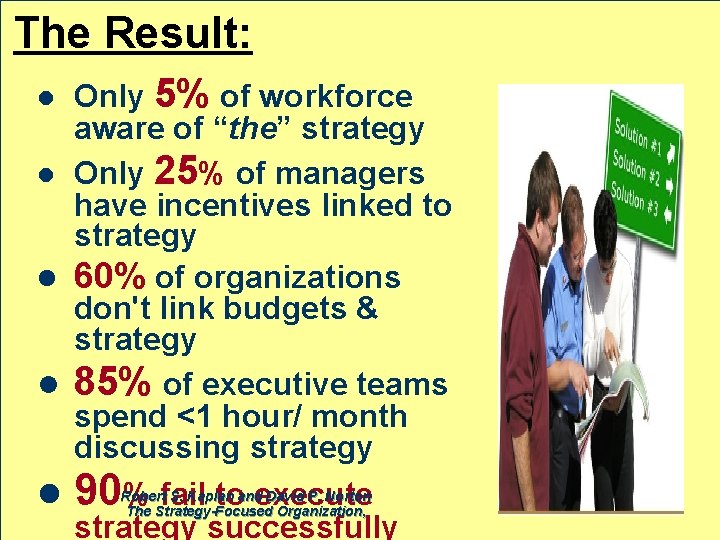
The Result: Only 5% of workforce aware of “the” strategy l Only 25% of managers have incentives linked to strategy l 60% of organizations don't link budgets & strategy l 85% of executive teams spend <1 hour/ month discussing strategy S. Kaplan and David P. Norton l 90 Robert % fail to execute The Strategy-Focused Organization, strategy successfully l
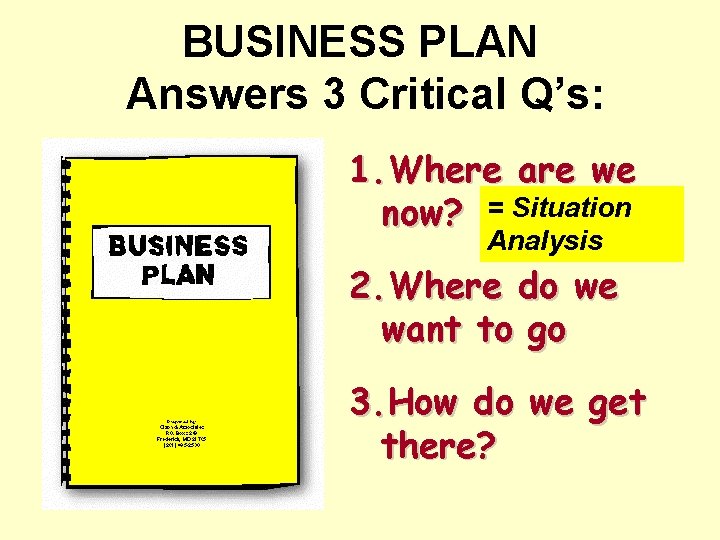
BUSINESS PLAN Answers 3 Critical Q’s: 1. Where are we now? = Situation Analysis 2. Where do we want to go 3. How do we get there?
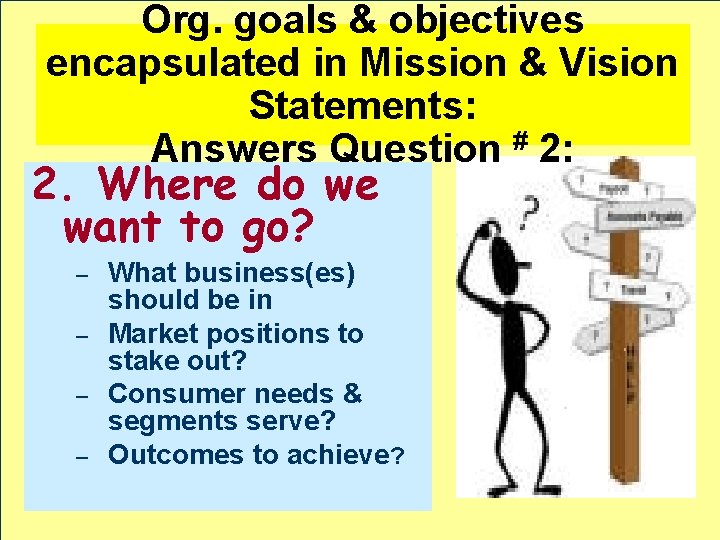
Org. goals & objectives encapsulated in Mission & Vision Statements: Answers Question # 2: 2. Where do we want to go? – – What business(es) should be in Market positions to stake out? Consumer needs & segments serve? Outcomes to achieve?
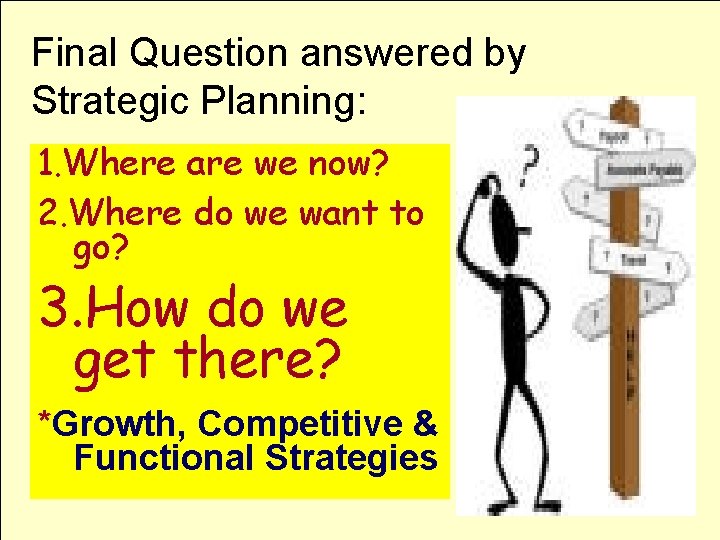
Final Question answered by Strategic Planning: 1. Where are we now? 2. Where do we want to go? 3. How do we get there? *Growth, Competitive & Functional Strategies
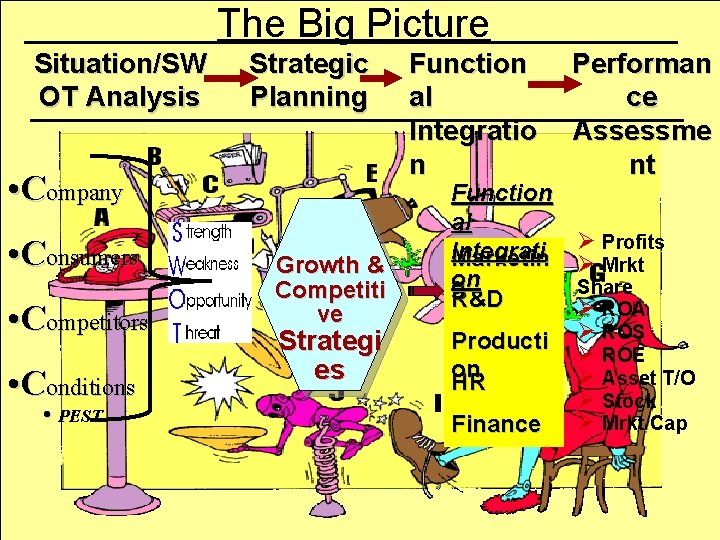
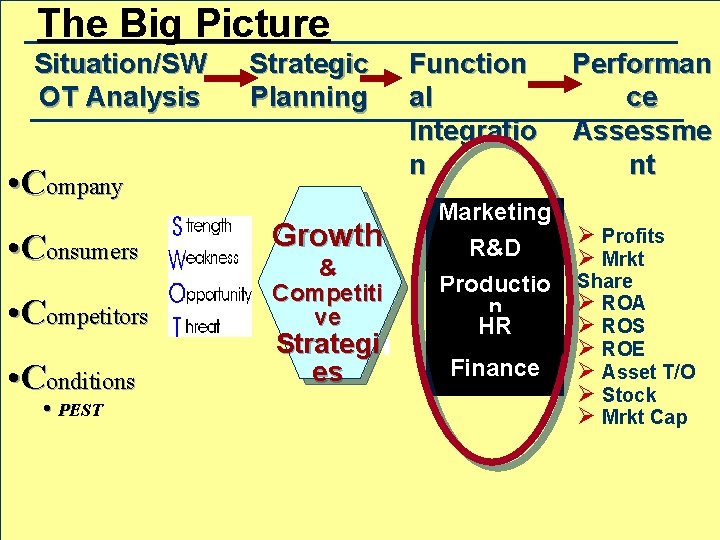
The Big Picture Situation/SW OT Analysis Strategic Planning • Company • Consumers • Competitors • Conditions • PEST Growth & Competiti ve Strategi es Function al Integratio n Function al Integrati Marketin on g R&D Producti on HR Finance Performan ce Assessme nt Ø Profits Ø Mrkt Share Ø ROA Ø ROS Ø ROE Ø Asset T/O Ø Stock Ø Mrkt Cap
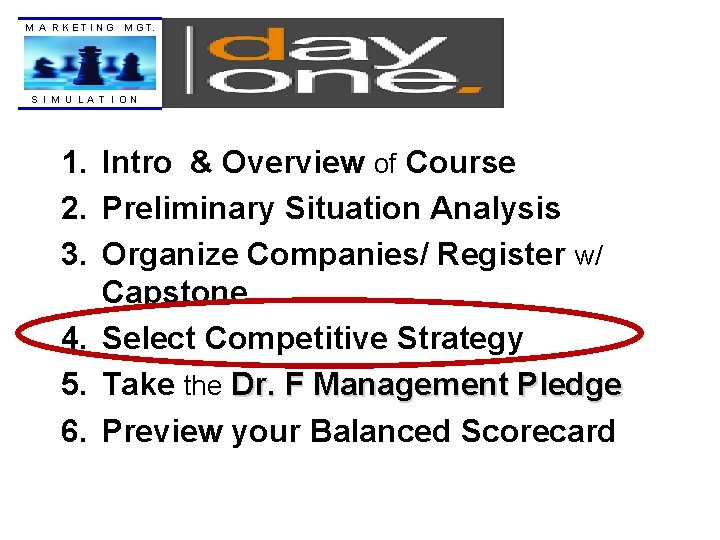
M A RKETING M G T. S I M U LA T I ON 1. Intro & Overview of Course 2. Preliminary Situation Analysis 3. Organize Companies/ Register w/ Capstone 4. Select Competitive Strategy 5. Take the Dr. F Management Pledge 6. Preview your Balanced Scorecard
st 1 Organize Companies Register @ http: //ww 2. capsim. com/login/
M A RKETING M G T. Strategic Thinking- the ten big ideas S I M U LA T I ON Prof Thomas/ Penn St. able to predict final standings w/in 1 place 90% of time –after observing initial group interaction. . . 7. Corporate culture & 8. Leadership craft. . . Leaders responsible for assuring strategy links values & vision. . .
M A RKETING M G T. S I M U LA T I ON 1. Intro & Overview of Course 2. Preliminary Situation Analysis 3. Organize Companies/ Register w/ Capstone 4. Select Competitive Strategy 5. Take the Dr. F Management Pledge 6. Preview your Balanced Scorecard
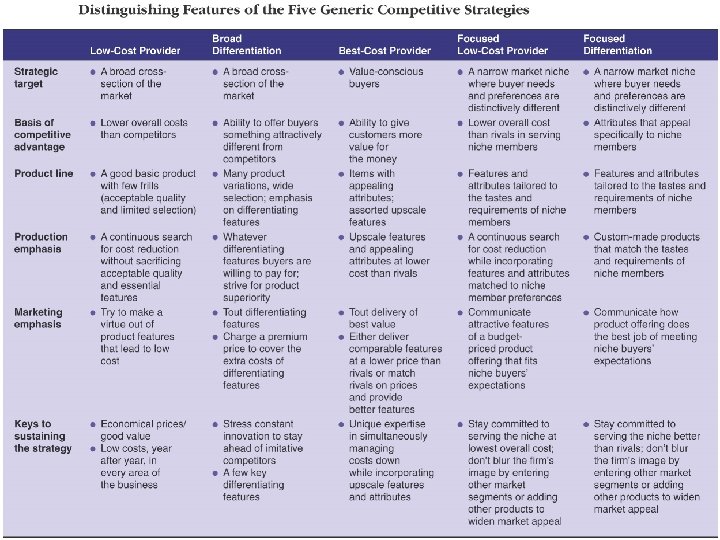
You can Formulate Strategy based on what Competitive advantage you focus on: Cost: Design, produce, market more efficiently than competitors Differentiation: Differentiation Deliver unique & superior value in terms of product quality, features, service
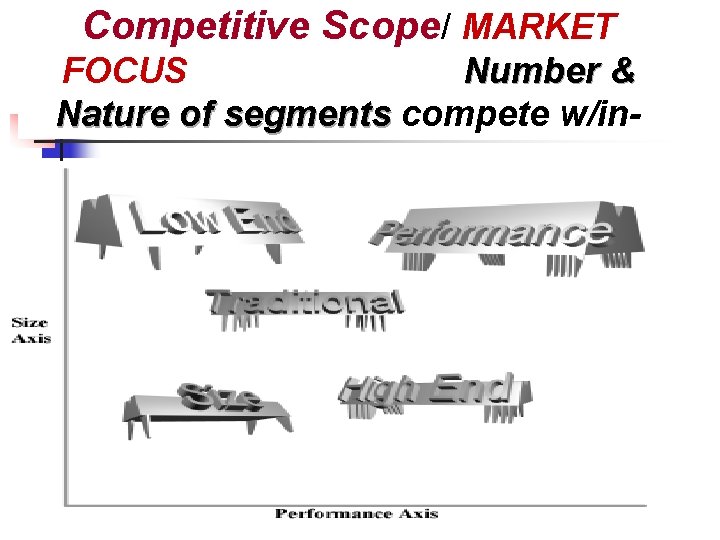
Competitive Scope/ MARKET FOCUS Number & Nature of segments compete w/in-
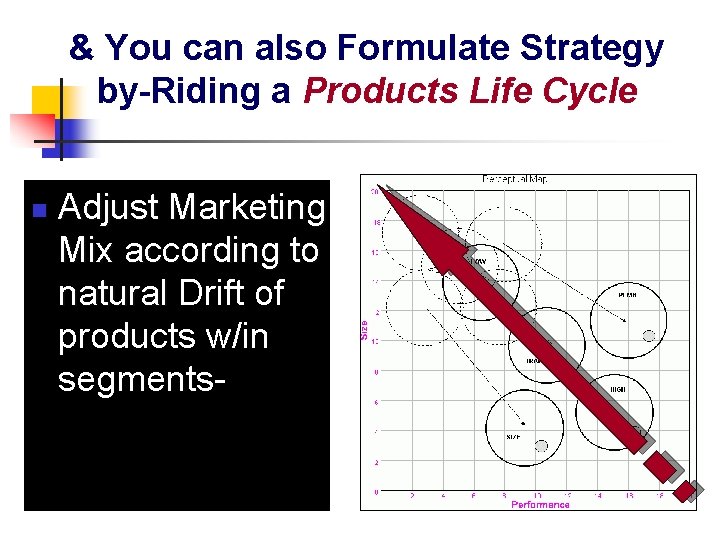
& You can also Formulate Strategy by-Riding a Products Life Cycle n Adjust Marketing Mix according to natural Drift of products w/in segments-
Put them all together &… 1. Cost/Quality Differentiation 2. Number & nature of segments compete w/in 3. Riding the Product Life Cycle
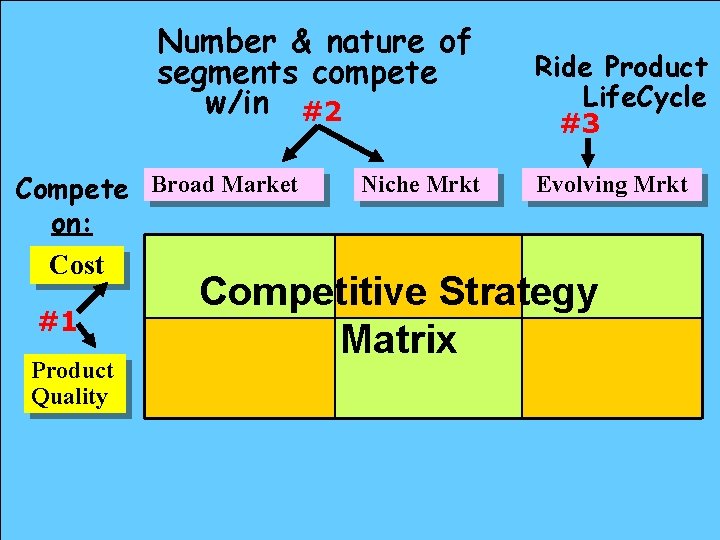
Number & nature of segments compete w/in #2 Compete Broad Market on: Cost #1 Product Quality Niche Mrkt Ride Product Life. Cycle #3 Evolving Mrkt Competitive Strategy Matrix
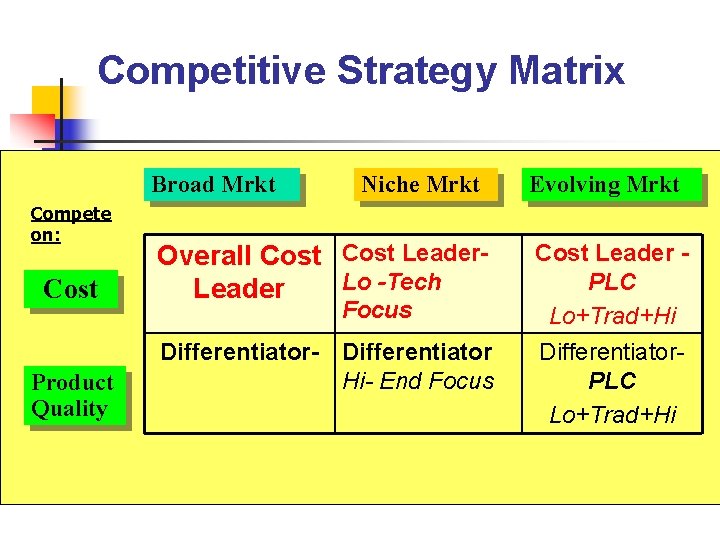
Competitive Strategy Matrix Broad Mrkt Compete on: Cost Product Quality Niche Mrkt Overall Cost Leader. Lo -Tech Leader Focus Differentiator- Differentiator Hi- End Focus Evolving Mrkt Cost Leader PLC Lo+Trad+Hi Differentiator. PLC Lo+Trad+Hi
M A RKETING M G T. S I M U LA T I ON Strategic Thinking- the ten big ideas 6. Resource allocation models – • Porter: strategic choices are set of basic generic strategies • (low cost, differentiation, market focus)
• Porter “What is Strategy” “If you don’t know where you are going any road will get you there. ” Lewis Carroll, -- Chapter 6, Alice in Wonderland
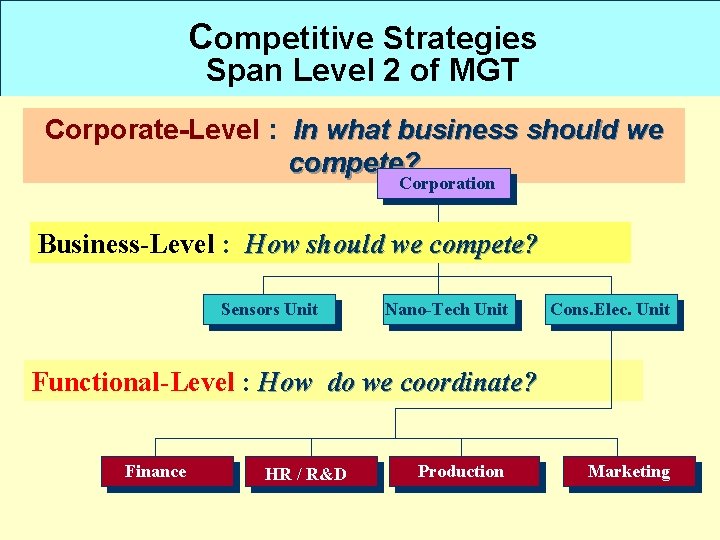
Competitive Strategies Span Level 2 of MGT Corporate-Level : In what business should we compete? Corporation Business-Level : How should we compete? Sensors Unit Nano-Tech Unit Cons. Elec. Unit Functional-Level : How do we coordinate? Finance HR / R&D Production Marketing
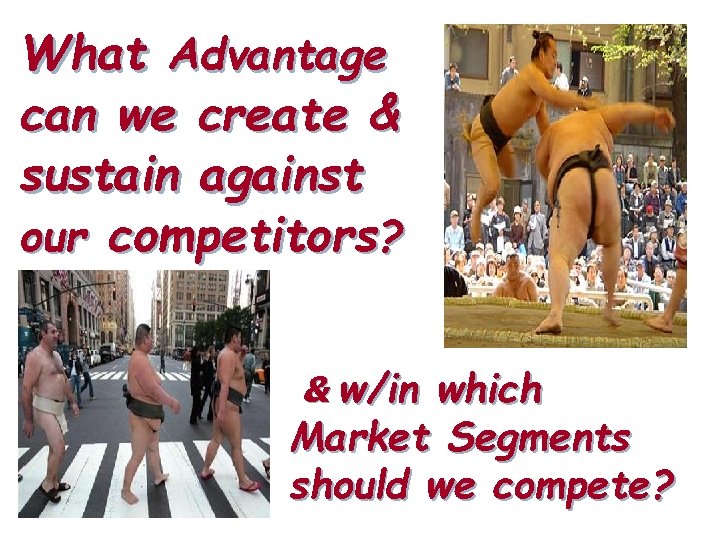
What Advantage can we create & sustain against our competitors? & w/in which Market Segments should we compete?
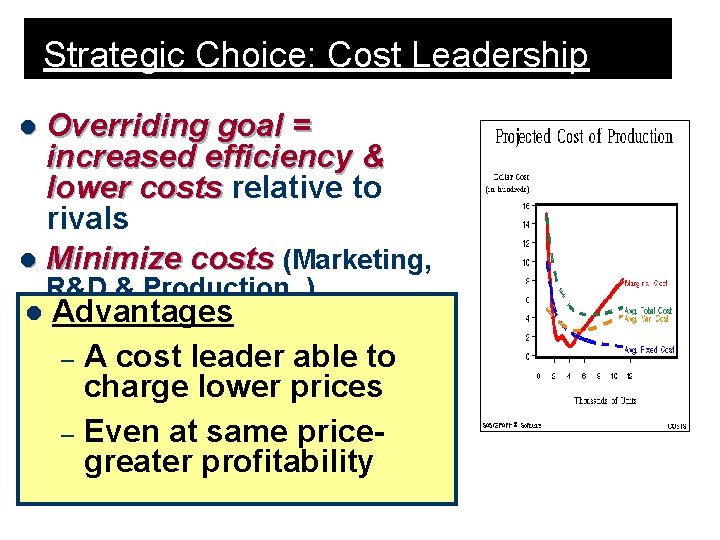
Strategic Choice: Cost Leadership Overriding goal = increased efficiency & lower costs relative to rivals l Minimize costs (Marketing, l l R&D & Production. . ) Advantages – A cost leader able to charge lower prices – Even at same pricegreater profitability
Strategic Choice: Differentiation Create a product that customers perceive as distinct/unique & offer superior quality/service Advantage Customers expect & willing to pay premium prices
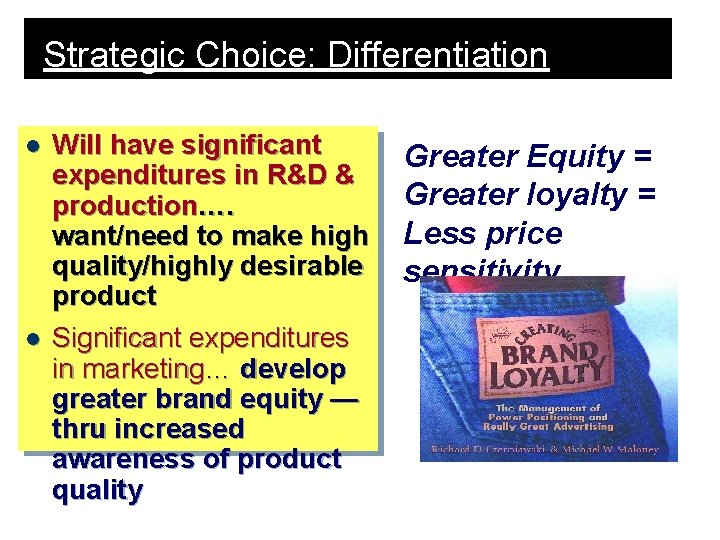
Strategic Choice: Differentiation l l Will have significant expenditures in R&D & production…. want/need to make high quality/highly desirable product Significant expenditures in marketing… develop greater brand equity — thru increased awareness of product quality Greater Equity = Greater loyalty = Less price sensitivity
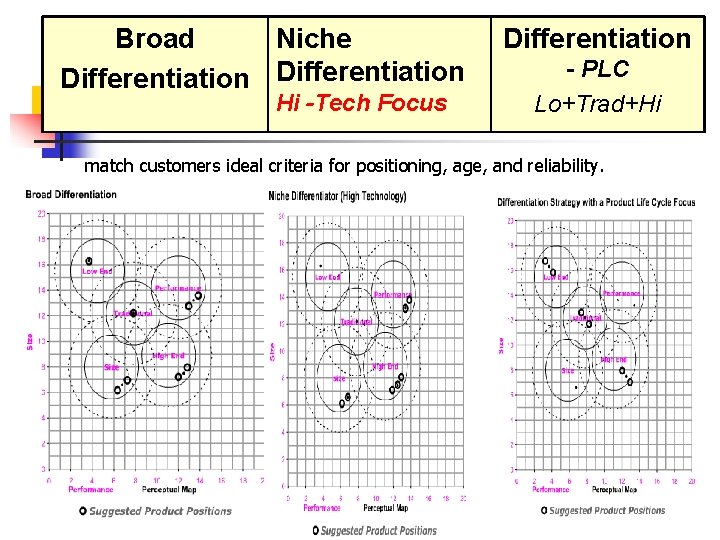
Broad Niche Differentiation Hi -Tech Focus Differentiation - PLC Lo+Trad+Hi match customers ideal criteria for positioning, age, and reliability.
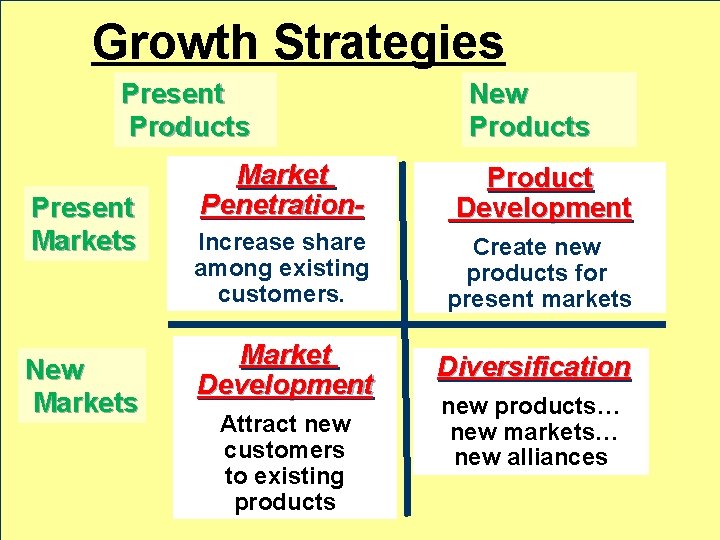
Growth Strategies Present Products Present Markets New Products Market Penetration- Product Development Increase share among existing customers. Create new products for present markets Market Development Diversification Attract new customers to existing products new products… new markets… new alliances
Select one of the Six Basic Strategies
The Big Picture Situation/SW OT Analysis Strategic Planning • Company • Consumers • Competitors • Conditions • PEST Growth & Competiti ve Strategi es Function al Integratio n Marketing R&D Productio n HR Finance Performan ce Assessme nt Ø Profits Ø Mrkt Share Ø ROA Ø ROS Ø ROE Ø Asset T/O Ø Stock Ø Mrkt Cap
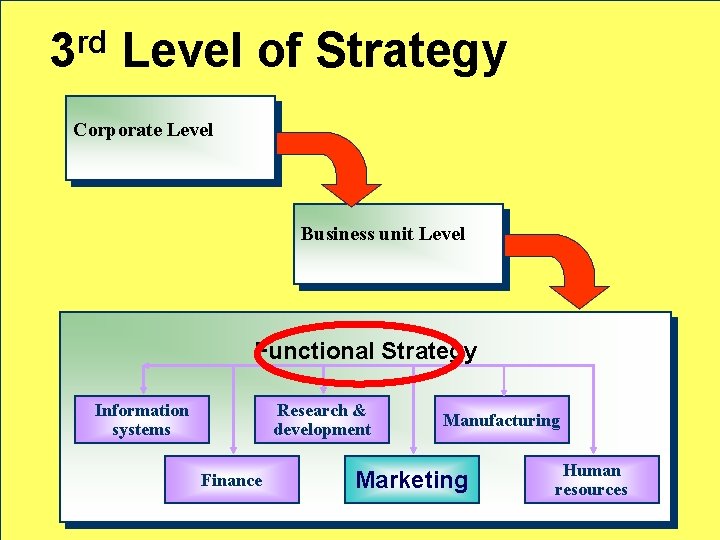
3 rd Level of Strategy Corporate Level Business unit Level Functional Strategy Information systems Research & development Finance Manufacturing Marketing Human resources
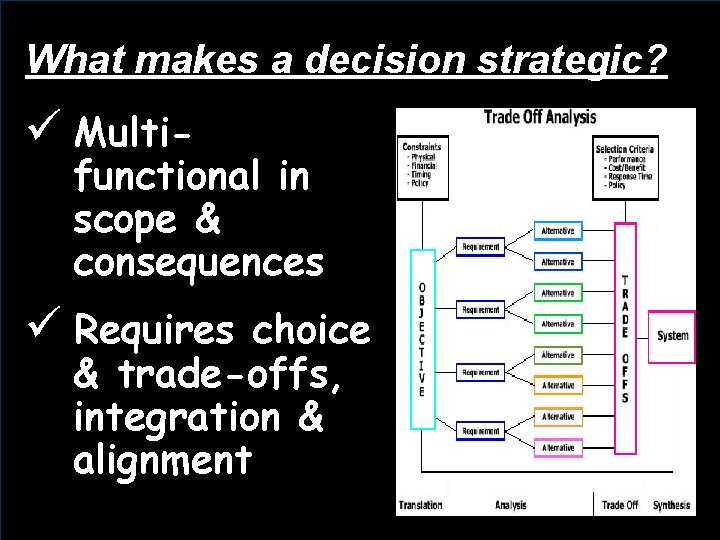
What makes a decision strategic? ü Multi- functional in scope & consequences ü Requires choice & trade-offs, integration & alignment
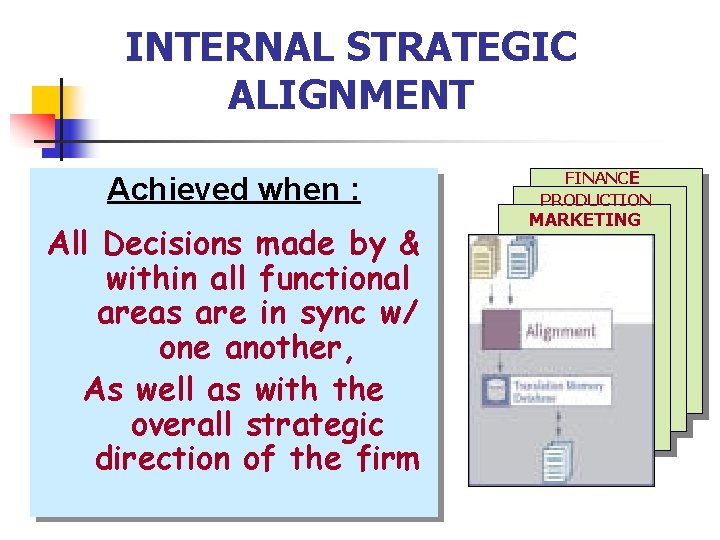
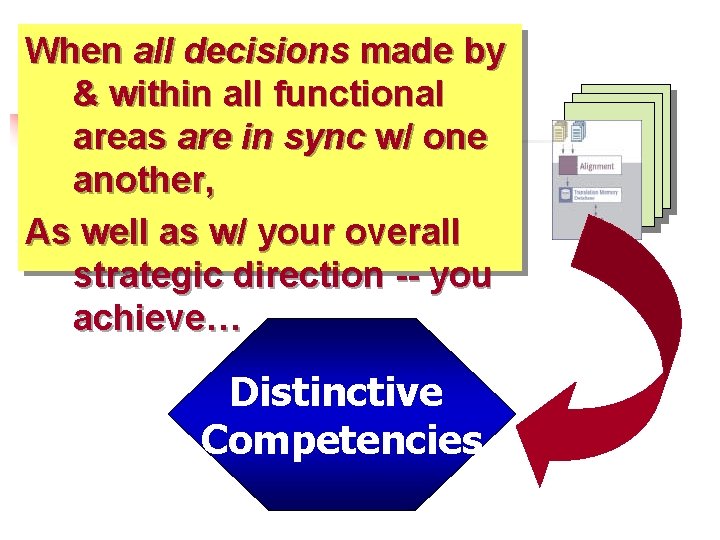
INTERNAL STRATEGIC ALIGNMENT Achieved when : All Decisions made by & within all functional areas are in sync w/ one another, As well as with the overall strategic direction of the firm FINANCE PRODUCTION MARKETING
Examples of Strategic Alignment
When all decisions made by & within all functional areas are in sync w/ one another, As well as w/ your overall strategic direction -- you achieve… Distinctive Competencies
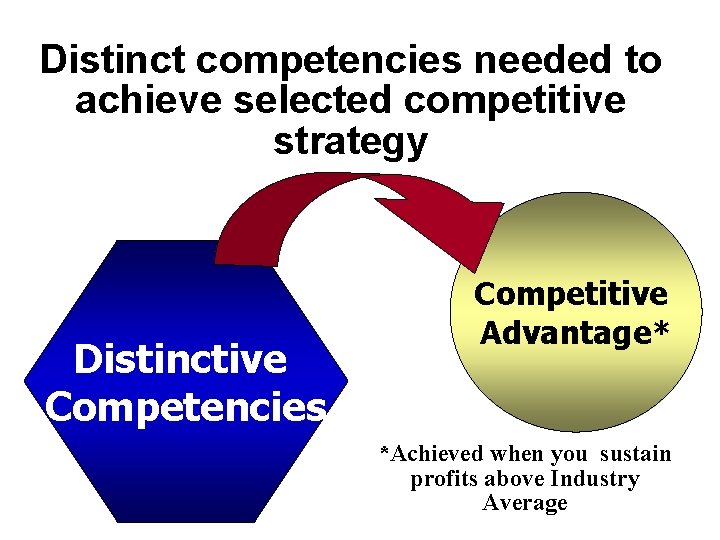
Distinct competencies needed to achieve selected competitive strategy Distinctive Competencies Competitive Advantage* *Achieved when you sustain profits above Industry Average
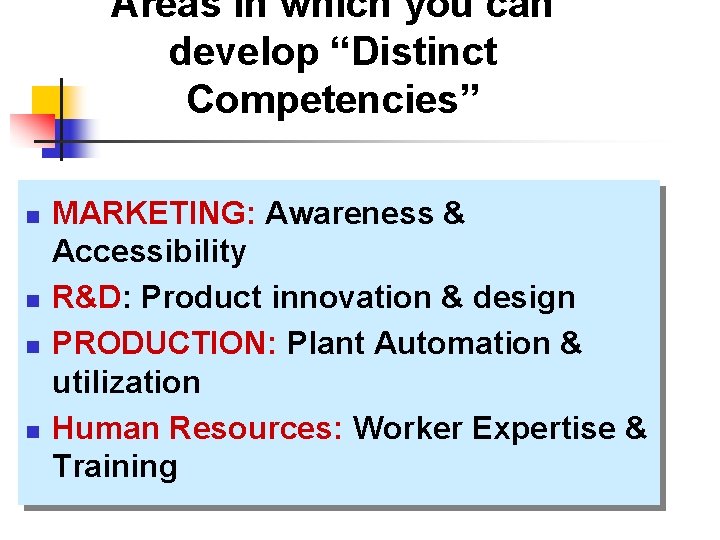
Areas in which you can develop “Distinct Competencies” n n MARKETING: Awareness & Accessibility R&D: Product innovation & design PRODUCTION: Plant Automation & utilization Human Resources: Worker Expertise & Training
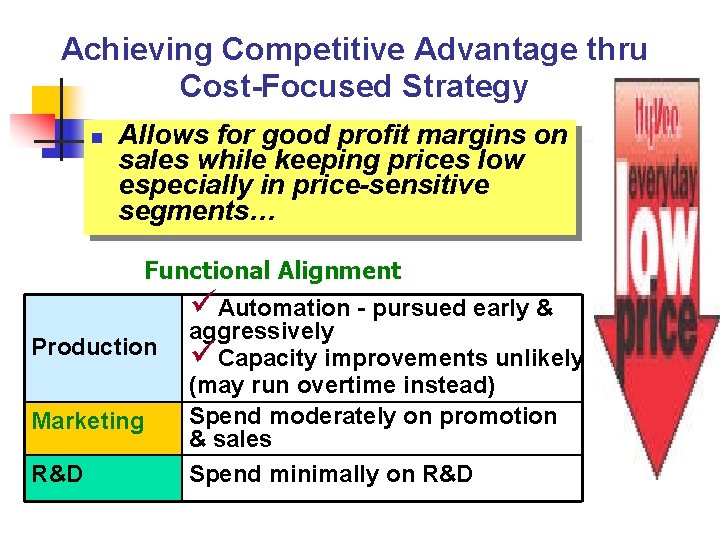
Achieving Competitive Advantage thru Cost-Focused Strategy n Allows for good profit margins on sales while keeping prices low especially in price-sensitive segments… Functional Alignment Production Marketing R&D üAutomation - pursued early & aggressively üCapacity improvements unlikely (may run overtime instead) Spend moderately on promotion & sales Spend minimally on R&D
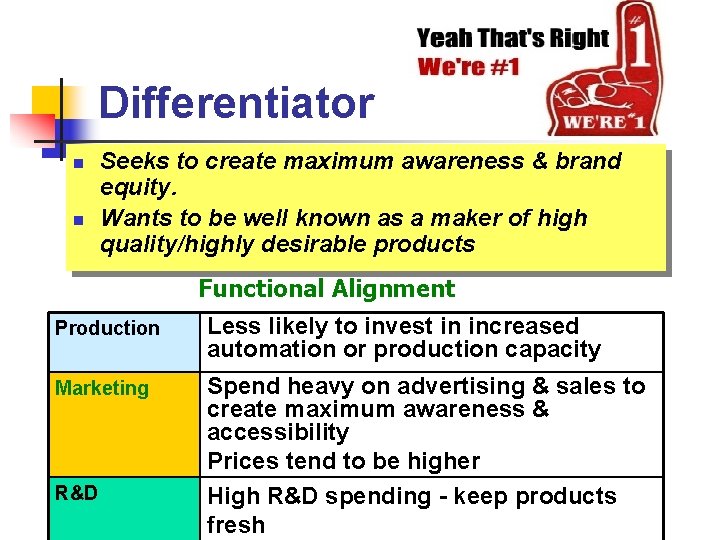
Differentiator n n Seeks to create maximum awareness & brand equity. Wants to be well known as a maker of high quality/highly desirable products Functional Alignment Production Less likely to invest in increased automation or production capacity Marketing Spend heavy on advertising & sales to create maximum awareness & accessibility Prices tend to be higher High R&D spending - keep products fresh R&D
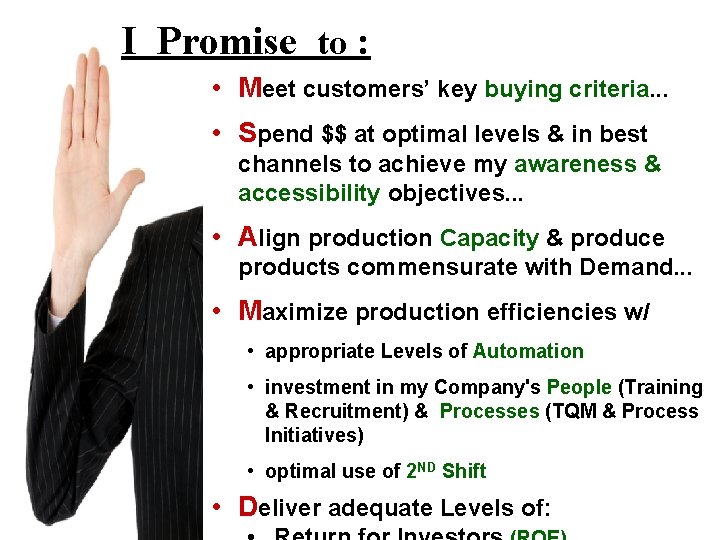
M A RKETING I Promise to : M G T. S I M U LA T I ON • Meet customers’ key buying criteria. . . • Spend $$ at optimal levels & in best channels to achieve my awareness & accessibility objectives. . . • Align production Capacity & produce products commensurate with Demand. . . • Maximize production efficiencies w/ • appropriate Levels of Automation • investment in my Company's People (Training & Recruitment) & Processes (TQM & Process Initiatives) • optimal use of 2 ND Shift • Deliver adequate Levels of: