Stepping Stone Detection at The Server Side A


- Slides: 37
Stepping Stone Detection at The Server Side A Real-Time Algorithm to Detect whether a proxy being is used as a Stepping Stone Devin Crane
Reference • R. Lin et all, “Stepping stone detection at the server side, ” in the proceeding 4 th IEEE Conference on Computer Communications Workshops (INFOCOM WKSHPS), pp. 964969, 2011.
Contents • • • Introduction Previous Work New Approach Hacking Vulnerabilities Conclusion
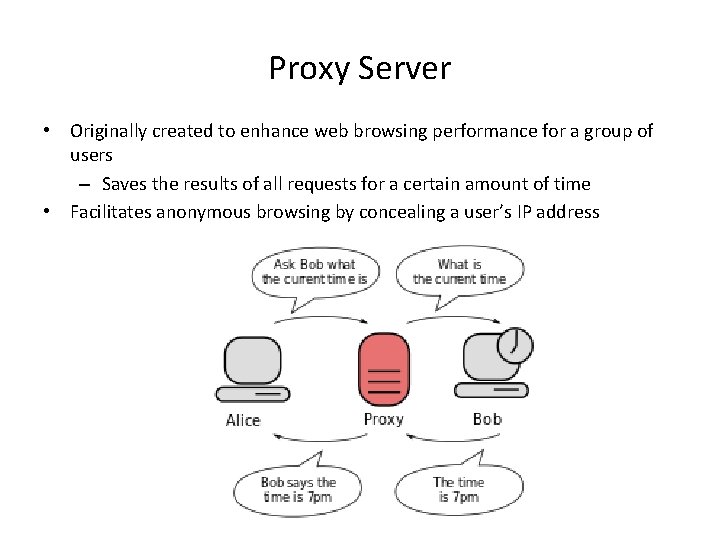
Proxy Server • Originally created to enhance web browsing performance for a group of users – Saves the results of all requests for a certain amount of time • Facilitates anonymous browsing by concealing a user’s IP address
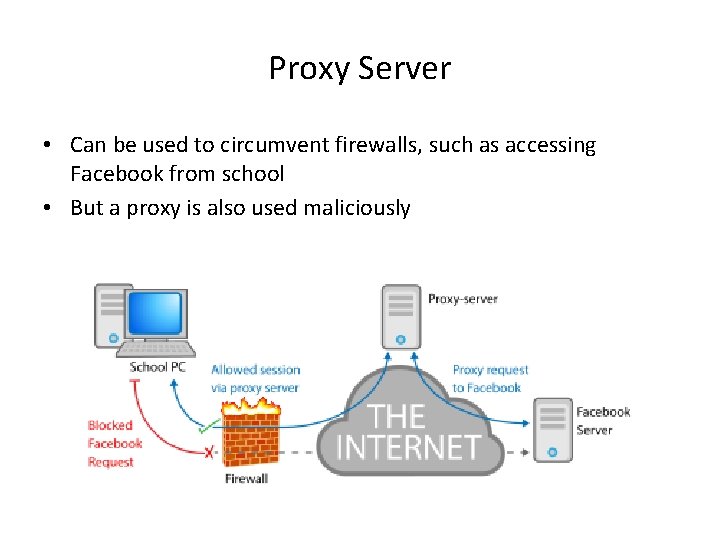
Proxy Server • Can be used to circumvent firewalls, such as accessing Facebook from school • But a proxy is also used maliciously
Goal • Detect the use of a stepping stone from the server’s perspective • No general method currently available • Dependent on use of Nagle’s algorithm, explained later
Contents • • • Introduction Previous Work New Approach Hacking Vulnerabilities Conclusion
Previous Work • A common solution is to check the header variables in a HTTP request for things like X-Forwarded-For or Via. Means the request should have relayed by a web proxy. – Doesn’t work for anonymous proxies, since it can simply choose to not add the header to a forwarded HTTP request
Previous Work • Other stepping stone detection research seeks to detect whether a host is being used as a stepping stone • This newly proposed approach seeks to detect whether a TCP connection is initiated by a stepping stone, from a server’s perspective
Previous Work - Hopper et al • Focused on anonymous routing networks, such as Tor or the use of a proxy • Used a latency-based attack to detect the location of a client behind the Tor network, based on the network latency between the client and the entry node of the Tor network • Measured the application-layer latency based on the time difference between when the proxy receives an HTML page and when the client processes the HTML page • Can be thwarted by making the proxy parse the HTML page and issue corresponding HTTP requests on behalf of the client, thereby making the measured network latency and application-layer latency too similar to detect
Contents • • • Introduction Previous Work New Approach Hacking Vulnerabilities Conclusion
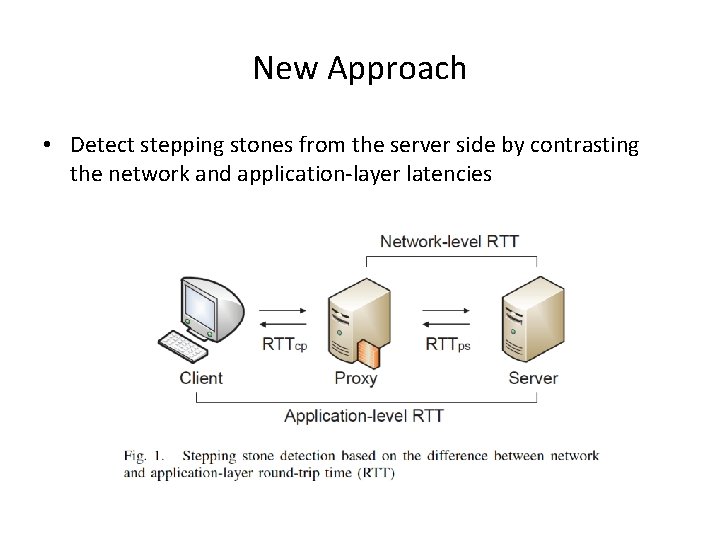
New Approach • Detect stepping stones from the server side by contrasting the network and application-layer latencies
Nagle’s Algorithm • Built into most, possibly all, of TCP implementations today • Basic idea is to reduce the number of packets generated by a TCP sender • Combines smaller packets into bigger packets • Because the algorithm changes the traffic pattern of TCP packet streams, the traffic generated by a client would have different patterns compared with the traffic relayed by a proxy • To be referred to as ‘Nagle’s’ going forward
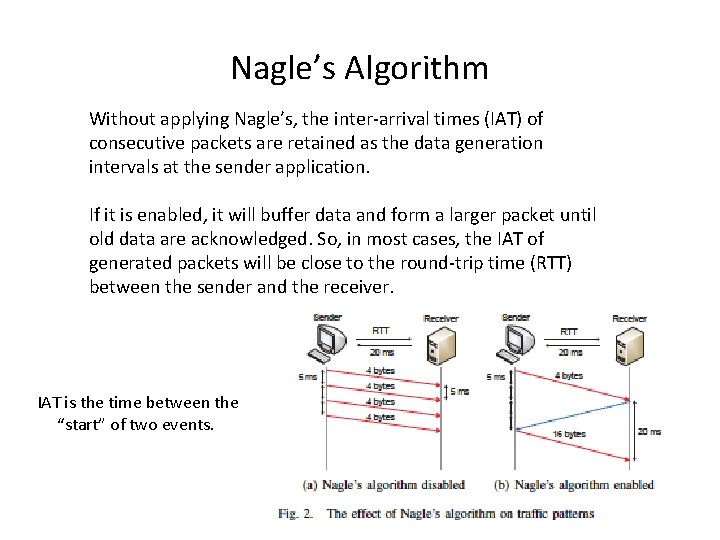
Nagle’s Algorithm Without applying Nagle’s, the inter-arrival times (IAT) of consecutive packets are retained as the data generation intervals at the sender application. If it is enabled, it will buffer data and form a larger packet until old data are acknowledged. So, in most cases, the IAT of generated packets will be close to the round-trip time (RTT) between the sender and the receiver. IAT is the time between the “start” of two events.
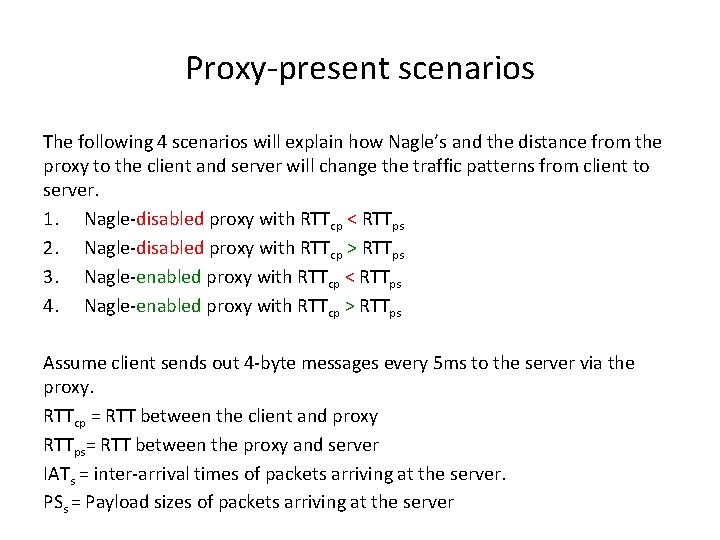
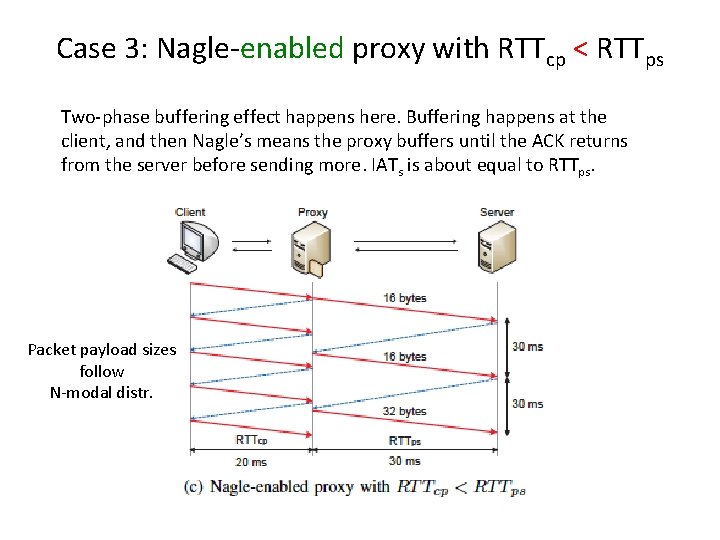
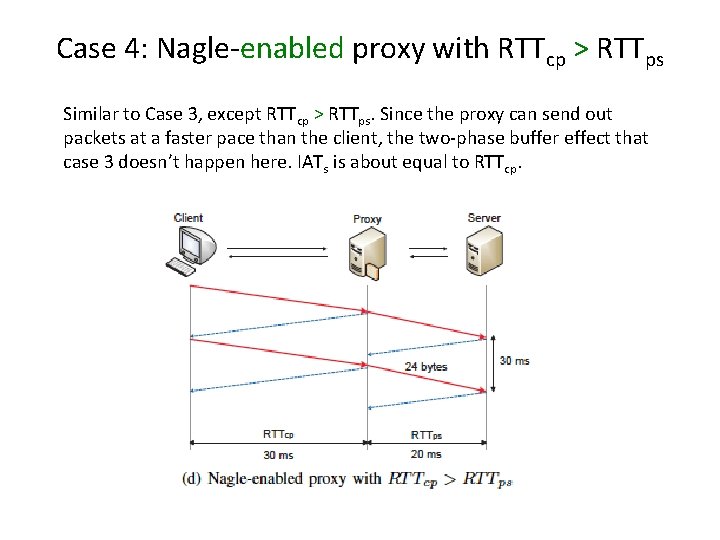
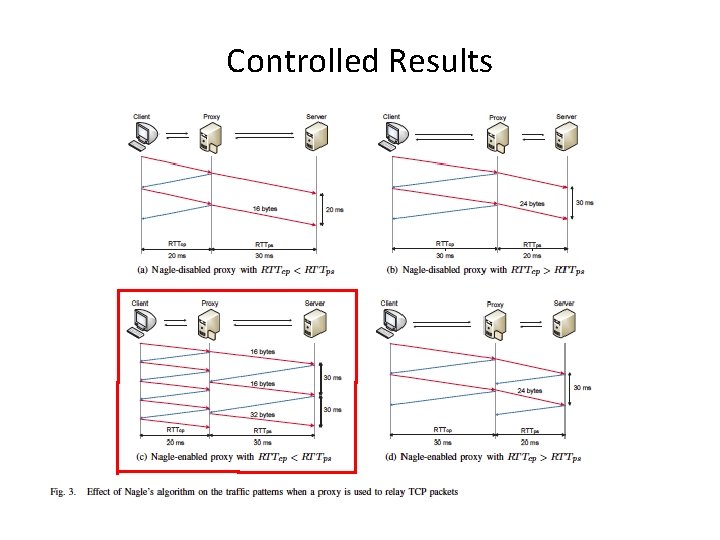
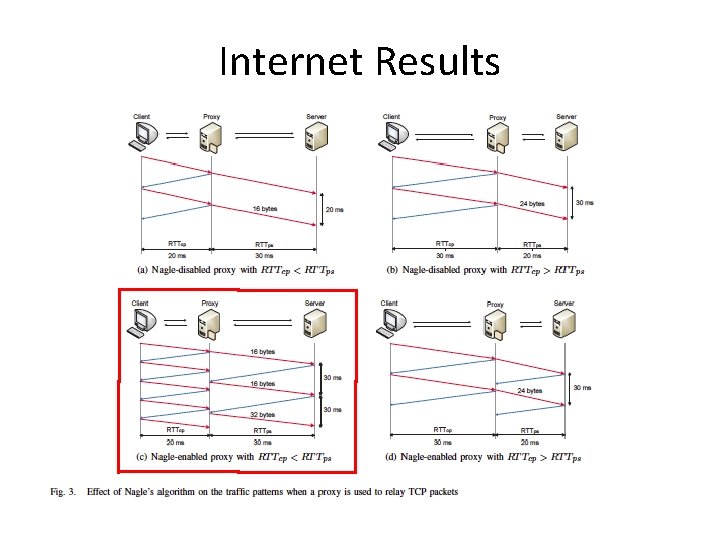
Proxy-present scenarios The following 4 scenarios will explain how Nagle’s and the distance from the proxy to the client and server will change the traffic patterns from client to server. 1. Nagle-disabled proxy with RTTcp < RTTps 2. Nagle-disabled proxy with RTTcp > RTTps 3. Nagle-enabled proxy with RTTcp < RTTps 4. Nagle-enabled proxy with RTTcp > RTTps Assume client sends out 4 -byte messages every 5 ms to the server via the proxy. RTTcp = RTT between the client and proxy RTTps= RTT between the proxy and server IATs = inter-arrival times of packets arriving at the server. PSs = Payload sizes of packets arriving at the server
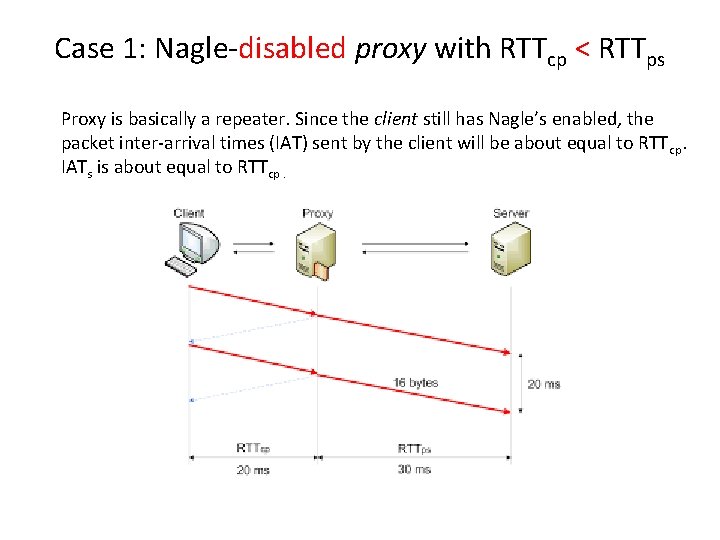
Case 1: Nagle-disabled proxy with RTTcp < RTTps Proxy is basically a repeater. Since the client still has Nagle’s enabled, the packet inter-arrival times (IAT) sent by the client will be about equal to RTT cp. IATs is about equal to RTTcp.
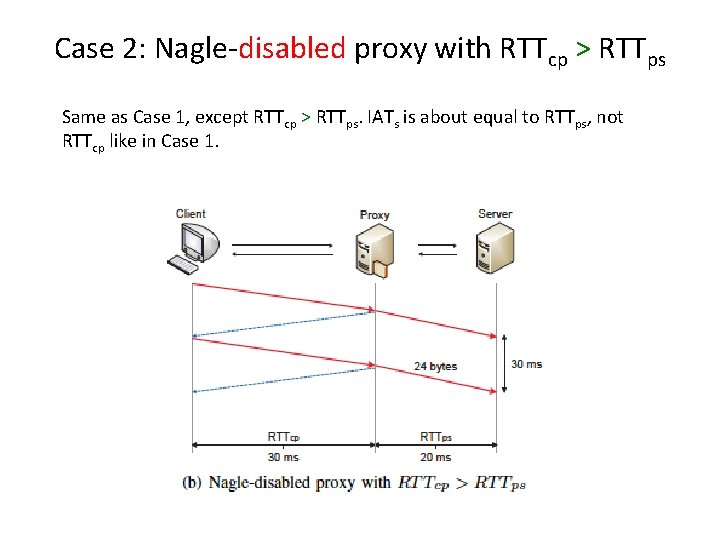
Case 2: Nagle-disabled proxy with RTTcp > RTTps Same as Case 1, except RTTcp > RTTps. IATs is about equal to RTTps, not RTTcp like in Case 1.
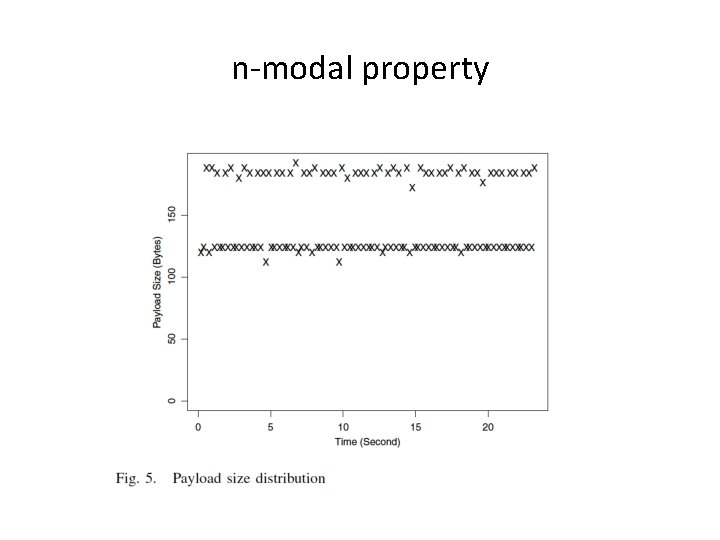
Case 3: Nagle-enabled proxy with RTTcp < RTTps Two-phase buffering effect happens here. Buffering happens at the client, and then Nagle’s means the proxy buffers until the ACK returns from the server before sending more. IATs is about equal to RTTps. Packet payload sizes follow N-modal distr.
n-modal property
Case 4: Nagle-enabled proxy with RTTcp > RTTps Similar to Case 3, except RTTcp > RTTps. Since the proxy can send out packets at a faster pace than the client, the two-phase buffer effect that case 3 doesn’t happen here. IATs is about equal to RTTcp.
Case Summary • If a proxy relays TCP traffic for a client towards a server, the patterns of the packets arriving at the server will reveal the presence of the proxy node. Also, the traffic patterns may be different depending on whether Nagle’s is enabled at the proxy and the relative magnitude or distance of RTTcp and RTTps. • The 4 cases show that IATs and PSs (packet payload sizes arriving at the server) are indicators for detecting the presence of the proxy node between a client and a server.
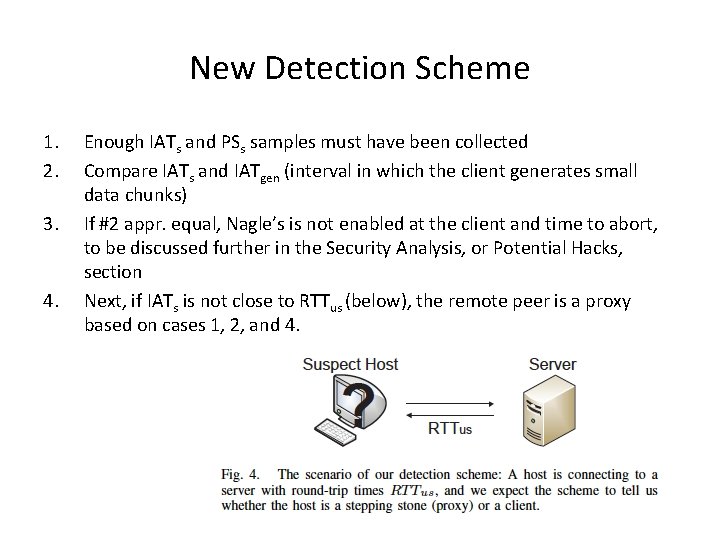
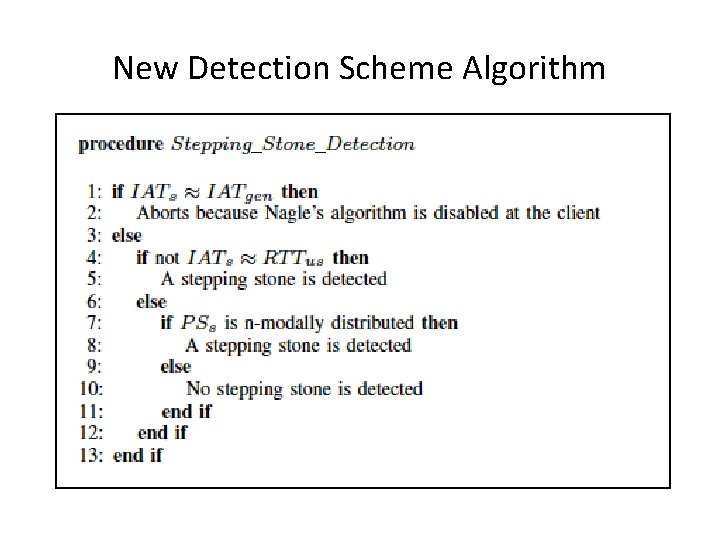
New Detection Scheme 1. 2. 3. 4. Enough IATs and PSs samples must have been collected Compare IATs and IATgen (interval in which the client generates small data chunks) If #2 appr. equal, Nagle’s is not enabled at the client and time to abort, to be discussed further in the Security Analysis, or Potential Hacks, section Next, if IATs is not close to RTTus (below), the remote peer is a proxy based on cases 1, 2, and 4.
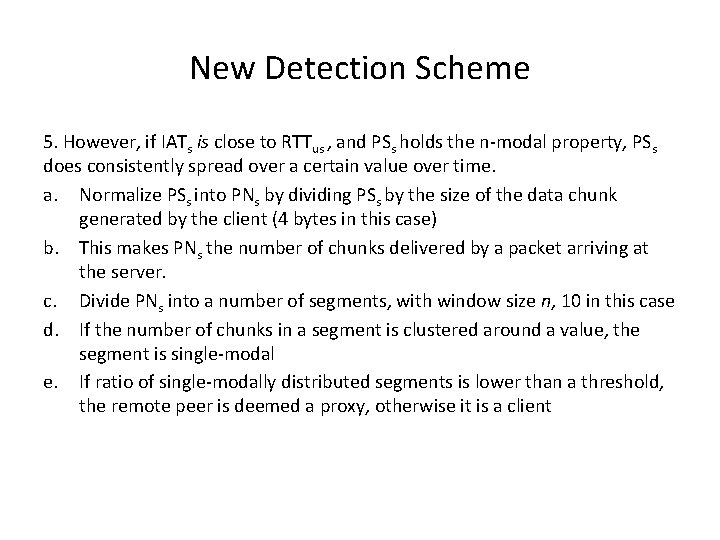
New Detection Scheme 5. However, if IATs is close to RTTus , and PSs holds the n-modal property, PSs does consistently spread over a certain value over time. a. Normalize PSs into PNs by dividing PSs by the size of the data chunk generated by the client (4 bytes in this case) b. This makes PNs the number of chunks delivered by a packet arriving at the server. c. Divide PNs into a number of segments, with window size n, 10 in this case d. If the number of chunks in a segment is clustered around a value, the segment is single-modal e. If ratio of single-modally distributed segments is lower than a threshold, the remote peer is deemed a proxy, otherwise it is a client
New Detection Scheme Algorithm
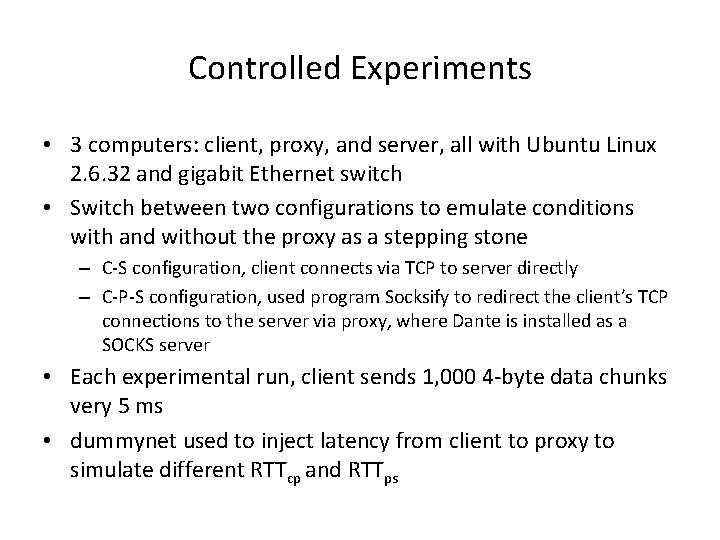
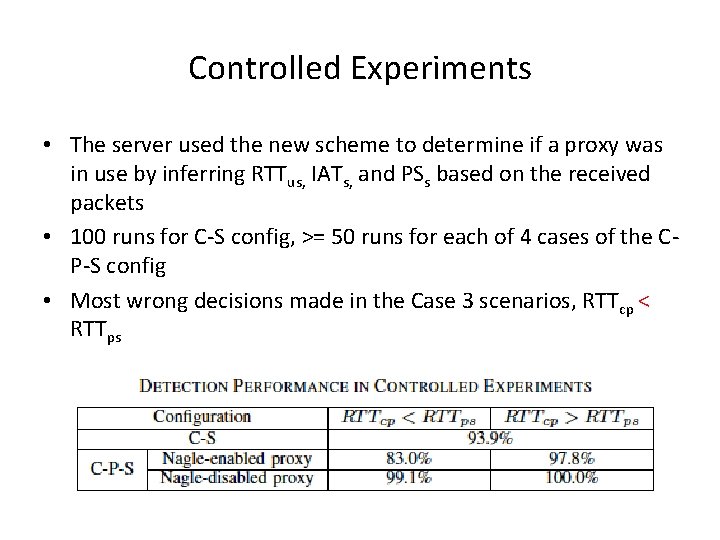
Controlled Experiments • 3 computers: client, proxy, and server, all with Ubuntu Linux 2. 6. 32 and gigabit Ethernet switch • Switch between two configurations to emulate conditions with and without the proxy as a stepping stone – C-S configuration, client connects via TCP to server directly – C-P-S configuration, used program Socksify to redirect the client’s TCP connections to the server via proxy, where Dante is installed as a SOCKS server • Each experimental run, client sends 1, 000 4 -byte data chunks very 5 ms • dummynet used to inject latency from client to proxy to simulate different RTTcp and RTTps
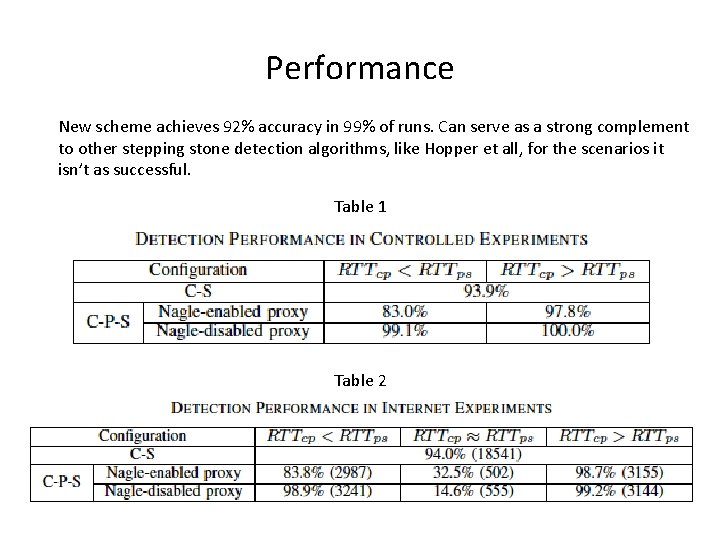
Controlled Experiments • The server used the new scheme to determine if a proxy was in use by inferring RTTus, IATs, and PSs based on the received packets • 100 runs for C-S config, >= 50 runs for each of 4 cases of the CP-S config • Most wrong decisions made in the Case 3 scenarios, RTTcp < RTTps
Controlled Results
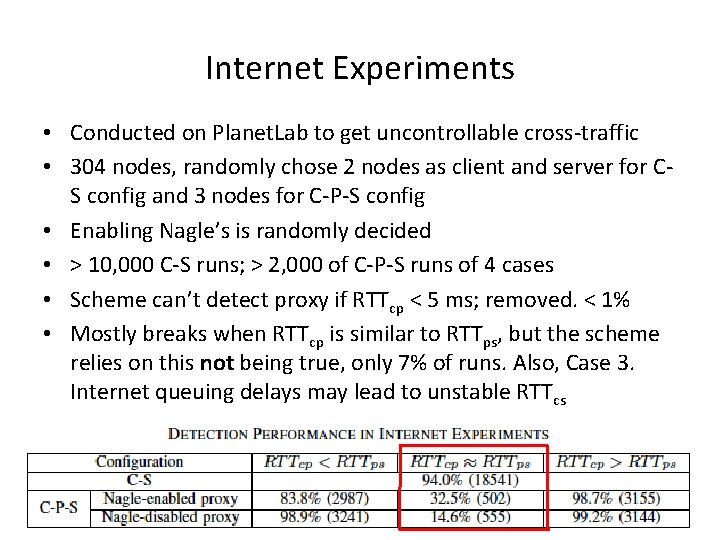
Internet Experiments • Conducted on Planet. Lab to get uncontrollable cross-traffic • 304 nodes, randomly chose 2 nodes as client and server for CS config and 3 nodes for C-P-S config • Enabling Nagle’s is randomly decided • > 10, 000 C-S runs; > 2, 000 of C-P-S runs of 4 cases • Scheme can’t detect proxy if RTTcp < 5 ms; removed. < 1% • Mostly breaks when RTTcp is similar to RTTps, but the scheme relies on this not being true, only 7% of runs. Also, Case 3. Internet queuing delays may lead to unstable RTTcs
Internet Results
Performance New scheme achieves 92% accuracy in 99% of runs. Can serve as a strong complement to other stepping stone detection algorithms, like Hopper et all, for the scenarios it isn’t as successful. Table 1 Table 2
Contents • • • Introduction Previous Work New Approach Hacking Vulnerabilities Conclusion
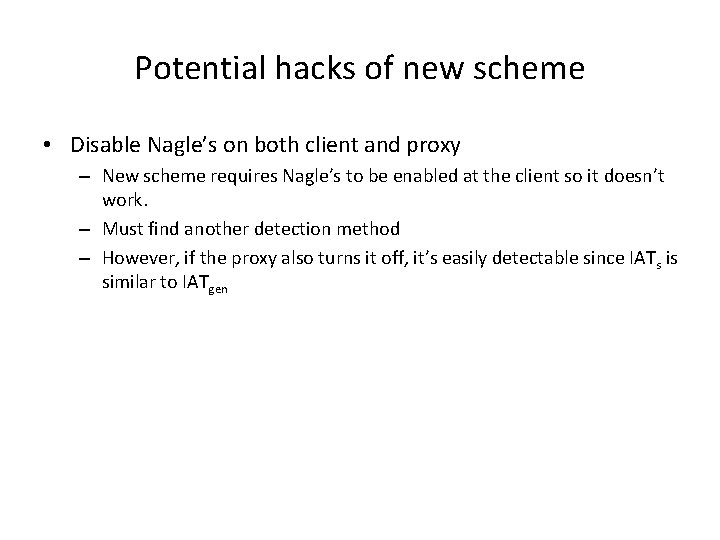
Potential hacks of new scheme • Disable Nagle’s on both client and proxy – New scheme requires Nagle’s to be enabled at the client so it doesn’t work. – Must find another detection method – However, if the proxy also turns it off, it’s easily detectable since IATs is similar to IATgen
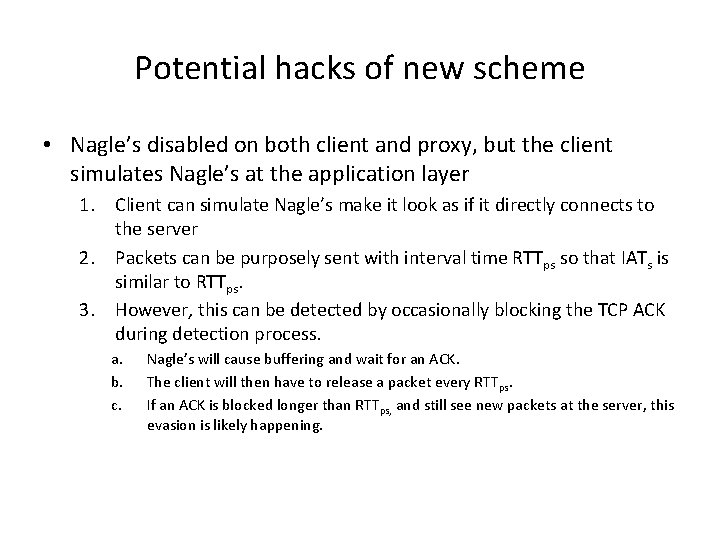
Potential hacks of new scheme • Nagle’s disabled on both client and proxy, but the client simulates Nagle’s at the application layer 1. Client can simulate Nagle’s make it look as if it directly connects to the server 2. Packets can be purposely sent with interval time RTTps so that IATs is similar to RTTps. 3. However, this can be detected by occasionally blocking the TCP ACK during detection process. a. b. c. Nagle’s will cause buffering and wait for an ACK. The client will then have to release a packet every RTTps. If an ACK is blocked longer than RTTps, and still see new packets at the server, this evasion is likely happening.
Potential hacks of new scheme • Nagle’s is disabled on the client but enabled on the proxy node – Client and proxy would be seen as a virtual node with a long internal processing delay. Hard to detect, but Hopper et al’s distance based scheme could help detect in this case
Contents • • • Introduction Previous Work New Approach Hacking Vulnerabilities Conclusion
Conclusion • Proposed a new scheme that allows a server to detect whether a remote peer of a TCP connection is a stepping stone • Because Nagle’s Algorithm changes the traffic patterns of TCP packet streams, the client traffic would have different patterns when compared with proxy-relayed traffic • Therefore this new scheme detects the presence of a stepping stone by observing the interarrival times and payload size of the packets arriving at a server • Considered a starting point to give critical Internet users the power to refuse anonymous access whenever necessary
Thank you • Any questions?