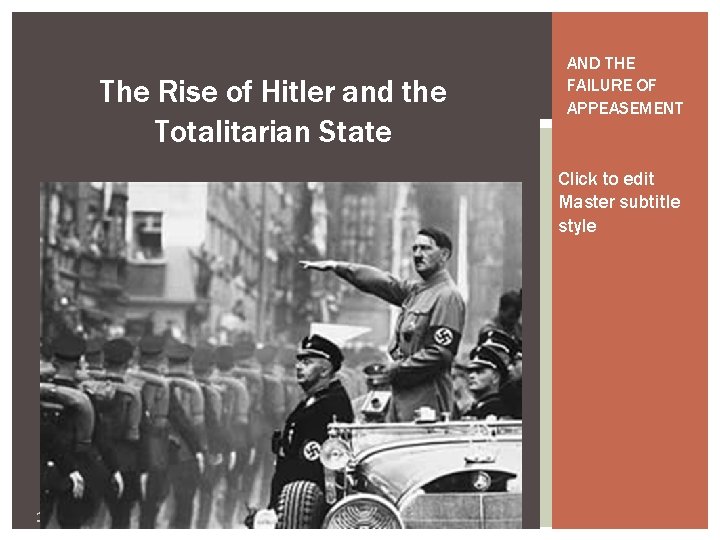
The Rise of Hitler and the Totalitarian State

- Slides: 24
The Rise of Hitler and the Totalitarian State AND THE FAILURE OF APPEASEMENT Click to edit Master subtitle style 11/14/13
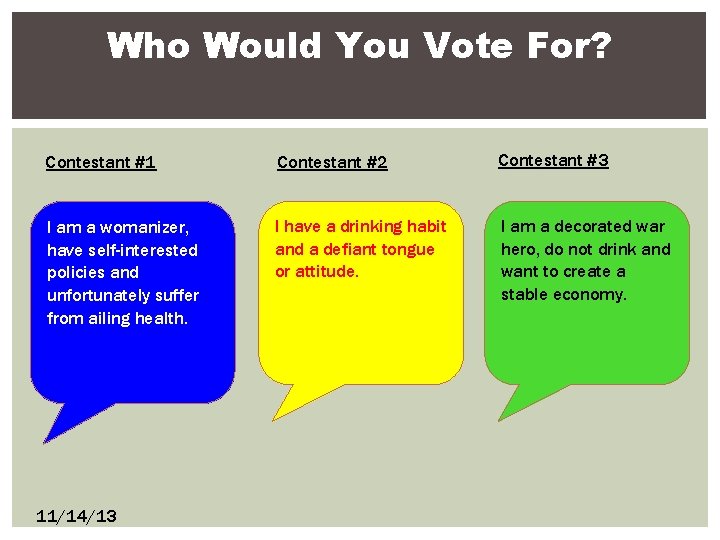
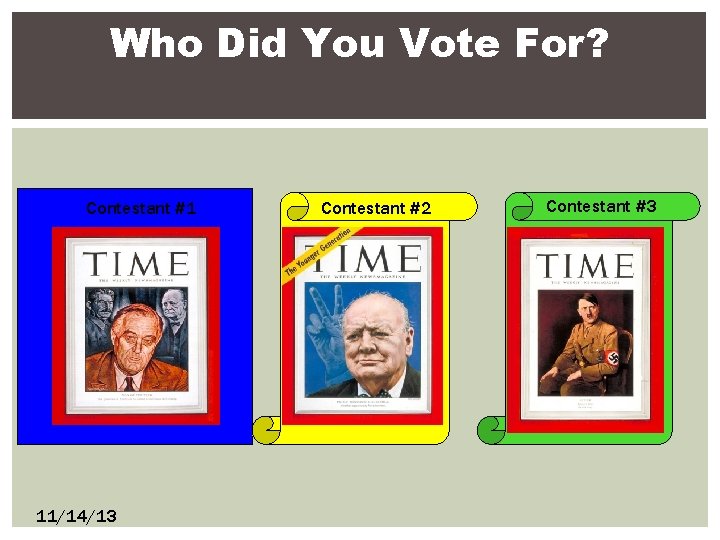
Who Would You Vote For? Contestant #1 Contestant #2 Contestant #3 I am a womanizer, have self-interested policies and unfortunately suffer from ailing health. I have a drinking habit and a defiant tongue or attitude. I am a decorated war hero, do not drink and want to create a stable economy. 11/14/13
Who Did You Vote For? Contestant #1 11/14/13 Contestant #2 Contestant #3
subordinated to the state, and opposing political and cultural expression is suppressed. � Why now? Increasing political, economic, and social unrest. Increasing nationalism. Desperation Definition: A form of government in which the political authority exercises absolute and centralized control over all aspects of life, the individual is subordinated to the state, and opposing political and cultural expression is suppressed. � Why now? � Increasing political, economic, and social unrest. � Increasing nationalism. � Desperation 11/14/13
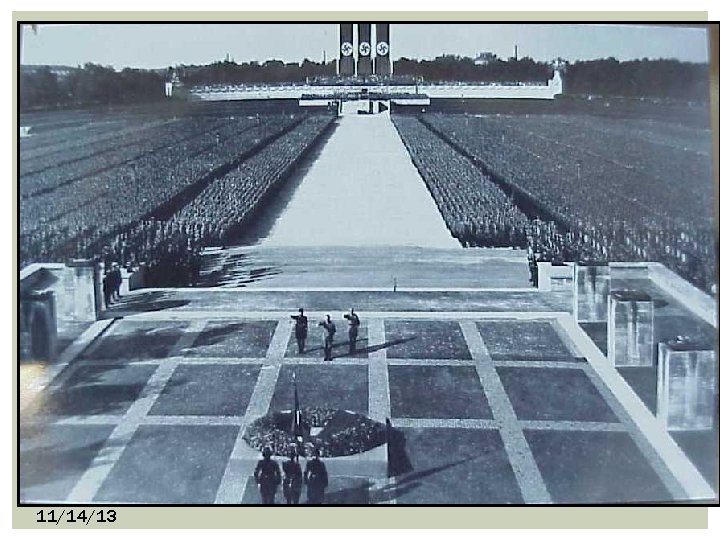
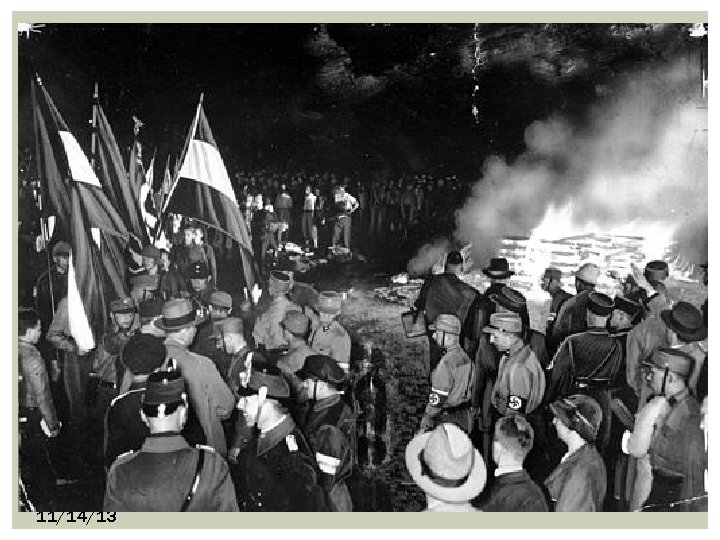
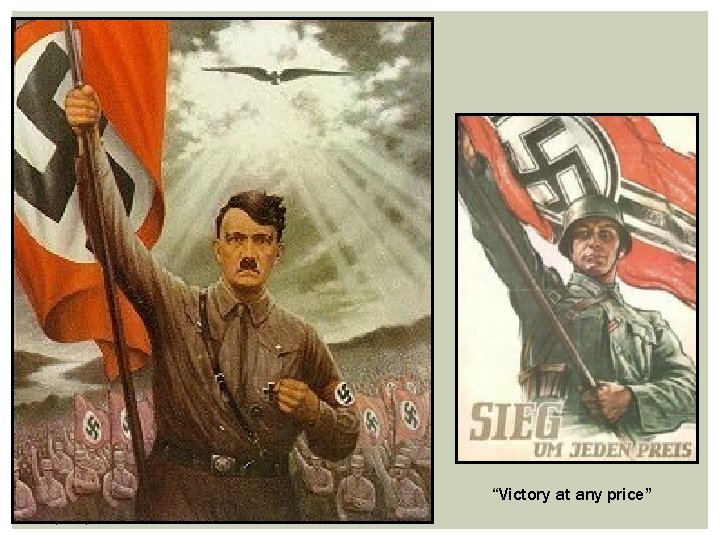
� military, economy, social, cultural) Highly nationalistic (flags, salutes, rallies, uniforms) Strict controls and laws Military state (secret police, army, military) Censorship (opposing literature and ideas) Propaganda (media – radio, newspapers, posters) One leader (dictator); charismatic Government establishes complete control of all aspects of the state (political, military, economy, social, cultural) � Highly nationalistic (flags, salutes, rallies, uniforms) � Strict controls and laws � Military state (secret police, army, military) � Censorship (opposing literature and ideas) � Propaganda (media – radio, newspapers, posters) � One leader (dictator); charismatic 11/14/13
Click to edit Master subtitle style 11/14/13
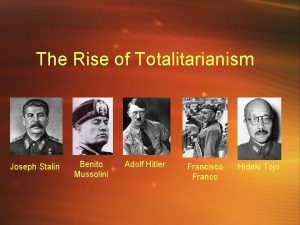
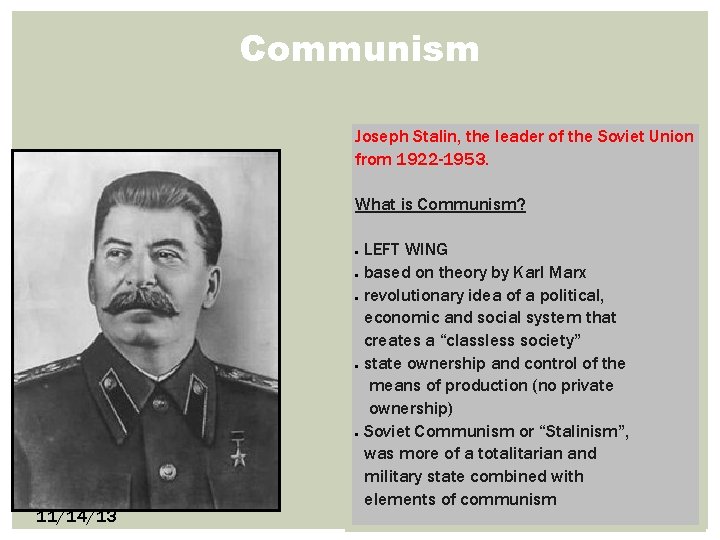
Communism Joseph Stalin, the leader of the Soviet Union from 1922 -1953. What is Communism? LEFT WING based on theory by Karl Marx revolutionary idea of a political, economic and social system that creates a “classless society” state ownership and control of the means of production (no private ownership) Soviet Communism or “Stalinism”, was more of a totalitarian and military state combined with elements of communism 11/14/13
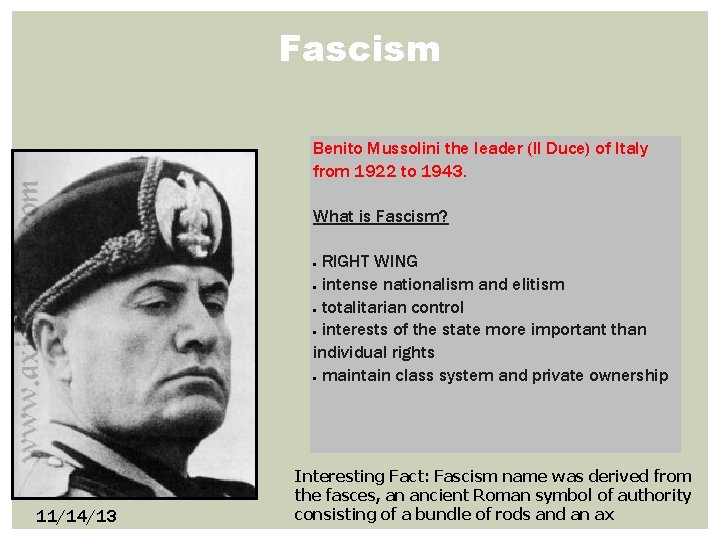
Fascism Benito Mussolini the leader (Il Duce) of Italy from 1922 to 1943. What is Fascism? RIGHT WING intense nationalism and elitism totalitarian control interests of the state more important than individual rights maintain class system and private ownership 11/14/13 Interesting Fact: Fascism name was derived from the fasces, an ancient Roman symbol of authority consisting of a bundle of rods and an ax
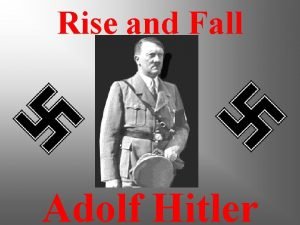
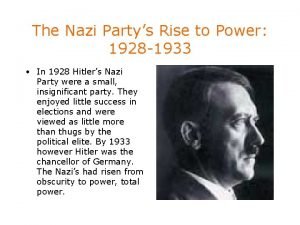
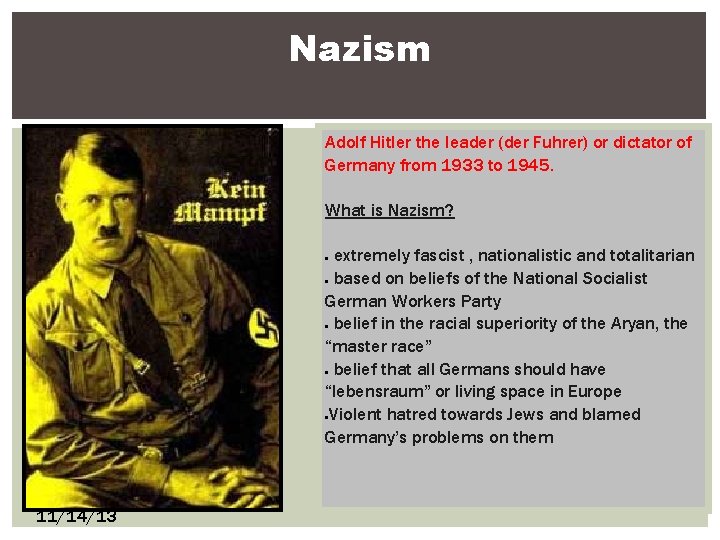
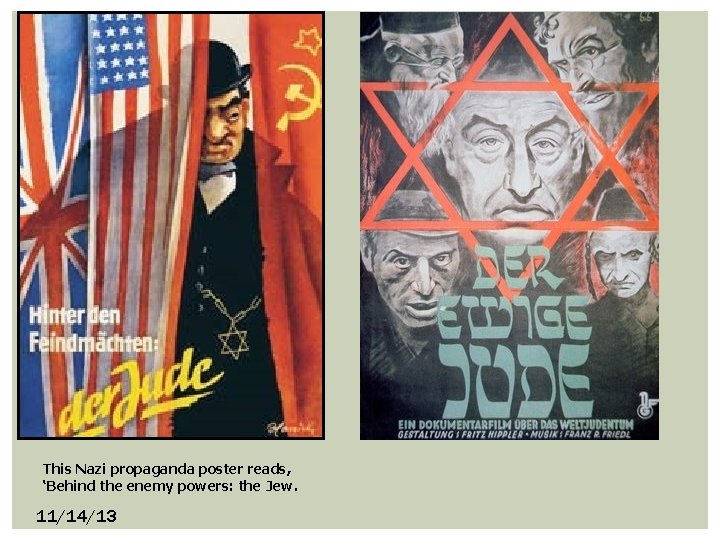
Nazism Adolf Hitler the leader (der Fuhrer) or dictator of Germany from 1933 to 1945. What is Nazism? extremely fascist , nationalistic and totalitarian based on beliefs of the National Socialist German Workers Party belief in the racial superiority of the Aryan, the “master race” belief that all Germans should have “lebensraum” or living space in Europe Violent hatred towards Jews and blamed Germany’s problems on them 11/14/13
11/14/13
11/14/13
“Victory at any price” 11/14/13
This Nazi propaganda poster reads, ‘Behind the enemy powers: the Jew. 11/14/13
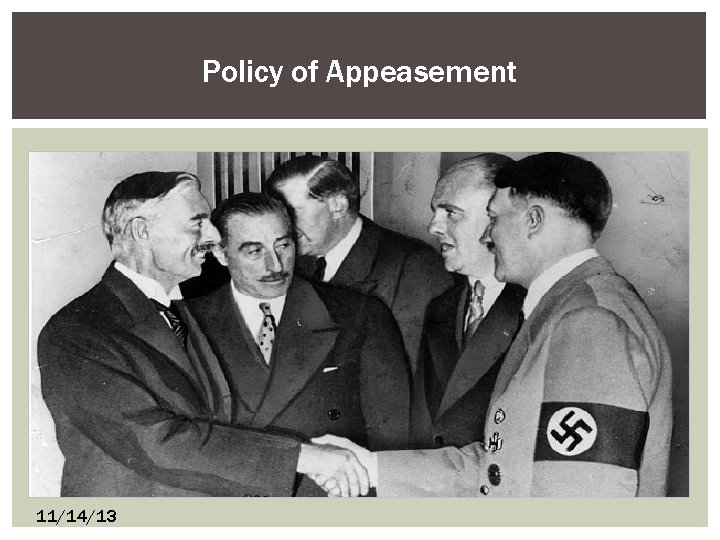
The Policy of Appeasement Definition: The willingness to surrender to an aggressors’ demands to avoid war. Policy adopted by Neville Chamberlin, Prime Minister of Great Britain. After WWI, most European countries wanted to avoid war at all costs. Britain believed the terms of the Treaty of Versailles were too harsh and that, therefore, Hitler was not out of line. Reality – The British and French were blind to the true nature of Hitler’s plan. Bought Hitler time and allowed him to gain territory unchallenged. (Also gave the British time to rearm and prepare for new threats). 11/14/13
Policy of Appeasement 11/14/13
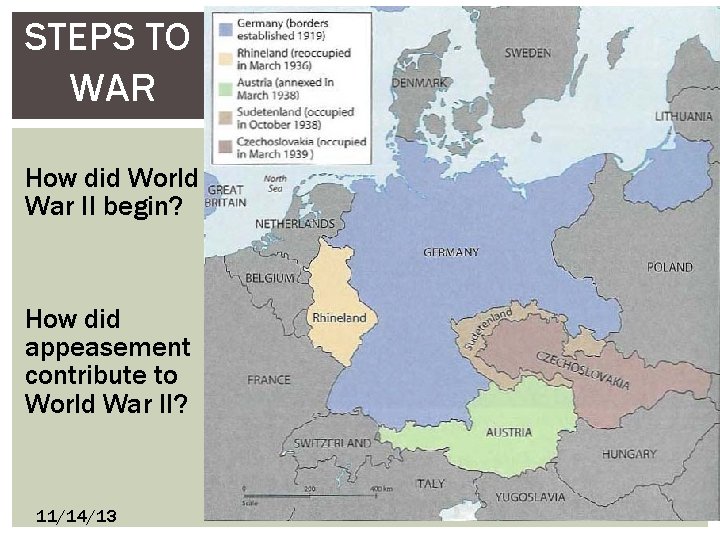
STEPS TO WAR How did World War II begin? How did appeasement contribute to World War II? 11/14/13
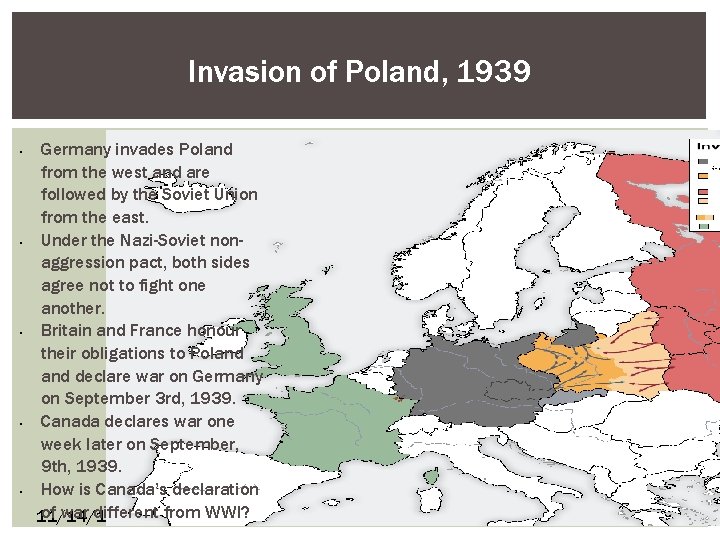
Invasion of Poland, 1939 § § § Germany invades Poland from the west and are followed by the Soviet Union from the east. Under the Nazi-Soviet nonaggression pact, both sides agree not to fight one another. Britain and France honour their obligations to Poland declare war on Germany on September 3 rd, 1939. Canada declares war one week later on September, 9 th, 1939. How is Canada’s declaration of war different from WWI? 11/14/13
� Could Hitler have been ‘stopped’ before 1939? � Was the Treaty of Versailles or Appeasement the main cause for WWII? � What was Canada’s position on appeasement? What was ‘isolationism’? 11/14/13
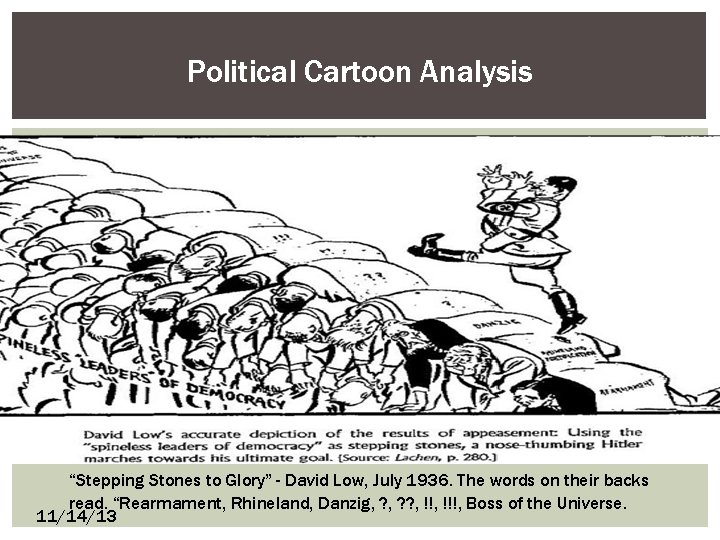
Political Cartoon Analysis “Stepping Stones to Glory” - David Low, July 1936. The words on their backs read. “Rearmament, Rhineland, Danzig, ? ? , !!!, Boss of the Universe. 11/14/13
� What is a Thesis? The thesis is the main or controlling idea of your paper The remainder of your paper should work towards proving your thesis Any information which does not work towards this end will come across as irrelevant Your thesis should answer a question It should be clearly stated in a single sentence � What is a Thesis? � The thesis is the main or controlling idea of your paper � The remainder of your paper should work towards proving your thesis � Any information which does not work towards this end will come across as irrelevant � Your thesis should answer a question � It should be clearly stated in a single sentence 11/14/13
How to write a thesis � � � As a thesis answers a question, a good thesis derives from a good question Normally you would start with a topic (i. e. Free Speech) and develop a list of quality questions (ie Should there be limits on Free Speech? ) However, you only have one topic and one question to answer for this essay � Were the Nuremberg trials justified? � To answer this question you must first conduct research on the subject. � Most likely, you will not know your thesis until you are almost done your research. � Come up with an answer to your question 11/14/13
Pollution is bad for the environment. Not really debatable. (Can only take one side of the argument). Better: � � At least 25 percent of the federal budget should be spent on limiting pollution. BAD: Can be argued for or against. Pollution is bad for the environment. Ø � Not really debatable. (Can only take one side of the argument). Better: At least 25 percent of the federal budget should be spent on limiting 11/14/13 pollution. �
Too broad and not debatable. (What do you mean by drugs? How is it detrimental? ) Better: � � Illegal BAD: drug use is detrimental because it encourages gang violence. More manageable (narrowed thesis – drugs narrowed to illegal drugs and the detriment narrowed to gang violence. ) Drug use is detrimental to society. Ø � Too broad and not debatable. (What do you mean by drugs? How is it detrimental? ) Better: � Illegal drug use is detrimental because it encourages gang violence. 11/14/13
People need to stay healthy for several important reasons. Too general Better: � � Students must get sufficient sleep at night in order to succeed in school. BAD: More specific, still arguable. People need to stay healthy for several important reasons. Ø Too general � Better: � Students must get sufficient sleep at night in order to succeed in school. More specific, still arguable. 11/14/13 Ø