
The Rise of Totalitarianism Joseph Stalin Benito Mussolini
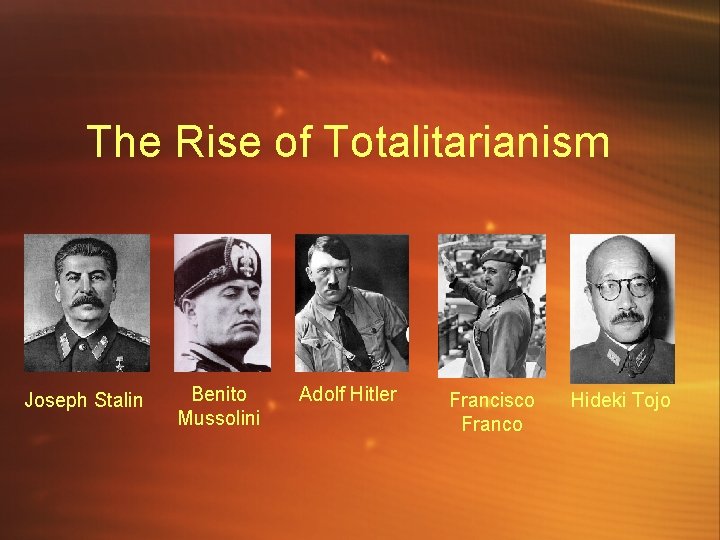
The Rise of Totalitarianism � Joseph Stalin Benito Mussolini Adolf Hitler Francisco Franco Hideki Tojo
Totalitarianism vs. Authoritarianism • 'Authoritarian' refers to the structure of government rather than to society. • Totalitarian regimes seek to control virtually all aspects of the social life. – Including: economy, education, art, science, private life and morals of citizens.

Rise of Totalitarianism • Totalitarianism can be traced back to the Great War. – Attrition made required total effort – War required all institutions & individuals to subordinate their interests to victory • Russia (1917), Italy (1922), Germany (1933), Spain (1939), Japan (1926)
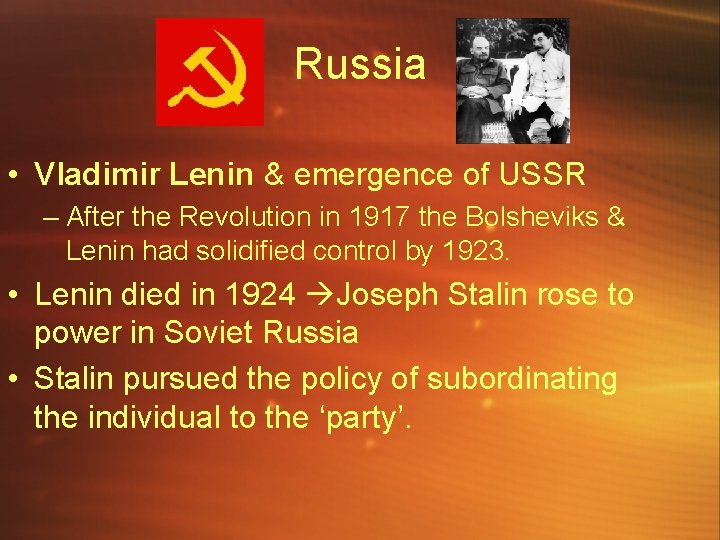
Russia • Vladimir Lenin & emergence of USSR – After the Revolution in 1917 the Bolsheviks & Lenin had solidified control by 1923. • Lenin died in 1924 Joseph Stalin rose to power in Soviet Russia • Stalin pursued the policy of subordinating the individual to the ‘party’.
Stalinism • “Stalinism”- Stalin’s style for the Soviet government – Stalin • Rejected dissent • Stalin = sole interpreter • World wide Communist revolution post-poned – Economic Changes • Rapid Industrialization (Five Year Plans) • Collectivization of Agriculture – Effective BUT… – Purges • Millions killed • Guilty executed or sent to Gulag
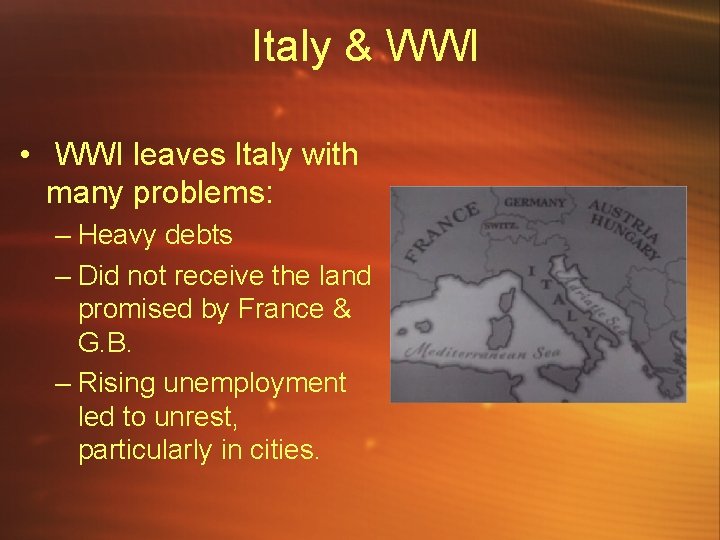
Italy & WWI • WWI leaves Italy with many problems: – Heavy debts – Did not receive the land promised by France & G. B. – Rising unemployment led to unrest, particularly in cities.
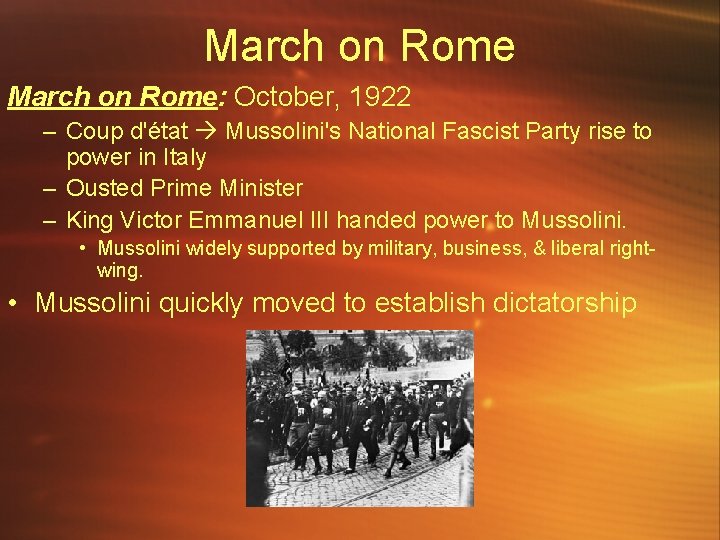
March on Rome: October, 1922 – Coup d'état Mussolini's National Fascist Party rise to power in Italy – Ousted Prime Minister – King Victor Emmanuel III handed power to Mussolini. • Mussolini widely supported by military, business, & liberal rightwing. • Mussolini quickly moved to establish dictatorship
Fascism • Fascism is a combination of many ideas – Corporatism: Power exercised through large organizations (businesses, trade unions) working with each other, directed by the state – Syndicalism: bringing industry & gov’t under control of labor unions – Nationalism, Expansionism, Social Progress, Anti-Communism in combination with censorship & state propaganda – Ideas of racial superiority
Nationalism, Race &Fascism • Struggle of nation & race fundamental in society – Communists emphasized class struggle • Nations bind people by their ancestry • Nations are natural & good • Fascism sought to solve economic, political, and social problems via ‘national rebirth’ – Celebrates the nation & race above all else, – Cults of unity, strength and purity.
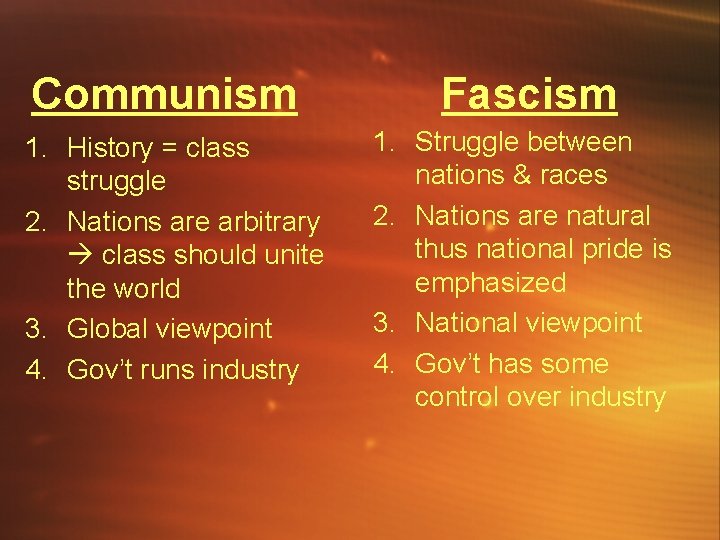
Communism Fascism 1. History = class struggle 2. Nations are arbitrary class should unite the world 3. Global viewpoint 4. Gov’t runs industry 1. Struggle between nations & races 2. Nations are natural thus national pride is emphasized 3. National viewpoint 4. Gov’t has some control over industry
Germany: Weimar Republic • A parliamentary republic established in 1919. • Faced numerous problems – Hyperinflation – Political extremists – War Reparations • Collapsed in the early 1930 s
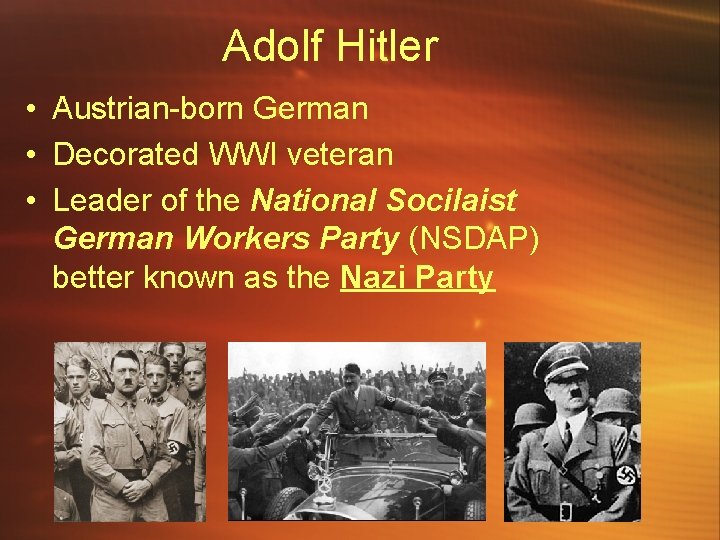
Adolf Hitler • Austrian-born German • Decorated WWI veteran • Leader of the National Socilaist German Workers Party (NSDAP) better known as the Nazi Party
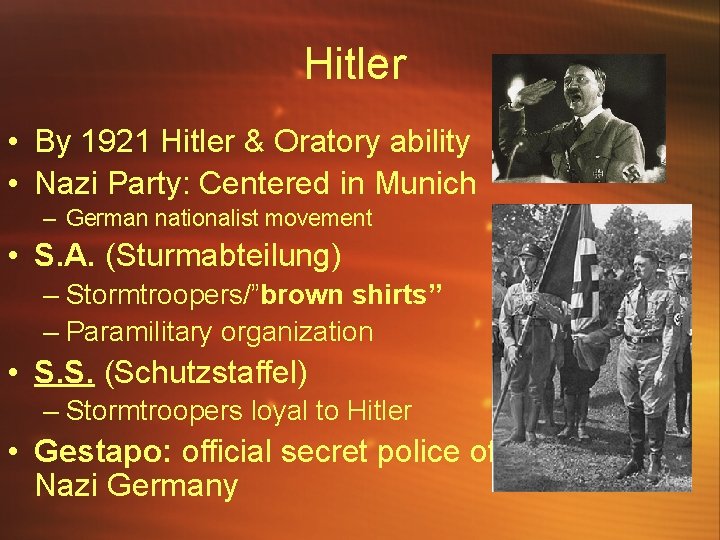
Hitler • By 1921 Hitler & Oratory ability • Nazi Party: Centered in Munich – German nationalist movement • S. A. (Sturmabteilung) – Stormtroopers/”brown shirts” – Paramilitary organization • S. S. (Schutzstaffel) – Stormtroopers loyal to Hitler • Gestapo: official secret police of Nazi Germany
Beer Hall Putsch November, 1923 • Failed Coup attempt • Hitler wanted to emulate the March on Rome • November 8 th: Declares a new government in a Beer Hall • November 9 th –The March Begins – To Bavarian War Ministry – Clash with police and march destroyed
Arrest, Trial, Prison • Hitler arrested for High Treason • Trial • Uses trial as a platform • Gains noteriety & popularity • April 1924 – Sentenced to 5 years – Served less than one year • Mein Kampf: “My Struggle” – Part Autobiography part political rant – Helps spread his ideas.
Strategy of Legality • Hitler changed his strategy to come to power. • The Strategy of Legality: – adhere to the rules of Weimar – Use the institutions of Weimar Republic to destroy it/come to power
Depression, Election • By 1930 the Depression strikes Germany • President Paul von Hindenburg ran for reelection in 1932 – The only one who could defeat Hitler – Wins election – Has difficulty fending off Nazis • 1933 Hindenburg appointed Hitler Chancellor of Germany
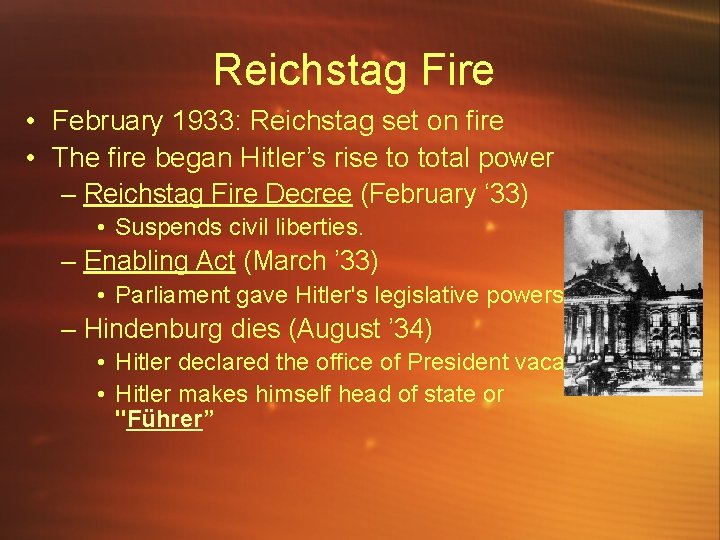
Reichstag Fire • February 1933: Reichstag set on fire • The fire began Hitler’s rise to total power – Reichstag Fire Decree (February ‘ 33) • Suspends civil liberties. – Enabling Act (March ’ 33) • Parliament gave Hitler's legislative powers. – Hindenburg dies (August ’ 34) • Hitler declared the office of President vacant • Hitler makes himself head of state or "Führer”
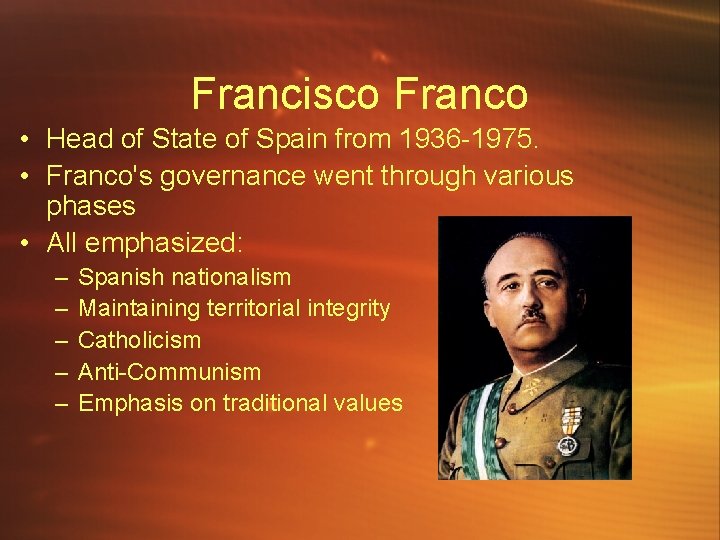
Francisco Franco • Head of State of Spain from 1936 -1975. • Franco's governance went through various phases • All emphasized: – – – Spanish nationalism Maintaining territorial integrity Catholicism Anti-Communism Emphasis on traditional values
Spanish Civil War • 1936 -1939: It began after a coup by Spanish Army Generals • The war ended with the victory of the rebel forces – Republican gov’t overthrown – Dictatorship established with Franco at its helm.
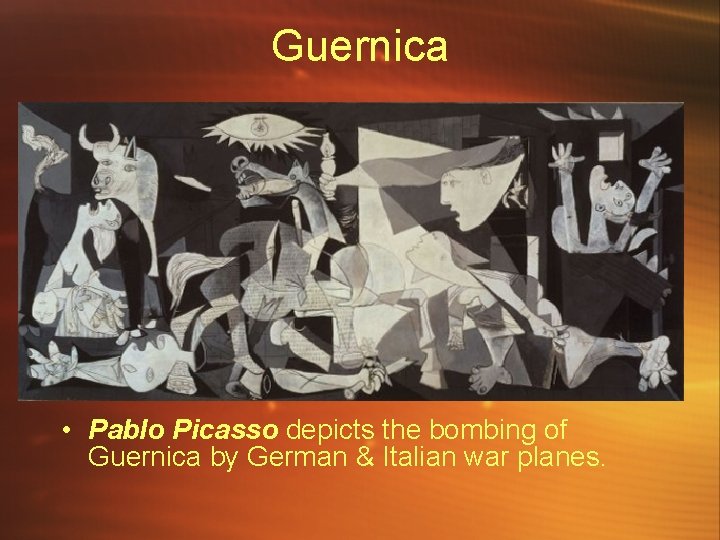
Guernica • Pablo Picasso depicts the bombing of Guernica by German & Italian war planes.
The Empire of Japan • Rapid industrialization and Militarization emergence as a world power – Leads to membership in the Axis Alliance of WWII • Gained notoriety war crimes against the people within their Empire.
Timeline • 1931 -32 • 1937 – Japan invades Manchuria – Japan – full scale invasion of China (Rape of Nanking) • 1935: • 1938 – Italy invades Ethiopia – Anschluss: Germany invades/ – Germany reintroduces annex Austria Conscription (violation) – Hitler claims Sudetenland • 1936 – Germany seizes – Germany Remilitarized Czechoslovakia Rhineland – Franco revolts against • 1939 Spainish Gov’t. – Italy invades/annexes Albania – Tripartate Pact: – Hitler demands Danzig (Poland) – First Concentration Camps – Sept. 1, 1939
- Slides: 23