Stacks CSE 3318 Algorithms and Data Structures Alexandra
- Slides: 23
Stacks CSE 3318 – Algorithms and Data Structures Alexandra Stefan University of Texas at Arlington 6/14/2021 1
General Queues • A queue (as a general concept) is a data type that stores a set of objects. – Let's use Item to denote the type of each object. • Operations that a queue supports are: – void insert(Queue q, Item x) - adds object x to set q. Want time complexity Θ(1) – Item delete(Queue q) - choose an object x, remove that object from q, and return it to the calling function. Want time complexity Θ(1) – Item peek(Queue q) - see what the object that would be deleted next is, but do not remove it from the queue. Return a copy of it or a reference to it. – bool is_empty(Queue q) – bool is_full(Queue q) – Queue create() - may take initial capacity as an argument – void destroy (Queue q) – Queue join(Queue q 1, Queue q 2) - joins two queues • Specialized queues (based on what item delete removes) – – Last inserted -> Stack / Pushdown Stack / LIFO (Last In First Out) First inserted -> FIFO Queue (First In First Out) Item with the smallest key (if each item contains a key) -> Priority Queue (Heap) Random item 2
Stack (Pushdown Stack) Operations: • • push - Puts an item "on top of the stack". pop - Removes the item from the top of the stack (the last item added). Applications • Function execution in computer programs: – when a function is called, it enters the calling stack. The function that leaves the calling stack is always the last one that entered (among functions still in the stack). • • • Provide a non-recursive implementation for problems that need a recursive solution Reverse order (e. g. reverse string) Check if balanced parenthesis Applications where you need to retrace your steps (and possibly try a different action). E. g. maze exploration, placing queens on a board. (Recursive solutions may be easier to write for such problems. ) Interpretation and evaluation of symbolic expressions: – evaluate expressions like (5+2)*(12 -3), or – parse C code (as a first step in the compilation process). • Search methods. – traverse or search a graph • Check leetcode – see what problems require a stack 3
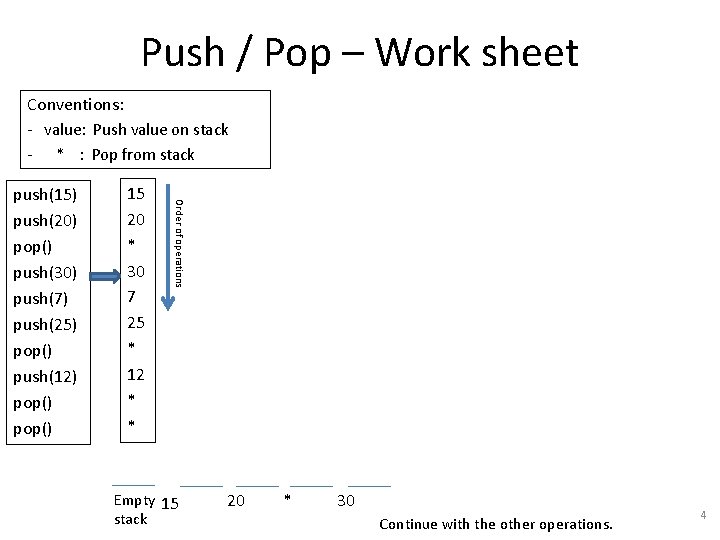
Push / Pop – Work sheet Conventions: - value: Push value on stack - * : Pop from stack 15 20 * 30 7 25 * 12 * * Order of operations push(15) push(20) pop() push(30) push(7) push(25) pop() push(12) pop() Empty 15 stack 20 * 30 Continue with the other operations. 4
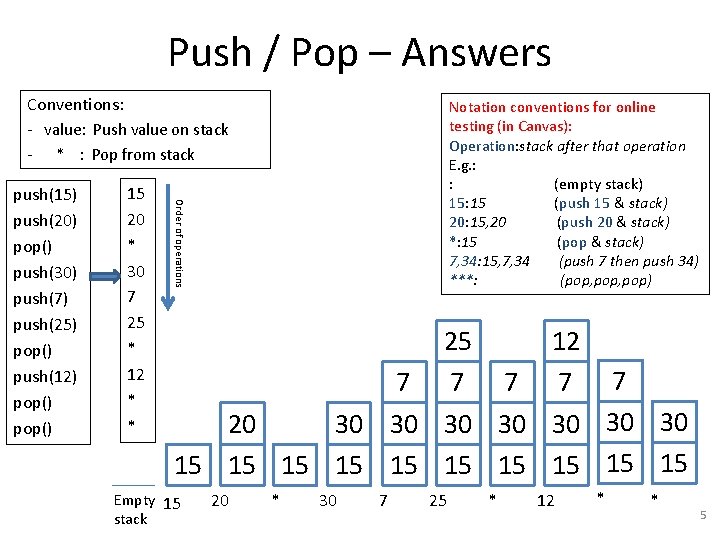
Push / Pop – Answers Conventions: Notation conventions for online testing (in Canvas): Operation: stack after that operation E. g. : : (empty stack) 15: 15 (push 15 & stack) 20: 15, 20 (push 20 & stack) *: 15 (pop & stack) 7, 34: 15, 7, 34 (push 7 then push 34) ***: (pop, pop) - value: Push value on stack - * : Pop from stack 15 20 * 30 7 25 * 12 * * Order of operations push(15) push(20) pop() push(30) push(7) push(25) pop() push(12) pop() 25 12 7 7 7 20 30 30 15 15 15 Empty 15 stack 20 * 30 7 25 * 12 * * 5
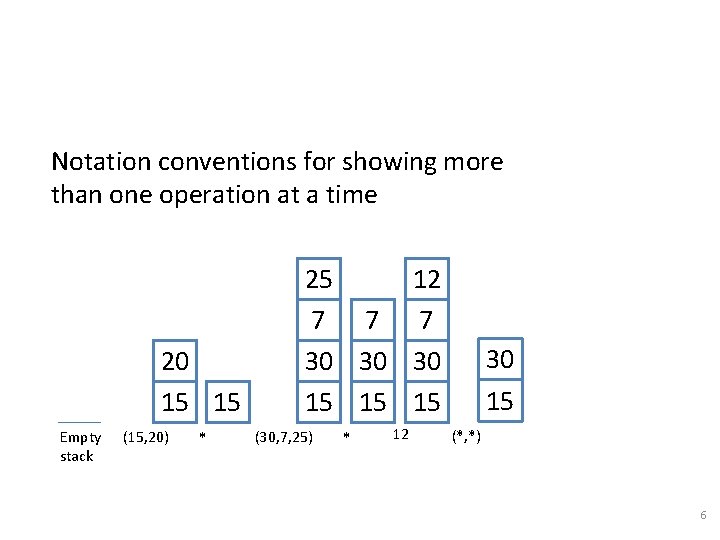
Notation conventions for showing more than one operation at a time 20 15 15 Empty stack (15, 20) * 25 12 7 7 7 30 30 30 15 15 15 (30, 7, 25) * 12 30 15 (*, *) 6
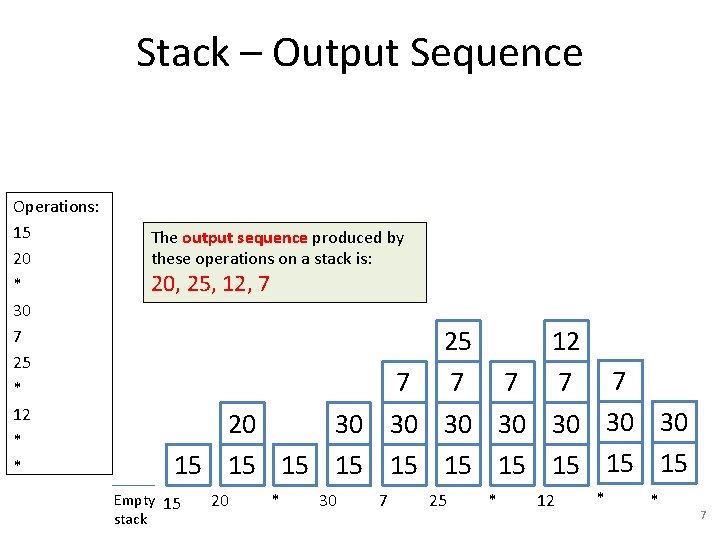
Stack – Output Sequence Operations: 15 20 * 30 7 25 * 12 * * The output sequence produced by these operations on a stack is: 20, 25, 12, 7 25 12 7 7 7 20 30 30 15 15 15 Empty 15 stack 20 * 30 7 25 * 12 * * 7
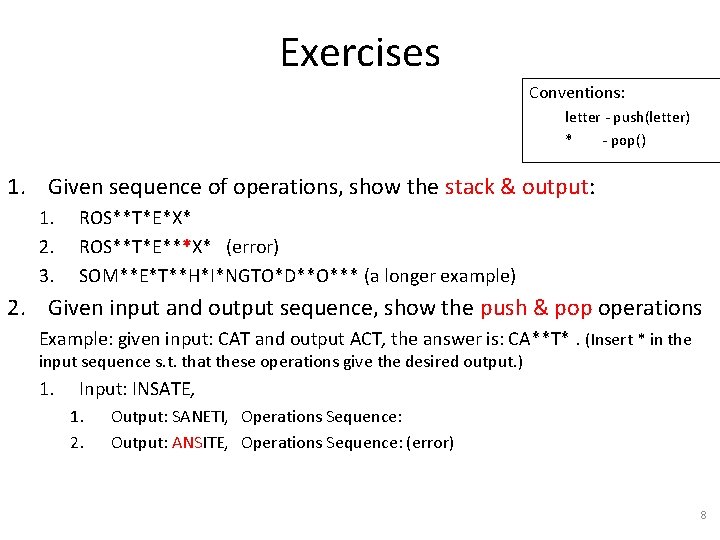
Exercises Conventions: letter - push(letter) * - pop() 1. Given sequence of operations, show the stack & output: 1. 2. 3. ROS**T*E*X* ROS**T*E***X* (error) SOM**E*T**H*I*NGTO*D**O*** (a longer example) 2. Given input and output sequence, show the push & pop operations Example: given input: CAT and output ACT, the answer is: CA**T*. (Insert * in the input sequence s. t. that these operations give the desired output. ) 1. Input: INSATE, 1. 2. Output: SANETI, Operations Sequence: Output: ANSITE, Operations Sequence: (error) 8
Implementing Stacks • A stack can be implemented using: – Linked lists or – arrays • Both implementations are fairly straightforward. 9
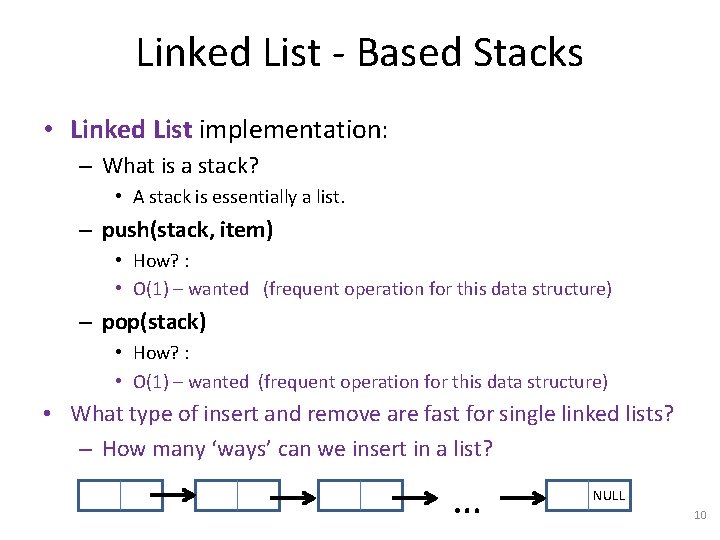
Linked List - Based Stacks • Linked List implementation: – What is a stack? • A stack is essentially a list. – push(stack, item) • How? : • O(1) – wanted (frequent operation for this data structure) – pop(stack) • How? : • O(1) – wanted (frequent operation for this data structure) • What type of insert and remove are fast for single linked lists? – How many ‘ways’ can we insert in a list? … NULL 10
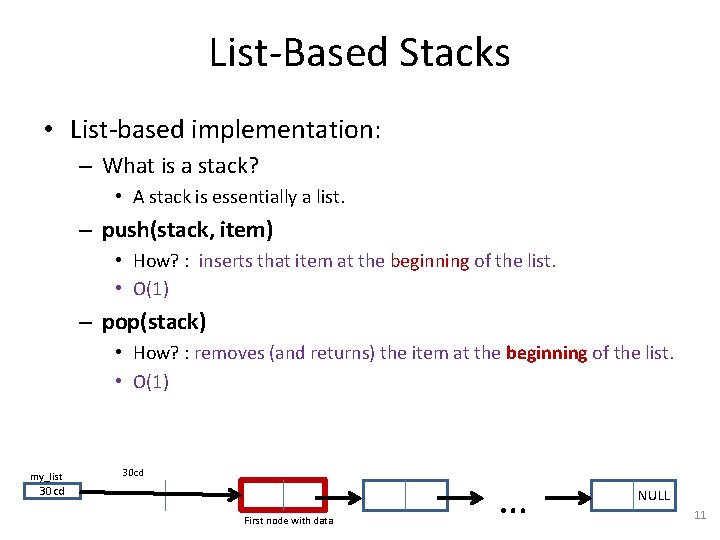
List-Based Stacks • List-based implementation: – What is a stack? • A stack is essentially a list. – push(stack, item) • How? : inserts that item at the beginning of the list. • O(1) – pop(stack) • How? : removes (and returns) the item at the beginning of the list. • O(1) my_list 30 cd First node with data … NULL 11
Array-Based Stacks 12
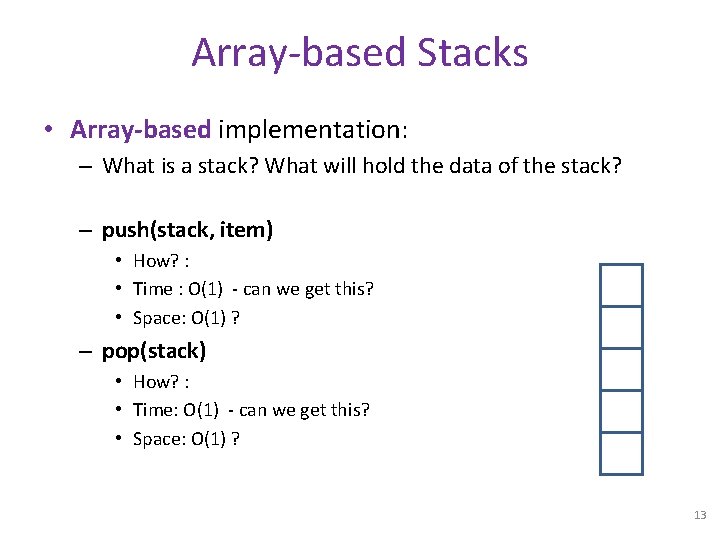
Array-based Stacks • Array-based implementation: – What is a stack? What will hold the data of the stack? – push(stack, item) • How? : • Time : O(1) - can we get this? • Space: O(1) ? – pop(stack) • How? : • Time: O(1) - can we get this? • Space: O(1) ? 13
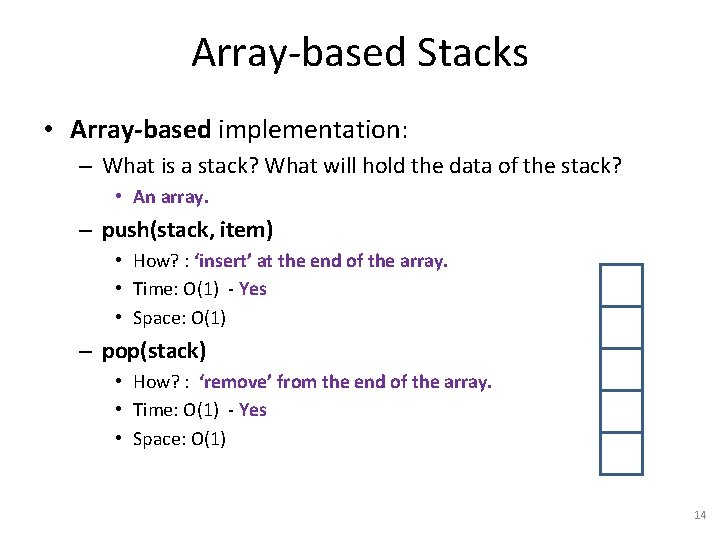
Array-based Stacks • Array-based implementation: – What is a stack? What will hold the data of the stack? • An array. – push(stack, item) • How? : ‘insert’ at the end of the array. • Time: O(1) - Yes • Space: O(1) – pop(stack) • How? : ‘remove’ from the end of the array. • Time: O(1) - Yes • Space: O(1) 14
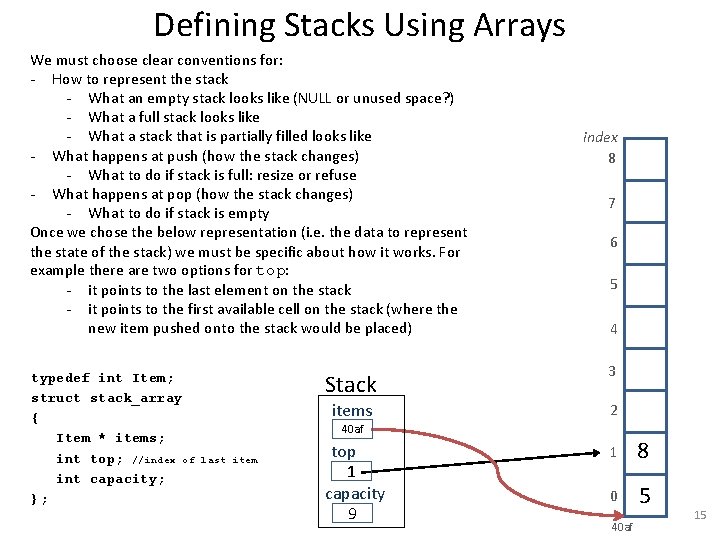
Defining Stacks Using Arrays We must choose clear conventions for: - How to represent the stack - What an empty stack looks like (NULL or unused space? ) - What a full stack looks like - What a stack that is partially filled looks like - What happens at push (how the stack changes) - What to do if stack is full: resize or refuse - What happens at pop (how the stack changes) - What to do if stack is empty Once we chose the below representation (i. e. the data to represent the state of the stack) we must be specific about how it works. For example there are two options for top: - it points to the last element on the stack - it points to the first available cell on the stack (where the new item pushed onto the stack would be placed) typedef int Item; struct stack_array { Item * items; int top; //index of int capacity; }; Stack items index 8 7 6 5 4 3 2 40 af last item top 1 capacity 9 1 8 0 55 5 40 af 15
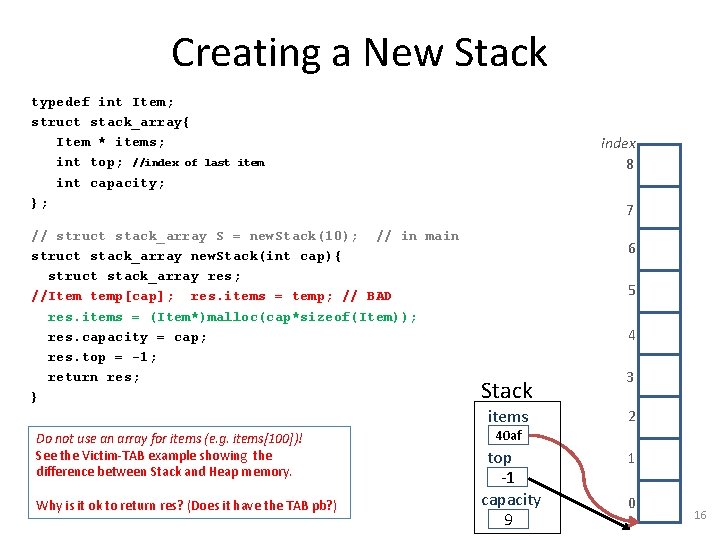
Creating a New Stack typedef int Item; struct stack_array{ Item * items; int top; //index of int capacity; }; index 8 last item // struct stack_array S = new. Stack(10); // in main struct stack_array new. Stack(int cap){ struct stack_array res; //Item temp[cap]; res. items = temp; // BAD res. items = (Item*)malloc(cap*sizeof(Item)); res. capacity = cap; res. top = -1; return res; } Do not use an array for items (e. g. items[100])! See the Victim-TAB example showing the difference between Stack and Heap memory. Why is it ok to return res? (Does it have the TAB pb? ) 7 6 5 4 Stack 3 items 2 top -1 capacity 9 1 40 af 0 55 16
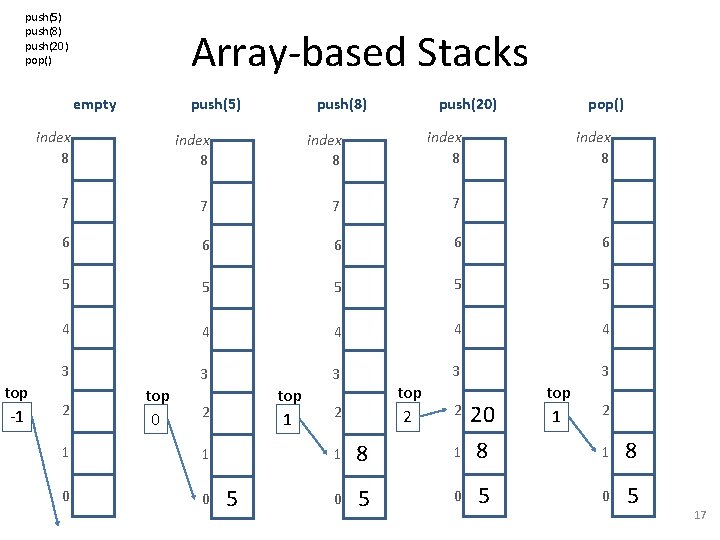
push(5) push(8) push(20) pop() Array-based Stacks empty top -1 push(8) push(5) push(20) pop() index 8 index 8 7 7 7 6 6 6 5 5 5 4 4 4 3 3 3 2 top 0 2 top 1 top 2 2 8 1 1 1 0 55 5 2 20 1 8 0 55 5 top 1 2 1 8 0 55 5 17
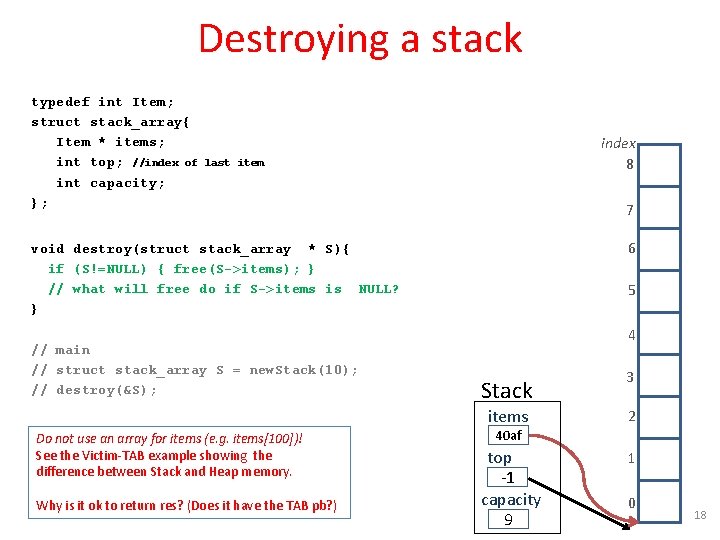
Destroying a stack typedef int Item; struct stack_array{ Item * items; int top; //index of int capacity; }; index 8 last item 7 6 void destroy(struct stack_array * S){ if (S!=NULL) { free(S->items); } // what will free do if S->items is NULL? } // main // struct stack_array S = new. Stack(10); // destroy(&S); Do not use an array for items (e. g. items[100])! See the Victim-TAB example showing the difference between Stack and Heap memory. Why is it ok to return res? (Does it have the TAB pb? ) 5 4 Stack 3 items 2 top -1 capacity 9 1 40 af 0 55 18
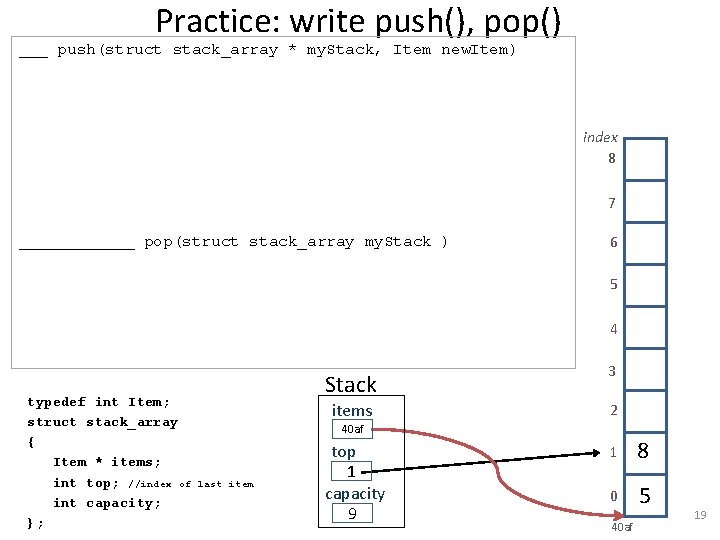
Practice: write push(), pop() ___ push(struct stack_array * my. Stack, Item new. Item) index 8 7 ______ pop(struct stack_array my. Stack ) 6 5 4 typedef int Item; struct stack_array { Item * items; int top; //index of int capacity; }; Stack items 3 2 40 af last item top 1 capacity 9 1 8 0 55 5 40 af 19
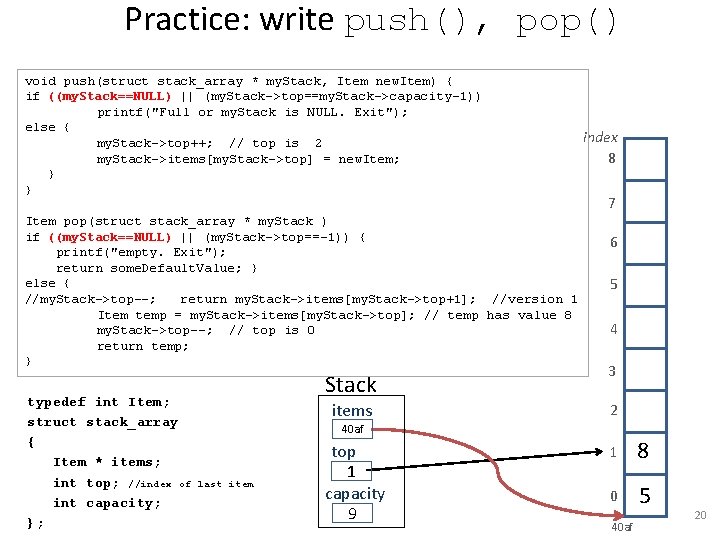
Practice: write push(), pop() void push(struct stack_array * my. Stack, Item new. Item) { if ((my. Stack==NULL) || (my. Stack->top==my. Stack->capacity-1)) printf("Full or my. Stack is NULL. Exit"); else { my. Stack->top++; // top is 2 my. Stack->items[my. Stack->top] = new. Item; } } Item pop(struct stack_array * my. Stack ) if ((my. Stack==NULL) || (my. Stack->top==-1)) { printf("empty. Exit"); return some. Default. Value; } else { //my. Stack->top--; return my. Stack->items[my. Stack->top+1]; //version 1 Item temp = my. Stack->items[my. Stack->top]; // temp has value 8 my. Stack->top--; // top is 0 return temp; } typedef int Item; struct stack_array { Item * items; int top; //index of int capacity; }; Stack items index 8 7 6 5 4 3 2 40 af last item top 1 capacity 9 1 8 0 55 5 40 af 20
Summary and Practice • Summary – Stack – Implementation (code) • Time complexity • Space complexity – Application • Practice from leetcode – 20. Valid Parentheses https: //leetcode. com/problems/valid-parentheses/ – 1544. Make The String Great https: //leetcode. com/problems/make-the-string-great/ – 1190. Reverse Substrings Between Each Pair of Parentheses https: //leetcode. com/problems/reverse-substrings-between-each-pair-ofparentheses/ 21
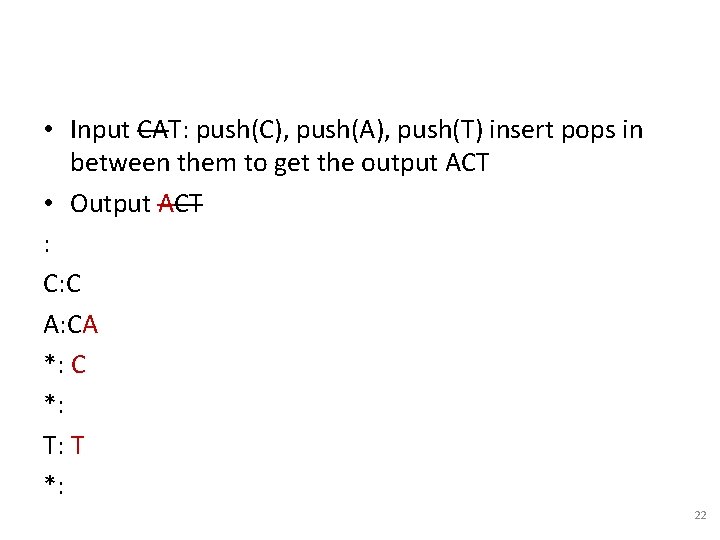
• Input CAT: push(C), push(A), push(T) insert pops in between them to get the output ACT • Output ACT : C: C A: CA *: C *: T: T *: 22
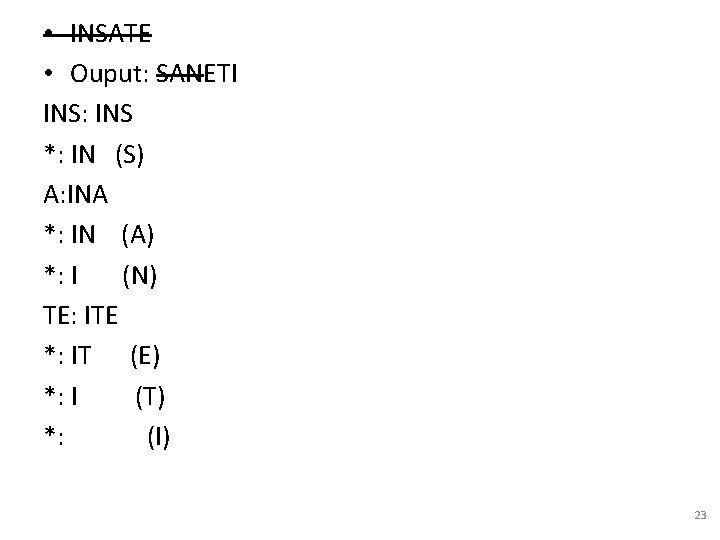
• INSATE • Ouput: SANETI INS: INS *: IN (S) A: INA *: IN (A) *: I (N) TE: ITE *: IT (E) *: I (T) *: (I) 23