Spices Spices are those plants the product of



- Slides: 22
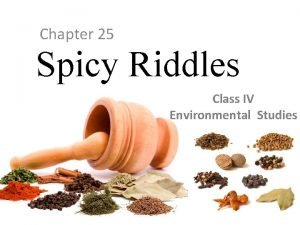
Spices • Spices are those plants, the product of which are used as food adjuncts to add flavor and aroma • Spices which are used as food adjuncts to add taste only are called Condiments. • Spices provide flavor due to presence of essential oils • They are used as a whole, ground, paste or in liquid forms to improve flavour, texture, impart colour and to increase shelf life of eatables, in medicinal preparations, cosmetics and perfumery. • India is the largest producer, consumer and exporter of spices in the world. Spices are one of the major foreign exchange earner crops.
• Since time immemorial, India is known as the land of spices. • There about 109 spices in use all over the world and 20 countries actively engaged in the production and export of one or more of them. • India accounts for more than 30 per cent of the world production. • The total annual average production of spices in India is estimated as 61, 69, 900 tonnes and area under spices is 31, 92, 640 hectare during 2014 -15. • Indian export accounts for 30 to 40 per cent of the world trade and nearly 20 -37 per cent of the foreign exchange is obtained through pepper, the “Black gold” among spices. Next to pepper, cardamom is well known throughout the world for its quality and high oil content. • Apart from two major spices, India produces tree spices like clove, nutmeg and cinnamon. Though tree spices have been in cultivation for more than 150 years, their production is not adequate to meet the internal demand. • Extensive areas are available for spices cultivation in Andaman and Nicobar Islands, Andhra Pradesh, Assam, West Bengal and Meghalaya, besides the southern states where considerable areas are under spices.
Difference between Spices and Condiments Spices Condiments Spice is an aromatic or pungent plant part (fruit, leaves, seed, root, bark, berry, bud, flower or vegetable) used to add flavor and aroma to the food. • Act as antioxidants • Act as antimicrobial compounds Food ingredients such as salt, mustard, or pickle that is used to add only taste to the food. India contributes 75% of spice production throughout the world, and world spice market is continuously growing. Cinnamon, cassia, nutmeg, mace, fennel, mustard, black pepper etc. are examples of spices The condiment trade is the second biggest market in specialty foods after that of cheese. • To enhance colour • To enhance flavour Barbecue sauce, compound butter, teriyaki sauce, soy sauce, marmite, ketchup, mustard, and mayonnaise are examples of condiments.
Major Spice Research Institutes in India • Central Plantation Crops Research Institute Kasargod, Kerela • Indian Institute of Spice Research, Calicut (Kerela) • National Research Centre for cardamom, Affangald, Mereata • National Research Centre for onion and garlic, Rajguru Nagar, Pune (Maharashtra) • National Research Centre for Seed Spices, Tabiji, Ajmer (Rajasthan)
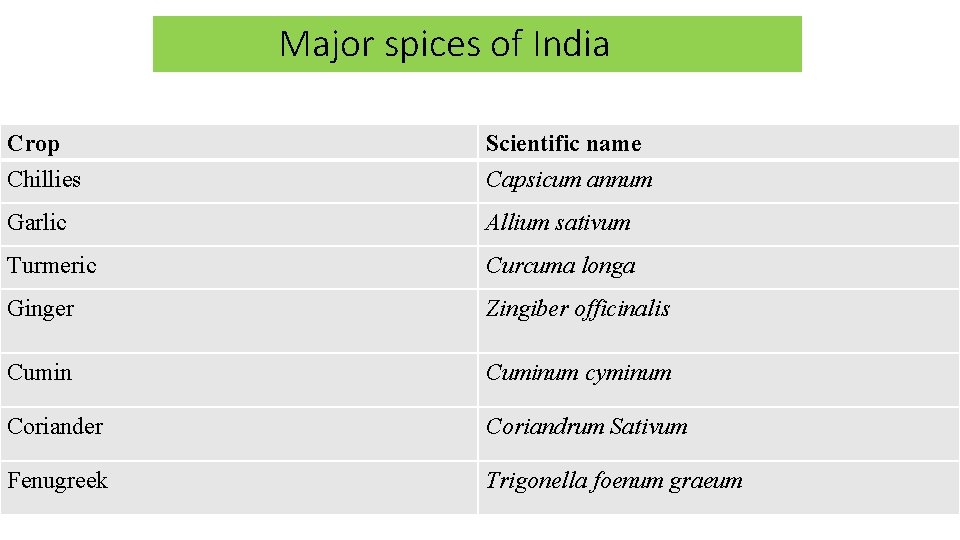
Major spices of India Crop Chillies Scientific name Capsicum annum Garlic Allium sativum Turmeric Curcuma longa Ginger Zingiber officinalis Cuminum cyminum Coriander Coriandrum Sativum Fenugreek Trigonella foenum graeum
Chilli Fenugreek Turmeric Coriander Garlic Ginger Cumin
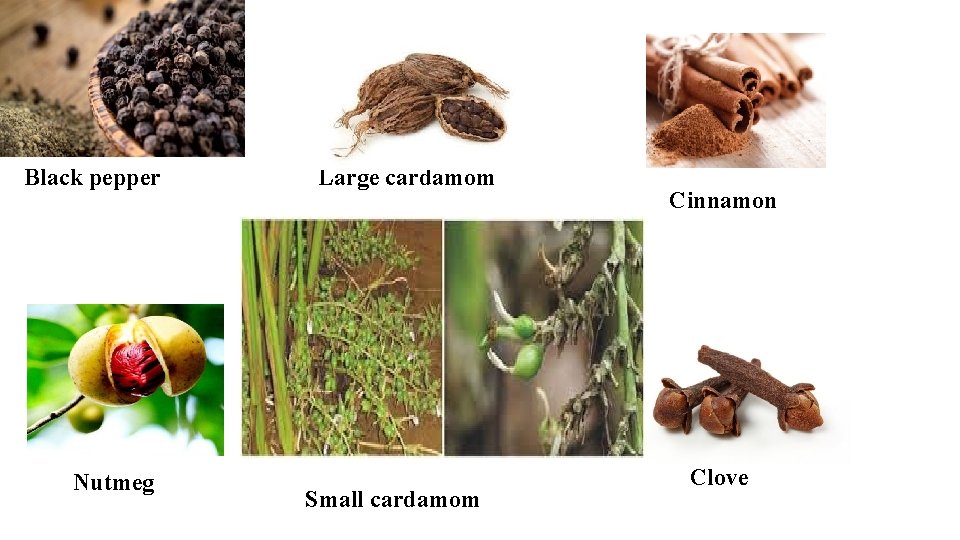
Black pepper Nutmeg Large cardamom Small cardamom Cinnamon Clove
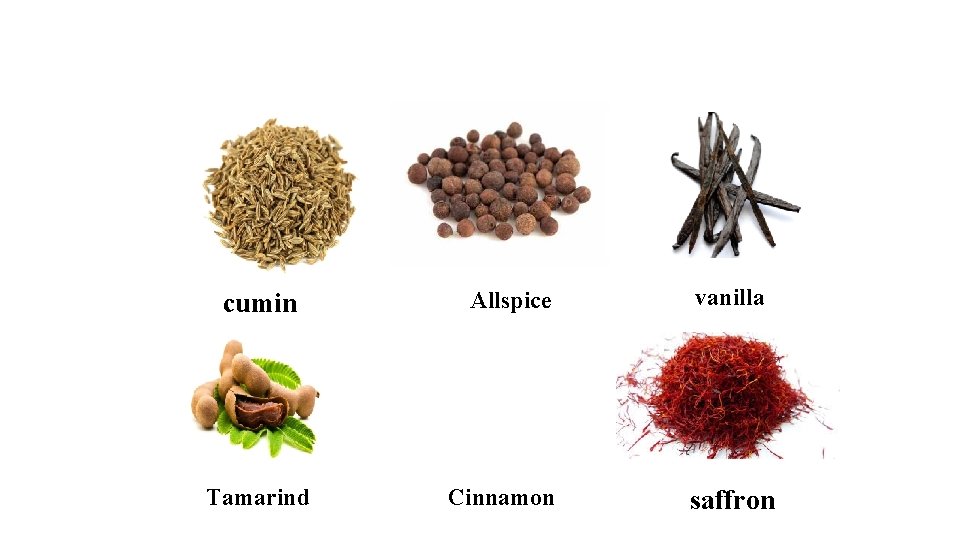
cumin Tamarind Allspice Cinnamon vanilla saffron
Minor spices Caper(Sharaarat masala)Horse Radish(Sahijan masaala)Sweet Flag (Dhvaj masaala) Star Anise(Saumph masaala) Hyssop(Zufah-yabis) Asafoetida(Hing)
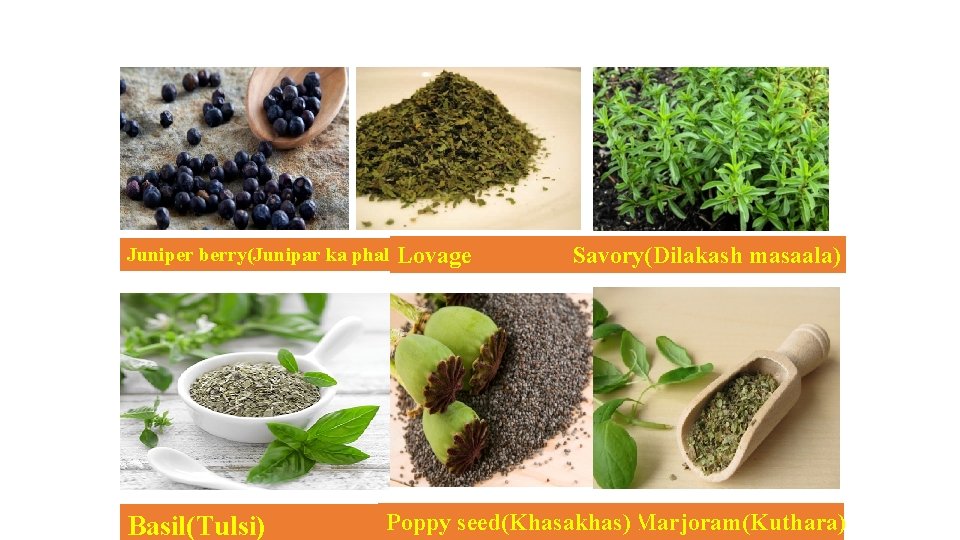
Juniper berry(Junipar ka phal)Lovage Basil(Tulsi) Savory(Dilakash masaala) Poppy seed(Khasakhas) Marjoram(Kuthara)
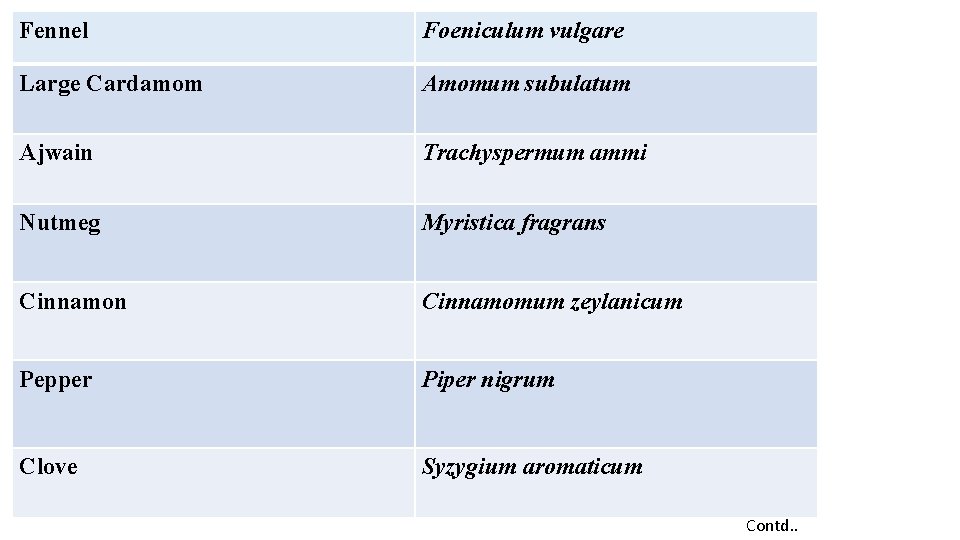
Fennel Foeniculum vulgare Large Cardamom Amomum subulatum Ajwain Trachyspermum ammi Nutmeg Myristica fragrans Cinnamon Cinnamomum zeylanicum Pepper Piper nigrum Clove Syzygium aromaticum Contd. .
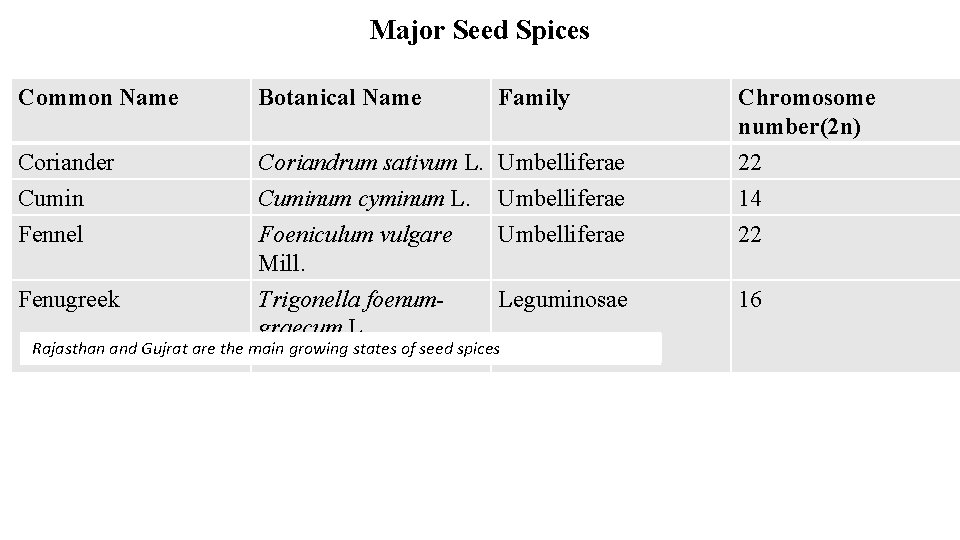
Major Seed Spices Common Name Botanical Name Coriander Cumin Coriandrum sativum L. Umbelliferae Cuminum cyminum L. Umbelliferae Fennel Foeniculum vulgare Mill. Trigonella foenumgraecum L. Fenugreek Family Chromosome number(2 n) 22 14 Umbelliferae 22 Leguminosae 16 Rajasthan and Gujrat are the main growing states of seed spices
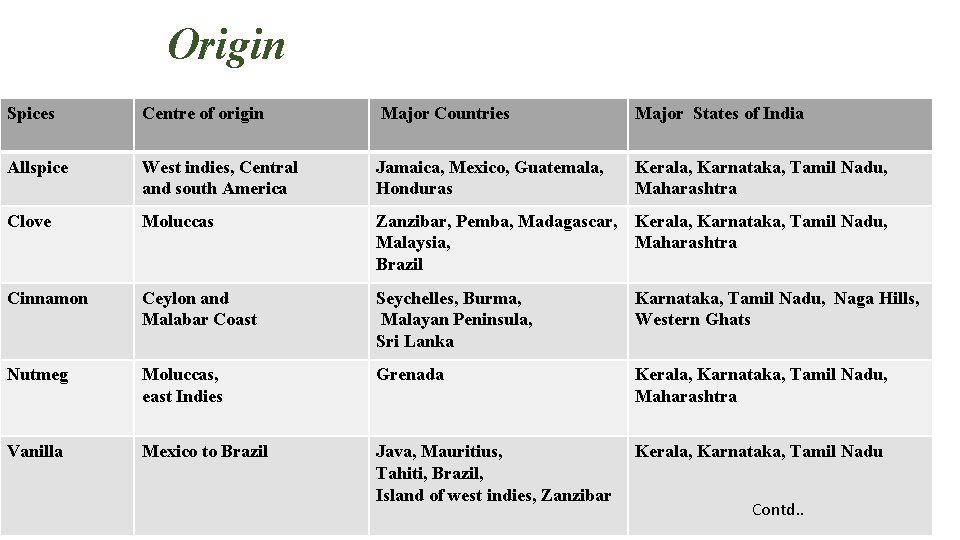
Origin Spices Centre of origin Major Countries Major States of India Allspice West indies, Central and south America Jamaica, Mexico, Guatemala, Honduras Kerala, Karnataka, Tamil Nadu, Maharashtra Clove Moluccas Zanzibar, Pemba, Madagascar, Kerala, Karnataka, Tamil Nadu, Malaysia, Maharashtra Brazil Cinnamon Ceylon and Malabar Coast Seychelles, Burma, Malayan Peninsula, Sri Lanka Karnataka, Tamil Nadu, Naga Hills, Western Ghats Nutmeg Moluccas, east Indies Grenada Kerala, Karnataka, Tamil Nadu, Maharashtra Vanilla Mexico to Brazil Java, Mauritius, Tahiti, Brazil, Island of west indies, Zanzibar Kerala, Karnataka, Tamil Nadu Contd. .
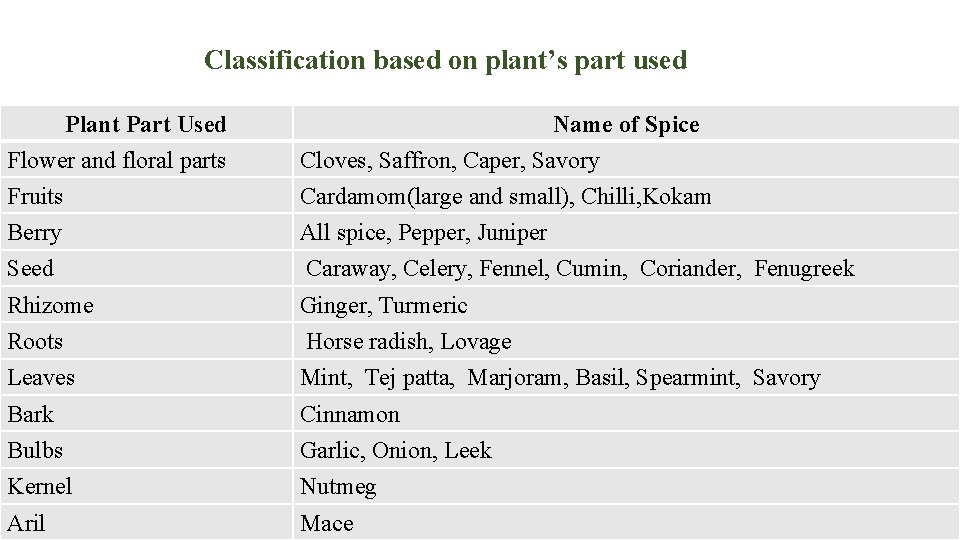
Classification based on plant’s part used Plant Part Used Flower and floral parts Fruits Name of Spice Cloves, Saffron, Caper, Savory Cardamom(large and small), Chilli, Kokam Berry All spice, Pepper, Juniper Seed Caraway, Celery, Fennel, Cumin, Coriander, Fenugreek Rhizome Ginger, Turmeric Roots Horse radish, Lovage Leaves Mint, Tej patta, Marjoram, Basil, Spearmint, Savory Bark Cinnamon Bulbs Garlic, Onion, Leek Kernel Nutmeg Aril Mace
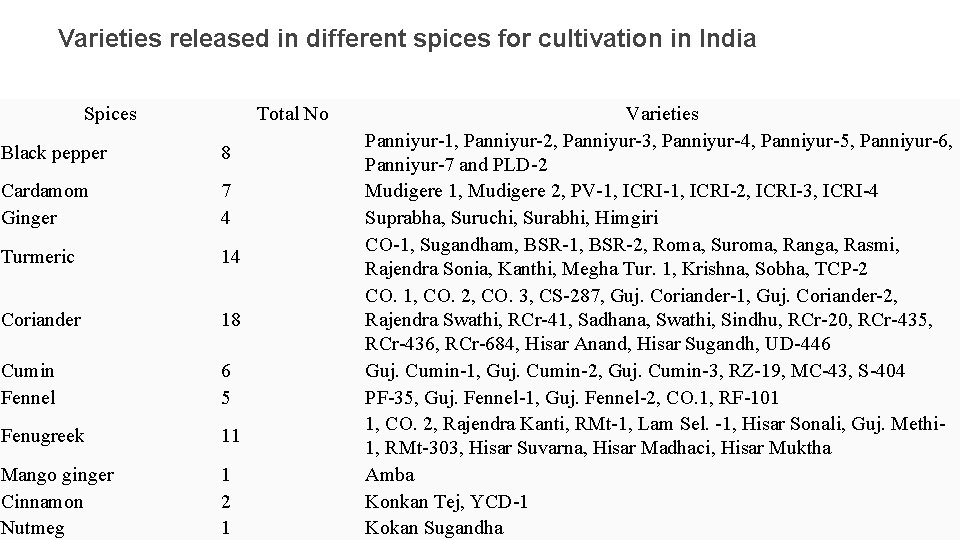
Varieties released in different spices for cultivation in India Spices Total No Black pepper 8 Cardamom Ginger 7 4 Turmeric 14 Coriander 18 Cumin Fennel 6 5 Fenugreek 11 Mango ginger Cinnamon Nutmeg 1 2 1 Varieties Panniyur-1, Panniyur-2, Panniyur-3, Panniyur-4, Panniyur-5, Panniyur-6, Panniyur-7 and PLD-2 Mudigere 1, Mudigere 2, PV-1, ICRI-2, ICRI-3, ICRI-4 Suprabha, Suruchi, Surabhi, Himgiri CO-1, Sugandham, BSR-1, BSR-2, Roma, Suroma, Ranga, Rasmi, Rajendra Sonia, Kanthi, Megha Tur. 1, Krishna, Sobha, TCP-2 CO. 1, CO. 2, CO. 3, CS-287, Guj. Coriander-1, Guj. Coriander-2, Rajendra Swathi, RCr-41, Sadhana, Swathi, Sindhu, RCr-20, RCr-435, RCr-436, RCr-684, Hisar Anand, Hisar Sugandh, UD-446 Guj. Cumin-1, Guj. Cumin-2, Guj. Cumin-3, RZ-19, MC-43, S-404 PF-35, Guj. Fennel-1, Guj. Fennel-2, CO. 1, RF-101 1, CO. 2, Rajendra Kanti, RMt-1, Lam Sel. -1, Hisar Sonali, Guj. Methi 1, RMt-303, Hisar Suvarna, Hisar Madhaci, Hisar Muktha Amba Konkan Tej, YCD-1 Kokan Sugandha
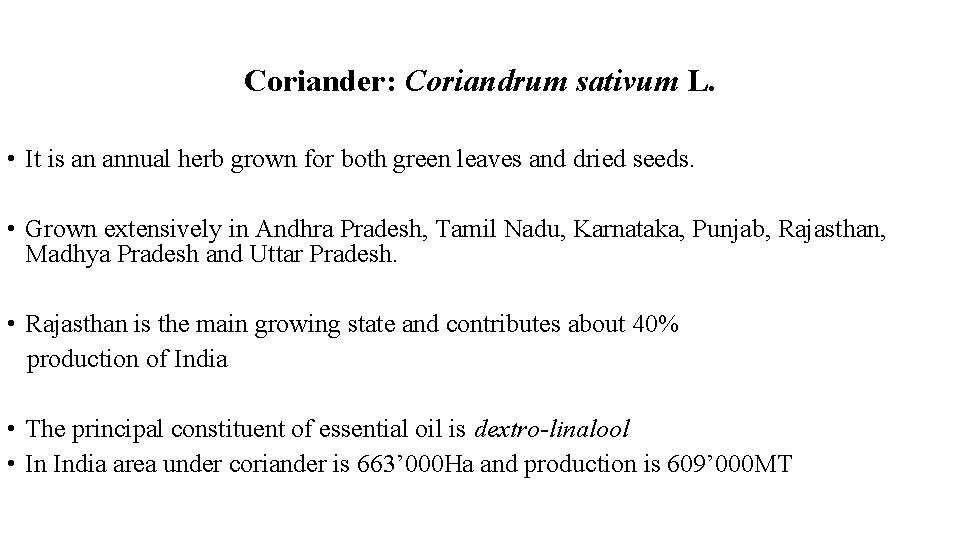
Coriander: Coriandrum sativum L. • It is an annual herb grown for both green leaves and dried seeds. • Grown extensively in Andhra Pradesh, Tamil Nadu, Karnataka, Punjab, Rajasthan, Madhya Pradesh and Uttar Pradesh. • Rajasthan is the main growing state and contributes about 40% production of India • The principal constituent of essential oil is dextro-linalool • In India area under coriander is 663’ 000 Ha and production is 609’ 000 MT
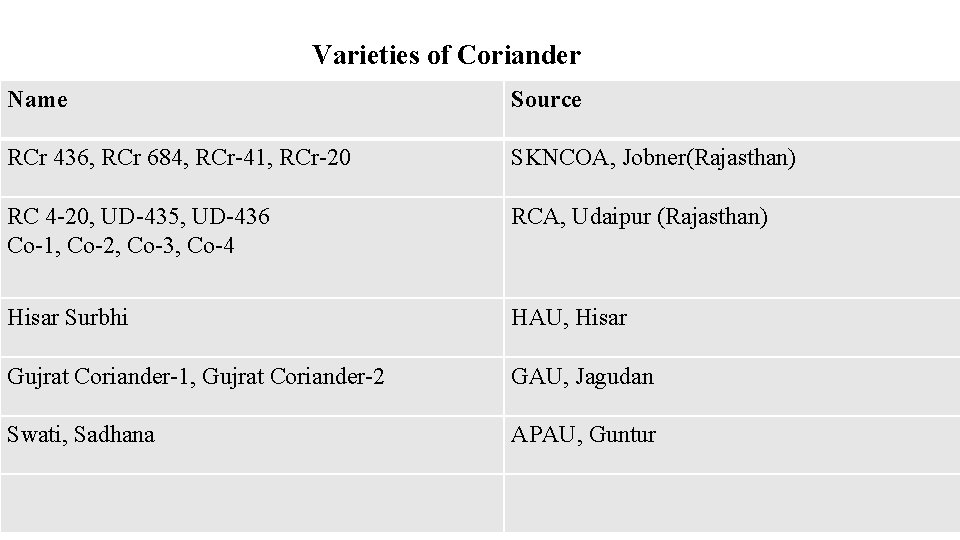
Varieties of Coriander Name Source RCr 436, RCr 684, RCr-41, RCr-20 SKNCOA, Jobner(Rajasthan) RC 4 -20, UD-435, UD-436 Co-1, Co-2, Co-3, Co-4 RCA, Udaipur (Rajasthan) Hisar Surbhi HAU, Hisar Gujrat Coriander-1, Gujrat Coriander-2 GAU, Jagudan Swati, Sadhana APAU, Guntur
Climate It is a tropical crop grown during cool season. Coriander is susceptible to frost particularly during flowering and grain formation stages. Cloudy weather during flowering and fruiting lead to insect-pest and disease attacks. Heavy rains affect the product quality. Moderately cool and dry weather during seed formation stage influences yield and quality of the produce. Soil and Field Preparation Can be grown in all types of soils rich in organic matter. However, loamy soils are the best. Crop is sensitive to saline and alkaline soils. One deep ploughing with a soil turning plough followed by 2 -3 light ploughings for making fine tilth Presowing irrigation is desirable for better germination
Manures and Fertilizers Apply well rotten FYM @ 200 q/ha N: P: K- @ 20: 30: 20. Besides, 40 kg N/ha into two equal splits at 30 and 60 days after sowing Sowing Time Area Sowing time Northern and central India and Mid- October to mid Andhra Pradesh November Tamil Nadu June- July and September. October Under rain- fed conditions September- October
Sowing Method and Seed Rate • 10 -15 kg/ha seed is sufficient for irrigated conditions while 25 to 30 kg/ha for unirrigated conditions • Seed splits into two halves by rubbing. Treatment of seed with Thiram @ 2. 5 g/kg seed is desirable. • Soaking of seeds in water for 12 -24 hours before sowing enhance seed germination • Optimum spacing: 30 × 15 cm. Irrigation First irrigation should be given after three days of sowing and thereafter at 10 -15 days interval, depending upon the availability of soil moisture. In general five irrigations are required at 30 -35 days, 60 -70 days, 100 -105 days and 110115 days after sowing Weed Control Critical stage is initial stage as growth of weeds is much faster than the crop First weeding and hoeing is done 25 days after sowing and second at 50 days after sowing Pre- emergence application of Pendimethalin/Stomp @ 1 kg/ha followed by one hand weeding at 25 days after sowing
Harvesting Coriander matures in about 90 -145 days depending upon the variety and growing conditions Change in colour from green to yellow colour of grains is an indication of maturity Harvesting should be done when 50% grains turn yellow. Delay in harvest leads to shattering and splitting od grains Yield Under rain-fed conditions: 6 -8 q/ha Irrigated conditions: 10 -12 q/ha
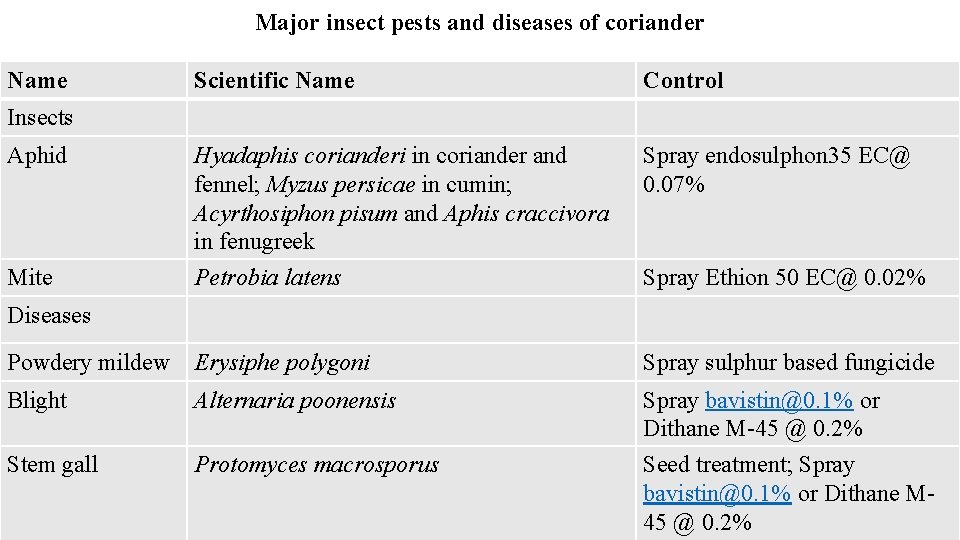
Major insect pests and diseases of coriander Name Scientific Name Control Aphid Hyadaphis corianderi in coriander and fennel; Myzus persicae in cumin; Acyrthosiphon pisum and Aphis craccivora in fenugreek Spray endosulphon 35 EC@ 0. 07% Mite Petrobia latens Spray Ethion 50 EC@ 0. 02% Insects Diseases Powdery mildew Erysiphe polygoni Spray sulphur based fungicide Blight Alternaria poonensis Stem gall Protomyces macrosporus Spray bavistin@0. 1% or Dithane M-45 @ 0. 2% Seed treatment; Spray bavistin@0. 1% or Dithane M 45 @ 0. 2%