Sparsity constraint Code energy Input decoding Code prediction



- Slides: 56
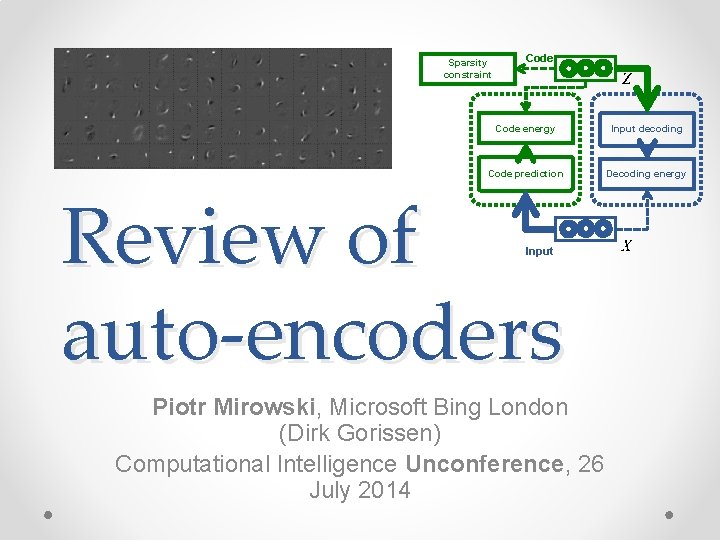
Sparsity constraint Code energy Input decoding Code prediction Decoding energy Review of auto-encoders Input Piotr Mirowski, Microsoft Bing London (Dirk Gorissen) Computational Intelligence Unconference, 26 July 2014
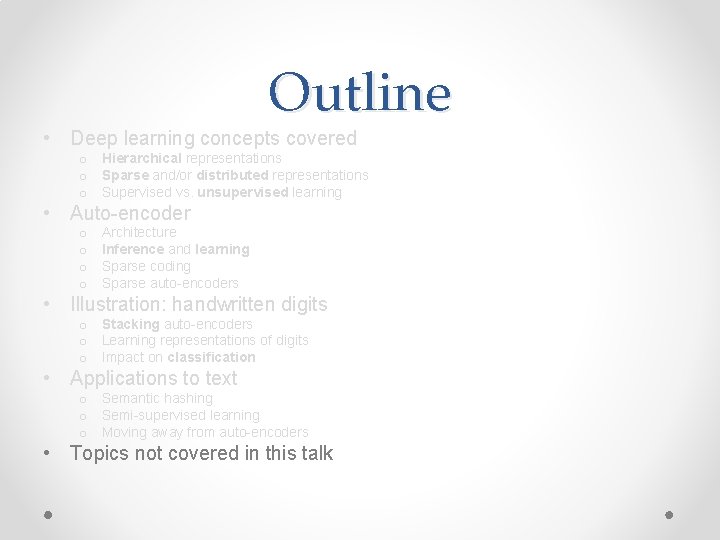
Outline • Deep learning concepts covered o Hierarchical representations o Sparse and/or distributed representations o Supervised vs. unsupervised learning • Auto-encoder o o Architecture Inference and learning Sparse coding Sparse auto-encoders • Illustration: handwritten digits o Stacking auto-encoders o Learning representations of digits o Impact on classification • Applications to text o Semantic hashing o Semi-supervised learning o Moving away from auto-encoders • Topics not covered in this talk
Outline • Deep learning concepts covered o Hierarchical representations o Sparse and/or distributed representations o Supervised vs. unsupervised learning • Auto-encoder o o Architecture Inference and learning Sparse coding Sparse auto-encoders • Illustration: handwritten digits o Stacking auto-encoders o Learning representations of digits o Impact on classification • Applications to text o Semantic hashing o Semi-supervised learning o Moving away from auto-encoders • Topics not covered in this talk
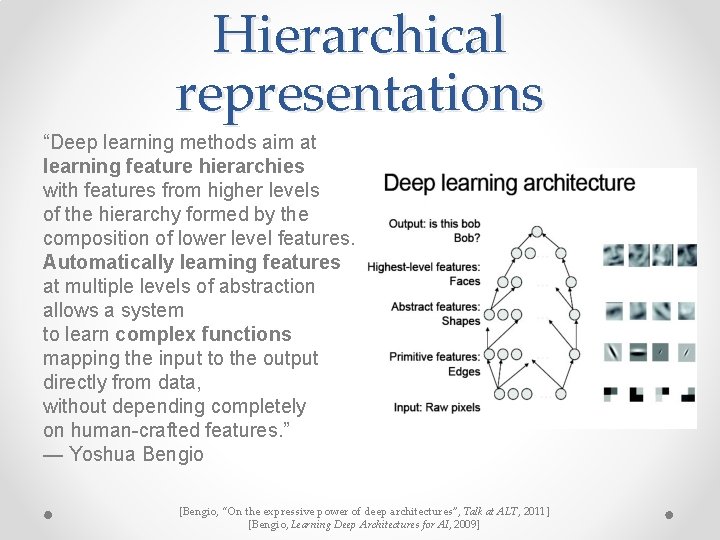
Hierarchical representations “Deep learning methods aim at learning feature hierarchies with features from higher levels of the hierarchy formed by the composition of lower level features. Automatically learning features at multiple levels of abstraction allows a system to learn complex functions mapping the input to the output directly from data, without depending completely on human-crafted features. ” — Yoshua Bengio [Bengio, “On the expressive power of deep architectures”, Talk at ALT, 2011] [Bengio, Learning Deep Architectures for AI, 2009]
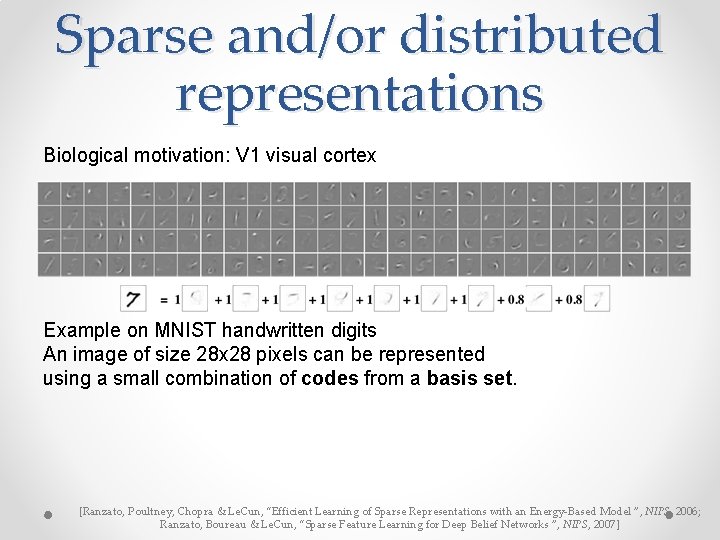
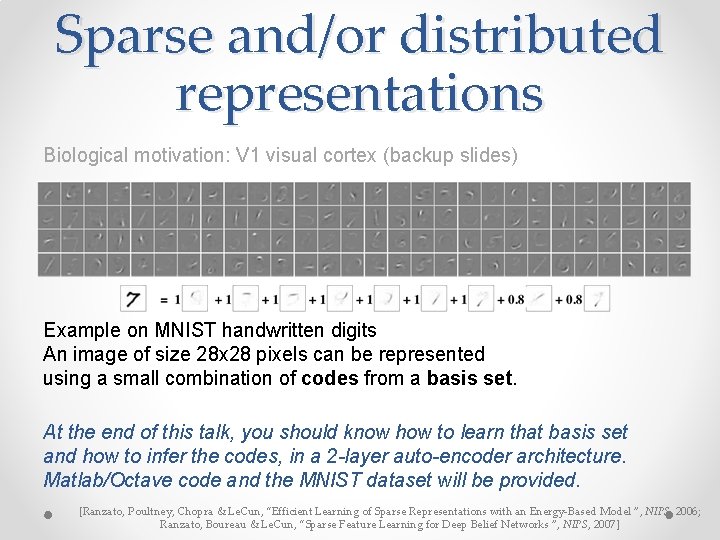
Sparse and/or distributed representations Biological motivation: V 1 visual cortex Example on MNIST handwritten digits An image of size 28 x 28 pixels can be represented using a small combination of codes from a basis set. [Ranzato, Poultney, Chopra & Le. Cun, “Efficient Learning of Sparse Representations with an Energy-Based Model ”, NIPS, 2006; Ranzato, Boureau & Le. Cun, “Sparse Feature Learning for Deep Belief Networks ”, NIPS, 2007]
Sparse and/or distributed representations Biological motivation: V 1 visual cortex (backup slides) Example on MNIST handwritten digits An image of size 28 x 28 pixels can be represented using a small combination of codes from a basis set. At the end of this talk, you should know how to learn that basis set and how to infer the codes, in a 2 -layer auto-encoder architecture. Matlab/Octave code and the MNIST dataset will be provided. [Ranzato, Poultney, Chopra & Le. Cun, “Efficient Learning of Sparse Representations with an Energy-Based Model ”, NIPS, 2006; Ranzato, Boureau & Le. Cun, “Sparse Feature Learning for Deep Belief Networks ”, NIPS, 2007]
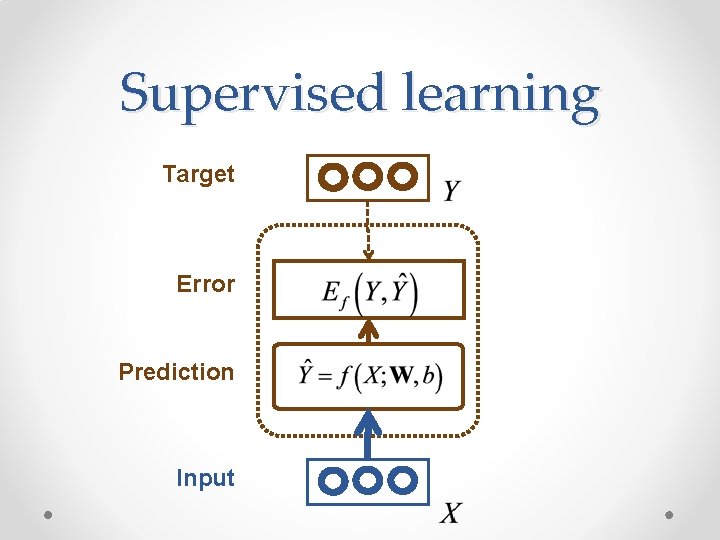
Supervised learning Target Error Prediction Input
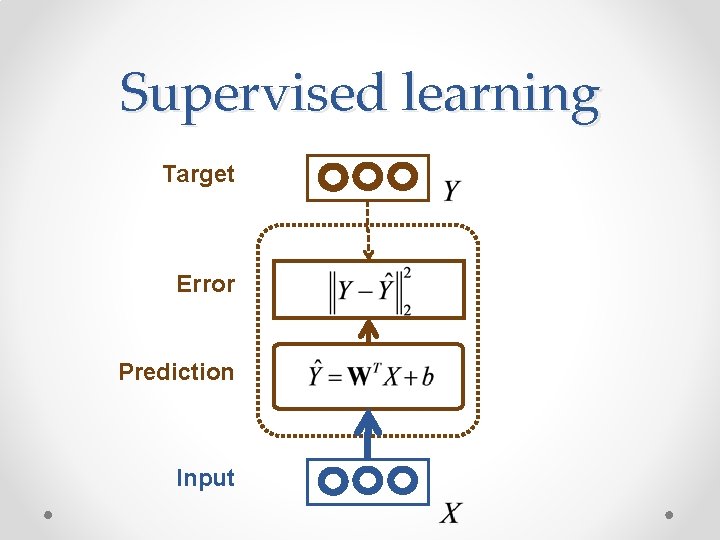
Supervised learning Target Error Prediction Input
Why not exploit unlabeled data?
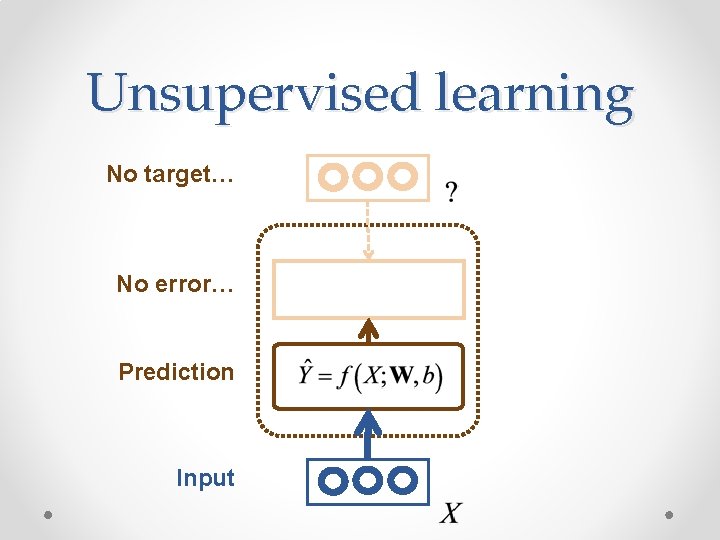
Unsupervised learning No target… No error… Prediction Input
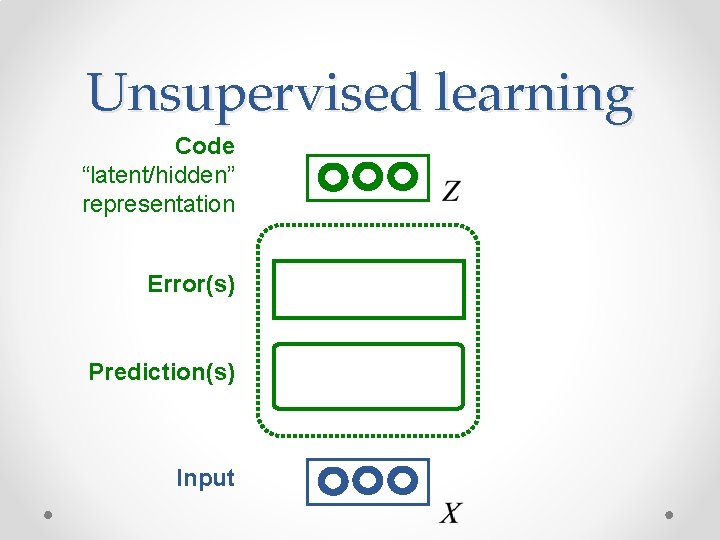
Unsupervised learning Code “latent/hidden” representation Error(s) Prediction(s) Input
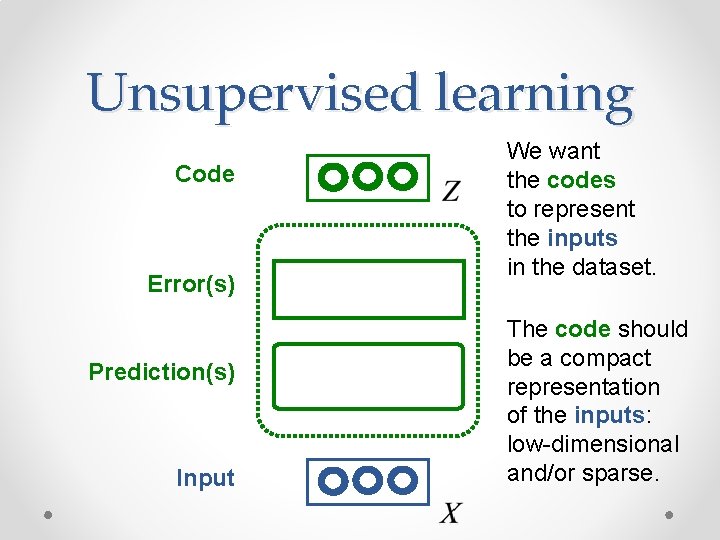
Unsupervised learning Code Error(s) Prediction(s) Input We want the codes to represent the inputs in the dataset. The code should be a compact representation of the inputs: low-dimensional and/or sparse.
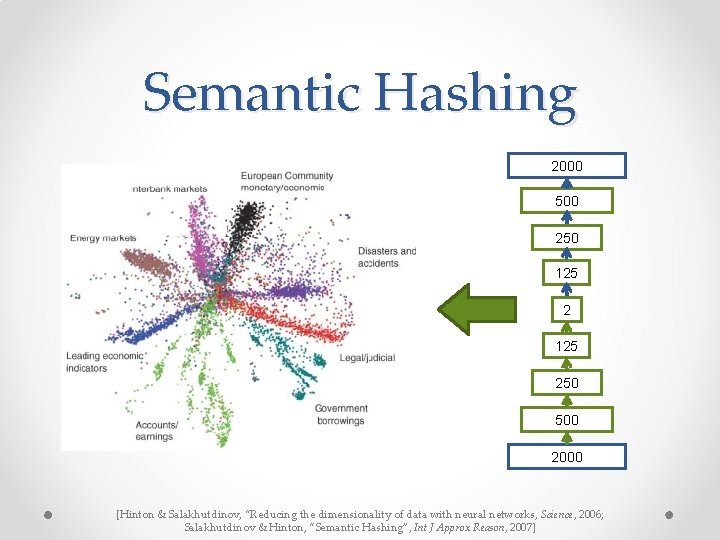
Examples of unsupervised learning • Linear decomposition of the inputs: o o Principal Component Analysis and Singular Value Decomposition Independent Component Analysis [Bell & Sejnowski, 1995] Sparse coding [Olshausen & Field, 1997] … • Fitting a distribution to the inputs: o Mixtures of Gaussians o Use of Expectation-Maximization algorithm [Dempster et al, 1977] o … • For text or discrete data: o o o Latent Semantic Indexing [Deerwester et al, 1990] Probabilistic Latent Semantic Indexing [Hofmann et al, 1999] Latent Dirichlet Allocation [Blei et al, 2003] Semantic Hashing …
Objective of this tutorial Study a fundamental building block for deep learning, the auto-encoder
Outline • Deep learning concepts covered o Hierarchical representations o Sparse and/or distributed representations o Supervised vs. unsupervised learning • Auto-encoder o o Architecture Inference and learning Sparse coding Sparse auto-encoders • Illustration: handwritten digits o Stacking auto-encoders o Learning representations of digits o Impact on classification • Applications to text o Semantic hashing o Semi-supervised learning o Moving away from auto-encoders • Topics not covered in this talk
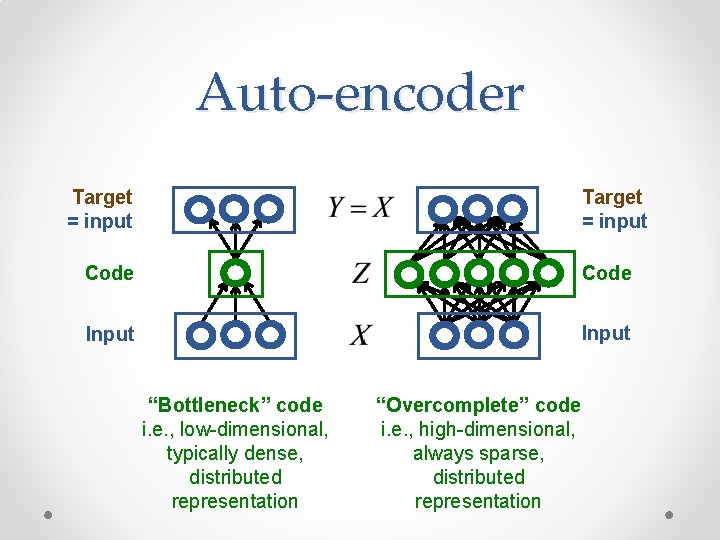
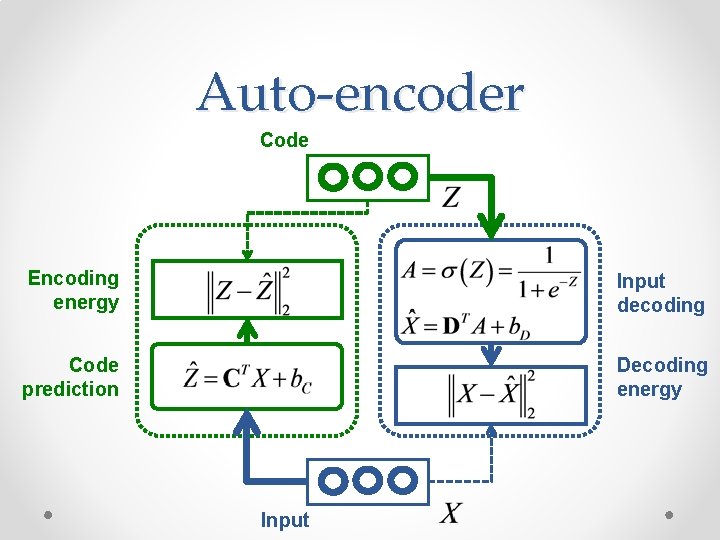
Auto-encoder Target = input Code Input “Bottleneck” code i. e. , low-dimensional, typically dense, distributed representation “Overcomplete” code i. e. , high-dimensional, always sparse, distributed representation
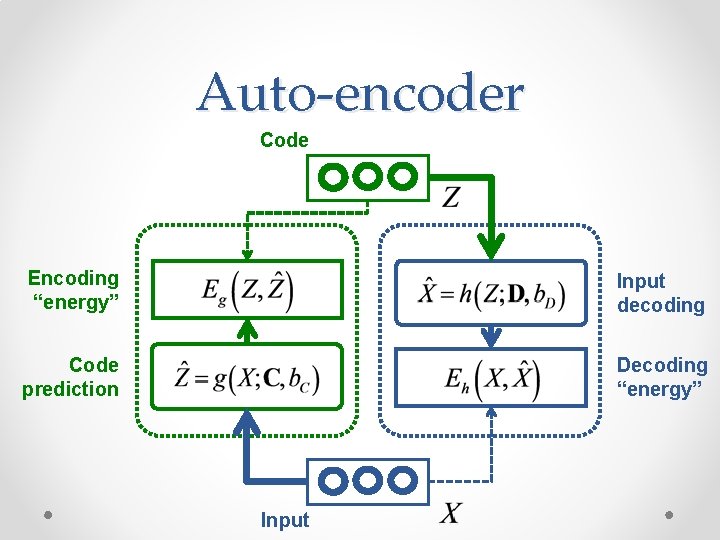
Auto-encoder Code Encoding “energy” Input decoding Code prediction Decoding “energy” Input
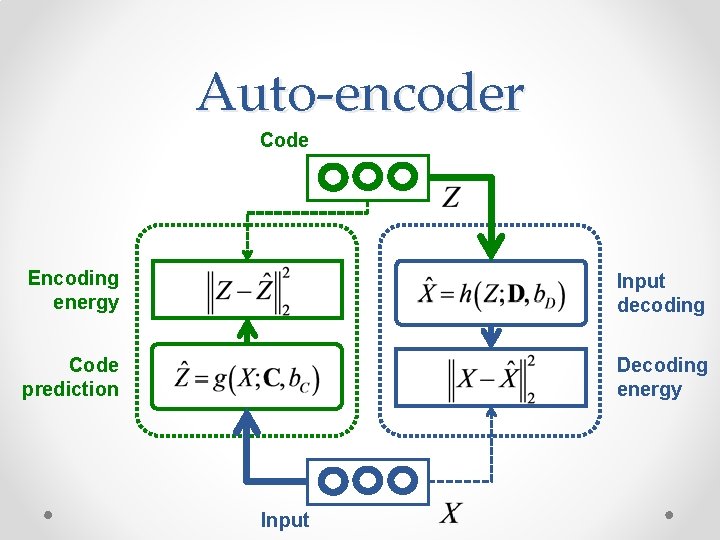
Auto-encoder Code Encoding energy Input decoding Code prediction Decoding energy Input
Auto-encoder loss function For one sample t coefficient of the encoder error Encoding energy Decoding energy For all T samples Encoding energy How do we get the codes Z? We note W={C, b. C, D, b. D} Decoding energy
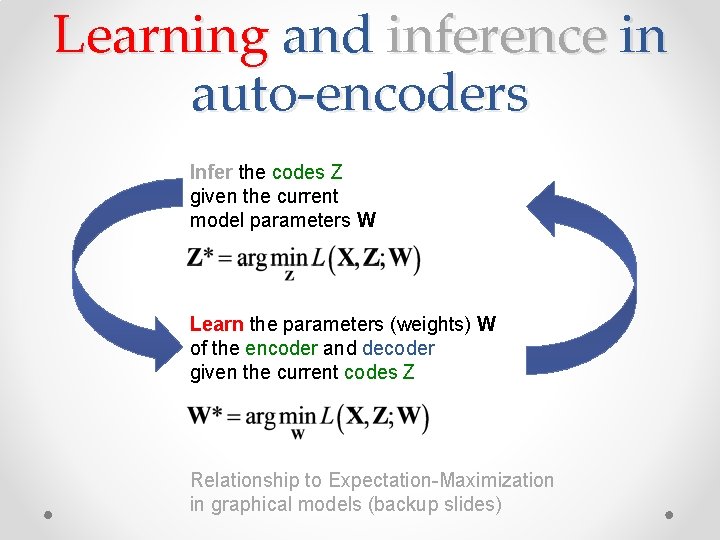
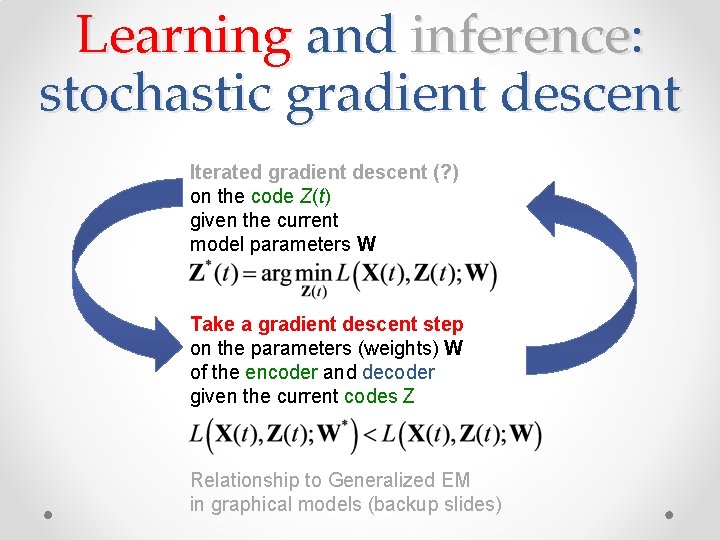
Learning and inference in auto-encoders Infer the codes Z given the current model parameters W Learn the parameters (weights) W of the encoder and decoder given the current codes Z Relationship to Expectation-Maximization in graphical models (backup slides)
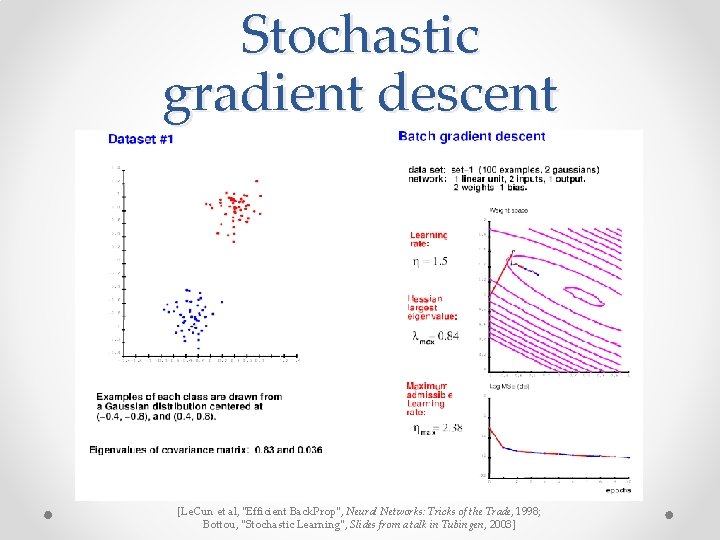
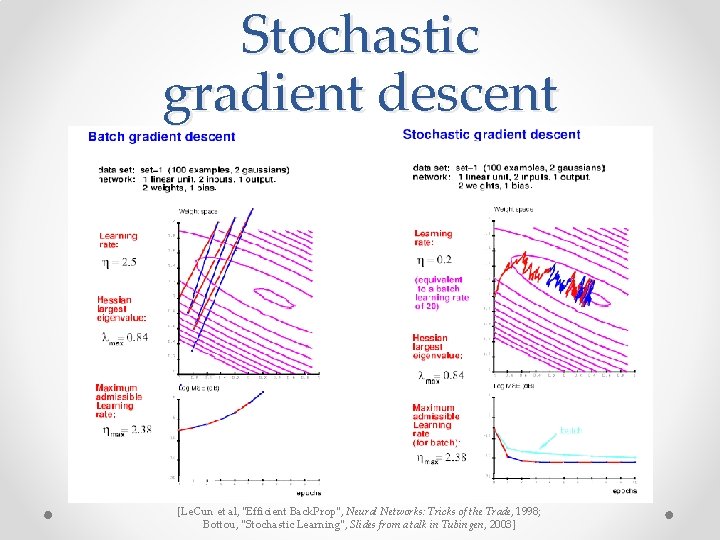
Learning and inference: stochastic gradient descent Iterated gradient descent (? ) on the code Z(t) given the current model parameters W Take a gradient descent step on the parameters (weights) W of the encoder and decoder given the current codes Z Relationship to Generalized EM in graphical models (backup slides)
Auto-encoder Code Encoding energy Input decoding Code prediction Decoding energy Input
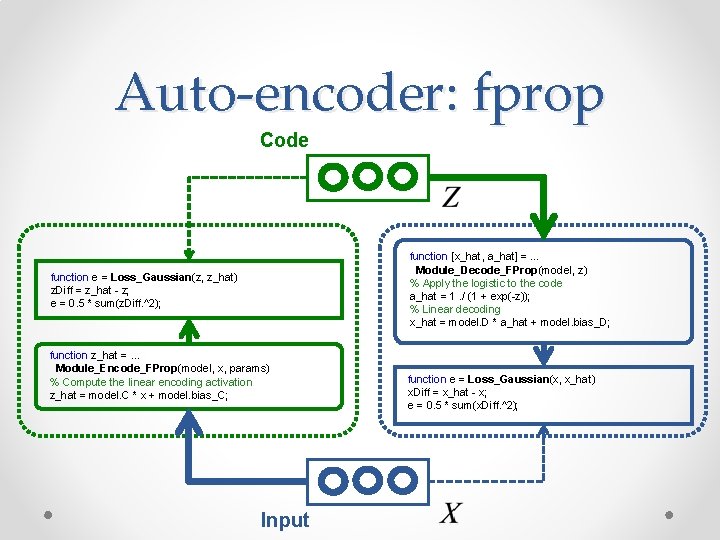
Auto-encoder: fprop Code function [x_hat, a_hat] = … Module_Decode_FProp(model, z) % Apply the logistic to the code a_hat = 1. / (1 + exp(-z)); % Linear decoding x_hat = model. D * a_hat + model. bias_D; function e = Loss_Gaussian(z, z_hat) z. Diff = z_hat - z; e = 0. 5 * sum(z. Diff. ^2); function z_hat = … Module_Encode_FProp(model, x, params) % Compute the linear encoding activation z_hat = model. C * x + model. bias_C; Input function e = Loss_Gaussian(x, x_hat) x. Diff = x_hat - x; e = 0. 5 * sum(x. Diff. ^2);
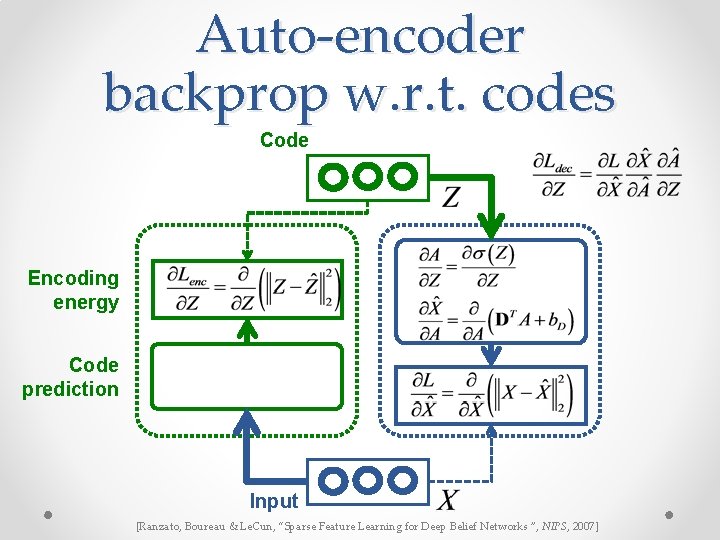
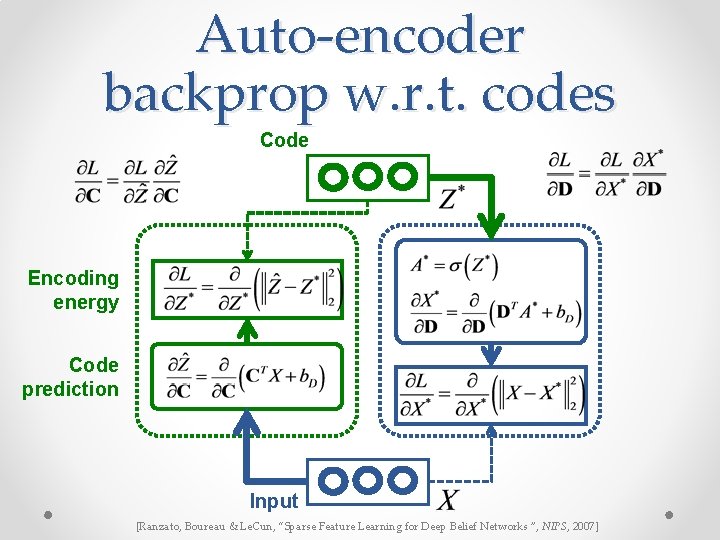
Auto-encoder backprop w. r. t. codes Code Encoding energy Code prediction Input [Ranzato, Boureau & Le. Cun, “Sparse Feature Learning for Deep Belief Networks ”, NIPS, 2007]
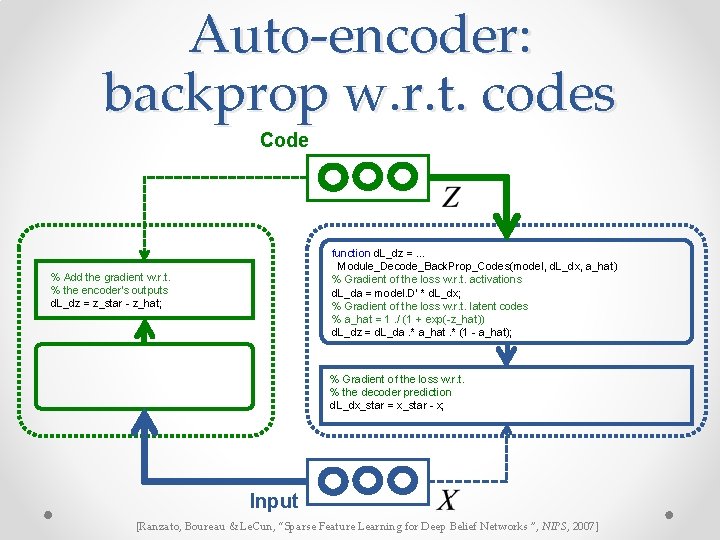
Auto-encoder: backprop w. r. t. codes Code function d. L_dz =. . . Module_Decode_Back. Prop_Codes(model, d. L_dx, a_hat) % Gradient of the loss w. r. t. activations d. L_da = model. D' * d. L_dx; % Gradient of the loss w. r. t. latent codes % a_hat = 1. / (1 + exp(-z_hat)) d. L_dz = d. L_da. * a_hat. * (1 - a_hat); % Add the gradient w. r. t. % the encoder's outputs d. L_dz = z_star - z_hat; % Gradient of the loss w. r. t. % the decoder prediction d. L_dx_star = x_star - x; Input [Ranzato, Boureau & Le. Cun, “Sparse Feature Learning for Deep Belief Networks ”, NIPS, 2007]
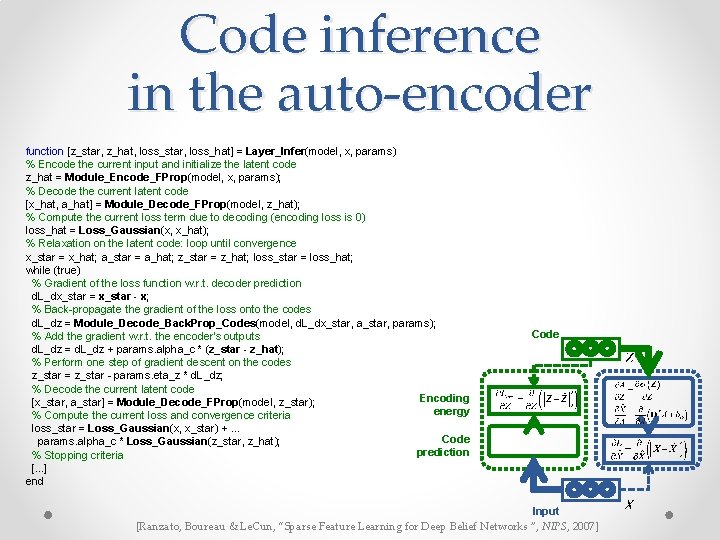
Code inference in the auto-encoder function [z_star, z_hat, loss_star, loss_hat] = Layer_Infer(model, x, params) % Encode the current input and initialize the latent code z_hat = Module_Encode_FProp(model, x, params); % Decode the current latent code [x_hat, a_hat] = Module_Decode_FProp(model, z_hat); % Compute the current loss term due to decoding (encoding loss is 0) loss_hat = Loss_Gaussian(x, x_hat); % Relaxation on the latent code: loop until convergence x_star = x_hat; a_star = a_hat; z_star = z_hat; loss_star = loss_hat; while (true) % Gradient of the loss function w. r. t. decoder prediction d. L_dx_star = x_star - x; % Back-propagate the gradient of the loss onto the codes d. L_dz = Module_Decode_Back. Prop_Codes(model, d. L_dx_star, a_star, params); % Add the gradient w. r. t. the encoder's outputs d. L_dz = d. L_dz + params. alpha_c * (z_star - z_hat); % Perform one step of gradient descent on the codes z_star = z_star - params. eta_z * d. L_dz; % Decode the current latent code Encoding [x_star, a_star] = Module_Decode_FProp(model, z_star); energy % Compute the current loss and convergence criteria loss_star = Loss_Gaussian(x, x_star) +. . . Code params. alpha_c * Loss_Gaussian(z_star, z_hat); prediction % Stopping criteria [. . . ] end Code Input [Ranzato, Boureau & Le. Cun, “Sparse Feature Learning for Deep Belief Networks ”, NIPS, 2007]
Auto-encoder backprop w. r. t. codes Code Encoding energy Code prediction Input [Ranzato, Boureau & Le. Cun, “Sparse Feature Learning for Deep Belief Networks ”, NIPS, 2007]
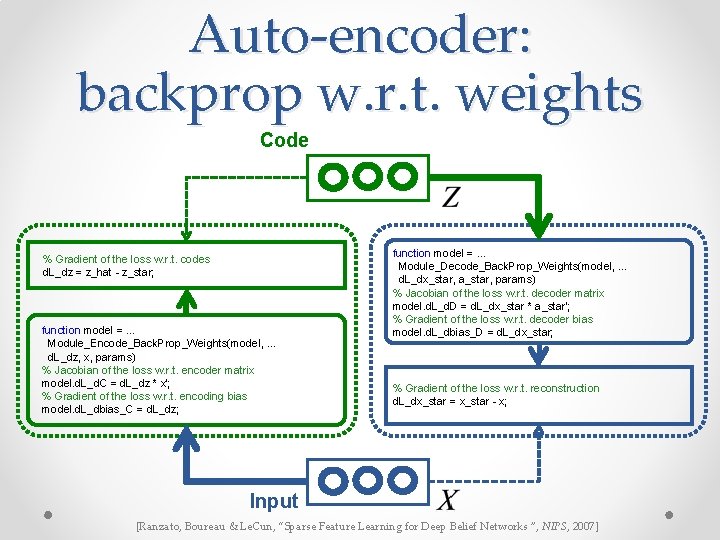
Auto-encoder: backprop w. r. t. weights Code % Gradient of the loss w. r. t. codes d. L_dz = z_hat - z_star; function model =. . . Module_Encode_Back. Prop_Weights(model, . . . d. L_dz, x, params) % Jacobian of the loss w. r. t. encoder matrix model. d. L_d. C = d. L_dz * x'; % Gradient of the loss w. r. t. encoding bias model. d. L_dbias_C = d. L_dz; function model =. . . Module_Decode_Back. Prop_Weights(model, . . . d. L_dx_star, a_star, params) % Jacobian of the loss w. r. t. decoder matrix model. d. L_d. D = d. L_dx_star * a_star'; % Gradient of the loss w. r. t. decoder bias model. d. L_dbias_D = d. L_dx_star; % Gradient of the loss w. r. t. reconstruction d. L_dx_star = x_star - x; Input [Ranzato, Boureau & Le. Cun, “Sparse Feature Learning for Deep Belief Networks ”, NIPS, 2007]
Usual tricks about classical SGD • Regularization (L 1 -norm or L 2 -norm) of the parameters? • Learning rate decay? • Momentum term on the parameters? • Choice of the learning hyperparameters o Cross-validation?
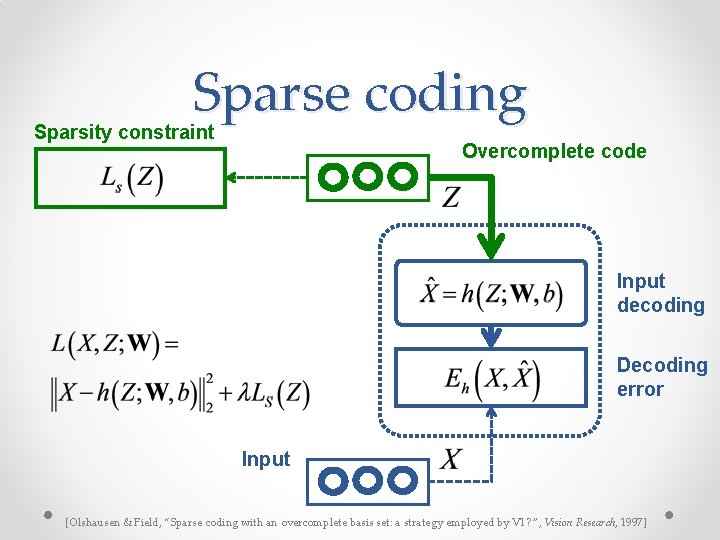
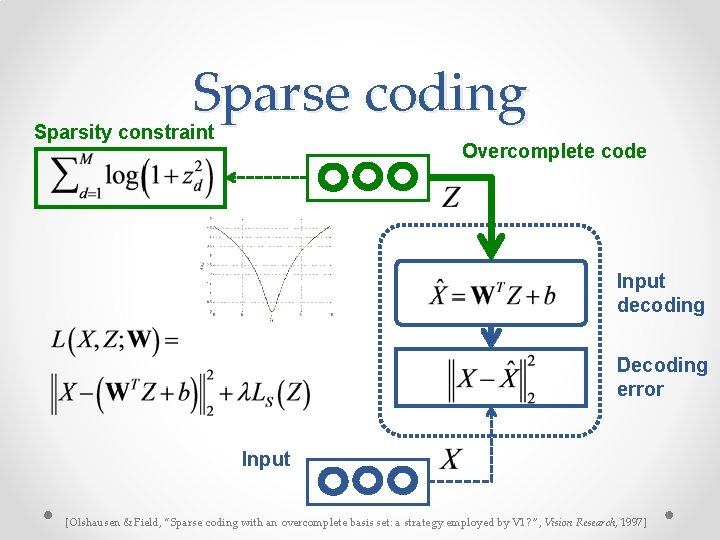
Sparse coding Sparsity constraint Overcomplete code Input decoding Decoding error Input [Olshausen & Field, “Sparse coding with an overcomplete basis set: a strategy employed by V 1? ”, Vision Research, 1997]
Sparse coding Sparsity constraint Overcomplete code Input decoding Decoding error Input [Olshausen & Field, “Sparse coding with an overcomplete basis set: a strategy employed by V 1? ”, Vision Research, 1997]
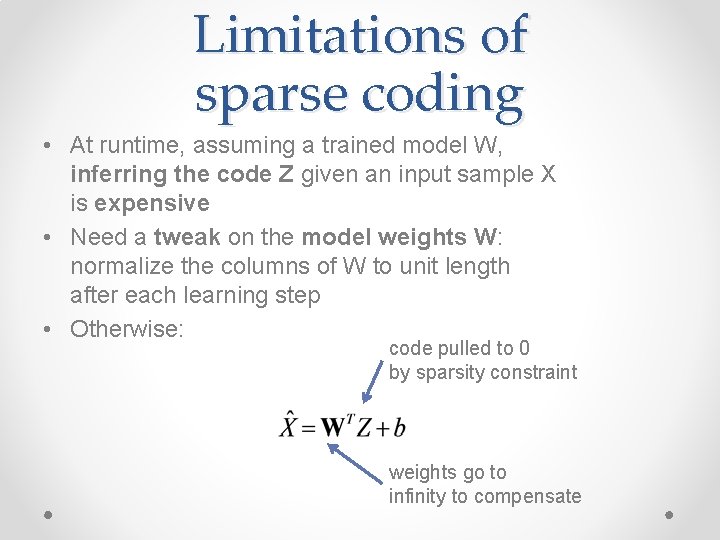
Limitations of sparse coding • At runtime, assuming a trained model W, inferring the code Z given an input sample X is expensive • Need a tweak on the model weights W: normalize the columns of W to unit length after each learning step • Otherwise: code pulled to 0 by sparsity constraint weights go to infinity to compensate
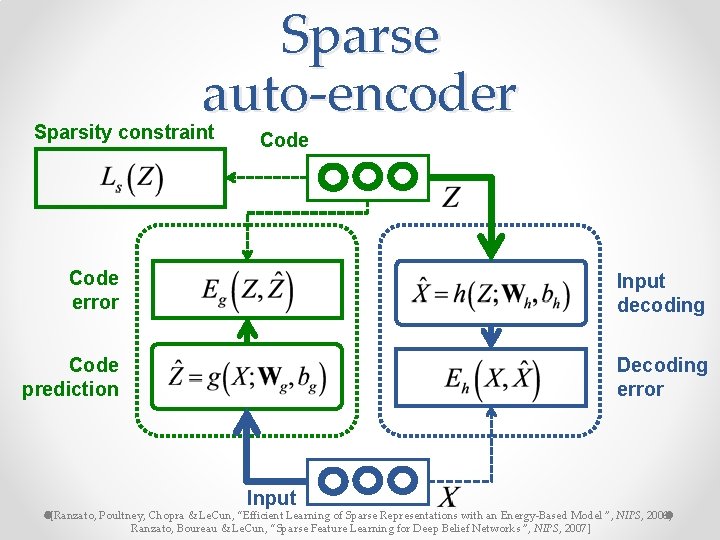
Sparse auto-encoder Sparsity constraint Code error Input decoding Code prediction Decoding error Input [Ranzato, Poultney, Chopra & Le. Cun, “Efficient Learning of Sparse Representations with an Energy-Based Model ”, NIPS, 2006; Ranzato, Boureau & Le. Cun, “Sparse Feature Learning for Deep Belief Networks ”, NIPS, 2007]
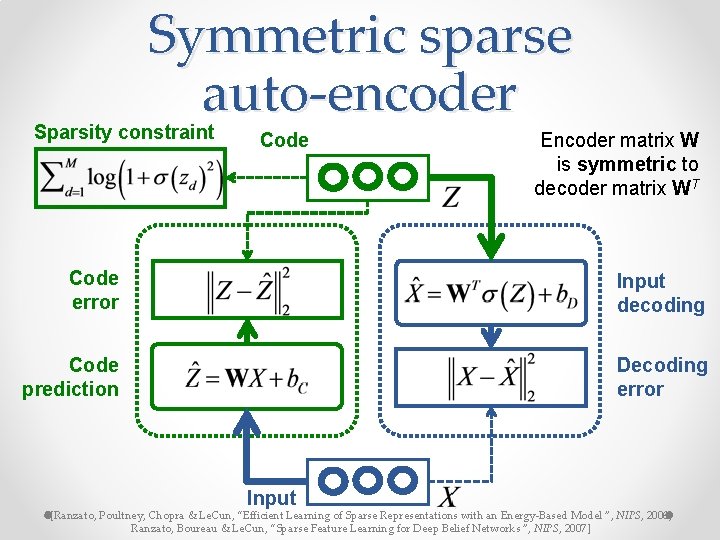
Symmetric sparse auto-encoder Sparsity constraint Code Encoder matrix W is symmetric to decoder matrix WT Code error Input decoding Code prediction Decoding error Input [Ranzato, Poultney, Chopra & Le. Cun, “Efficient Learning of Sparse Representations with an Energy-Based Model ”, NIPS, 2006; Ranzato, Boureau & Le. Cun, “Sparse Feature Learning for Deep Belief Networks ”, NIPS, 2007]
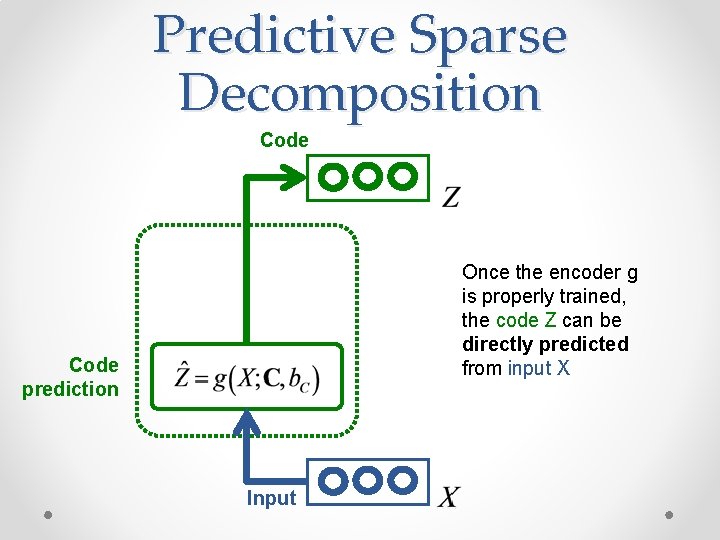
Predictive Sparse Decomposition Code Once the encoder g is properly trained, the code Z can be directly predicted from input X Code prediction Input
Outline • Deep learning concepts covered o Hierarchical representations o Sparse and/or distributed representations o Supervised vs. unsupervised learning • Auto-encoder o o Architecture Inference and learning Sparse coding Sparse auto-encoders • Illustration: handwritten digits o Stacking auto-encoders o Learning representations of digits o Impact on classification • Applications to text o Semantic hashing o Semi-supervised learning o Moving away from auto-encoders • Topics not covered in this talk
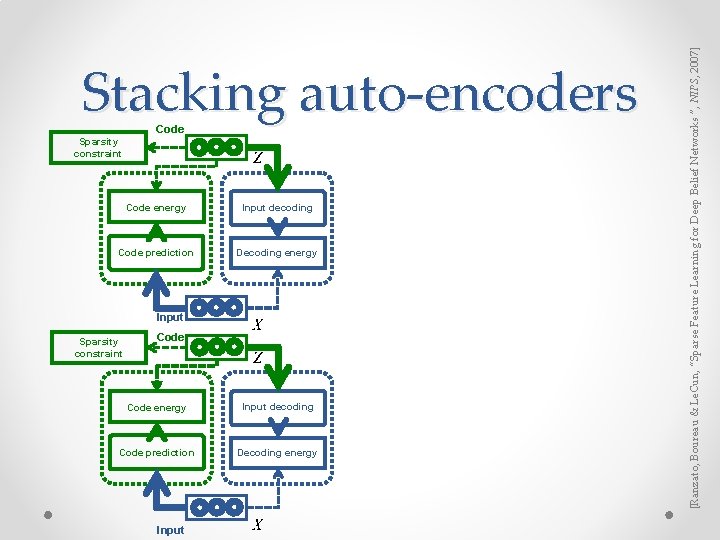
Code Sparsity constraint Code energy Input decoding Code prediction Decoding energy Input [Ranzato, Boureau & Le. Cun, “Sparse Feature Learning for Deep Belief Networks ”, NIPS, 2007] Stacking auto-encoders
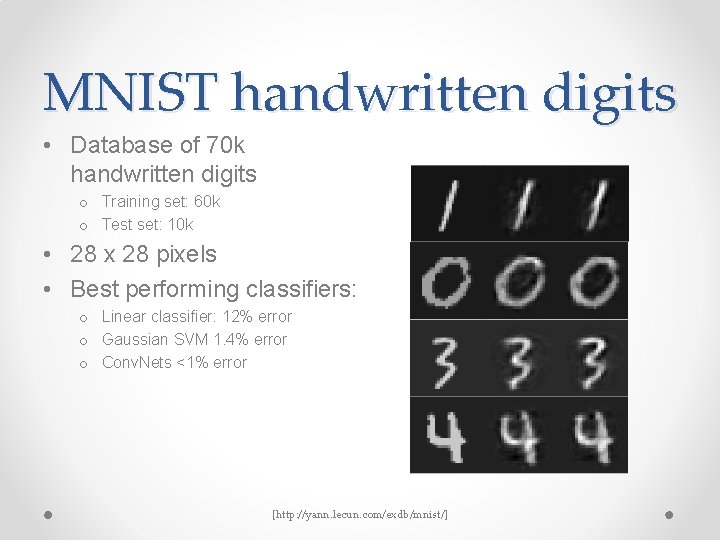
MNIST handwritten digits • Database of 70 k handwritten digits o Training set: 60 k o Test set: 10 k • 28 x 28 pixels • Best performing classifiers: o Linear classifier: 12% error o Gaussian SVM 1. 4% error o Conv. Nets <1% error [http: //yann. lecun. com/exdb/mnist/]
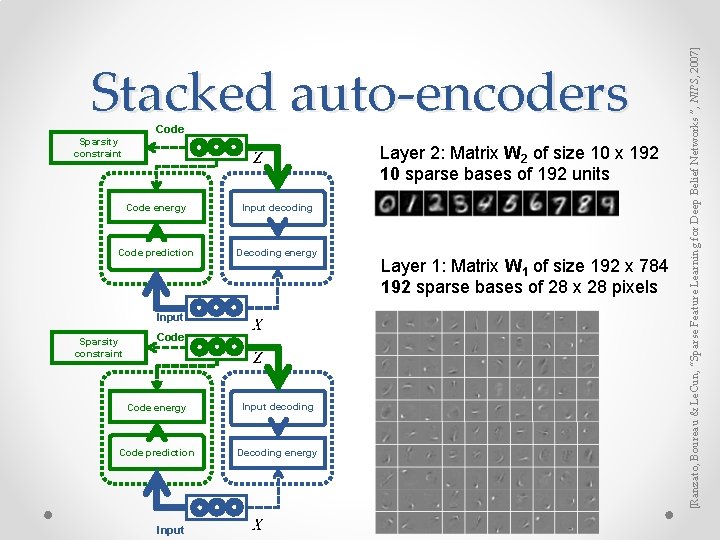
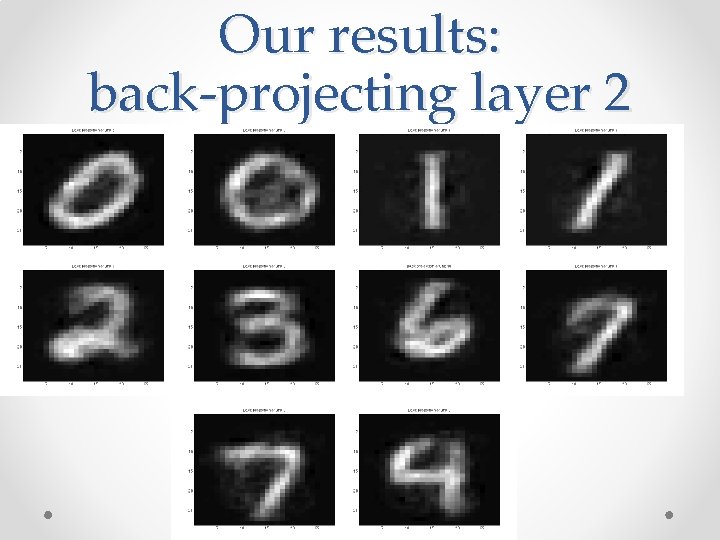
Code Sparsity constraint Layer 2: Matrix W 2 of size 10 x 192 10 sparse bases of 192 units Code energy Input decoding Code prediction Decoding energy Input Sparsity constraint Code energy Input decoding Code prediction Decoding energy Input Layer 1: Matrix W 1 of size 192 x 784 192 sparse bases of 28 x 28 pixels [Ranzato, Boureau & Le. Cun, “Sparse Feature Learning for Deep Belief Networks ”, NIPS, 2007] Stacked auto-encoders
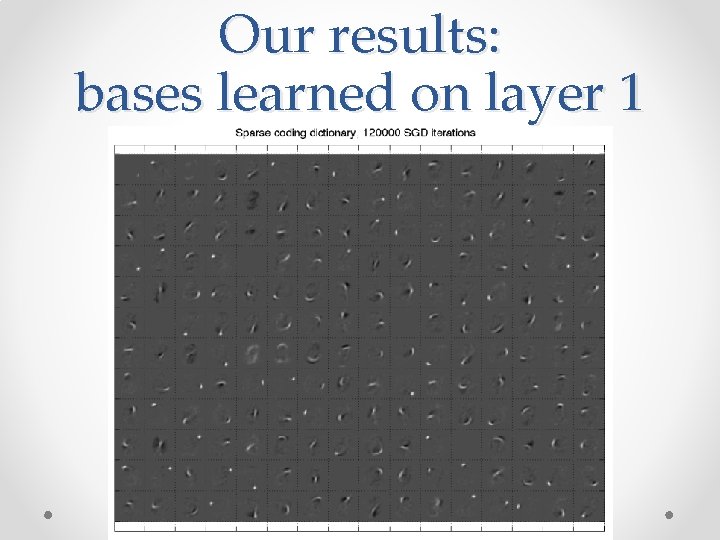
Our results: bases learned on layer 1
Our results: back-projecting layer 2
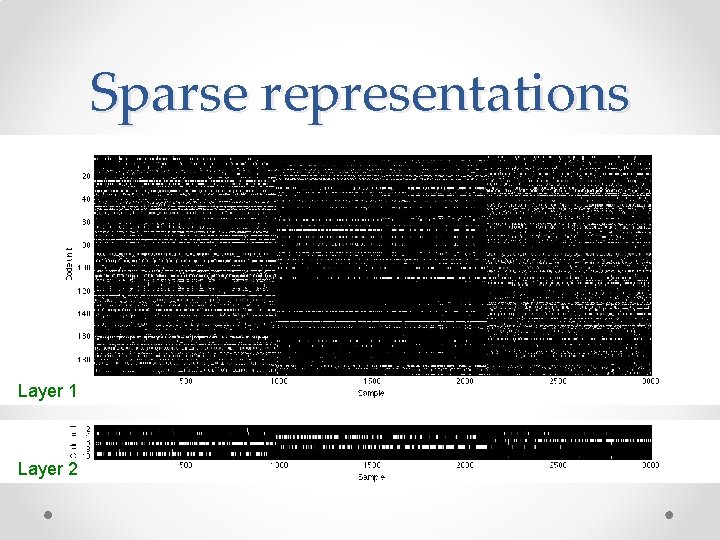
Sparse representations Layer 1 Layer 2
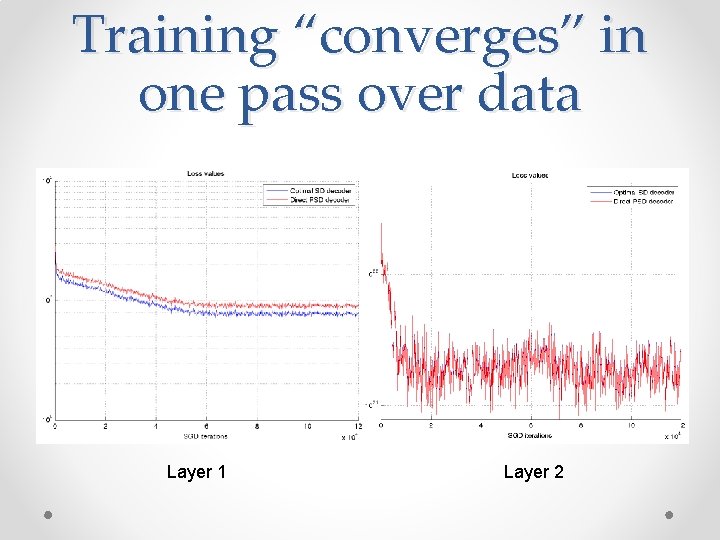
Training “converges” in one pass over data Layer 1 Layer 2
Outline • Deep learning concepts covered o Hierarchical representations o Sparse and/or distributed representations o Supervised vs. unsupervised learning • Auto-encoder o o Architecture Inference and learning Sparse coding Sparse auto-encoders • Illustration: handwritten digits o Stacking auto-encoders o Learning representations of digits o Impact on classification • Applications to text o Semantic hashing o Semi-supervised learning o Moving away from auto-encoders • Topics not covered in this talk
Semantic Hashing 2000 500 250 125 250 500 2000 [Hinton & Salakhutdinov, “Reducing the dimensionality of data with neural networks, Science, 2006; Salakhutdinov & Hinton, “Semantic Hashing”, Int J Approx Reason, 2007]
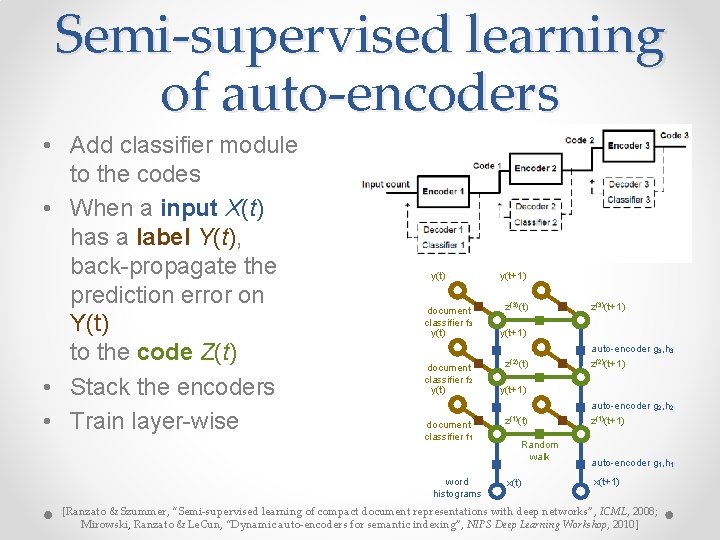
Semi-supervised learning of auto-encoders • Add classifier module to the codes • When a input X(t) has a label Y(t), back-propagate the prediction error on Y(t) to the code Z(t) • Stack the encoders • Train layer-wise y(t) document classifier f 3 y(t) document classifier f 2 y(t) document classifier f 1 word histograms y(t+1) z(3)(t+1) y(t+1) z(2)(t) auto-encoder g 3, h 3 z(2)(t+1) y(t+1) z(1)(t) Random walk x(t) auto-encoder g 2, h 2 z(1)(t+1) auto-encoder g 1, h 1 x(t+1) [Ranzato & Szummer, “Semi-supervised learning of compact document representations with deep networks”, ICML, 2008; Mirowski, Ranzato & Le. Cun, “Dynamic auto-encoders for semantic indexing”, NIPS Deep Learning Workshop, 2010]
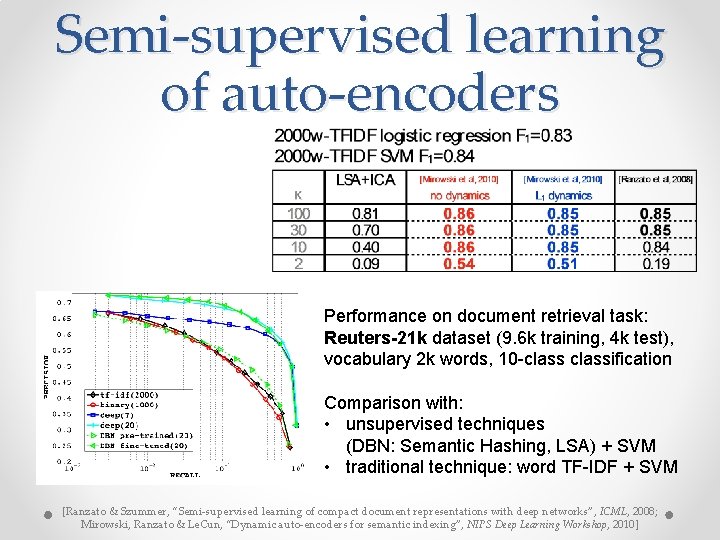
Semi-supervised learning of auto-encoders Performance on document retrieval task: Reuters-21 k dataset (9. 6 k training, 4 k test), vocabulary 2 k words, 10 -classification Comparison with: • unsupervised techniques (DBN: Semantic Hashing, LSA) + SVM • traditional technique: word TF-IDF + SVM [Ranzato & Szummer, “Semi-supervised learning of compact document representations with deep networks”, ICML, 2008; Mirowski, Ranzato & Le. Cun, “Dynamic auto-encoders for semantic indexing”, NIPS Deep Learning Workshop, 2010]
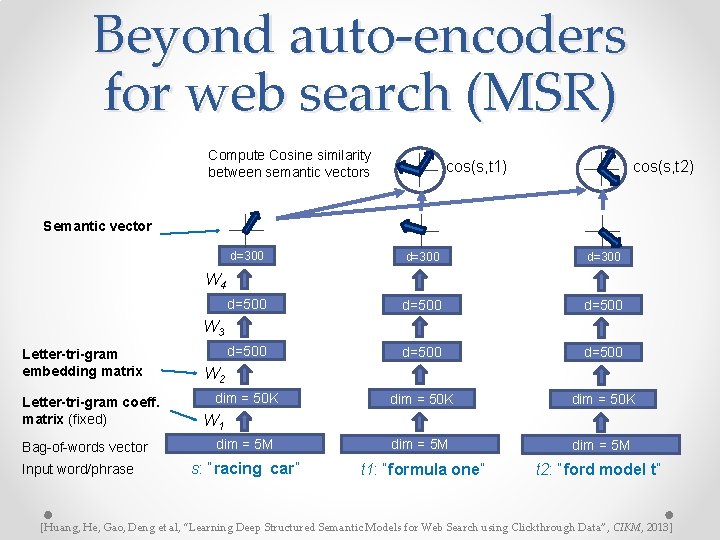
Beyond auto-encoders for web search (MSR) Compute Cosine similarity between semantic vectors cos(s, t 1) cos(s, t 2) Semantic vector d=300 d=500 d=500 dim = 50 K dim = 5 M s: “racing car” t 1: “formula one” t 2: “ford model t” W 4 W 3 Letter-tri-gram embedding matrix Letter-tri-gram coeff. matrix (fixed) Bag-of-words vector Input word/phrase W 2 W 1 [Huang, He, Gao, Deng et al, “Learning Deep Structured Semantic Models for Web Search using Clickthrough Data”, CIKM, 2013]
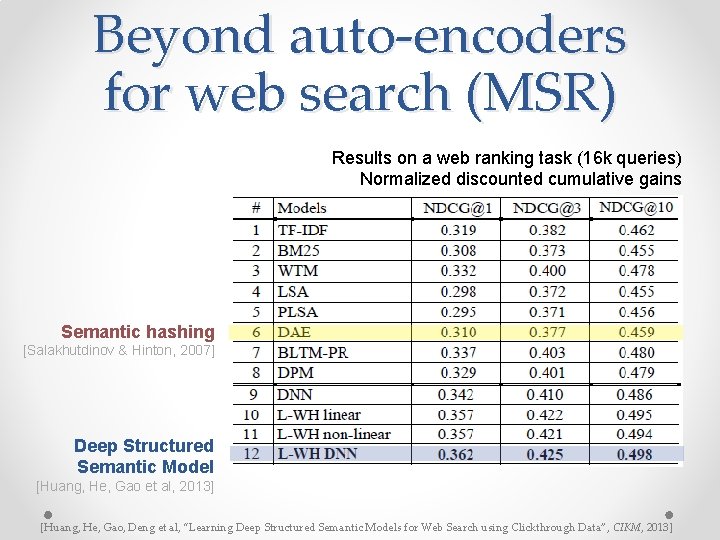
Beyond auto-encoders for web search (MSR) Results on a web ranking task (16 k queries) Normalized discounted cumulative gains Semantic hashing [Salakhutdinov & Hinton, 2007] Deep Structured Semantic Model [Huang, He, Gao et al, 2013] [Huang, He, Gao, Deng et al, “Learning Deep Structured Semantic Models for Web Search using Clickthrough Data”, CIKM, 2013]
Outline • Deep learning concepts covered o Hierarchical representations o Sparse and/or distributed representations o Supervised vs. unsupervised learning • Auto-encoder o o Architecture Inference and learning Sparse coding Sparse auto-encoders • Illustration: handwritten digits o Stacking auto-encoders o Learning representations of digits o Impact on classification • Applications to text o Semantic hashing o Semi-supervised learning o Moving away from auto-encoders • Topics not covered in this talk
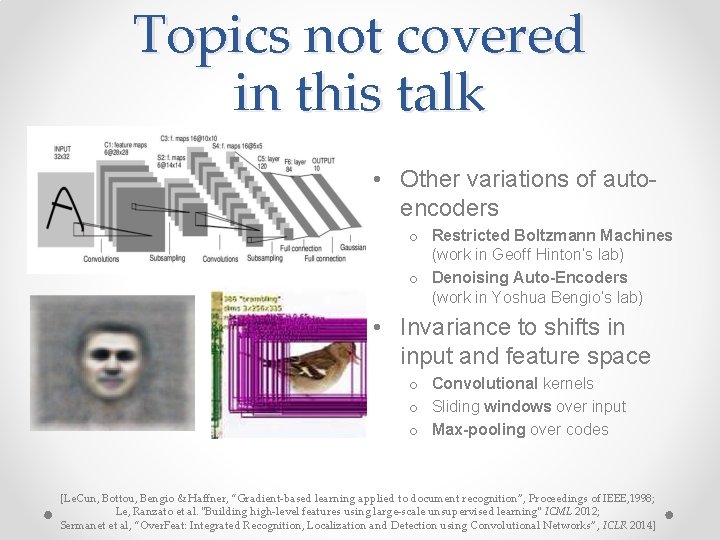
Topics not covered in this talk • Other variations of autoencoders o Restricted Boltzmann Machines (work in Geoff Hinton’s lab) o Denoising Auto-Encoders (work in Yoshua Bengio’s lab) • Invariance to shifts in input and feature space o Convolutional kernels o Sliding windows over input o Max-pooling over codes [Le. Cun, Bottou, Bengio & Haffner, “Gradient-based learning applied to document recognition”, Proceedings of IEEE, 1998; Le, Ranzato et al. "Building high-level features using large-scale unsupervised learning" ICML 2012; Sermanet et al, “Over. Feat: Integrated Recognition, Localization and Detection using Convolutional Networks”, ICLR 2014]
Thank you! • Tutorial code: https: //github. com/piotrmirowski http: //piotrmirowski. wordpress. com • Contact: piotr. mirowski@computer. org • Acknowledgements: Marc’Aurelio Ranzato (FB) Yann Le. Cun (FB/NYU)
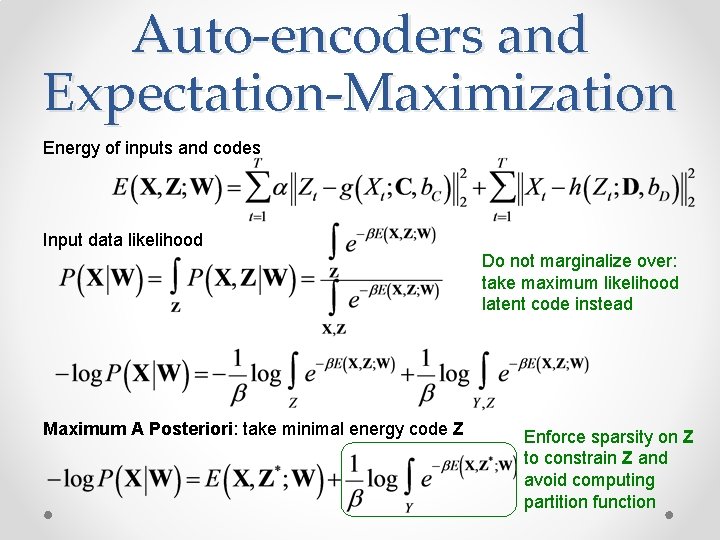
Auto-encoders and Expectation-Maximization Energy of inputs and codes Input data likelihood Do not marginalize over: take maximum likelihood latent code instead Maximum A Posteriori: take minimal energy code Z Enforce sparsity on Z to constrain Z and avoid computing partition function
Stochastic gradient descent [Le. Cun et al, "Efficient Back. Prop", Neural Networks: Tricks of the Trade, 1998; Bottou, "Stochastic Learning", Slides from a talk in Tubingen, 2003]
Stochastic gradient descent [Le. Cun et al, "Efficient Back. Prop", Neural Networks: Tricks of the Trade, 1998; Bottou, "Stochastic Learning", Slides from a talk in Tubingen, 2003]
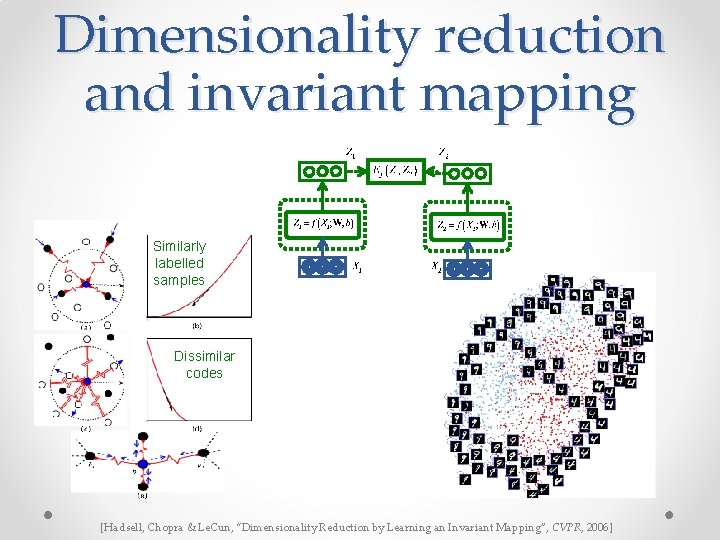
Dimensionality reduction and invariant mapping Similarly labelled samples Dissimilar codes [Hadsell, Chopra & Le. Cun, “Dimensionality Reduction by Learning an Invariant Mapping”, CVPR, 2006]