
Planning Chapter 13 Rich knight Dr Suthikshn Kumar
- Slides: 48
Planning Chapter 13: Rich & knight Dr. Suthikshn Kumar
Planning • The methods which focus on ways of decomposing the original problem into appropriate subparts and on ways of recording and handling interactions among the subparts as they are detected during the problem-solving process are often called as planning. • Planning refers to the process of computing several steps of a problem-solving procedure before executing any of them.
Components of a planning system • Choose the best rule to apply next based on the best available heuristic information. • Apply the chosen rule to compute the new problem state that arises from its application. • Detect when a solution has been found. • Detect dead ends so that they can be abandoned and the system’s effort directed in more fruitful directions. • Detect when an almost correct solution has been found and employ special techniques to make it totally correct.
Choose the rules to apply • The most widely used technique for selecting an appropriate rules to apply is first to isolate a set of differences between desired goal state and then to identify those rules that are relevant to reducing those differences. • If several rules, a variety of other heuristic information can be exploited to choose among them
Applying Rules • In simple systems, applying rules is easy. Each rule simply specified the problem state that would result from its application. • In complex systems, we must be able to deal with rules that specify only a small part of the complete problem state. • One way is to describe, for each action, each of the changes it makes to the state description.
Detecting a solution • A planning system has succeeded in finding a solution to a problem when it has found a sequence of operators that transforms the initial problem state into the goal state. • How will it know when this has been done? • In simple problem-solving systems, this question is easily answered by a straightforward match of the state descriptions. • One of the representative systems for planning systems is, predicate logic. Suppose that as a part of our goal, we have the predicate P(x). To see whether P(x) is satisfied in some state, we ask whether we can prove P(x) given the assertions that describe that state and the axioms that define the world model.
Detecting Dead Ends • As a planning system is searching for a sequence of operators to solve a particular problem, it must be able to detect when it is exploring a path that can never lead to a solution. • The same reasoning mechanisms that can be used to detect a solution can often be used for detecting a dead end. • If the search process is reasoning forward from the initial state, it can prune any path that leads to a state from which the goal state cannot be reached. • If search process is reasoning backward from the goal state, it can also terminate a path either because it is sure that the initial state cannot be reached or because little progress is being made.
Repairing an Almost Correct Solution • The kinds of techniques we are discussing are often useful in solving nearly decomposable problems. • One good way of solving such problems is to assume that they are completely decomposable, proceed to solve the subproblems separately, and then check that when the subsolutions are combined, they do infact yield a solution to the original problem.
Goal Stack Planning • In this method, the problem solver makes use of a single stack that contains both goals and operators that have been proposed to satisfy those goals. • The problem solver also relies on a database that describes the current situation and a set of operators described as PRECONDITION, ADD, and DELETE lists. • The goal stack planning method attacks problems involving conjoined goals by solving the goals one at a time, in order. • A plan generated by this method contains a sequence of operators for attaining the first goal, followed by a complete sequence for the second goal etc.
Goal Stack Planning • At each succeeding step of the problem solving process, the top goal on the stack will be pursued. • When a sequence of operators that satisfies it is found, that sequence is applied to the state description, yielding new description. • Next, the goal that is then at the top of the stack is explored an attempt is made to satisfy it, starting from the situation that was produced as a result of satisfying the first goal. • This process continues until the goal stack is empty. • Then as one last check, the original goal is compared to the final state derived from the application of the chosen operators. • If any components of the goal are not satisfied in that state, then those unsolved parts of the goal are reinserted onto the stack and the process is resumed.
Nonlinear Planning using Constraint Posting. • Difficult problems cause goal interactions, • The operators used to solve one subproblem may interfere with the solution to a previous subproblem. • Most problems require an interwined plan in which multiple subproblems are worked on simultaneously. • Such a plan is called nonlinear plan because it is not composed of a linear sequence of complete subplans.
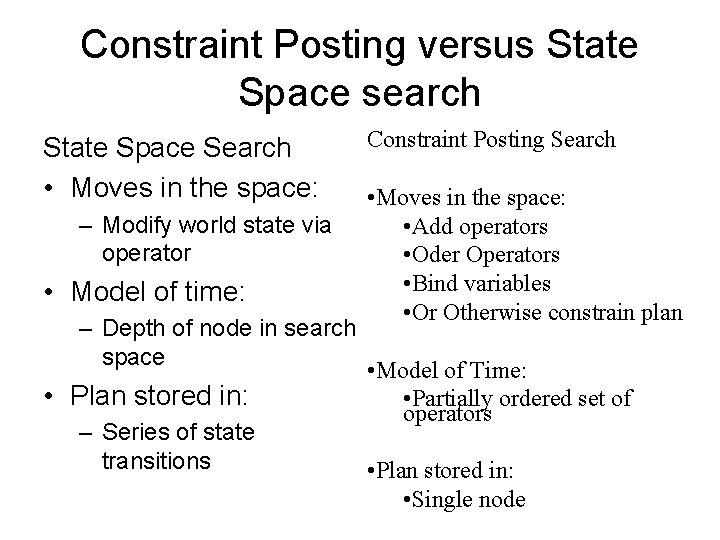
Constraint Posting • The idea of constraint posting is to build up a plan by incrementally hypothesizing operators, partial orderings between operators, and binding of variables within operators. • At any given time in the problem-solving process, we may have a set of useful operators but perhaps no clear idea of how those operators should be ordered with respect to each other. • A solution is a partially ordered, partially instantiated set of operators to generate an actual plan, we convert the partial order into any of a number of total orders.
Constraint Posting versus State Space search State Space Search • Moves in the space: – Modify world state via operator • Model of time: – Depth of node in search space • Plan stored in: – Series of state transitions Constraint Posting Search • Moves in the space: • Add operators • Oder Operators • Bind variables • Or Otherwise constrain plan • Model of Time: • Partially ordered set of operators • Plan stored in: • Single node
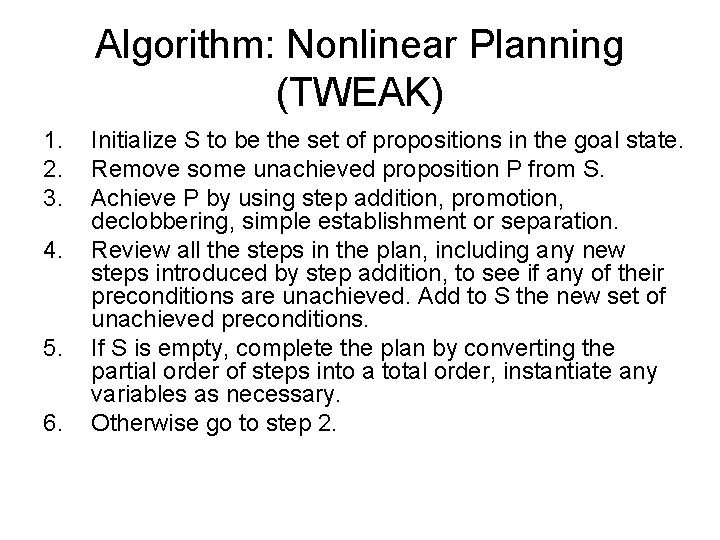
Algorithm: Nonlinear Planning (TWEAK) 1. 2. 3. 4. 5. 6. Initialize S to be the set of propositions in the goal state. Remove some unachieved proposition P from S. Achieve P by using step addition, promotion, declobbering, simple establishment or separation. Review all the steps in the plan, including any new steps introduced by step addition, to see if any of their preconditions are unachieved. Add to S the new set of unachieved preconditions. If S is empty, complete the plan by converting the partial order of steps into a total order, instantiate any variables as necessary. Otherwise go to step 2.
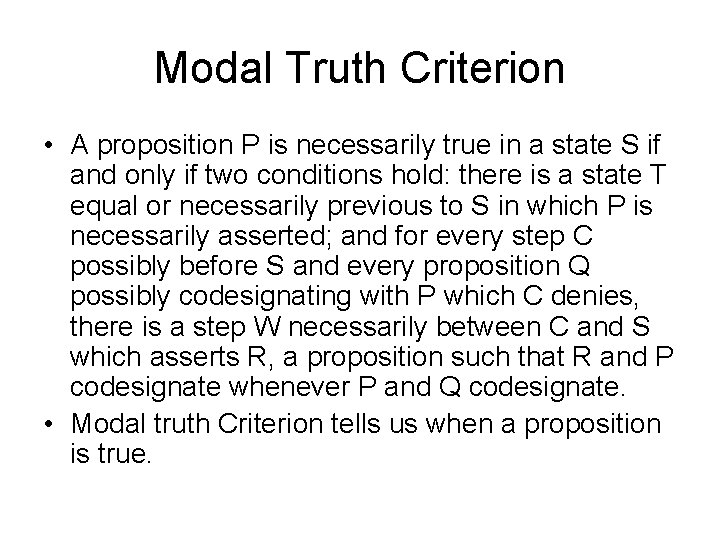
Modal Truth Criterion • A proposition P is necessarily true in a state S if and only if two conditions hold: there is a state T equal or necessarily previous to S in which P is necessarily asserted; and for every step C possibly before S and every proposition Q possibly codesignating with P which C denies, there is a step W necessarily between C and S which asserts R, a proposition such that R and P codesignate whenever P and Q codesignate. • Modal truth Criterion tells us when a proposition is true.
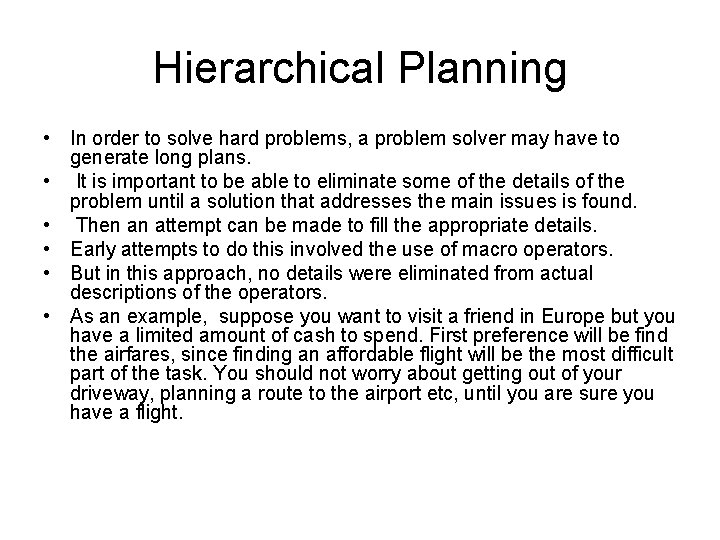
Hierarchical Planning • In order to solve hard problems, a problem solver may have to generate long plans. • It is important to be able to eliminate some of the details of the problem until a solution that addresses the main issues is found. • Then an attempt can be made to fill the appropriate details. • Early attempts to do this involved the use of macro operators. • But in this approach, no details were eliminated from actual descriptions of the operators. • As an example, suppose you want to visit a friend in Europe but you have a limited amount of cash to spend. First preference will be find the airfares, since finding an affordable flight will be the most difficult part of the task. You should not worry about getting out of your driveway, planning a route to the airport etc, until you are sure you have a flight.
ABSTRIPS • ABSTRIPS actually planned in a hierarchy of abstraction spaces, in each of which preconditions at a lower level of abstraction were ignored. • ABSTRIPS approach is as follows: – First solve the problem completely, considering only preconditions whose criticality value is the highest possible. – These values reflect the expected difficulty of satisfying the precondition. – To do this, do exactly what STRIPS did, but simply ignore the preconditions of lower than peak criticality. – Once this is done, use the constructed plan as the outline of a complete plan and consider preconditions at the next-lowest criticality level. – Because this approach explores entire plans at one level of detail before it looks at the lower-level details of any one of them, it has been called length-first approach.
Hierarchical Planning • The assignment of appropriate criticality value is critical to the success of this hierarchical planning method. • Those preconditions that no operator can satisfy are clearly the most critical. • Example, solving a problem of moving robot, for applying an operator, PUSH-THROUGH DOOR, the precondition that there exist a door big enough for the robot to get through is of high criticality since there is nothing we can do about it if it is not true.
Reactive Systems • The idea of reactive systems is to avoid planning altogether, and instead use the observable situation as a clue to which one can simply react. • A reactive system must have access to a knowledge base of some sort that describes what actions should be taken under what circumstances. • A reactive system is very different from the other kinds of planning systems we have discussed because it chooses actions one at a time. • It does not anticipate and select an entire action sequence before it does the first thing. • Example is a Thermostat. The job of thermostat is to keep the temperature constant.
Thermostat • • Is an example for reactive systems. Its job is to keep the temperature constant inside a room. One might imagine a solution to this problem that requires significant amounts of planning, taking into account how the external temperature rises and falls during the day, how heat flows from room to room, and so forth. Real thermostat uses simple pair of situation-action rules: 1. If the temperature in the room is k degrees above the desired temperature, then turn the airconditioner on. 2. If the temperature in the room is k degrees below desired temperature, then turn the airconditioner off.
Reactive Systems • Ractive systems are capable of surprisingly complex behaviours. • The main advantage reactive systems have over traditional planners is that they operate robustly in domains that are difficult to model completely and accurately. • Reactive systems dispense with modeling altogether and base their actions directly on their perception of the world. • Another advantage of reactive systems is that they are extremely responsive, since they avoid the combinatorial explosion involved in deliberative planning. • This makes them attractive for real time tasks such as driving and walking.
Other Planning Techniques • • Triangle tables Metaplanning Macro-operators Case based planning.
Blocks World • Inorder to compare the variety of methods of planning, we should find it useful to look at all of them in a single domain that is complex enough that the need for each of the mechanisms is apparent yet simple enough that easy-to follow examples can be found.
Blocks world problem • There is a flat surface on which blocks can be placed • There a number of square blocks, all the same size. • They can be stacked one upon the other. • There is robot arm that can manipulate the blocks
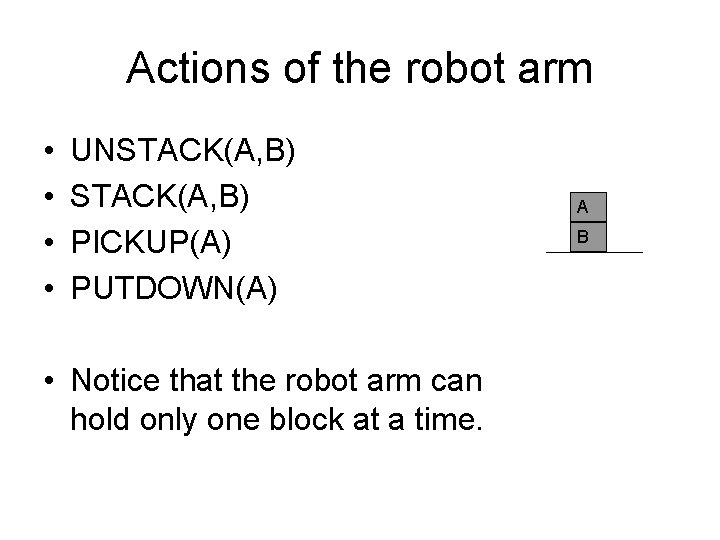
Actions of the robot arm • • UNSTACK(A, B) PICKUP(A) PUTDOWN(A) • Notice that the robot arm can hold only one block at a time. A B
Predicates • Inorder to specify both the conditions under which an operation may be performed and the results of performing it, we need the following predicates: • ON(A, B) • ONTABLES(A) • CLEAR(A) • HOLDING(A) • ARMEMPTY
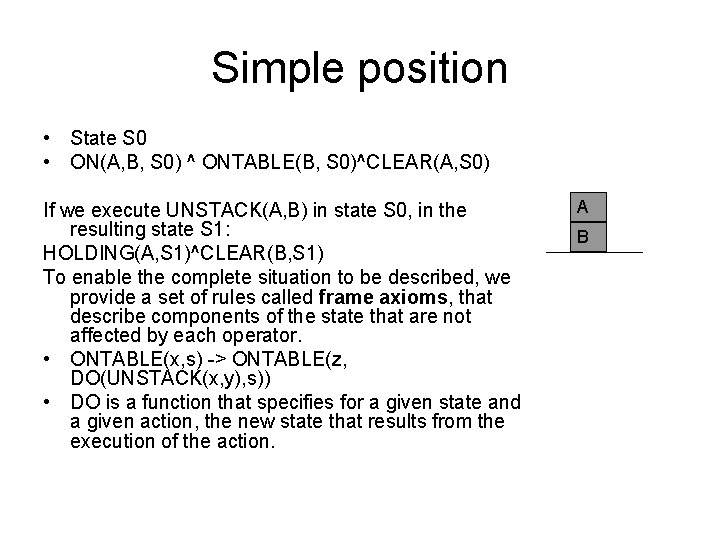
Simple position • State S 0 • ON(A, B, S 0) ^ ONTABLE(B, S 0)^CLEAR(A, S 0) If we execute UNSTACK(A, B) in state S 0, in the resulting state S 1: HOLDING(A, S 1)^CLEAR(B, S 1) To enable the complete situation to be described, we provide a set of rules called frame axioms, that describe components of the state that are not affected by each operator. • ONTABLE(x, s) -> ONTABLE(z, DO(UNSTACK(x, y), s)) • DO is a function that specifies for a given state and a given action, the new state that results from the execution of the action. A B
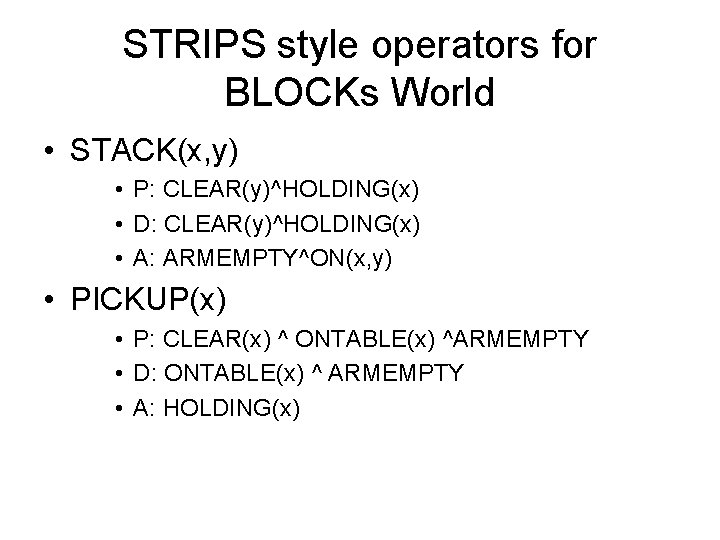
Robot –problem solving system (STRIPS) • List of new predicates that the operator causes: ADD, DELETE • PRECONDITIONS list contains those predicates that must be true for the operator to be applied.
STRIPS style operators for BLOCKs World • STACK(x, y) • P: CLEAR(y)^HOLDING(x) • D: CLEAR(y)^HOLDING(x) • A: ARMEMPTY^ON(x, y) • PICKUP(x) • P: CLEAR(x) ^ ONTABLE(x) ^ARMEMPTY • D: ONTABLE(x) ^ ARMEMPTY • A: HOLDING(x)
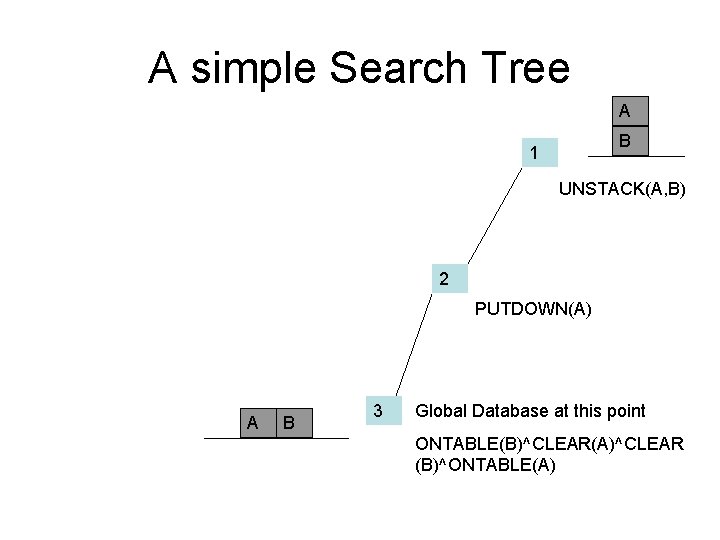
A simple Search Tree A B 1 UNSTACK(A, B) 2 PUTDOWN(A) A B 3 Global Database at this point ONTABLE(B)^CLEAR(A)^CLEAR (B)^ONTABLE(A)
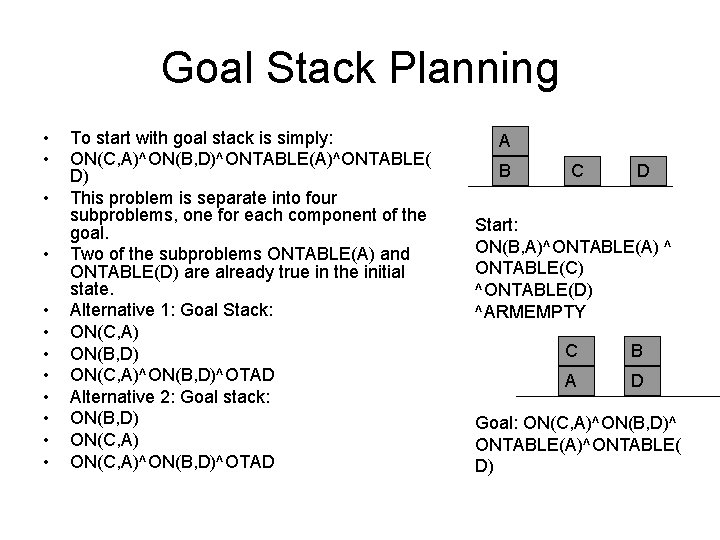
Goal Stack Planning • • • To start with goal stack is simply: ON(C, A)^ON(B, D)^ONTABLE(A)^ONTABLE( D) This problem is separate into four subproblems, one for each component of the goal. Two of the subproblems ONTABLE(A) and ONTABLE(D) are already true in the initial state. Alternative 1: Goal Stack: ON(C, A) ON(B, D) ON(C, A)^ON(B, D)^OTAD Alternative 2: Goal stack: ON(B, D) ON(C, A)^ON(B, D)^OTAD A B C D Start: ON(B, A)^ONTABLE(A) ^ ONTABLE(C) ^ONTABLE(D) ^ARMEMPTY C B A D Goal: ON(C, A)^ON(B, D)^ ONTABLE(A)^ONTABLE( D)
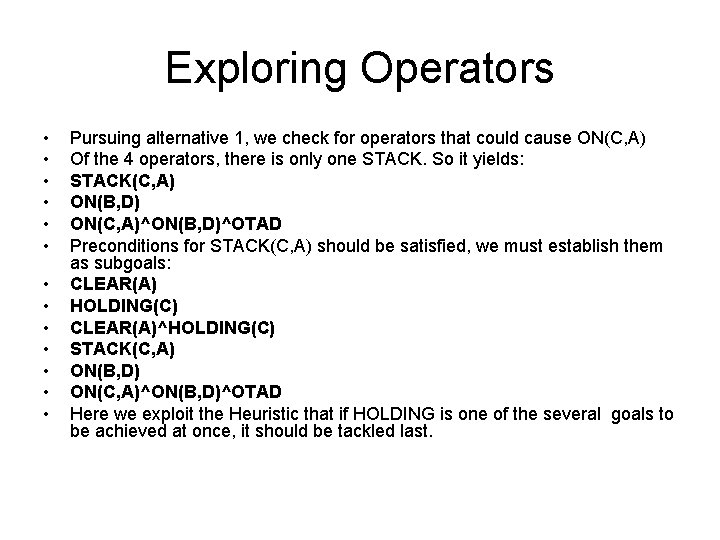
Exploring Operators • • • • Pursuing alternative 1, we check for operators that could cause ON(C, A) Of the 4 operators, there is only one STACK. So it yields: STACK(C, A) ON(B, D) ON(C, A)^ON(B, D)^OTAD Preconditions for STACK(C, A) should be satisfied, we must establish them as subgoals: CLEAR(A) HOLDING(C) CLEAR(A)^HOLDING(C) STACK(C, A) ON(B, D) ON(C, A)^ON(B, D)^OTAD Here we exploit the Heuristic that if HOLDING is one of the several goals to be achieved at once, it should be tackled last.
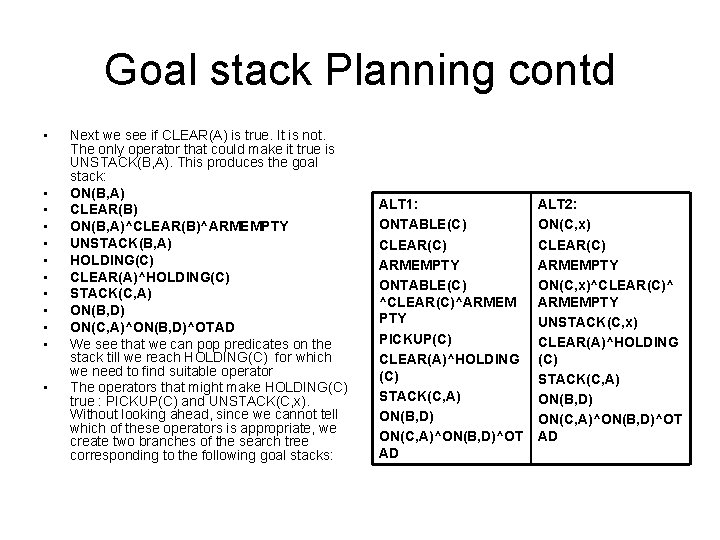
Goal stack Planning contd • • • Next we see if CLEAR(A) is true. It is not. The only operator that could make it true is UNSTACK(B, A). This produces the goal stack: ON(B, A) CLEAR(B) ON(B, A)^CLEAR(B)^ARMEMPTY UNSTACK(B, A) HOLDING(C) CLEAR(A)^HOLDING(C) STACK(C, A) ON(B, D) ON(C, A)^ON(B, D)^OTAD We see that we can pop predicates on the stack till we reach HOLDING(C) for which we need to find suitable operator The operators that might make HOLDING(C) true : PICKUP(C) and UNSTACK(C, x). Without looking ahead, since we cannot tell which of these operators is appropriate, we create two branches of the search tree corresponding to the following goal stacks: ALT 1: ONTABLE(C) CLEAR(C) ARMEMPTY ONTABLE(C) ^CLEAR(C)^ARMEM PTY PICKUP(C) CLEAR(A)^HOLDING (C) STACK(C, A) ON(B, D) ON(C, A)^ON(B, D)^OT AD ALT 2: ON(C, x) CLEAR(C) ARMEMPTY ON(C, x)^CLEAR(C)^ ARMEMPTY UNSTACK(C, x) CLEAR(A)^HOLDING (C) STACK(C, A) ON(B, D) ON(C, A)^ON(B, D)^OT AD
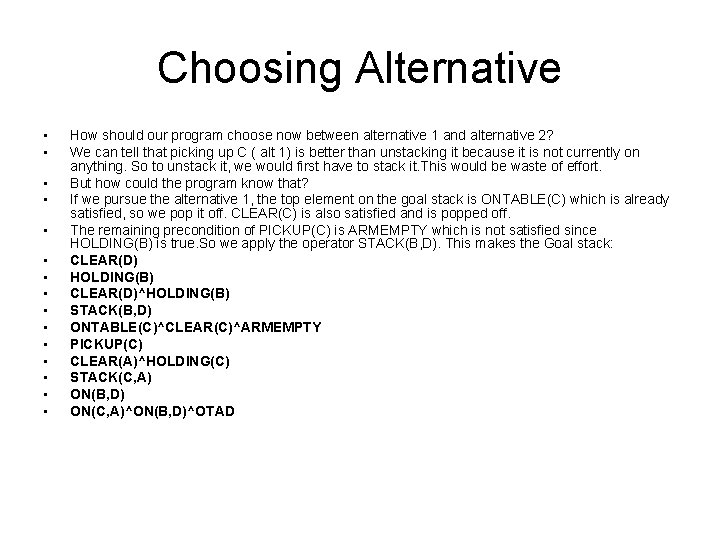
Choosing Alternative • • • • How should our program choose now between alternative 1 and alternative 2? We can tell that picking up C ( alt 1) is better than unstacking it because it is not currently on anything. So to unstack it, we would first have to stack it. This would be waste of effort. But how could the program know that? If we pursue the alternative 1, the top element on the goal stack is ONTABLE(C) which is already satisfied, so we pop it off. CLEAR(C) is also satisfied and is popped off. The remaining precondition of PICKUP(C) is ARMEMPTY which is not satisfied since HOLDING(B) is true. So we apply the operator STACK(B, D). This makes the Goal stack: CLEAR(D) HOLDING(B) CLEAR(D)^HOLDING(B) STACK(B, D) ONTABLE(C)^CLEAR(C)^ARMEMPTY PICKUP(C) CLEAR(A)^HOLDING(C) STACK(C, A) ON(B, D) ON(C, A)^ON(B, D)^OTAD
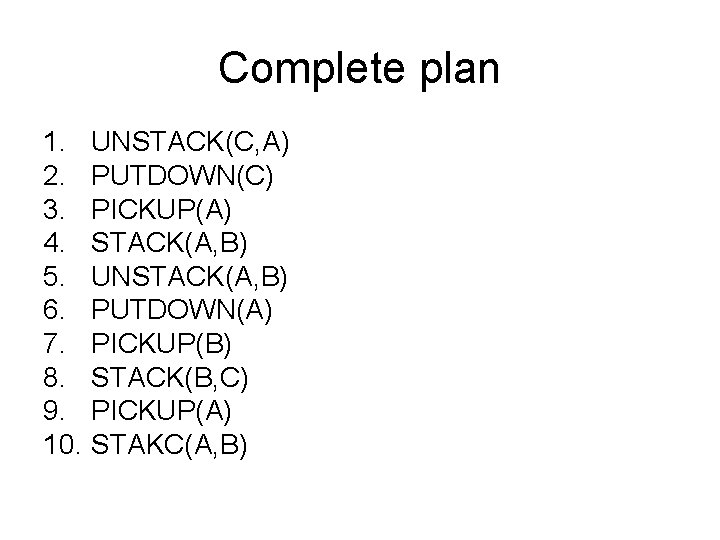
Complete plan 1. UNSTACK(C, A) 2. PUTDOWN(C) 3. PICKUP(A) 4. STACK(A, B) 5. UNSTACK(A, B) 6. PUTDOWN(A) 7. PICKUP(B) 8. STACK(B, C) 9. PICKUP(A) 10. STAKC(A, B)
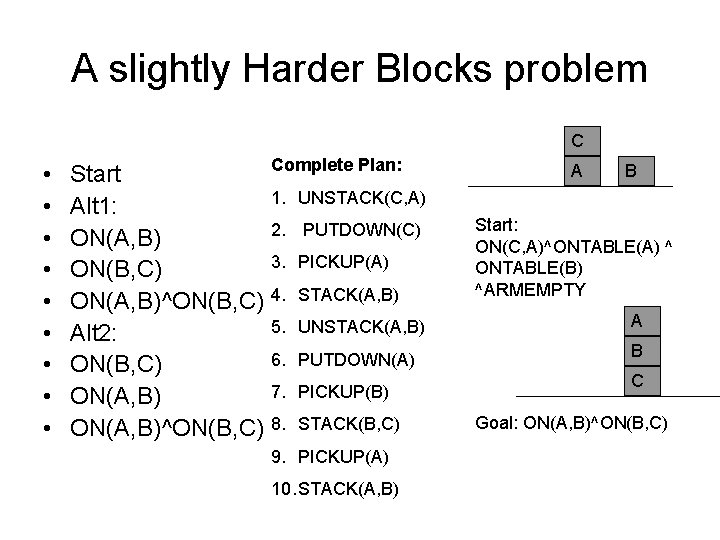
A slightly Harder Blocks problem C • • • Start Alt 1: ON(A, B) ON(B, C) ON(A, B)^ON(B, C) Alt 2: ON(B, C) ON(A, B)^ON(B, C) Complete Plan: A B 1. UNSTACK(C, A) 2. PUTDOWN(C) 3. PICKUP(A) 4. STACK(A, B) Start: ON(C, A)^ONTABLE(A) ^ ONTABLE(B) ^ARMEMPTY 5. UNSTACK(A, B) A 6. PUTDOWN(A) B 7. PICKUP(B) 8. STACK(B, C) 9. PICKUP(A) 10. STACK(A, B) C Goal: ON(A, B)^ON(B, C)
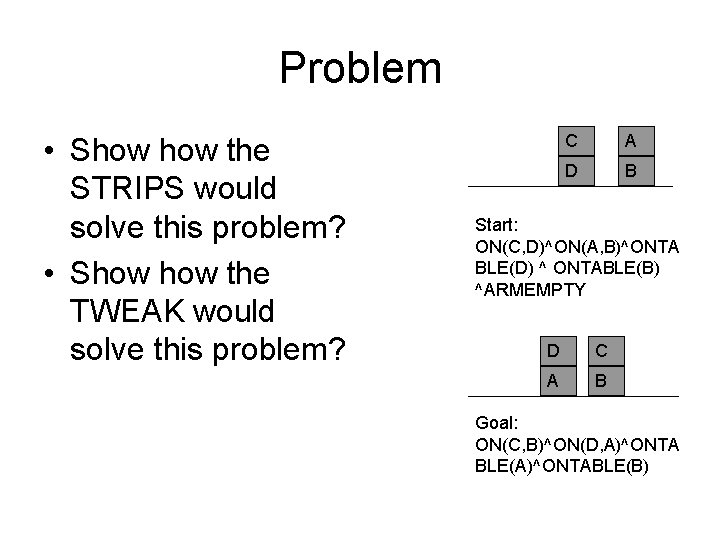
Problem • Show the STRIPS would solve this problem? • Show the TWEAK would solve this problem? C A D B Start: ON(C, D)^ON(A, B)^ONTA BLE(D) ^ ONTABLE(B) ^ARMEMPTY D C A B Goal: ON(C, B)^ON(D, A)^ONTA BLE(A)^ONTABLE(B)
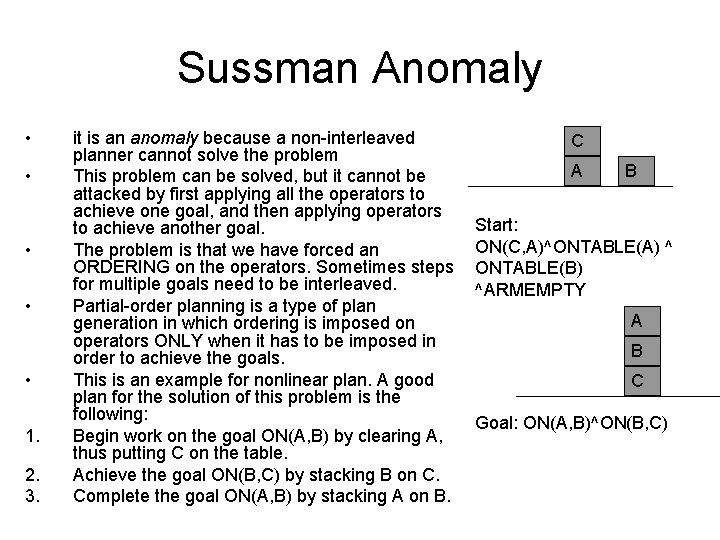
Sussman Anomaly • • • 1. 2. 3. it is an anomaly because a non-interleaved planner cannot solve the problem This problem can be solved, but it cannot be attacked by first applying all the operators to achieve one goal, and then applying operators to achieve another goal. The problem is that we have forced an ORDERING on the operators. Sometimes steps for multiple goals need to be interleaved. Partial-order planning is a type of plan generation in which ordering is imposed on operators ONLY when it has to be imposed in order to achieve the goals. This is an example for nonlinear plan. A good plan for the solution of this problem is the following: Begin work on the goal ON(A, B) by clearing A, thus putting C on the table. Achieve the goal ON(B, C) by stacking B on C. Complete the goal ON(A, B) by stacking A on B. C A B Start: ON(C, A)^ONTABLE(A) ^ ONTABLE(B) ^ARMEMPTY A B C Goal: ON(A, B)^ON(B, C)
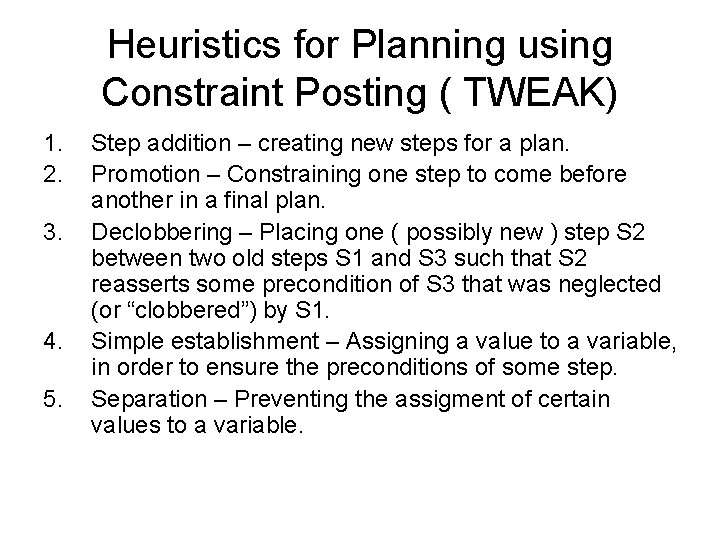
Heuristics for Planning using Constraint Posting ( TWEAK) 1. 2. 3. 4. 5. Step addition – creating new steps for a plan. Promotion – Constraining one step to come before another in a final plan. Declobbering – Placing one ( possibly new ) step S 2 between two old steps S 1 and S 3 such that S 2 reasserts some precondition of S 3 that was neglected (or “clobbered”) by S 1. Simple establishment – Assigning a value to a variable, in order to ensure the preconditions of some step. Separation – Preventing the assigment of certain values to a variable.
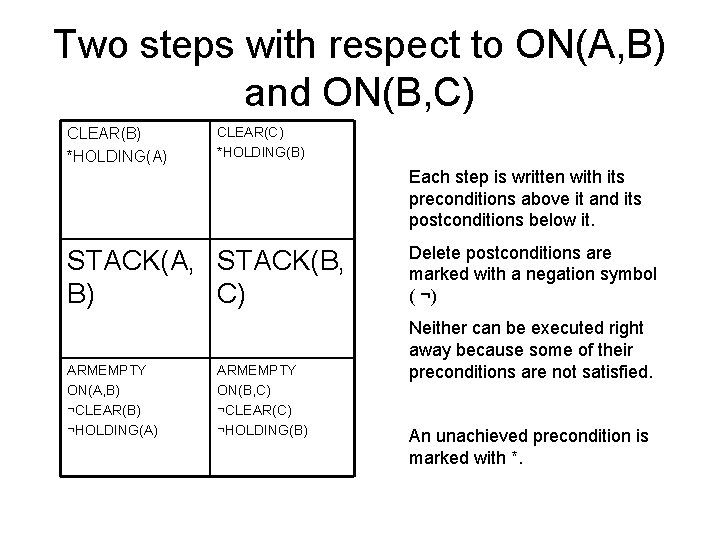
Two steps with respect to ON(A, B) and ON(B, C) CLEAR(B) *HOLDING(A) CLEAR(C) *HOLDING(B) Each step is written with its preconditions above it and its postconditions below it. STACK(A, STACK(B, B) C) ARMEMPTY ON(A, B) ¬CLEAR(B) ¬HOLDING(A) ARMEMPTY ON(B, C) ¬CLEAR(C) ¬HOLDING(B) Delete postconditions are marked with a negation symbol ( ¬) Neither can be executed right away because some of their preconditions are not satisfied. An unachieved precondition is marked with *.
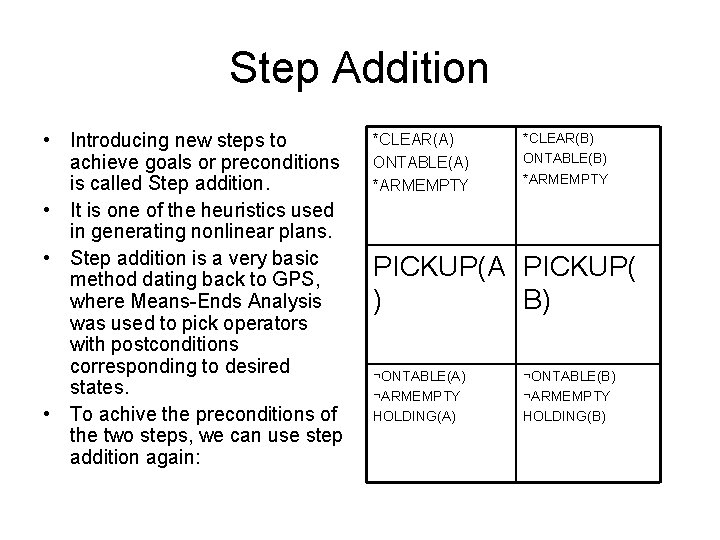
Step Addition • Introducing new steps to achieve goals or preconditions is called Step addition. • It is one of the heuristics used in generating nonlinear plans. • Step addition is a very basic method dating back to GPS, where Means-Ends Analysis was used to pick operators with postconditions corresponding to desired states. • To achive the preconditions of the two steps, we can use step addition again: *CLEAR(A) ONTABLE(A) *ARMEMPTY *CLEAR(B) ONTABLE(B) *ARMEMPTY PICKUP(A PICKUP( ) B) ¬ONTABLE(A) ¬ARMEMPTY HOLDING(A) ¬ONTABLE(B) ¬ARMEMPTY HOLDING(B)
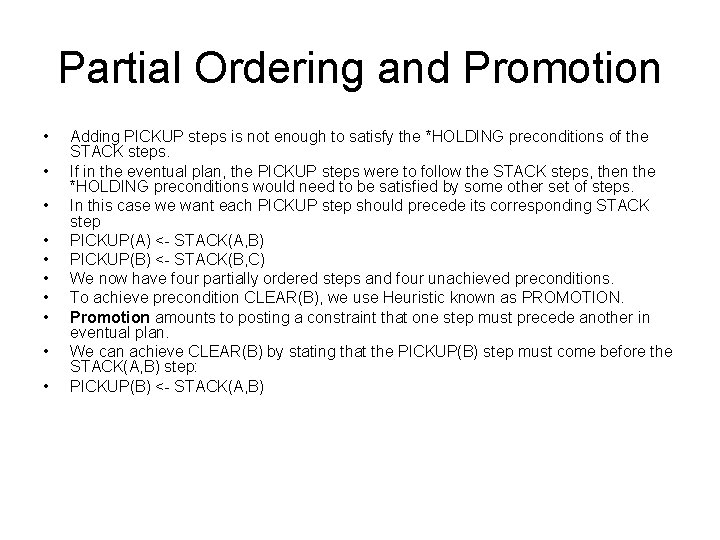
Partial Ordering and Promotion • • • Adding PICKUP steps is not enough to satisfy the *HOLDING preconditions of the STACK steps. If in the eventual plan, the PICKUP steps were to follow the STACK steps, then the *HOLDING preconditions would need to be satisfied by some other set of steps. In this case we want each PICKUP step should precede its corresponding STACK step PICKUP(A) <- STACK(A, B) PICKUP(B) <- STACK(B, C) We now have four partially ordered steps and four unachieved preconditions. To achieve precondition CLEAR(B), we use Heuristic known as PROMOTION. Promotion amounts to posting a constraint that one step must precede another in eventual plan. We can achieve CLEAR(B) by stating that the PICKUP(B) step must come before the STACK(A, B) step: PICKUP(B) <- STACK(A, B)
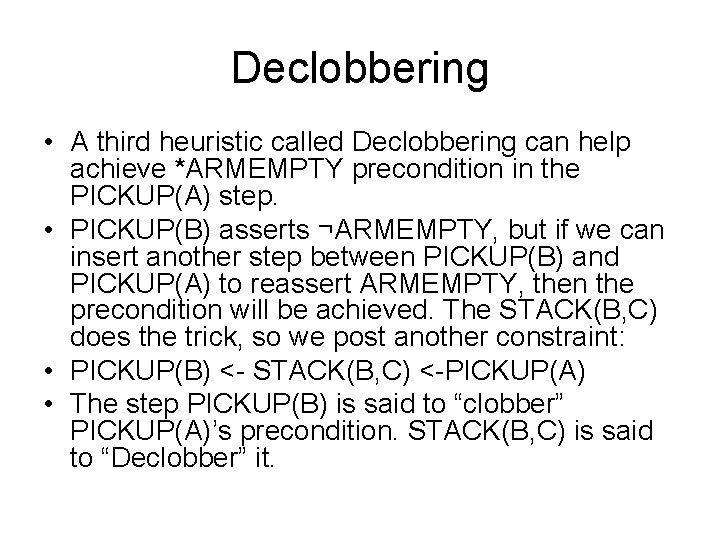
Declobbering • A third heuristic called Declobbering can help achieve *ARMEMPTY precondition in the PICKUP(A) step. • PICKUP(B) asserts ¬ARMEMPTY, but if we can insert another step between PICKUP(B) and PICKUP(A) to reassert ARMEMPTY, then the precondition will be achieved. The STACK(B, C) does the trick, so we post another constraint: • PICKUP(B) <- STACK(B, C) <-PICKUP(A) • The step PICKUP(B) is said to “clobber” PICKUP(A)’s precondition. STACK(B, C) is said to “Declobber” it.
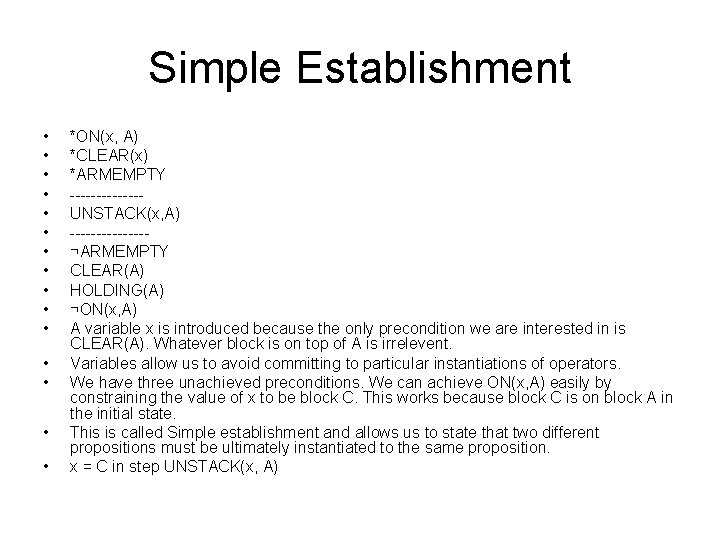
Simple Establishment • • • • *ON(x, A) *CLEAR(x) *ARMEMPTY -------UNSTACK(x, A) -------¬ARMEMPTY CLEAR(A) HOLDING(A) ¬ON(x, A) A variable x is introduced because the only precondition we are interested in is CLEAR(A). Whatever block is on top of A is irrelevent. Variables allow us to avoid committing to particular instantiations of operators. We have three unachieved preconditions. We can achieve ON(x, A) easily by constraining the value of x to be block C. This works because block C is on block A in the initial state. This is called Simple establishment and allows us to state that two different propositions must be ultimately instantiated to the same proposition. x = C in step UNSTACK(x, A)
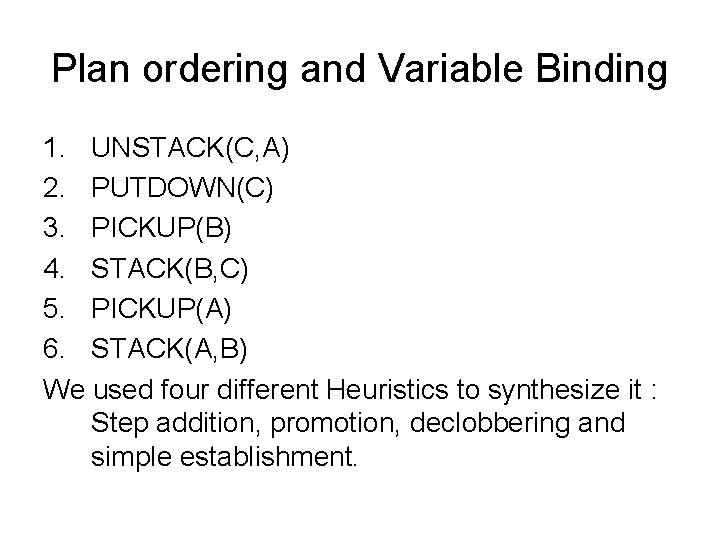
Plan ordering and Variable Binding 1. UNSTACK(C, A) 2. PUTDOWN(C) 3. PICKUP(B) 4. STACK(B, C) 5. PICKUP(A) 6. STACK(A, B) We used four different Heuristics to synthesize it : Step addition, promotion, declobbering and simple establishment.
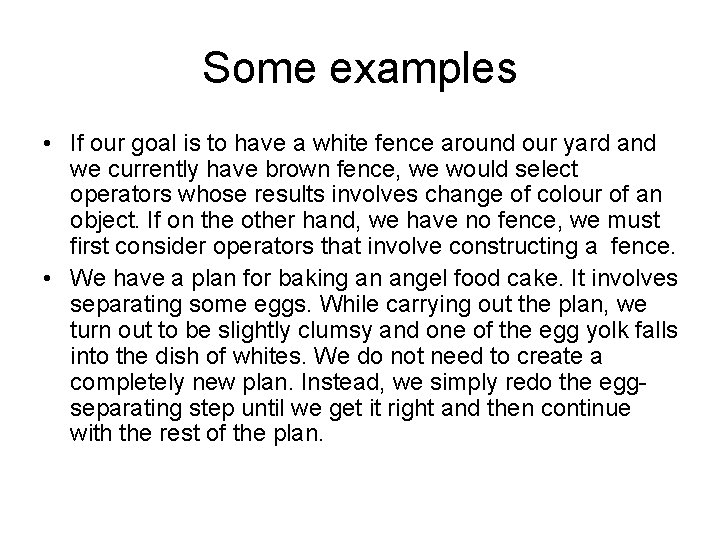
Some examples • If our goal is to have a white fence around our yard and we currently have brown fence, we would select operators whose results involves change of colour of an object. If on the other hand, we have no fence, we must first consider operators that involve constructing a fence. • We have a plan for baking an angel food cake. It involves separating some eggs. While carrying out the plan, we turn out to be slightly clumsy and one of the egg yolk falls into the dish of whites. We do not need to create a completely new plan. Instead, we simply redo the eggseparating step until we get it right and then continue with the rest of the plan.
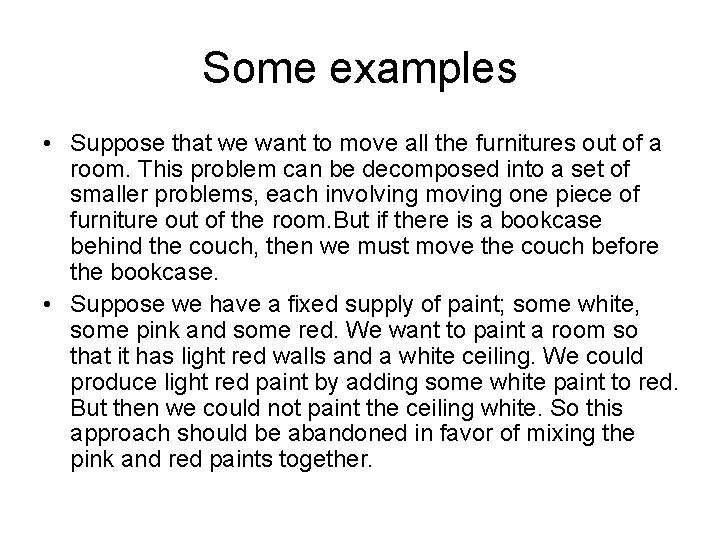
Some examples • Suppose that we want to move all the furnitures out of a room. This problem can be decomposed into a set of smaller problems, each involving moving one piece of furniture out of the room. But if there is a bookcase behind the couch, then we must move the couch before the bookcase. • Suppose we have a fixed supply of paint; some white, some pink and some red. We want to paint a room so that it has light red walls and a white ceiling. We could produce light red paint by adding some white paint to red. But then we could not paint the ceiling white. So this approach should be abandoned in favor of mixing the pink and red paints together.
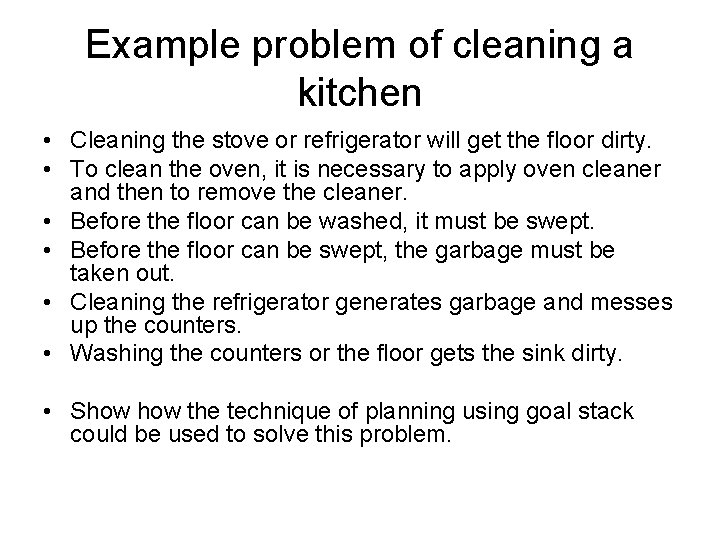
Example problem of cleaning a kitchen • Cleaning the stove or refrigerator will get the floor dirty. • To clean the oven, it is necessary to apply oven cleaner and then to remove the cleaner. • Before the floor can be washed, it must be swept. • Before the floor can be swept, the garbage must be taken out. • Cleaning the refrigerator generates garbage and messes up the counters. • Washing the counters or the floor gets the sink dirty. • Show the technique of planning using goal stack could be used to solve this problem.