SI Joint Dysfunciton Steven Garfin M D Distinguished

- Slides: 33
SI Joint Dysfunciton Steven Garfin, M. D. Distinguished Professor and Chair Department of Orthopaedic Surgery, UCSD
Disclosures AO Spine Medtronic Benvenue Medical Nu. Vasive, Inc. EBI Samumed Globus Medical SI Bone, Inc. Intrinsic Therapy Spinal Kinetics Johnson & Johnson, De. Puy Spine Stryker Magnifi Group Symmetry Vertiflex
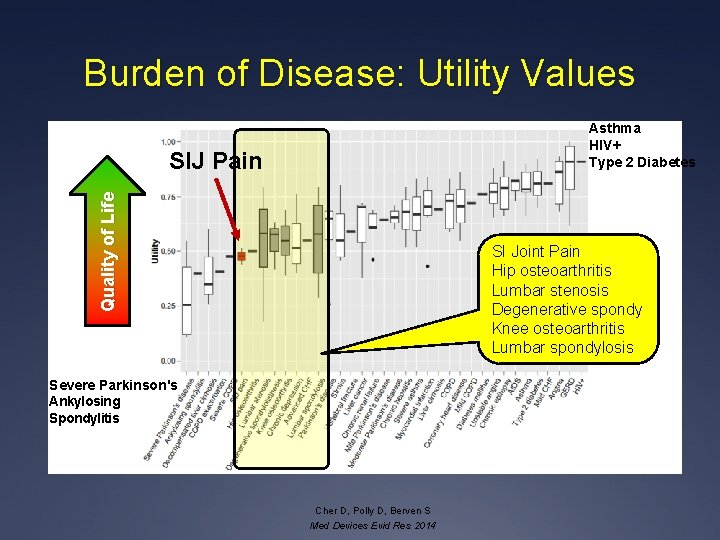
Burden of Disease: Utility Values Asthma HIV+ Type 2 Diabetes SIJ Pain Quality of Life High SI Joint Pain Hip osteoarthritis Lumbar stenosis Degenerative spondy Knee osteoarthritis Lumbar spondylosis Low Severe Parkinson's Ankylosing Spondylitis Cher D, Polly D, Berven S Med Devices Evid Res 2014
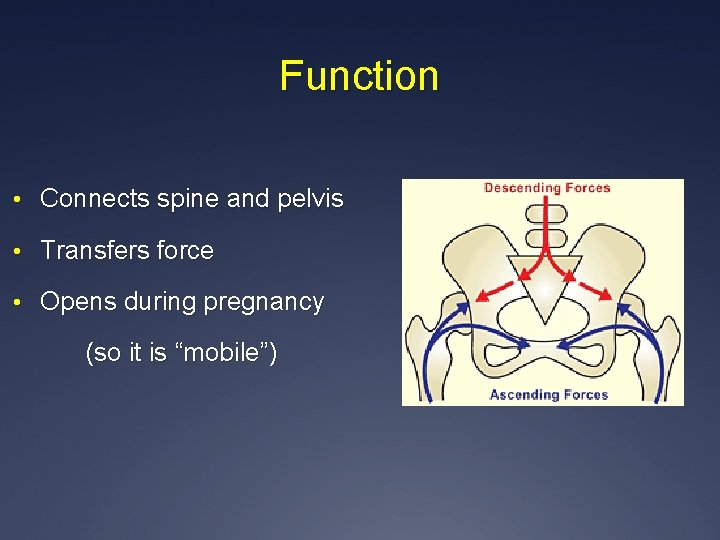
Function • Connects spine and pelvis • Transfers force • Opens during pregnancy (so it is “mobile”)
SI Joint • Large surface area • 1/4 – 1/3 synovial (anterior) • Cartilaginous surfaces • Strong ligaments • + Motions (multi-directions) < 4⁰ Can be arthritic
SI Joint – with age • Surfaces flat until puberty • Then ridges appear • 3 RD and 4 TH decade: elevations and depressions appear • Articular surfaces erode “Arthritic changes”
Innervation • Synovium and capsule contain unmyelinated nerve endings for pain and temperature • Anteriorly from L 2 -S 2 ventral rami and sacral plexus • Posteriorly from L 4 -S 4 dorsal rami Solomen, 1957 Nakegawa 1966 Ikeda, 1991 Grob, 1995 Could “sense” pain
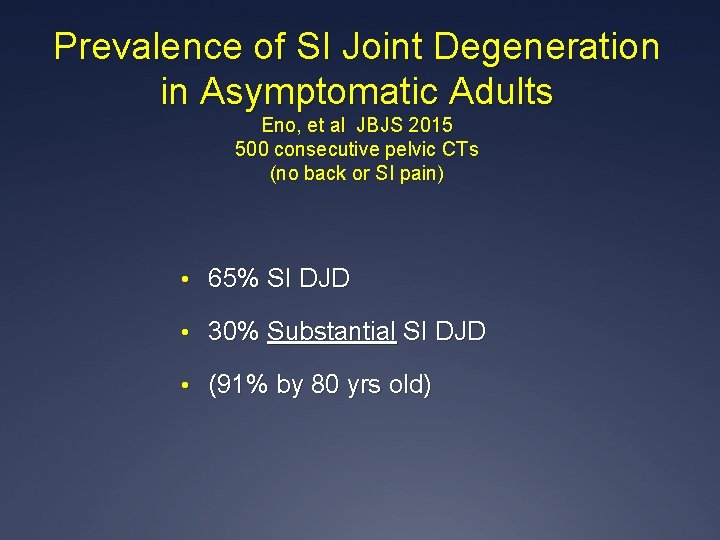
Prevalence of SI Joint Degeneration in Asymptomatic Adults Eno, et al JBJS 2015 500 consecutive pelvic CTs (no back or SI pain) • 65% SI DJD • 30% Substantial SI DJD • (91% by 80 yrs old)
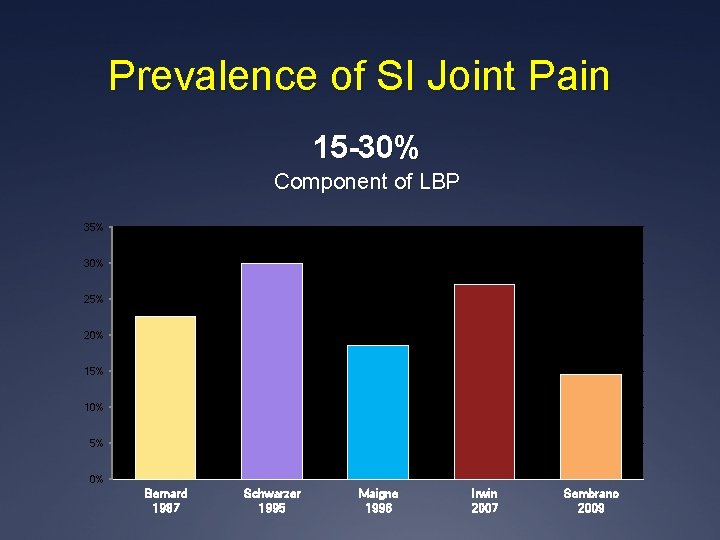
Prevalence of SI Joint Pain 15 -30% Component of LBP 35% 0. 3 30% 25% 0. 27 0. 226 0. 185 20% 0. 145 15% 10% 5% 0% Bernard 1987 Schwarzer 1995 Maigne 1996 Irwin 2007 Sembrano 2009
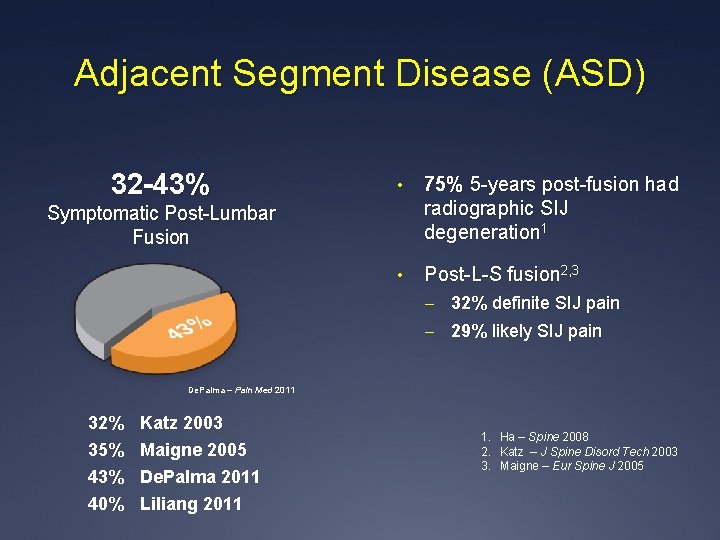
Adjacent Segment Disease (ASD) 32 -43% • 75% 5 -years post-fusion had radiographic SIJ degeneration 1 • Post-L-S fusion 2, 3 Symptomatic Post-Lumbar Fusion 32% definite SIJ pain – 29% likely SIJ pain – De. Palma – Pain Med 2011 32% 35% 43% 40% Katz 2003 Maigne 2005 De. Palma 2011 Liliang 2011 1. Ha – Spine 2008 2. Katz – J Spine Disord Tech 2003 3. Maigne – Eur Spine J 2005
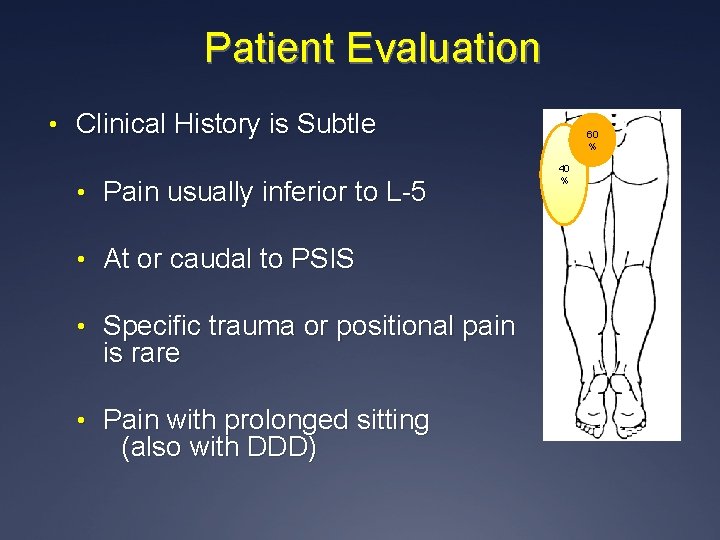
Patient Evaluation • Clinical History is Subtle • Pain usually inferior to L-5 • At or caudal to PSIS • Specific trauma or positional pain is rare • Pain with prolonged sitting (also with DDD) 60 % 40 %
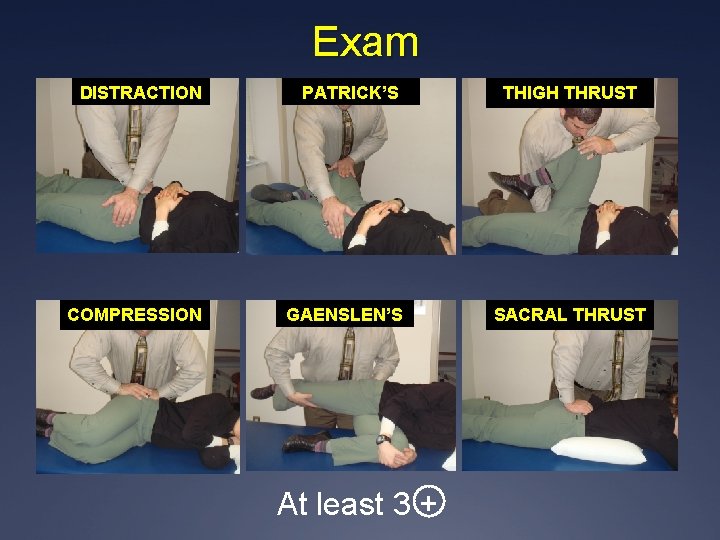
Exam DISTRACTION PATRICK’S COMPRESSION GAENSLEN’S At least 3 + THIGH THRUST SACRAL THRUST
Radiologic Testing • X-rays, CT, MRI for abnormalities/asymmetry (often not helpful) • Fluoroscopic or CT guided SI Joint injection (pain relief)
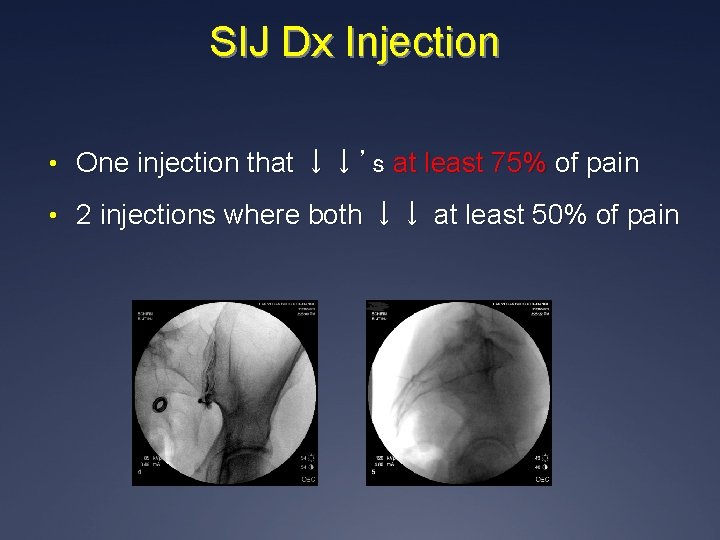
SIJ Dx Injection • One injection that ↓↓’s at least 75% of pain • 2 injections where both ↓↓ at least 50% of pain
Non-Op RX • Physical therapy, manipulations/modalities • NSAIDs • Muscle relaxants • “Pelvic belt” • SI steroid injection No data to support
“Fusion” Candidate • SI Joint pain = chronic • SI Joint = primary pain generator (other primary causes ruled out) • + response to diagnostic injection(s)
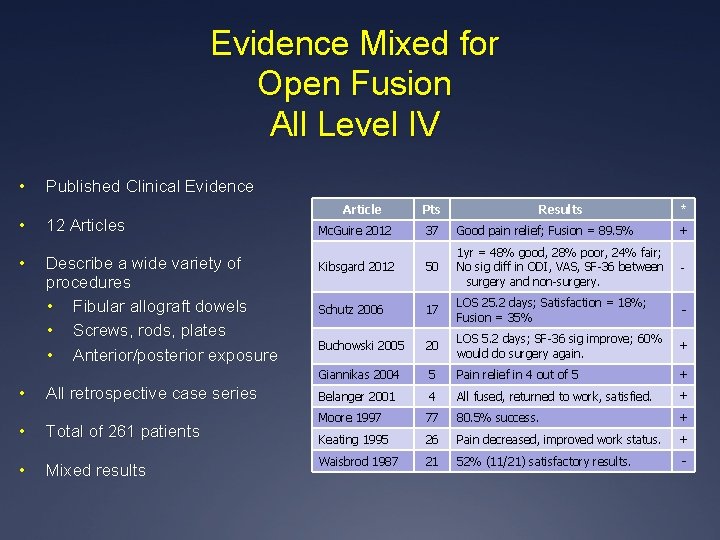
Evidence Mixed for Open Fusion All Level IV • Published Clinical Evidence • 12 Articles • Describe a wide variety of procedures • Fibular allograft dowels • Screws, rods, plates • Anterior/posterior exposure • All retrospective case series • Total of 261 patients • Mixed results Article Pts Results * Mc. Guire 2012 37 Good pain relief; Fusion = 89. 5% + Kibsgard 2012 50 1 yr = 48% good, 28% poor, 24% fair; No sig diff in ODI, VAS, SF-36 between surgery and non-surgery. - Schutz 2006 17 LOS 25. 2 days; Satisfaction = 18%; Fusion = 35% - Buchowski 2005 20 LOS 5. 2 days; SF-36 sig improve; 60% would do surgery again. + Giannikas 2004 5 Pain relief in 4 out of 5 + Belanger 2001 4 All fused, returned to work, satisfied. + Moore 1997 77 80. 5% success. + Keating 1995 26 Pain decreased, improved work status. + Waisbrod 1987 21 52% (11/21) satisfactory results. -
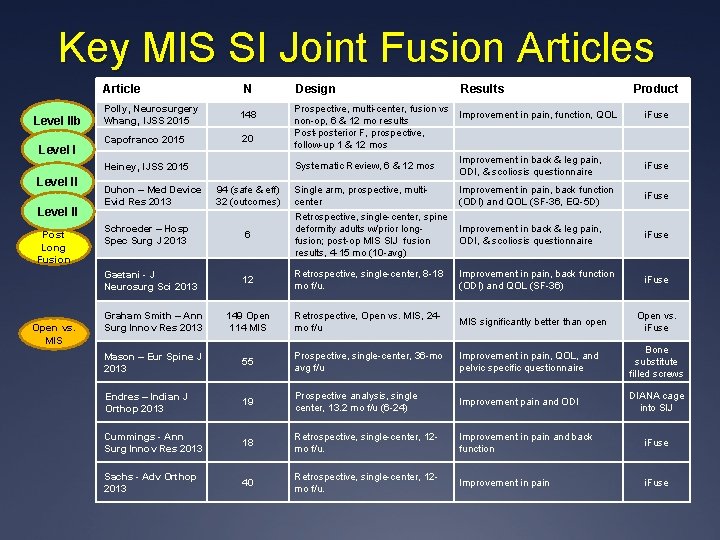
Key MIS SI Joint Fusion Articles Article Level IIb Level I N Polly, Neurosurgery Whang, IJSS 2015 148 Capofranco 2015 20 Level II Post Long Fusion Open vs. MIS Duhon – Med Device Evid Res 2013 Prospective, multi-center, fusion vs non-op, 6 & 12 mo results Post-posterior F, prospective, follow-up 1 & 12 mos 94 (safe & eff) 32 (outcomes) Results Product Improvement in pain, function, QOL i. Fuse Improvement in back & leg pain, ODI, & scoliosis questionnaire i. Fuse Single arm, prospective, multicenter Retrospective, single-center, spine deformity adults w/prior longfusion; post-op MIS SIJ fusion results, 4 -15 mo (10 -avg) Improvement in pain, back function (ODI) and QOL (SF-36, EQ-5 D) i. Fuse Improvement in back & leg pain, ODI, & scoliosis questionnaire i. Fuse Systematic Review, 6 & 12 mos Heiney, IJSS 2015 Level II Design Schroeder – Hosp Spec Surg J 2013 6 Gaetani - J Neurosurg Sci 2013 12 Retrospective, single-center, 8 -18 mo f/u. Improvement in pain, back function (ODI) and QOL (SF-36) Graham Smith – Ann Surg Innov Res 2013 149 Open 114 MIS Retrospective, Open vs. MIS, 24 mo f/u MIS significantly better than open Mason – Eur Spine J 2013 55 Prospective, single-center, 36 -mo avg f/u Improvement in pain, QOL, and pelvic specific questionnaire Bone substitute filled screws Endres – Indian J Orthop 2013 19 Prospective analysis, single center, 13. 2 mo f/u (6 -24) Improvement pain and ODI DIANA cage into SIJ Cummings - Ann Surg Innov Res 2013 18 Retrospective, single-center, 12 mo f/u. Improvement in pain and back function i. Fuse Sachs - Adv Orthop 2013 40 Retrospective, single-center, 12 mo f/u. Improvement in pain i. Fuse Open vs. i. Fuse
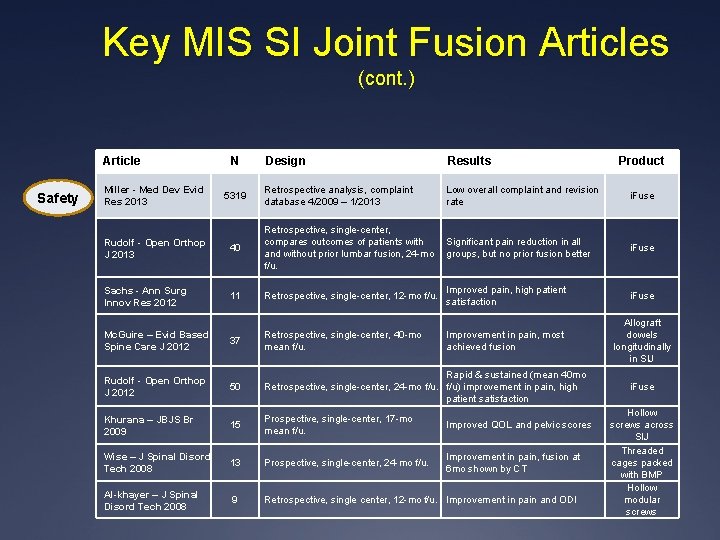
Key MIS SI Joint Fusion Articles (cont. ) Article Safety Miller - Med Dev Evid Res 2013 N 5319 Design Results Product Retrospective analysis, complaint database 4/2009 – 1/2013 Low overall complaint and revision rate i. Fuse Significant pain reduction in all groups, but no prior fusion better i. Fuse Rudolf - Open Orthop J 2013 40 Retrospective, single-center, compares outcomes of patients with and without prior lumbar fusion, 24 -mo f/u. Sachs - Ann Surg Innov Res 2012 11 Retrospective, single-center, 12 -mo f/u. Improved pain, high patient satisfaction i. Fuse Mc. Guire – Evid Based Spine Care J 2012 37 Retrospective, single-center, 40 -mo mean f/u. Improvement in pain, most achieved fusion Allograft dowels longitudinally in SIJ Rudolf - Open Orthop J 2012 50 Rapid & sustained (mean 40 mo Retrospective, single-center, 24 -mo f/u) improvement in pain, high patient satisfaction Khurana – JBJS Br 2009 15 Prospective, single-center, 17 -mo mean f/u. Improved QOL and pelvic scores Wise – J Spinal Disord Tech 2008 13 Prospective, single-center, 24 -mo f/u. Improvement in pain, fusion at 6 mo shown by CT Al-khayer – J Spinal Disord Tech 2008 9 Retrospective, single center, 12 -mo f/u. Improvement in pain and ODI i. Fuse Hollow screws across SIJ Threaded cages packed with BMP Hollow modular screws
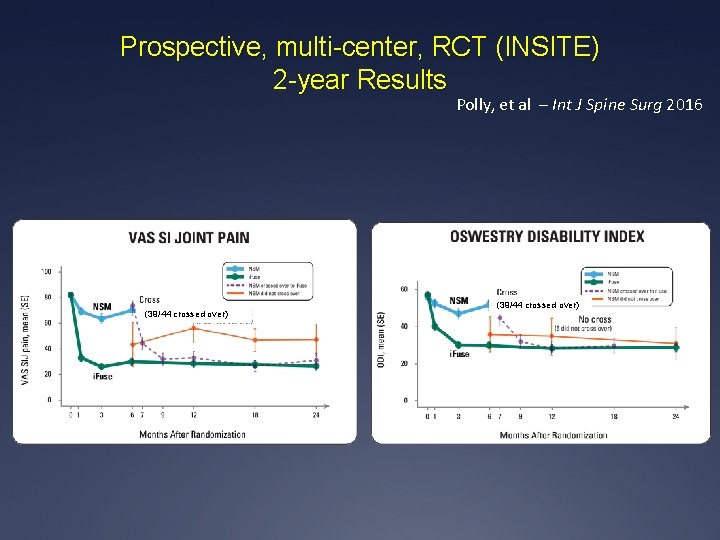
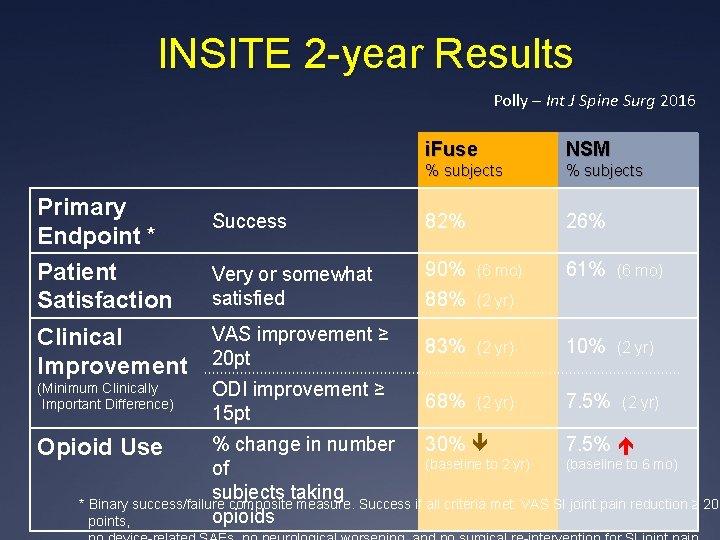
Prospective, multi-center, RCT (INSITE) 2 -year Results Polly, et al – Int J Spine Surg 2016 (39/44 crossed over)
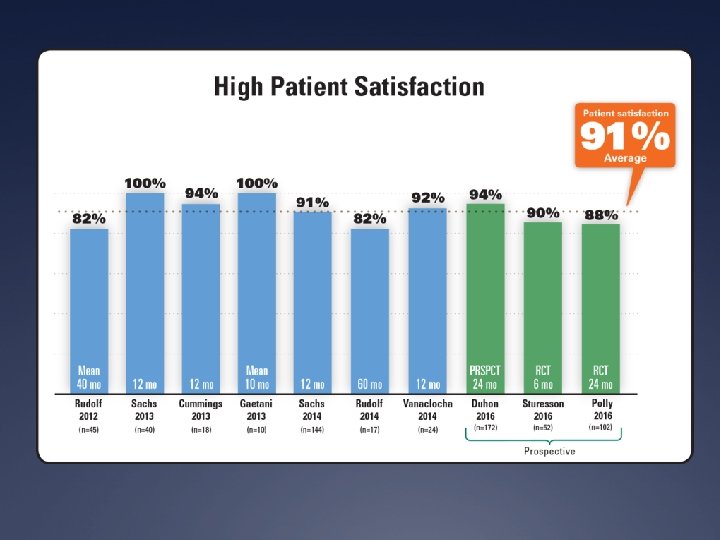
INSITE 2 -year Results Polly – Int J Spine Surg 2016 i. Fuse NSM % subjects Success 82% 26% Very or somewhat satisfied 90% 88% (6 mo) VAS improvement ≥ Clinical Improvement 20 pt 83% (Minimum Clinically Important Difference) 68% Primary Endpoint * Patient Satisfaction ODI improvement ≥ 15 pt 61% (6 mo) (2 yr) 10% (2 yr) 7. 5% (2 yr) 30% 7. 5% % change in number (baseline to 2 yr) (baseline to 6 mo) of subjects taking * Binary success/failure composite measure. Success if all criteria met: VAS SI joint pain reduction ≥ 20 opioids points, Opioid Use
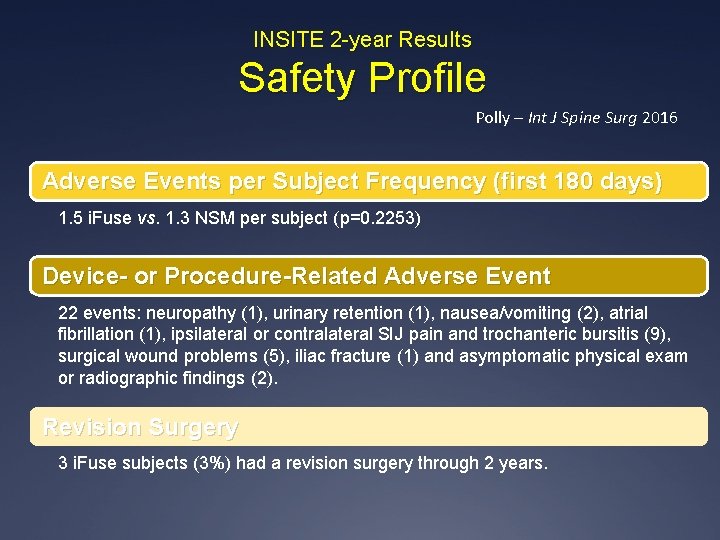
INSITE 2 -year Results Safety Profile Polly – Int J Spine Surg 2016 Adverse Events per Subject Frequency (first 180 days) 1. 5 i. Fuse vs. 1. 3 NSM per subject (p=0. 2253) Device- or Procedure-Related Adverse Event 22 events: neuropathy (1), urinary retention (1), nausea/vomiting (2), atrial fibrillation (1), ipsilateral or contralateral SIJ pain and trochanteric bursitis (9), surgical wound problems (5), iliac fracture (1) and asymptomatic physical exam or radiographic findings (2). Revision Surgery 3 i. Fuse subjects (3%) had a revision surgery through 2 years.
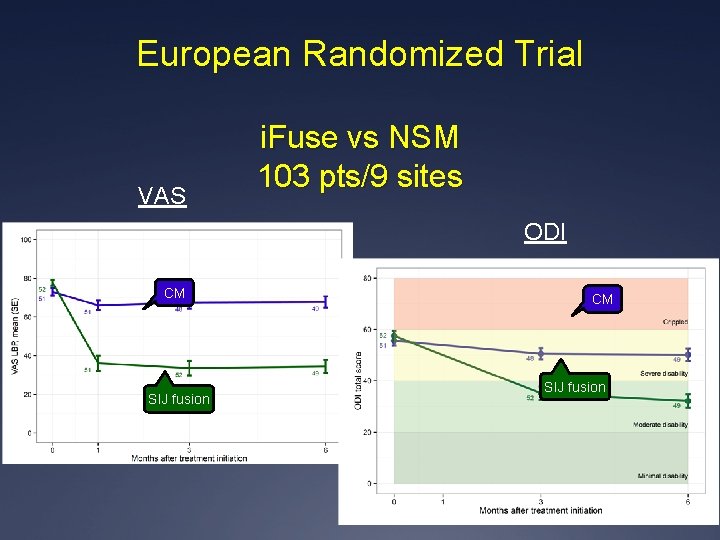
European Randomized Trial VAS i. Fuse vs NSM 103 pts/9 sites ODI CM SIJ fusion
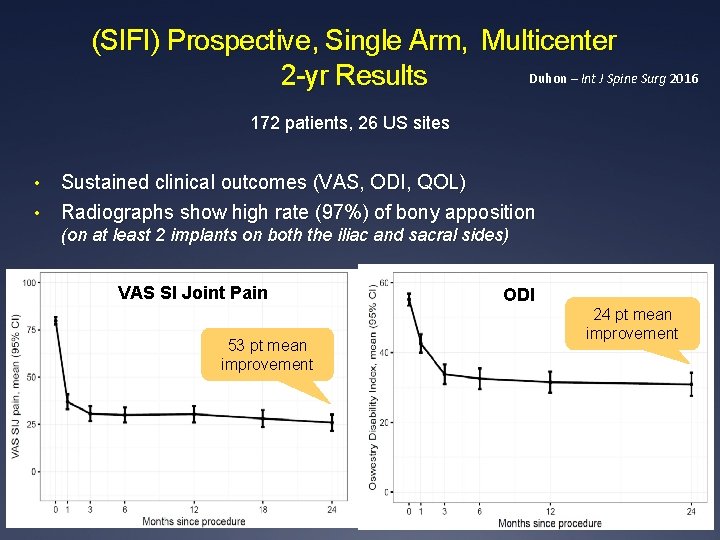
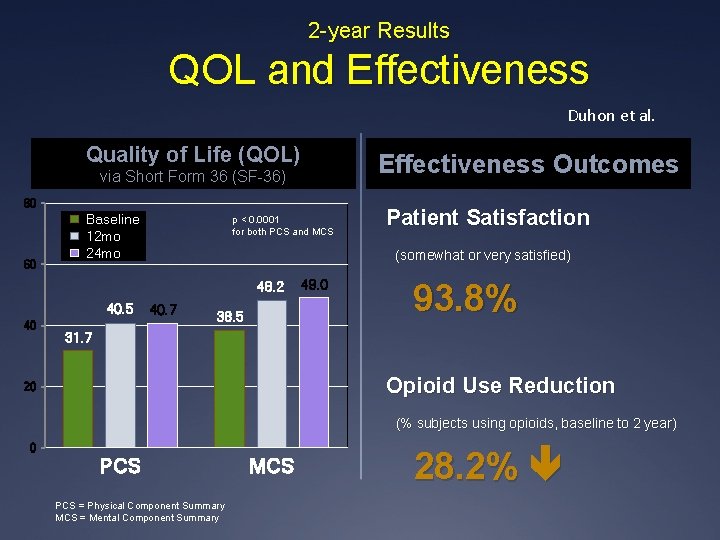
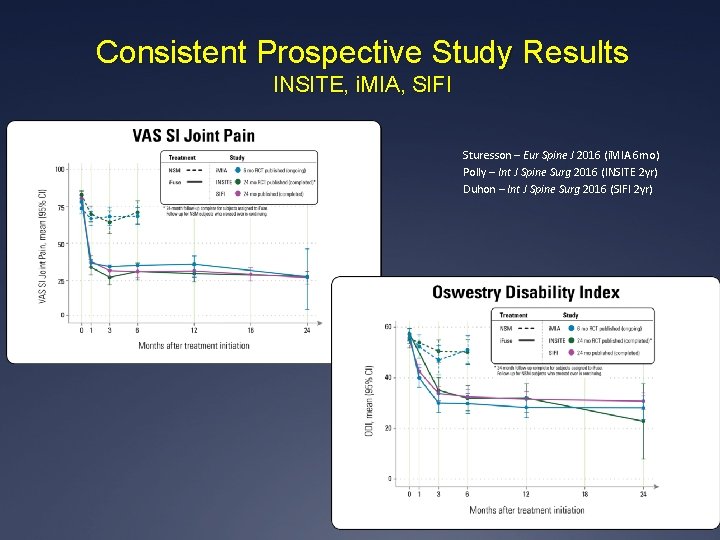
(SIFI) Prospective, Single Arm, Multicenter Duhon – Int J Spine Surg 2016 2 -yr Results 172 patients, 26 US sites Sustained clinical outcomes (VAS, ODI, QOL) • Radiographs show high rate (97%) of bony apposition • (on at least 2 implants on both the iliac and sacral sides) VAS SI Joint Pain 53 pt mean improvement ODI 24 pt mean improvement
2 -year Results QOL and Effectiveness Duhon et al. Quality of Life (QOL) via Short Form 36 (SF-36) 80 60 Baseline 12 mo 24 mo p < 0. 0001 for both PCS and MCS 40 Patient Satisfaction (somewhat or very satisfied) 48. 2 40. 5 Effectiveness Outcomes 40. 7 38. 5 49. 0 93. 8% 31. 7 Opioid Use Reduction 20 (% subjects using opioids, baseline to 2 year) 0 PCS = Physical Component Summary MCS = Mental Component Summary MCS 28. 2%
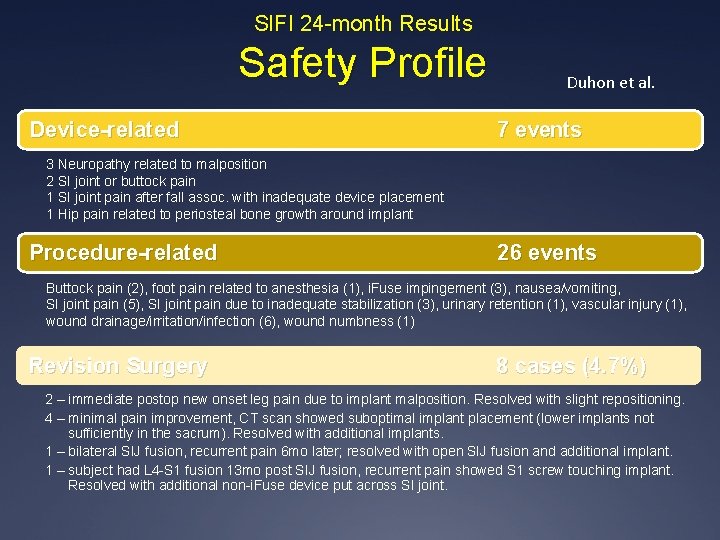
SIFI 24 -month Results Safety Profile Device-related Duhon et al. 7 events 3 Neuropathy related to malposition 2 SI joint or buttock pain 1 SI joint pain after fall assoc. with inadequate device placement 1 Hip pain related to periosteal bone growth around implant Procedure-related 26 events Buttock pain (2), foot pain related to anesthesia (1), i. Fuse impingement (3), nausea/vomiting, SI joint pain (5), SI joint pain due to inadequate stabilization (3), urinary retention (1), vascular injury (1), wound drainage/irritation/infection (6), wound numbness (1) Revision Surgery 8 cases (4. 7%) 2 – immediate postop new onset leg pain due to implant malposition. Resolved with slight repositioning. 4 – minimal pain improvement, CT scan showed suboptimal implant placement (lower implants not sufficiently in the sacrum). Resolved with additional implants. 1 – bilateral SIJ fusion, recurrent pain 6 mo later; resolved with open SIJ fusion and additional implant. 1 – subject had L 4 -S 1 fusion 13 mo post SIJ fusion, recurrent pain showed S 1 screw touching implant. Resolved with additional non-i. Fuse device put across SI joint.
Consistent Prospective Study Results INSITE, i. MIA, SIFI Sturesson – Eur Spine J 2016 (i. MIA 6 mo) Polly – Int J Spine Surg 2016 (INSITE 2 yr) Duhon – Int J Spine Surg 2016 (SIFI 2 yr)
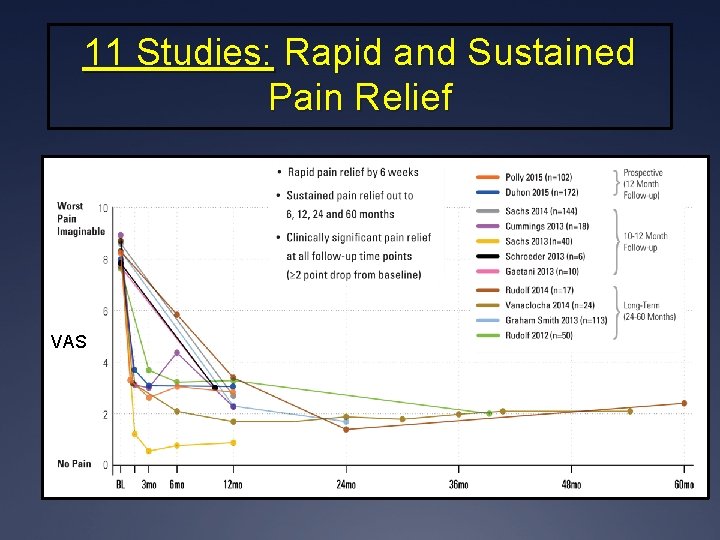
11 Studies: Rapid and Sustained Pain Relief VAS
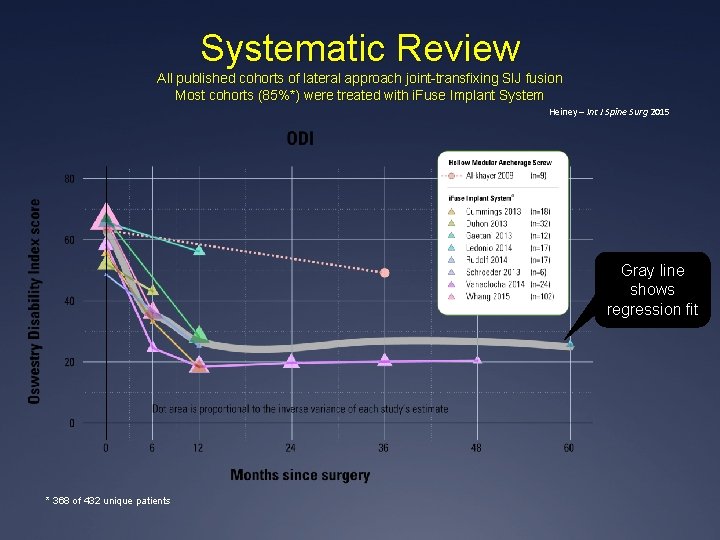
Systematic Review All published cohorts of lateral approach joint-transfixing SIJ fusion Most cohorts (85%*) were treated with i. Fuse Implant System Heiney – Int J Spine Surg 2015 Gray line shows regression fit * 368 of 432 unique patients
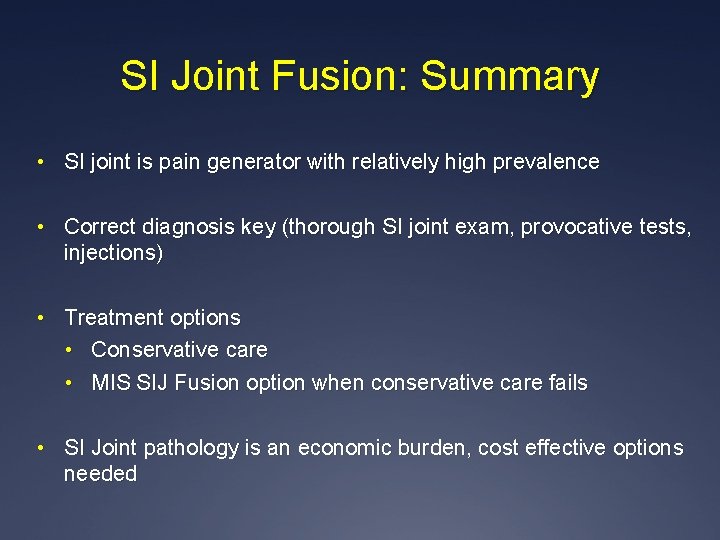
SI Joint Fusion: Summary • SI joint is pain generator with relatively high prevalence • Correct diagnosis key (thorough SI joint exam, provocative tests, injections) • Treatment options • Conservative care • MIS SIJ Fusion option when conservative care fails • SI Joint pathology is an economic burden, cost effective options needed
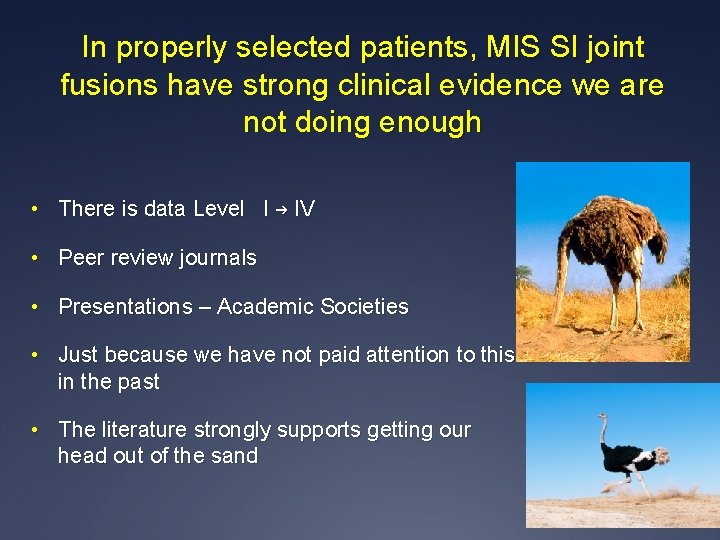
In properly selected patients, MIS SI joint fusions have strong clinical evidence we are not doing enough • There is data Level I → IV • Peer review journals • Presentations – Academic Societies • Just because we have not paid attention to this in the past • The literature strongly supports getting our head out of the sand
Thank You