Selfish Operons Greedy Selection and SIN Christopher A


- Slides: 42
Selfish Operons, Greedy Selection, and SIN Christopher A. Voigt Denise Wolf Adam Arkin Group Meeting 2003 Department of Pharmaceutical Chemistry
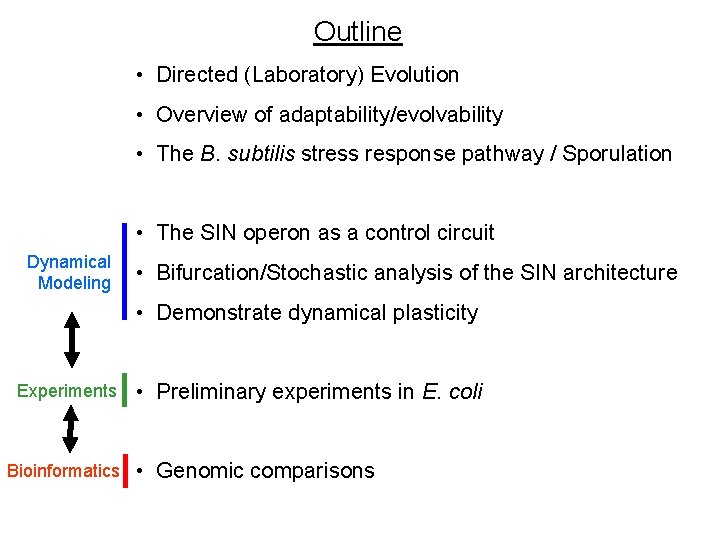
Outline • Directed (Laboratory) Evolution • Overview of adaptability/evolvability • The B. subtilis stress response pathway / Sporulation • The SIN operon as a control circuit Dynamical Modeling • Bifurcation/Stochastic analysis of the SIN architecture • Demonstrate dynamical plasticity Experiments Bioinformatics • Preliminary experiments in E. coli • Genomic comparisons
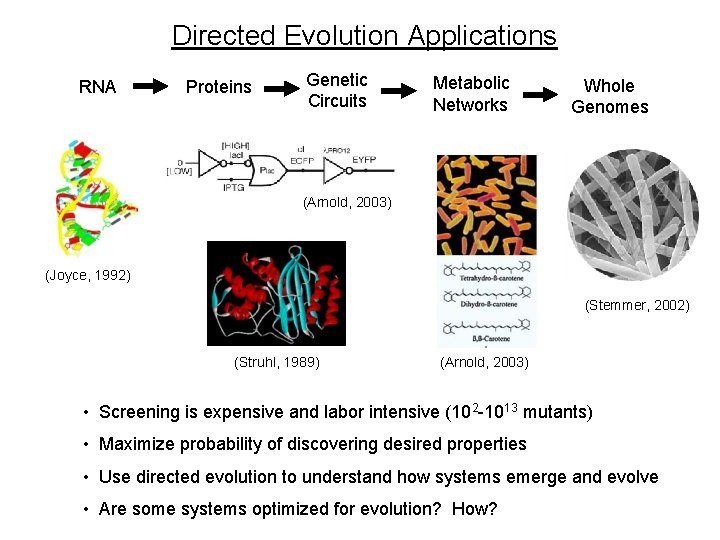
Directed Evolution Applications RNA Proteins Genetic Circuits Metabolic Networks Whole Genomes (Arnold, 2003) (Joyce, 1992) (Stemmer, 2002) (Struhl, 1989) (Arnold, 2003) • Screening is expensive and labor intensive (102 -1013 mutants) • Maximize probability of discovering desired properties • Use directed evolution to understand how systems emerge and evolve • Are some systems optimized for evolution? How?
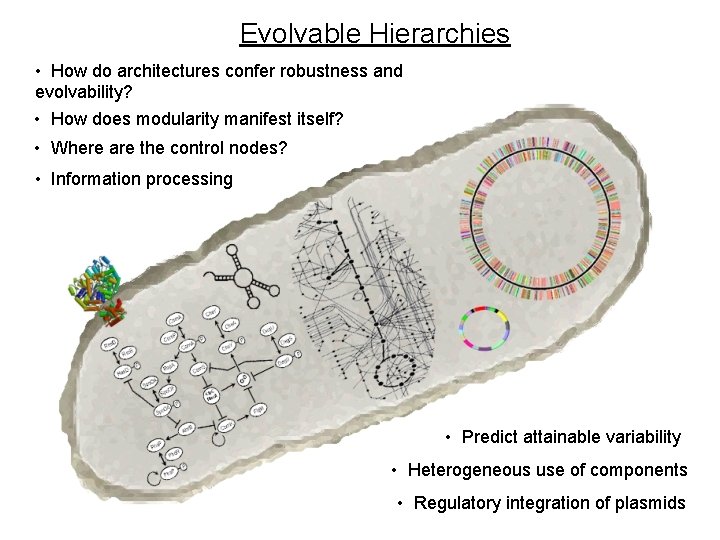
Evolvable Hierarchies • How do architectures confer robustness and evolvability? • How does modularity manifest itself? • Where are the control nodes? • Information processing • Predict attainable variability • Heterogeneous use of components • Regulatory integration of plasmids
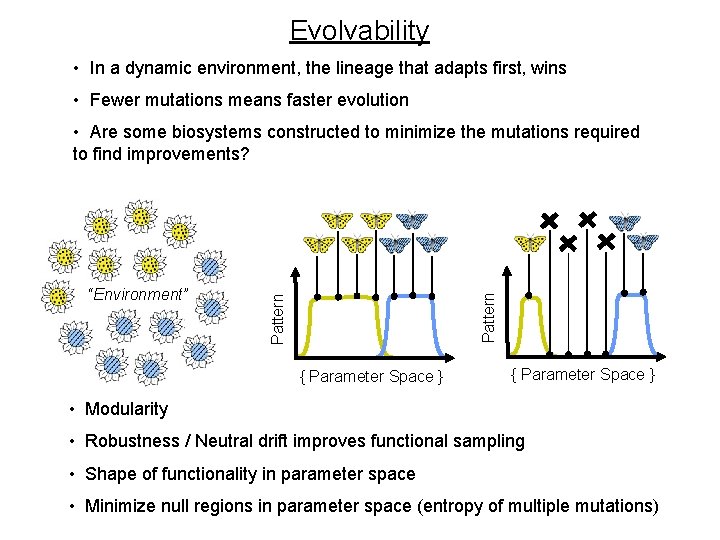
Evolvability • In a dynamic environment, the lineage that adapts first, wins • Fewer mutations means faster evolution Pattern “Environment” Pattern • Are some biosystems constructed to minimize the mutations required to find improvements? { Parameter Space } • Modularity • Robustness / Neutral drift improves functional sampling • Shape of functionality in parameter space • Minimize null regions in parameter space (entropy of multiple mutations)
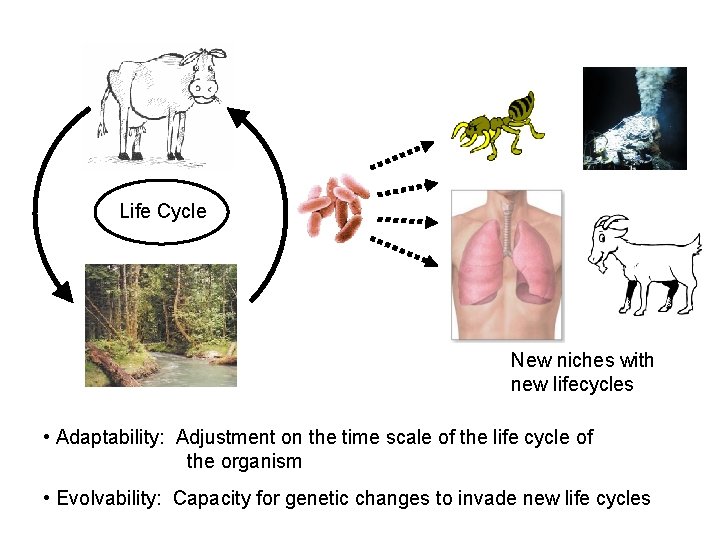
Life Cycle New niches with new lifecycles • Adaptability: Adjustment on the time scale of the life cycle of the organism • Evolvability: Capacity for genetic changes to invade new life cycles
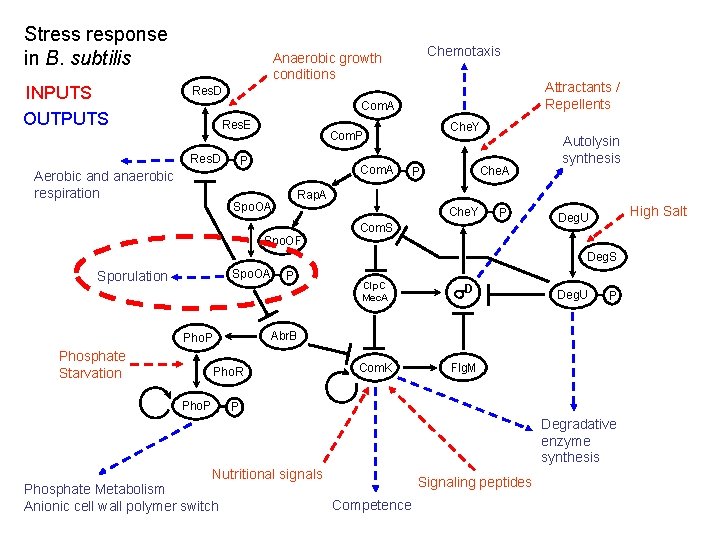
Stress response in B. subtilis INPUTS OUTPUTS Chemotaxis Anaerobic growth conditions Attractants / Repellents Res. D Com. A Res. E Res. D Aerobic and anaerobic respiration Che. Y Com. P P Com. A Che. A P Autolysin synthesis Rap. A Spo. OA Che. Y Spo. OF P Com. S High Salt Deg. U Deg. S Spo. OA Sporulation Clp. C Mec. A s. D Com. K Flg. M Deg. U P Abr. B Pho. P Phosphate Starvation P Pho. R Pho. P P Degradative enzyme synthesis Nutritional signals Phosphate Metabolism Anionic cell wall polymer switch Signaling peptides Competence
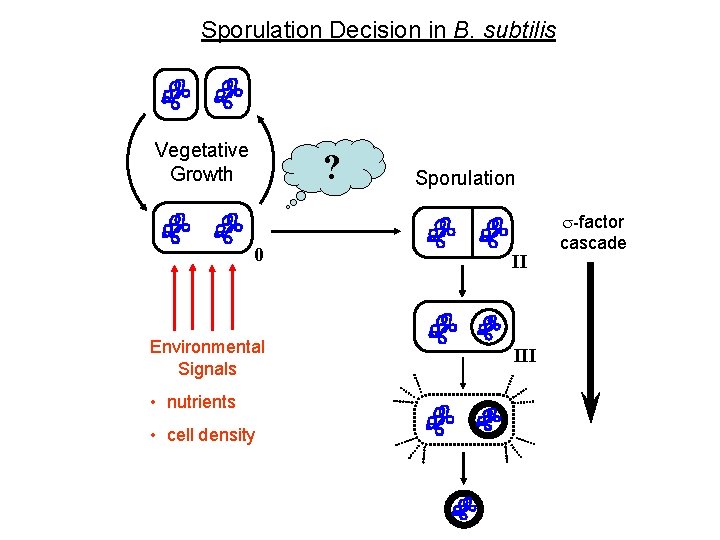
Sporulation Decision in B. subtilis Vegetative Growth ? 0 Environmental Signals • nutrients • cell density Sporulation II III s-factor cascade
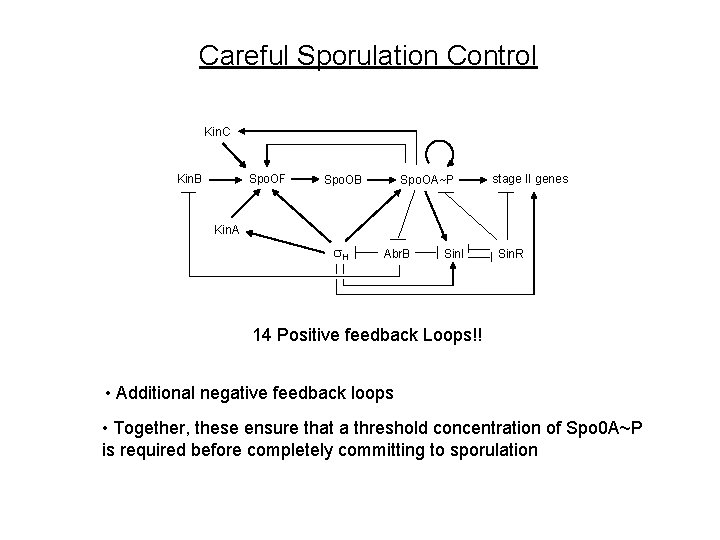
Careful Sporulation Control Kin. C Spo. OF Kin. B Spo. OA~P stage II genes Kin. A s. H Abr. B Sin. I Sin. R 14 Positive feedback Loops!! • Additional negative feedback loops • Together, these ensure that a threshold concentration of Spo 0 A~P is required before completely committing to sporulation
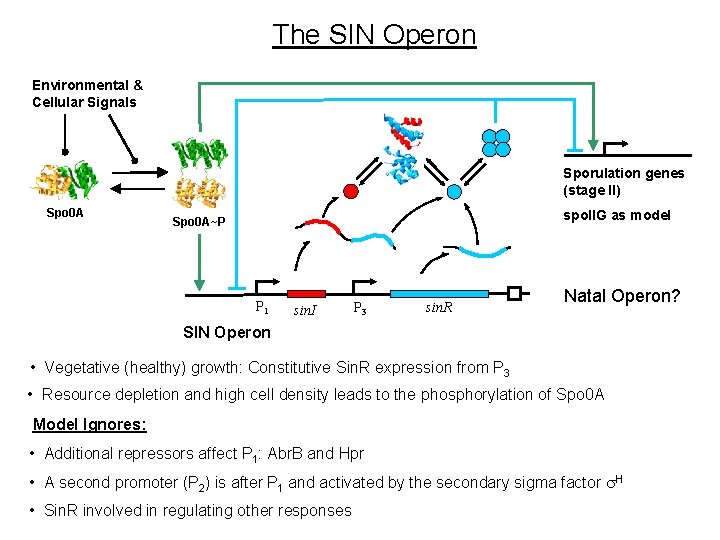
The SIN Operon Environmental & Cellular Signals Sporulation genes (stage II) Spo 0 A spo. IIG as model Spo 0 A~P P 1 sin. I P 3 sin. R Natal Operon? SIN Operon • Vegetative (healthy) growth: Constitutive Sin. R expression from P 3 • Resource depletion and high cell density leads to the phosphorylation of Spo 0 A Model Ignores: • Additional repressors affect P 1: Abr. B and Hpr • A second promoter (P 2) is after P 1 and activated by the secondary sigma factor s. H • Sin. R involved in regulating other responses
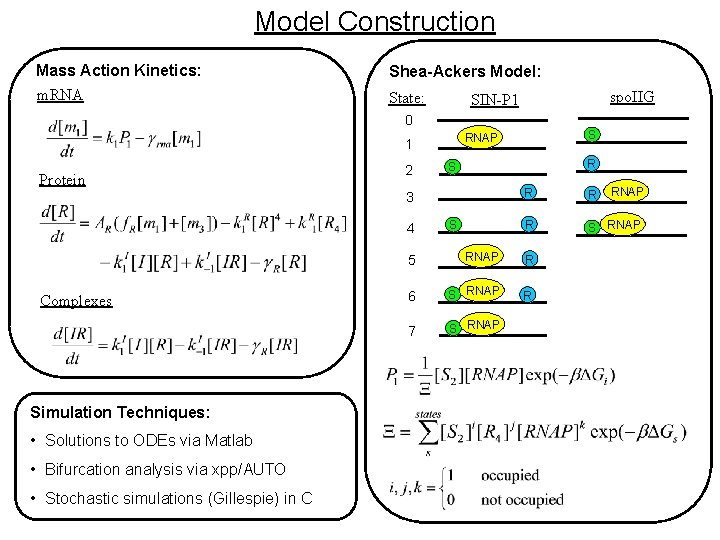
Model Construction Mass Action Kinetics: m. RNA Shea-Ackers Model: State: spo. IIG SIN-P 1 0 Protein 2 R S 3 4 Complexes Simulation Techniques: • Solutions to ODEs via Matlab • Bifurcation analysis via xpp/AUTO • Stochastic simulations (Gillespie) in C S RNAP 1 S RNAP R R R S RNAP 5 RNAP R 6 S RNAP R 7 S RNAP
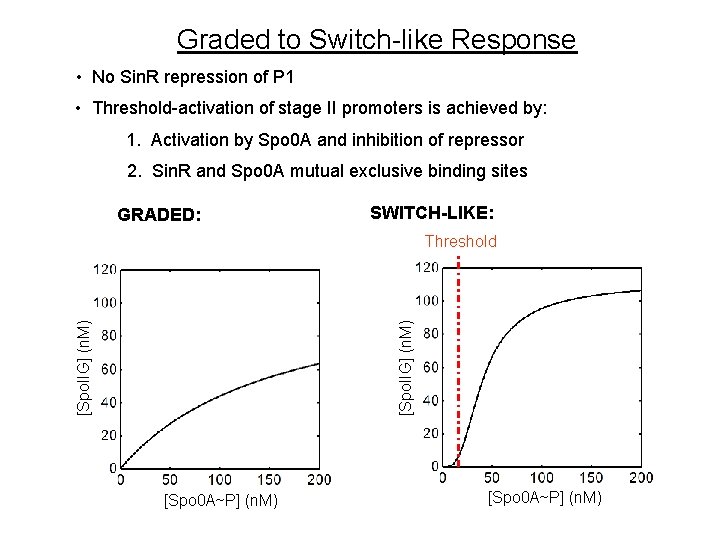
Graded to Switch-like Response • No Sin. R repression of P 1 • Threshold-activation of stage II promoters is achieved by: 1. Activation by Spo 0 A and inhibition of repressor 2. Sin. R and Spo 0 A mutual exclusive binding sites GRADED: SWITCH-LIKE: [Spo. IIG] (n. M) Threshold [Spo 0 A~P] (n. M)
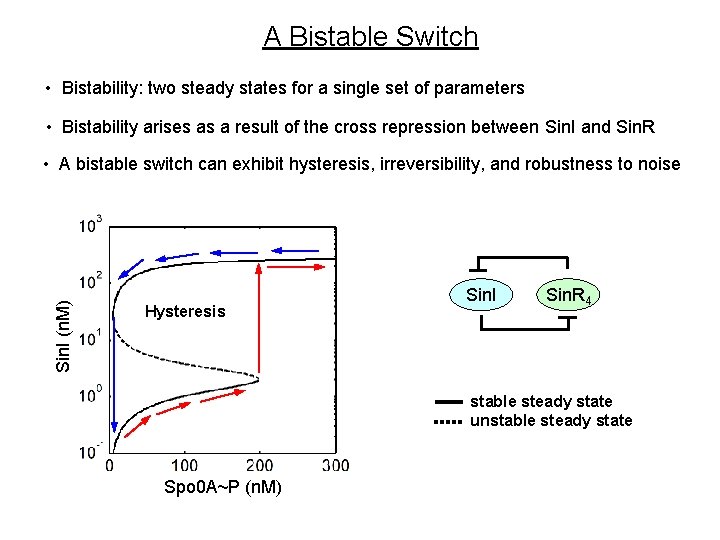
A Bistable Switch • Bistability: two steady states for a single set of parameters • Bistability arises as a result of the cross repression between Sin. I and Sin. R Sin. I (n. M) • A bistable switch can exhibit hysteresis, irreversibility, and robustness to noise Hysteresis Sin. I Sin. R 4 stable steady state unstable steady state Spo 0 A~P (n. M)
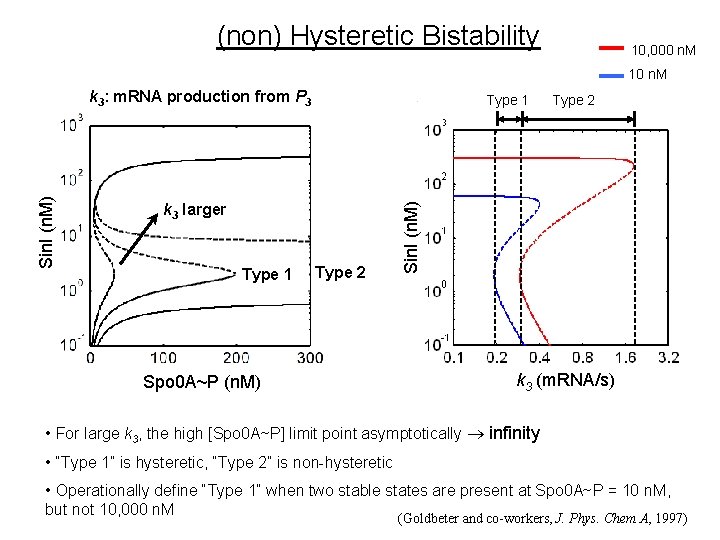
(non) Hysteretic Bistability 10, 000 n. M 10 n. M Type 1 k 3 larger Type 1 Type 2 Spo 0 A~P (n. M) Type 2 Sin. I (n. M) k 3: m. RNA production from P 3 k 3 (m. RNA/s) • For large k 3, the high [Spo 0 A~P] limit point asymptotically infinity • “Type 1” is hysteretic, “Type 2” is non-hysteretic • Operationally define “Type 1” when two stable states are present at Spo 0 A~P = 10 n. M, but not 10, 000 n. M (Goldbeter and co-workers, J. Phys. Chem A, 1997)
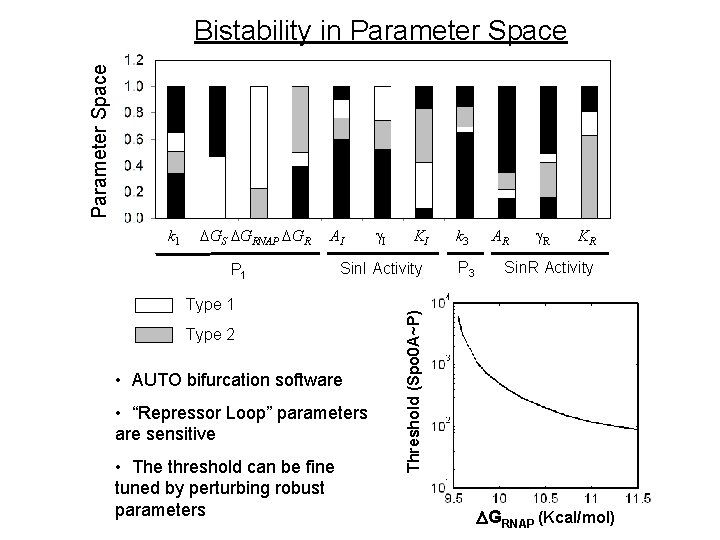
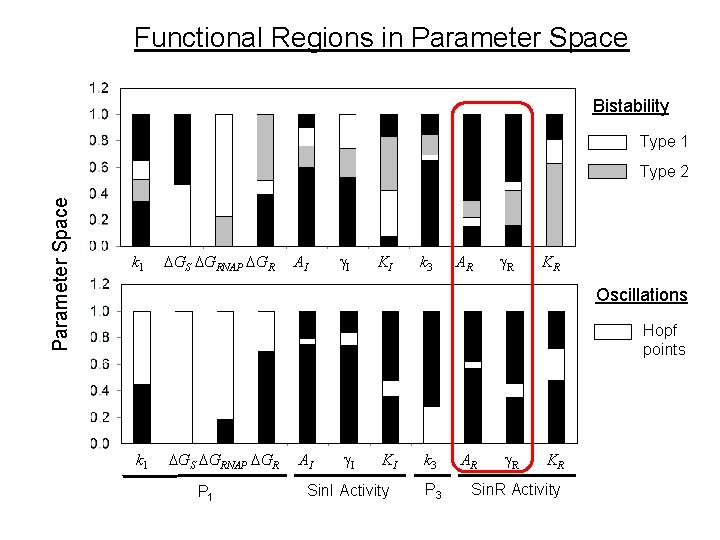
Parameter Space Bistability in Parameter Space DGS DGRNAP DGR AI P 1 KI Sin. I Activity Type 1 Type 2 • AUTO bifurcation software • “Repressor Loop” parameters are sensitive • The threshold can be fine tuned by perturbing robust parameters g. I k 3 P 3 AR g. R KR Sin. R Activity Threshold (Spo 0 A~P) k 1 DGRNAP (Kcal/mol)
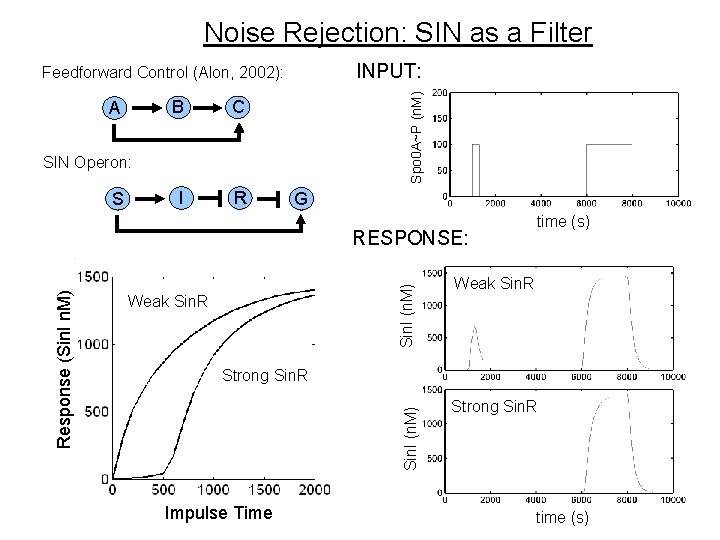
Noise Rejection: SIN as a Filter INPUT: A B C I R Spo 0 A~P (n. M) Feedforward Control (Alon, 2002): SIN Operon: S G Sin. I (n. M) Weak Sin. R Strong Sin. R Sin. I (n. M) Response (Sin. I n. M) RESPONSE: time (s) Impulse Time Strong Sin. R time (s)
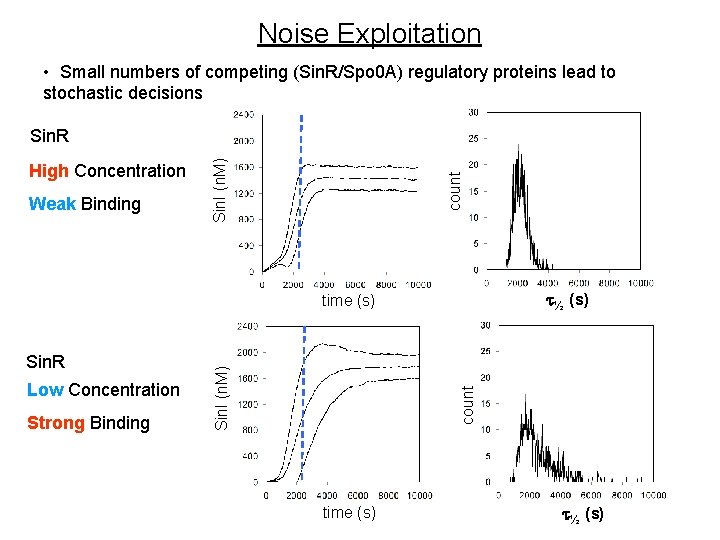
Noise Exploitation • Small numbers of competing (Sin. R/Spo 0 A) regulatory proteins lead to stochastic decisions Weak Binding count High Concentration Sin. I (n. M) Sin. R ½ (s) Low Concentration Strong Binding count Sin. R Sin. I (n. M) time (s) ½ (s)
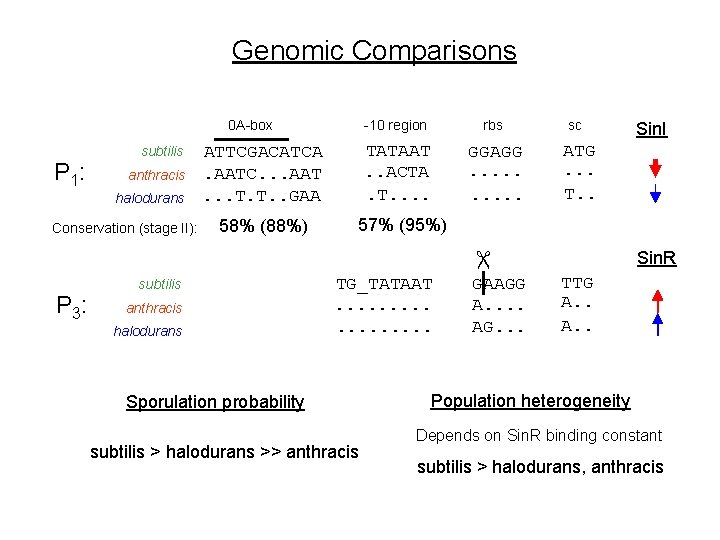
Genomic Comparisons 0 A-box P 1: subtilis anthracis halodurans Conservation (stage II): -10 region rbs ATTCGACATCA. AATC. . . AAT. . . T. T. . GAA TATAAT. . ACTA. T. . GGAGG. . 58% (88%) 57% (95%) sc ATG. . . T. . Sin. R subtilis P 3: anthracis halodurans TG_TATAAT. . . . Sporulation probability subtilis > halodurans >> anthracis GAAGG A. . AG. . . Sin. I TTG A. . Population heterogeneity Depends on Sin. R binding constant subtilis > halodurans, anthracis
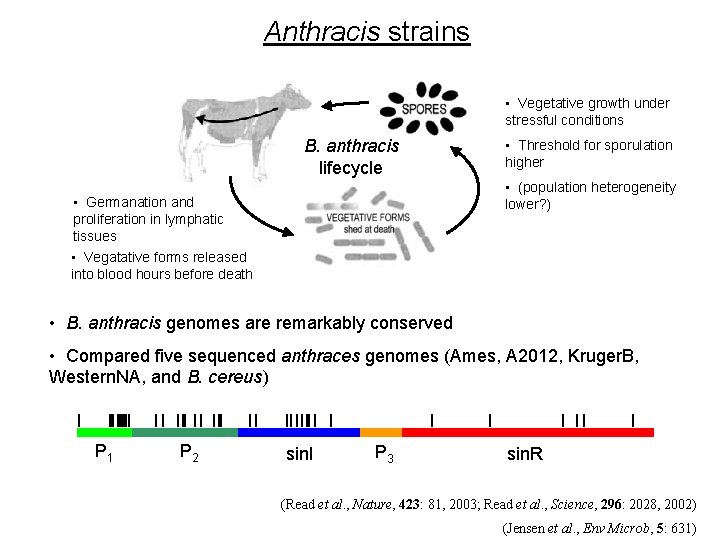
Anthracis strains • Vegetative growth under stressful conditions B. anthracis lifecycle • Threshold for sporulation higher • (population heterogeneity lower? ) • Germanation and proliferation in lymphatic tissues • Vegatative forms released into blood hours before death • B. anthracis genomes are remarkably conserved • Compared five sequenced anthraces genomes (Ames, A 2012, Kruger. B, Western. NA, and B. cereus) P 1 P 2 sin. I P 3 sin. R (Read et al. , Nature, 423: 81, 2003; Read et al. , Science, 296: 2028, 2002) (Jensen et al. , Env Microb, 5: 631)
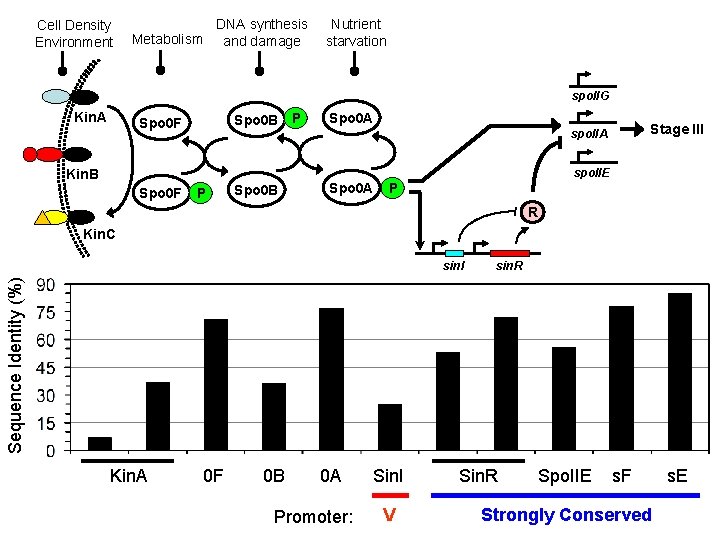
Cell Density Environment DNA synthesis Metabolism and damage Nutrient starvation spo. IIG Kin. A Spo 0 B P Spo 0 F Spo 0 A Stage III spo. IIA spo. IIE Kin. B Spo 0 F P Spo 0 B Spo 0 A P R Kin. C sin. R Sequence Identity (%) sin. I Kin. A 0 F 0 B 0 A Promoter: Sin. I V Sin. R Spo. IIE s. F Strongly Conserved s. E
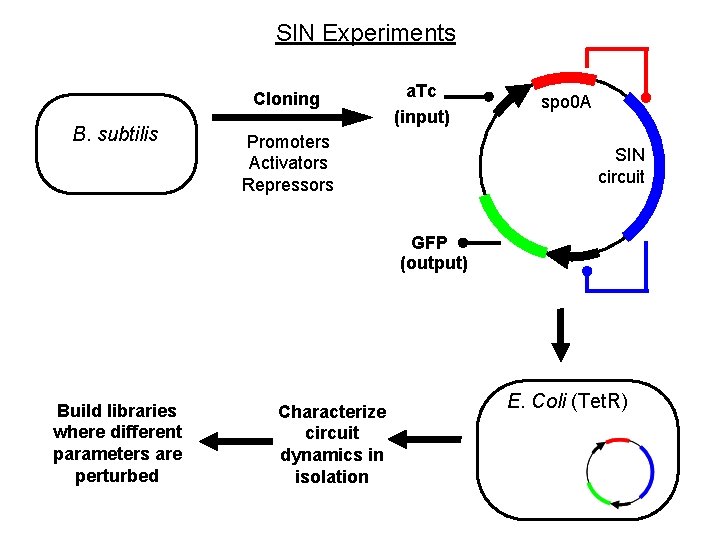
SIN Experiments Cloning B. subtilis a. Tc (input) Promoters Activators Repressors spo 0 A SIN circuit GFP (output) Build libraries where different parameters are perturbed Characterize circuit dynamics in isolation E. Coli (Tet. R)
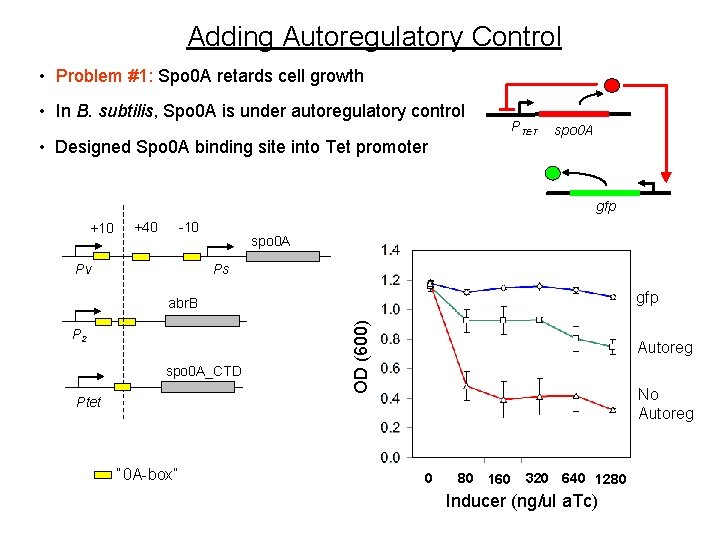
Adding Autoregulatory Control • Problem #1: Spo 0 A retards cell growth • In B. subtilis, Spo 0 A is under autoregulatory control • Designed Spo 0 A binding site into Tet promoter PTET spo 0 A gfp +10 +40 -10 spo 0 A Ps Pv gfp P 2 spo 0 A_CTD OD (600) abr. B Autoreg No Autoreg Ptet “ 0 A-box” 0 80 160 320 640 1280 Inducer (ng/ul a. Tc)
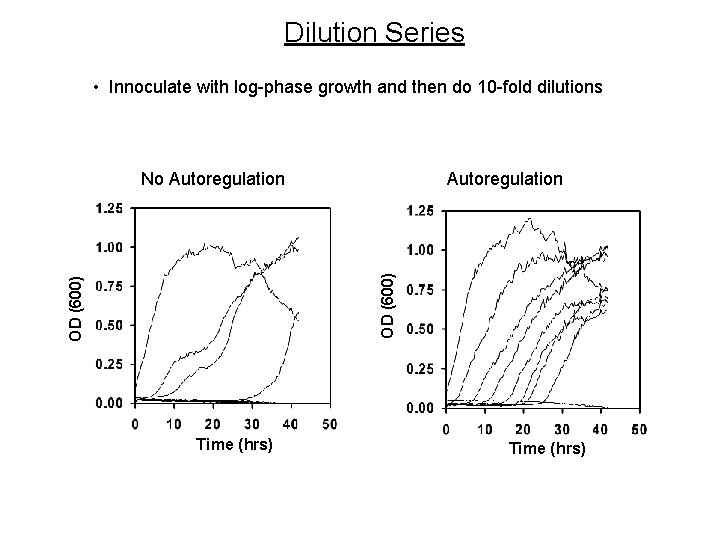
Dilution Series • Innoculate with log-phase growth and then do 10 -fold dilutions Autoregulation OD (600) No Autoregulation Time (hrs)
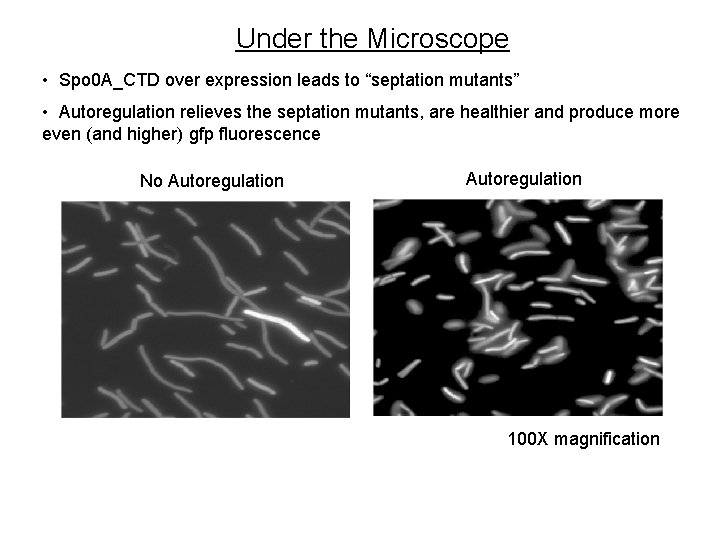
Under the Microscope • Spo 0 A_CTD over expression leads to “septation mutants” • Autoregulation relieves the septation mutants, are healthier and produce more even (and higher) gfp fluorescence No Autoregulation 100 X magnification
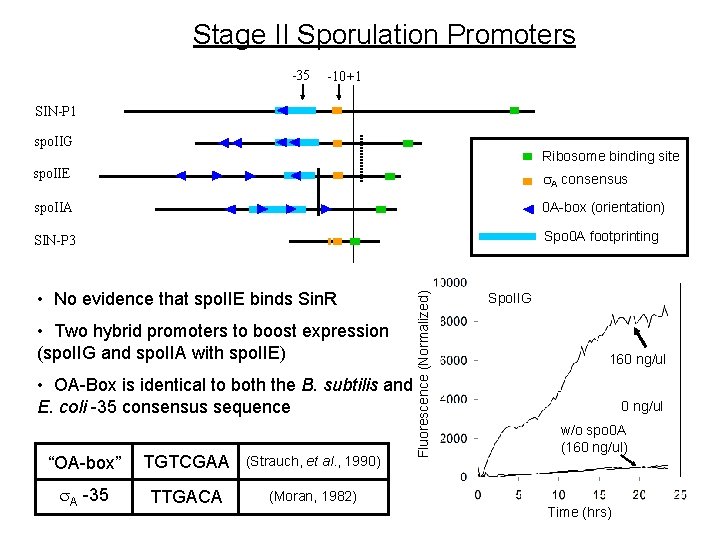
Stage II Sporulation Promoters -35 -10 +1 SIN-P 1 spo. IIG Ribosome binding site s. A consensus spo. IIA 0 A-box (orientation) SIN-P 3 Spo 0 A footprinting • No evidence that spo. IIE binds Sin. R • Two hybrid promoters to boost expression (spo. IIG and spo. IIA with spo. IIE) • OA-Box is identical to both the B. subtilis and E. coli -35 consensus sequence “OA-box” TGTCGAA (Strauch, et al. , 1990) s. A -35 TTGACA (Moran, 1982) Fluorescence (Normalized) spo. IIE Spo. IIG 160 ng/ul w/o spo 0 A (160 ng/ul) Time (hrs)
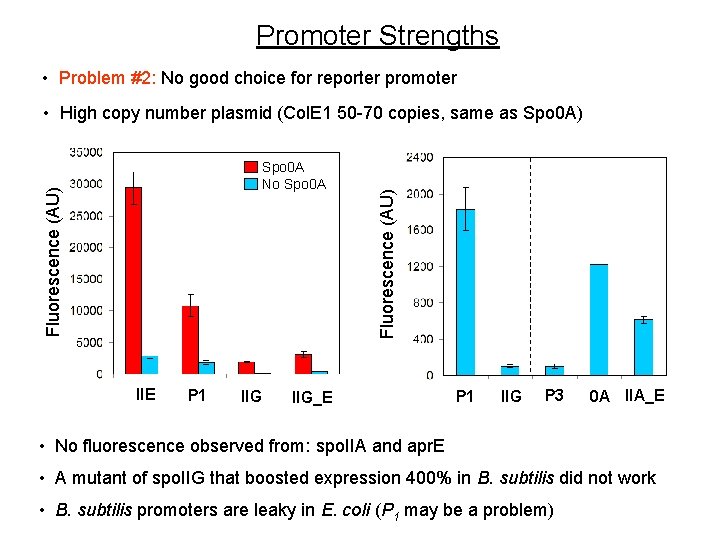
Promoter Strengths • Problem #2: No good choice for reporter promoter Fluorescence (AU) Spo 0 A No Spo 0 A IIE P 1 IIG Fluorescence (AU) • High copy number plasmid (Col. E 1 50 -70 copies, same as Spo 0 A) IIG_E P 1 IIG P 3 0 A IIA_E • No fluorescence observed from: spo. IIA and apr. E • A mutant of spo. IIG that boosted expression 400% in B. subtilis did not work • B. subtilis promoters are leaky in E. coli (P 1 may be a problem)
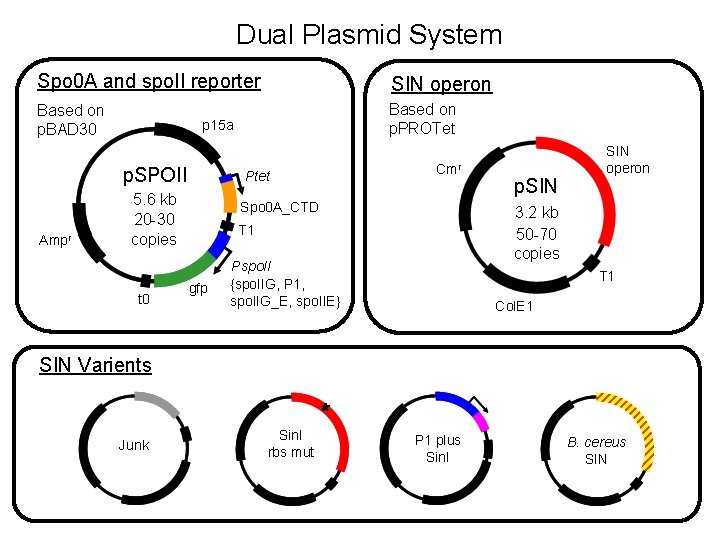
Dual Plasmid System Spo 0 A and spo. II reporter SIN operon Based on p. BAD 30 Based on p. PROTet p 15 a p. SPOII Ampr Ptet 5. 6 kb 20 -30 copies t 0 Cmr Spo 0 A_CTD 3. 2 kb 50 -70 copies T 1 gfp p. SIN operon Pspo. II {spo. IIG, P 1, spo. IIG_E, spo. IIE} T 1 Col. E 1 SIN Varients Junk Sin. I rbs mut P 1 plus Sin. I B. cereus SIN
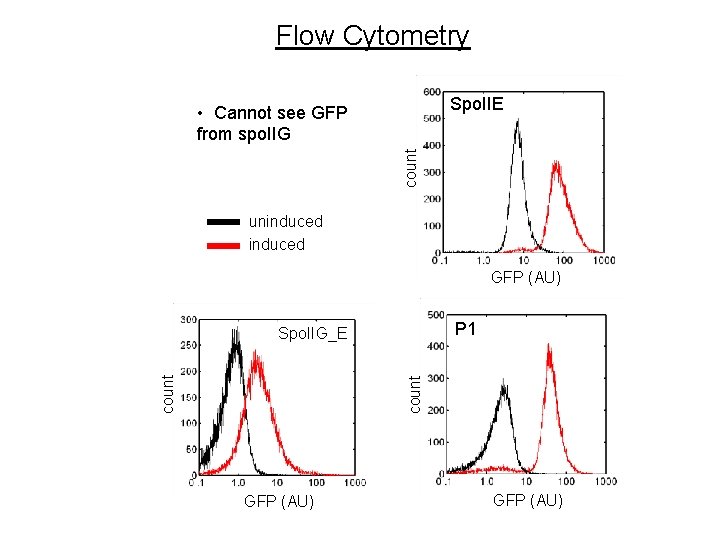
Flow Cytometry Spo. IIE count • Cannot see GFP from spo. IIG uninduced GFP (AU) P 1 count Spo. IIG_E GFP (AU)
Concentration Series Grow Overnight in 5 ml LB (16 hrs) 20 ng/ml count Innoculate 50 ul into 5 ml fresh LB, Grow to log phase (4 hrs) a. Tc 40 ng/ml 160 ng/ml GFP (AU) Stop expression with 2 mg/ml Kanamycin in PBS SIN fraction on Innoculate 200 ul into 1 ml w/ a. Tc, Induce (2 hrs) spo. IIG • B. cereus no change • Leakiness from P 1 a problem? a. Tc (ng/ml)
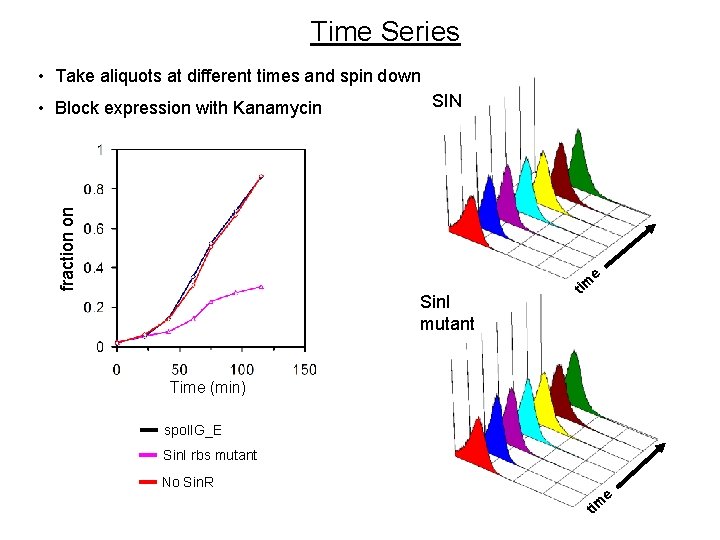
Time Series • Take aliquots at different times and spin down SIN fraction on • Block expression with Kanamycin e Sin. I mutant tim Time (min) spo. IIG_E Sin. I rbs mutant No Sin. R e tim
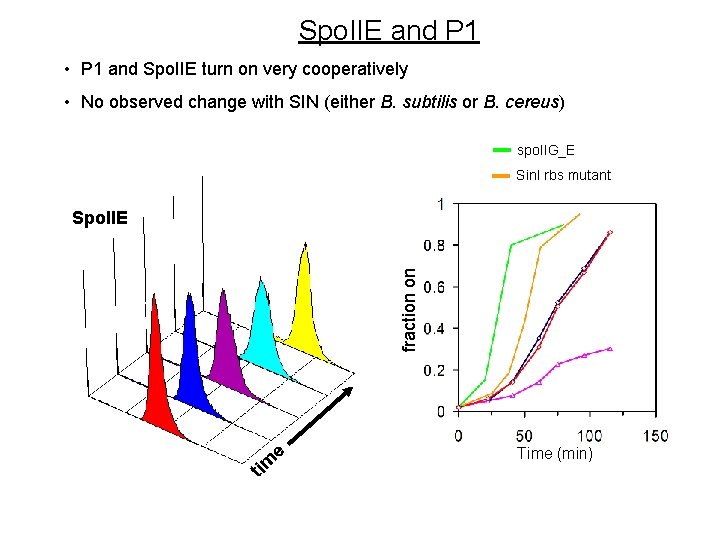
Spo. IIE and P 1 • P 1 and Spo. IIE turn on very cooperatively • No observed change with SIN (either B. subtilis or B. cereus) spo. IIG_E Sin. I rbs mutant fraction on Spo. IIE e m ti Time (min)
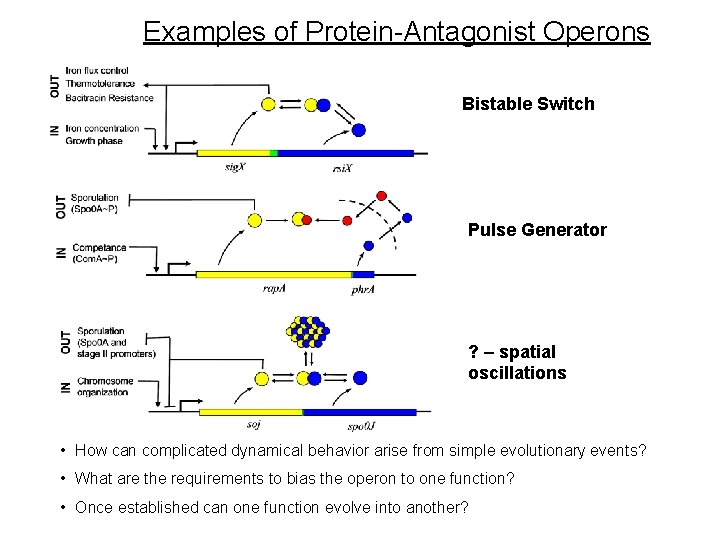
Examples of Protein-Antagonist Operons Bistable Switch Pulse Generator ? – spatial oscillations • How can complicated dynamical behavior arise from simple evolutionary events? • What are the requirements to bias the operon to one function? • Once established can one function evolve into another?
AUTO Bifurcation Tool Set of differential equations Solve to steady state (XPP) Determines bifurcation points by computing eigenvalues of A( ) AUTO tracks the stability of the fixed point as is perturbed AUTO • Will give tutorial at some point (no really, I will)
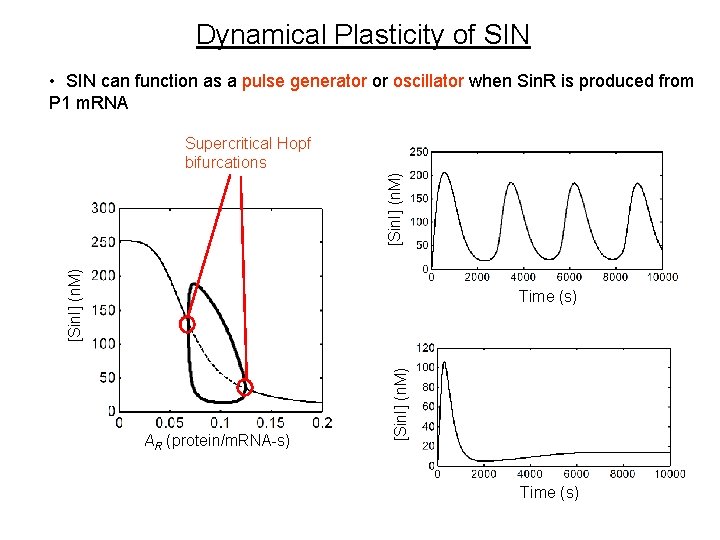
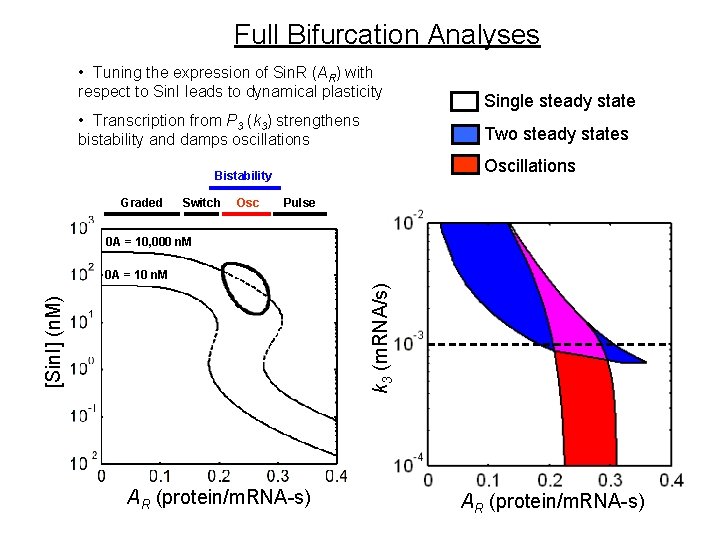
Dynamical Plasticity of SIN • SIN can function as a pulse generator or oscillator when Sin. R is produced from P 1 m. RNA [Sin. I] (n. M) Supercritical Hopf bifurcations AR (protein/m. RNA-s) [Sin. I] (n. M) Time (s)
Functional Regions in Parameter Space Bistability Type 1 Parameter Space Type 2 k 1 DGS DGRNAP DGR AI g. I KI k 3 AR g. R KR Oscillations Hopf points k 1 DGS DGRNAP DGR P 1 AI g. I KI Sin. I Activity k 3 P 3 AR g. R KR Sin. R Activity
Full Bifurcation Analyses • Tuning the expression of Sin. R (AR) with respect to Sin. I leads to dynamical plasticity • Transcription from P 3 (k 3) strengthens bistability and damps oscillations Two steady states Oscillations Bistability Graded Switch Osc Single steady state Pulse 0 A = 10, 000 n. M [Sin. I] (n. M) k 3 (m. RNA/s) 0 A = 10 n. M AR (protein/m. RNA-s)
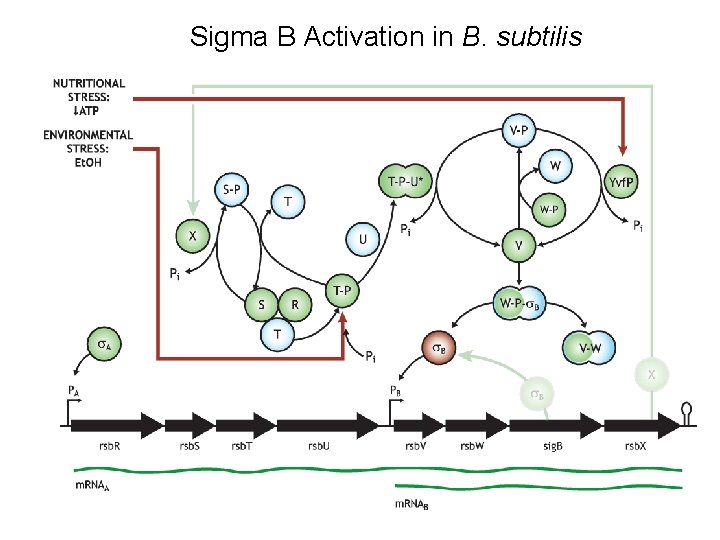
Sigma B Activation in B. subtilis
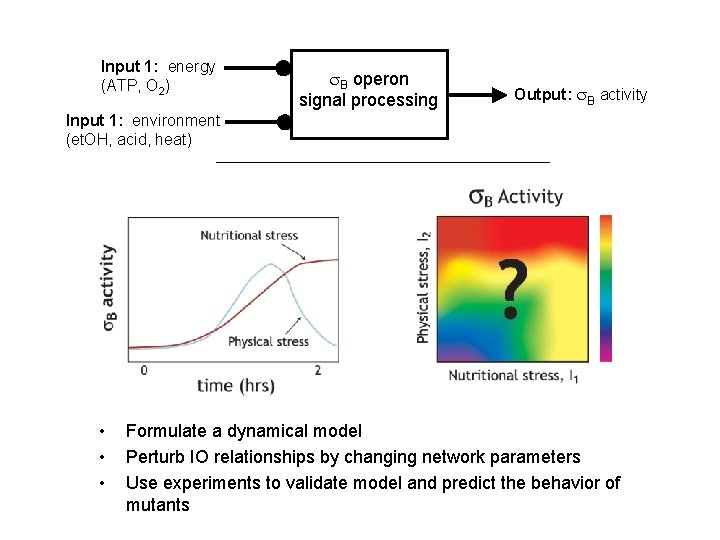
Input 1: energy (ATP, O 2) s. B operon signal processing Output: s. B activity Input 1: environment (et. OH, acid, heat) • • • Formulate a dynamical model Perturb IO relationships by changing network parameters Use experiments to validate model and predict the behavior of mutants
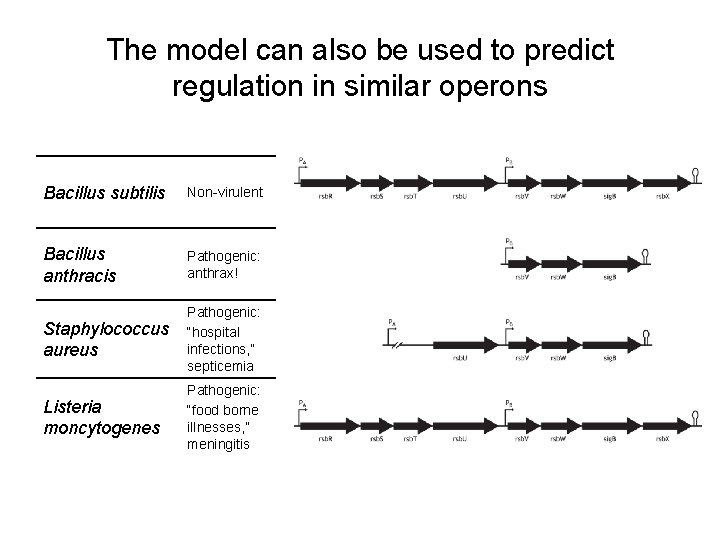
The model can also be used to predict regulation in similar operons Bacillus subtilis Non-virulent Bacillus anthracis Pathogenic: anthrax! Staphylococcus aureus Pathogenic: “hospital infections, ” septicemia Listeria moncytogenes Pathogenic: “food borne illnesses, ” meningitis
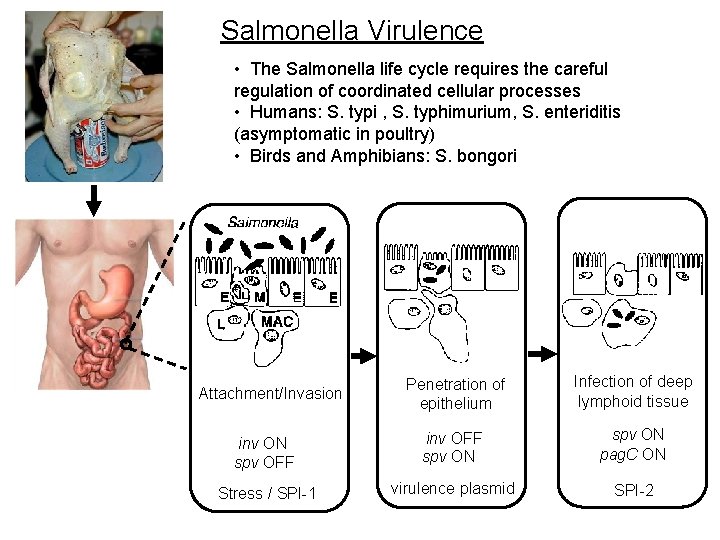
Salmonella Virulence • The Salmonella life cycle requires the careful regulation of coordinated cellular processes • Humans: S. typi , S. typhimurium, S. enteriditis (asymptomatic in poultry) • Birds and Amphibians: S. bongori Penetration of epithelium Infection of deep lymphoid tissue inv ON spv OFF inv OFF spv ON pag. C ON Stress / SPI-1 virulence plasmid SPI-2 Attachment/Invasion
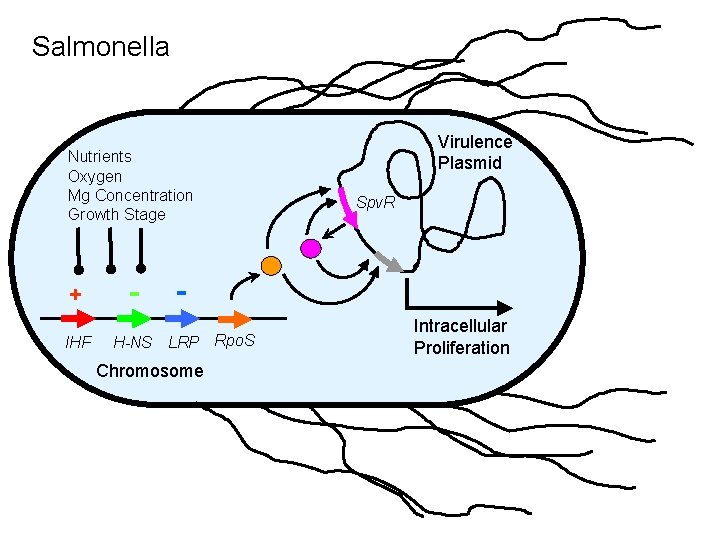
Salmonella Nutrients Oxygen Mg Concentration Growth Stage + IHF - Virulence Plasmid Spv. R - H-NS LRP Rpo. S Chromosome Intracellular Proliferation
Conclusions • Simple protein/antagonist pairs lead to complex dynamical behaviors • SIN can vary between a graded and switch-like response, filters noisy input signals, and can implement a stochastic decision • SIN exhibits bistability and functional plasticity • SIN provides a sink for mutations that can alter the dynamics of entry into sporulation without perturbing the underlying computation (phosphorelay) or spore formation (stage II and III). • Rebuilding the circuit in E. coli requires engineering Future Work • Better systems: Can we stick spo. IIG_E with beta-galactosidase in the genome? Put SIN on puc. Reengineer the P 1 promoter to be tighter in coli. Study using B. subtilis SIN deletion strain (with SIN on PSC 101). • Are some systems more modular? Is it important to look at selfish operons/plasmids? Spv. R in Salmonella. • More complex regulatory/integration modules (s. B in Bacillus) in their homogeneous context • Building libraries of random and directed circuits