S Maekawa IMR Tohoku University Spin Charge and



- Slides: 38
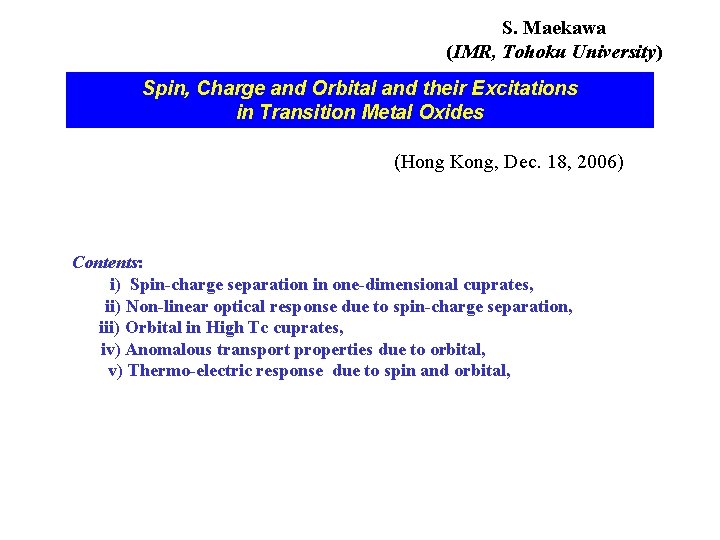
S. Maekawa (IMR, Tohoku University) Spin, Charge and Orbital and their Excitations in Transition Metal Oxides (Hong Kong, Dec. 18, 2006) Contents: i) Spin-charge separation in one-dimensional cuprates, ii) Non-linear optical response due to spin-charge separation, iii) Orbital in High Tc cuprates, iv) Anomalous transport properties due to orbital, v) Thermo-electric response due to spin and orbital,
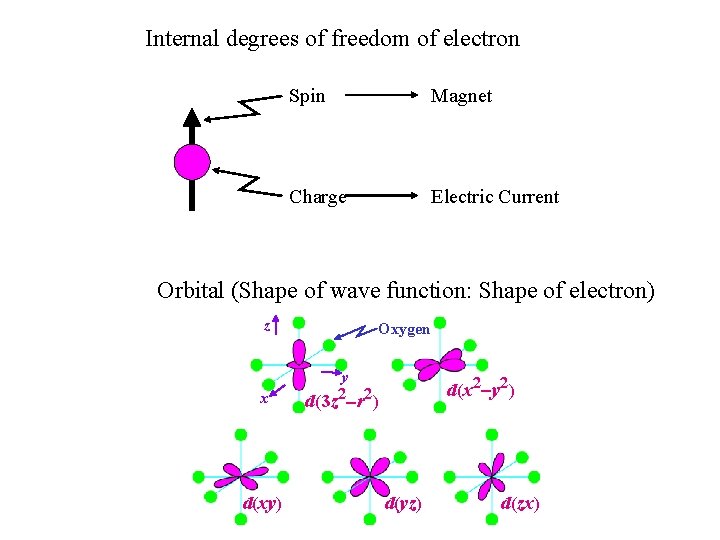
Internal degrees of freedom of electron Spin Magnet Charge Electric Current Orbital (Shape of wave function: Shape of electron) z Oxygen y x d(xy) d(x 2 y 2) d(3 z 2 r 2) d(yz) d(zx)
Hong Kong Conference December 18, 2006 Anomalous Electronic Lattices in Cobaltates S. Maekawa, W. Koshibae and N. Bulut (IMR, Tohoku University, Sendai)
Co - Oxides in triangular lattice (Nax. Co. O 2 and Nax. Co. O 2・y. H 2 O) i) Review of Unconventional properties ii) Orbital degeneracy in the frustrated lattice crystal lattice vs. electron lattice unconventional properties
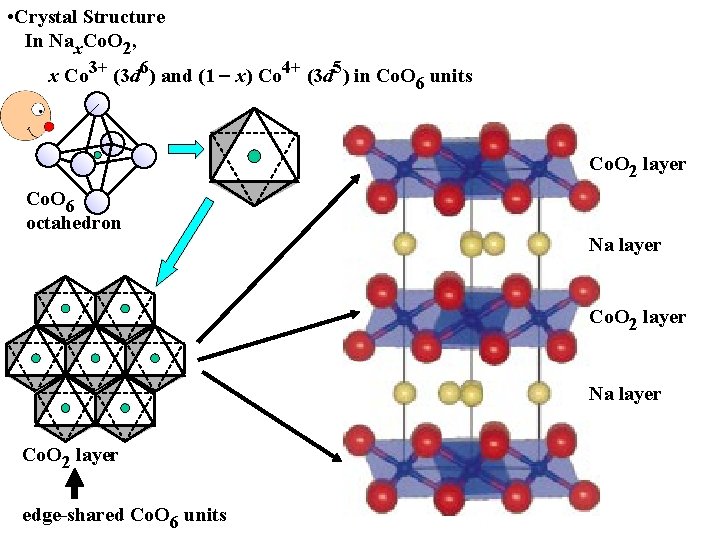
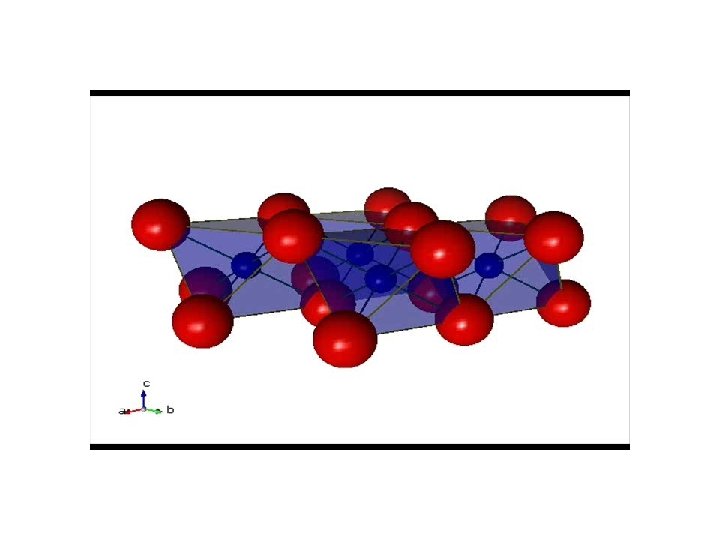
• Crystal Structure In Nax. Co. O 2, x Co 3+ (3 d 6) and (1 x) Co 4+ (3 d 5) in Co. O 6 units Co. O 2 layer Co. O 6 octahedron Na layer Co. O 2 layer edge-shared Co. O 6 units
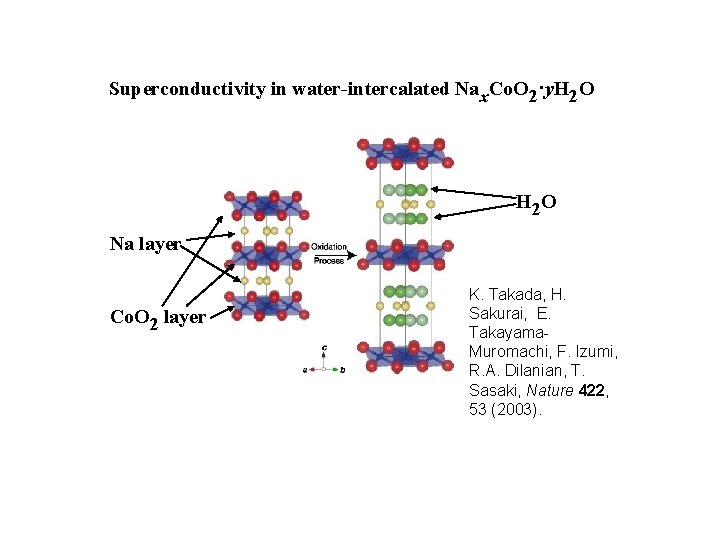
Superconductivity in water-intercalated Nax. Co. O 2·y. H 2 O Na layer Co. O 2 layer K. Takada, H. Sakurai, E. Takayama. Muromachi, F. Izumi, R. A. Dilanian, T. Sasaki, Nature 422, 53 (2003).
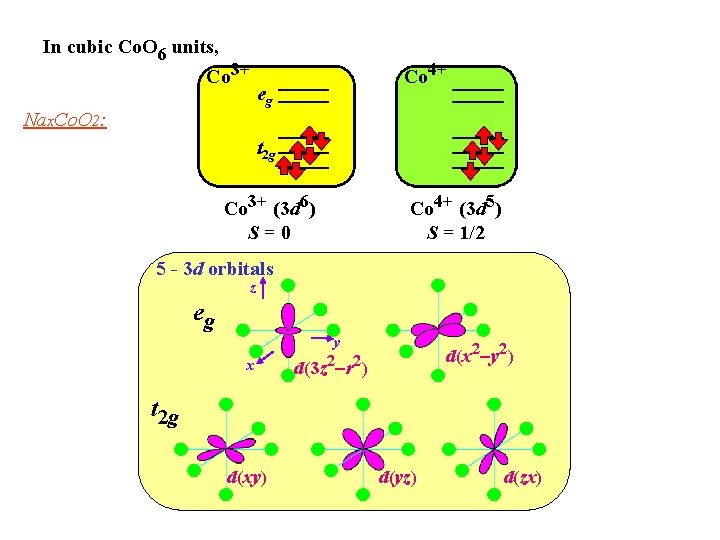
In cubic Co. O 6 units, Co 3+ Co 4+ eg Nax. Co. O 2: t 2 g Co 3+ (3 d 6) S=0 Co 4+ (3 d 5) S = 1/2 5 - 3 d orbitals z eg y x d(x 2 y 2) d(3 z 2 r 2) t 2 g d(xy) d(yz) d(zx)
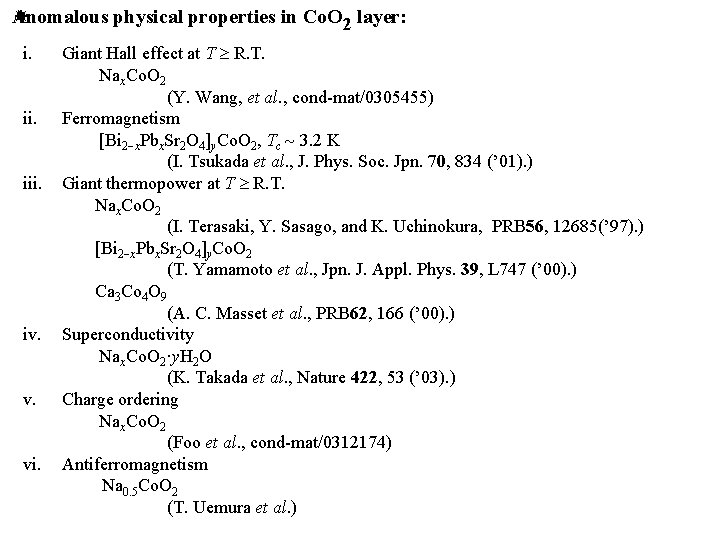
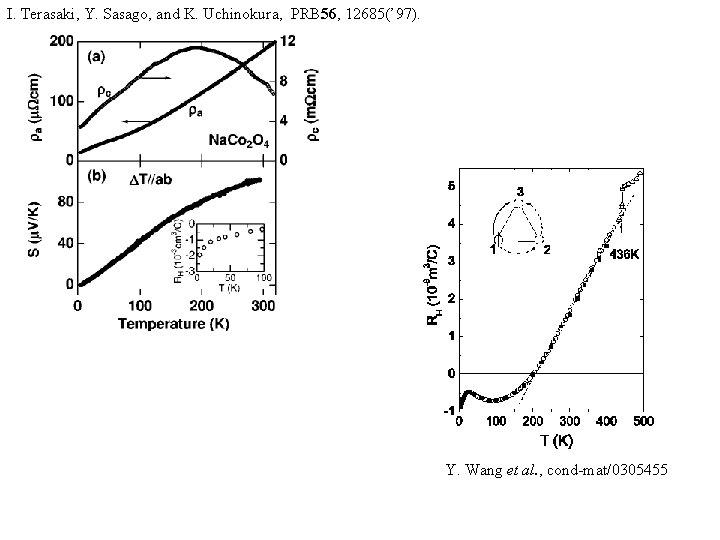
Anomalous physical properties in Co. O 2 layer: i. iii. iv. v. vi. Giant Hall effect at T R. T. Nax. Co. O 2 (Y. Wang, et al. , cond-mat/0305455) Ferromagnetism [Bi 2 -x. Pbx. Sr 2 O 4]y. Co. O 2, Tc ~ 3. 2 K (I. Tsukada et al. , J. Phys. Soc. Jpn. 70, 834 (’ 01). ) Giant thermopower at T R. T. Nax. Co. O 2 (I. Terasaki, Y. Sasago, and K. Uchinokura, PRB 56, 12685(’ 97). ) [Bi 2 -x. Pbx. Sr 2 O 4]y. Co. O 2 (T. Yamamoto et al. , Jpn. J. Appl. Phys. 39, L 747 (’ 00). ) Ca 3 Co 4 O 9 (A. C. Masset et al. , PRB 62, 166 (’ 00). ) Superconductivity Nax. Co. O 2·y. H 2 O (K. Takada et al. , Nature 422, 53 (’ 03). ) Charge ordering Nax. Co. O 2 (Foo et al. , cond-mat/0312174) Antiferromagnetism Na 0. 5 Co. O 2 (T. Uemura et al. )
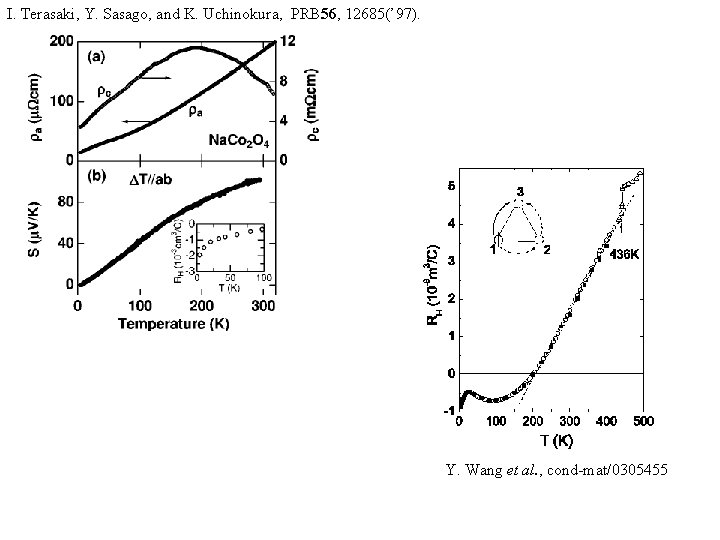
I. Terasaki, Y. Sasago, and K. Uchinokura, PRB 56, 12685(’ 97). Y. Wang et al. , cond-mat/0305455
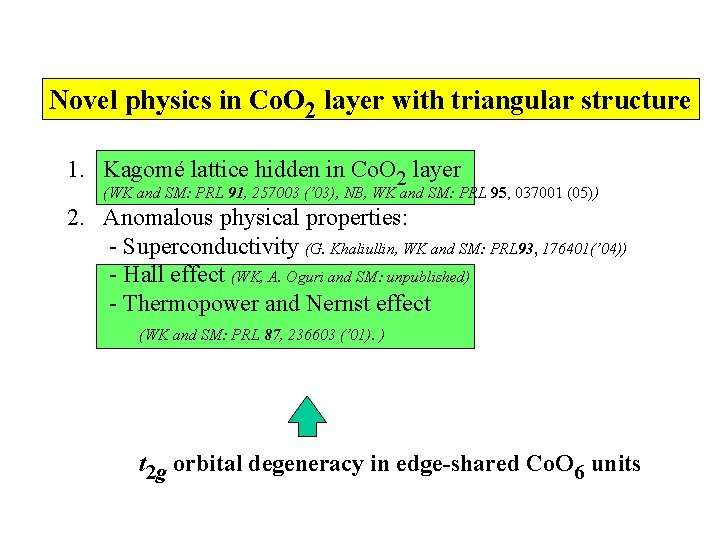
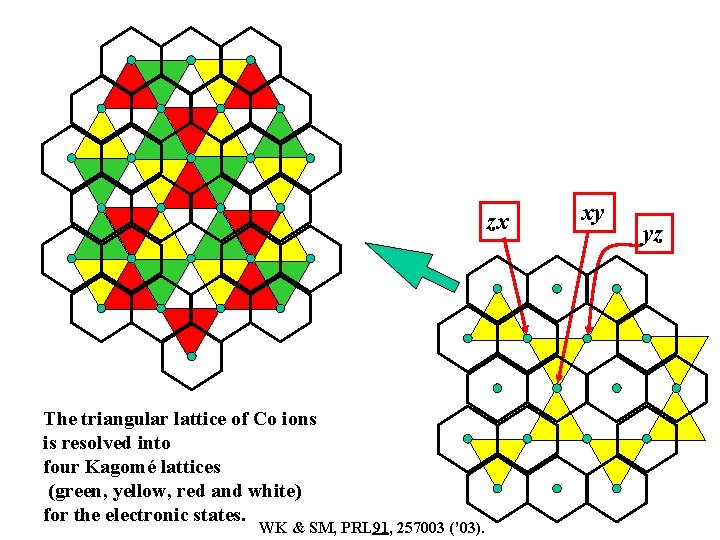
Novel physics in Co. O 2 layer with triangular structure 1. Kagomé lattice hidden in Co. O 2 layer (WK and SM: PRL 91, 257003 (’ 03), NB, WK and SM: PRL 95, 037001 (05)) 2. Anomalous physical properties: - Superconductivity (G. Khaliullin, WK and SM: PRL 93, 176401(’ 04)) - Hall effect (WK, A. Oguri and SM: unpublished) - Thermopower and Nernst effect (WK and SM: PRL 87, 236603 (’ 01). ) t 2 g orbital degeneracy in edge-shared Co. O 6 units
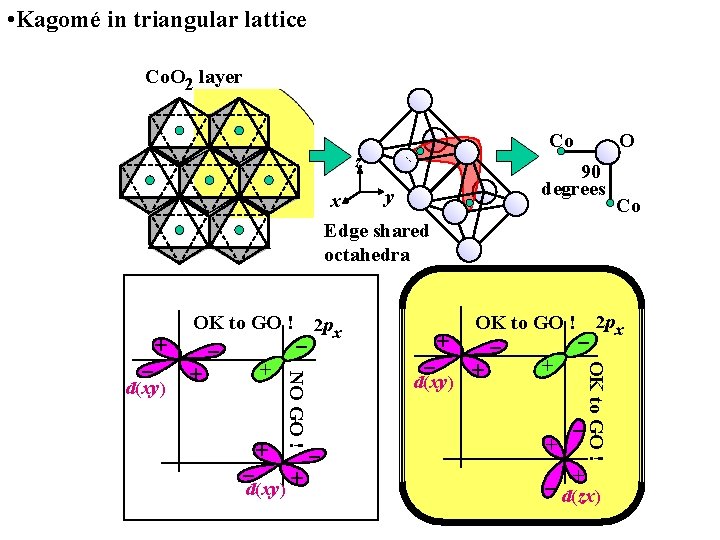
• Kagomé in triangular lattice Co. O 2 layer Co z 90 degrees y x Edge shared octahedra + + d(xy) Co OK to GO ! 2 px + + + OK to GO ! d(xy) NO GO ! OK to GO ! 2 px + + O + d(zx)
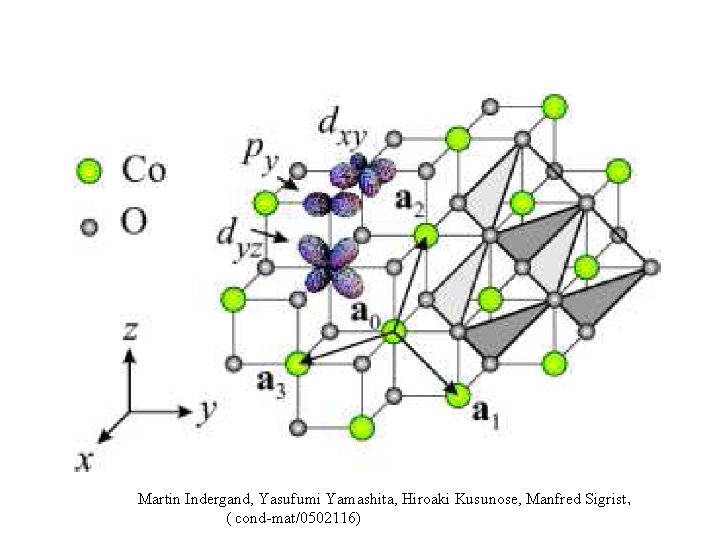
Martin Indergand, Yasufumi Yamashita, Hiroaki Kusunose, Manfred Sigrist, ( cond-mat/0502116)
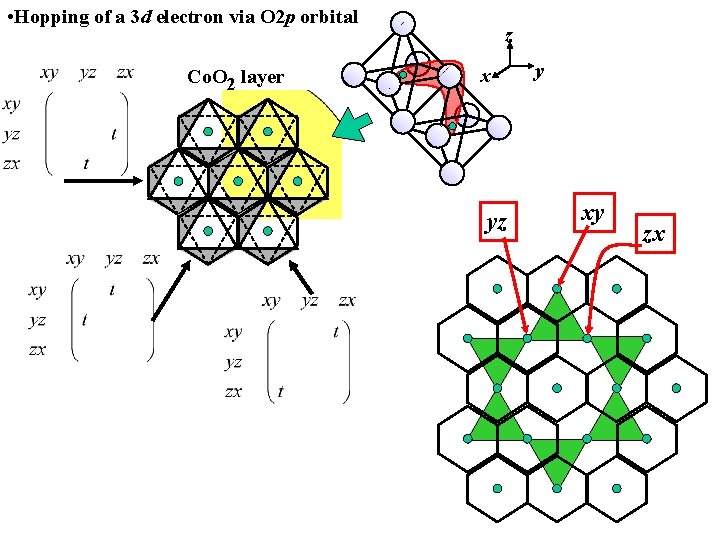
• Hopping of a 3 d electron via O 2 p orbital Co. O 2 layer z x yz y xy zx
zx yz The triangular lattice of Co ions is resolved into four Kagomé lattices (green, yellow, red and white) for the electronic states. WK & SM, PRL 91, 257003 (’ 03). xy yz zx
I. Terasaki, Y. Sasago, and K. Uchinokura, PRB 56, 12685(’ 97). Y. Wang et al. , cond-mat/0305455
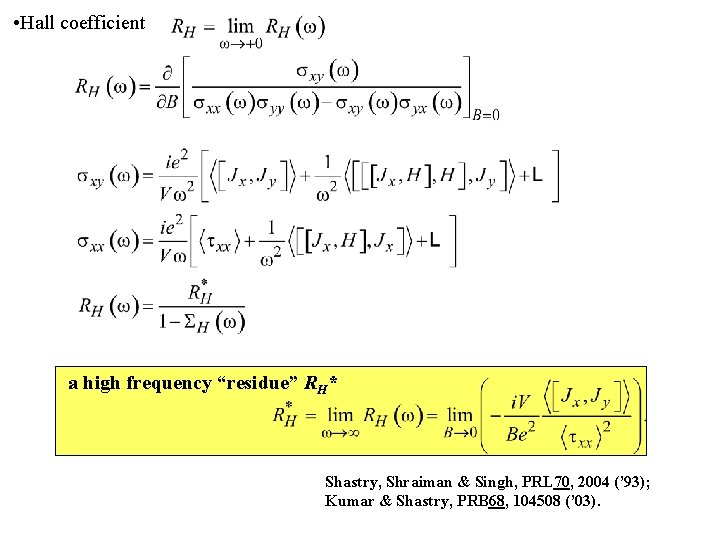
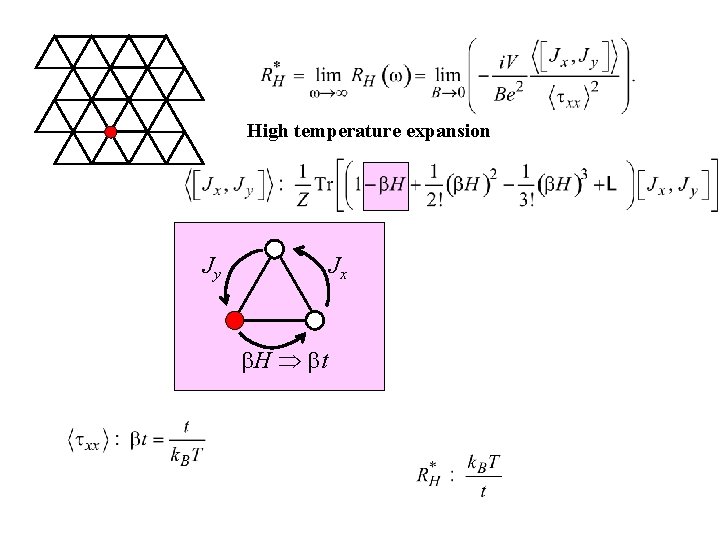
• Hall coefficient a high frequency “residue” RH* Shastry, Shraiman & Singh, PRL 70, 2004 (’ 93); Kumar & Shastry, PRB 68, 104508 (’ 03).
Jy Jx b. H bt These contributions are absent !!
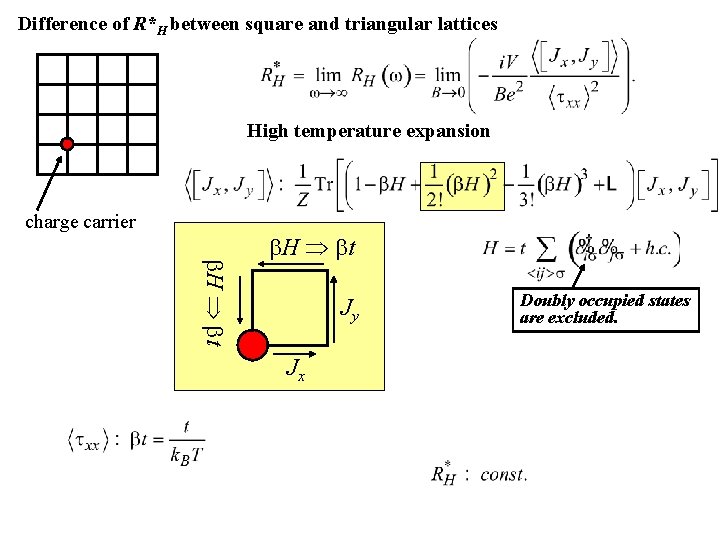
Difference of R*H between square and triangular lattices High temperature expansion charge carrier b. H bt Jy Jx Doubly occupied states are excluded.
High temperature expansion Jy Jx b. H bt
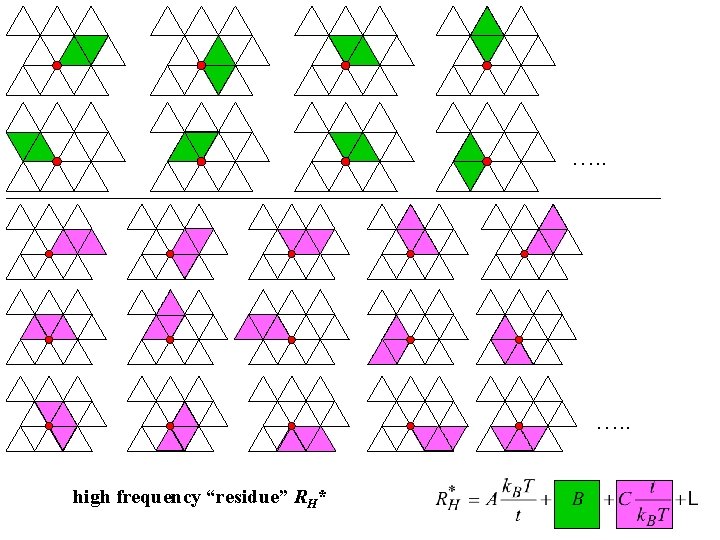
a high frequency “residue” RH* Jx Jy b. H bt
…. . high frequency “residue” RH*
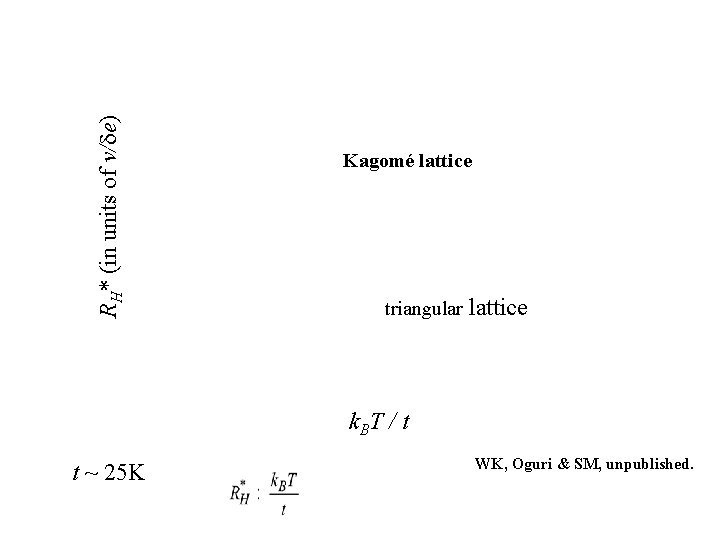
RH* (in units of v/de) Kagomé lattice triangular lattice k BT / t t ~ 25 K WK, Oguri & SM, unpublished.
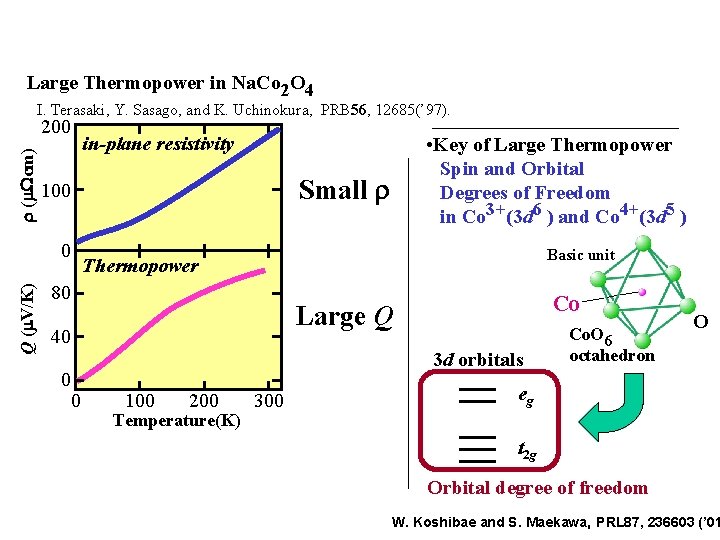
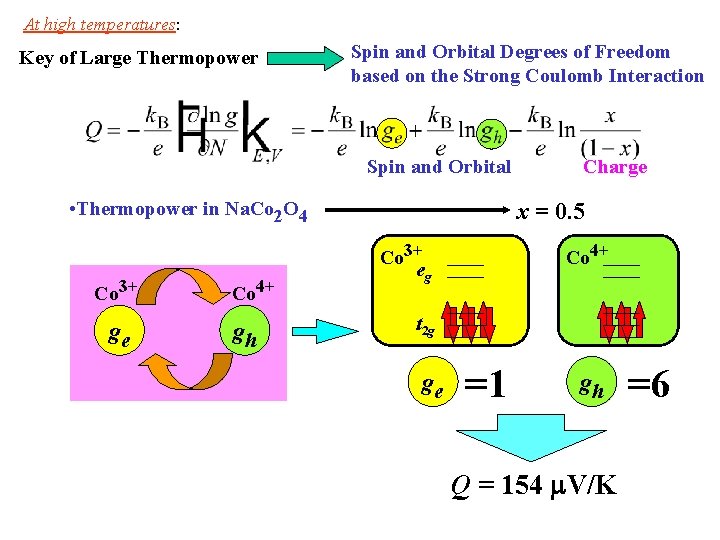
Large Thermopower in Na. Co 2 O 4 I. Terasaki, Y. Sasago, and K. Uchinokura, PRB 56, 12685(’ 97). r (m. Wcm) 200 Basic unit Thermopower 80 Co Large Q 40 0 0 • Key of Large Thermopower Spin and Orbital Degrees of Freedom in Co 3+(3 d 6 ) and Co 4+(3 d 5 ) Small r 100 0 Q (m. V/K) in-plane resistivity 3 d orbitals 100 200 Temperature(K) 300 Co. O 6 octahedron O eg t 2 g Orbital degree of freedom W. Koshibae and S. Maekawa,PRL 87, 236603 (’ 01
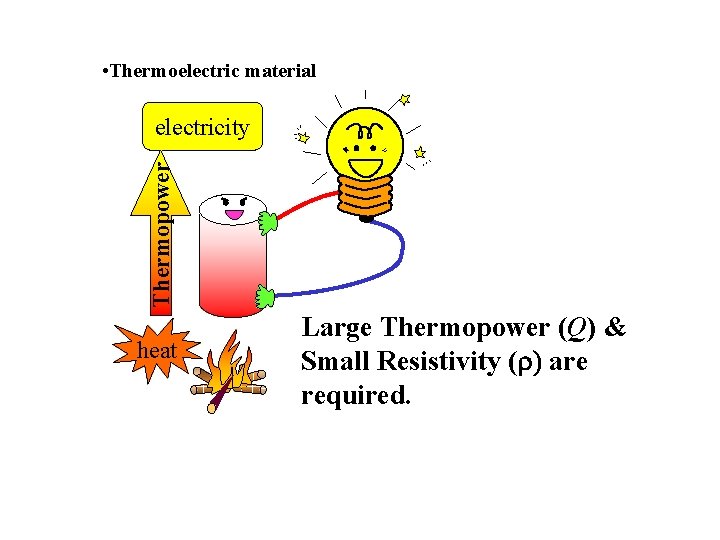
• Thermoelectric material Thermopower electricity heat Large Thermopower (Q) & Small Resistivity (r) are required.
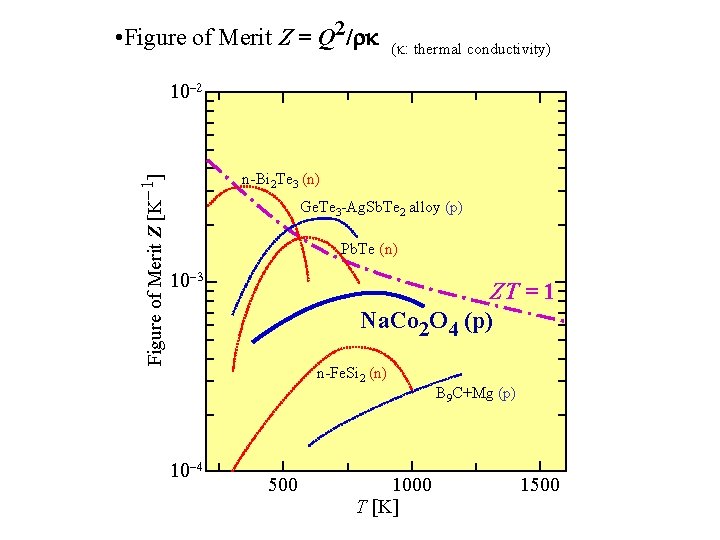
• Figure of Merit Z = Q 2/rk (k: thermal conductivity) Figure of Merit Z [K-1] 10 -2 n-Bi 2 Te 3 (n) Ge. Te 3 -Ag. Sb. Te 2 alloy (p) Pb. Te (n) 10 -3 ZT = 1 Na. Co 2 O 4 n-Si. Ge (p) [n] n-Fe. Si 2 (n) 10 -4 500 1000 T [K] B 9 C+Mg (p) 1500
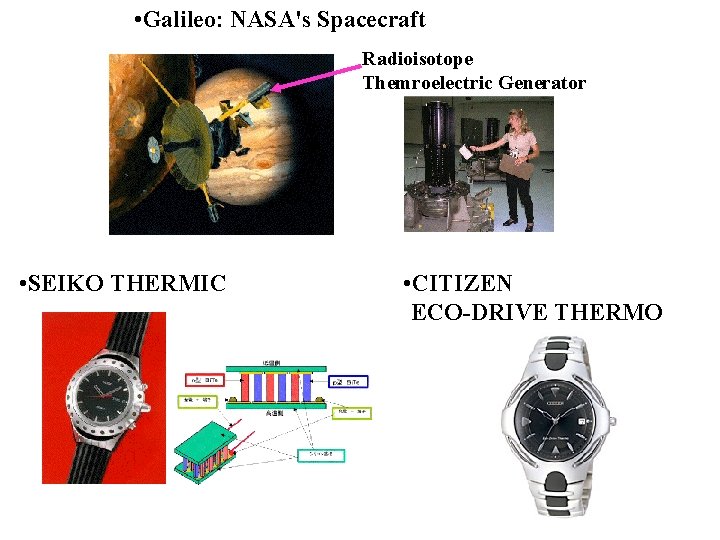
• Galileo: NASA's Spacecraft Radioisotope Themroelectric Generator • SEIKO THERMIC • CITIZEN ECO-DRIVE THERMO
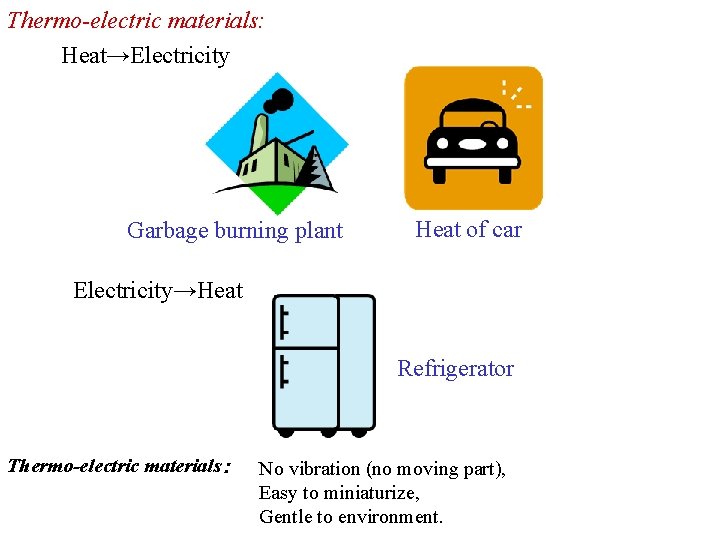
Thermo-electric materials: Heat→Electricity Garbage burning plant Heat of car Electricity→Heat Refrigerator Thermo-electric materials: No vibration (no moving part), Easy to miniaturize, Gentle to environment.
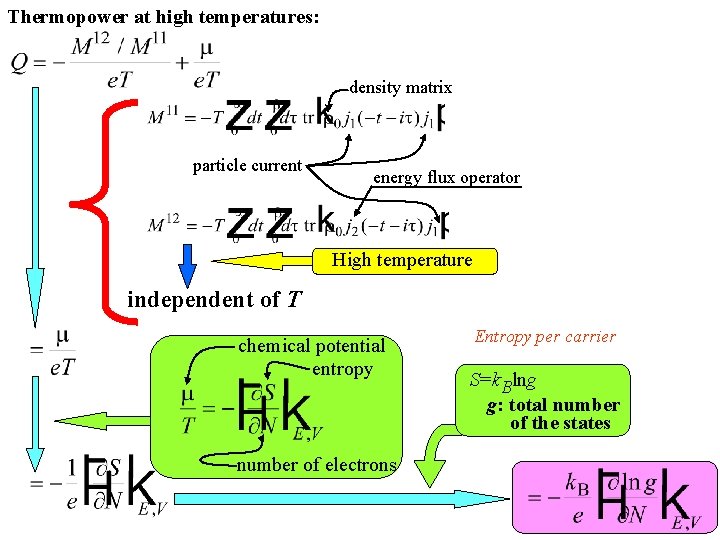
Thermopower at high temperatures: density matrix particle current energy flux operator High temperature independent of T chemical potential entropy number of electrons Entropy per carrier S=k. Blng g: total number of the states
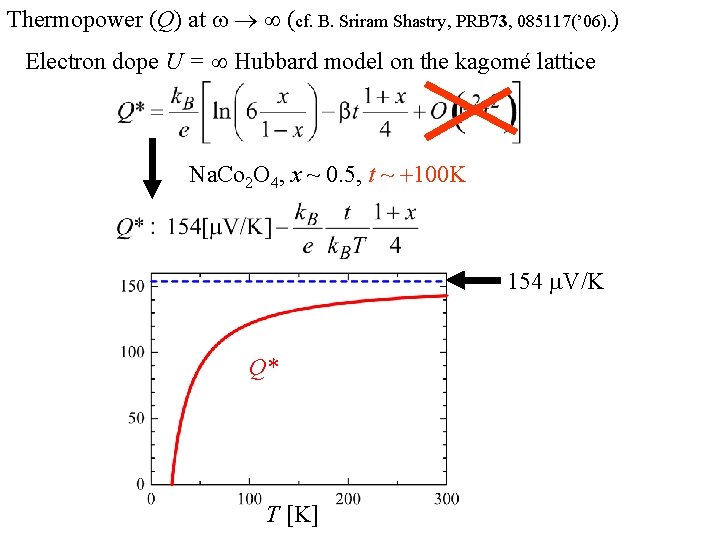
At high temperatures: Key of Large Thermopower Spin and Orbital Degrees of Freedom based on the Strong Coulomb Interaction Spin and Orbital • Thermopower in Na. Co 2 O 4 Co 3+ ge Co 4+ gh Charge x = 0. 5 Co 3+ eg Co 4+ t 2 g ge =1 gh Q = 154 m. V/K =6
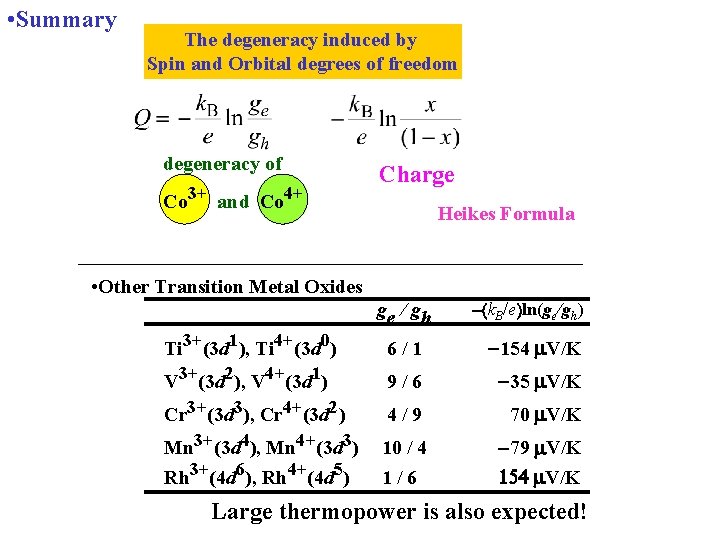
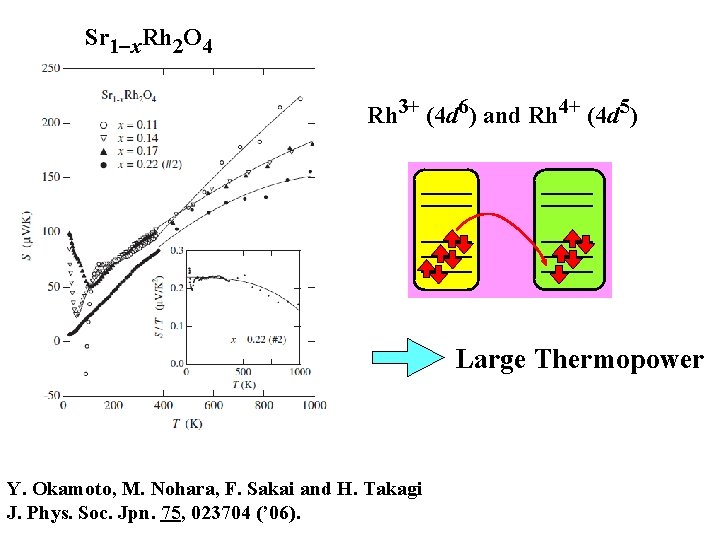
• Summary The degeneracy induced by Spin and Orbital degrees of freedom degeneracy of Co 3+ and Co 4+ Charge Heikes Formula • Other Transition Metal Oxides ge / gh (k. B/e)ln(ge/gh) Ti 3+(3 d 1), Ti 4+(3 d 0) 6/1 154 m. V/K V 3+(3 d 2), V 4+(3 d 1) 9/6 35 m. V/K Cr 3+(3 d 3), Cr 4+(3 d 2) 4/9 70 m. V/K Mn 3+(3 d 4), Mn 4+(3 d 3) Rh 3+(4 d 6), Rh 4+(4 d 5) 10 / 4 1/6 79 m. V/K 154 m. V/K Large thermopower is also expected!
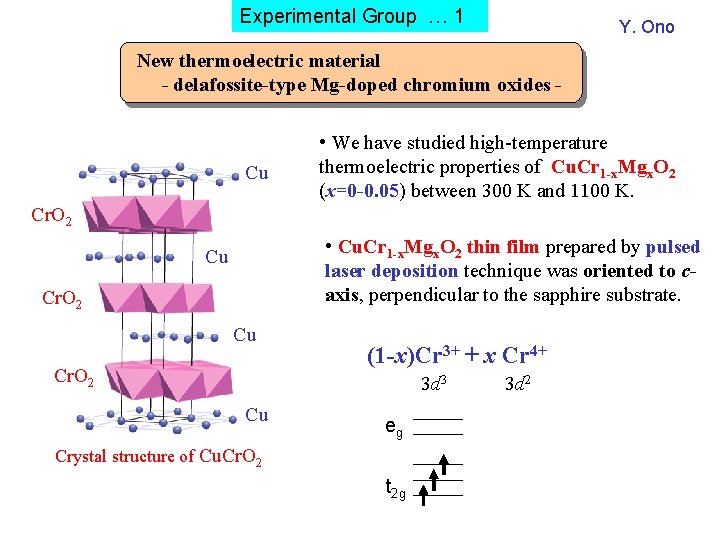
Experimental Group … 1 Y. Ono New thermoelectric material - delafossite-type Mg-doped chromium oxides - Cu • We have studied high-temperature thermoelectric properties of Cu. Cr 1 -x. Mgx. O 2 (x=0 -0. 05) between 300 K and 1100 K. Cr. O 2 • Cu. Cr 1 -x. Mgx. O 2 thin film prepared by pulsed laser deposition technique was oriented to caxis, perpendicular to the sapphire substrate. Cu Cr. O 2 (1 -x)Cr 3+ + x Cr 4+ 3 d 3 Cu eg Crystal structure of Cu. Cr. O 2 t 2 g 3 d 2
Sr 1 x. Rh 2 O 4 Rh 3+ (4 d 6) and Rh 4+ (4 d 5) Large Thermopower Y. Okamoto, M. Nohara, F. Sakai and H. Takagi J. Phys. Soc. Jpn. 75, 023704 (’ 06).
Thermopower (Q) at w (cf. B. Sriram Shastry, PRB 73, 085117(’ 06). ) Electron dope U = Hubbard model on the kagomé lattice Na. Co 2 O 4, x ~ 0. 5, t ~ +100 K 154 m. V/K Q* T [K]
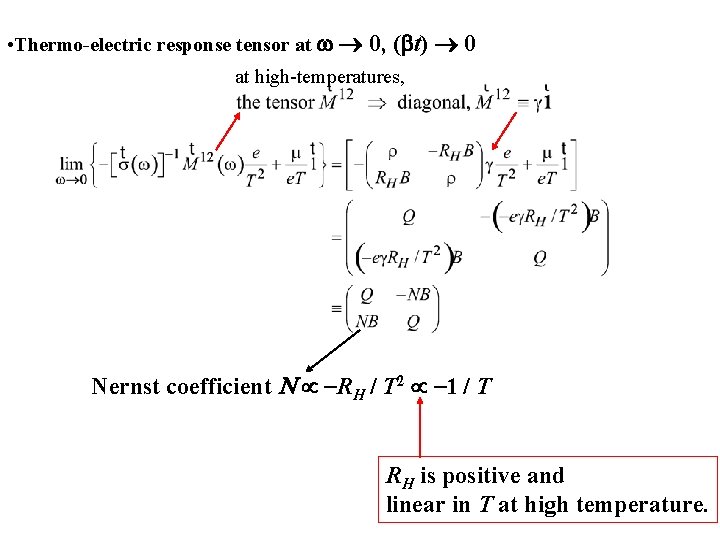
• Thermo-electric response tensor at w 0, (bt) 0 at high-temperatures, Nernst coefficient N RH / T 2 1 / T RH is positive and linear in T at high temperature.
In conclusion; It is of crucial importance to see the electronic lattice hidden in the frustrated crystal lattice.