ROMA TRE UNIVERSITY Master in Human Development and



- Slides: 52
ROMA TRE UNIVERSITY Master in Human Development and Food Security Academic Edition 2016 -2017
ROMA TRE UNIVERSITY Development Economics Module Course in Macroeconomics Debt and Structural Adjustment: Old and New Crisis Massimo Pallottino massimo. pallottino@uniroma 3. it
Debt: an everlasting history § Debt and debt crisis are not something new: the idea § of financing (economic and politic) ventures, at individual as well as at state level is found in premodern and in modern history. Kindleberger: phases of (a) growth; followed by ‘bubbles’ or (b) manias; and ending in (c) crisis. (Hanlon, 2012) 3
Do debt crisis represent an exception? § After the WWII (Kaiser, 2013) § Eighties: Third World Debt § 1989 -91: fall of the Soviet Union, and financial crisis § § § in the former Union’s countries 1994 -95 Mexico’s debt crisis 1996 -97: Asian financial crisis 2007: a long prepared financial crisis blows-up 4
What debt are we talking about? § Sovereign debt: public, or publicly guaranteed • Domestic, external (currency) • Owed to public bodies (governements, multilaterals) • Owed to private bodies (banks, investment funds, private equities) § § Private debt Credit: ODA concessional/ Commercial § Debt strucure • Interest rate • Maturity (short/long) • Grace period
Multiple dimensions § Financial dimensions § Economic dimension (resources for what? ) § Social dimensions (the social costs of debt and its § § § service) Internal political dimensions External political dimensions (power issues related to to borrowing and servicing – or not servicing) Juridical dimensions (legitimacy of debt) 6
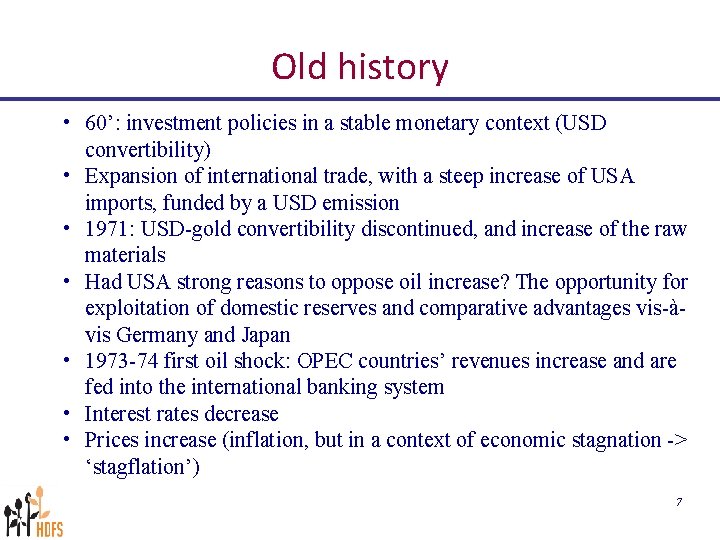
Old history • 60’: investment policies in a stable monetary context (USD convertibility) • Expansion of international trade, with a steep increase of USA imports, funded by a USD emission • 1971: USD-gold convertibility discontinued, and increase of the raw materials • Had USA strong reasons to oppose oil increase? The opportunity for exploitation of domestic reserves and comparative advantages vis-àvis Germany and Japan • 1973 -74 first oil shock: OPEC countries’ revenues increase and are fed into the international banking system • Interest rates decrease • Prices increase (inflation, but in a context of economic stagnation -> ‘stagflation’) 7
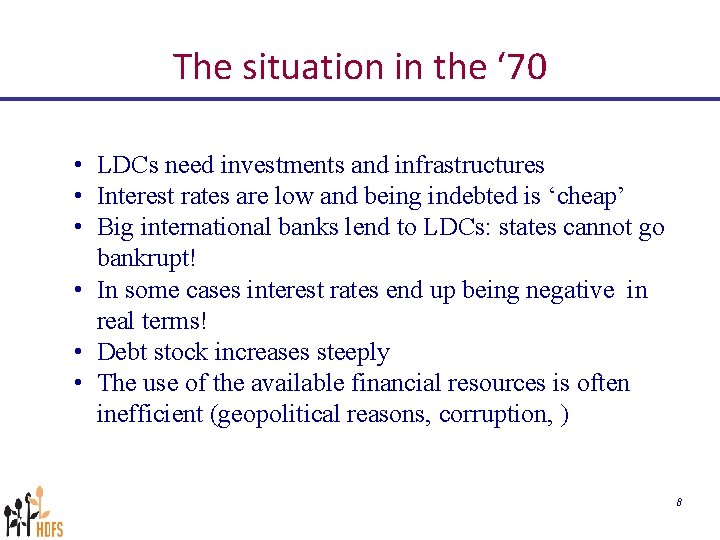
The situation in the ‘ 70 • LDCs need investments and infrastructures • Interest rates are low and being indebted is ‘cheap’ • Big international banks lend to LDCs: states cannot go bankrupt! • In some cases interest rates end up being negative in real terms! • Debt stock increases steeply • The use of the available financial resources is often inefficient (geopolitical reasons, corruption, ) 8
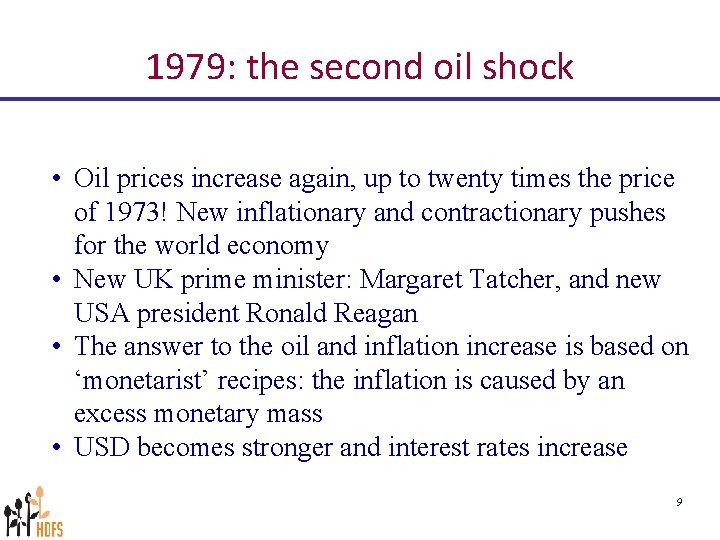
1979: the second oil shock • Oil prices increase again, up to twenty times the price of 1973! New inflationary and contractionary pushes for the world economy • New UK prime minister: Margaret Tatcher, and new USA president Ronald Reagan • The answer to the oil and inflation increase is based on ‘monetarist’ recipes: the inflation is caused by an excess monetary mass • USD becomes stronger and interest rates increase 9
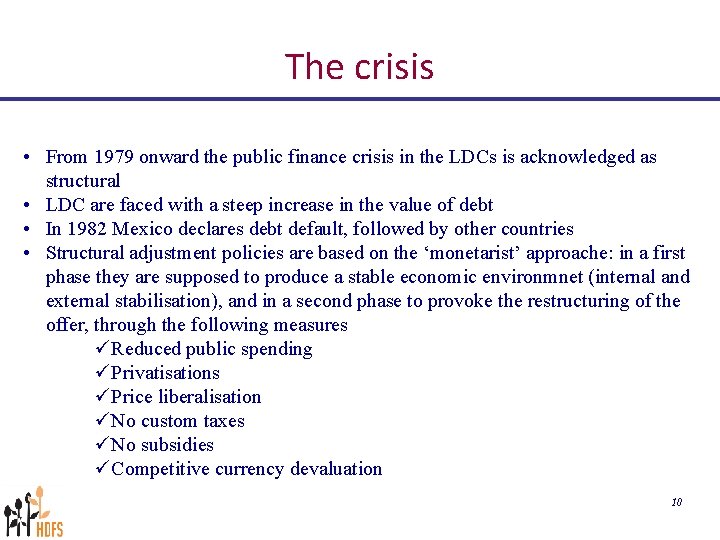
The crisis • From 1979 onward the public finance crisis in the LDCs is acknowledged as structural • LDC are faced with a steep increase in the value of debt • In 1982 Mexico declares debt default, followed by other countries • Structural adjustment policies are based on the ‘monetarist’ approache: in a first phase they are supposed to produce a stable economic environmnet (internal and external stabilisation), and in a second phase to provoke the restructuring of the offer, through the following measures üReduced public spending üPrivatisations üPrice liberalisation üNo custom taxes üNo subsidies üCompetitive currency devaluation 10
Debt dynamics: from private to public § Debt was initially rather private than public • There was a pressure for the ‘publicisation’ of private debt, in order to make the sitution less risky for the lenders • When the problems arose, sovereign debt was refinanced largely by IFIs, in order to avoid a crack of the northern banks that had given out loans 11
Debt dynamics: a largely financial vicious circle § Between 1982 and 1998 indebted countries repaid as § § much as four times the original value of credit received In the same period their debt stock increased up to four times the original amount In 1998, indebted counties repaid as much as 1. 40 USD for each 1 USD received in ODA. (quoted by Sassen 2014)
How to face debt crisis? § Trading on secondary markets § Buy back options § Restructuring/rescheduling (NPV Vs face value) § Debt swaps (Debt-for-equity, Debt-fordevelopment, Debt-for-nature Swap) § Cancellation 13
The options in the ‘ 80 § Solving the creditors’ problems… § Baker plan (1985): involuntary lending, creditors’ § coordination, and structural conditionalities Brady plan (1989): the principle of the reduction of debt is acknowledged. • Buyback • Debt for equity swaps • Par bond swaps , where face value is conserved, but • interest rates are reduced to a flat rate of 6% New financial resources 14
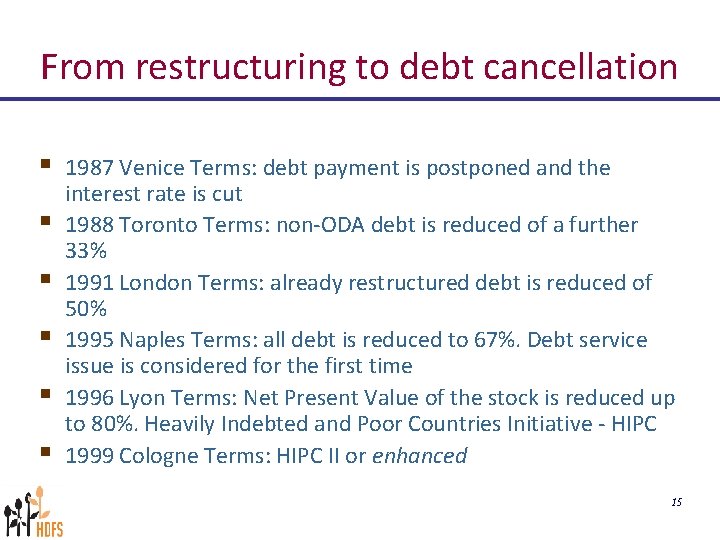
From restructuring to debt cancellation § § § 1987 Venice Terms: debt payment is postponed and the interest rate is cut 1988 Toronto Terms: non-ODA debt is reduced of a further 33% 1991 London Terms: already restructured debt is reduced of 50% 1995 Naples Terms: all debt is reduced to 67%. Debt service issue is considered for the first time 1996 Lyon Terms: Net Present Value of the stock is reduced up to 80%. Heavily Indebted and Poor Countries Initiative - HIPC 1999 Cologne Terms: HIPC II or enhanced 15
A turning point § Debt reduction policies are acknowledged as § § substantially ineffective Structural adjustment programmes are acknowledged as substantially ineffective A big mobilisation of the international civil society (Bimingham, 1998; Cologne 1999) 16
Cologne: HIPC II - enhanced Objectives: • To increase the debt cancellation • To accelerate the debt cancellation • To widen the number of beneficiary countries • To guarantee that funds are used for poverty reduction The Bank and the Fund change their traditional facilities 17
‘Too much’ debt? § Too much when… § A Human Development Approach to debt § sustainability Too much in financial terms 18
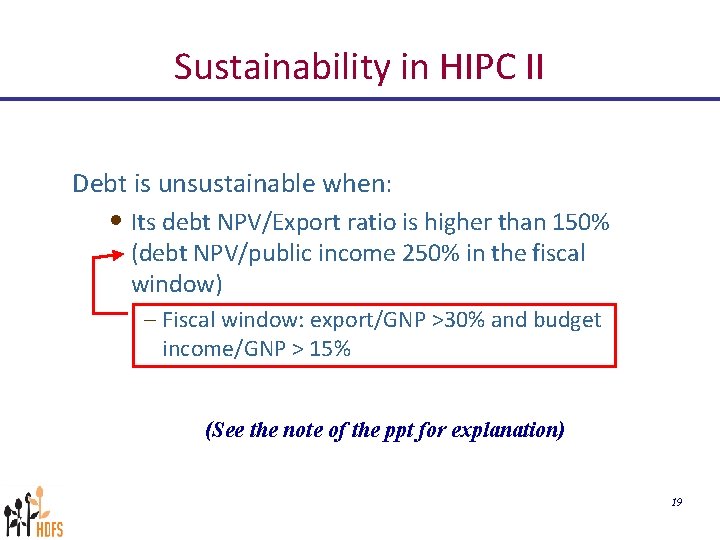
Sustainability in HIPC II Debt is unsustainable when: • Its debt NPV/Export ratio is higher than 150% (debt NPV/public income 250% in the fiscal window) – Fiscal window: export/GNP >30% and budget income/GNP > 15% (See the note of the ppt for explanation) 19
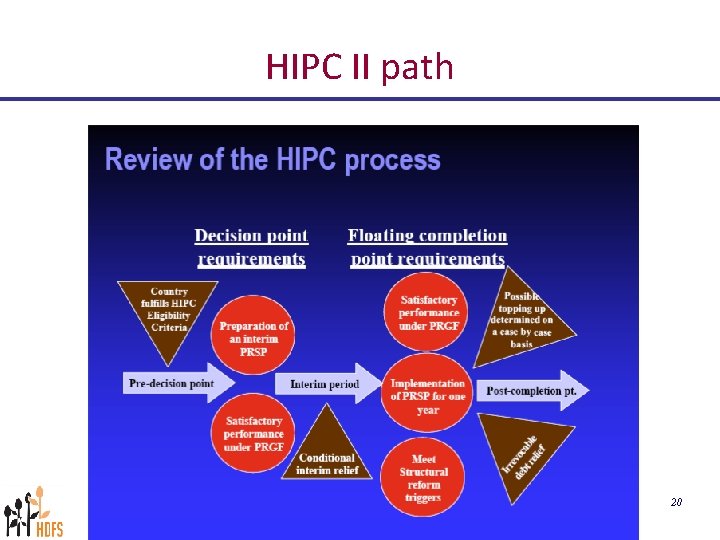
HIPC II path Debt - History 20
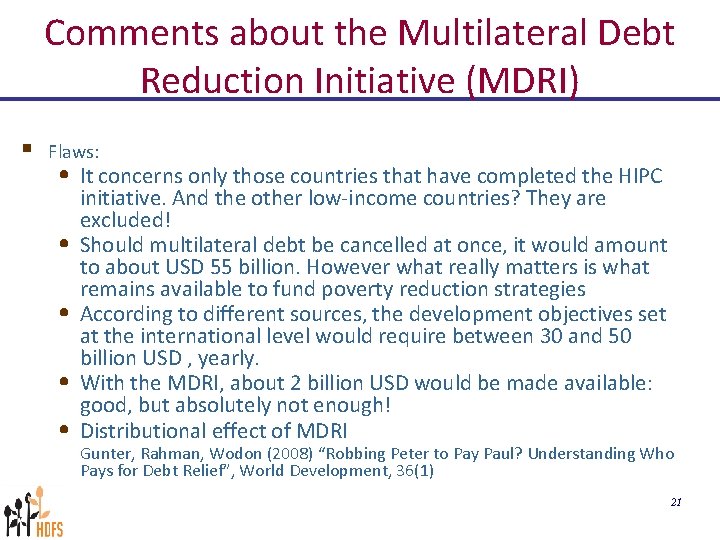
Comments about the Multilateral Debt Reduction Initiative (MDRI) § Flaws: • It concerns only those countries that have completed the HIPC • • initiative. And the other low-income countries? They are excluded! Should multilateral debt be cancelled at once, it would amount to about USD 55 billion. However what really matters is what remains available to fund poverty reduction strategies According to different sources, the development objectives set at the international level would require between 30 and 50 billion USD , yearly. With the MDRI, about 2 billion USD would be made available: good, but absolutely not enough! Distributional effect of MDRI Gunter, Rahman, Wodon (2008) “Robbing Peter to Pay Paul? Understanding Who Pays for Debt Relief”, World Development, 36(1) 21
Conditionality • On which basis has debt cancellation been accessed? 22
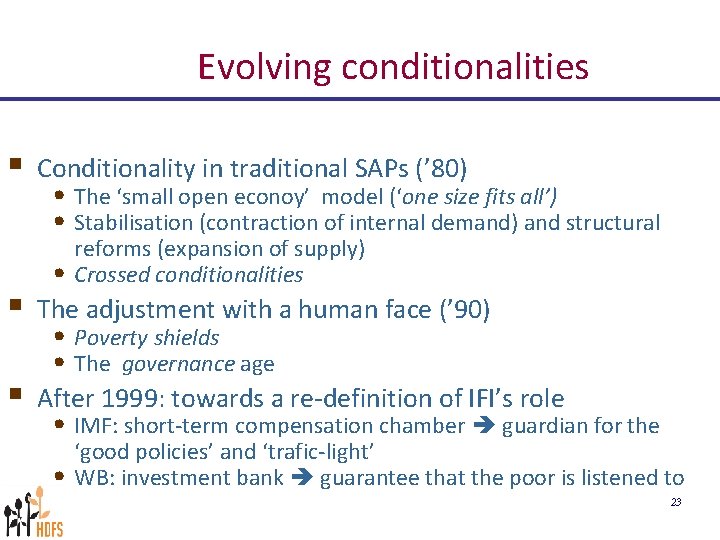
Evolving conditionalities § § § Conditionality in traditional SAPs (’ 80) • The ‘small open econoy’ model (‘one size fits all’) • Stabilisation (contraction of internal demand) and structural reforms (expansion of supply) Crossed conditionalities • The adjustment with a human face (’ 90) • Poverty shields • The governance age After 1999: towards a re-definition of IFI’s role • IMF: short-term compensation chamber guardian for the • ‘good policies’ and ‘trafic-light’ WB: investment bank guarantee that the poor is listened to 23
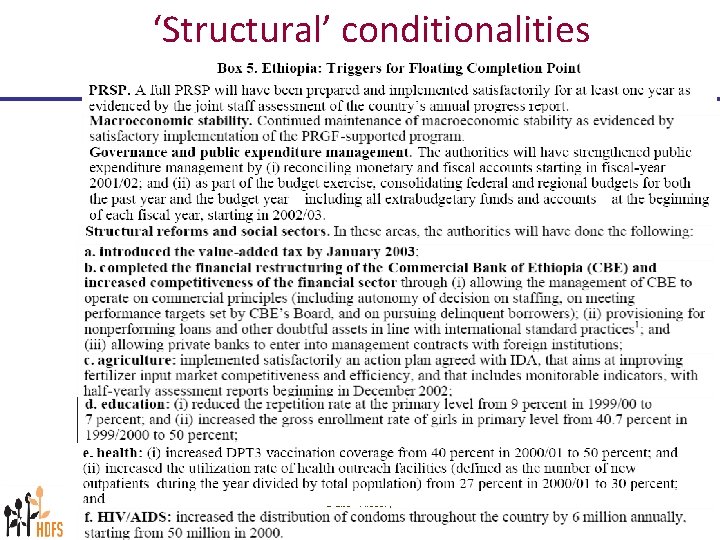
‘Structural’ conditionalities Debt - History 24
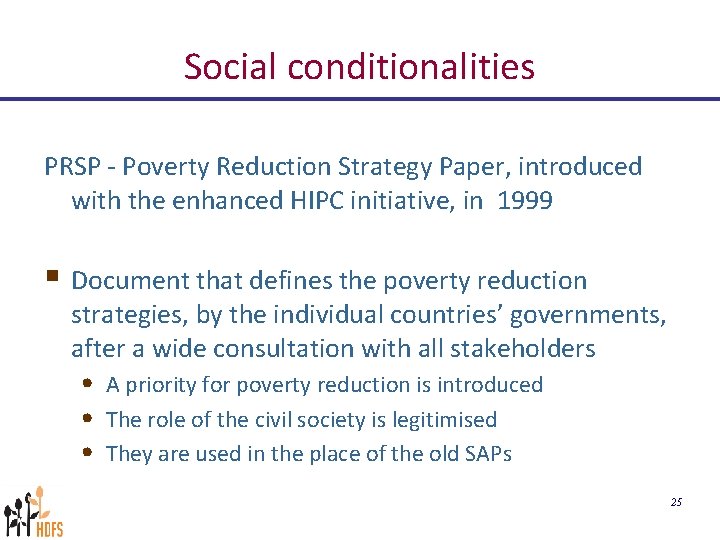
Social conditionalities PRSP - Poverty Reduction Strategy Paper, introduced with the enhanced HIPC initiative, in 1999 § Document that defines the poverty reduction strategies, by the individual countries’ governments, after a wide consultation with all stakeholders • A priority for poverty reduction is introduced • The role of the civil society is legitimised • They are used in the place of the old SAPs 25
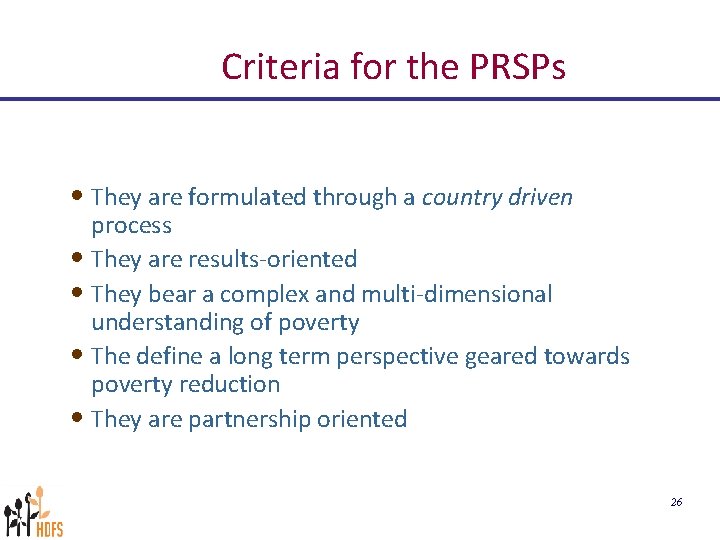
Criteria for the PRSPs • They are formulated through a country driven process • They are results-oriented • They bear a complex and multi-dimensional understanding of poverty • The define a long term perspective geared towards poverty reduction • They are partnership oriented 26
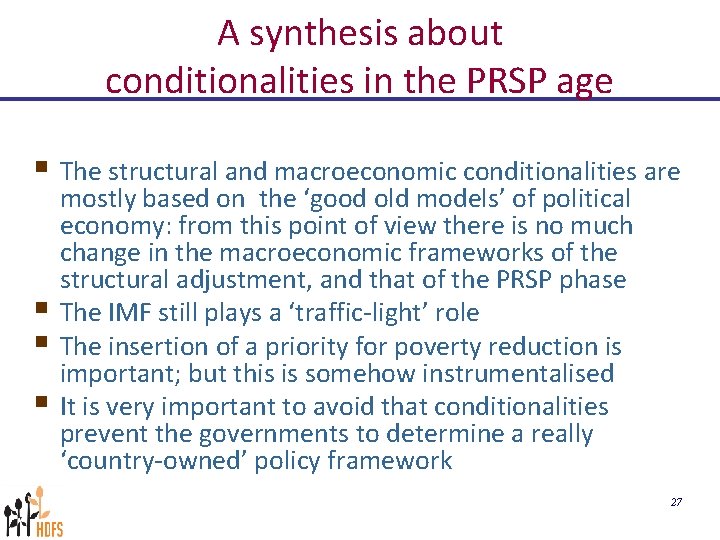
A synthesis about conditionalities in the PRSP age § The structural and macroeconomic conditionalities are § § § mostly based on the ‘good old models’ of political economy: from this point of view there is no much change in the macroeconomic frameworks of the structural adjustment, and that of the PRSP phase The IMF still plays a ‘traffic-light’ role The insertion of a priority for poverty reduction is important; but this is somehow instrumentalised It is very important to avoid that conditionalities prevent the governments to determine a really ‘country-owned’ policy framework 27
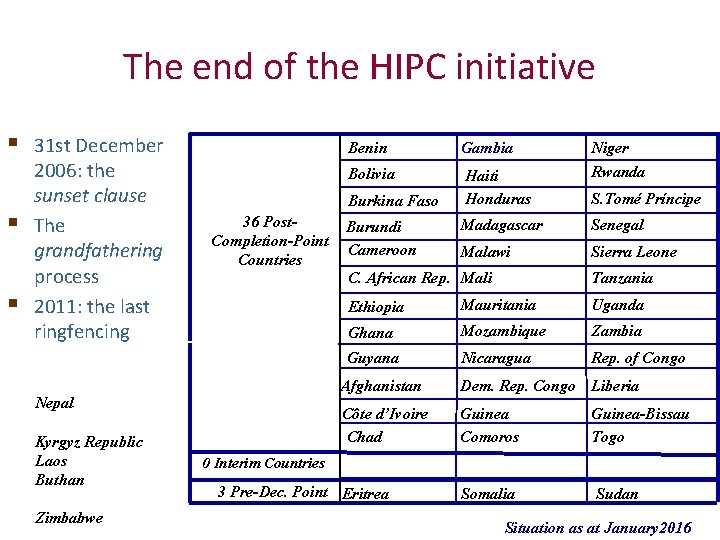
The end of the HIPC initiative § § § 31 st December 2006: the sunset clause The grandfathering process 2011: the last ringfencing Zimbabwe Gambia Niger Bolivia Haiti Honduras Rwanda Madagascar Senegal Malawi Sierra Leone Burkina Faso 36 Post. Completion-Point Countries Burundi Cameroon C. African Rep. Mali Nepal Kyrgyz Republic Laos Buthan Benin S. Tomé Príncipe Tanzania Ethiopia Mauritania Uganda Ghana Mozambique Zambia Guyana Nicaragua Rep. of Congo Afghanistan Dem. Rep. Congo Liberia Côte d’Ivoire Chad Guinea Comoros Guinea-Bissau Togo 0 Interim Countries 3 Pre-Dec. Point Eritrea Debt - History Somalia Sudan 28 Situation as at January 2016
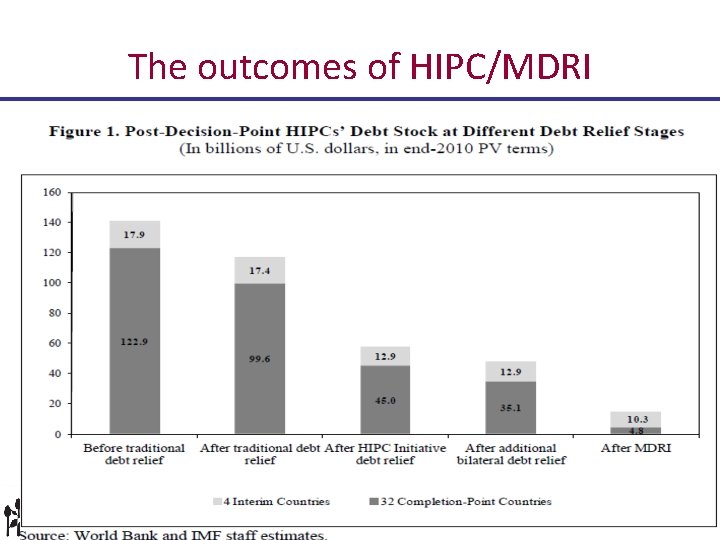
The outcomes of HIPC/MDRI Debt - History 29
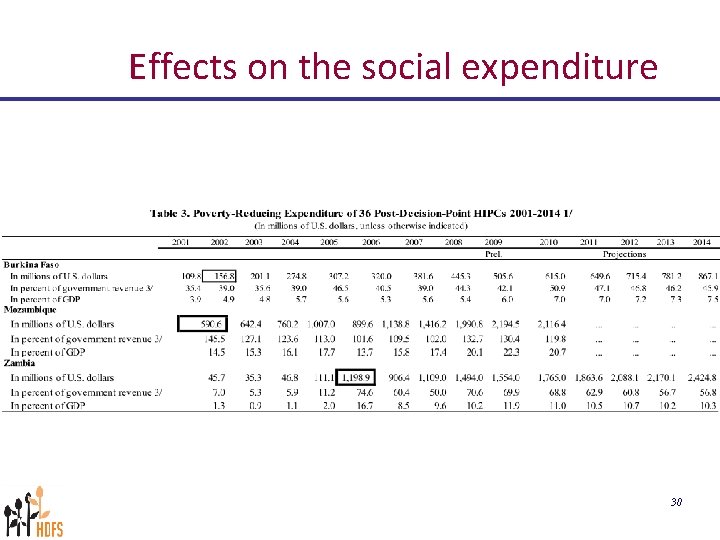
Effects on the social expenditure 30
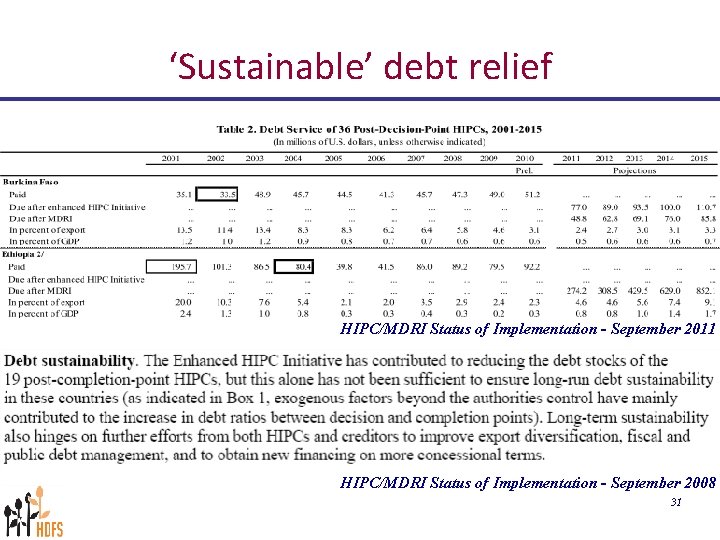
‘Sustainable’ debt relief HIPC/MDRI Status of Implementation - September 2011 HIPC/MDRI Status of Implementation - September 2008 31
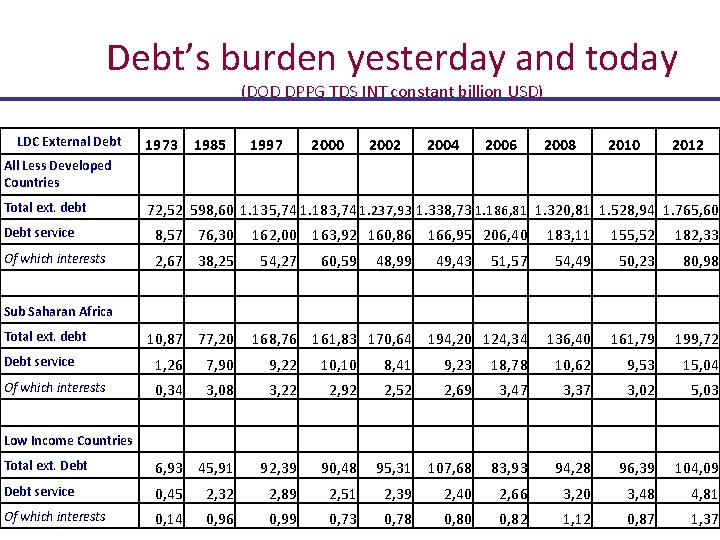
Debt’s burden yesterday and today (DOD DPPG TDS INT constant billion USD) LDC External Debt 1973 1985 All Less Developed Countries Total ext. debt 1997 2000 2002 2004 2006 2008 2012 72, 52 598, 60 1. 135, 74 1. 183, 74 1. 237, 93 1. 338, 73 1. 186, 81 1. 320, 81 1. 528, 94 1. 765, 60 Debt service 8, 57 76, 30 Of which interests 2, 67 38, 25 162, 00 163, 92 160, 86 166, 95 206, 40 54, 27 60, 59 48, 99 49, 43 Sub Saharan Africa 2010 Total ext. debt 10, 87 77, 20 51, 57 183, 11 155, 52 182, 33 54, 49 50, 23 80, 98 136, 40 161, 79 199, 72 168, 76 161, 83 170, 64 194, 20 124, 34 Debt service 1, 26 7, 90 9, 22 10, 10 8, 41 9, 23 18, 78 10, 62 9, 53 15, 04 Of which interests 0, 34 3, 08 3, 22 2, 92 2, 52 2, 69 3, 47 3, 37 3, 02 5, 03 83, 93 94, 28 96, 39 104, 09 Low Income Countries Total ext. Debt 6, 93 45, 91 Debt service 0, 45 2, 32 2, 89 Of which interests 0, 14 0, 96 0, 99 92, 39 90, 48 95, 31 107, 68 2, 51 2, 39 2, 40 2, 66 3, 20 3, 48 0, 73 0, 78 0, 80 0, 82 1, 12 0, 87 Debt - History 32 4, 81 1, 37
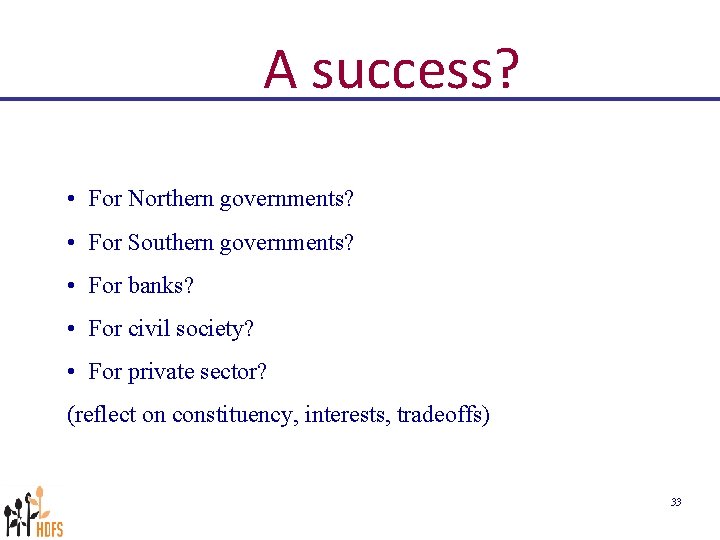
A success? • For Northern governments? • For Southern governments? • For banks? • For civil society? • For private sector? (reflect on constituency, interests, tradeoffs) 33
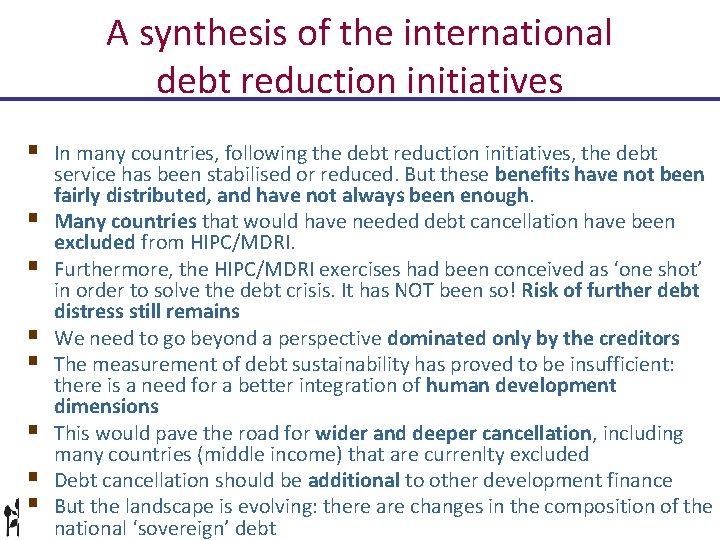
A synthesis of the international debt reduction initiatives § § § § In many countries, following the debt reduction initiatives, the debt service has been stabilised or reduced. But these benefits have not been fairly distributed, and have not always been enough. Many countries that would have needed debt cancellation have been excluded from HIPC/MDRI. Furthermore, the HIPC/MDRI exercises had been conceived as ‘one shot’ in order to solve the debt crisis. It has NOT been so! Risk of further debt distress still remains We need to go beyond a perspective dominated only by the creditors The measurement of debt sustainability has proved to be insufficient: there is a need for a better integration of human development dimensions This would pave the road for wider and deeper cancellation, including many countries (middle income) that are currenlty excluded Debt cancellation should be additional to other development finance 34 Debt - History But the landscape is evolving: there are changes in the composition of the national ‘sovereign’ debt
Non-HIPC countries § Debt swaps: contested in the age of debt § § cancellation Pilote experiences during the debt relief age: Guinea, Kenya… Extensive recourse to debt swaps in various configurations
Accountability, civil society…. ? Alongside macroeconoinic conditionalities, 'country ownership' has been a central principle of the HIPC Initiative. PRSs were the major vehicle through which such ownership was to be realised. However, country ownership has, at best, translated into truncaled forms of ownership by governments, with parliaments and other state institutions often being quite marginal. Democratic or citizen ownership has been largely overlooked in discussions of 'country ownership'. Because of this, genuinely democratic oversight of the governance of debt continues to be minimal. This is a major lacuna in the design of contemporary debt-relief schemes. It is surprising that many leading donors strongly espouse 'democracy', 'democratisation' and 'accountability' in other important contexts, but see these principles at best as having only limited or narrow relevance to the governance of debt. Walker B. (2011) "Using Debt Exchanges to Enhance Public Accountability to Citizens", in "Debt-for -Development Exchanges: History and New Applications", Buckley R. P. (ed), Cambridge University Debt: trends and options Press, Cambridge 36
System or ‘ad hoc’? “While preserving the core principles of the HIPC Initiative, IDA and the IMF have continued to make use of the flexibility available in the framework governing the Initiative. Judgment has continued to be used in the area of completion point triggers. The Boards granted waivers to Afghanistan and Liberia for missed triggers on the basis that they had been substantially implemented and sufficient progress had been made toward the underlying objectives. Comoros reached its decision point following the progress made on clearance of its arrears, which will count as debt relief provided by its multilateral and official bilateral creditors. Flexibility was also exercised in the area of preparation and implementation of poverty reduction strategies. ” HIPC/MDRI Status of Implementation - September 2010 37 Debt - History
Implications/consequences How has the scenario changed, following the debt crisis, the debt relief policies, and the related policies? • More debt is now possible, and poorest countries are more solvent • More countries are now more ‘othodox’ in terms of political economy • Paving the way for a major restructuring of the global economy (Sassen) 38
SPECIAL CASES
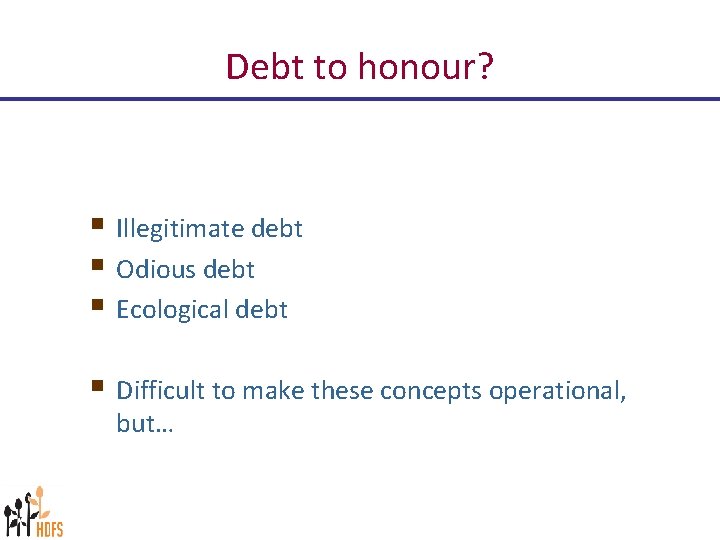
Debt to honour? § Illegitimate debt § Odious debt § Ecological debt § Difficult to make these concepts operational, but…
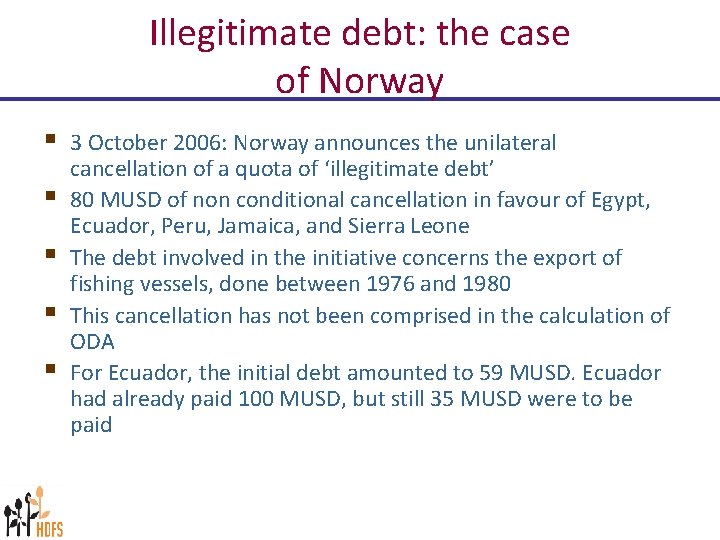
Illegitimate debt: the case of Norway § § § 3 October 2006: Norway announces the unilateral cancellation of a quota of ‘illegitimate debt’ 80 MUSD of non conditional cancellation in favour of Egypt, Ecuador, Peru, Jamaica, and Sierra Leone The debt involved in the initiative concerns the export of fishing vessels, done between 1976 and 1980 This cancellation has not been comprised in the calculation of ODA For Ecuador, the initial debt amounted to 59 MUSD. Ecuador had already paid 100 MUSD, but still 35 MUSD were to be paid
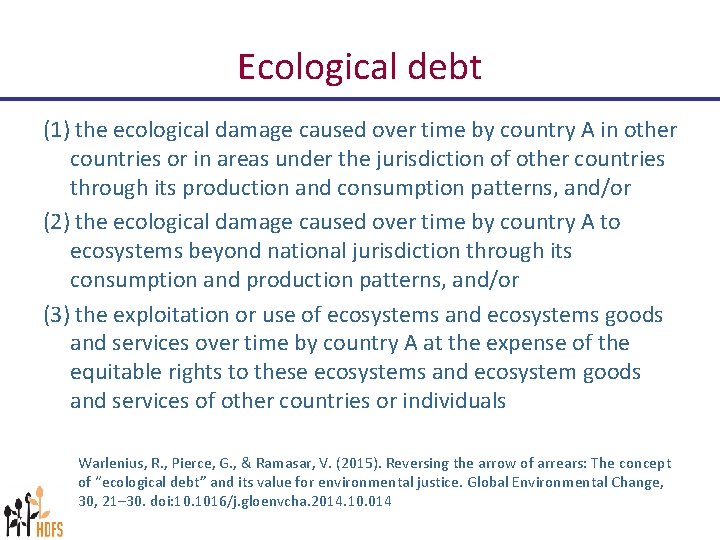
Ecological debt (1) the ecological damage caused over time by country A in other countries or in areas under the jurisdiction of other countries through its production and consumption patterns, and/or (2) the ecological damage caused over time by country A to ecosystems beyond national jurisdiction through its consumption and production patterns, and/or (3) the exploitation or use of ecosystems and ecosystems goods and services over time by country A at the expense of the equitable rights to these ecosystems and ecosystem goods and services of other countries or individuals Warlenius, R. , Pierce, G. , & Ramasar, V. (2015). Reversing the arrow of arrears: The concept of “ecological debt” and its value for environmental justice. Global Environmental Change, 30, 21– 30. doi: 10. 1016/j. gloenvcha. 2014. 10. 014
CURRENT TRENDS
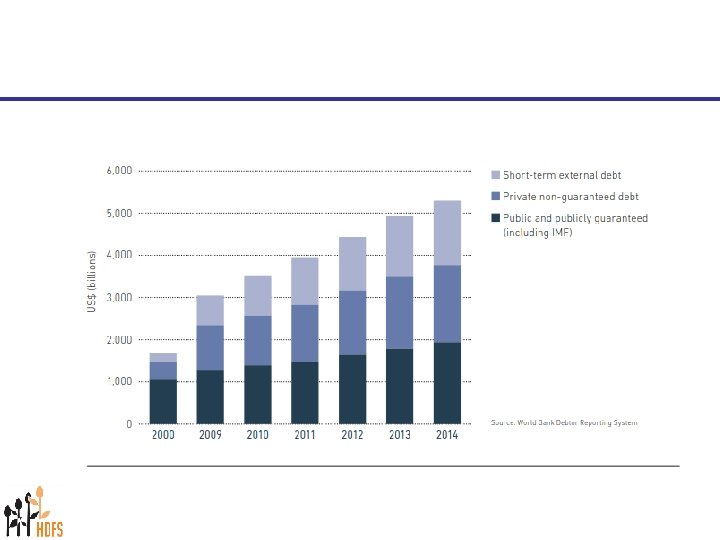
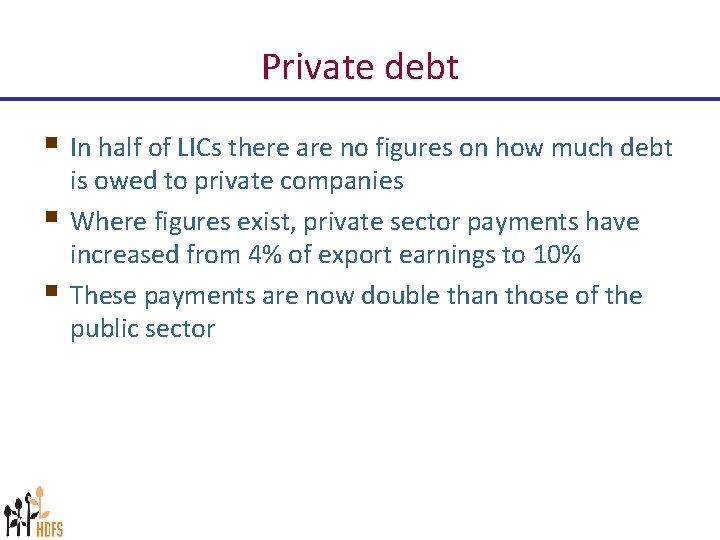
Private debt § In half of LICs there are no figures on how much debt § § is owed to private companies Where figures exist, private sector payments have increased from 4% of export earnings to 10% These payments are now double than those of the public sector
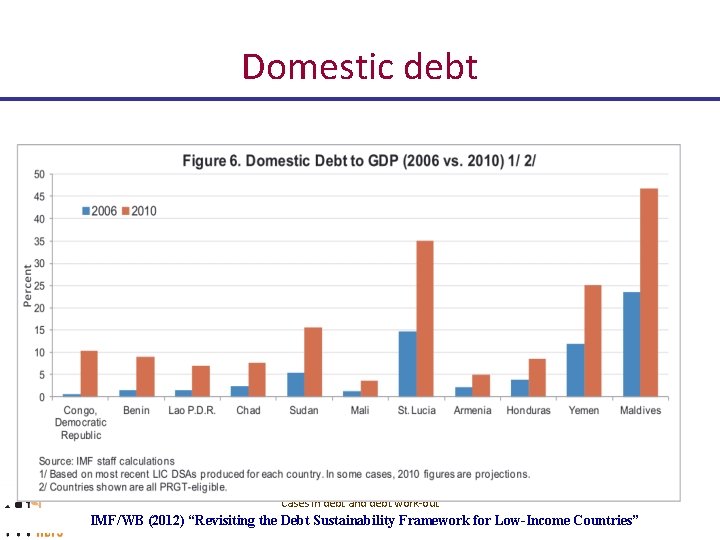
Domestic debt Cases in debt and debt work-out IMF/WB (2012) “Revisiting the Debt Sustainability Framework for Low-Income Countries”
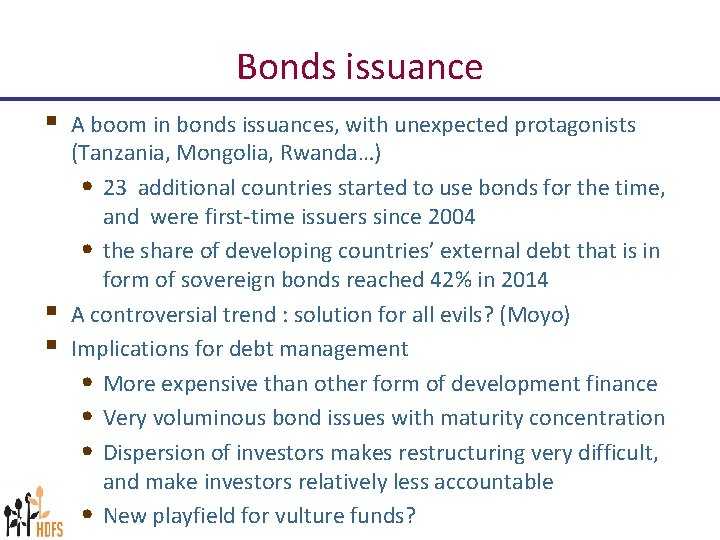
Bonds issuance § § § A boom in bonds issuances, with unexpected protagonists (Tanzania, Mongolia, Rwanda…) • 23 additional countries started to use bonds for the time, and were first-time issuers since 2004 • the share of developing countries’ external debt that is in form of sovereign bonds reached 42% in 2014 A controversial trend : solution for all evils? (Moyo) Implications for debt management • More expensive than other form of development finance • Very voluminous bond issues with maturity concentration • Dispersion of investors makes restructuring very difficult, and make investors relatively less accountable • New playfield for vulture funds?
Public Private Partnership § Favoured by current development rhetoric § Effect on cost of finance for public investments is § § controversial (UK data 2011: cost increase) Increased costs of investments Sliding off balance sheets of public accounts
SCENARIOS
Paving the way for new debt crisis…? • The low but growing level of residual external debt • The internal and private debt, that often hides an external debt in • • • commercial terms. New actors, such as China and India, which are not part of the ‘traditional’ negotiation instances, such as the Paris Club Still no comprehensive arrangement is in place to deal with potential or current excessive (? ) debt Policy responses to the last financial crisis sofar have demonstrately been short-sighted, in some cases leading to an unnecessary worsening of the situation Declaration on debt distress management adopted by UNGA (Sept. 2015); by clear signs of low attention by the international community (cf. outcomes of Addis conference on Ff. D) Complexity, shadow finance, deregulation, inequalities
A debt regime for the future § Putting debt at work for development • Credit finance ‘is’ a tool? • The context of Sustainable Development Goals § Preventing new debt crisis • Responsible lending • Debt distress evaluation (FMI) § Acknowledging and facing over-indebtedness • No arbitration mechanisms • What kind of response?
BIBLIOGRAPHY § § § Bibliography Buckley, R. P. (Ed. ). (2011). Debt-for-development exchanges: history and new applications. Cambridge, U. K. ; New York: Cambridge University Press. Ellmers, B. (2016). The evolving nature of developing country debt and solutions for change. Brussels: European Network on Debt and Development (EURODAD). Retrieved from http: //eurodad. org/files/pdf/1546625 -theevolving-nature-of-developing-country-debt-and-solutions-for-change 1474374793. pdf Hanlon, J. (2012). Debt and development. In P. A. Haslam, J. Schafer, & P. Beaudet (Eds. ), Introduction to international development: approaches, actors, and issues (Second edition. , pp. 262– 278). Don Mills Ontario: Oxford University Press. Sassen, S. (2014). Expulsions: brutality and complexity in the global economy. Cambridge, Massachusetts: Harvard University Press. Taylor, M. (2012). The International Financial Institutions. In P. A. Haslam, J. Schafer, & P. Beaudet (Eds. ), Introduction to international development: approaches, actors, and issues (Second edition. , pp. 159– 174). Don Mills 52 Ontario: Oxford University Press.