Roadside Inspections Customer Training Topic Ryder Fleet Risk

- Slides: 21
Roadside Inspections Customer Training Topic Ryder Fleet Risk Services
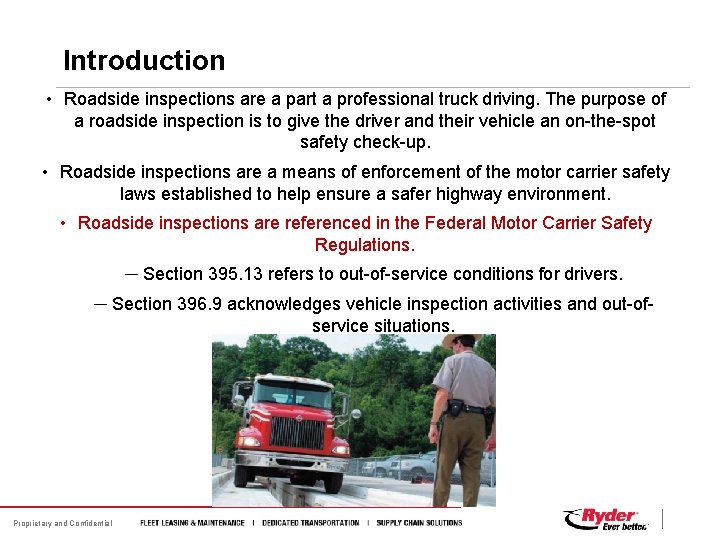
Introduction • Roadside inspections are a part a professional truck driving. The purpose of a roadside inspection is to give the driver and their vehicle an on-the-spot safety check-up. • Roadside inspections are a means of enforcement of the motor carrier safety laws established to help ensure a safer highway environment. • Roadside inspections are referenced in the Federal Motor Carrier Safety Regulations. ─ Section 395. 13 refers to out-of-service conditions for drivers. ─ Section 396. 9 acknowledges vehicle inspection activities and out-ofservice situations. Proprietary and Confidential
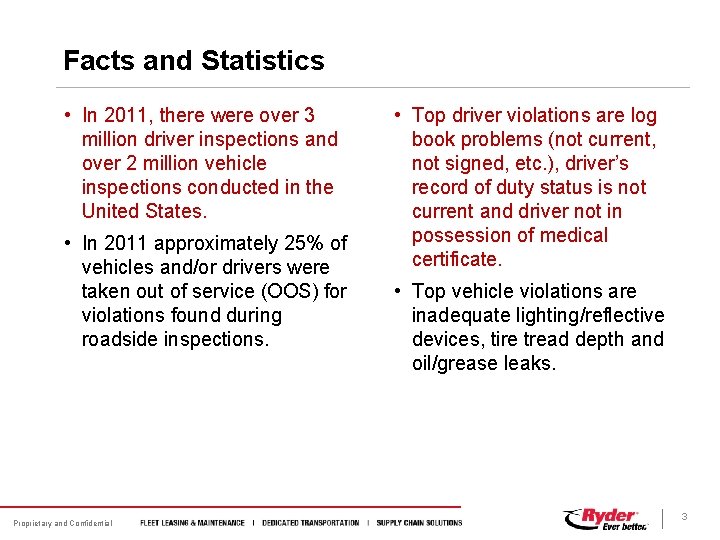
Facts and Statistics • In 2011, there were over 3 million driver inspections and over 2 million vehicle inspections conducted in the United States. • In 2011 approximately 25% of vehicles and/or drivers were taken out of service (OOS) for violations found during roadside inspections. Proprietary and Confidential • Top driver violations are log book problems (not current, not signed, etc. ), driver’s record of duty status is not current and driver not in possession of medical certificate. • Top vehicle violations are inadequate lighting/reflective devices, tire tread depth and oil/grease leaks. 3
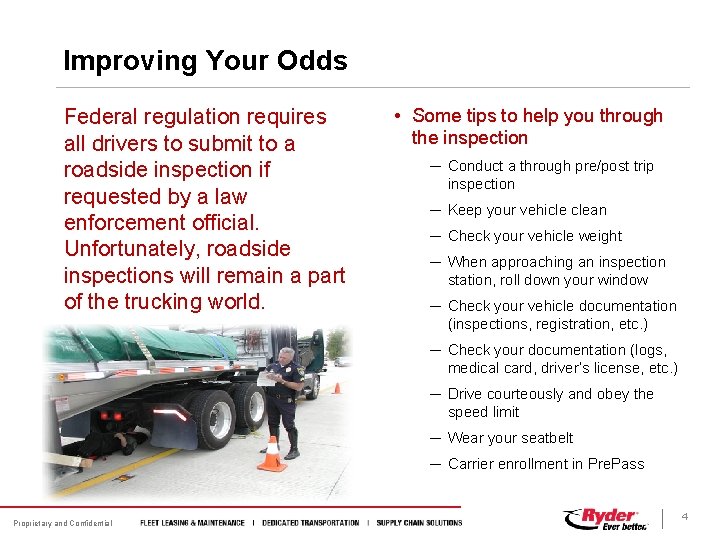
Improving Your Odds Federal regulation requires all drivers to submit to a roadside inspection if requested by a law enforcement official. Unfortunately, roadside inspections will remain a part of the trucking world. • Some tips to help you through the inspection ─ Conduct a through pre/post trip inspection ─ Keep your vehicle clean ─ Check your vehicle weight ─ When approaching an inspection station, roll down your window ─ Check your vehicle documentation (inspections, registration, etc. ) ─ Check your documentation (logs, medical card, driver’s license, etc. ) ─ Drive courteously and obey the speed limit ─ Wear your seatbelt ─ Carrier enrollment in Pre. Pass Proprietary and Confidential 4
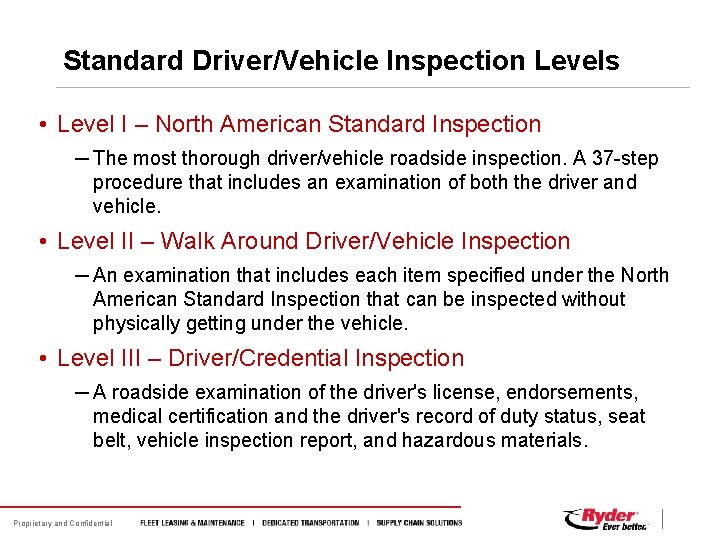
Standard Driver/Vehicle Inspection Levels • Level I – North American Standard Inspection ─ The most thorough driver/vehicle roadside inspection. A 37 -step procedure that includes an examination of both the driver and vehicle. • Level II – Walk Around Driver/Vehicle Inspection ─ An examination that includes each item specified under the North American Standard Inspection that can be inspected without physically getting under the vehicle. • Level III – Driver/Credential Inspection ─ A roadside examination of the driver's license, endorsements, medical certification and the driver's record of duty status, seat belt, vehicle inspection report, and hazardous materials. Proprietary and Confidential
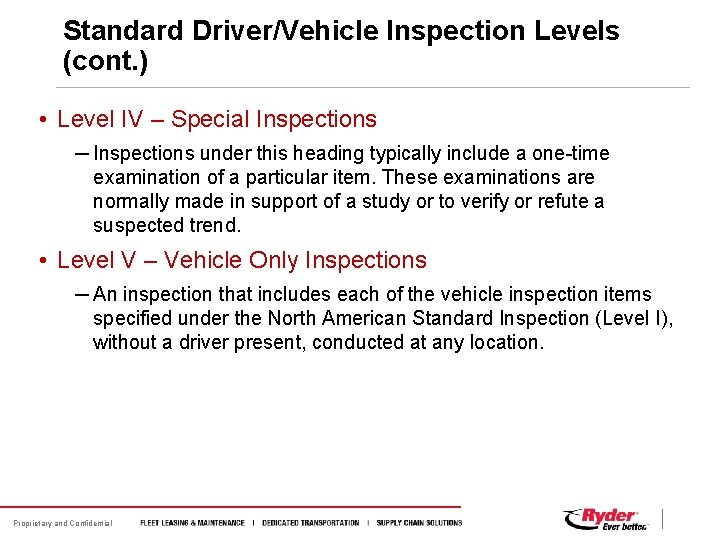
Standard Driver/Vehicle Inspection Levels (cont. ) • Level IV – Special Inspections ─ Inspections under this heading typically include a one-time examination of a particular item. These examinations are normally made in support of a study or to verify or refute a suspected trend. • Level V – Vehicle Only Inspections ─ An inspection that includes each of the vehicle inspection items specified under the North American Standard Inspection (Level I), without a driver present, conducted at any location. Proprietary and Confidential
Standard Driver/Vehicle Inspection Levels (cont. . ) • Level VI – Enhanced NAS Inspection for Radioactive Shipments − North American Standard Inspection for Transuranic Waste and Highway Route Controlled Quantities (HRCQ) of Radioactive Material – An inspection for select radiological shipments, which include inspection procedures, enhancements to the North American Standard Level I inspection, radiological requirements, and the North American Standard Out-of-Service Criteria for Transuranic Waste and Highway Route Controlled Quantities (HRCQ) of Radioactive Material. Proprietary and Confidential
Pre. Pass is a commercial motor vehicle pre-authorization process which can reduce the number of roadside inspections for a driver or all drivers of a particular carrier. To participate, a carrier must apply for the service, providing carrier credentials, permit and insurance information, load information and safety status. If the information is acceptable, transponders are issued for each vehicle in the carrier’s fleet and drivers are allowed to bypass scales if they receive the proper signal from the transponder. Carriers/ drivers must have a good safety record to be accepted into the Prepass program Proprietary and Confidential
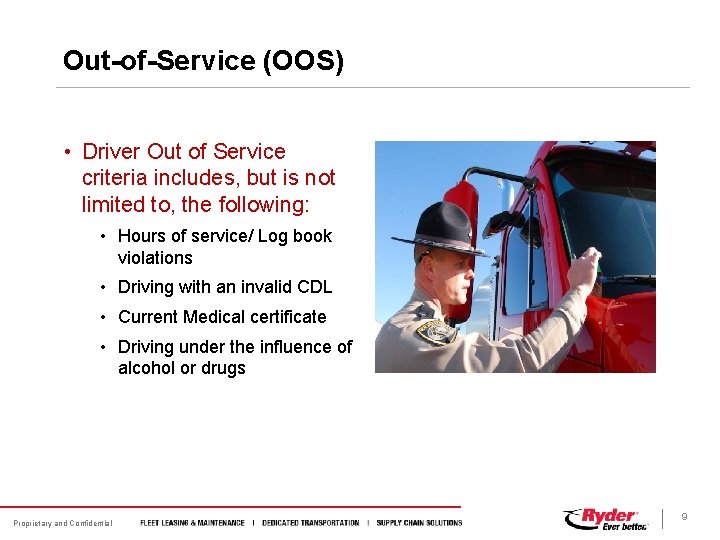
Out-of-Service (OOS) • Driver Out of Service criteria includes, but is not limited to, the following: • Hours of service/ Log book violations • Driving with an invalid CDL • Current Medical certificate • Driving under the influence of alcohol or drugs Proprietary and Confidential 9
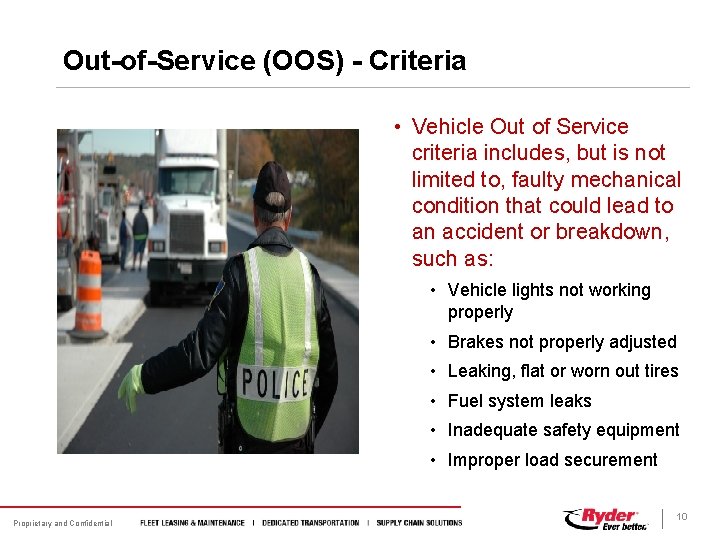
Out-of-Service (OOS) - Criteria • Vehicle Out of Service criteria includes, but is not limited to, faulty mechanical condition that could lead to an accident or breakdown, such as: • Vehicle lights not working properly • Brakes not properly adjusted • Leaking, flat or worn out tires • Fuel system leaks • Inadequate safety equipment • Improper load securement Proprietary and Confidential 10
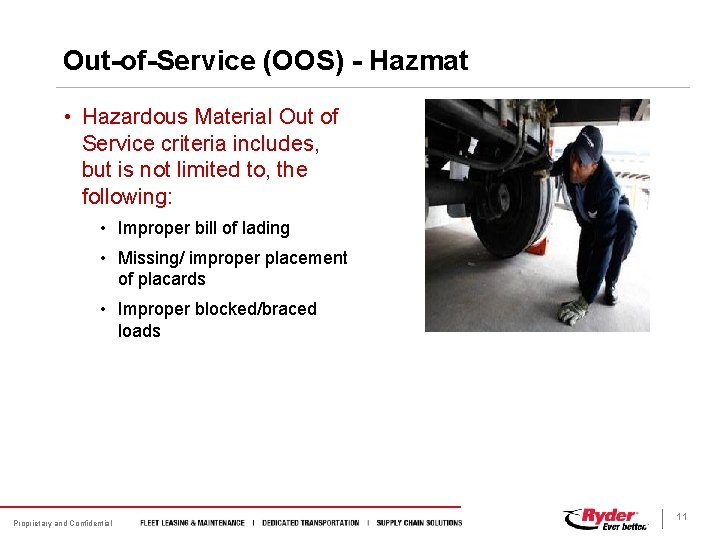
Out-of-Service (OOS) - Hazmat • Hazardous Material Out of Service criteria includes, but is not limited to, the following: • Improper bill of lading • Missing/ improper placement of placards • Improper blocked/braced loads Proprietary and Confidential 11
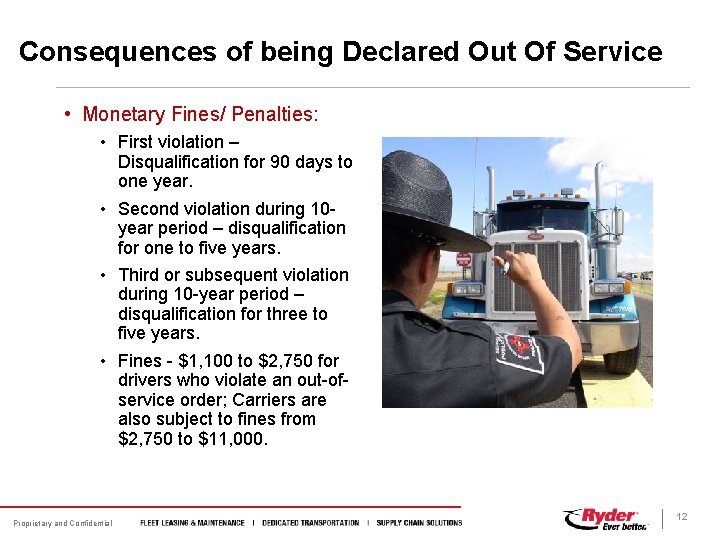
Consequences of being Declared Out Of Service • Monetary Fines/ Penalties: • First violation – Disqualification for 90 days to one year. • Second violation during 10 year period – disqualification for one to five years. • Third or subsequent violation during 10 -year period – disqualification for three to five years. • Fines - $1, 100 to $2, 750 for drivers who violate an out-ofservice order; Carriers are also subject to fines from $2, 750 to $11, 000. Proprietary and Confidential 12
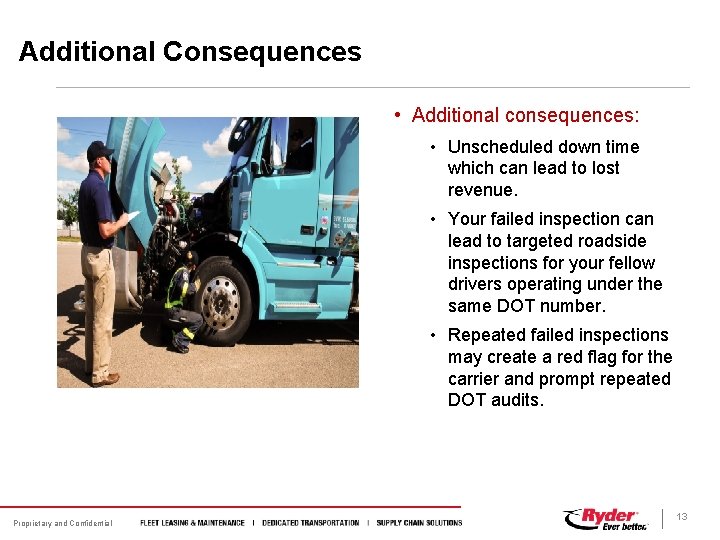
Additional Consequences • Additional consequences: • Unscheduled down time which can lead to lost revenue. • Your failed inspection can lead to targeted roadside inspections for your fellow drivers operating under the same DOT number. • Repeated failed inspections may create a red flag for the carrier and prompt repeated DOT audits. Proprietary and Confidential 13
Comprehensive Safety Analysis (CSA) and Roadside Inspections The following violations have a severe impact on driver data and carrier results: • Jumping an out-of-service order • Operating a vehicle while ill, fatigued, or under the influence • Violating hours-of-service limits • Log falsifications • Driving a CMV while disqualified • Required vehicle light not operating • Defective tires • Suspension defects • Steering system defects • No flags and/or lights on a projecting load • Cargo not secured Proprietary and Confidential 14
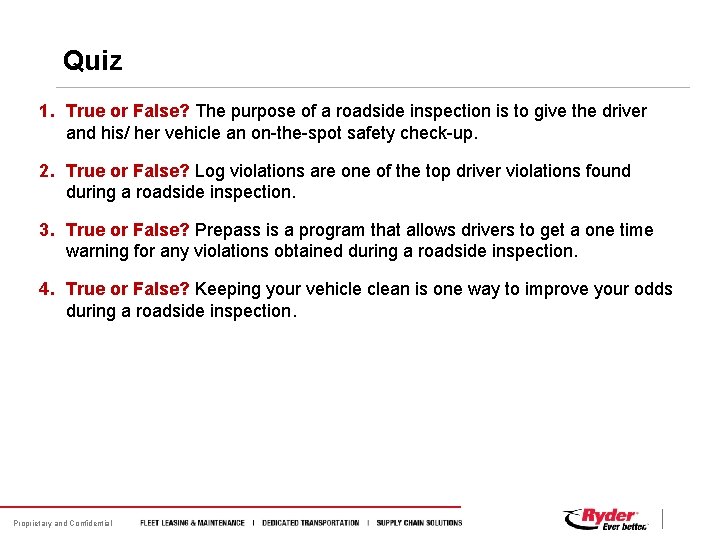
Quiz 1. True or False? The purpose of a roadside inspection is to give the driver and his/ her vehicle an on-the-spot safety check-up. 2. True or False? Log violations are one of the top driver violations found during a roadside inspection. 3. True or False? Prepass is a program that allows drivers to get a one time warning for any violations obtained during a roadside inspection. 4. True or False? Keeping your vehicle clean is one way to improve your odds during a roadside inspection. Proprietary and Confidential
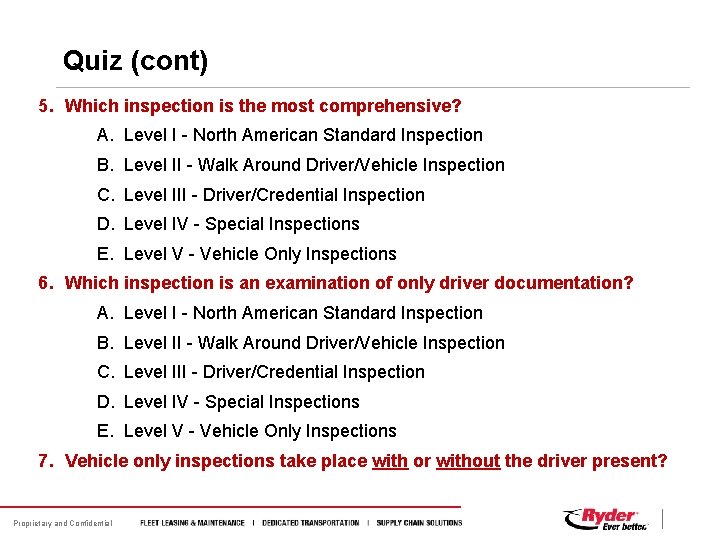
Quiz (cont) 5. Which inspection is the most comprehensive? A. Level I - North American Standard Inspection B. Level II - Walk Around Driver/Vehicle Inspection C. Level III - Driver/Credential Inspection D. Level IV - Special Inspections E. Level V - Vehicle Only Inspections 6. Which inspection is an examination of only driver documentation? A. Level I - North American Standard Inspection B. Level II - Walk Around Driver/Vehicle Inspection C. Level III - Driver/Credential Inspection D. Level IV - Special Inspections E. Level V - Vehicle Only Inspections 7. Vehicle only inspections take place with or without the driver present? Proprietary and Confidential
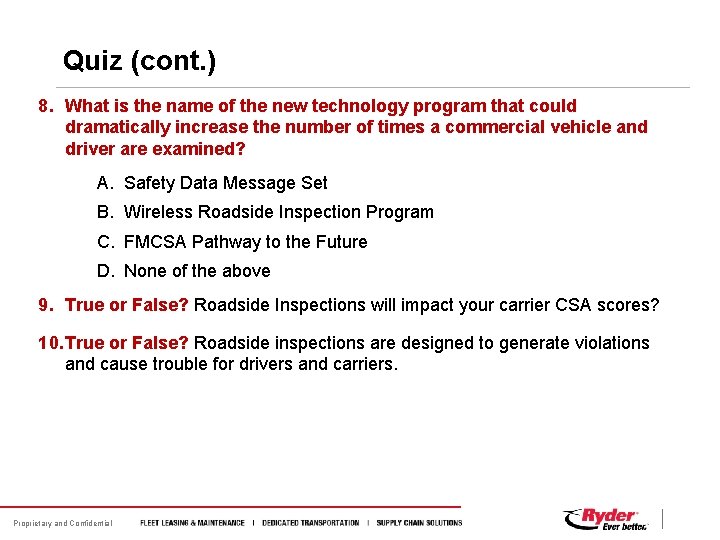
Quiz (cont. ) 8. What is the name of the new technology program that could dramatically increase the number of times a commercial vehicle and driver are examined? A. Safety Data Message Set B. Wireless Roadside Inspection Program C. FMCSA Pathway to the Future D. None of the above 9. True or False? Roadside Inspections will impact your carrier CSA scores? 10. True or False? Roadside inspections are designed to generate violations and cause trouble for drivers and carriers. Proprietary and Confidential
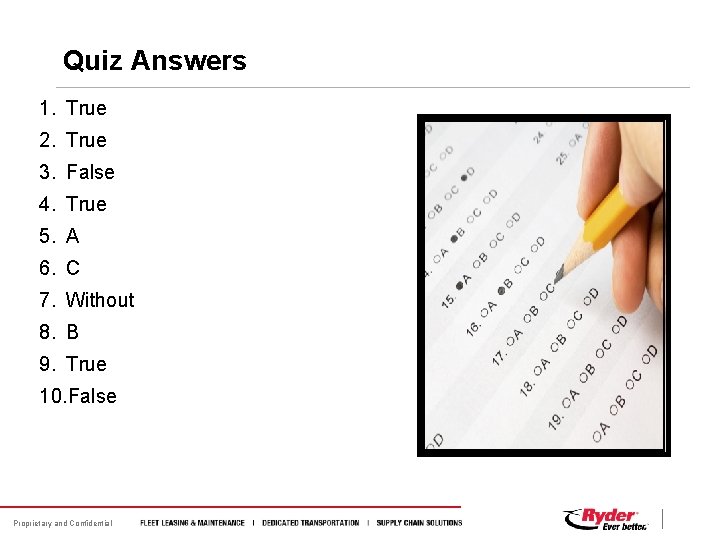
Quiz Answers 1. True 2. True 3. False 4. True 5. A 6. C 7. Without 8. B 9. True 10. False Proprietary and Confidential
Question or Comments? Proprietary and Confidential
Additional Information - Ryder Safety Services Rydersafetyservices. com offers solutions to help you operate safely and remain in compliance, whether you run vehicles, manage warehouses, hire drivers, or maintain your own fleet. § § Fleet safety equipment Compliance support services − − − § Driver Qualification Files Drug and Alcohol Testing Log Auditing Safety Training Materials at a discounted price − − JJ Keller Pro. Tread – On-line Driver Training And Much More! Proprietary and Confidential
Additional Information on Rules and Regulations This document is intended to be a guide on applicable rules and regulations. Although it may be used as a guide/reference for your training needs, this document is not intended to be used as the standard for FMCSA rules and regulations. Additional information can be found on the FMCSA website. The FMCSA website will contain the most accurate and upto-date information on any and all applicable rules and regulations. http: //www. fmcsa. dot. gov Proprietary and Confidential