Richmond Fellowship Queensland Hot off the Press RFQ
- Slides: 18
Richmond Fellowship Queensland Hot off the Press! RFQ Hospital to Home (H 2 H) Program Evaluation Report Kingsley Bedwell Chief Executive, Richmond Fellowship Queensland (RFQ) Sarah Childs Executive Manager Clinical and Services, Richmond Fellowship Queensland (RFQ) Richmond Fellowship Queensland
Hospital to Home (H 2 H) Pilot Evaluation Findings August 2018 Richmond Fellowship Queensland (RFQ) and Metro North Mental Health – The Prince Charles Hospital (TPCH) This independent evaluation was conducted by Associate Professor Yvette Miller and funded by Richmond Fellowship Queensland (RFQ). Richmond Fellowship Queensland
• • • RFQ thanks Associate Professor Brett Emmerson AM, Executive Director Metro North Mental Health for his role in developing and approving the Pilot. RFQ thanks the management and clinical team at Metro North Mental Health – The Prince Charles Hospital for their partnership in delivering the Pilot. RFQ thanks Queensland Health for funding the delivery of the Pilot through Community Managed Mental Health funding. RFQ thanks the Director General Queensland Health for approval to source the Hospital and Health Service data. RFQ thanks the Mental Health Alcohol and Other Drugs Branch, Queensland Health for creating the Hospital and Health Service data reports. Richmond Fellowship Queensland
Rationale • Targeting acute care patients occupying a bed without clinical reason and at high risk of early readmission • Ensuring the clinical and support needs of this group are met in the first six weeks following discharge • Keeping people healthy in the community Richmond Fellowship Queensland
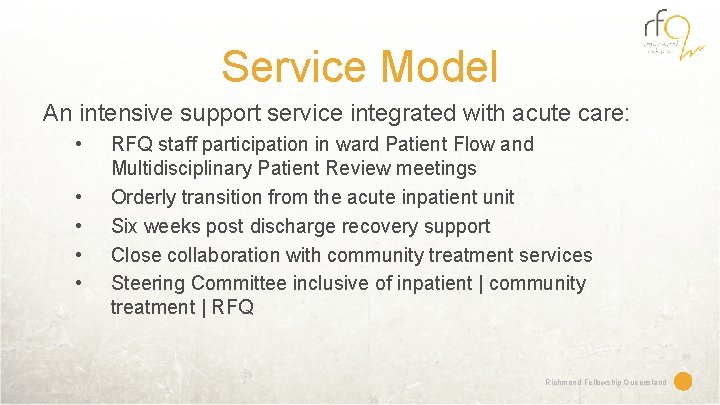
Service Model An intensive support service integrated with acute care: • • • RFQ staff participation in ward Patient Flow and Multidisciplinary Patient Review meetings Orderly transition from the acute inpatient unit Six weeks post discharge recovery support Close collaboration with community treatment services Steering Committee inclusive of inpatient | community treatment | RFQ Richmond Fellowship Queensland
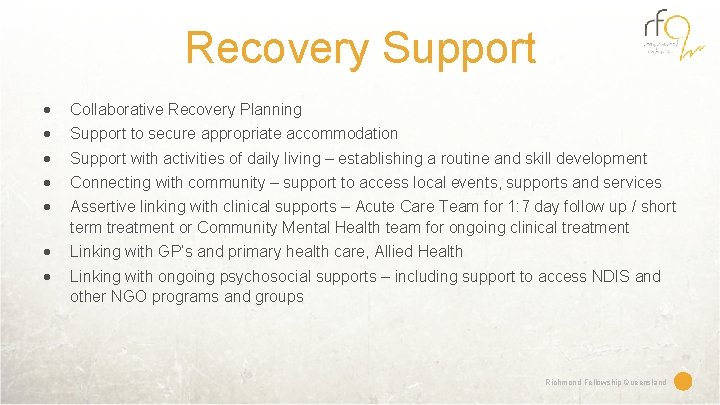
Recovery Support Collaborative Recovery Planning Linking with GP’s and primary health care, Allied Health Support to secure appropriate accommodation Support with activities of daily living – establishing a routine and skill development Connecting with community – support to access local events, supports and services Assertive linking with clinical supports – Acute Care Team for 1: 7 day follow up / short term treatment or Community Mental Health team for ongoing clinical treatment Linking with ongoing psychosocial supports – including support to access NDIS and other NGO programs and groups Richmond Fellowship Queensland
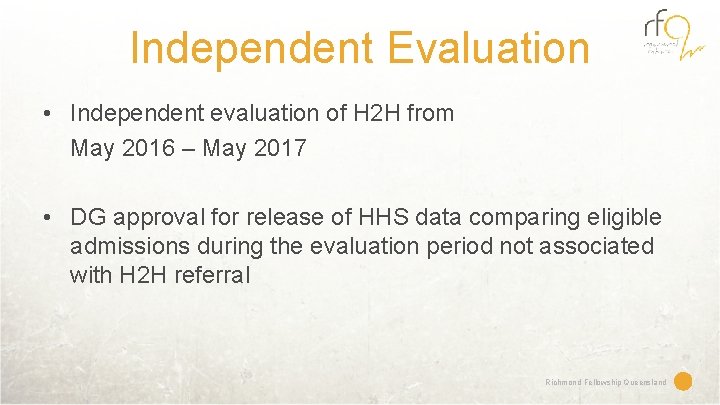
Independent Evaluation • Independent evaluation of H 2 H from May 2016 – May 2017 • DG approval for release of HHS data comparing eligible admissions during the evaluation period not associated with H 2 H referral Richmond Fellowship Queensland
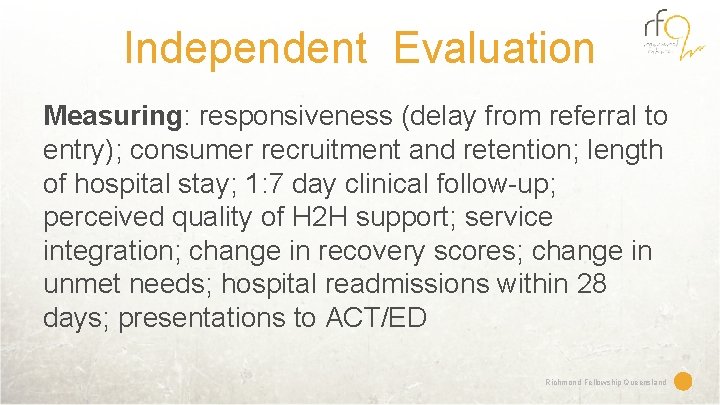
Independent Evaluation Measuring: responsiveness (delay from referral to entry); consumer recruitment and retention; length of hospital stay; 1: 7 day clinical follow-up; perceived quality of H 2 H support; service integration; change in recovery scores; change in unmet needs; hospital readmissions within 28 days; presentations to ACT/ED Richmond Fellowship Queensland
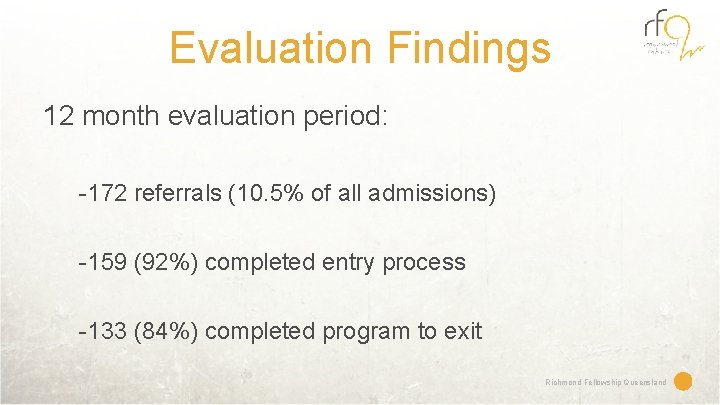
Evaluation Findings 12 month evaluation period: -172 referrals (10. 5% of all admissions) -159 (92%) completed entry process -133 (84%) completed program to exit Richmond Fellowship Queensland
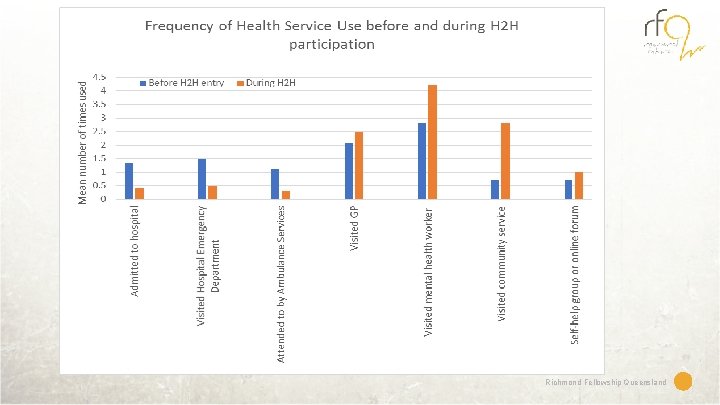
Evaluation Findings Patients referred to H 2 H: • had a significantly longer mean length of stay, indicating referrals that were appropriate to the program goals and target group. • were significantly more likely to experience 7 -day post-discharge follow up clinical contact. • experienced significant reductions in frequency of acute service use and significantly less likelihood of hospital re-admission within 28 days. Richmond Fellowship Queensland
• experienced improved service integration and significant increases in frequency of visiting mental health workers and community services. • were more likely to feel they had moved forward in their recovery during H 2 H (at exit from H 2 H, only 11. 7% felt they had stayed the same or gone backwards in their recovery compared to 55% who felt their recovery had stayed the same or gone backwards in the period prior to H 2 H). Richmond Fellowship Queensland
• reported a 90. 8% reduction in number of unmet needs from entry to exit. • felt that the program helped them to feel confident to stay out of hospital ‘all of the time’ or ‘a lot’ (93. 2%). • were very likely (98. 5%) to report they would recommend H 2 H to a friend as a result of their experience of the program. Richmond Fellowship Queensland
Richmond Fellowship Queensland
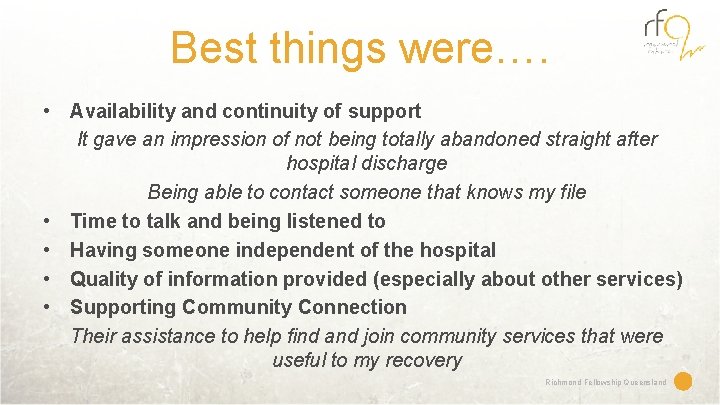
Best things were…. • Availability and continuity of support It gave an impression of not being totally abandoned straight after hospital discharge Being able to contact someone that knows my file • Time to talk and being listened to • Having someone independent of the hospital • Quality of information provided (especially about other services) • Supporting Community Connection Their assistance to help find and join community services that were useful to my recovery Richmond Fellowship Queensland
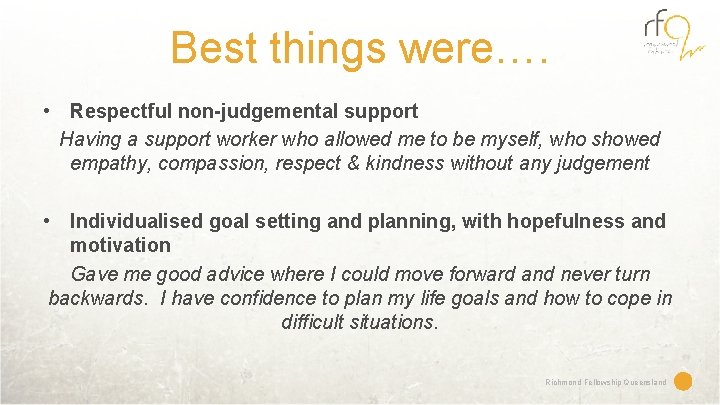
Best things were…. • Respectful non-judgemental support Having a support worker who allowed me to be myself, who showed empathy, compassion, respect & kindness without any judgement • Individualised goal setting and planning, with hopefulness and motivation Gave me good advice where I could move forward and never turn backwards. I have confidence to plan my life goals and how to cope in difficult situations. Richmond Fellowship Queensland
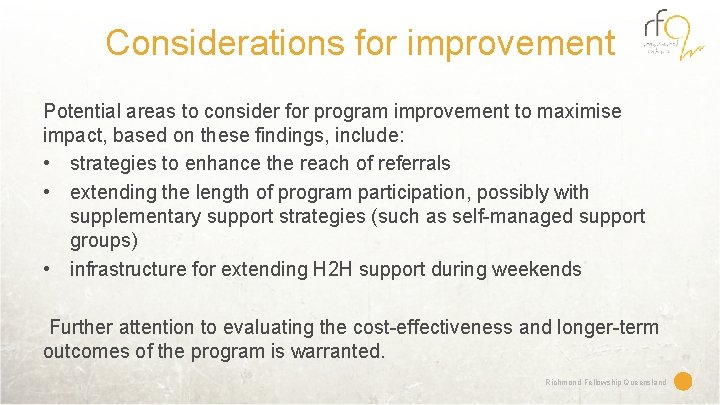
Considerations for improvement Potential areas to consider for program improvement to maximise impact, based on these findings, include: • strategies to enhance the reach of referrals • extending the length of program participation, possibly with supplementary support strategies (such as self-managed support groups) • infrastructure for extending H 2 H support during weekends Further attention to evaluating the cost-effectiveness and longer-term outcomes of the program is warranted. Richmond Fellowship Queensland
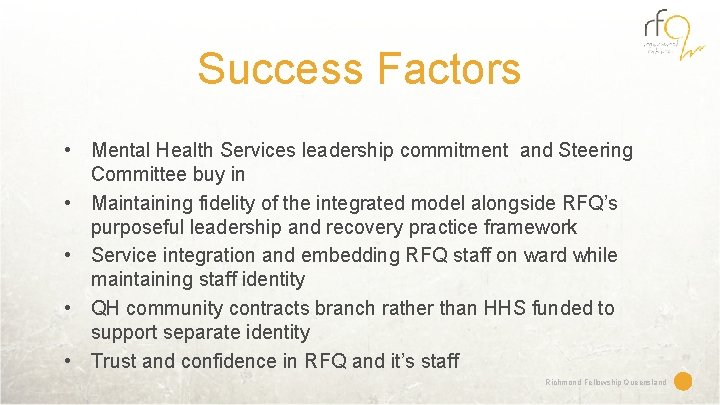
Success Factors • Mental Health Services leadership commitment and Steering Committee buy in • Maintaining fidelity of the integrated model alongside RFQ’s purposeful leadership and recovery practice framework • Service integration and embedding RFQ staff on ward while maintaining staff identity • QH community contracts branch rather than HHS funded to support separate identity • Trust and confidence in RFQ and it’s staff Richmond Fellowship Queensland
Questions? For further information contact: Kingsley Bedwell or Sarah Childs Richmond Fellowship Queensland PO Box 655 Annerley QLD 4103 hq@rfq. com. au Richmond Fellowship Queensland