Regional Clusters Ana Teresa Tavares Lehmann University of



- Slides: 26
Regional Clusters Ana Teresa Tavares Lehmann University of Porto – FEP, CEF. UP, EGP-UPBS
Clusters: Working Definition “Geographic concentrations of interconnected companies, specialized suppliers, service providers, firms in related industries, and associated institutions (e. g. , universities, standards agencies, trade associations) in a particular field that compete but also cooperate” (Michael Porter, 2000)
Clusters – not a new concept • Marshall 1890, 1920 • Industrial districts; Spatial dimension • Agglomeration economies; Externalities • “something in the air” • “When an industry has thus chosen a locality for itself, it is likely to stay there long: so great are the advantages which people following the same skilled trade get from near neighbourhood to one another. The mysteries of the trade become no mysteries; but are as it were in the air. . . ” (A. Marshall, Principles of Economics, 1890)
Clusters – not a new concept • 3 key aspects: – Knowledge spillovers – Input-output relationships – Labour market pooling • Collective efficiency and increasing returns • Benefits of a shared vision, co-location and co-evolution • Specialisation – increasing Productivity - Competitiveness • Clusters as a convenient and pragmatic organising principle through which to focus resources and build partnerships • Building strong regional economies takes decades
Regional Clustering • From Fordism to post-Fordism: – From hierarchical firms to networks • Alliance capitalism (Dunning, 1997) • The Associational Economy (Cooke and Morgan, 1998) • Porter: Clustering for Competitiveness – Productivity; greater ability to innovate; lower barriers to entry; public policy has a significant role to play (cluster upgrading, helping infant clusters) • Industrial districts: agglomeration economies – Marshall, Becattini, Krugman – Cumulative causation leading to path dependencies • Learning regions, innovative milieux and innovation systems – Clustering: a tool to improve a region’s knowledge base and innovativeness – Learning: key factor of regional competitiveness (Maillat, Morgan, Florida etc)
Relevant Dimensions of a Cluster • Geographic scope: on which geographic scale does the cluster operate? • Vertical scope (depth – deep/shallow): what supplier-customer chains can be identified in a cluster? • Horizontal scope (breadth – broad/narrow): are there competitors cooperating in the cluster? • Also: – – – – – Activity base (activity-rich or activity-poor) Growth potential (embryonic & growing to mature & declining) Innovative capacity (high or low) Competitive position (in national and international markets) Governance structure (how transactions are managed) Ownership structure (domestic vs foreign, mixed) Cluster ‘type’ (working, latent, potential, policy-driven, ‘wishful thinking’) Specialized organizations Government policy towards clustering
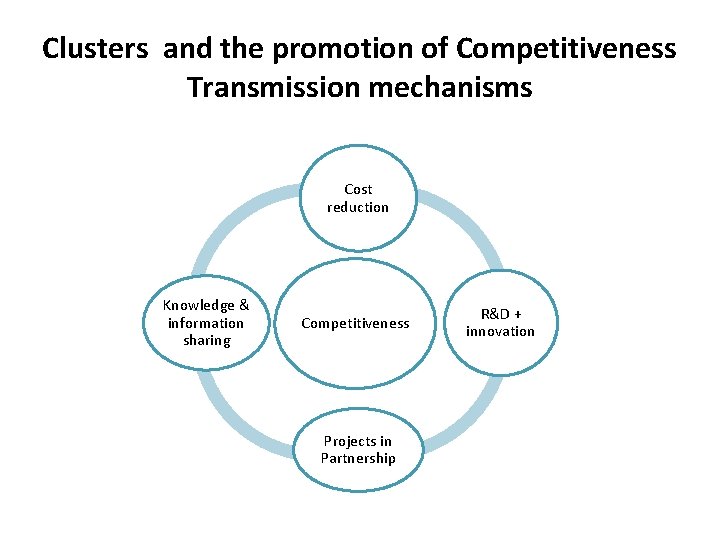
Clusters and the promotion of Competitiveness Transmission mechanisms Cost reduction Knowledge & information sharing Competitiveness Projects in Partnership R&D + innovation
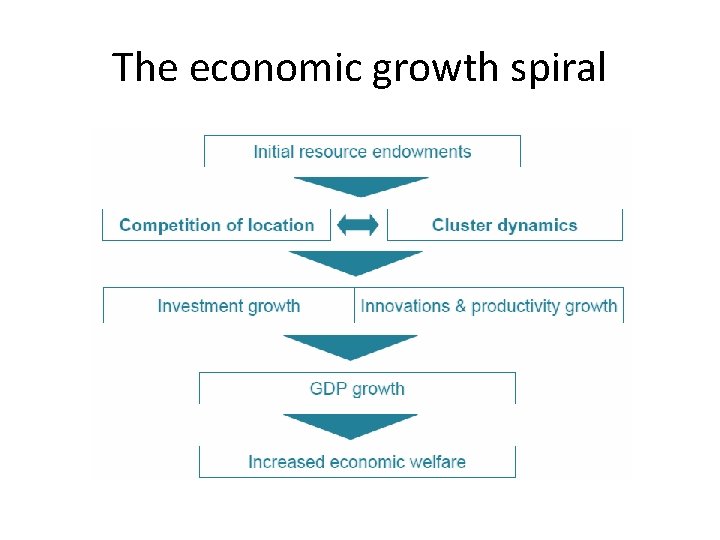
The economic growth spiral
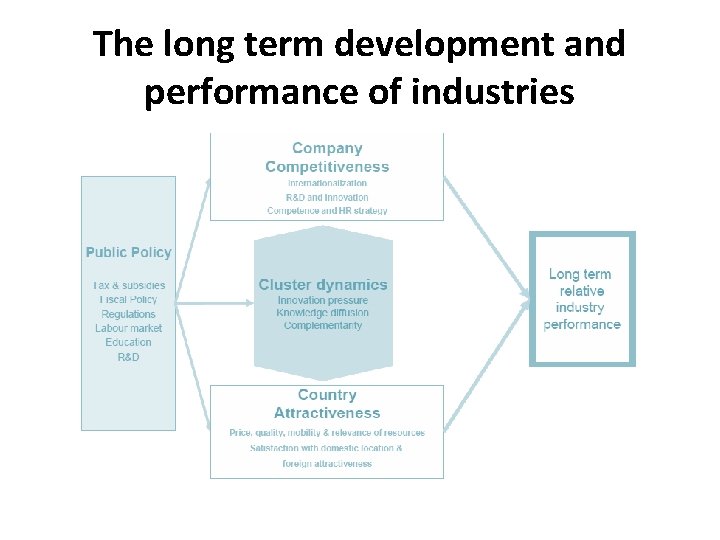
The long term development and performance of industries
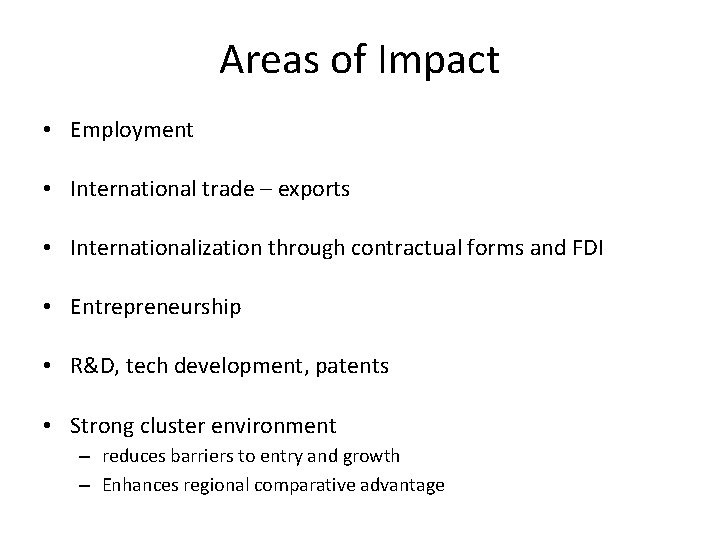
Areas of Impact • Employment • International trade – exports • Internationalization through contractual forms and FDI • Entrepreneurship • R&D, tech development, patents • Strong cluster environment – reduces barriers to entry and growth – Enhances regional comparative advantage
Clusters & Smart Specialization • Smart specialization strategies are place-based strategies • Clusters are an important element in smart specialization strategies (Commission Communication: Regional Policy contributing to smart growth, 2010) • Value for money, i. e. smart R&D investment in the context of scarce public resources; prioritizing very clearly • Outward orientation • Users and customers: a new source of inspiration, involved directly in co-creating value • An essence of smart specialization is to explore new cross-sectoral linkages that become growth drivers
Internationalization of Clusters • Internationalization of the members of the cluster • Internationalization of the cluster as a whole • Different types of internationalization – Exports; Contractual Modes; Foreign Direct Investment (Subsidiaries) • Networks; Resource/knowledge-based view; transaction costs • The cluster as a facilitator, an enabler – for initiatives that individual members cannot afford or develop alone • Collaborative networks: ‘punching above our weight’ – Can overcome liability of smallness (of firms/organizations & countries)
Internationalization of Clusters • Clusters help – Overcoming scarcity of resources and competences: accessing them – Particularly important in clusters dominated by SMEs; linkages – Cost/risk reductions (internationalization is no piece of cake!) & increase in potential gains; scale & specialization leading to increases in profitability and other performance indicators – Efficiency gains, knowledge accumulation, visibility, brand/image: $$$ – Value added & created: help integrated solutions, synergies • What can/should the cluster do? • What is the role of public policy? – Enabler, simplifier, … or else?
Regional Cluster Policy • Clusters may (or may not) arise spontaneously – Can regional clusters be engineered? – Starting clusters ex nihilo is very difficult; cathedrals in the desert. . . – Example of a mainly market-induced cluster: Watchmaking cluster in the Swiss Jura (Maillat, 1995); the role of tradition in production • Nowadays, an increasing number of OECD and emerging countries’ governments actively pursue cluster-based policy as a means to foster regional development – All government efforts to develop & support clusters in a specific region – From studies to setting up platforms, to establishing brokering and networking schemes to providing subsidies for cooperation
Regional Cluster Policy • Levels of policy – multiple, juxtaposed – Policies at national and regional, even city, level – Supranational programmes, e. g. Regional Innovation Strategies (RIS) programme of the European Commission, OECD’s Focus Group on Clusters, etc • An heterodox economic policy mix framework – In which relevant dimensions of economic policy at large are reformulated in terms of regional policy (Storper & Scott, 1995) – 3 main policy areas: regional, S&T, industrial/enterprise policy – Hence, cluster policy can hardly be isolated from other policy areas – Difficult to assess how many resources have been committed to cluster policy – there’s no cluster policy per se? • Benchmarking efforts – identifying and matching ‘best practices’ – Learning by comparing – Yet, successful examples cannot be transferred mechanically – ‘best practices’ more a source of inspiration than recipes for successful regional development
Regional Cluster Policy • Targets: places, sectors, value chains, specific actors • Identification of clusters: – Top-down – Bottom-up – A combination of the two • Competitive or non-competitive
Regional Cluster Policy • Co-operative, multi-actor and place-based – Harnessing proximity • Promoting interclusters’ linkages: cross-fertilization – Cluster overlap – Networking platforms • Opportunities for ‘high tech’ regional clusters can be found in paraphrasing Schumpeter’s (1934) term for innovations – ‘new combinations’ of existing clusters – New clusters are often spin-offs of existing ones – Regional specializations transformed – structural change – Instruments to maintain employment and promote restructuring and adaptation in other sectors • Cluster upgrading; cluster growth and cluster decline
Regional Cluster Policy: Risks • Related to the use of a cluster approach generally • More specific risks related to the design of such programmes • Picking winners • Insufficient economic diversification • Lock-in • Over-reliance on key firms • Just throwing money to selected actors • Lack of private sector involvement
Regional Cluster Policy • The problem of evaluation – Lack of robust tools to measure whether or not such policies are successful • Some sort of monitoring component for ongoing funding decisions • . . . Policy inconsistency and short-termism. . . • Policy coherence within and across levels of government • Any policy (strategy) is as good as its implementation
Cluster Policy in Portugal
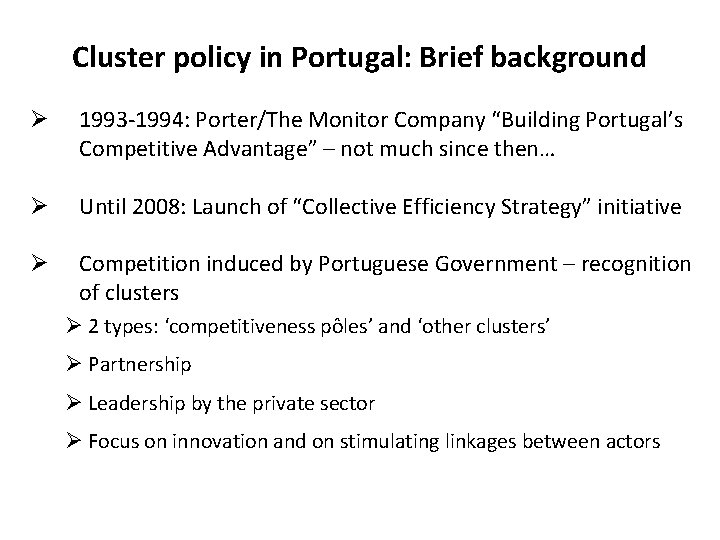
Cluster policy in Portugal: Brief background Ø 1993 -1994: Porter/The Monitor Company “Building Portugal’s Competitive Advantage” – not much since then… Ø Until 2008: Launch of “Collective Efficiency Strategy” initiative Ø Competition induced by Portuguese Government – recognition of clusters Ø 2 types: ‘competitiveness pôles’ and ‘other clusters’ Ø Partnership Ø Leadership by the private sector Ø Focus on innovation and on stimulating linkages between actors
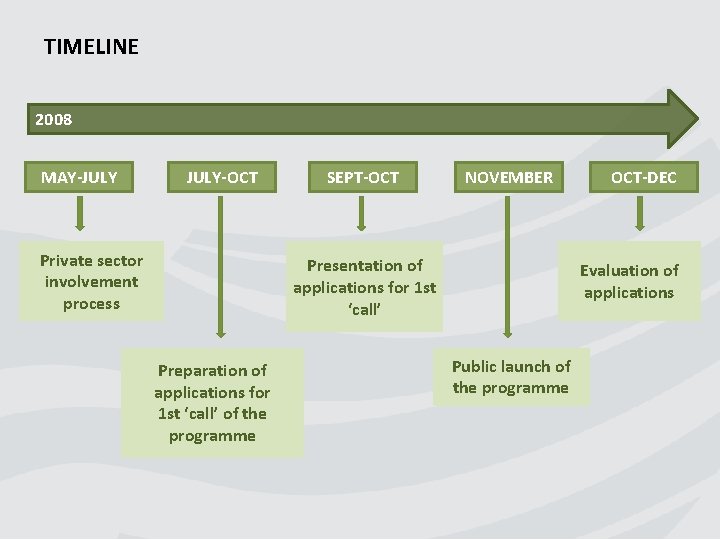
TIMELINE 2008 MAY-JULY-OCT Private sector involvement process SEPT-OCT NOVEMBER Presentation of applications for 1 st ‘call’ Preparation of applications for 1 st ‘call’ of the programme OCT-DEC Evaluation of applications Public launch of the programme
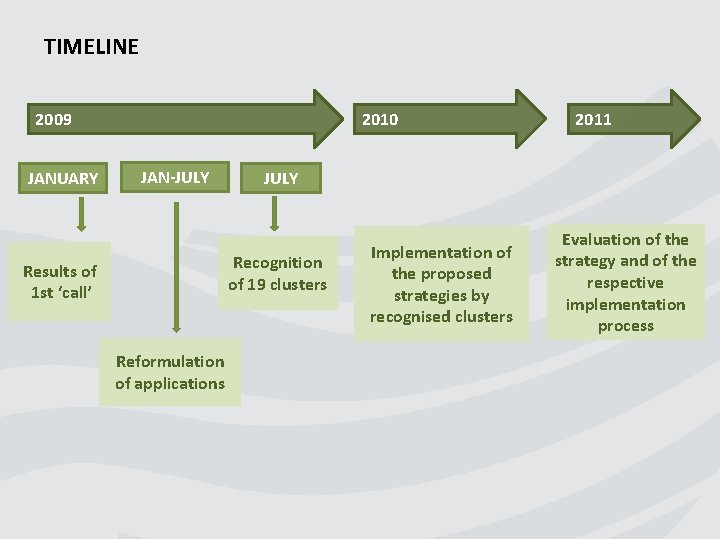
TIMELINE 2009 JANUARY 2010 JAN-JULY Recognition of 19 clusters Results of 1 st ‘call’ Reformulation of applications 2011 Implementation of the proposed strategies by recognised clusters Evaluation of the strategy and of the respective implementation process
CLUSTERS – NORTE REGION FASHION HEALTH AGROINDUSTRIES PRODUCTION TECHNOLOGIES TOURISM FOREST-BASED PRODUCTS ICT CLUSTERS AUTOMOTIVE AND MOBILITY ENERGY HABITAT DOURO WINE CREATIVE INDUSTRIES Headquarters in the Norte Region Headquarters outside the Norte Region FURNITURE MARINE
Some general comments • …in spite of certain limitations… • Forged effective partnerships between different actors • Created strong networks, in the majority of cases – With the best and most representative players • Helped focusing on innovation & internationalisation • Increased dynamic – Number of participants & tighter links between them – Projects implemented – continuous successful bidding • International visibility & credibility
Thank you for your attention (and for clustering here today) Ana Teresa T. Lehmann