
Determine conservation objects biodiversity objects Christina Lehmann 2014
Determine conservation objects: biodiversity objects © Christina Lehmann 2014 Phase I Preparation and Initial Conceptualisation Step 2
Credits and conditions of use © Centre for Econics and Ecosystem Management, 2014 The Centre for Econics and Ecosystem Management strongly recommends that this presentation is given by experts familiar with the adaptive management process in general (especially as designed as the Conservation Measures Partnership’s Open Standards for the Practice of Conservation) as well as the MARISCO Method itself. You are free to share this presentation and adapt it for your use under the following conditions: • You must attribute the work in the manner specified by the authors (but not in any way that suggests that they endorse you or your use of the work). • You may not use this work for commercial purposes. • If you alter, transform, or build upon this work, you must remove the Centre for Econics and Ecosystem Management logo, and you may distribute the resulting work only under the same or similar conditions to this one. This material was created under the leadership and responsibility of Prof. Dr. Pierre Ibisch and Dr. Peter Hobson, codirectors of the Centre for Econics and Ecosystem Management, which was jointly established by Eberswalde University for Sustainable Development and Writtle College. Compare: Ibisch, P. L. & P. R. Hobson (eds. ) (2014): The MARISCO method: Adaptive MAnagement of vulnerability and RISk at COnservation sites. A guidebook for risk-robust, adaptive, and ecosystem-based conservation of biodiversity. Centre for Econics and Ecosystem Management, Eberswalde (ISBN 978 -3 -00 -043244 -6). 195 pp. - The Powerpoint Presentation was conceived by Christina Lehmann and Pierre Ibisch. Authors of graphs and photographs are indicated on the corresponding slides. Supported by the Deutsche Gesellschaft für Internationale Zusammenarbeit (GIZ) Gmb. H on behalf of the Bundesministerium für wirtschaftliche Zusammenarbeit und Entwicklung (BMZ). 2 2. Determine conservation objects - biodiversity objects
3 2. Determine conservation objects - biodiversity objects
Learning objectives Participants understand the crucial strategic contribution of this step shaping the further planning process as all further analysis and strategies developed in the ongoing process will aim at the conservation of these biodiversity conservation targets; and further identified human wellbeing targets are depending on it. Participants have the skills to guide a team through the process of identifying important systems of the conservation site that represent compositional elements of an ecosystem, but also the processes, structures and dynamics that govern them. ´Participants dispose of the skills to facilitate the visualization of the relations and nested-ness of the selected biodiversity conservation objects. 4 2. Determine conservation objects - biodiversity objects
Outline What does determining biodiversity objects mean? ? Why do we determine biodiversity objects? How do we determine biodiversity objects? Practical Tips 5 2. Determine conservation objects - biodiversity objects
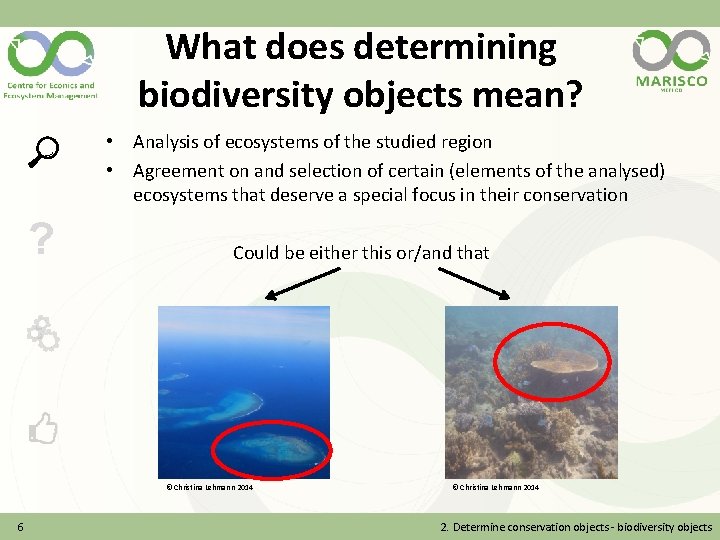
What does determining biodiversity objects mean? • Analysis of ecosystems of the studied region • Agreement on and selection of certain (elements of the analysed) ecosystems that deserve a special focus in their conservation ? Could be either this or/and that © Christina Lehmann 2014 6 © Christina Lehmann 2014 2. Determine conservation objects - biodiversity objects
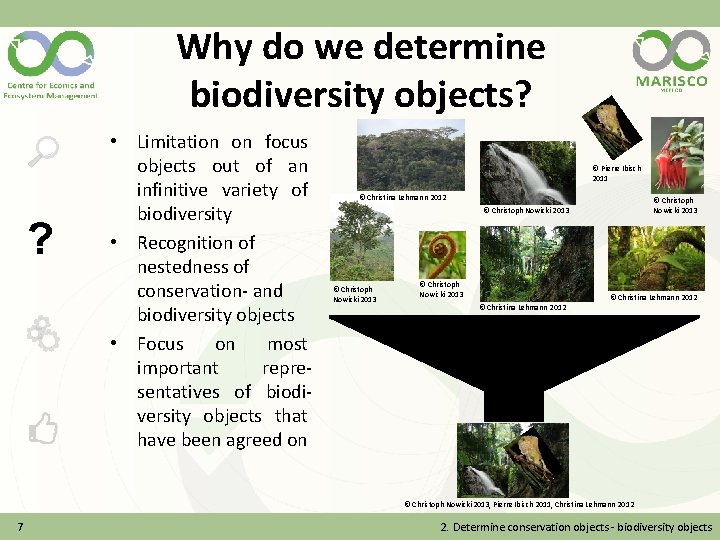
Why do we determine biodiversity objects? ? • Limitation on focus objects out of an infinitive variety of biodiversity • Recognition of nestedness of conservation- and biodiversity objects • Focus on most important representatives of biodiversity objects that have been agreed on © Pierre Ibisch 2011 © Christina Lehmann 2012 © Christoph Nowicki 2013 © Christina Lehmann 2012 © Christoph Nowicki 2013, Pierre Ibisch 2011, Christina Lehmann 2012 7 2. Determine conservation objects - biodiversity objects
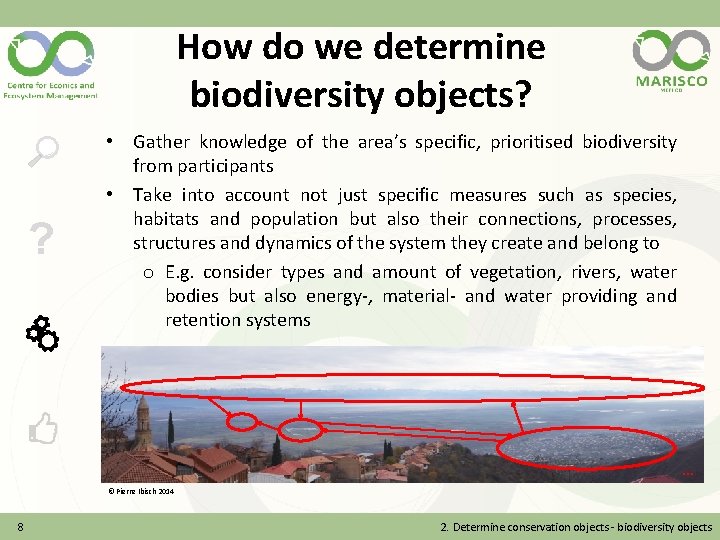
How do we determine biodiversity objects? ? • Gather knowledge of the area’s specific, prioritised biodiversity from participants • Take into account not just specific measures such as species, habitats and population but also their connections, processes, structures and dynamics of the system they create and belong to o E. g. consider types and amount of vegetation, rivers, water bodies but also energy-, material- and water providing and retention systems … © Pierre Ibisch 2014 8 2. Determine conservation objects - biodiversity objects
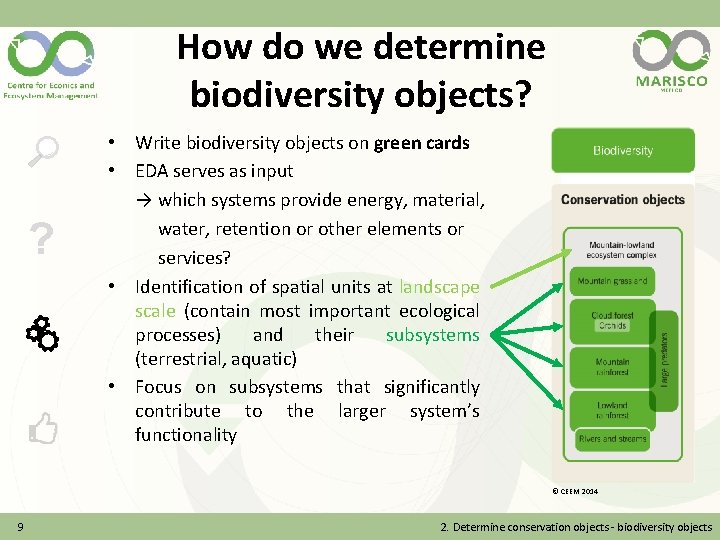
How do we determine biodiversity objects? ? • Write biodiversity objects on green cards • EDA serves as input → which systems provide energy, material, water, retention or other elements or services? • Identification of spatial units at landscape scale (contain most important ecological processes) and their subsystems (terrestrial, aquatic) • Focus on subsystems that significantly contribute to the larger system’s functionality © CEEM 2014 9 2. Determine conservation objects - biodiversity objects
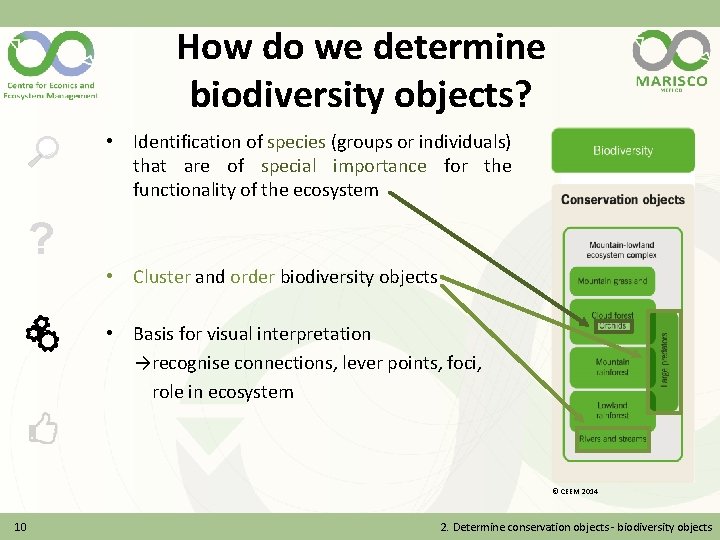
How do we determine biodiversity objects? • Identification of species (groups or individuals) that are of special importance for the functionality of the ecosystem ? • Cluster and order biodiversity objects • Basis for visual interpretation →recognise connections, lever points, foci, role in ecosystem © CEEM 2014 10 2. Determine conservation objects - biodiversity objects
Practical Tips ? 11 • Some participants may have a certain connection to certain elements of their ecosystems – whenever you feel like an element seems to have a special (emotional) value for people, include it into the model • Try to organise these elements into categories already, if possible (e. g. terrestrial, hydric, forests, agro-ecosystems etc. ) 2. Determine conservation objects - biodiversity objects
- Slides: 11