PTS 3 development status NAGOYA UNIV MC RYUTA





- Slides: 33
PTS 3 development status NAGOYA UNIV. MC RYUTA KOBAYASHI 1
Contents Lens’s aberration Evaluate scanning speed Future plan & others ◦ Speed up plan ◦ Other scanning mode 2
Contents Lens’s aberration Evaluate scanning speed Future plan & others ◦ Speed up plan ◦ Other scanning mode 3
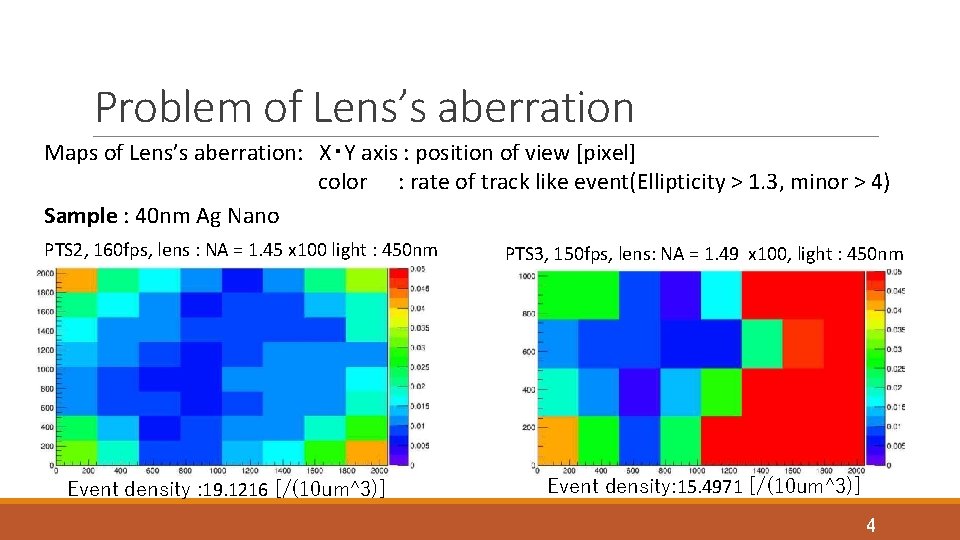
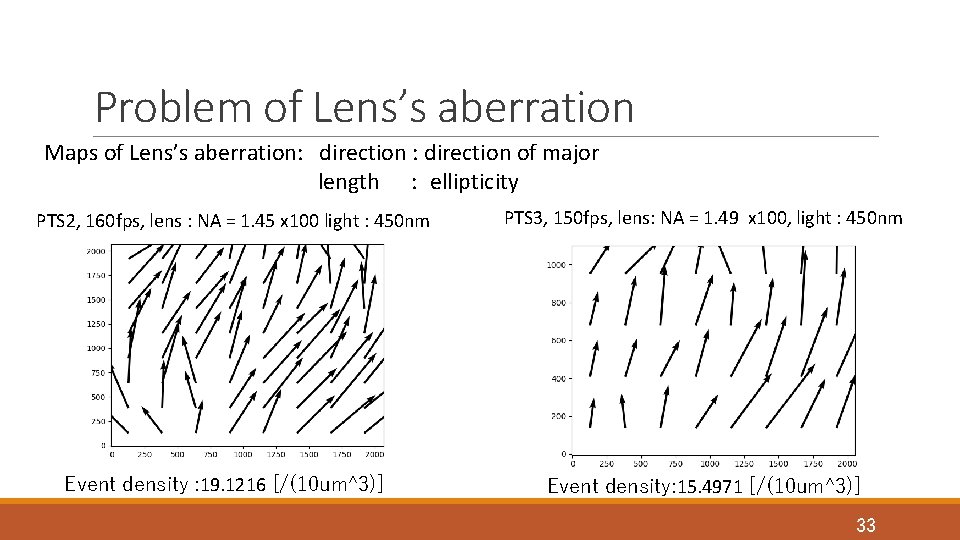
Problem of Lens’s aberration Maps of Lens’s aberration: X・Y axis : position of view [pixel] color : rate of track like event(Ellipticity > 1. 3, minor > 4) Sample : 40 nm Ag Nano PTS 2, 160 fps, lens : NA = 1. 45 x 100 light : 450 nm Event density : 19. 1216 [/(10 um^3)] PTS 3, 150 fps, lens: NA = 1. 49 x 100, light : 450 nm Event density: 15. 4971 [/(10 um^3)] 4
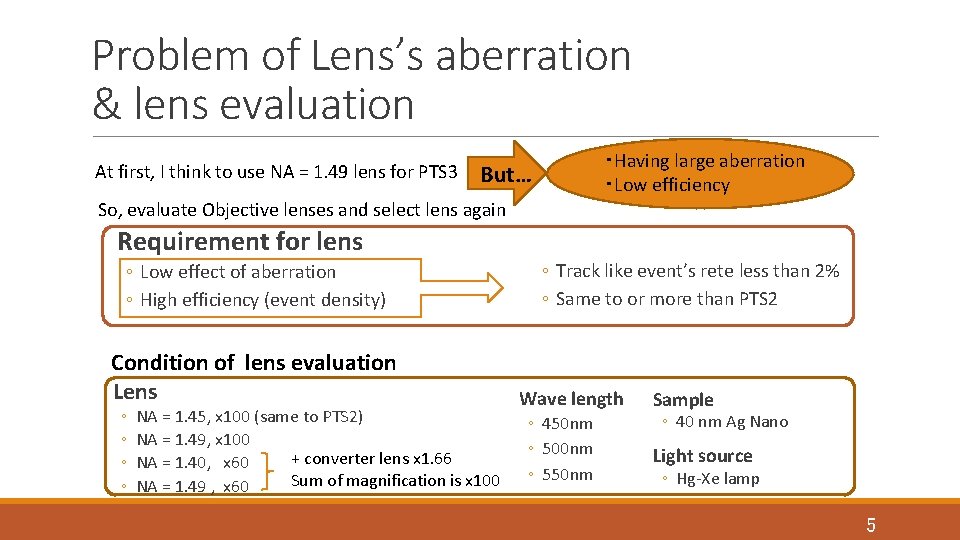
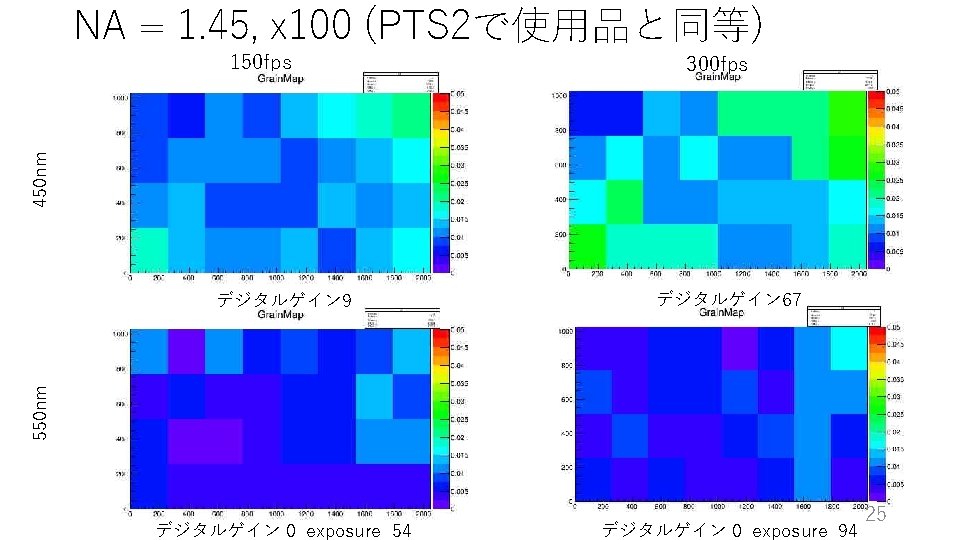
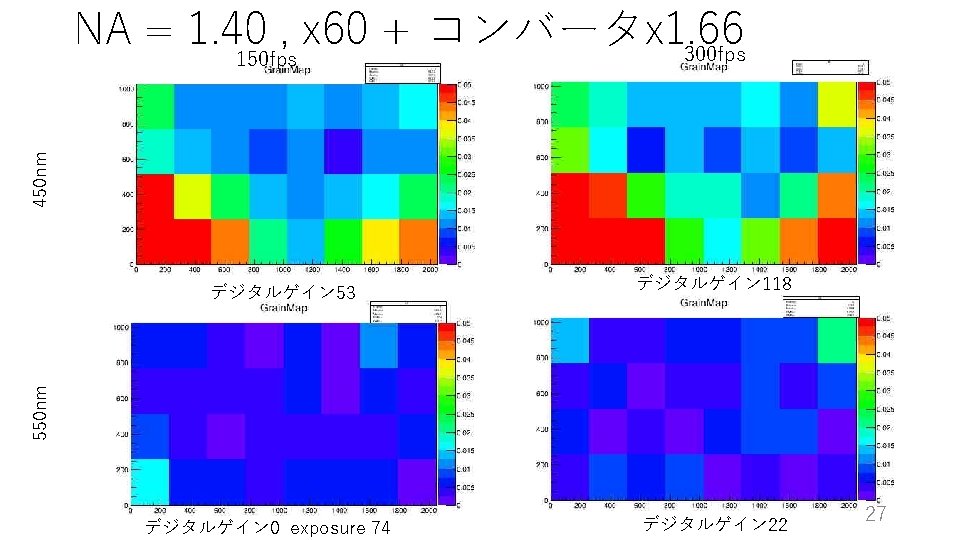
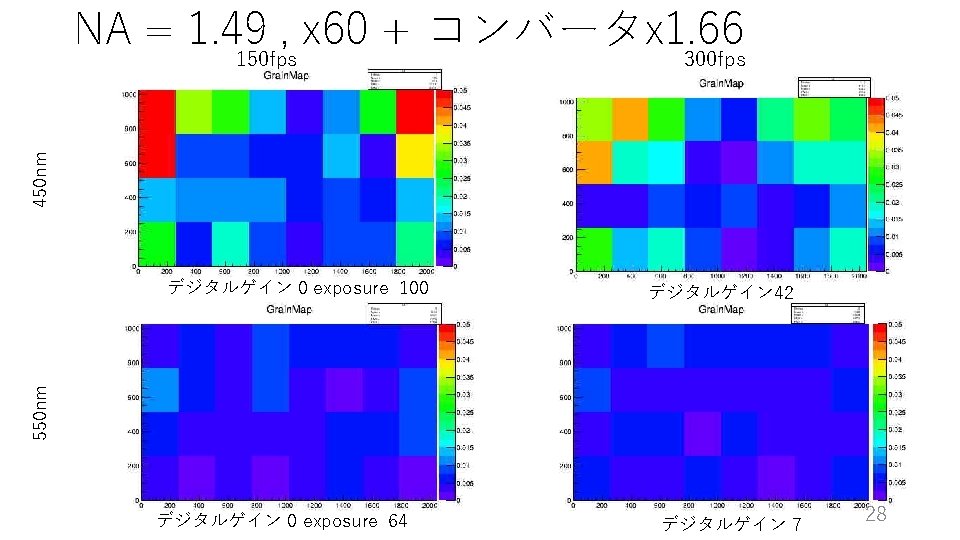
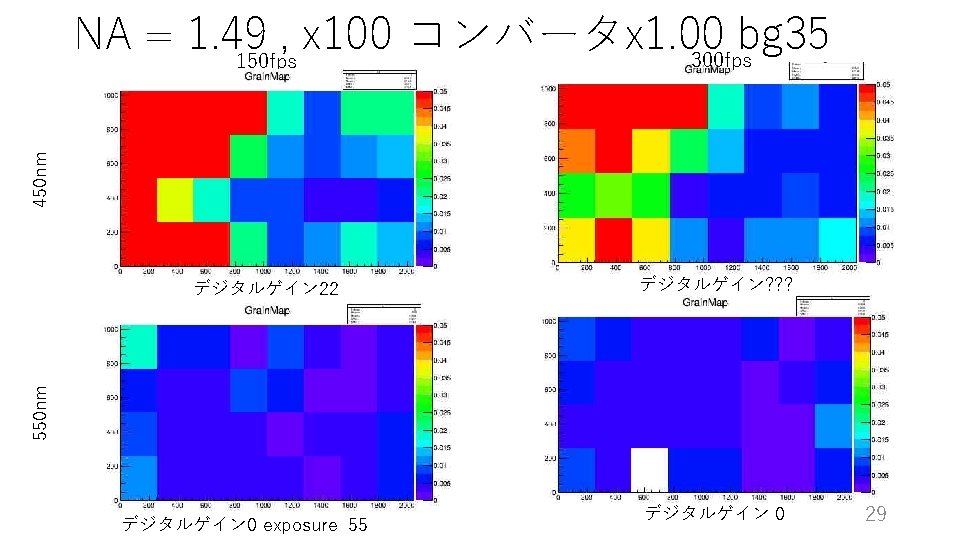
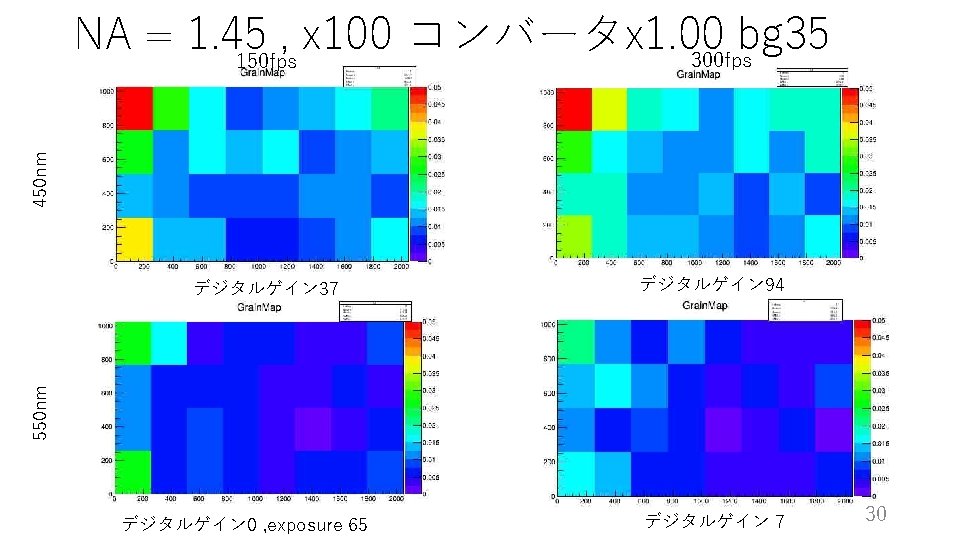
Problem of Lens’s aberration & lens evaluation At first, I think to use NA = 1. 49 lens for PTS 3 ・Having large aberration ・Low efficiency But… So, evaluate Objective lenses and select lens again Requirement for lens ◦ Low effect of aberration ◦ High efficiency (event density) Condition of lens evaluation Lens ◦ ◦ NA = 1. 45, x 100 (same to PTS 2) NA = 1. 49, x 100 + converter lens x 1. 66 NA = 1. 40, x 60 Sum of magnification is x 100 NA = 1. 49 , x 60 ◦ Track like event’s rete less than 2% ◦ Same to or more than PTS 2 Wave length ◦ 450 nm ◦ 500 nm ◦ 550 nm Sample ◦ 40 nm Ag Nano Light source ◦ Hg-Xe lamp 5
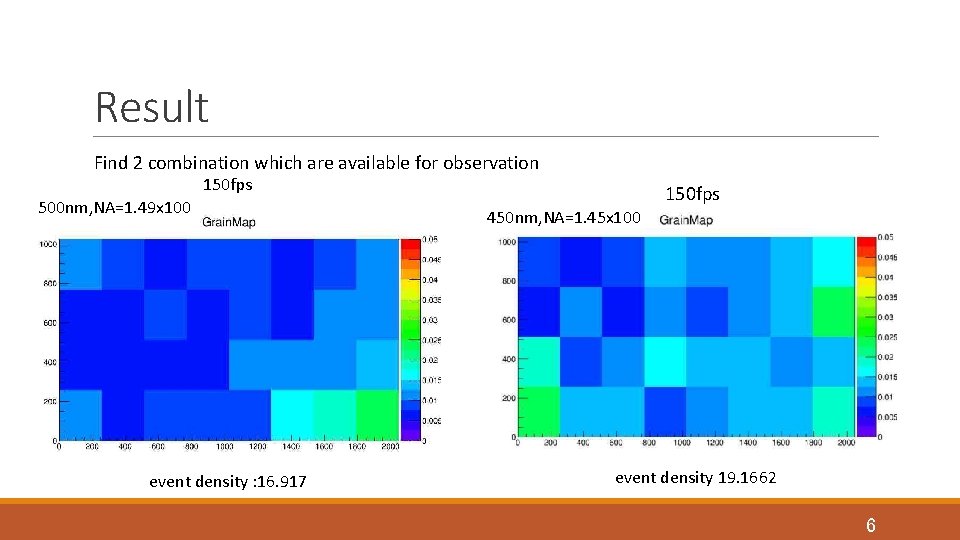
Result Find 2 combination which are available for observation 150 fps 500 nm, NA=1. 49 x 100 event density : 16. 917 450 nm, NA=1. 45 x 100 150 fps event density 19. 1662 6
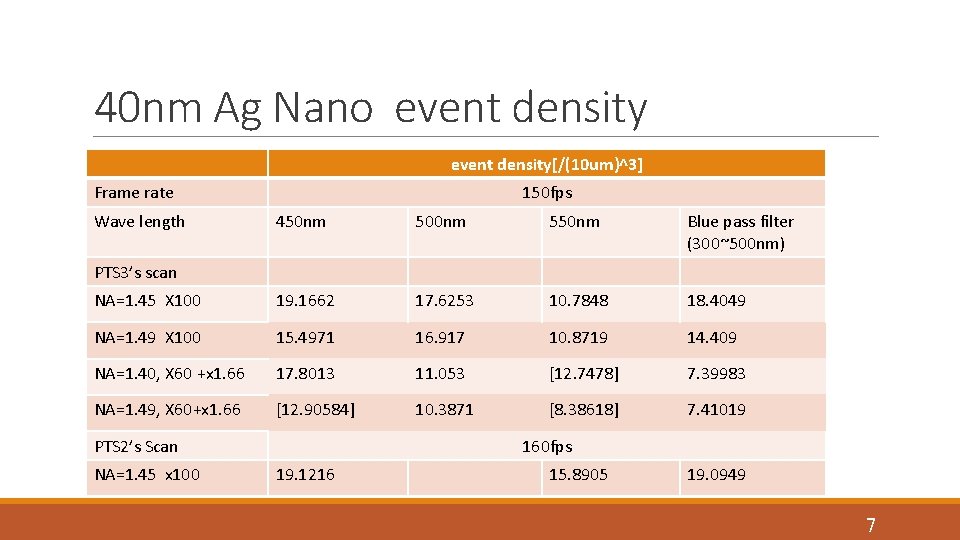
40 nm Ag Nano event density[/(10 um)^3] Frame rate Wave length 150 fps 450 nm 500 nm 550 nm Blue pass filter (300~500 nm) NA=1. 45 X 100 19. 1662 17. 6253 10. 7848 18. 4049 NA=1. 49 X 100 15. 4971 16. 917 10. 8719 14. 409 NA=1. 40, X 60 +x 1. 66 17. 8013 11. 053 [12. 7478] 7. 39983 NA=1. 49, X 60+x 1. 66 [12. 90584] 10. 3871 [8. 38618] 7. 41019 PTS 3’s scan PTS 2’s Scan NA=1. 45 x 100 160 fps 19. 1216 15. 8905 19. 0949 7
Contents Lens’s aberration Evaluate scanning speed Future plan & others ◦ Speed up plan ◦ Other scanning mode 8
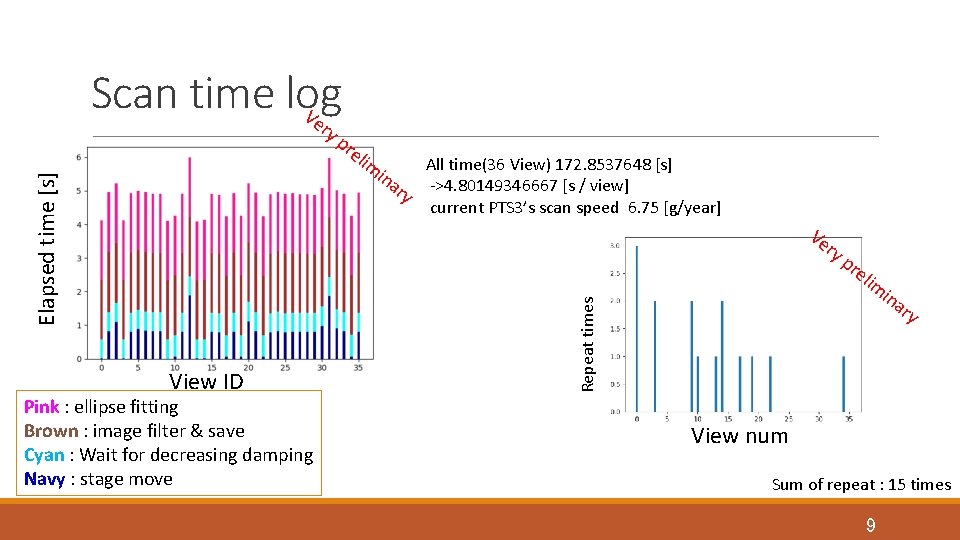
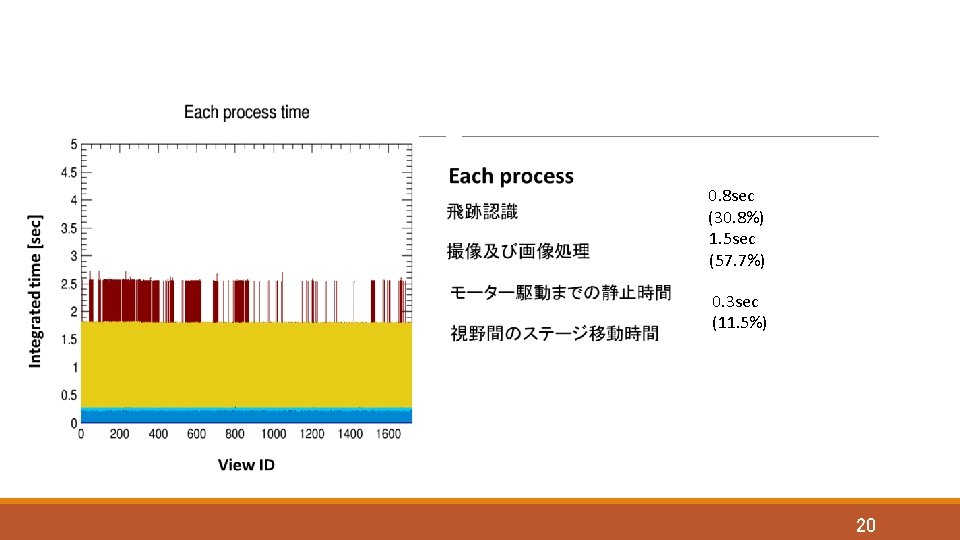
Scan time log Ve r Elapsed time [s] yp re lim ina ry All time(36 View) 172. 8537648 [s] ->4. 80149346667 [s / view] current PTS 3’s scan speed 6. 75 [g/year] Ve ry Pink : ellipse fitting Brown : image filter & save Cyan : Wait for decreasing damping Navy : stage move eli m ina ry Repeat times View ID pr View num Sum of repeat : 15 times 9
Contents Lens’s aberration Evaluate scanning speed Future plan & others ◦ Speed up plan ◦ Other scanning mode 10
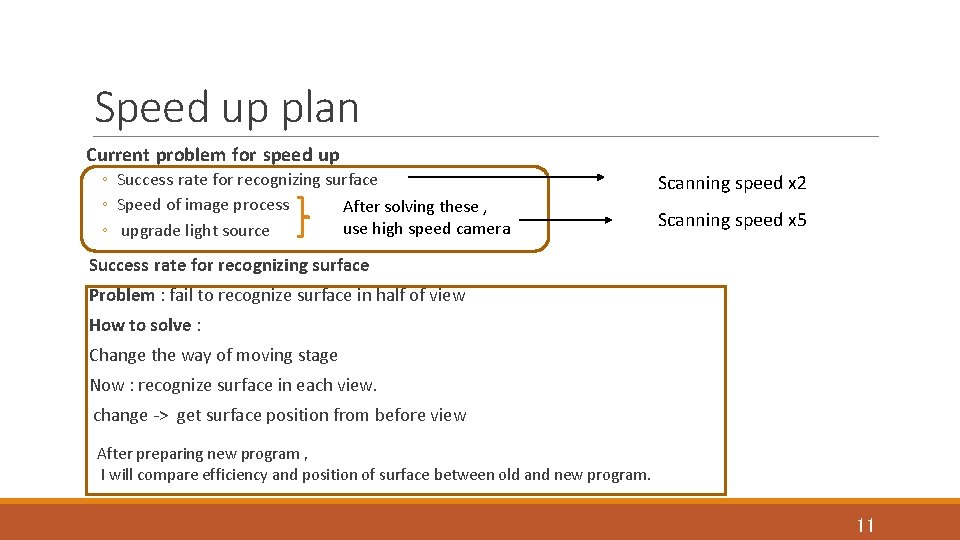
Speed up plan Current problem for speed up ◦ Success rate for recognizing surface ◦ Speed of image process After solving these , use high speed camera ◦ upgrade light source Scanning speed x 2 Scanning speed x 5 Success rate for recognizing surface Problem : fail to recognize surface in half of view How to solve : Change the way of moving stage Now : recognize surface in each view. change -> get surface position from before view After preparing new program , I will compare efficiency and position of surface between old and new program. 11
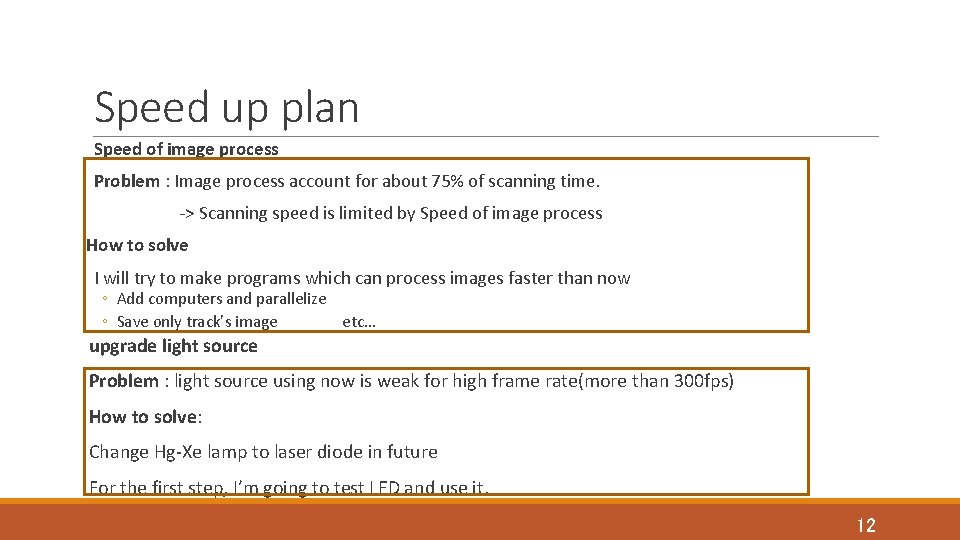
Speed up plan Speed of image process Problem : Image process account for about 75% of scanning time. -> Scanning speed is limited by Speed of image process How to solve I will try to make programs which can process images faster than now ◦ Add computers and parallelize ◦ Save only track’s image etc… upgrade light source Problem : light source using now is weak for high frame rate(more than 300 fps) How to solve: Change Hg-Xe lamp to laser diode in future For the first step, I’m going to test LED and use it. 12
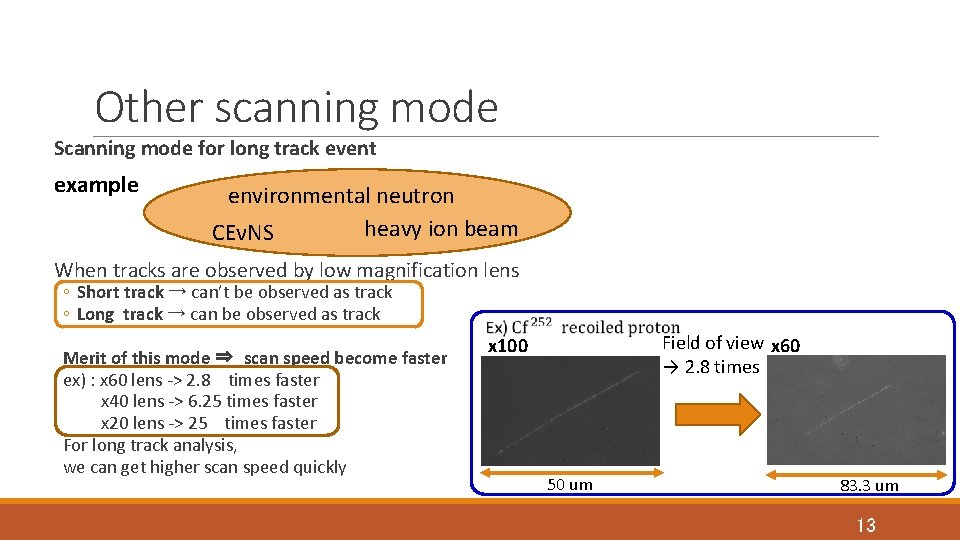
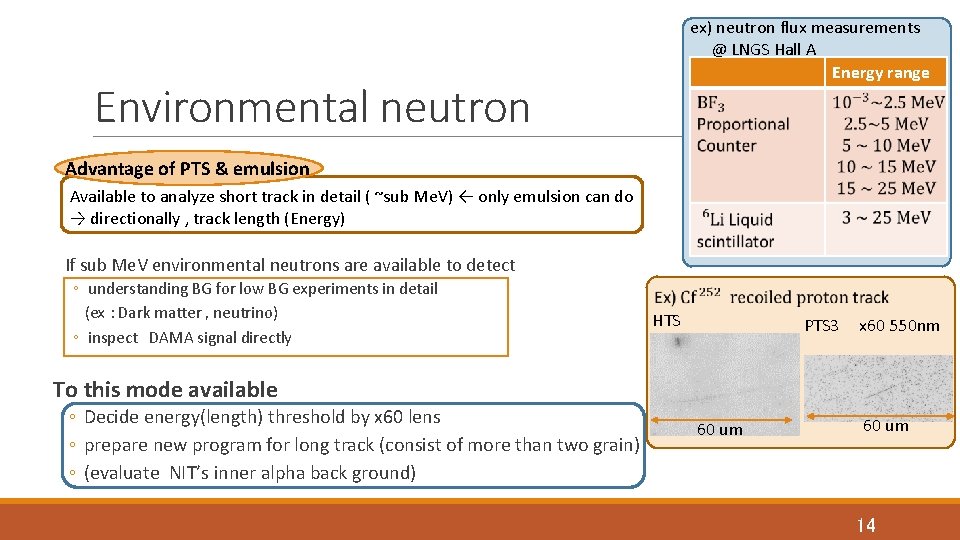
Other scanning mode Scanning mode for long track event example environmental neutron heavy ion beam CEνNS When tracks are observed by low magnification lens ◦ Short track → can’t be observed as track ◦ Long track → can be observed as track Merit of this mode ⇒ scan speed become faster ex) : x 60 lens -> 2. 8 times faster x 40 lens -> 6. 25 times faster x 20 lens -> 25 times faster For long track analysis, we can get higher scan speed quickly Field of view x 60 → 2. 8 times x 100 50 um 83. 3 um 13
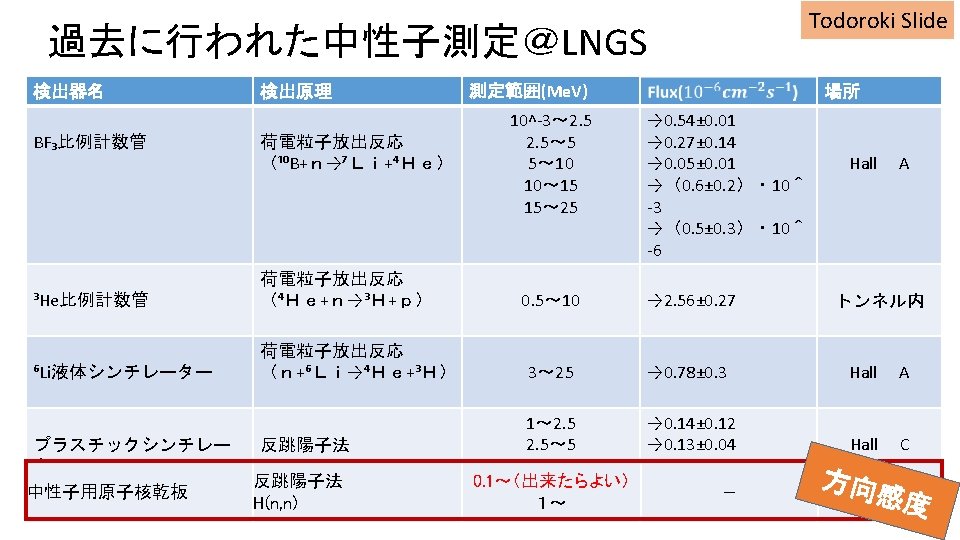
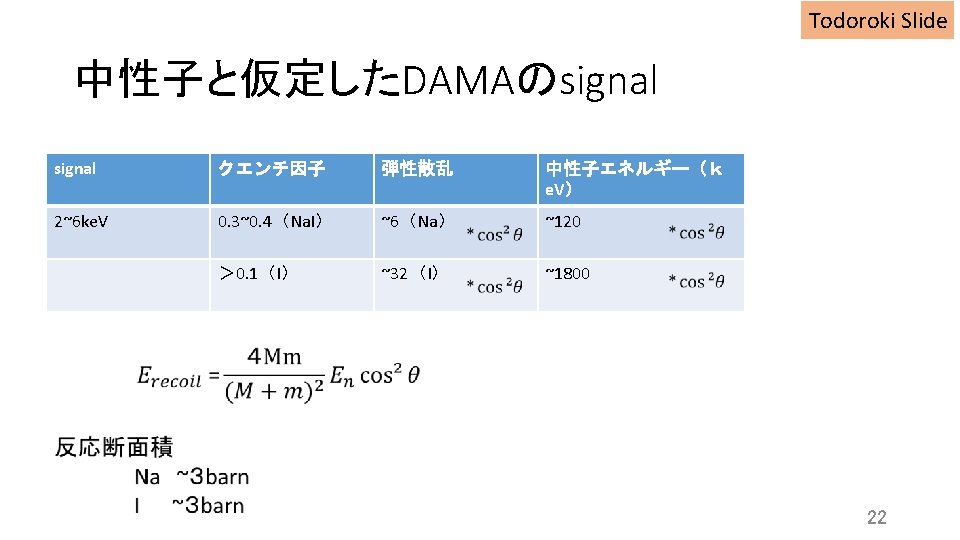
ex) neutron flux measurements @ LNGS Hall A Energy range Environmental neutron Advantage of PTS & emulsion Available to analyze short track in detail ( ~sub Me. V) ← only emulsion can do → directionally , track length (Energy) If sub Me. V environmental neutrons are available to detect ◦ understanding BG for low BG experiments in detail (ex : Dark matter , neutrino) ◦ inspect DAMA signal directly HTS PTS 3 x 60 550 nm To this mode available ◦ Decide energy(length) threshold by x 60 lens ◦ prepare new program for long track (consist of more than two grain) ◦ (evaluate NIT’s inner alpha back ground) 60 um 14
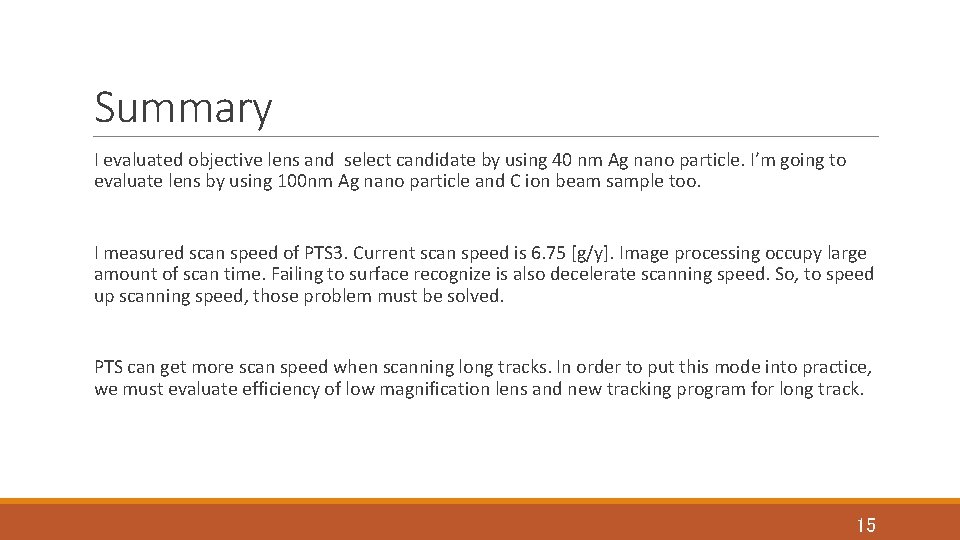
Summary I evaluated objective lens and select candidate by using 40 nm Ag nano particle. I’m going to evaluate lens by using 100 nm Ag nano particle and C ion beam sample too. I measured scan speed of PTS 3. Current scan speed is 6. 75 [g/y]. Image processing occupy large amount of scan time. Failing to surface recognize is also decelerate scanning speed. So, to speed up scanning speed, those problem must be solved. PTS can get more scan speed when scanning long tracks. In order to put this mode into practice, we must evaluate efficiency of low magnification lens and new tracking program for long track. 15
Back up 16
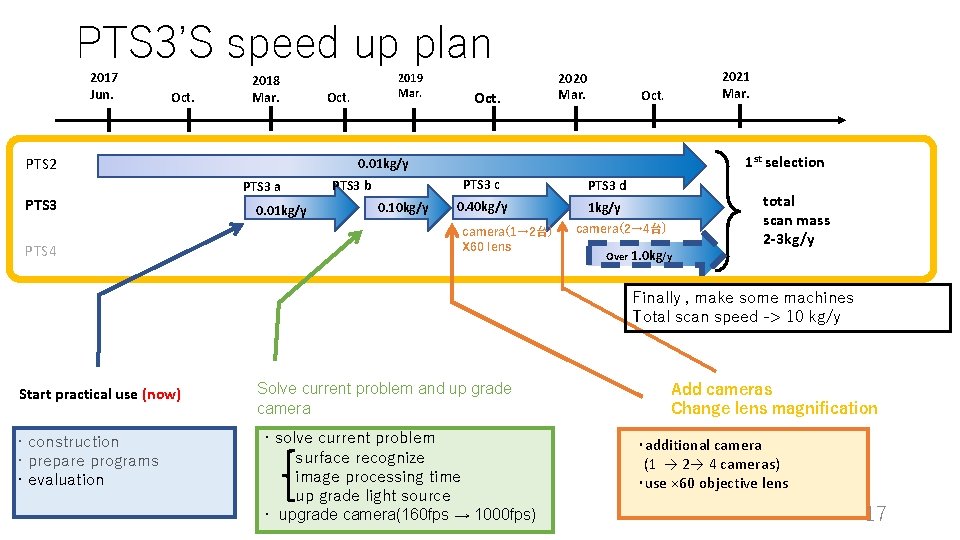
PTS 3’S speed up plan 2017 Jun. Oct. 2018 Mar. PTS 2 PTS 4 Oct. 2020 Mar. 2021 Mar. Oct. 1 st selection 0. 01 kg/y PTS 3 a PTS 3 2019 Mar. 0. 01 kg/y PTS 3 b 0. 10 kg/y PTS 3 c PTS 3 d 0. 40 kg/y 1 kg/y camera(1→ 2台) X 60 lens camera(2→ 4台) Over 1. 0 kg/y total scan mass 2 -3 kg/y Finally , make some machines Total scan speed -> 10 kg/y Start practical use (now) ・construction ・prepare programs ・evaluation Solve current problem and up grade camera ・solve current problem surface recognize image processing time up grade light source ・ upgrade camera(160 fps → 1000 fps) Add cameras Change lens magnification ・additional camera (1 → 2→ 4 cameras) ・use × 60 objective lens 17
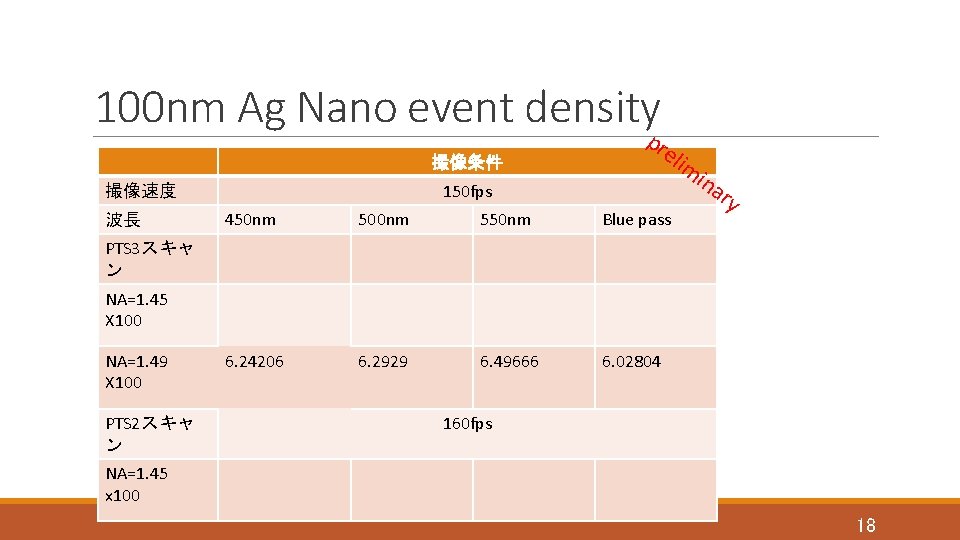
100 nm Ag Nano event densityp 撮像条件 150 fps 撮像速度 波長 re li 450 nm 500 nm 550 nm Blue pass 6. 24206 6. 2929 6. 49666 6. 02804 mi na r y PTS 3スキャ ン NA=1. 45 X 100 NA=1. 49 X 100 PTS 2スキャ ン 160 fps NA=1. 45 x 100 18
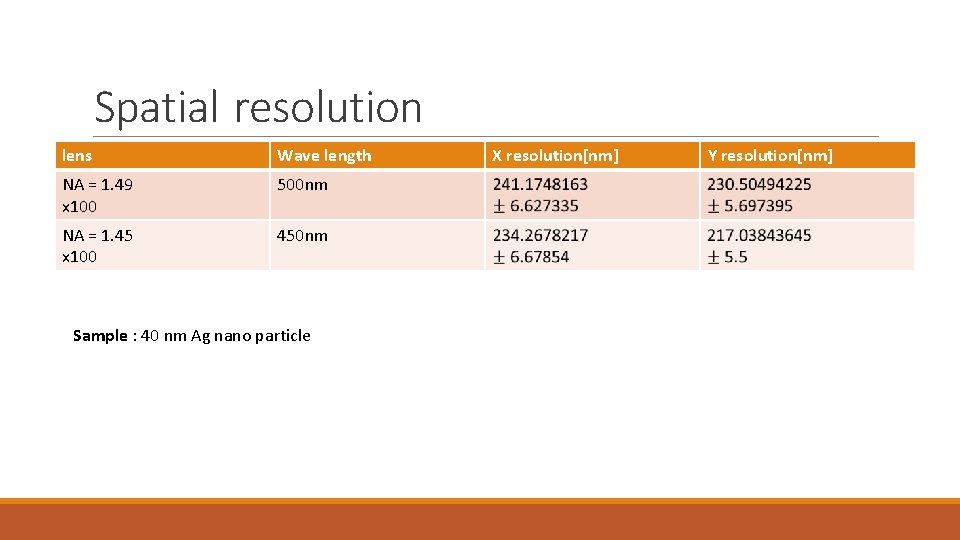
Spatial resolution lens Wave length NA = 1. 49 x 100 500 nm NA = 1. 45 x 100 450 nm Sample : 40 nm Ag nano particle X resolution[nm] Y resolution[nm]
0. 8 sec (30. 8%) 1. 5 sec (57. 7%) 0. 3 sec (11. 5%) 20
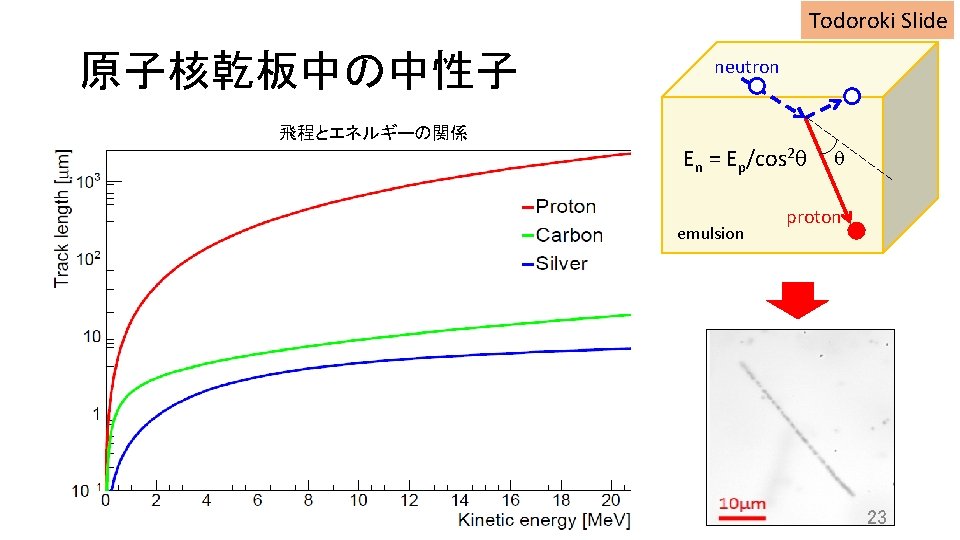
Todoroki Slide 原子核乾板中の中性子 neutron 飛程とエネルギーの関係 En = Ep/cos 2 q emulsion q proton 23
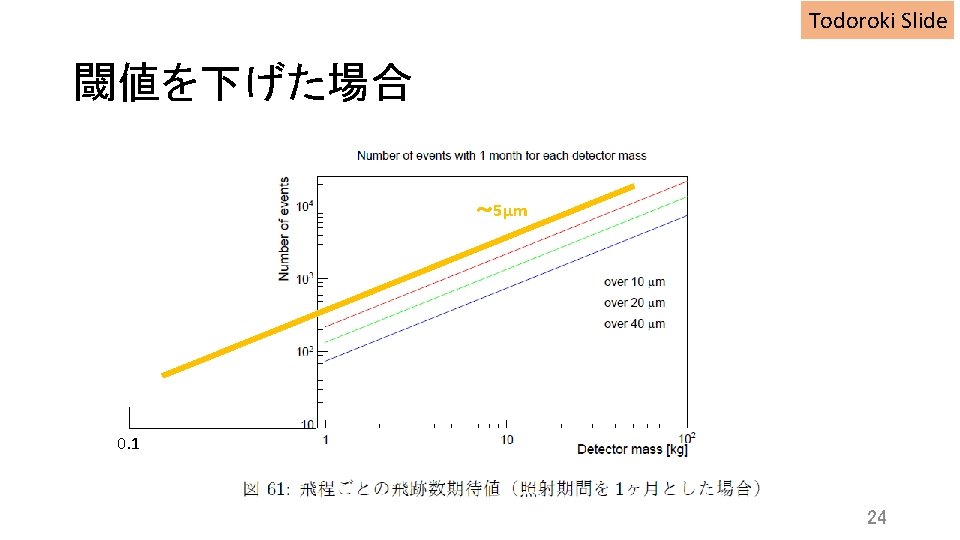
Todoroki Slide 閾値を下げた場合 ~ 5μm 0. 1 24
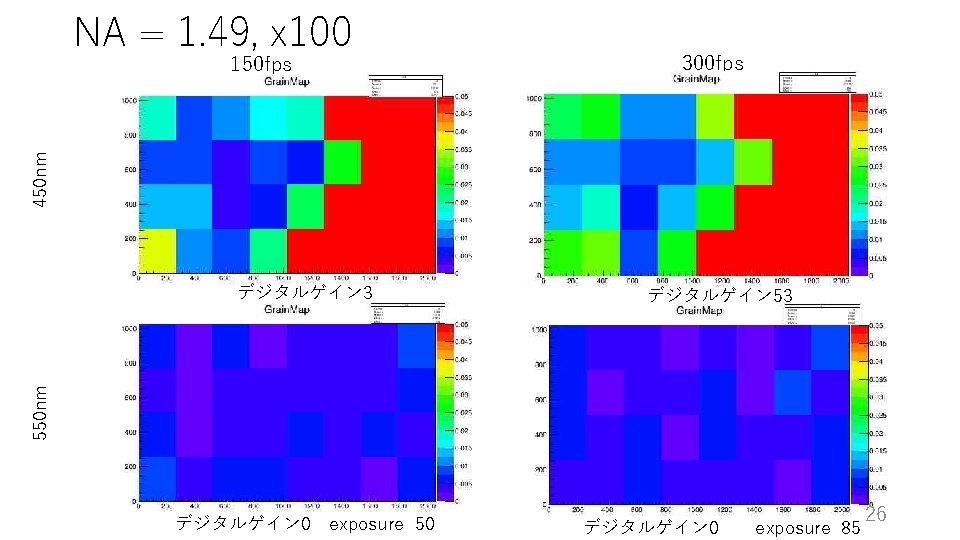
NA = 1. 49, x 100 300 fps 450 nm 150 fps デジタルゲイン 53 デジタルゲイン 0 exposure 50 デジタルゲイン 0 exposure 85 550 nm デジタルゲイン 3 26
450 nm NA = 1. 49 , x 60 + コンバータx 1. 66 150 fps 300 fps デジタルゲイン 42 550 nm デジタルゲイン 0 exposure 100 デジタルゲイン 0 exposure 64 デジタルゲイン 7 28
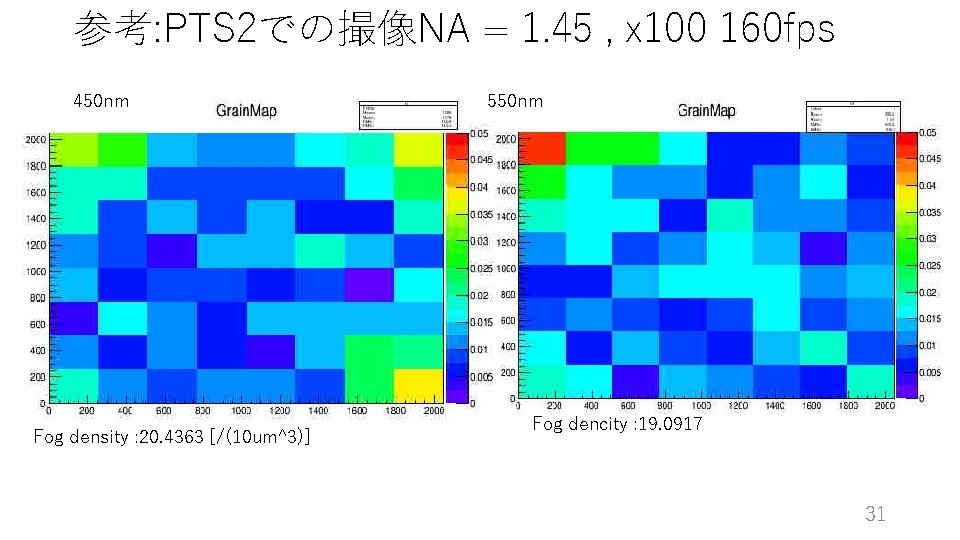
参考: PTS 2での撮像NA = 1. 45 , x 100 160 fps 450 nm Fog density : 20. 4363 [/(10 um^3)] 550 nm Fog dencity : 19. 0917 31
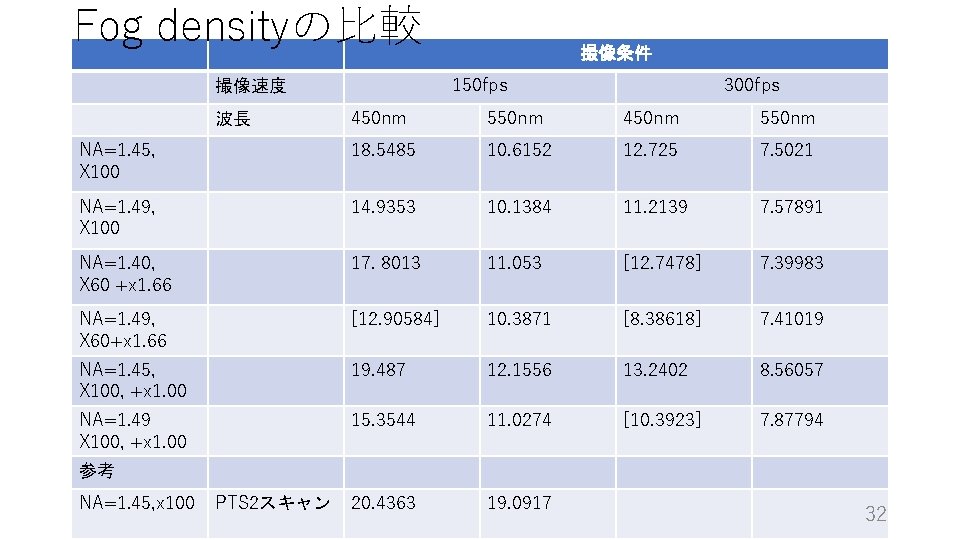
Fog densityの比較 撮像条件 150 fps 撮像速度 300 fps 450 nm 550 nm NA=1. 45, X 100 18. 5485 10. 6152 12. 725 7. 5021 NA=1. 49, X 100 14. 9353 10. 1384 11. 2139 7. 57891 NA=1. 40, X 60 +x 1. 66 17. 8013 11. 053 [12. 7478] 7. 39983 NA=1. 49, X 60+x 1. 66 [12. 90584] 10. 3871 [8. 38618] 7. 41019 NA=1. 45, X 100, +x 1. 00 19. 487 12. 1556 13. 2402 8. 56057 NA=1. 49 X 100, +x 1. 00 15. 3544 11. 0274 [10. 3923] 7. 87794 20. 4363 19. 0917 波長 参考 NA=1. 45, x 100 PTS 2スキャン 32
Problem of Lens’s aberration Maps of Lens’s aberration: direction of major length : ellipticity PTS 2, 160 fps, lens : NA = 1. 45 x 100 light : 450 nm Event density : 19. 1216 [/(10 um^3)] PTS 3, 150 fps, lens: NA = 1. 49 x 100, light : 450 nm Event density: 15. 4971 [/(10 um^3)] 33