Psy 280 Perception Prof Anderson Department of Psychology






- Slides: 50
Psy 280: Perception Prof. Anderson Department of Psychology Vision 7 Motion 1
Optional papers: Qu. ALMRI Question/hypothesis n Alternative n Logic n Method n Results n Inferences n n Detailed description on website 2
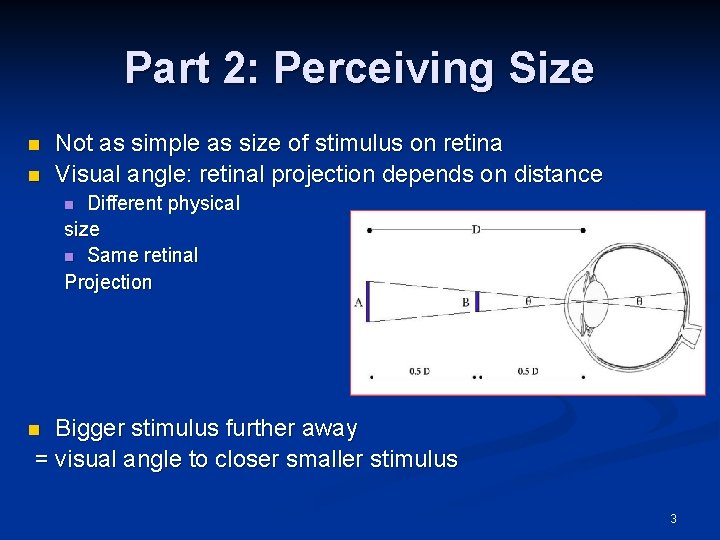
Part 2: Perceiving Size n n Not as simple as size of stimulus on retina Visual angle: retinal projection depends on distance Different physical size n Same retinal Projection n Bigger stimulus further away = visual angle to closer smaller stimulus n 3
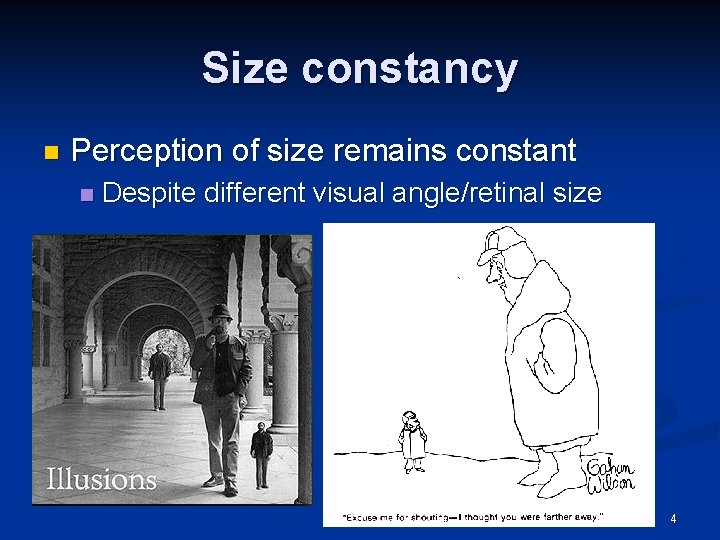
Size constancy n Perception of size remains constant n Despite different visual angle/retinal size 4
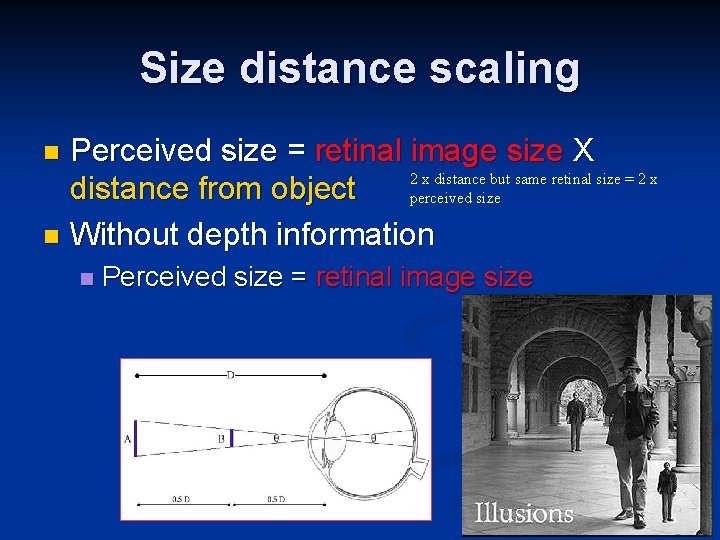
Size distance scaling Perceived size = retinal image size X 2 x distance but same retinal size = 2 x distance from object perceived size n Without depth information n n Perceived size = retinal image size 5
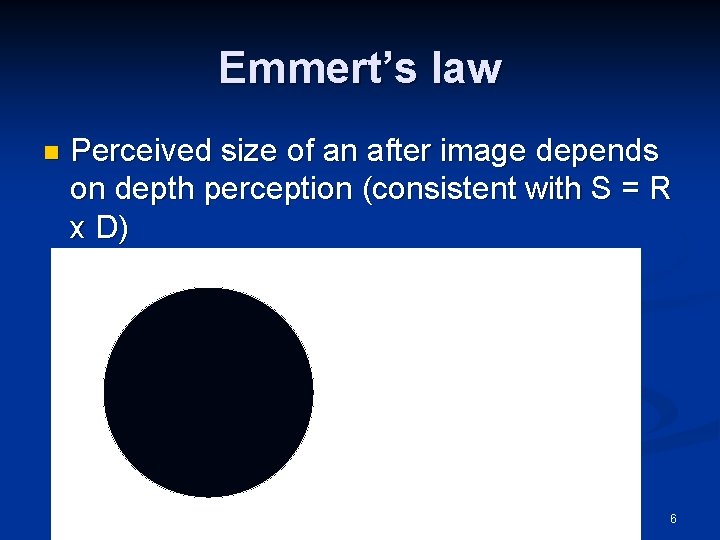
Emmert’s law n Perceived size of an after image depends on depth perception (consistent with S = R x D) 6
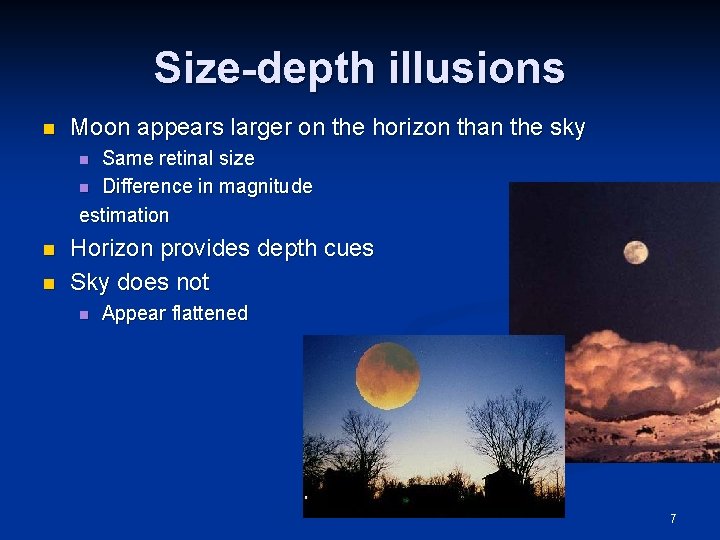
Size-depth illusions n Moon appears larger on the horizon than the sky Same retinal size n Difference in magnitude estimation n Horizon provides depth cues Sky does not n Appear flattened 7
Motion 8
Motion: Frames of reference n n What does the term "at rest" mean? Can you cite an example of an object at rest? n n Is the room at rest? Room has at least three types of motion n n Motion due to earth : 24000 miles / 24 hours = 1000 miles/hr Earth circles the sun: 2 pi 93, 000 miles / 8760 hours = 66700 miles/hr Sun circles the galaxy (30, 000 light year = r) every 1 / 4 billion years 1. 76 x 1017 miles / 2. 19 x 1012 hr = 80400 miles/ hr Is there anything that is not moving? n n Must be careful about our description of motion Moving relative to what reference frame? 9
Animism: Worshiping the light n Divides living organisms Animals vs plants n Capacity for voluntary movement n n vs n phototropism Co-evolution Organisms that move n Evolution of a capacity to sense movement n 10
Invisible motion: Morning glory n n 5 AM to 7 PM Open in morning n n Pollination by diurnal insect Dies in afternoon Motion too slow to notice even dramatic change Our visual system are tuned to events that move more quickly n E. g. , Animals (fast) not plants (slow) 11
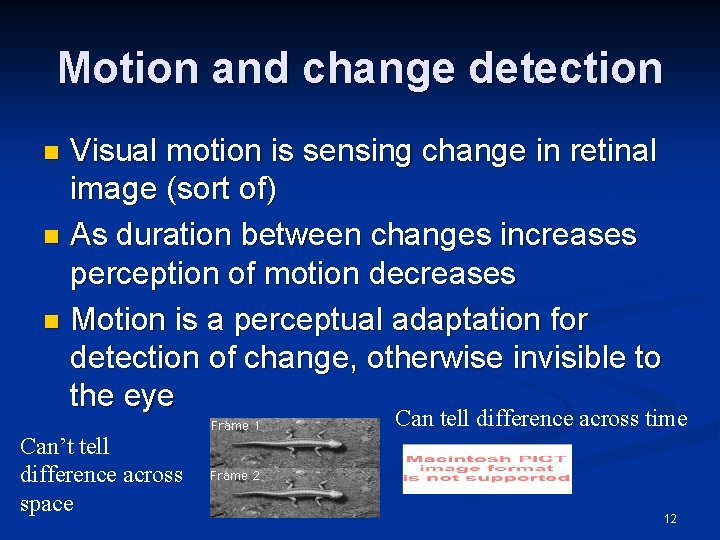
Motion and change detection Visual motion is sensing change in retinal image (sort of) n As duration between changes increases perception of motion decreases n Motion is a perceptual adaptation for detection of change, otherwise invisible to the eye n Can tell difference across time Can’t tell difference across space 12
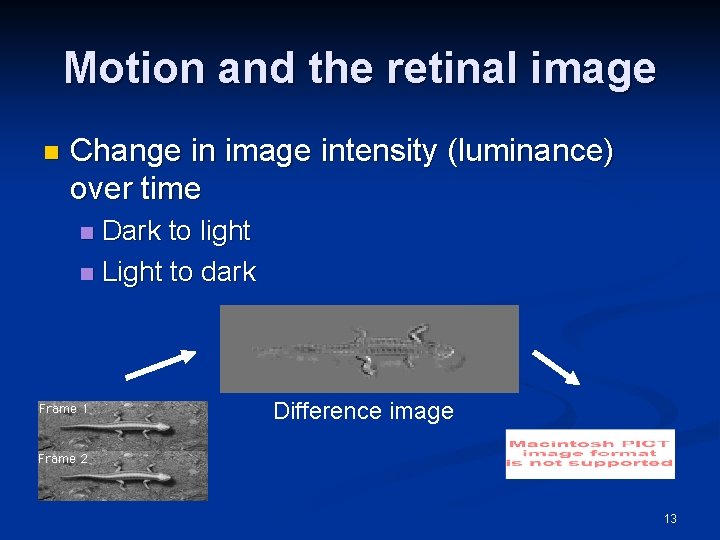
Motion and the retinal image n Change in image intensity (luminance) over time Dark to light n Light to dark n Difference image 13
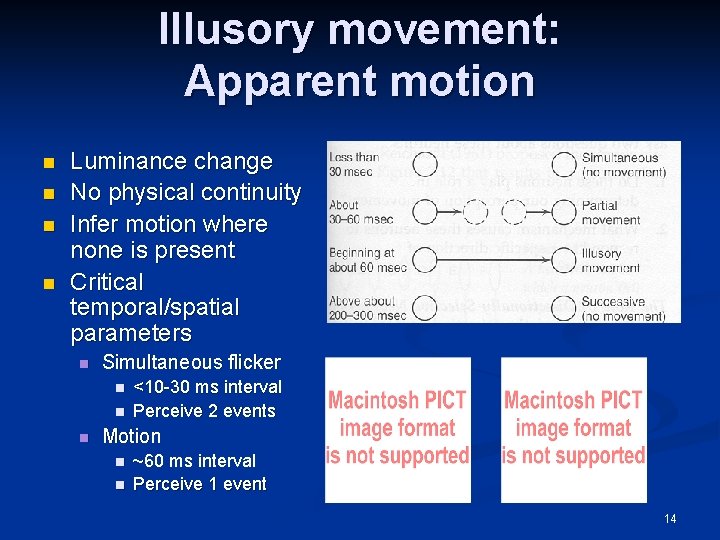
Illusory movement: Apparent motion n n Luminance change No physical continuity Infer motion where none is present Critical temporal/spatial parameters n Simultaneous flicker n n n <10 -30 ms interval Perceive 2 events Motion n n ~60 ms interval Perceive 1 event 14
Not just simple luminance change: 2 nd order motion n First-order motion n Change in luminance boundary Luminance change doesn’t explain all motion Second-order motion n Motion but no luminance boundary Not net luminance change Object disappears when motion stops 15
Second order motion: Illusory shapes and motion n No luminance boundary for low-level motion detectors to use Motion perception must rely on other topdown/higher-order influences Simple luminance based motion detectors can’t explain all of motion perception 16
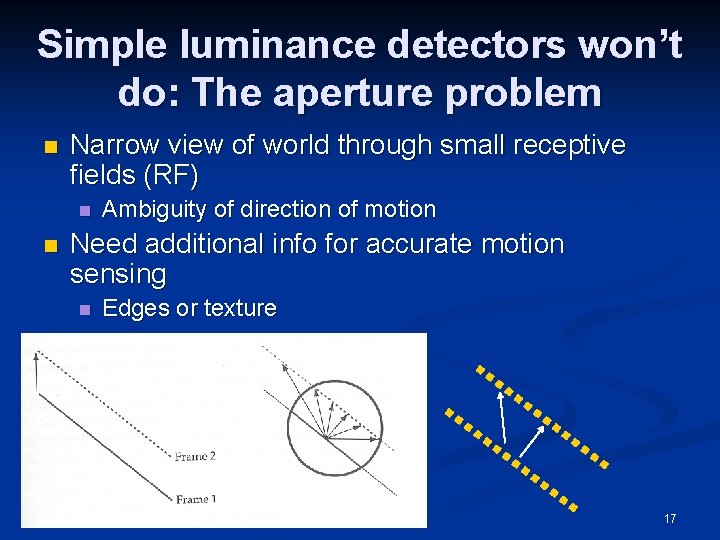
Simple luminance detectors won’t do: The aperture problem n Narrow view of world through small receptive fields (RF) n n Ambiguity of direction of motion Need additional info for accurate motion sensing n Edges or texture 17
The aperture problem n n n Looking at motion through the window of one neuron RF represents horizontal motion Global scene has different motion n n Local computations don’t necessarily explain motion Need to share information across neurons Perceived motion 18
Motion perception: More than the sum of its parts n The underlying mechanism involves signals at different retinal locations being integrated to arrive at global motion signals 19
Motion integration at the same retinal location: Plaids n First order low-level motion detectors n n Respond to each component of motion (horizontal and vertical) Motion integration n Don’t perceive either n Create common directional signal n n Like force vectors Down & left moving plaid 20
Motion detection as an opponent process n Like colour vision: Red-green, blue-yellow n Motion n n Up-down Left-right Spiral in-out Enhances “motion contrast” 21
Motion after effect n n Reversing waterfall Fatigue your direction sensitive neurons See opposite motion where there is none Explanation n n No motion Direction selective cells produce equal responses No longer equally oppose each other E. g. , Adapt to red— >perceive green 22
Spiral motion after effect: Disfiguring Brad • Fatigue neurons representing radial expansion • Induces radial contraction due to lessened inhibitory influence • Motion (perception) is a perceptual/neural process, not necessarily 23 a property of the world (object movement)!
Direction repulsion: Lateral inhibitory influences in motion n n Vertical and 45 degree movement Interact to enlarge directional disparity Evidence of lateral inhibitory interactions between motion detectors Enhancement of directional “contrast” Motion “mach bands” Actual Perceived 24
Perceptual organization: Structure from motion n Motion perception not used just to assess stimulus movement Can define “objects” Laws of organization n n Common fate Things that move together belong to same object A camouflaged animal is difficult to see until it moves Not just knowledge based n Can see novel objects 25
Structure from motion: Kinetic depth n n n Can define depth What motion cues define depth? Parallax n n Differing dot velocity Track single dot n n See velocity change Infer depth from motion 26
Kinetic depth: Shadow motion n Moving shadows are also strong cue for depth change n Heuristic n Ambiguous info n n n Shadow might reflect light source movement Assume light source is constant Sun doesn’t move that fast 27
Experience and motion perception: Biological motion Dot walkers n We each have our own motion signature n n n Recognition by motion Experience influences motion perception 28
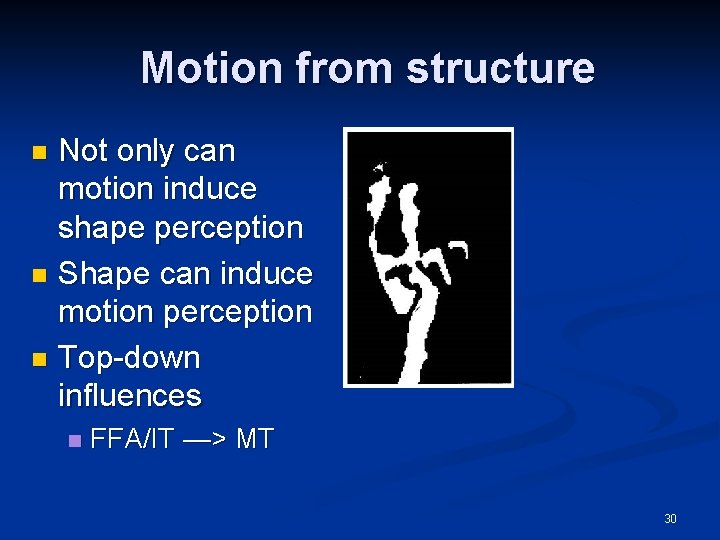
Motion from structure Not only can motion induce shape perception n Shape can induce motion perception n Top-down influences n n FFA/IT —> MT 29
Motion from structure Not only can motion induce shape perception n Shape can induce motion perception n Top-down influences n n FFA/IT —> MT 30
How does the brain represent motion? 31
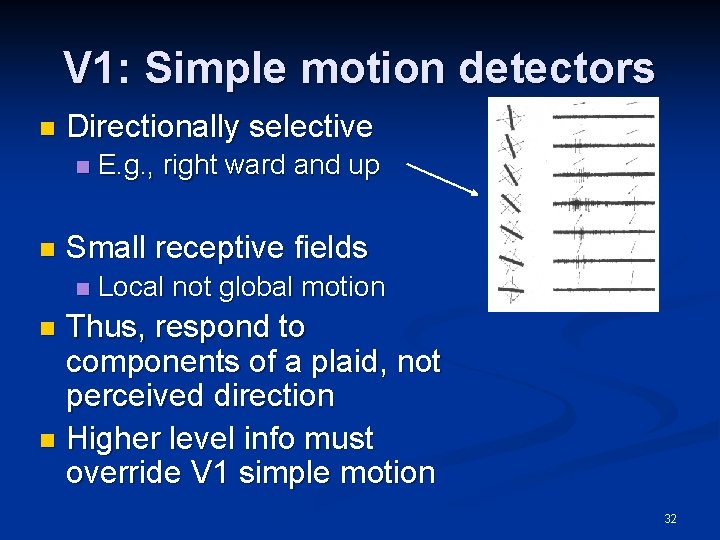
V 1: Simple motion detectors n Directionally selective n n E. g. , right ward and up Small receptive fields n Local not global motion Thus, respond to components of a plaid, not perceived direction n Higher level info must override V 1 simple motion n 32
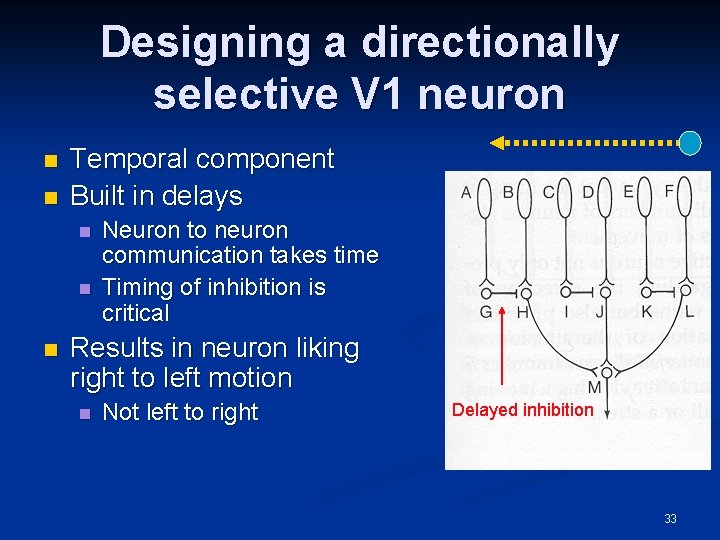
Designing a directionally selective V 1 neuron n n Temporal component Built in delays n n n Neuron to neuron communication takes time Timing of inhibition is critical Results in neuron liking right to left motion n Not left to right Delayed inhibition 33
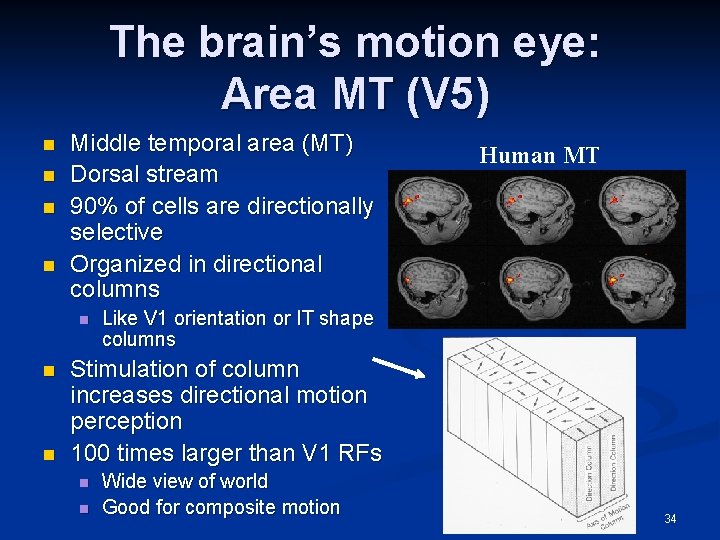
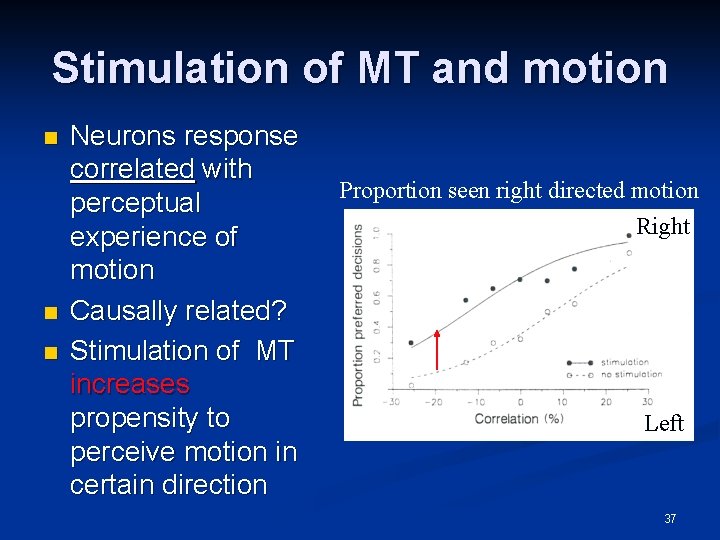
The brain’s motion eye: Area MT (V 5) n n Middle temporal area (MT) Dorsal stream 90% of cells are directionally selective Organized in directional columns n n n Human MT Like V 1 orientation or IT shape columns Stimulation of column increases directional motion perception 100 times larger than V 1 RFs n n Wide view of world Good for composite motion 34
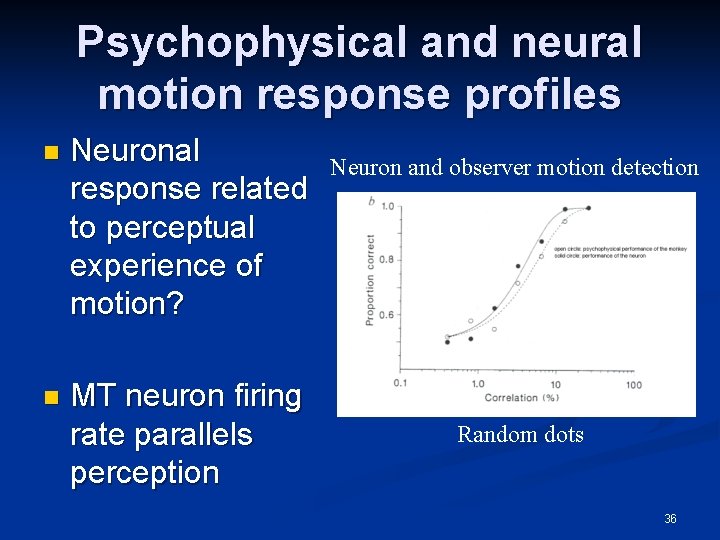
MT motion processing: Random dot stimuli n How do we know MT supports motion perception? 0%, 30%, and 100% coherence n Use to determine monkey/human detection of directional motion n 35
Psychophysical and neural motion response profiles n Neuronal response related to perceptual experience of motion? n MT neuron firing rate parallels perception Neuron and observer motion detection Random dots 36
Stimulation of MT and motion n Neurons response correlated with perceptual experience of motion Causally related? Stimulation of MT increases propensity to perceive motion in certain direction Proportion seen right directed motion Right Left 37
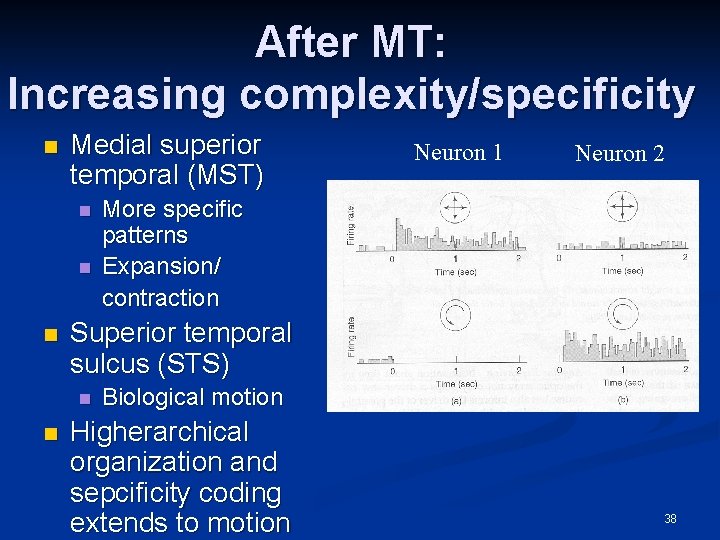
After MT: Increasing complexity/specificity n Medial superior temporal (MST) n n n Neuron 2 More specific patterns Expansion/ contraction Superior temporal sulcus (STS) n n Neuron 1 Biological motion Higherarchical organization and sepcificity coding extends to motion 38
Keeping the world still n Examples of motion w/out retinal change n E. g. , motion after effects n What about retinal change w/out motion? n Eyes constantly make small fast movements n n Why doesn’t world appear to shake or move when we move our eyes? n n n Remember: World fades without these movements Would get pretty nauseating Vision needs to “correct” for eye movements How does it do it? 39
Corollary discharge theory n Integration of retinal stimulation and eye movements n Use motor signals to stabilize vision n Head movement Eye movement How about movement without motor signal? n n (keep one eye closed) Push your open eye. Gently please! World moves! 40
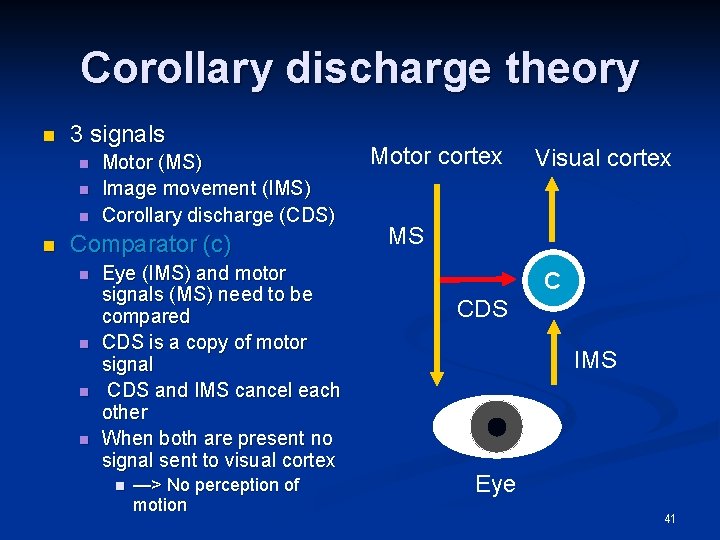
Corollary discharge theory n 3 signals n n Motor (MS) Image movement (IMS) Corollary discharge (CDS) Comparator (c) n n Eye (IMS) and motor signals (MS) need to be compared CDS is a copy of motor signal CDS and IMS cancel each other When both are present no signal sent to visual cortex n —> No perception of motion Motor cortex Visual cortex MS C CDS IMS Eye 41
Corollary discharge theory n Anytime CDS and IMS don’t co-occur —> perceive motion n IMS alone —> perceive motion n Veridical movement n n Eyes still, stimulus moves Illusory movement Pushing your eye n Move image on retina w/out MS/CDS n n This theory makes interesting predictions n CDS alone should also result in motion 42
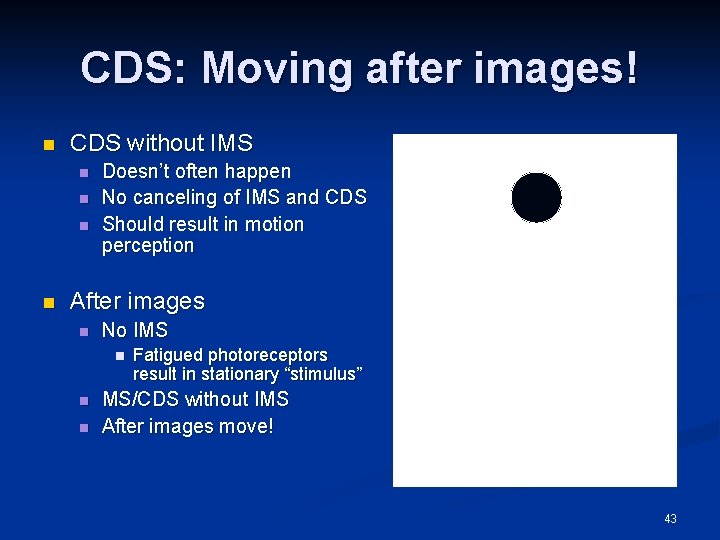
CDS: Moving after images! n CDS without IMS n n Doesn’t often happen No canceling of IMS and CDS Should result in motion perception After images n No IMS n n n Fatigued photoreceptors result in stationary “stimulus” MS/CDS without IMS After images move! 43
CDS alone results in motion perception n Track a flying bird No IMS, stabilized on retina n MS/CDS without IMS n CDS activates motion perception in cortex n n Paralyze eye muscles n Can send MS but no eye movement n MS/CDS n without IMS Stationary events appear to move 44
Motion perception is more than movement across the retina n Perception more than what retina tells us n So what’s new! n Can dissociate retinal change and motion perception n Retinal change without motion perception n Move eyes across stationary scene n n World doesn’t move despite radical retinal shift Motion perception without retinal change n Track a moving object n No movement across retina: Powerful perception of motion 45
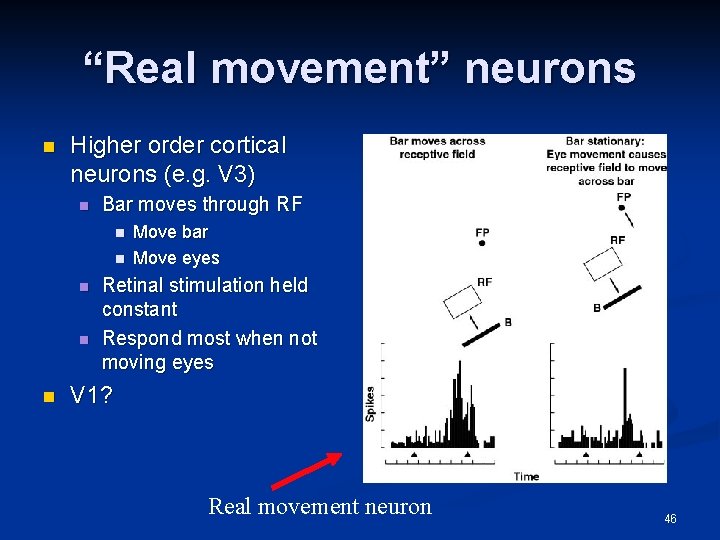
“Real movement” neurons n Higher order cortical neurons (e. g. V 3) n Bar moves through RF n n n Move bar Move eyes Retinal stimulation held constant Respond most when not moving eyes V 1? Real movement neuron 46
The End 47
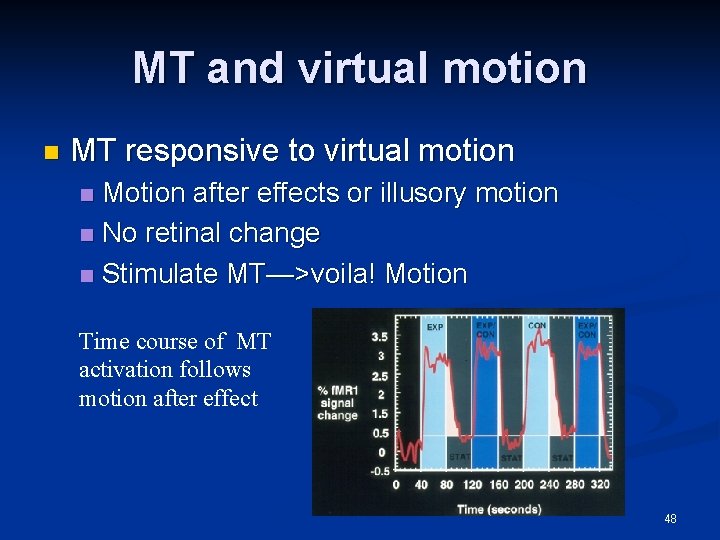
MT and virtual motion n MT responsive to virtual motion Motion after effects or illusory motion n No retinal change n Stimulate MT—>voila! Motion n Time course of MT activation follows motion after effect 48
3 D motion: More motion heuristics n Visual stimulus is ambiguous Multiple interpretations n Which is visual system attracted to? n n Vision assumes movement of rigid objects 49
Intelligence of motion perception 1. Notice oscillation in direction of motion: Due to single reversal 2. Look at with and without blinking your eyes 50