PROGRAM OF PHYSICS Lecturer Dr DO Xuan Hoi


- Slides: 39
PROGRAM OF “PHYSICS” Lecturer: Dr. DO Xuan Hoi Room 413 E-mail : dxhoi@hcmiu. edu. vn
PHYSICS 4 (Wave and Modern Physics) 02 credits (30 periods) Chapter 1 Mechanical Wave Chapter 2 Properties of Light Chapter 3 Introduction to Quantum Physics Chapter 4 Atomic Physics Chapter 5 Relativity and Nuclear Physics
References : Halliday D. , Resnick R. and Walker, J. (2005), Fundamentals of Physics, Extended seventh edition. John Willey and Sons, Inc. Alonso M. and Finn E. J. (1992). Physics, Addison. Wesley Publishing Company Hecht, E. (2000). Physics. Calculus, Second Edition. Brooks/Cole. Faughn/Serway (2006), Serway’s College Physics, Brooks/Cole. Roger Muncaster (1994), A-Level Physics, Stanley Thornes.
http: //ocw. mit. edu/Ocw. Web/Physics/index. htm http: //www. opensourcephysics. org/index. html http: //hyperphysics. phyastr. gsu. edu/hbase/HFrame. html http: //www. practicalphysics. org/go/Default. ht ml http: //www. msm. cam. ac. uk/ http: //www. iop. org/index. html. . .
PHYSICS 4 Chapter 3 Introduction to Quantum Physics The Wave Property of Electrons De Broglie’s Theory - Matter Wave The Schrödinger’s Equation The Heisenberg’s uncertainty principle Particle in a square well Tunneling Phenomena
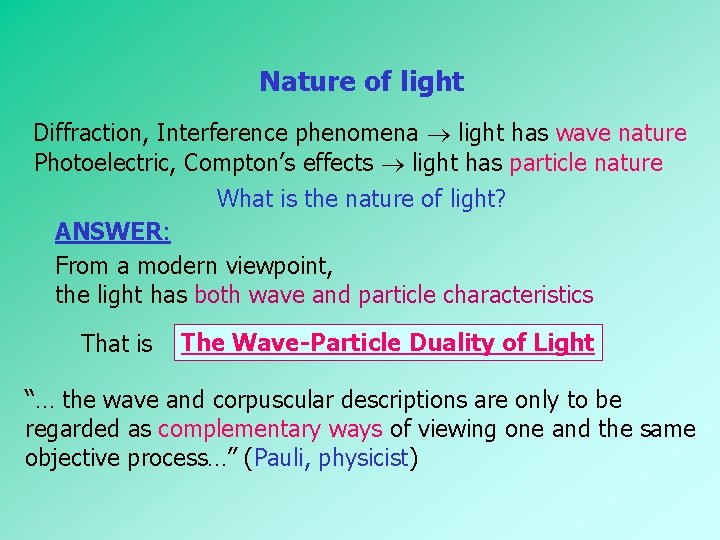
Nature of light Diffraction, Interference phenomena light has wave nature Photoelectric, Compton’s effects light has particle nature What is the nature of light? ANSWER: From a modern viewpoint, the light has both wave and particle characteristics That is The Wave-Particle Duality of Light “… the wave and corpuscular descriptions are only to be regarded as complementary ways of viewing one and the same objective process…” (Pauli, physicist)
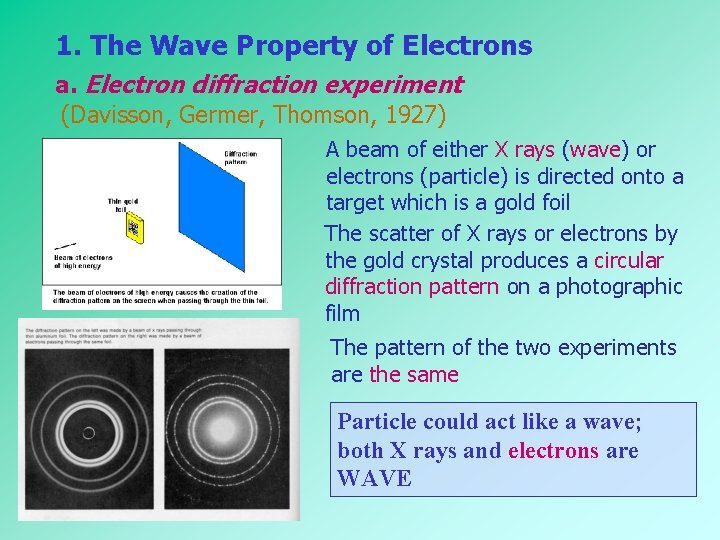
1. The Wave Property of Electrons a. Electron diffraction experiment (Davisson, Germer, Thomson, 1927) A beam of either X rays (wave) or electrons (particle) is directed onto a target which is a gold foil The scatter of X rays or electrons by the gold crystal produces a circular diffraction pattern on a photographic film The pattern of the two experiments are the same Particle could act like a wave; both X rays and electrons are WAVE
b. Discussion Similar diffraction and interference experiments have been realized with protons, neutrons, and various atoms (see “Atomic Interferometer”, Xuan Hoi DO, report of practice of Bachelor degree of Physics, University Paris-North, 1993) In 1994, it was demonstrated with iodine molecules I 2 Wave interference patterns of atoms Small objects like electrons, protons, neutrons, atoms, and molecules travel as waves - we call these waves “matter waves”
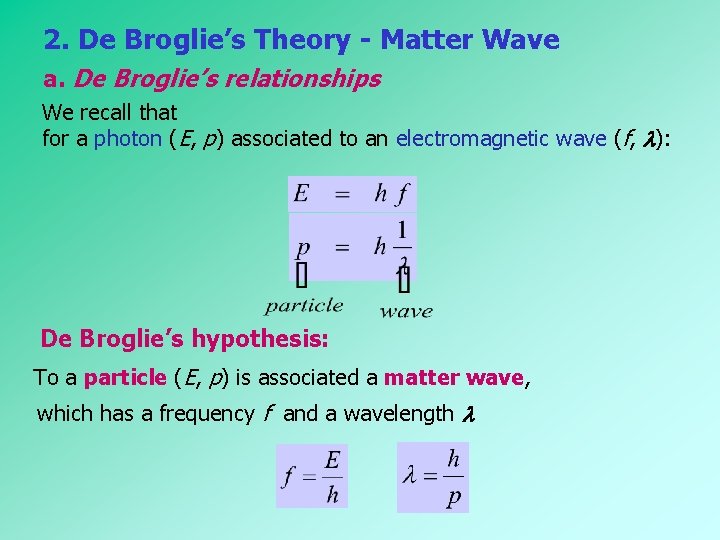
2. De Broglie’s Theory - Matter Wave a. De Broglie’s relationships We recall that for a photon (E, p) associated to an electromagnetic wave (f, ): De Broglie’s hypothesis: To a particle (E, p) is associated a matter wave, which has a frequency f and a wavelength
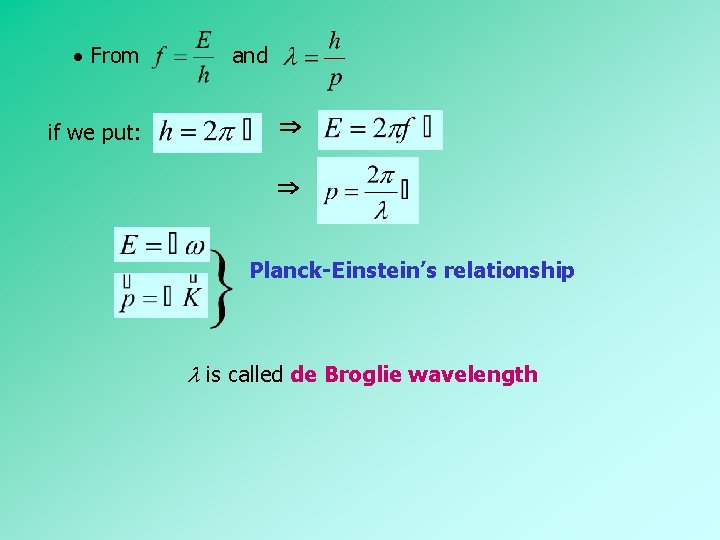
From if we put: and Planck-Einstein’s relationship is called de Broglie wavelength
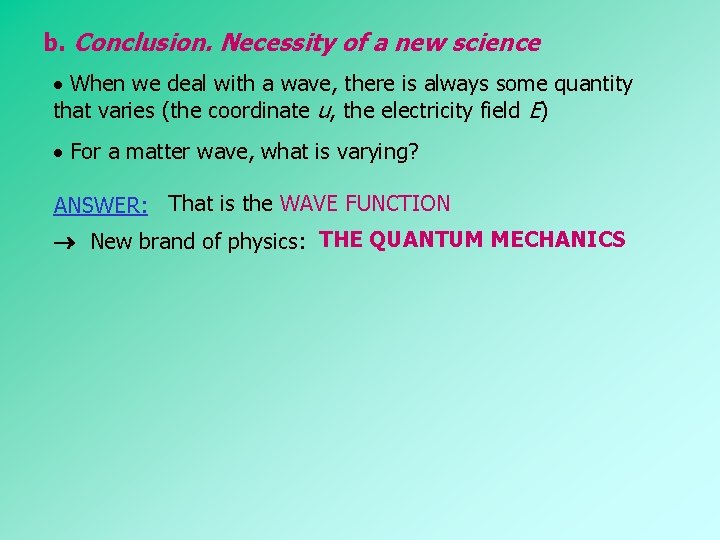
b. Conclusion. Necessity of a new science When we deal with a wave, there is always some quantity that varies (the coordinate u, the electricity field E) For a matter wave, what is varying? ANSWER: That is the WAVE FUNCTION New brand of physics: THE QUANTUM MECHANICS
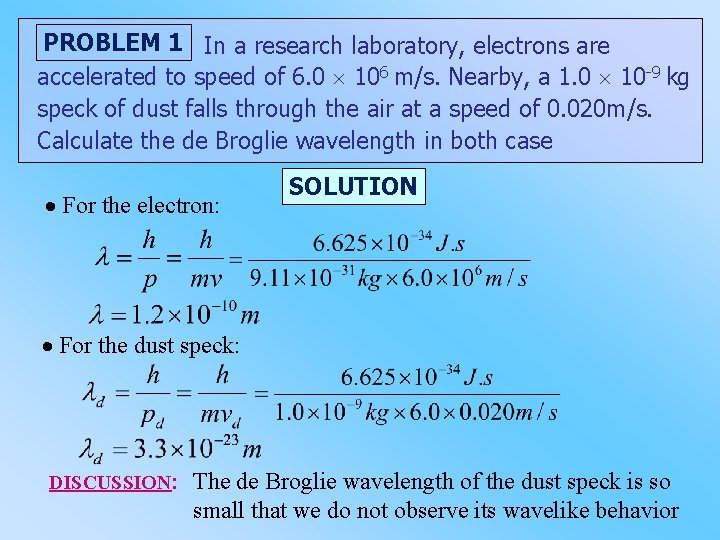
PROBLEM 1 In a research laboratory, electrons are accelerated to speed of 6. 0 106 m/s. Nearby, a 1. 0 10 -9 kg speck of dust falls through the air at a speed of 0. 020 m/s. Calculate the de Broglie wavelength in both case For the electron: SOLUTION For the dust speck: DISCUSSION: The de Broglie wavelength of the dust speck is so small that we do not observe its wavelike behavior
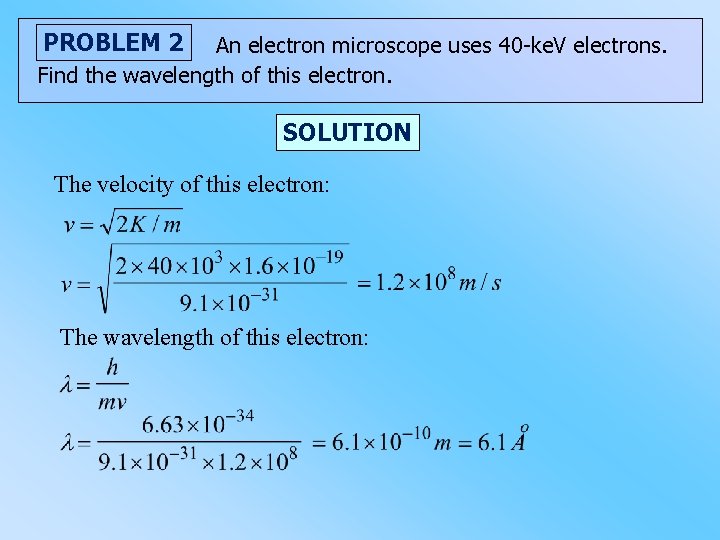
PROBLEM 2 An electron microscope uses 40 -ke. V electrons. Find the wavelength of this electron. SOLUTION The velocity of this electron: The wavelength of this electron:
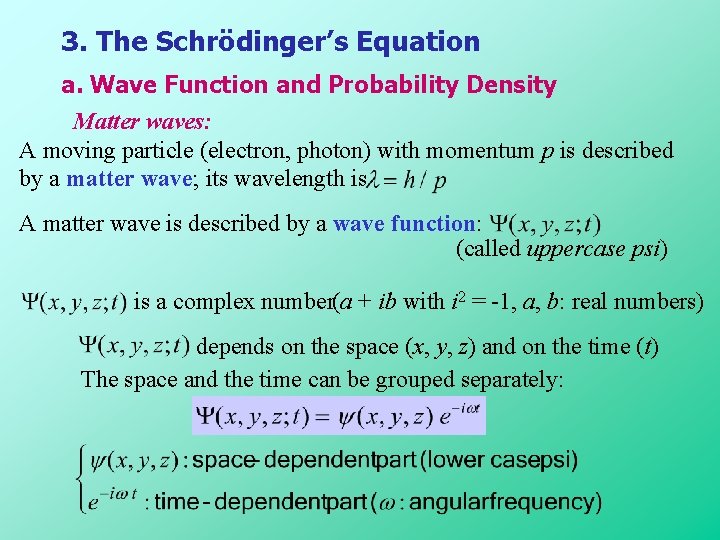
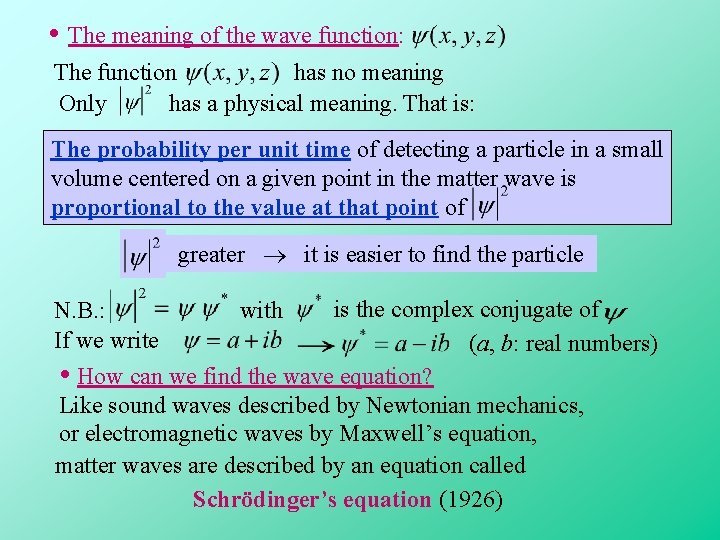
3. The Schrödinger’s Equation a. Wave Function and Probability Density Matter waves: A moving particle (electron, photon) with momentum p is described by a matter wave; its wavelength is A matter wave is described by a wave function: (called uppercase psi) is a complex number(a + ib with i 2 = -1, a, b: real numbers) depends on the space (x, y, z) and on the time (t) The space and the time can be grouped separately:
• The meaning of the wave function: The function has no meaning Only has a physical meaning. That is: The probability per unit time of detecting a particle in a small volume centered on a given point in the matter wave is proportional to the value at that point of greater it is easier to find the particle is the complex conjugate of (a, b: real numbers) • How can we find the wave equation? Like sound waves described by Newtonian mechanics, or electromagnetic waves by Maxwell’s equation, matter waves are described by an equation called Schrödinger’s equation (1926) N. B. : If we write with
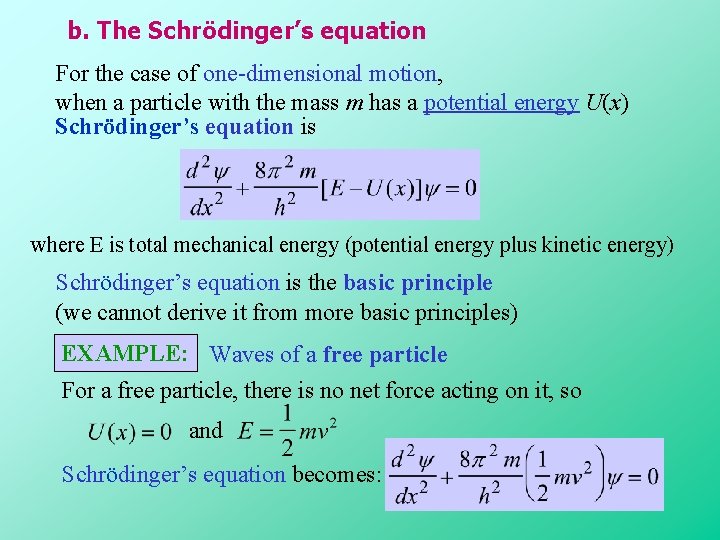
b. The Schrödinger’s equation For the case of one-dimensional motion, when a particle with the mass m has a potential energy U(x) Schrödinger’s equation is where E is total mechanical energy (potential energy plus kinetic energy) Schrödinger’s equation is the basic principle (we cannot derive it from more basic principles) EXAMPLE: Waves of a free particle For a free particle, there is no net force acting on it, so and Schrödinger’s equation becomes:
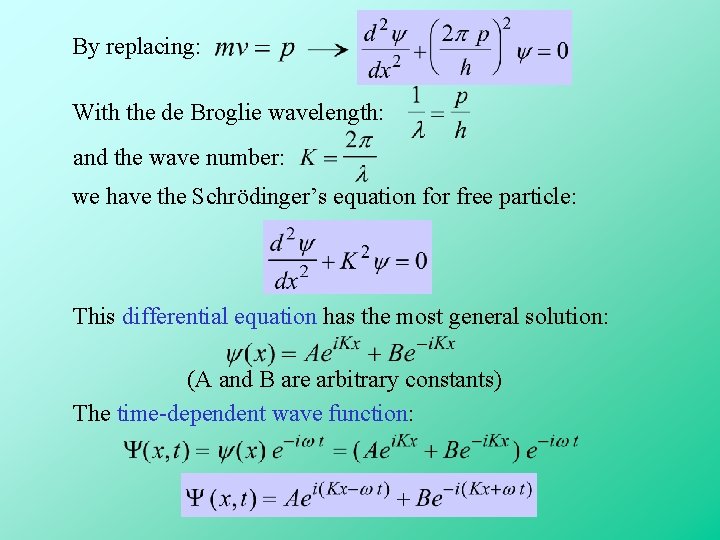
By replacing: With the de Broglie wavelength: and the wave number: we have the Schrödinger’s equation for free particle: This differential equation has the most general solution: (A and B are arbitrary constants) The time-dependent wave function:
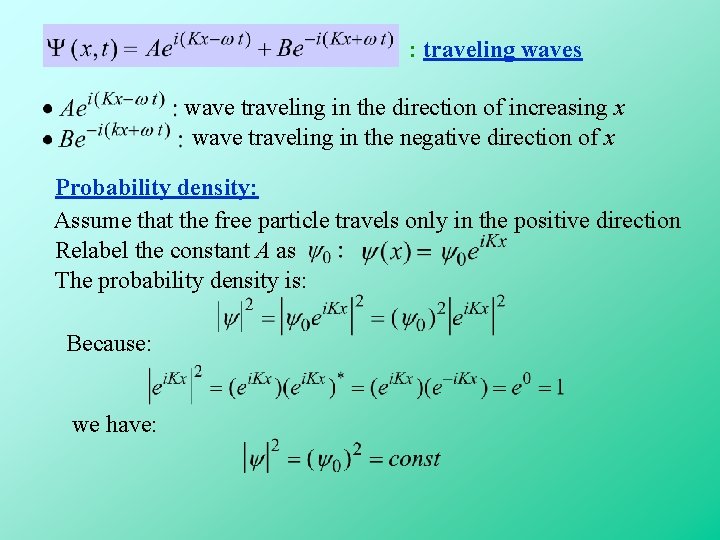
: traveling waves wave traveling in the direction of increasing x wave traveling in the negative direction of x Probability density: Assume that the free particle travels only in the positive direction Relabel the constant A as The probability density is: Because: we have:
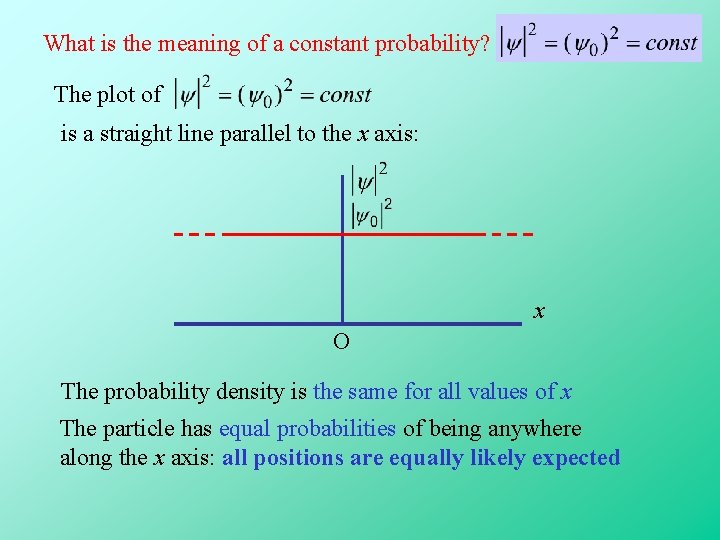
What is the meaning of a constant probability? The plot of is a straight line parallel to the x axis: x O The probability density is the same for all values of x The particle has equal probabilities of being anywhere along the x axis: all positions are equally likely expected
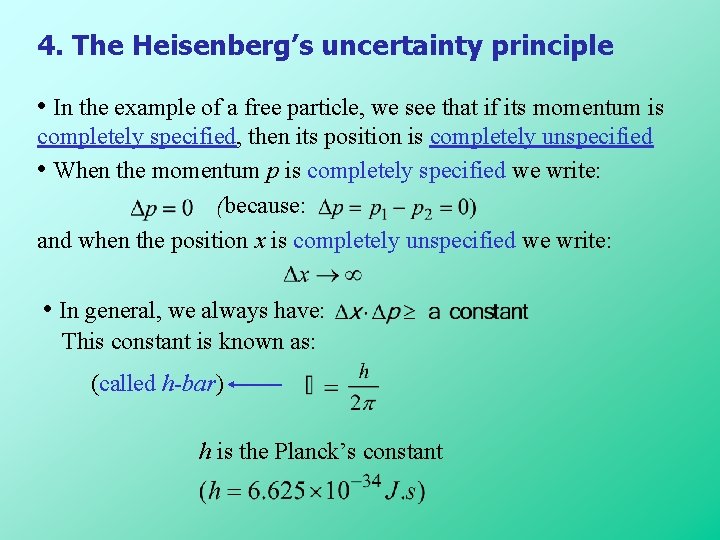
4. The Heisenberg’s uncertainty principle • In the example of a free particle, we see that if its momentum is completely specified, then its position is completely unspecified • When the momentum p is completely specified we write: (because: and when the position x is completely unspecified we write: • In general, we always have: This constant is known as: (called h-bar) h is the Planck’s constant
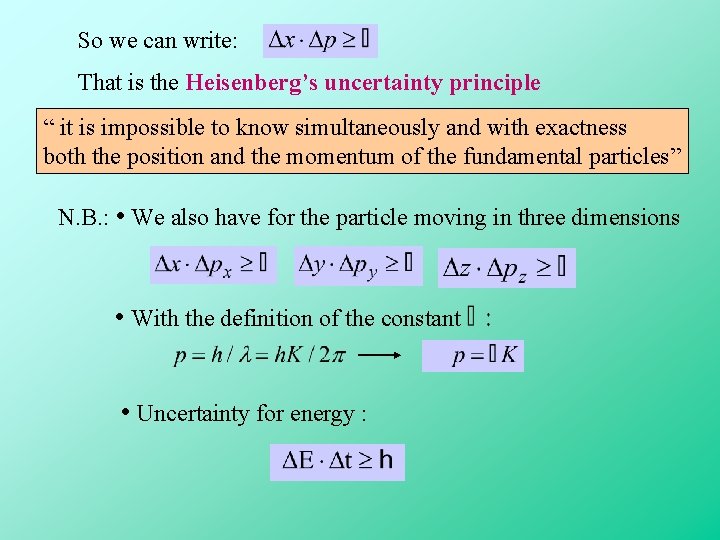
So we can write: That is the Heisenberg’s uncertainty principle “ it is impossible to know simultaneously and with exactness both the position and the momentum of the fundamental particles” N. B. : • We also have for the particle moving in three dimensions • With the definition of the constant • Uncertainty for energy :
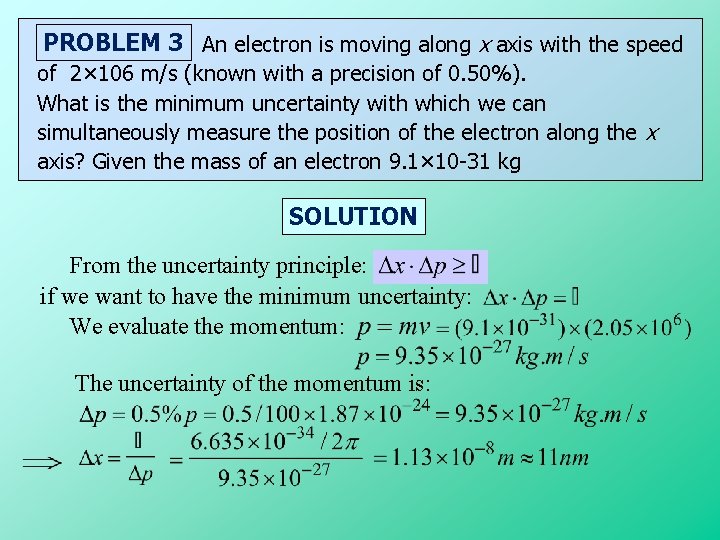
PROBLEM 3 An electron is moving along x axis with the speed of 2× 10⁶ m/s (known with a precision of 0. 50%). What is the minimum uncertainty with which we can simultaneously measure the position of the electron along the x axis? Given the mass of an electron 9. 1× 10 -31 kg SOLUTION From the uncertainty principle: if we want to have the minimum uncertainty: We evaluate the momentum: The uncertainty of the momentum is:
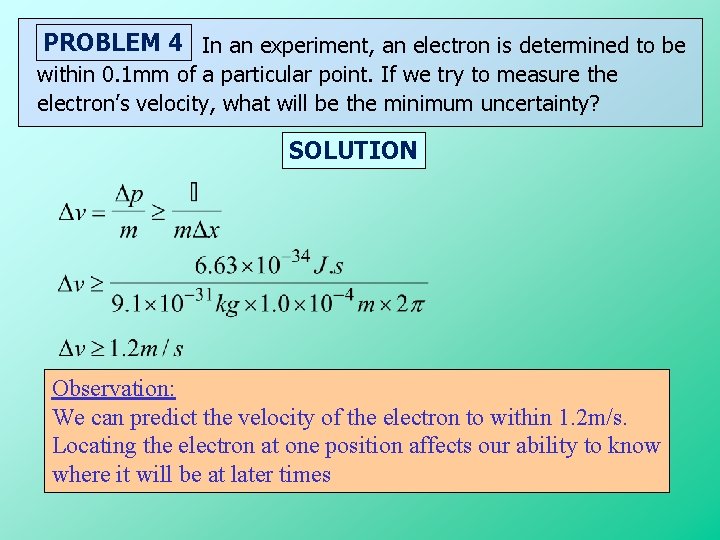
PROBLEM 4 In an experiment, an electron is determined to be within 0. 1 mm of a particular point. If we try to measure the electron’s velocity, what will be the minimum uncertainty? SOLUTION Observation: We can predict the velocity of the electron to within 1. 2 m/s. Locating the electron at one position affects our ability to know where it will be at later times
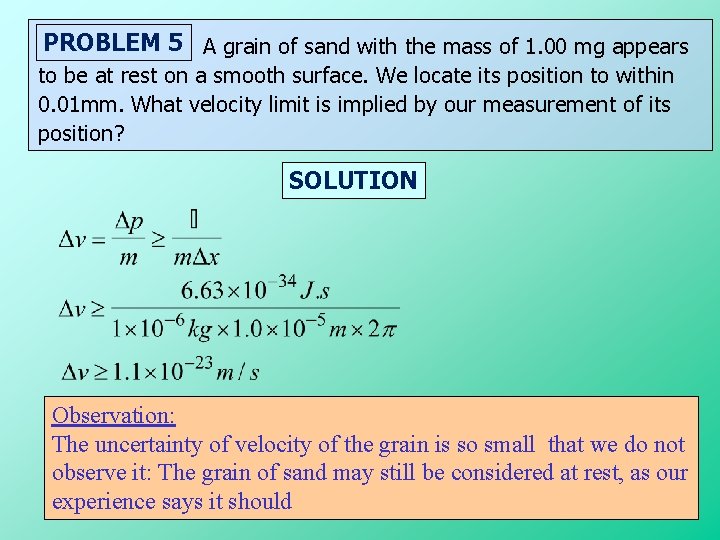
PROBLEM 5 A grain of sand with the mass of 1. 00 mg appears to be at rest on a smooth surface. We locate its position to within 0. 01 mm. What velocity limit is implied by our measurement of its position? SOLUTION Observation: The uncertainty of velocity of the grain is so small that we do not observe it: The grain of sand may still be considered at rest, as our experience says it should
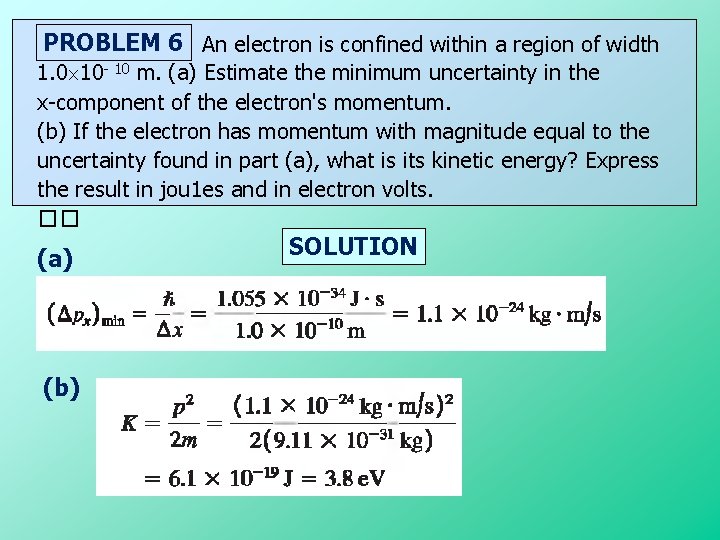
PROBLEM 6 An electron is confined within a region of width 1. 0 10 - 10 m. (a) Estimate the minimum uncertainty in the x-component of the electron's momentum. (b) If the electron has momentum with magnitude equal to the uncertainty found in part (a), what is its kinetic energy? Express the result in jou 1 es and in electron volts. �� (a) (b) SOLUTION
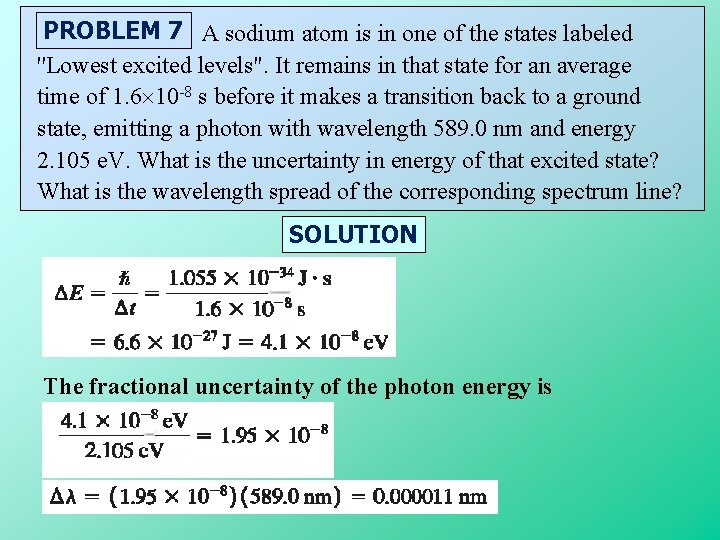
PROBLEM 7 A sodium atom is in one of the states labeled ''Lowest excited levels". It remains in that state for an average time of 1. 6 10 -8 s before it makes a transition back to a ground state, emitting a photon with wavelength 589. 0 nm and energy 2. 105 e. V. What is the uncertainty in energy of that excited state? What is the wavelength spread of the corresponding spectrum line? SOLUTION The fractional uncertainty of the photon energy is
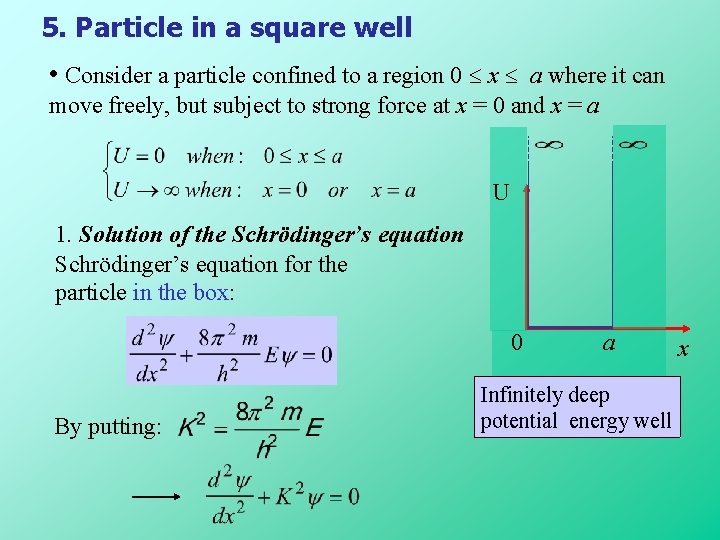
5. Particle in a square well • Consider a particle confined to a region 0 x a where it can move freely, but subject to strong force at x = 0 and x = a U 1. Solution of the Schrödinger’s equation for the particle in the box: 0 By putting: a Infinitely deep potential energy well x
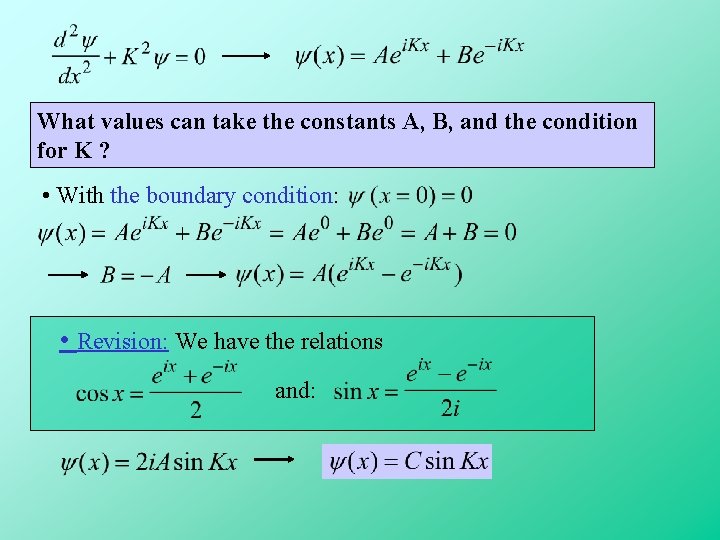
What values can take the constants A, B, and the condition for K ? • With the boundary condition: • Revision: We have the relations and:
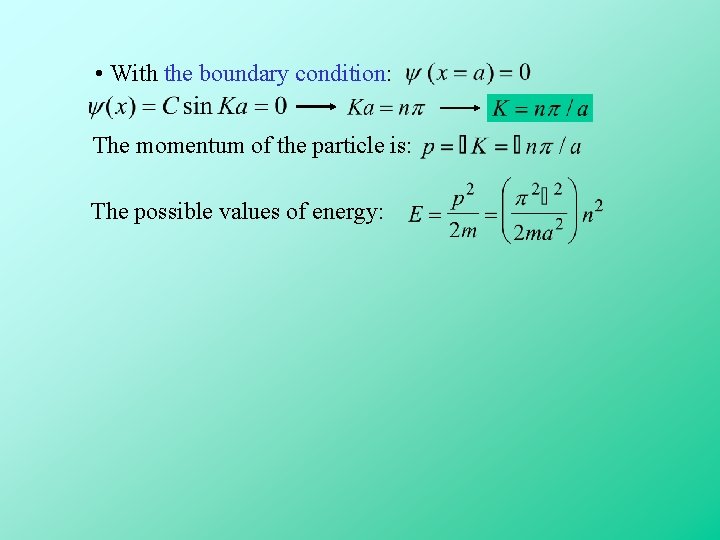
• With the boundary condition: The momentum of the particle is: The possible values of energy:
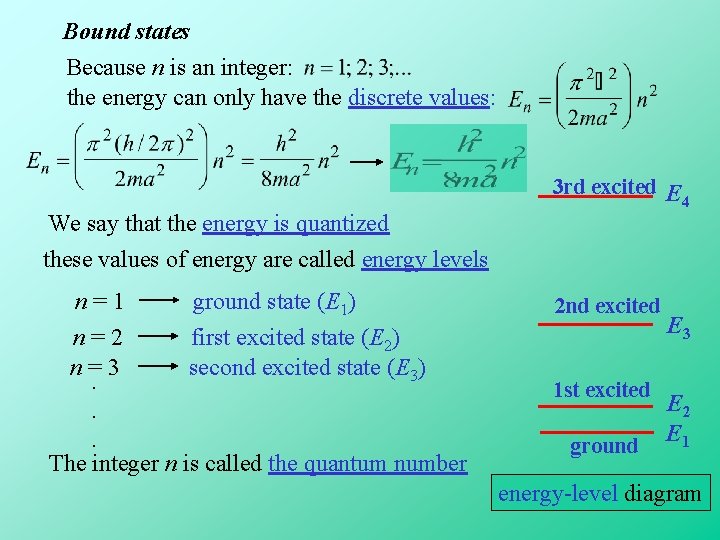
Bound states Because n is an integer: the energy can only have the discrete values: We say that the energy is quantized these values of energy are called energy levels n=1 ground state (E 1) n=2 first excited state (E 2) n=3 second excited state (E 3). . . The integer n is called the quantum number 3 rd excited E 4 2 nd excited 1 st excited ground E 3 E 2 E 1 energy-level diagram
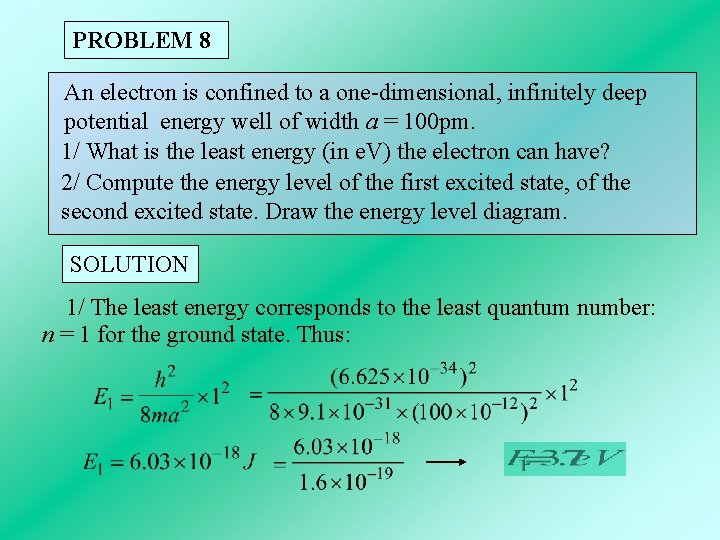
PROBLEM 8 An electron is confined to a one-dimensional, infinitely deep potential energy well of width a = 100 pm. 1/ What is the least energy (in e. V) the electron can have? 2/ Compute the energy level of the first excited state, of the second excited state. Draw the energy level diagram. SOLUTION 1/ The least energy corresponds to the least quantum number: n = 1 for the ground state. Thus:
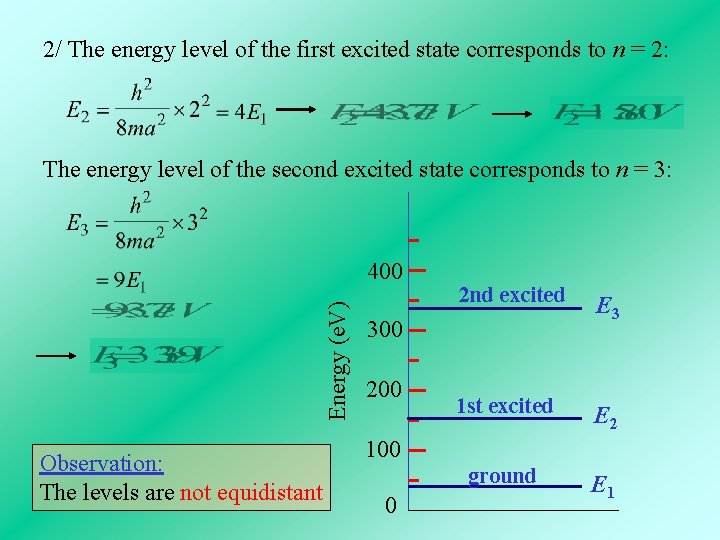
2/ The energy level of the first excited state corresponds to n = 2: The energy level of the second excited state corresponds to n = 3: Energy (e. V) 400 Observation: The levels are not equidistant 2 nd excited E 3 1 st excited E 2 ground E 1 300 200 100 0
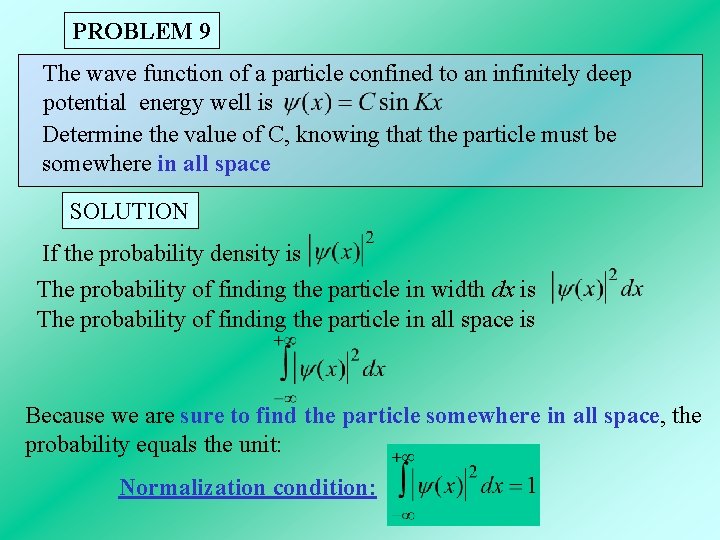
PROBLEM 9 The wave function of a particle confined to an infinitely deep potential energy well is Determine the value of C, knowing that the particle must be somewhere in all space SOLUTION If the probability density is The probability of finding the particle in width dx is The probability of finding the particle in all space is Because we are sure to find the particle somewhere in all space, the probability equals the unit: Normalization condition:
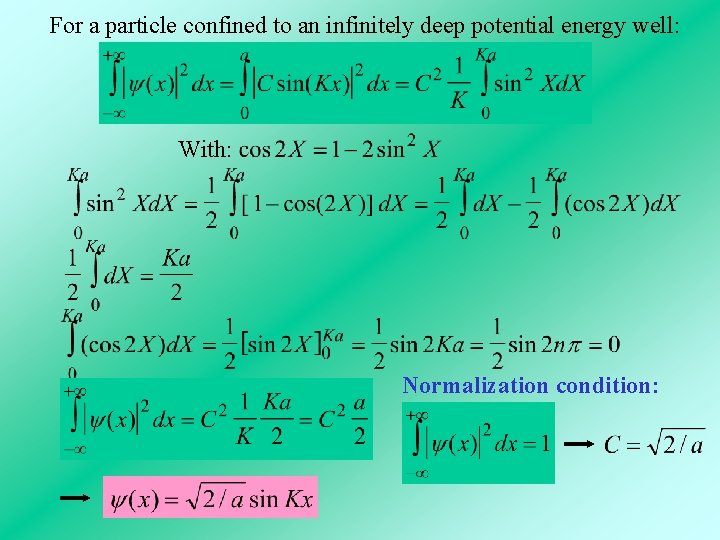
For a particle confined to an infinitely deep potential energy well: With: Normalization condition:
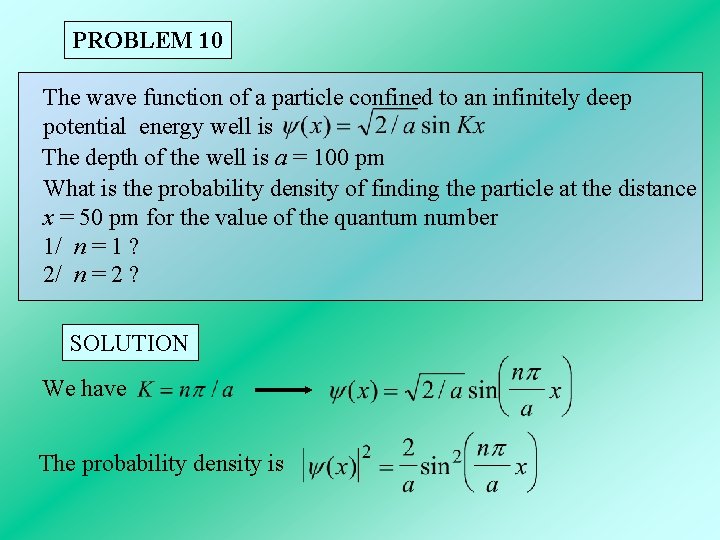
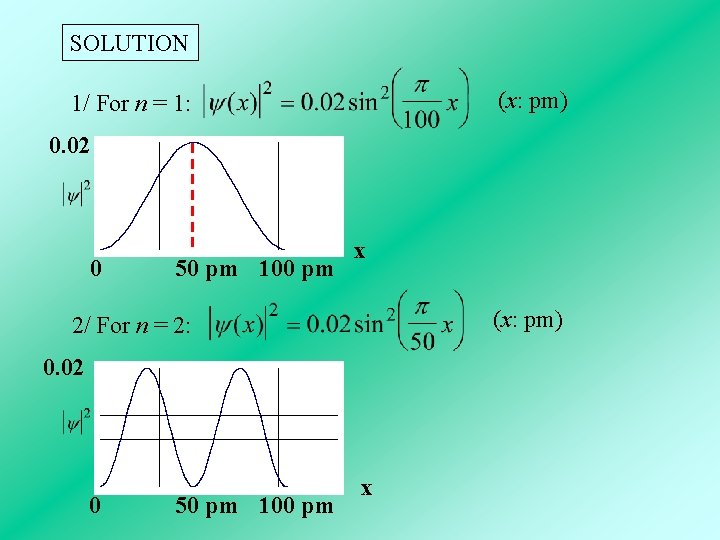
PROBLEM 10 The wave function of a particle confined to an infinitely deep potential energy well is The depth of the well is a = 100 pm What is the probability density of finding the particle at the distance x = 50 pm for the value of the quantum number 1/ n = 1 ? 2/ n = 2 ? SOLUTION We have The probability density is
SOLUTION (x: pm) 1/ For n = 1: 0. 02 0 50 pm 100 pm x (x: pm) 2/ For n = 2: 0. 02 0 50 pm 100 pm x
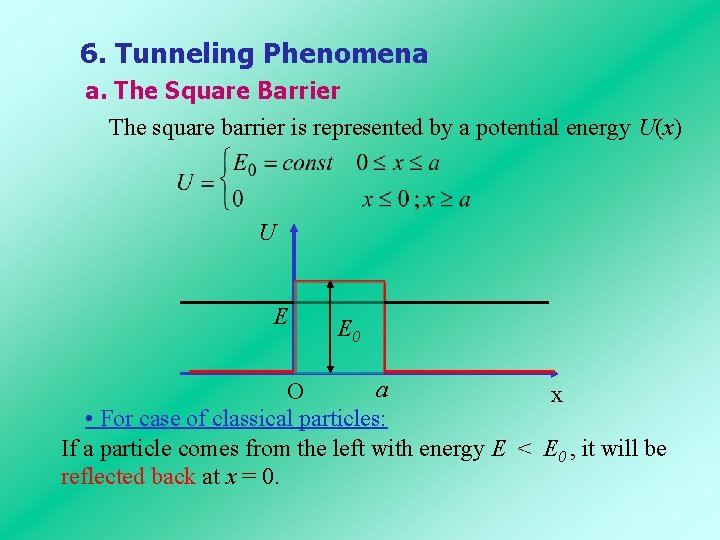
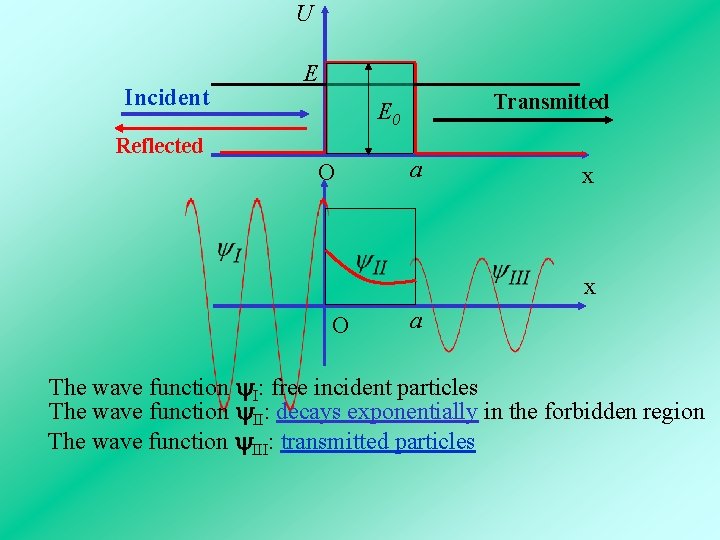
6. Tunneling Phenomena a. The Square Barrier The square barrier is represented by a potential energy U(x) U E E 0 a O x • For case of classical particles: If a particle comes from the left with energy E < E 0 , it will be reflected back at x = 0.
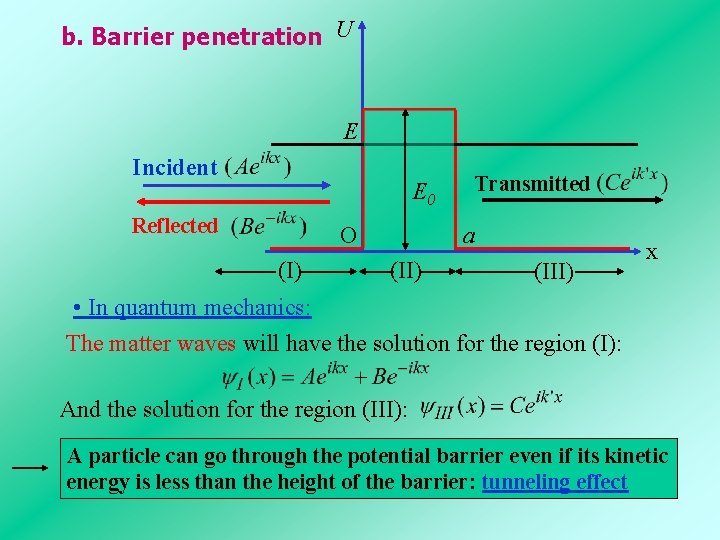
b. Barrier penetration U E Incident E 0 Reflected a O (I) Transmitted (II) (III) x • In quantum mechanics: The matter waves will have the solution for the region (I): And the solution for the region (III): A particle can go through the potential barrier even if its kinetic energy is less than the height of the barrier: tunneling effect
U Incident E Transmitted E 0 Reflected O a x x O a The wave function I: free incident particles The wave function II: decays exponentially in the forbidden region The wave function III: transmitted particles