Productivity and Quality Management Lecture 12 Summary of








- Slides: 63
Productivity and Quality Management Lecture 12
Summary of Last Lecture • Philosophy of Total Productive Maintenance (TPM) • History of TPM • Types of Maintenance • Objectives and Policies of TPM • Similarities and Differences between TPM and TQM
This Lecture • • • TPM Models and Theories 5 S Theory Pillars of TPM Implementation Benefits of Applying Total Productive Maintenance
TPM MODELS AND THEORIES
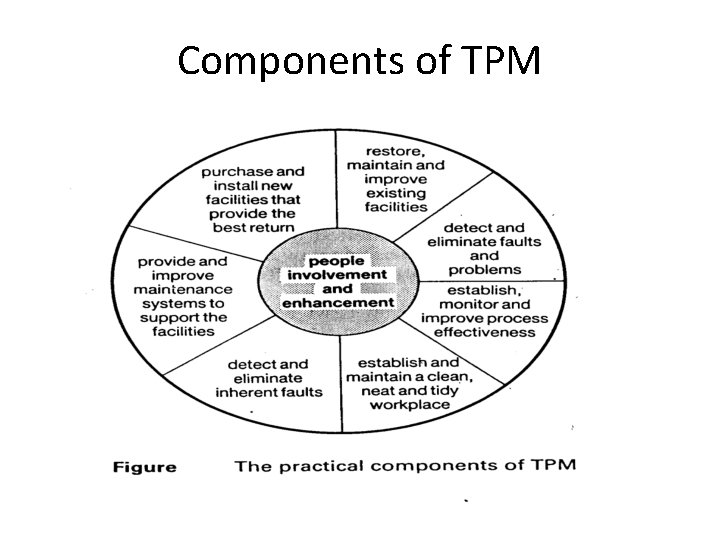
Components of TPM
MUDA: 7 Types of Production Losses • TPM identifies seven types losses (types of waste) (muda), namely: – – – – Set-up Initial adjustment time Equipment breakdown time Idling and minor losses Speed (cycle time) losses Start-up quality losses, and Process quality losses It then works systematically to eliminate them by making improvements (kaizen).
5 S PHILOSOPHY
5 S Philosophy �Based on five Japanese words that begin with ‘S’, the 5 S Philosophy focuses on effective work place organization and standardized work procedures. 5 S’s 1. Sort : (Seiri) 2. Set In Order: (Seiton) 3. Shine: (Seiso) 4. Standardize: (Seiketsu) 5. Sustain: (Shitsuke)
Sort : (Seiri) • The first S focuses on eliminating unnecessary items from the workplace. • An effective visual method to identify these unneeded items is called red tagging. • A red tag is placed on all items not required to complete your job. These items are then moved to a central holding area. • This process is for evaluation of the red tag items.
Set In Order: (Seiton) • second S focuses on efficient and effective storage methods and how to organize the work area. • Strategies for effective Set In Order are painting floors, outlining work areas and locations, shadow boards, and modular shelving and cabinets for needed items such as trash cans, brooms, mop and buckets
Shine: (Seiso) • Once you have eliminated the clutter and junk that has been clogging your work areas and identified the necessary items, the next step is to thoroughly clean the work area. • Workers will also begin to notice changes in equipment and facility location such as air, oil, coolant leaks, fatigue, breakage, and misalignment. • These changes, if left unattended, could lead to equipment failure and loss of production.
Standardize: (Seiketsu) • Now the first three S’s are implemented. • Use standard methods to keep Sort, Set In Order, and Shine to a condition. • Allow your employees to participate in the development of such standards.
Sustain: (Shitsuke) • This is the most difficult S to implement and achieve. • Maintain through empowerment, commitment, and discipline. • Sustain focuses on defining a new status quo and standard of work place organization.
Benifits of 5 S’s • • • Simplifies work environment reduces waste Improves quality Improves safety Provide self esteem for everyone in the organization.
PILLARS OF TPM
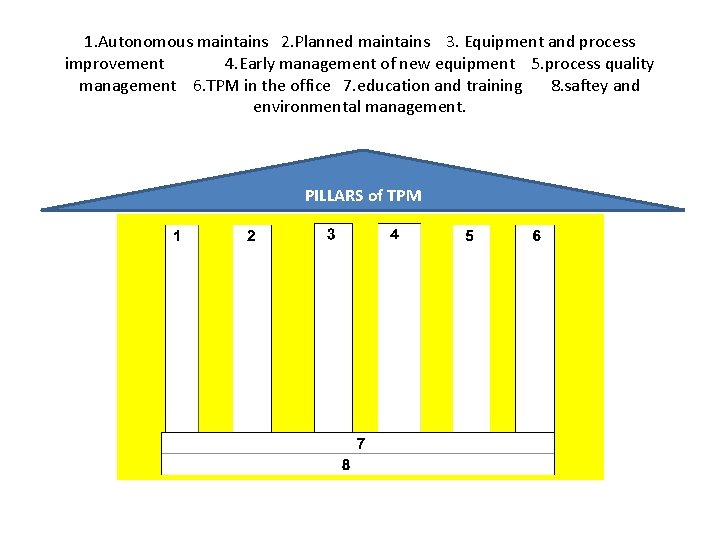
Eight Pillars of TPM Activity • TPM has 8 pillars of activity, [2] each being set to achieve a “zero” target. These 8 pillars are the following: – – – – Focused improvement (Kobetsu Kaizen); Autonomous maintenance (Jishu Hozen); Planned maintenance training and education early-phase management quality maintenance (Hinshitsu Hozen); Office TPM Safety, Health & Environment • Some organizations also additional pillars according to their work place like: – Tools Management – Information Technology
1. Autonomous maintains 2. Planned maintains 3. Equipment and process improvement 4. Early management of new equipment 5. process quality management 6. TPM in the office 7. education and training 8. saftey and environmental management. PILLARS of TPM
Autonomous Maintenance (1) • Train the operators to close the gap between them and the maintenance staff, making it easier for both to work as one team • Change the equipment so the operator can identify any abnormal conditions and measure before it affects the process or leads to a failure
Autonomous Maintenance (2) �Seven (7) steps are implemented to progressively increase operators knowledge, participation and responsibility for the equipment. 1. perform initial cleaning and inspection 2. Countermeasures for the causes and effects of dirt and dust 3. Eastblish cleaning and lubrication standards 4. Counducting general inspection training 5. Carry out equipment inspection checks 6. workplace management and controls 7. Continious improvement
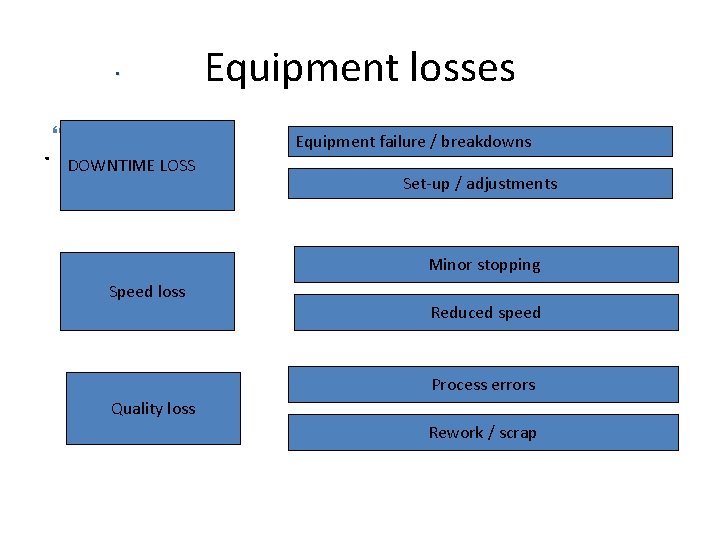
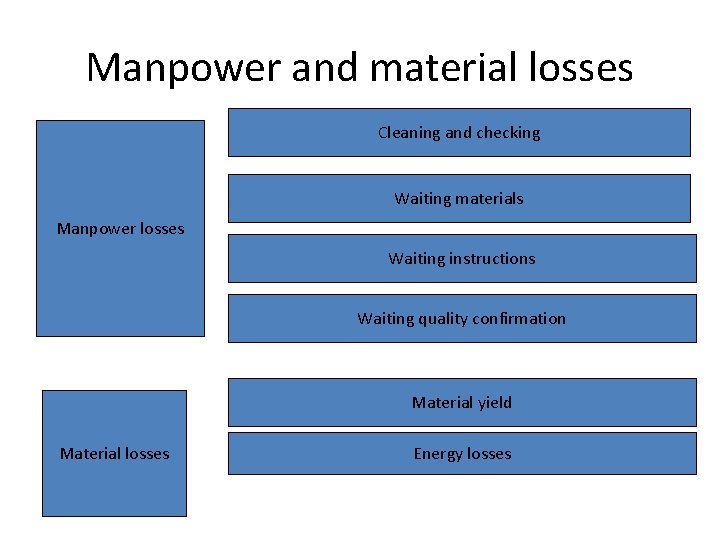
Equipment and process improvement (3) �Objectives: Maximize efficiency by eliminating waste and manufacturing loss �Manufacturing losses are categorized into 13 bid losses: � Equipment losses (6) � Manpower losses (4) � Material losses (3)
. . . Equipment losses Equipment failure / breakdowns DOWNTIME LOSS Set-up / adjustments Minor stopping Speed loss Reduced speed Process errors Quality loss Rework / scrap
Manpower and material losses • . Cleaning and checking Waiting materials Manpower losses Waiting instructions Waiting quality confirmation Material yield Material losses Energy losses
TPM Success Measurement • A set of performance metrics which is considered to fit well in a lean manufacturing/TPM environment is overall equipment effectiveness, or OEE. • For advanced TPM world class practitioners, the OEE cannot be converted to costs using Target Costing Management (TCM) • OEE measurements are used as a guide to the potential improvement that can be made to equipment and by identifying which of the 6 losses is the greater, then the techniques applicable to that type of loss. • Consistent application of the applicable improvement techniques to the sources of major losses will positively impact the performance of that equipment. • Using a criticality analysis across the factory should identify which equipment should be improved first, also to gain the quickest overall factory performance. • The use of Cost Deployment is quite rare, but can be very useful in identifying the priority for selective TPM deployment.
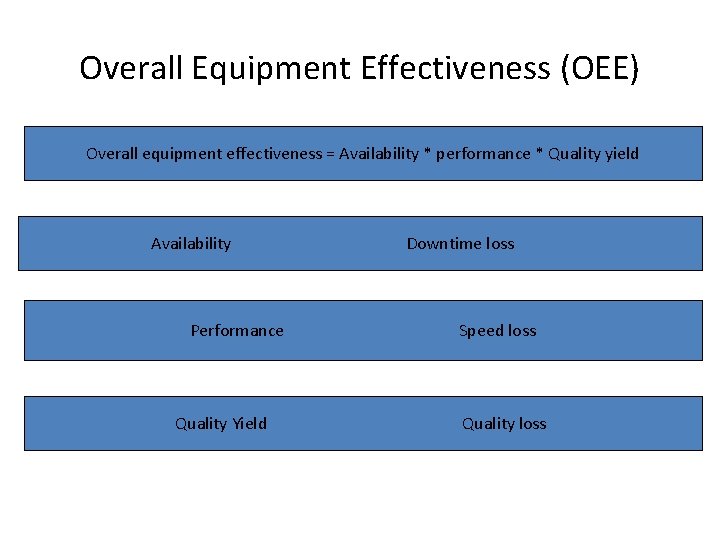
Overall Equipment Effectiveness • OEE figures are determined by combining the availability and performance of your equipment with the quality of parts made • OEE measures the efficiency of the machine during its loading time. • Planned downtime does not effect the OEE figure
Overall Equipment Effectiveness (OEE) • . Overall equipment effectiveness = Availability * performance * Quality yield Availability Performance Quality Yield Downtime loss Speed loss Quality loss
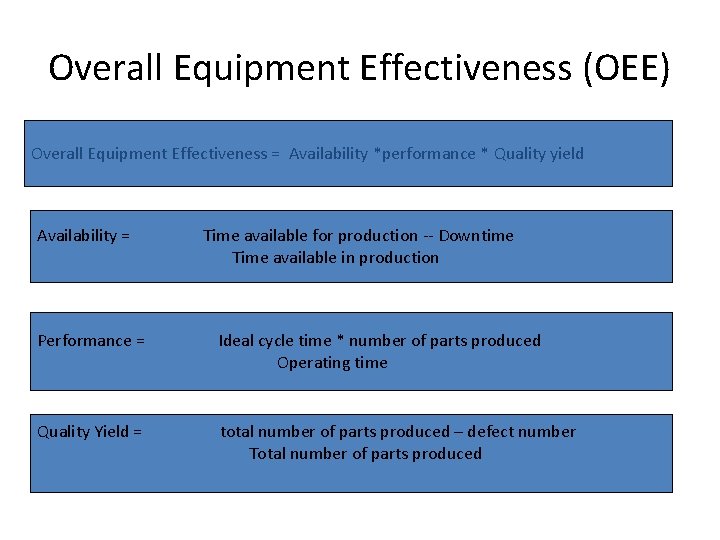
Overall Equipment Effectiveness (OEE) • . Overall Equipment Effectiveness = Availability *performance * Quality yield Availability = Time available for production -- Downtime Time available in production Performance = Ideal cycle time * number of parts produced Operating time Quality Yield = total number of parts produced – defect number Total number of parts produced
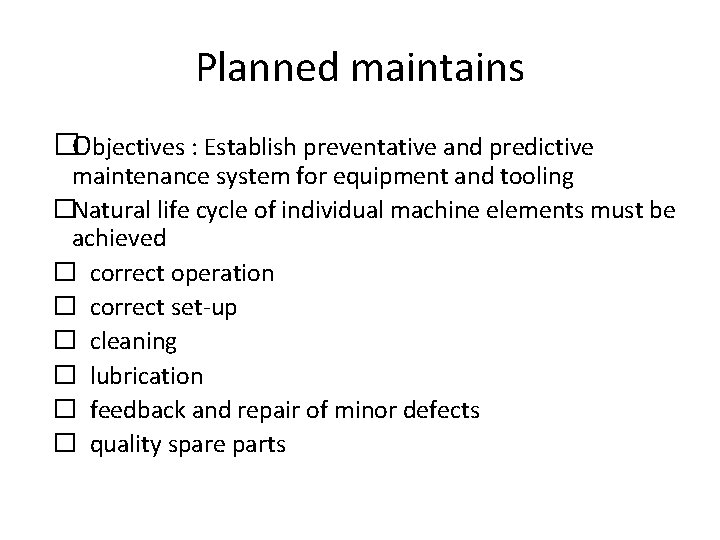
Planned maintains �Objectives : Establish preventative and predictive maintenance system for equipment and tooling �Natural life cycle of individual machine elements must be achieved � correct operation � correct set-up � cleaning � lubrication � feedback and repair of minor defects � quality spare parts
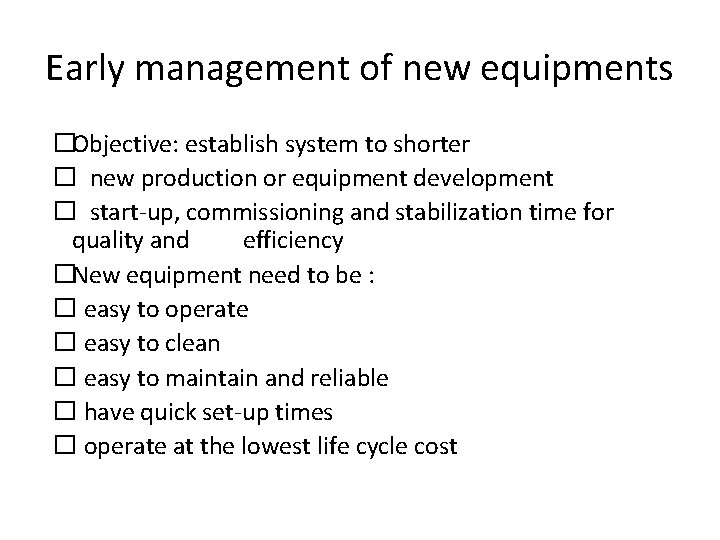
Early management of new equipments �Objective: establish system to shorter � new production or equipment development � start-up, commissioning and stabilization time for quality and efficiency �New equipment need to be : � easy to operate � easy to clean � easy to maintain and reliable � have quick set-up times � operate at the lowest life cycle cost
Process quality management �Definition: a process for controlling the condition of equipment components that affect variability in product quality �Objectives: to set and maintain condition to accomplish zero definition �Quality rate has direct correlation with � material condition � equipment precision � production methods � process parameters
TPM in administration and support department • Administration and support departments can be seen as process plans whose principles tasks are to collect, process and distribute information. • Process analysis should be applied to streaming information flow
Education and training • TPM is a continuous learning process • Two major components : • soft skills training : how to work as a team, diversity training and communication skills • Technical training : upgrading problem-solving and equipment-related skills
Safety and environmental management • Assuring safety and preventing adverse environment impacts are important priority in ant TPM effort
Requirement and fundamental improvements • Increasing motivation: changing people attitudes • Increasing competency and people skills • Improving the work environment, so that it support the establishment of a program for implementing TPM
TPM IMPLEMENTATION
History of TPM Implementation • TPM first introduced in Japan 20 years ago and rigorously been applied in past 10 years • TPM planning & implementation in Japanese factories supported by JIPM (Japan Institute of Plant Maintenance) • Awarded yearly prizes to various industries: ü ü ü Automotive Metals Chemicals Rubber Food Glass etc.
History of TPM Implementation • Initially implemented in high-to-medium volume production areas • Later successfully applied in: ü Low-volume production ü High-to-low volume assembly ü Development areas ü Warehouse ü Whole range of industry
Challenges in Implementing TPM • TPM has basically three primary goals: – Zero Product Defects – Zero Equipment Unplanned Failures and – Zero Accidents • It sets out to achieve these goals by Gap Analysis of previous historical records of Product Defects, Equipment Failures and Accidents. • Through a clear understanding of this Gap Analysis through Fishbone Cause-Effect Analysis, Why-Why Cause-Effect Analysis, and P-M Analysis enables physical investigation to discover new latent Fuguai (slight deterioration) during the first step in TPM Autonomous Maintenance, a process called "Initial Cleaning".
Corporate Adoption of TPM • A typical TPM implementation requires companywide participation and full results can only be seen after 3 years and sometimes 5 years. • The main reason for this long duration is due to the basic involvement and training required for Autonomous Maintenance participation where operators participate in the restoring the equipment to its original capability and condition and then improving the equipment.
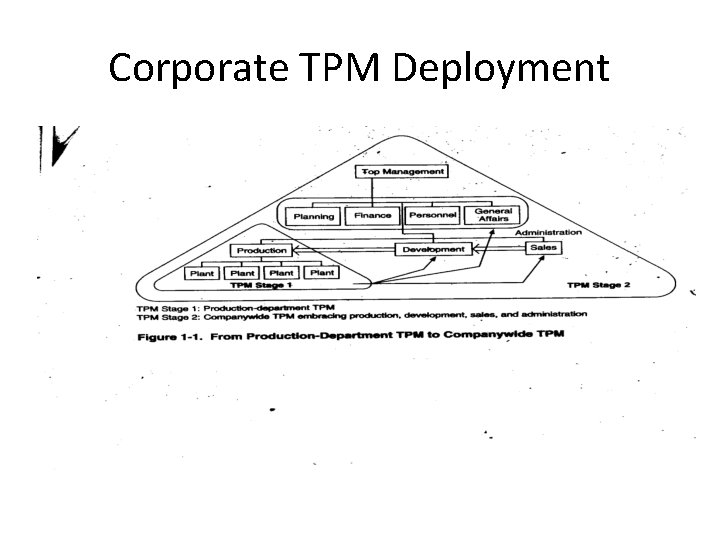
Corporate TPM Deployment
TPM Development Plan Preparation 1. Formally announce the decision to introduce TPM 2. Conduct TPM introductory education and publicity campaign 3. Create TPM promotion organization 4. Establish basic TPM policy and goals 5. Draft a master plan for implementing TPM
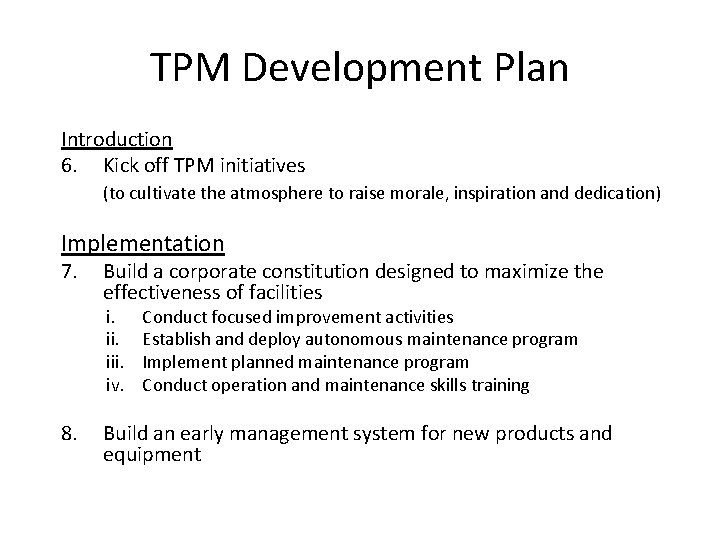
TPM Development Plan Introduction 6. Kick off TPM initiatives (to cultivate the atmosphere to raise morale, inspiration and dedication) Implementation 7. Build a corporate constitution designed to maximize the effectiveness of facilities i. iii. iv. 8. Conduct focused improvement activities Establish and deploy autonomous maintenance program Implement planned maintenance program Conduct operation and maintenance skills training Build an early management system for new products and equipment
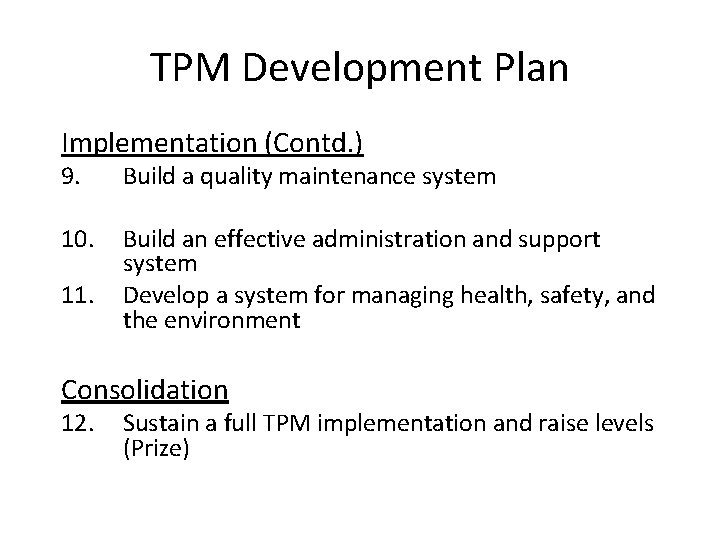
TPM Development Plan Implementation (Contd. ) 9. Build a quality maintenance system 10. Build an effective administration and support system Develop a system for managing health, safety, and the environment 11. Consolidation 12. Sustain a full TPM implementation and raise levels (Prize)
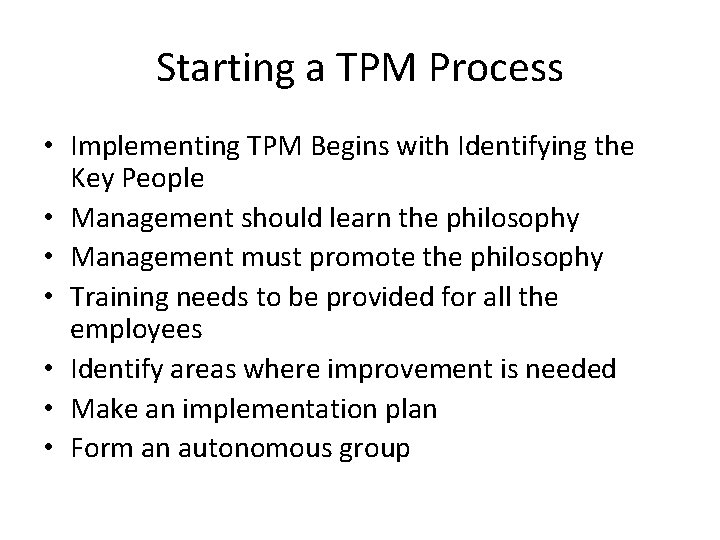
Starting a TPM Process • Implementing TPM Begins with Identifying the Key People • Management should learn the philosophy • Management must promote the philosophy • Training needs to be provided for all the employees • Identify areas where improvement is needed • Make an implementation plan • Form an autonomous group
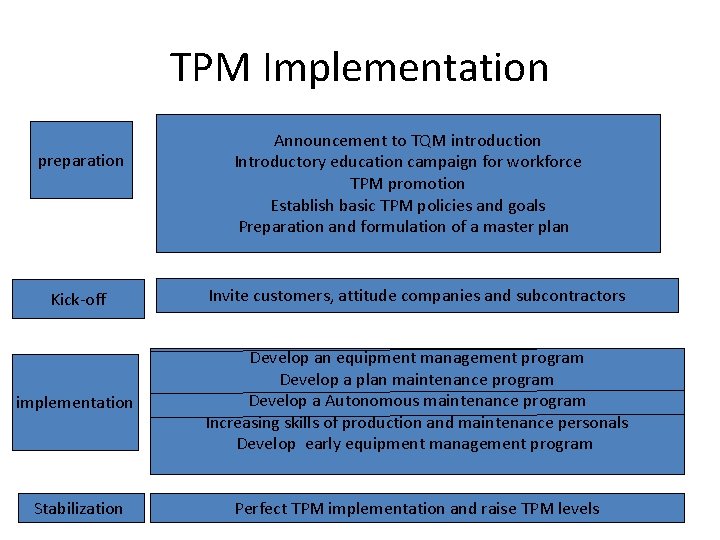
TPM Implementation • . preparation Announcement to TQM introduction Introductory education campaign for workforce TPM promotion Establish basic TPM policies and goals Preparation and formulation of a master plan Kick-off Invite customers, attitude companies and subcontractors implementation Develop an equipment management program Develop a plan maintenance program Develop a Autonomous maintenance program Increasing skills of production and maintenance personals Develop early equipment management program Stabilization Perfect TPM implementation and raise TPM levels
Fast Track TPM Implementation • An effective “Fast-Track TPM Implementation Approach” has been successful in a paper mill, in electronics industries and documented. • It circumvented this problem by assigning Project Teams to do “Autonomous Maintenance” for the AM Steps including: 1) Initial Cleaning 2) Eliminating Sources of Contamination and Improving Equipment Accessibility. 3) Production Operators take over the Autonomous Maintenance after the AM Step 3 (Initial Maintenance Standards) has been established. • This has been proven to reduce TPM implementation time by about 50%.
Announce top management decision to introduce TPM • State TPM objectives in a company newsletter • Place articles on TPM in a company newspaper
Introductory education campaign • Seminars for managers • Slide presentation for all employs
TPM Promotion • • • Special committees at every level to promote TPM Newsletter Articles Videos Posters
Establishing basic TPM policies and goals • Analyze existing conditions • Set goals • Predicting results
Preparation and Formulation of a master plan • A master plan lays out your goals, what you will do to achieve them and when you will achieve them • Detailed plans for each pillar have to be prepared
TPM Kick-off • The main kick-off to TPM should take the form of a formal presentation with all the employees attending • This opportunity can be used to gain the full support of the employees • Invite external customers, affiliation and subcontracting companies
Develop an equipment management program �The principle of designing for maintenance prevention can be new products, and to new existing machines �New products: must be designed so that they can be easily produced on new existing machines �New machines : must be designed for easier operation, changeover and maintenance �Existing machines: �Determine how to eliminate the problem and reduce maintenance through an equipment design change or by changing the process
TPM BENEFITS
Why TPM is So Popular Three main reasons: 1. It guarantees dramatic results (Significant tangible results) • Reduce equipment breakdowns • Minimize idle time and minor stops • Less quality defects and claims • Increase productivity • Reduce manpower and cost • Lower inventory • Reduce accidents
Why TPM is So Popular 2. Visibly transform the workplace (plant environment) • • • Through TPM, a filthy, rusty plant covered in oil and grease, leaking fluids and spilt powders can be reborn as a pleasant and safe working environment Customers and other visitors are impressed by the change Confidence on plant’s product increases
Why TPM is So Popular 3. Raises the level of workers knowledge and skills As TPM activities begin to yield above concrete results, it helps: • The workers to become motivated • Involvement increases • Improvement suggestions proliferate • People begin to think of TPM as part of the job
TPM Benefits • Increase equipment productivity • • • Reduced equipment downtime Increased plan capacity Lower maintenance and production cost Approaching zero equipment-caused defects Enhance job satisfaction Increase return on investment
conclusion • TPM may be the only thing that stands between success and total failure for some companies. • It can be adapted to work not only in industrial plants, but in construction, building maintenance, transportation, and in a variety of other situations.
Summary • • • TPM Models and Theories 5 S Theory Pillars of TPM Implementation Benefits of Applying Total Productive Maintenance
Improving Productivity