Position Criticality in Chess Endgames Guy Haworth and

- Slides: 19
Position Criticality in Chess Endgames Guy Haworth and Árpád Rusz guy. haworth@bnc. oxon. org 1 Pos. Crit. , 2011 -11 -11
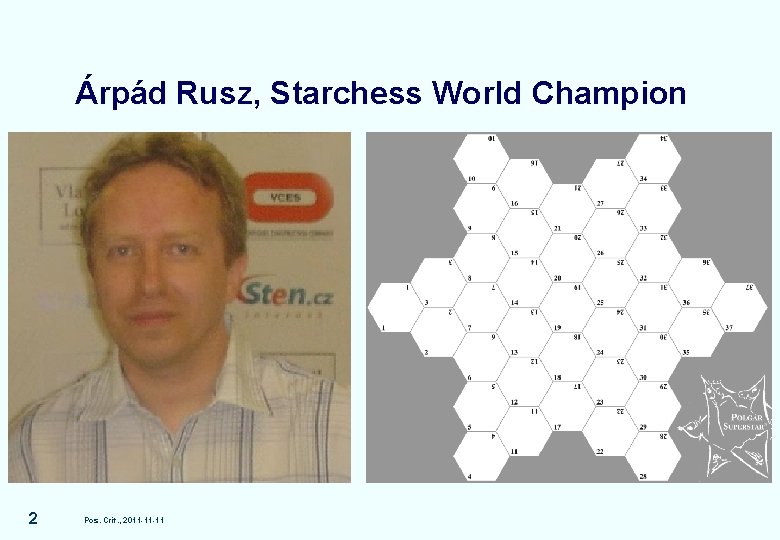
Árpád Rusz, Starchess World Champion 2 Pos. Crit. , 2011 -11 -11
Topics l l l l 3 Original inspiration Example problem to solve: the Saavedra study Problems with the graph as a proof mechanism The chess variant, Chess(SP) Algorithm and implementation Supplementary solvable problems Arpad’s Starchess implementation Futures Pos. Crit. , 2011 -11 -11
The original inspiration: the Chess Win Study the most famous study. . . Saavedra & Barbier (1895): 1. c 7 Rd 6+ 2. Kb 5 Rd 5+ 3. Kb 4 Rd 4+ 4. Kb 3 Rd 3+ 5. Kc 2 Rd 4! 6. c 8=R!! c 7"' 1 w 4 1 b Kb 5"' 2 Pos. Crit. , 2011 -11 -11 Kb 4“(‘) 3 4 Kc 2"' 5 6 Kb 3"' 7 Photo by Matt Scott, used under a CCA 2. 0 Generic license
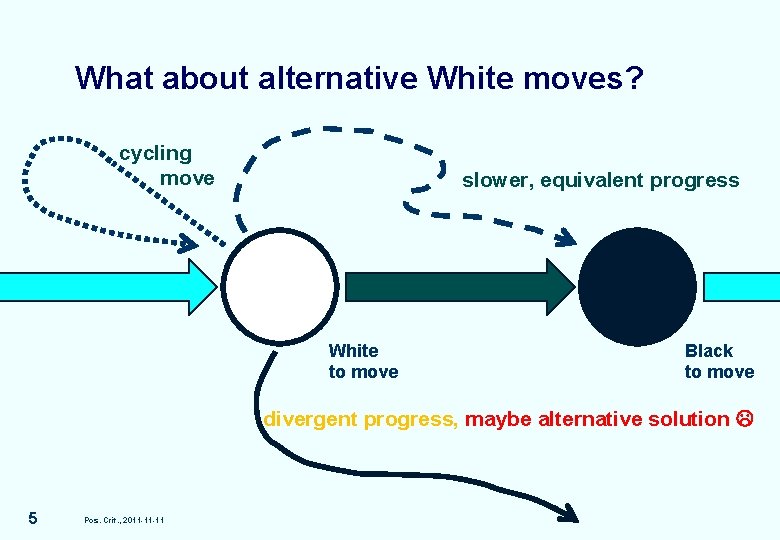
What about alternative White moves? cycling move slower, equivalent progress White to move Black to move divergent progress, maybe alternative solution 5 Pos. Crit. , 2011 -11 -11
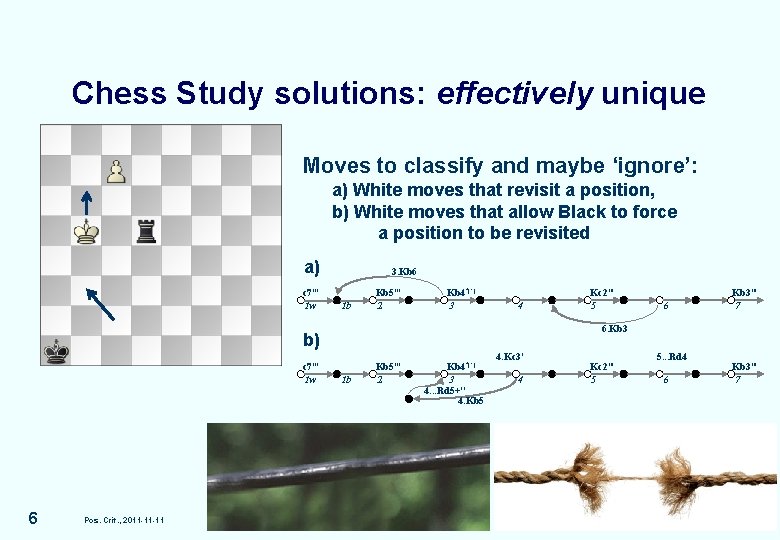
Chess Study solutions: effectively unique Moves to classify and maybe ‘ignore’: a) White moves that revisit a position, b) White moves that allow Black to force a position to be revisited a) c 7"' 1 w 3. Kb 6 1 b Kb 5"' 2 Kb 4“(‘) 3 4 6 Pos. Crit. , 2011 -11 -11 6 Kb 3"' 7 6. Kb 3 b) c 7"' 1 w Kc 2"' 5 1 b Kb 5"' 2 Kb 4“(‘) 3 4. . . Rd 5+" 4. Kb 5 4. Kc 3' 4 Kc 2"' 5 5. . . Rd 4 6 Kb 3"' 7
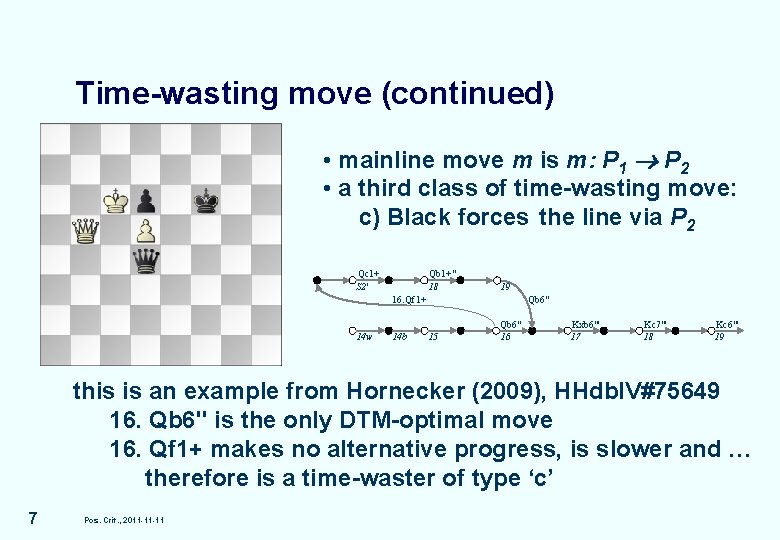
Time-wasting move (continued) • mainline move m is m: P 1 P 2 • a third class of time-wasting move: c) Black forces the line via P 2 Qc 1+ S 2' Qb 1+" 18 19 16. Qf 1+ 14 w 14 b Qb 6" 15 Qb 6" 16 Kxb 6"' 17 Kc 7"' 18 Kc 6"' 19 this is an example from Hornecker (2009), HHdb. IV#75649 16. Qb 6" is the only DTM-optimal move 16. Qf 1+ makes no alternative progress, is slower and … therefore is a time-waster of type ‘c’ 7 Pos. Crit. , 2011 -11 -11
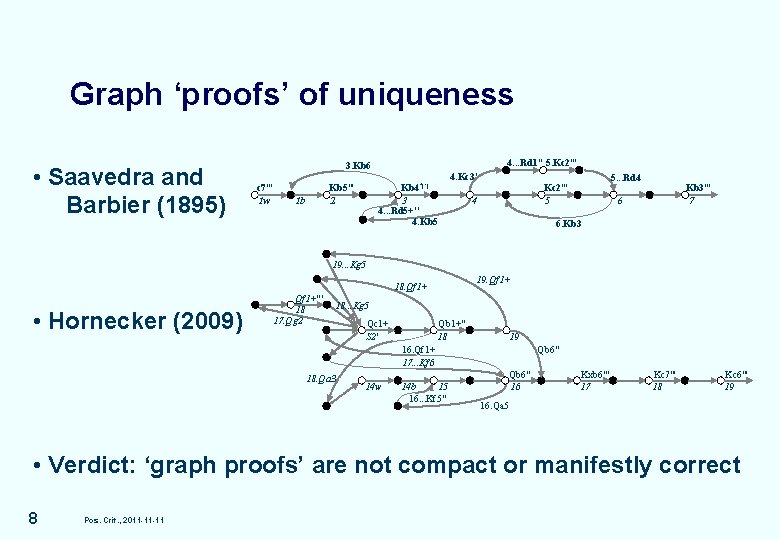
Graph ‘proofs’ of uniqueness • Saavedra and Barbier (1895) 4. . . Rd 1" 5. Kc 2"' 3. Kb 6 c 7"' 1 w Kb 4“(‘) 3 4. . . Rd 5+" 4. Kb 5"' 2 1 b 4. Kc 3' 5. . . Rd 4 Kc 2"' 5 4 Kb 3"' 7 6 6. Kb 3 19. . . Kg 5 19. Qf 1+ 18. Qf 1+ • Hornecker (2009) Qf 1+"' 18 17. Qg 2 18. . . Kg 5 Qc 1+ S 2' Qb 1+" 18 19 16. Qf 1+ 17. . . Kf 6 18. Qa 3 14 w 14 b 15 16. . . Kf 5" Qb 6" 16 Kxb 6"' 17 Kc 7"' 18 Kc 6"' 19 16. Qa 5 • Verdict: ‘graph proofs’ are not compact or manifestly correct 8 Pos. Crit. , 2011 -11 -11
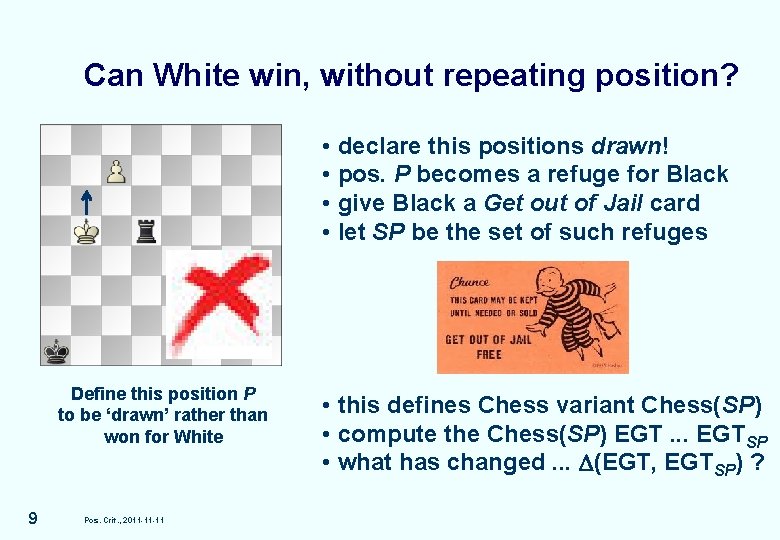
Can White win, without repeating position? • declare this positions drawn! • pos. P becomes a refuge for Black • give Black a Get out of Jail card • let SP be the set of such refuges Define this position P to be ‘drawn’ rather than won for White 9 Pos. Crit. , 2011 -11 -11 • this defines Chess variant Chess(SP) • compute the Chess(SP) EGT. . . EGTSP • what has changed. . . (EGT, EGTSP) ?
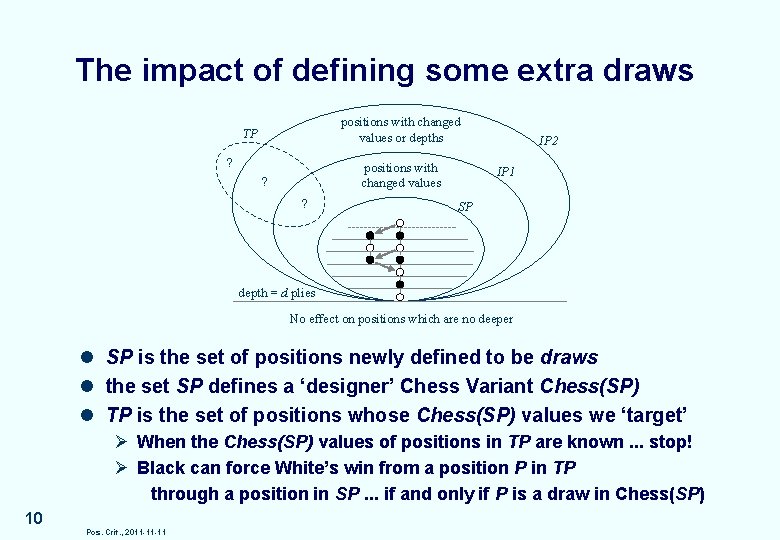
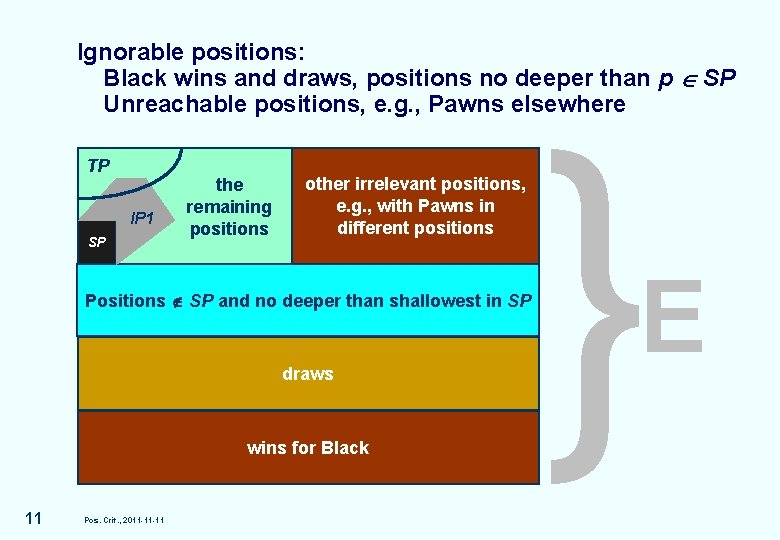
The impact of defining some extra draws positions with changed values or depths TP ? positions with changed values ? ? IP 2 IP 1 SP depth = d plies No effect on positions which are no deeper l SP is the set of positions newly defined to be draws l the set SP defines a ‘designer’ Chess Variant Chess(SP) l TP is the set of positions whose Chess(SP) values we ‘target’ Ø When the Chess(SP) values of positions in TP are known. . . stop! Ø Black can force White’s win from a position P in TP through a position in SP. . . if and only if P is a draw in Chess(SP) 10 Pos. Crit. , 2011 -11 -11
} Ignorable positions: Black wins and draws, positions no deeper than p SP Unreachable positions, e. g. , Pawns elsewhere TP IP 1 SP the remaining positions other irrelevant positions, e. g. , with Pawns in different positions Positions SP and no deeper than shallowest in SP draws wins for Black 11 Pos. Crit. , 2011 -11 -11 E
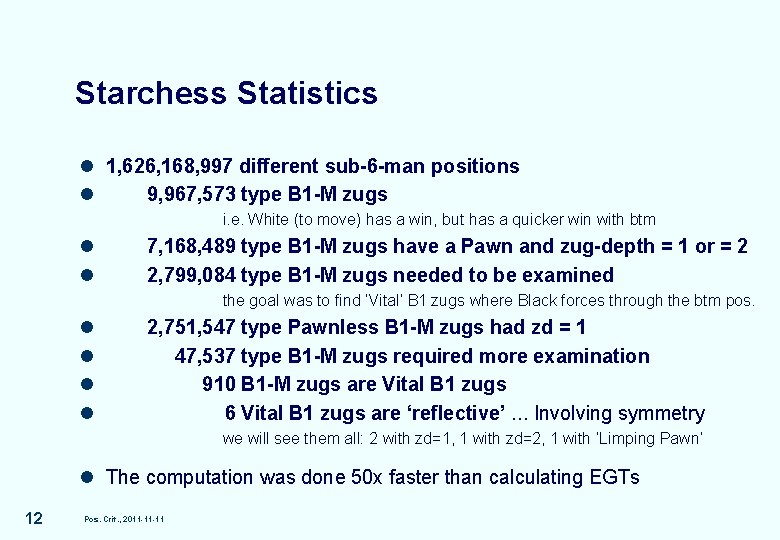
Starchess Statistics l 1, 626, 168, 997 different sub-6 -man positions l 9, 967, 573 type B 1 -M zugs i. e. White (to move) has a win, but has a quicker win with btm l l 7, 168, 489 type B 1 -M zugs have a Pawn and zug-depth = 1 or = 2 2, 799, 084 type B 1 -M zugs needed to be examined the goal was to find ‘Vital’ B 1 zugs where Black forces through the btm pos. l l 2, 751, 547 type Pawnless B 1 -M zugs had zd = 1 47, 537 type B 1 -M zugs required more examination 910 B 1 -M zugs are Vital B 1 zugs 6 Vital B 1 zugs are ‘reflective’. . . Involving symmetry we will see them all: 2 with zd=1, 1 with zd=2, 1 with ‘Limping Pawn’ l The computation was done 50 x faster than calculating EGTs 12 Pos. Crit. , 2011 -11 -11
Starchess: the start position and moves Video 13 Pos. Crit. , 2011 -11 -11
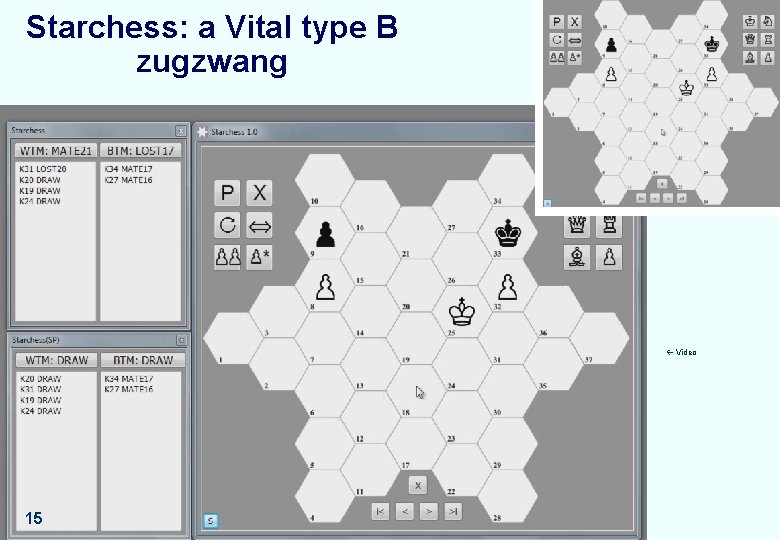
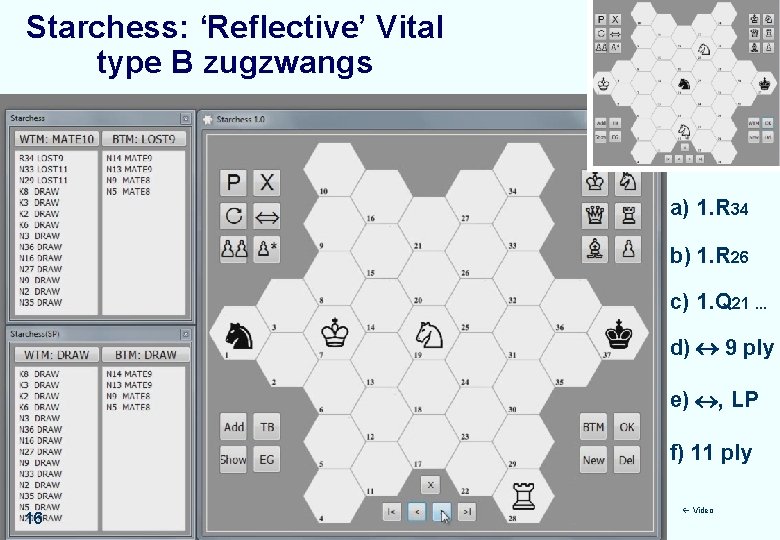
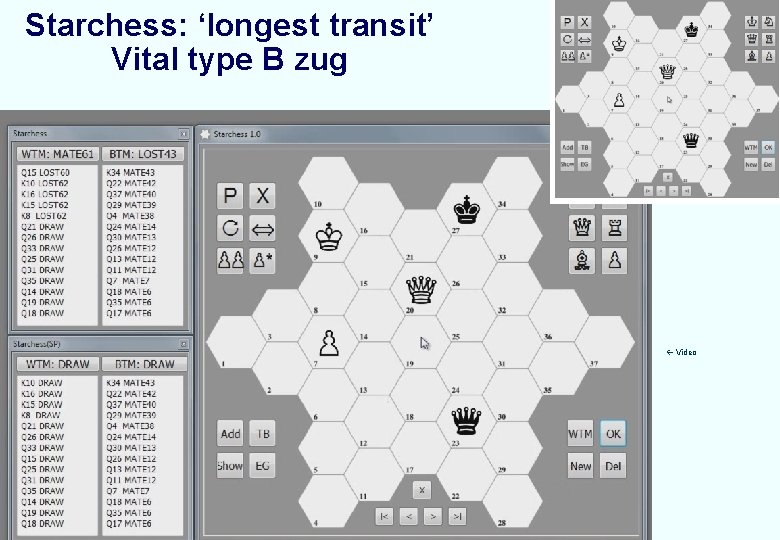
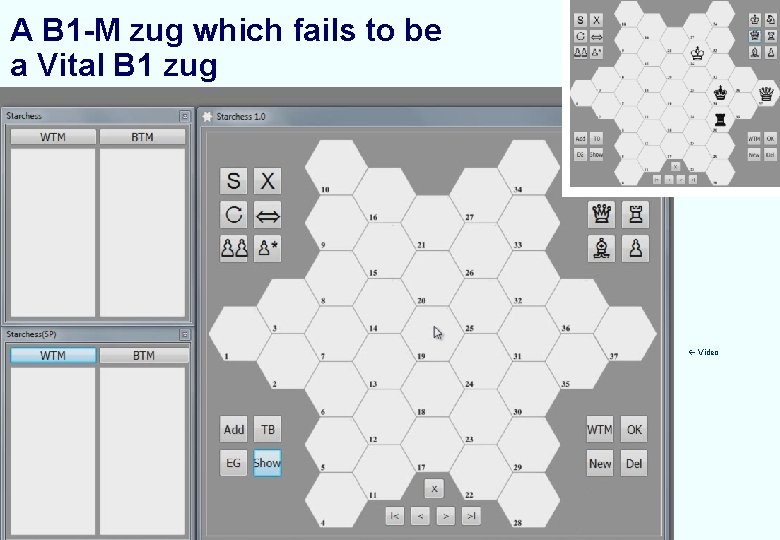
Guide to the Starchess videos following l In the top left panel are indicated: Ø the Starchess values and depths if White to move, or Black to move Ø the Starchess values and depths after the various moves available l In the bottom left panel are indicated: Ø the Starchess(SP) values and depths if White to move, or Black to move Ø the Starchess(SP) values and depths after the various moves available l Thus, it is possible to see: Ø if a position is a type B 1 -M zugzwang in Starchess Ø If a position is a vital type B zug (if so, the position is a draw, wtm, when the shallower btm position is set to draw) l Top right is the opening position of some line illustrated 14 Pos. Crit. , 2011 -11 -11
Starchess: a Vital type B zugzwang Video 15 Pos. Crit. , 2011 -11 -11
Starchess: ‘Reflective’ Vital type B zugzwangs a) 1. R 34 b) 1. R 26 c) 1. Q 21. . . d) 9 ply e) , LP f) 11 ply 16 Video Pos. Crit. , 2011 -11 -11
Starchess: ‘longest transit’ Vital type B zug Video 17 Pos. Crit. , 2011 -11 -11
A B 1 -M zug which fails to be a Vital B 1 zug Video 18 Pos. Crit. , 2011 -11 -11
Going forward. . . l Compose some 250 Starchess studies based on zug transits l Identify positions with An Essentially Unique Winning Move l Identify sequences of such positions l Audit 70, 799 study positions in the Endgame Table Zone (ETZ) Ø modified Chess EGT generators are in prospect Ø sub-6 -man Pawnless positions, sub-6 -man Pawnful etc. l Implement Chess(SP) in a way in which it can be widely used Ø by composers, validators, judges of and the audience for studies Ø Adopting various sets of positions as SP Ø Exploiting prior per-endgame-slice WDL and EGT information l Devise a structure for Study Expositions which. . . separates out the ‘core story’ and essential aesthetics from. . . the detail lines which are needed for technical completeness 19 Pos. Crit. , 2011 -11 -11