MEDICAL ASPECTS OF CRITICALITY ACCIDENT IN SAROV RUSSIA
- Slides: 25
MEDICAL ASPECTS OF CRITICALITY ACCIDENT IN SAROV, RUSSIA Module XIX
What is a criticality accident? l An unplanned event, when the neutron balance at fission is distorted and the nuclear chain reaction becomes uncontrolled Module Medical XIX-24 2
Neutron balance l Neutrons released in fission may be lost by escaping the container or n being absorbed by non-fissile materials n Module Medical XIX-24 3
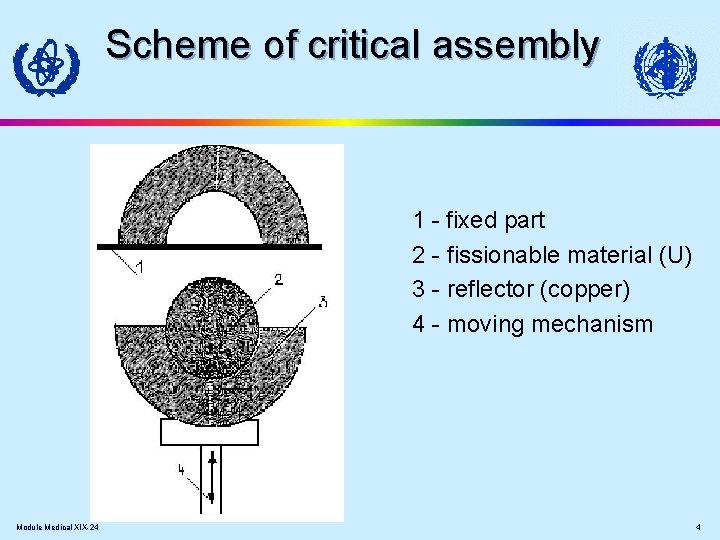
Scheme of critical assembly 1 - fixed part 2 - fissionable material (U) 3 - reflector (copper) 4 - moving mechanism Module Medical XIX-24 4
Accident circumstances in Sarov, 17 June 1997 10: 50: during construction of critical assembly, component from upper copper reflector suddenly slipped from technician’s rubber gloved hand l fell onto lower part of assembly, already constructed and containing enriched uranium core l Module Medical XIX-24 5
Accident circumstances l Point of criticality exceeded, flash of blue light and wave of heat l 10. 52: technician informed supervisors and colleagues l he Module Medical XIX-24 thought his exposure would be fatal 6
Accident consequences l First few minutes after criticality excursion he was fully conscious and active l 10. 59: initial direct measurements of neutron induced gamma radiation emitted by radionuclides in his body (mainly by 24 Na) indicated a whole body dose of about 10 Gy Module Medical XIX-24 7
Accident management l 11. 00 -11. 09: building evacuated l 11. 10: nurse arrived - Accident Report Card completed l 11. 20: ambulance to local hospital Module Medical XIX-24 8
Medical management 11: 45: Technician arrived at hospital of Sarov Occupational Medical Service within one hour of accident l experiencing nausea and began to vomit l Vomiting more frequent over two hours. Given antiemetic drugs, and vomiting stopped around 14: 00 l Module Medical XIX-24 9
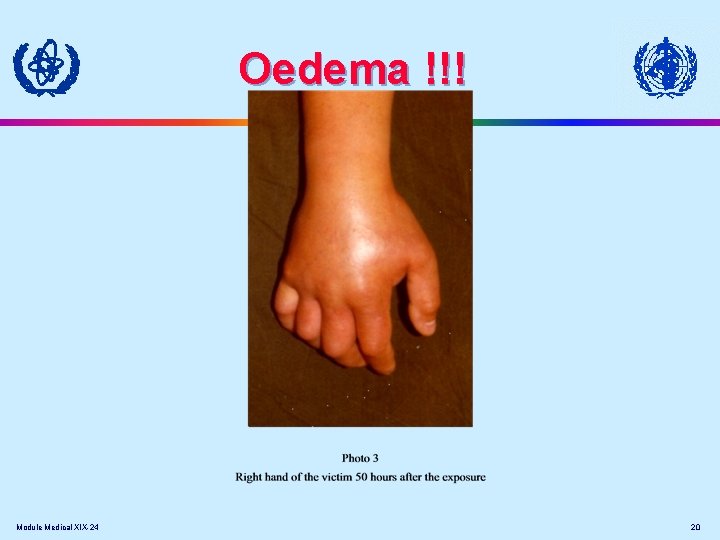
Rapid development of early symptoms l In 3 -4 hrs patient’s general condition poor fatigue, dizziness, headache, pallor, shivering, confusion, excessive perspiration l Rapidly invasive erythema appeared on hands with invasive oedema Known hypotony progressed very quickly. In 3 -4 hrs decreased to 70/50 and did not respond to treatment l No diarrhoea l Module Medical XIX-24 10
Typical early haematological parameters of very severe exposure Module Medical XIX-24 11
Transfer to specialized clinic at Biophysics Institute, Moscow On admission to this hospital, 10 hours postexposure, patient still active, could walk and was stable in vertical position. Fully conscious but persistent fatigue and headache l First night (17– 18 June), swelling of hands worsened, pain intolerable l Swelling extended to forearms l Module Medical XIX-24 12
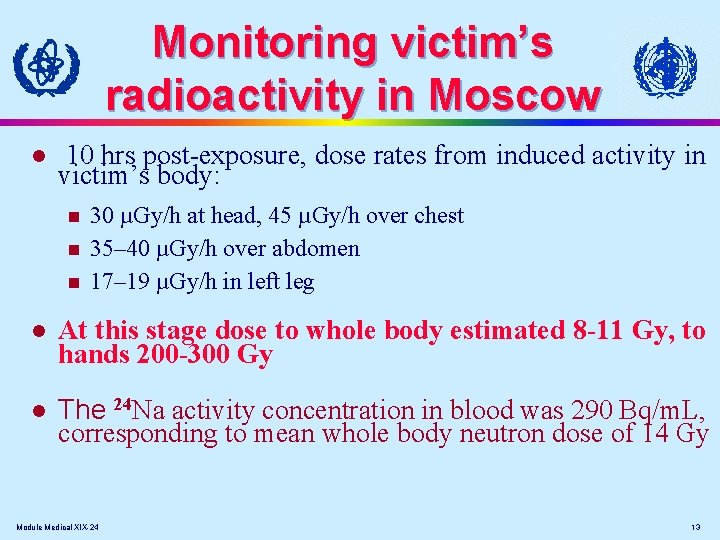
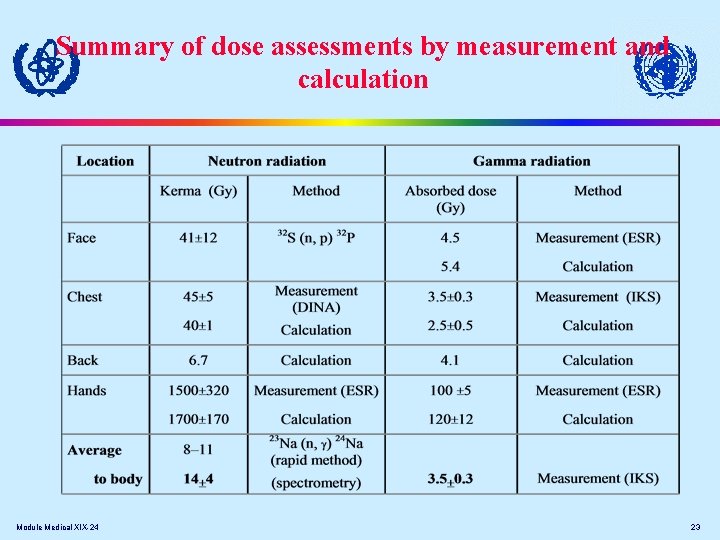
Monitoring victim’s radioactivity in Moscow l 10 hrs post-exposure, dose rates from induced activity in victim’s body: n n n 30 µGy/h at head, 45 µGy/h over chest 35– 40 µGy/h over abdomen 17– 19 µGy/h in left leg l At this stage dose to whole body estimated 8 -11 Gy, to hands 200 -300 Gy l The 24 Na activity concentration in blood was 290 Bq/m. L, corresponding to mean whole body neutron dose of 14 Gy Module Medical XIX-24 13
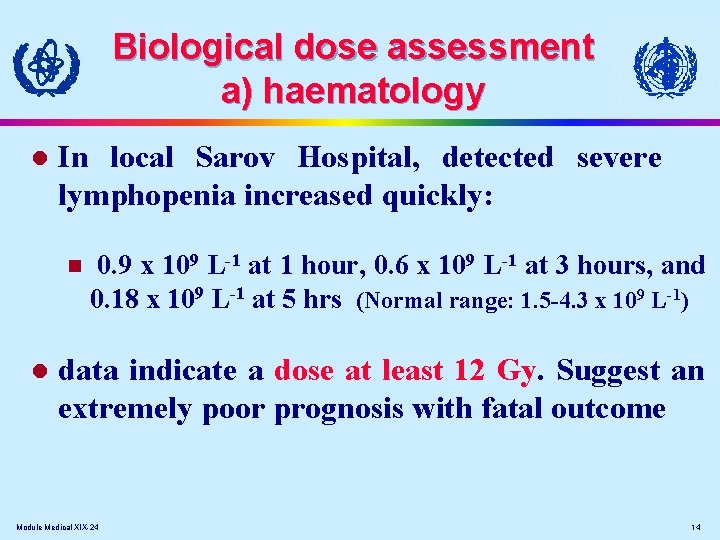
Biological dose assessment a) haematology l In local Sarov Hospital, detected severe lymphopenia increased quickly: n l 0. 9 x 10⁹ L-1 at 1 hour, 0. 6 x 10⁹ L-1 at 3 hours, and 0. 18 x 109 L-1 at 5 hrs (Normal range: 1. 5 -4. 3 x 10⁹ L-1) data indicate a dose at least 12 Gy. Suggest an extremely poor prognosis with fatal outcome Module Medical XIX-24 14
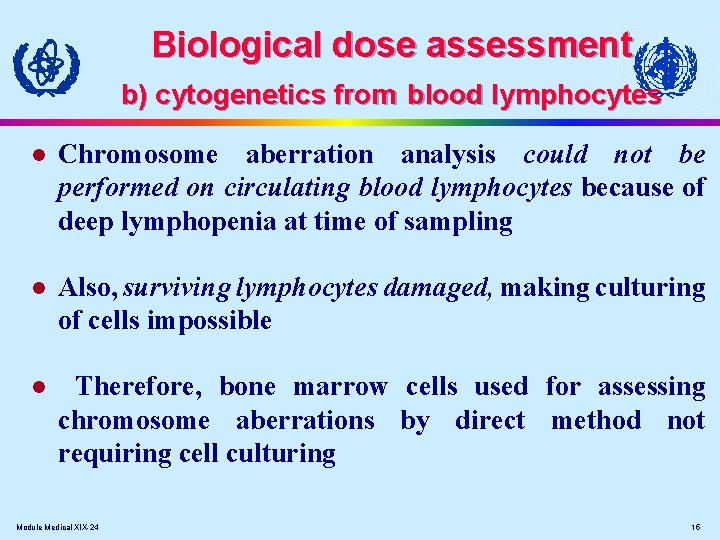
Biological dose assessment b) cytogenetics from blood lymphocytes l Chromosome aberration analysis could not be performed on circulating blood lymphocytes because of deep lymphopenia at time of sampling l Also, surviving lymphocytes damaged, making culturing of cells impossible l Therefore, bone marrow cells used for assessing chromosome aberrations by direct method not requiring cell culturing Module Medical XIX-24 15
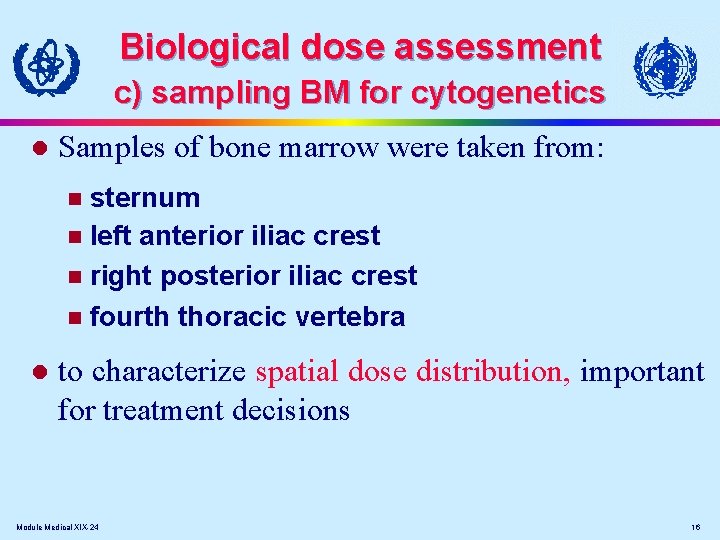
Biological dose assessment c) sampling BM for cytogenetics l Samples of bone marrow were taken from: sternum n left anterior iliac crest n right posterior iliac crest n fourth thoracic vertebra n l to characterize spatial dose distribution, important for treatment decisions Module Medical XIX-24 16
Biological dose assessment d) doses estimated for BM sites l at least 15 Gy to sternum (no metaphases seen, damaged, fully fragmented chromosomes) l 10– 15 Gy to left anterior iliac crest (analysis of 12 metaphases: half had aberrations and rest fragmented chromosomes) l 6– 7 Gy right posterior iliac crest (50 metaphases: 48 had multiple aberrations, two fragmented chromosomes) l about 6 Gy to fourth thoracic vertebra (three metaphases: two had fragmented chromosomes) Module Medical XIX-24 17
Treatment in specialized hospital linics of Institute of Biophysics, Moscow l Because of drop in pressure in femoral vein, steroids administered and volume of infused fluids increased to 200 m. L/h l Oligouria persisted and worsened, fluid infusion reduced to 100 m. L/h l Total volume of fluid infused on second day 2800 m. L, compared with urinary output 1200 m. L Module Medical XIX-24 18
Drugs and dosages for preventive treatment in specialized hospital l To prevent infection: irrigation of both hands with Lioxazol, special drug developed by pharmaceutical laboratory of Biophysics Institute (administered 1 x 1 -2 hrs), Acyclovir (6 mg per kg of body weight over 8 hrs), Ketoconazole (200 mg 2 x day); and Ciprofloxacin (250 mg 2 x day) l To prevent thrombosis: continuous perfusion of sodium heparin (20 000 IU per day) with plasma infusion l To prevent necrosis: Aprotinin (1 million IU per day) Module Medical XIX-24 19
Oedema !!! Module Medical XIX-24 20
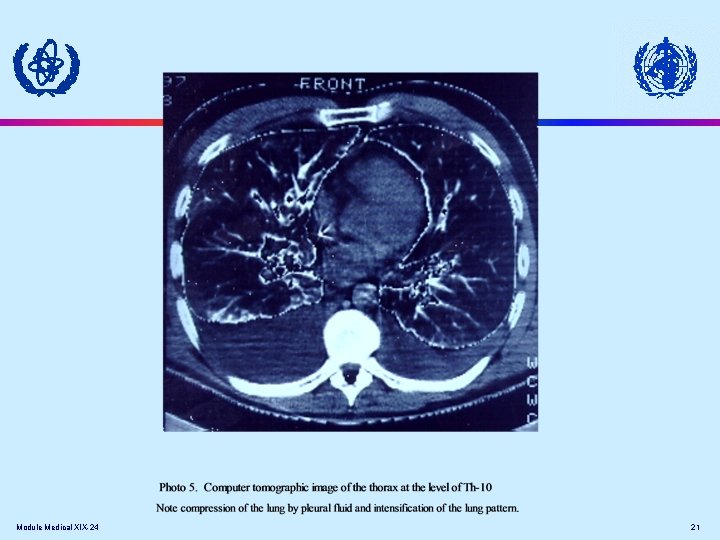
Module Medical XIX-24 21
3 rd day: terminal stage l Vascular damage --> hypoalbuminaemia, hypocalcaemia, progressive acidosis, lung oedema, hypoxaemia l 03: 20, 20 June 97 (66. 5 hrs after exposure) dramatic drop in blood pressure, bradycardia and death due to heart failure Module Medical XIX-24 22
Summary of dose assessments by measurement and calculation Module Medical XIX-24 23
Dose calculation by Monte Carlo method l Technician estimated distance of his hands from surface of critical assembly as about 5 cm and calculations were made accounting for known neutron and photon fluxes and their spatial distribution around assembly l Total dose to hands could lie between 800 and 2000 Gy. Final estimates were 1700 kerma (Gy) for neutron and about 120 Gy for gamma components Module Medical XIX-24 24
Lessons High n-doses may result in moderate early clinical signs, but do not necessarily indicate good prognosis l Patient died before clinical symptoms of gastrointestinal or bone marrow syndrome could develop l Death occurred within three days of exposure, not due to effects on central nervous system but on vascular system l Observe radiation safety rules! l Module Medical XIX-24 25